Saturday, June 13, 2009

Anatomy of a Quadrillion Dollar Scam: Assessing the Damage and Making Our Way in a Post-Gluttony Era

Correspondent Zeus Y. offers a provocative and deeply insightful context for understanding and resolving the global financial crisis.


Introduction:

Debts are never assets, yet debts have been defined as assets by banks, investment houses, credit card companies, and brokers. If these entities or persons loan you money, they call the resulting debt on your part an asset for them, because you will ostensibly pay them back the principal, with interest, creating profit for them. If you give them money, they must pay you interest (no matter how small), and hence they consider your money a liability. They offset that liability by loaning your money to others at higher interest and pocketing the difference. This used to be what banks did and how they made their money.

With the massive deregulation of financial markets, banks began to effectively merge with investment houses and insurance companies under a rubric of "complete financial services," leveraging and investing money in higher and higher interest ventures, with greater and greater risks, involving huge theoretical profits. These new ventures tended to involve something other than lending, i.e. providing "services" or "guarantees" in the form of default insurance and other promises.

None of these new ventures and products were or are necessary to the credit market, day-to-day business, or efficient economies. Some of these vehicles could, if managed correctly with adequate capital reserves, do some positive things like distribute risk. However, most appear to be simply a boondoggle-- siphoning real value, adding nothing, and substituting a promise of astronomical theoretical future riches for actual ability to pay out. Most have not been managed correctly and have neither had the necessary capital reserves nor prudent investment strategies to shore up those reserves. Predictably, the world financial market is now in free fall.

In this debacle, a profound metaphysical error has emerged--viewing debt itself as an asset. This has fateful and far-reaching practical consequences we are just now beginning to see and assess. Debt adds nothing. It does not produce anything or hold any value. Debt is not the asset but rather the lendee’s ability topay that debt, interest and principal, and, failing that, provide something of real value (collateral) that covers the full amount of the debt. Those are the assets, which the debt-extender holds claim to through a legal contract.

This error of debt-as-asset has spawned a series of wide-ranging and false assumptions about worth resulting in a massive financialization of markets, where derivative financial vehicles based in abstract and theoretical models for assigning value have gained an eerie and superseding reality over actual government managed money supply and concrete value production (stemming from labor, commodities, creativity, intelligence, property improvement, technological innovation, etc.) Let me state this again: This financialization and its vehicles have no basis in actual, concrete assets. (emphasis added: CHS) Their only power lies in their ability to trade theoretical, non-real value (what I call counterfeit value), for things of real value.

This financial "shadow market" is able to do this by deliberately infiltrating and integrating itself into a healthy economic system. Like a parasitic invader, it protects itself from detection by lobbying successfully to subvert government regulation, scrutiny, and enforcement, by claiming itself as "private" and thus immune from public transparency requirements, and by developing mechanisms that are so complex that no one knows exactly what they do or what they might be worth. It works just like any confidence game.

The more financial vehicles one could create, the more "innovative," abstract, and complex they could be, the more fees and profits one could take in, and the less people could question what these entities were selling, the more people had to trust institutional "experts" and their assertions of value, profit, etc. Financial institutions were essentially creating their own counterfeit money through these exotic vehicles as if they had the printing presses right there in their offices.

This is confirmed by widespread statements in the financial press that the value of these vehicles are not “unknown” but rather "unknowable". Many cannot even be traced back to the real assets they were meant to service or represent, including actual deeds to properties that were packaged into "complex" securities. Though the actual dollar value of complex so-called derivatives is not known, the amount in transactions on so-called "derivatives" has been estimated by some reports at over one quadrillion dollars, that is 1,000,000,000,000,000.00 dollars. If only a conservative 2 % fee were charged on these transactions, that alone would amount to a 20+ trillion dollar skim job, and that is laying aside the profit-skimming and greater fees charged in many hedge fund arrangements (i.e. 20% of profits and 5% fees in one case).

The Macro View:

Oddly enough, given the fatal metaphysical error I have mentioned (debt = asset), almost all the concoctions stemming from that error have been "rationally consistent" with the irrational premise. Too bad logical consistency with false premises will virtually guarantee disastrous conclusions. Let us spell out in detail this "rational" behavior stemming from irrational assumptions.

First let us recast traditional debt in tune with the new, false assumptions mentioned above. In traditional economics, "good" debt would be a loan extended to someone with sterling credit, with a healthy income or revenue stream, and collateral that far exceeds the value of the loan. Collection is fairly simple. Risk is transparently low. The interest rate charged would be correspondingly relatively low. "Bad" debt would be someone with a low to middling credit rating, with borderline income or revenue, and with collateral that flirted with being equivalent to the loan. Risk is transparently higher. The interest rate charged would be correspondingly higher to offset the greater risk of default and failure to recoup the full value of the loan. "Insane" debt, would be someone with an incredibly low or no credit rating, whose income or revenue is well below what is necessary to pay off the loan, and whose collateral property has no, or even negative, equity in it (think of houses bought with liar loans, balloon loans, negative amortization loans).

In a traditional system, people with "insane credit" would never get a loan, because they have no way of paying it, and they do not have collateral worth anything near value of the loan. In the new system, debt is "equivalized" so that what I have called "insane" debtors actually become the most sought after market! Why? Think about it: No distinction is being made between debts that can be paid and those that cannot possibly be paid (at least without completely fantastical projections of increasing value in the property, commodity, stock, etc. upon which the loan is being drawn). All debt is seen as asset. Insane debt = bad debt = good debt = asset. This is confirmed empirically in Moody’s rating of absolute junk as secure AAA investment.

The lousier and more untenable the loan, the greater the "risk", therefore the greater interest and fees one can charge on it, and therefore the greater the ostensible return and/or profit! Combine this with the ability to externalize or pass on the liability by selling the insane loan or insuring it against default, a lender or servicer has every incentive to hand out the worst possible loans because they generate the highest fees and interest rates. "But," you may protest, "there are no foundations or fundamentals underneath these deals. They are completely irrational." In this new system, there don’t need to be fundamentals because mathematical models can now simply create and assign present value based on theoretical projections of future values accepted as if those future values were fact.

So all the incentive is toward expanding the market for heavy, pervasive debt that is impossible to pay, and then to further spawn lucrative financial derivatives (including servicing and guaranteeing loans) from that market. Add consumer industries to this balloon, like housing and automobile manufacturing that benefit from this false creation of equity based on future value, and you have a juggernaut. This house of cards is perpetuated by its own "new era" mythology ("values will always go up," "deficits don’t matter") and the fact that everyone seems to be getting richer from the loan originator to the lendee/investor—the brokers, the servicers, the appraisers, the realtors, the county property tax assessments, the furniture store owner, the homeowner.

If this situation weren’t bad enough, a new hyper-catalyst enters the picture--leveraging. Two major problems emerged here to magnify many thousand or millions fold the damage already levied by fraudulent and fantastical lending. First, unregulated private companies (equity firms, hedge funds, etc.) were able to fabricate wealth and inflate their holdings and net worth to either further invest or buy outright real companies, as Cerberus did with Chrysler. Their unregulated "money" was based in "equity" based on "marked to model" theoretical value.

Second, unregulated financial instruments like credit default swaps had no effectively no reserve requirement at all, because their reserve "money" was also based on "assets" based on "marked to model" theoretical value. Furthermore, this unregulated, self-assigned value could be, if they so desired, leveraged into investments in ratios that could defy infinity. As we know, zero multiplied by a million is still zero. Imagine if you or I could assign a 200 billion dollar asset value to our dog’s house, and use this assigned value to buy a major international conglomerate.

When people say that this is "unthinkable," what they are really saying is, "I don’t want to think about it. I don’t want to acknowledge this happened or can happen." However, just connect the dots. It’s simple. Is there anything preventing this from happening. No. Applicable regulations have been removed, and those still on the books have not been enforced. Is there any reason not to do it given the incentives and principles at play? No. Therefore, it will happen.

What we have is essentially private, unregulated money creation prompting hyperinflation in certain markets. We have an intensely large, and at this time, unknown amount of counterfeit money and value mixed in with the real. Apparently we cannot tell real money apart from counterfeit money very easily, and/or we are trying to hide the counterfeit cash through deficit bailouts from the taxpayers.

We also know that we cannot keep these fraudulence-based markets (i.e. housing) artificially inflated because they are so out of line with reality-based fundamentals and facts. However, we also largely do not have the grit to face the consequences of this rip off. So our interim strategy appears to be to try to ease into austerity by hiding the deficits, allowing companies to continue to mark to model, holding foreclosed houses off the market, etc. It is a common and understandable (but not excusable) human response. It won’t work, and it will both deepen and elongate the painful coming to terms.

Even money markets fell below 100% of principal. Think about that. That’s unprecedented in its scale and severity. You don’t need a canary to tell you what is going on. There has been a massive liquidity drain. Money has disappeared and been replaced with fraudulent substitutes of value. I’ve mentioned in other essays that this situation will eventually require massive debt forgiveness. Fraudulent or concocted wealth begets fraudulent debt. So we should come to terms with the necessity of debt erasure for larger swathes of the globe. The instigators have unfortunately, not only already been forgiven, but been rewarded with hundreds of billions of dollars of bailout money. Accountability, if it ever happens would demand these instigators go bankrupt, face criminal prosecution, and supply restitution, including returning their private, ill-gotten gains.

The Micro View:

How does this profoundly twisted macro mentality play itself out on the micro level? Let’s look at some examples:

Credit card companies

Many people are aware that those consumers who pay off their credit cards every month are a liability to the credit card company. They get a short-term loan at no interest on a no-fee credit card (though the credit card company does charge a fee to the vendor). So credit card companies don’t like those who pay off their cards. Furthermore by paying up, you, the borrower, have wiped out the credit company’s "asset"—debt. They need someone who preferably misses a payment, so the effective interest rate can kick to 30 – 35%, someone who only makes the minimum payment, so the principal debt increases over time (enlarging the "asset"), and someone that will always pay the minimum payment even if they can never pay off the card.

Again the most desirable client is one who has the worst financial habits, not the one with the best. There is a reason that someone who carries a balance gets a higher credit score than someone who pays off the balance. All is swell at least until that underwater client defaults with thousand of others. Not even the industry written bankruptcy "reform" will hold the tide as that happens in increasing numbers.

Banks

Banks, in this "new era," expanded their traditional lending operations into broader "financial services." There was more money to be made and more market share to grab by creating a whole new host of products built around "servicing" loans (rather than just collecting them), providing financial advice, and establishing credit lines. Especially as money becomes cheaper and cheaper (i.e. the Federal Reserve sets effective bank lending rates near zero), the effective marginal profit from straight lending dwindles. Banks cannot pay anything lower than a quarter percent to savers, and competition forces the lending percentages down. Since traditional reserves are based on capital from savings (considered a liability), the pressure mounts to find a way to "capitalize" through debt.

So banks "branched out" in tune with "successful" lobbying and deregulation. This created both conflicts of interests and dangerous precedents, effectively merging banking with insurance and investment brokering. Maintaining capital reserves became a quaint notion because money lying around was so "unproductive." A myth arose that money would always be there and interest always low. This myth has proven, of course, false. Even with low interest, there is now a liquidity crisis, because real wealth was siphoned off by unproductive and no-value-added services, either stored as private wealth in opaque Swiss bank accounts, invested in worthless crap (like credit default swaps), or dumped into plunging markets (like housing).

Credit default swaps (CDS’s)

I’ve already written many essays on this subject, so I will only summarize the transparent fraud perpetrated under these "vehicles." CDS’s are unregulated insurance against defaults on loans. Though the mechanisms have not been officially investigated and audited, it does not take a genius to conclude that AIG and others could "guarantee" loans and receives premiums for nothing, that is, without actually possessing any reserve capital or exchange service at all. Using their once respected reputation as collateral, and dubious investments conveniently and generously assigned value by their own accountants, these institutions could create cash flow without providing anything in return except assurances. No wonder these vehicles were so attractive.

This would be like you or me receiving nice batches of money from our neighbors to insure against their houses being destroyed by fire, using our own house as collateral, with all of us living in the middle of a tinder-dry pine forest. The fire simply is going happen sooner rather than later with these conditions (akin to the poor fundamentals in the economy), and you and I won’t have anything left with which to pay others. However, we will have a huge private stash created by the fees and premiums we have charged and the bonuses we’ve given ourselves. This, at least, could help us rebuild our own mansions.

Housing

According to any kind of fundamental analysis (see Patrick.net for a good summary) the transparent irrationality of house prices could not have been clearer. Real incomes have been flat or declining over the last decade, even though productivity rose substantially. Purchased houses in overheated markets required monthly payments three times what is would cost to rent the same house. Some people were paying as much as 10, even 20, times their salaries to buy a house. (I remember a newspaper report of a 750,000 dollar house bought on a 40,000 dollar/year salary.) Reporting and underwriting requirements simply disappeared on the false conviction that "housing prices will always go up in the new era." Of course this could not be sustained, any more than an actual house could be supported on a foundation of air (without the fitting metaphor of balloons as in the new Pixar movie Up).

Stocks

Stocks were bound to fall as well, since they were being inflated by a number of factors related to the outright greed and entitlement created by this "new era" thinking. First, many companies who once only manufactured products decided to financialize themselves, i.e. GM, which went from only manufacturing cars to providing GMAC financing. Second, chief executives found their huge bonuses tied to stock prices, so they found ways to manipulate demand/value, and thus stock prices, by buying up their own stock, or better yet by leveraging their assets 30 to 1 to expand business, merge with other companies in huge multi-billion dollar deals. Great paper profits mean great bonuses even when you are cannibalizing stability.

Third, housing and other irrationally inflated sectors provided stockpiles of illusory consumer equity and short-term job growth, encouraging a consumer spending orgy on a range of goods and services that buoyed the economy. Fourth, for eight years a presidential administration and its entire executive branch allowed industries to write environmental laws allowing for indiscriminant toxification of the environment, waste in energy, and pliant, absentee oversight in agencies like the Security and Exchange Commission. We are now coming to terms with the fact that environmental and economic limits are and will continue to force a decline in manufacturing and sales. Those cut GM dealerships and factories are not coming back.

Conclusion:

Believe it or not, the exposure of these falsehoods and a return to real economy should be the basis for optimism not pessimism. I, for one, am only too eager to leave behind the anxiety mixed with empty hedonism of a debt-driven economy. We now have a pressing need to commit to creativity, transparency, honesty, accountability, and real prosperity. Our Greek tragedy lies not only in the economic hole our irrational binging has left us with, but the moral, physical, environmental, and character hole. It is no surprise to me that skyrocketing obesity, approval of torture, toxic crap from China, the burying of a perfectly functioning electric car (GM’s EV-1), and the out-of-control cost of sick profiteering (mistakenly called health care) all happened to attend this delusional phase of our economy.

We now have a chance for real quality of life based in those important things we have been neglecting—love, friends, family, community, healthy eating and farming, breathing clean air, drinking clean water, making an honest living, working hard, and learning about our world and each other. We are recovering from a long illness symptomized by a suicidal, selfish, unreflective, and exploitative egoism. If we take advantage of this opportunity, refuse to listen to self-interested "experts" who seem to care about nothing but their own obsolete authority, money, and power, we can move toward single-payer health insurance, sustainable, organic, community-focused agriculture, demilitarization, economic equity, more leisure time, and a diverse, interconnected global citizenry. For too long "national interest" has been associated with using others instead of respecting them, foisting consequences on future generations instead of working together to co-create a healthy, vital world. Now we have a choice. It is time, given our current and profound lesson about the alternative, to make the right one.

Copyright 2009 Zeus Yiamouyiannis, Ph.D. all rights reserved in all media

Of Two Minds is now available via Kindle: Of Two Minds blog-Kindle

Of Two Minds reader forum (hosted offsite, reader moderated)

Thank you, Cynthia P. ($20), for your extremely generous contribution to this site. I am greatly honored by your support and readership.

Friday, June 12, 2009

Food and Energy Are Still Too Cheap

The tremendous waste of food and energy in the U.S. reveals that these essentials are still too cheap to be conserved/valued.


I know you hate it when I come up with some outrageously contrarian view (come on, you know you love it!) and so let's consider the notion that food and energy are still absurdly cheap in the U.S.

Why is this contrarian? Joining "green shoots/ recession is ending" as a popular rote-repeated cliche is "food is so expensive 'poor people' can only afford McDonalds and macaroni and cheese."

If food is so horribly expensive, why do I find huge quantities of perfectly good untouched/unopened food in trash bins? Yes, I am a dumpster diver, mostly because I hate to see perfectly good food/stuff dumped in the landfill.

Recently I pulled out: steaks (the costly kind sealed in plastic), high quality ground beef, unopened spaghetti packages, half-used spices, an unopened bag of frozen mahi-mahi and numerous cans of soup, etc.

OK, so somebody's roommate moved out and they promptly threw away all the guy/gal's food, including unopened steaks, ground beef, pasta, canned goods, etc. Note that they couldn't be bothered to give the stuff to a food bank--they just dumped it. I find this all the time; it is not a rarity.

Yes, the cans were past the absurd "best by" date--but canned goods will last for years past the due dates. The food industry doesn't even test this stuff for actual longevity in the sense of "past this date, if you eat this, you die"--they just set the dates such that the consumer will be encouraged to toss it and buy new stuff.

I propose a new metric for the cost of food: the squeamish/cost ratio. If the squeamishness caused by the fact that someone else bought and/or touched this unopened food (horrors!) is outweighed by the value of the food such that it is consumed, then food is in fact expensive.

The corollary is the canned-good expiration date/cost ratio. If the chances of dying a horrible, lingering death due to food poisoning (note to consumers: your body has a mechanism for rejecting spoiled food called "vomiting") are finally outweighed by a rational calculation that the odds of said horrible, lingering death due to mysterious toxicity of canned food are actually remote, leading to consumption of "expired" sealed food, then food can be said to be expensive.

Other corollaries suggest themselves: if a head of lettuce is tossed because the outer leaves are wilted, if a pound of perfectly good veggies are tossed because one harmless bug was found on said veggie, etc., then food is still far too cheap.

Let me tell you what will happen when food is really expensive. People won't be going through trash bins looking for brand-new shoes and aluminum cans; they'll be pulling out whatever edible food has been tossed. Squeamishness will decline to near-zero.

If food were actually costly, somebody elese would have snagged all those goodies before I even got to the trash bin. Meanwhile, here in the U.S., even homeless people have the "right" to be squeamish: anything past its expiration date by even a day is tossed lest an organization be accused of treating their patrons as less worthy than any other squeamish American. Homeless people have been known (first-hand report from a volunteer) to reject sandwiches which don't meet their refined standards.

Let's face it: food is treated as expendable trash in the U.S.

Three of us were recently making a 400-mile drive after an exhausting week and so we stopped at Burger King for lunch (one of two annual visits to a fast-food emporium). It cost $11.30 for three sandwiches: no drinks, fries or other goodies. Seeing as how I can buy an entire bag of real food for $10-$15 in an ethnic market, that didn't strike me a "cheap." Fast-food is not "cheap" by any metric except perhaps toxic calories.

As for energy: when galoots in oversized pickups and SUVs are drag-racing off the line when the traffic light turns green, energy is still far too cheap.When gasoline hit $4.50/gallon, I observed the first faint glimmerings of conservation. When gasoline hits $10/gallon (and it will, sooner than most expect) then conservation might actually take hold.

I know the idea that food and energy are expensive is dearly beloved; we prefer self-pity to the conclusions drawn from observable behaviors. Take a look around; do some dumpster-diving and watch how people are driving. Those behaviors indicate food and energy are still incredibly cheap in the U.S. When food actually becomes expensive, people won't be throwing away pasta because the bag was opened by another mortal who actually cooked some of the contents; they will be snatching the half-full bag up as a found treasure.

Hopefully your local library has a copy of Depletion and Abundance: Life on the New Home Front by Sharon Astyk.


A few classics in case you missed them:

The Long Emergency: Surviving the End of Oil, Climate Change, and Other Converging Catastrophes of the Twenty-First Century James Howard Kunstler

The Future of Life E.O. Wilson

Globalization and Its Discontents Joseph Stiglitz

On Peak Oil:

Beyond Oil: The View from Hubbert's Peak

The Party's Over: Oil, War and the Fate of Industrial Societies

The End of Oil: On the Edge of a Perilous New World

Twilight in the Desert: The Coming Saudi Oil Shock and the World Economy

On chemical/toxins overload:

Our Stolen Future: How We Are Threatening Our Fertility, Intelligence and Survival

On the demographic time bomb about to explode:

Fewer: How the New Demography of Depopulation Will Shape Our Future

The Coming Generational Storm: What You Need to Know about America's Economic Future

On collapse of advanced civilization:

Collapse: How Societies Choose to Fail or Succeed (Jared Diamond)

The Collapse of Complex Societies

A realistic appraisal of alternative energy:

Sustainable Energy - Without the Hot Air

Our previous lists of hot reading and viewing can be found at Books and Films.


Of Two Minds is now available via Kindle: Of Two Minds blog-Kindle

Of Two Minds reader forum (hosted offsite, reader moderated)

Thank you, Mikail C. ($50), for your outrageously generous contribution to this site. I am greatly honored by your support and readership.

Thursday, June 11, 2009

The Dollar Conundrum: Poison or Cure?

Either the dollar is defended with high interest rates or it will collapse under the tsunami of debt/money expansion. If it collapses then the cost of imports will skyrocket. Either way, the credit-addicted U.S. economy will implode.


The choice just ahead is stark: either passively watch the dollar collapse as the tsunami of money expansion and Federal borrowing slams it or start defending it with much higher interest rates. Either way, the credit-dependent U.S. economy will be unable to borrow freely at low cost from the rest of the world.

The blogosphere is chockful of reports documenting our trading partners' not-so-subtle stampede to the dollar exit--is there any mystery here? None whatsoever. Even a so-called reserve currency like the dollar responds to supply and demand: as the Fed pushes money expansion up by 100% (you've seen the hockey-stick charts by now) and the U.S. Treasury borrows trillions of dollars to fund a widening deficit and various trillion-dollar bailouts of failed and/or fraud-filled/looted industries, then this burgeoning supply overwhelms demand, pushing down the value.

There is a positive feedback loop strengthening here. The more the dollar falls in value against other currencies, oil and gold, the greater the pressure on non-U.S. holders of dollars to dump their bucks before they fall even lower in value. This selling further lowers the value of the dollar, triggering even more angst/panic/pressure to dump/sell dollars.

How low will this feedback loop push the dollar? There are various technical analysis-based guesses or projections, but I am guessing just on fundamental issues that a fall of 50% would be a good start to re-align the dollar with its fundamentals (lousy and getting worse).

So what happens to the cost of imports like oil when the dollar falls in half? They double. So even if oil remained at current levels when priced in yen, euros or gold, it could be $150 per barrel to those of us paid (or holding) dollars.

It doesn't take much imagination to reckon the damage that doubling would do to the energy-profligate U.S. economy. Just recall last summer when gasoline hit $4.50 and then go on from there.

It also doesn't take much to imagine what a doubling of import prices would do to the sales of imports. They would decline if for no other reason than fewer people could afford them. The loss of sales to those who depend on exports to the U.S. to generate surpluses in their own economies would be severely negative.

Now cheerleaders will note that such a staggering depreciation of the dollar would make U.S.-based manufacturing suddenly look attractive in comparison to suddenly-costly overseas production. But you can't just swap out factories and relocate entire supply chains; that takes time.

Such a pronounced decline in the dollar's value would devastate the bond and T-bill market as everyone fled the dollar; this would trigger a catastrophic drop in the value of every existing bond and basically evaporate the U.S. Treasury's ability to sell more debt or even roll over existing government debt. At that point the U.S. government would actually not only have to live within its means (spend no more than revenues) but it would have to pay off bonds as they came due--that is, spend considerably less than revenues.

The same of course would be true for corporate bonds, new home mortgages, etc. All U.S. debt would drop 50% in value and become increasingly illiquid as fewer and fewer investors will be willing to gamble on its future purchasing power.

For a credit/debt-based economy, the inability to float new debt and roll over old debt would be cataclysmic.

The only way out of the crisis (and indeed the only way to stave it off beforehand) would be to raise interest rates to such a high level that dollar-denominated debt would become attractive. This is not without historic precedent; buyers of long-term T-bills in late 1981 earned a 16% return.

What happens if the interest rate on T-bills and other debt jumps to 10%? Mortgage rates jump to 12%. And what would that do to real estate valuations? Since buyers can only afford X per month, then as interest costs doubles, the mortgage valuation (and the value of the underlying property) has to fall in half.

So right as standard-issue financial pundits (SIFPs) like the execrable Jim Cramer are announcing the bottom in housing, house prices could fall in half from current levels. Can't happen? Don't bet on it.

If interest rates doubled or tripled, that would eviscerate every sector of the economy which depends on credit--which means, well, all of them, but especially autos and real estate. With their collateral (house) worth half of its already diminished 2009 valuation, the average middle class household would be unable to support any new debt.

Oh, and let's not forget what happens to equity markets when interest rates double: they crash. Why take a chance on risky stocks when you can get 10% on a "safe" T-bill? And so there is another body-blow to household equity/collateral: everyone's 401K, IRA and other equity holdings will be smashed.

In the last bout of higher interest rates (for different reasons) in the 1970s, stocks (adjusted for inflation) lost fully 2/3 of their value. We would be foolish to expect anything less severe if the dollar crashes and interest rates double to defend what's left of the currency's purchasing power.

No economy can support stupendous imbalances in trade and capital flows forever. The book The Dollar Crisis: Causes, Consequences, Cures does a good job of explaining why.

So the choice is stark: either drink the poison of a dollar falling in half and the subsequent collapse of the bond and credit markets, or double interest rates and drink the poison of a collapse in the value of existing bonds and the strangulation of the housing market via high interest rates.

Either way, the value of existing bonds will be destroyed. Either way, the credit-dependent U.S. economy finds itself without the ability to palm off dollars on "marks" for absurdly low rates of return. The only question is: what end-state will we choose? One in which the dollar is essentially destroyed as a store of value, or one in which we face reality and start paying a high enough return to salvage what's left of its value?

Yes, that will destroy easy, low-cost credit, and every sector which depends on it. But at least savings, incomes and assets will be conserved and not destroyed along with the dollar. The first poison (complete destruction of the dollar) is fatal; the second (raising rates to defend the dollar) is painful and wrenching, but ultimately positive. For much higher rates would rid the economy of its multiple destructive imbalances and disincentives; it would be the equivalent of a chemotherapy treatment from which the patient (the U.S. economy) emerges stronger and healthier. As the book recommended above phrased it, a "cure" is available, and it's called much higher rates of return.


A few classics in case you missed them:

The Long Emergency: Surviving the End of Oil, Climate Change, and Other Converging Catastrophes of the Twenty-First Century James Howard Kunstler

The Future of Life E.O. Wilson

Globalization and Its Discontents Joseph Stiglitz

On Peak Oil:

Beyond Oil: The View from Hubbert's Peak

The Party's Over: Oil, War and the Fate of Industrial Societies

The End of Oil: On the Edge of a Perilous New World

Twilight in the Desert: The Coming Saudi Oil Shock and the World Economy

On chemical/toxins overload:

Our Stolen Future: How We Are Threatening Our Fertility, Intelligence and Survival

On the demographic time bomb about to explode:

Fewer: How the New Demography of Depopulation Will Shape Our Future

The Coming Generational Storm: What You Need to Know about America's Economic Future

On collapse of advanced civilization:

Collapse: How Societies Choose to Fail or Succeed (Jared Diamond)

The Collapse of Complex Societies

A realistic appraisal of alternative energy:

Sustainable Energy - Without the Hot Air

Our previous lists of hot reading and viewing can be found at Books and Films.


Of Two Minds is now available via Kindle: Of Two Minds blog-Kindle

Of Two Minds reader forum (hosted offsite, reader moderated)

Thank you, Alberto R. ($20), for your continuing generosity to this site in money, ideas, and encouragement. I am greatly honored by your support and readership.

Wednesday, June 10, 2009

A Top-Level Economy Based On Credit/Consumption


The U.S. economy produces little surplus and as a result it has lived off expanding credit and frivolous consumption. A top-level economy without a foundation of surplus will collapse.


One of the key insights in Joseph Tainter's The Collapse of Complex Societies is that once an economy's primary surplus dwindles to zero, it is doomed to implosion. The U.S. surplus has been less than zero for decades.

Correspondent Michael S. recently recommended this article on Joseph Tainter's work: Professor at USU says U.S. society may collapse:

Tainter, who heads the department of environment and society at Utah State University, told the newspaper that the current course of the economy and what some believe is a desperate effort to shore up the complex and almost inscrutable financial sector of the economy are manifestations of at least a partial collapse that invariably follows a society's boom.

That the U.S. economy is primarily "top-level" consumption teetering on a dwindling foundation of real surplus is painfuly obvious. This "you can't parody American life, it's a self-parody" article, Growing Up in a Recession(BusinessWeek) appears to be sympathetic to the poor folks who once raked in $250,000 a year producing nothing of value and cheers their valiant attempts to "re-invent" themselves into some equivalently useless work which they hope will produce $250,000 of "value".

The recession has been one long reckoning with expectations for Nicole and her two kids, Maguire, 8, and Payton Grace, 5. Nicole had been earning more than $250,000 a year for nearly a decade. She rented a posh three-bedroom condo with a yard. The beach was nearby. They traveled. It was a good life.

As 2008 began, potential buyers of the multimillion-dollar homes she listed were hesitating, and then deals started to fall apart. By March there was no business at all. She didn't sell another house until almost a year later: it was in foreclosure, and her commission was $2,000.

From $250,000 a year to $2,000. Hmm. And what does being a realtor prepare you to do now that real estate isn't come back?

Continuing the self-parody, another former high-earner's daughter bemoans that her Mom had to cut the hours of her personal assistant. Wow, I had no idea how tough life could get! Even worse, her favorite cafe closed. My oh my, call the pastor for grief counseling.

Mom, meanwhile, is busy turning her expertise in providing AIG with logo-imprinted umbrellas to helping would-be artists/writers etc. make it big vis social networking.

Heh. If you set out to parody a flailing, absurdist response to the complete collapse of frivolous corporate and consumer spending, could you top this? I can't.

Elsewhere in the article, other people who once earned $240,000 are stunned that the merry-go-round actually ground to a halt. Unable to confess that their former "professions" were top-level frivolities without any real economic value, thay are picking through the shards of the consumer society, hoping that magical thinking will get them through "this rough patch."

Uh, I hate to be the one to tell you, folks, but this rough patch will last about 20 years--or maybe longer. The reason is that the entire 25-year bull market in everything from 1982-2007 was built not on surplus production which could be traded at a profit but on ever-larger mountains of debt: debt taken on by our government, corporations and households. Behold reality:

The chart clearly shows that debt has replaced production and surplus as the source of spending money in every level of the U.S. economy. But credit has this funny characteristic: it is based on collateral of some sort. Once the collateral (houses, office towers, stock portfolios, net income, etc.) decline in value then there is no basis for additional credit.

Next up: the horrific plight of "trustafarians" facing cuts in Mommy and Daddy's largesse: Parental Lifelines, Frayed to Breaking (NY Times)

Famed for its concentration of heavily subsidized 20-something residents — also nicknamed trust-funders or trustafarians — Williamsburg is showing signs of trouble. Parents whose money helped fuel one of the city’s most radical gentrifications in recent years have stopped buying their children new luxury condos, subsidizing rents and providing cash to spend at Bedford Avenue’s boutiques and coffee houses.

But as the recession deepened last fall, his parents had to cut the staff at their event planning company to 30 workers from 50. Asked for his help, Mr. Drury cast aside his other pursuits and started work as a project manager for his parents.

May I be the first to predict that this event planning company will soon cut the other 30 staffers, reducing the payroll to Mom, Dad and Junior? And that may well be just a brief stop on the one-way ride to total insolvency.

Again, it strains imagination to parody such a trove of self-parody. Careers mentioned include the usual grunge band (so what if music is now free--I'm gonna be a rock star!), wallpaper designer, intern at a modeling agency and party organizer. Apparently the trustafarian youth of America (or at least of New York City) have degenerated to the point that they need to hire a pal to organize their parties. Or maybe they're just too busy... but doing what?

And can organizing a few parties for buds really net out the $2,500 per month you need to pay $1,500 rent and pursue your career designing wallpaper while also "having fun"? Somehow I doubt it.

The U.S. runs a surplus in agricultural products, aircraft, software--and precious little else. On the other side of the ledger, we import hundreds of billions of dollars of goods. Little things like oil (2/3 of what we consume is imported).

The sad truth is the chief export of the U.S. is the simulacrum "value" of the U.S. dollar: we ship you this worthless paper and you ship us actual stuff. The con has worked brilliantly for 25 years, only now the marks (exporters) are slowly waking up to the realization the paper they took is, well, paper--and a "promise" that the U.S. won't depreciate the paper to zero too quickly.

Yeah--and the check's in the mail, we promise.

The boldness and longevity of this con still amazes me. Yes, I understand that exporters had no choice; there was literally nobody else to sell to except the magical-thinking-lovin' U.S. consumer. So taking the paper con (dollars) was still slightly more attractive than the alternative: economic decay and domestic insurrection.

Various cheerleaders in the mainstream media hawked America's vaunted surplus in services as the "way we're gonna balance the trade deficit." Nice idea, but it turned out much of that supposed surplus was just a higher-level con: so-called "financial services" of the innovatively fraudulent sort which have now cost the rest of the world trillions of dollars in losses.

An economy with little surplus in goods and services has no foundation. The con worked for 25 golden years. Now we as a nation will soon find the marks have finally grown weary of the dollar con. Soon they will demand a lot more dollars for the goods they ship, or they will demand payment in other currencies or in gold. One way or the other, the marks are moving away from the shell-game table where they have lost trillions, and the dollar will lose half its value.

When the dollar loses half its value, then oil will double in price for those of us paid in dollars. And everything else which is imported will also double in price.

How much grunge music, wallpaper designs, social networking marketing and event planning can we export and sell at a profit? Would you part with a barrel of oil for any of the above? Maybe for a bushel of wheat--especially if the "street" is hungry and a mob is forming.

But growing food has a funny little characteristic: it's bloody hard work.Ditto making anything you can exchange for something of tangible value. As for services: the only services of measurable value are those which enhance, repair or enable productive output which can be traded for tangible goods. Designing wallpaper and planning parties don't cut it.

I don't mean to pound on those of you fortunate enough to make a living planning events or designing wallpaper patterns; great gigs if you can get them. I am the first to admit this blog is not exactly an exportable good.... (maybe an exportable bad....) My point is simply that productive assets and labor will be scarce/in demand while superfluous services will be in oversupply/not in demand. Thus everyone hoping to make a living providing superfluous/frivolous services would be prudent to have a Plan B trade/craft/service.

I am not going to trade the hours spent repairing a chicken coop (food production) or solar-water heater (energy capture/production) for some trust-baby's ability to organize a party or program an iPod. Amazingly, perhaps, I can manage the former on my own (it's called potluck) and have zero need for the latter service. I can also figure out the worthlessness of social networking on my own as well.

Examples of things for which there will probably be demand globally:

-- flexible thin-film photovoltaic cells which can be installed on any surface

-- thin-film polymers which when placed on windows cut heat loss dramatically

-- inexpensive solar ovens

-- homebrew beer

-- software which simplifies and improves network security

A powerful concept, scarcity; where there is no scarcity, there is little value. Cash and net income will be scarce, while there will be few scarcities in services of any kind. That's what happens when a top-level economy crashes back down to its foundations.

Here are a few titles of note on food/diet:

It's a Long Road to a Tomato: Tales of an Organic Farmer Who Quit the Big City for the (Not So) Simple Life

The Urban Homestead: Your Guide to Self-sufficient Living in the Heart of the City

Diet for a Small Planet

The Omnivore's Dilemma: A Natural History of Four Meals


And some classics in case you missed them:

The Long Emergency: Surviving the End of Oil, Climate Change, and Other Converging Catastrophes of the Twenty-First Century by James Howard Kunstler

The Future of Life E.O. Wilson

On Peak Oil:

Beyond Oil: The View from Hubbert's Peak

The Party's Over: Oil, War and the Fate of Industrial Societies

The End of Oil: On the Edge of a Perilous New World

Twilight in the Desert: The Coming Saudi Oil Shock and the World Economy

On chemical/toxins overload:

Our Stolen Future: How We Are Threatening Our Fertility, Intelligence and Survival

On the demographic time bomb about to explode:

Fewer: How the New Demography of Depopulation Will Shape Our Future

The Coming Generational Storm: What You Need to Know about America's Economic Future

On collapse of advanced civilization:

Collapse: How Societies Choose to Fail or Succeed (Jared Diamond)

The Collapse of Complex Societies

A realistic appraisal of alternative energy:

Sustainable Energy - Without the Hot Air

Our previous lists of hot reading and viewing can be found at Books and Films.


Of Two Minds is now available via Kindle: Of Two Minds blog-Kindle

Of Two Minds reader forum (hosted offsite, reader moderated)

Thank you, Cheryl A. ($100), for your unparalleled contributions of money, ideas, and aid to this site. I am greatly honored by your support and readership.

Tuesday, June 09, 2009

Eating the Seed Corn


"Eating the seed corn" means that the seed necessary for next year's crop has been consumed in the desperation of starvation. Only the perverse or foolish would consume it as a gamble, as the U.S. has done.


Correspondent Don E. recently observed the power of the dread phrase "eating the seed corn:"

A phrase that has always made my blood run cold is 'eating the seed corn.' For some reason it affects me far more that the words 'spending our children's inheritance' and such. such a grim pic. I see the family trying to stay alive til spring, and then no seed to plant. Ghastly. I read pearl s. buck when i was about 12 - found a box of books of hers under a house we were renting, and she gave me a picture that stays with me: famine in china and the seed rice all gone. I think it was the mother digging up the pot of seed rice buried under the floor and eating it uncooked in absolute desperation.

We as a nation are eating the seed corn. Like Don E., I have indelible memories of Pearl S. Buck's writing: for me, it was the scene in The Good Earth in which the father pleads with his profligate sons not to sell the rice-growing land for cash to gamble away. The sons (naturally) ignored the feeble old man and sold the family's land for "the high life."

We as a nation have eaten the seed corn and sold the family land in order to gamble that confidence can replace collateral. The gamble is lost and a well-earned poverty lies ahead. The nation's future was bet on the questionable notion that euphoric confidence in the U.S. economy's future will spark a flood of new consumer borrowing and spending--even though the banking sector is deleveraging trillions in bad debt and the consumer's collateral (housing and retirement/stock portfolios) has lost $13 trillion in value over the past year.

In other words: collateral lost? Then borrow against your confidence. Eat the seed corn now and we'll borrow more later--because everyone trusts America to pay its debts.

Until they don't.

President Obama and his advisors, Treasury secretary and Fed chairman are gambling trillions of borrowed dollars that pouring the borrowed money into failed banks, insurance companies, auto manufacturers and assorted other sinkholes will somehow magically spark a renewal of those ephemeral "animal spirits" which cause consumers to run out and borrow stupendous sums and then squander it all on new stuff.

The gamble will fail, regardless of the stock market's Cargo Cult-like faith in the "green shoots" of financial recovery, for credit must be based on collateral. With their real estate and other holdings down by $13 trillion and their incomes in decline, the American consumer is unable to support any additional credit. Only a fool who perversely wants to lose money would give credit to an over-leveraged, over-indebted borrower with no collateral.

Even worse, as interest rates on the trillions borrowed skyrocket then the interest payments alone will crowd out spending on Medicare, Medicaid, Defense, etc., essentially impoverishing the American people who placidly stood by while the bet was placed ("$3 trillion on number 13, please") and lost.

Americans are also eating their seed corn. Would anyone care to guess how many American households are burning through their savings, withdrawing IRA funds or draining the last of their remaining credit just to get by? At least one of my friends is draining his retirement funds to live while some investment real estate sells and he launches a new enterprise. If the real estate fails to sell, he could run out of money despite being worth quite a lot on paper. I doubt he is the only one in this circumstance, or the only one eating the seed corn in hopes 2010 will be better.

But what if credit still requires collateral in 2010? What if "animal spirits" still need to be backed up with income? Perhaps eating the nation's seed corn on a gamble to maintain the status quo--borrow and spend, borrow and spend, brawk!--will be in retrospect viewed as the very acme of political shortsightedness and financial cupidity.


A few titles worth borrowing from your local library:

The Long Emergency: Surviving the End of Oil, Climate Change, and Other Converging Catastrophes of the Twenty-First Century by James Howard Kunstler

The Future of Life E.O. Wilson

On Peak Oil:

Beyond Oil: The View from Hubbert's Peak

The Party's Over: Oil, War and the Fate of Industrial Societies

The End of Oil: On the Edge of a Perilous New World

Twilight in the Desert: The Coming Saudi Oil Shock and the World Economy

On chemical/toxins overload:

Our Stolen Future: How We Are Threatening Our Fertility, Intelligence and Survival

On the demographic time bomb about to explode:

Fewer: How the New Demography of Depopulation Will Shape Our Future

The Coming Generational Storm: What You Need to Know about America's Economic Future

On collapse of advanced civilization:

Collapse: How Societies Choose to Fail or Succeed (Jared Diamond)

The Collapse of Complex Societies

A realistic appraisal of alternative energy:

Sustainable Energy - Without the Hot Air

Our previous lists of hot reading and viewing can be found at Books and Films.


Of Two Minds is now available via Kindle: Of Two Minds blog-Kindle

Of Two Minds reader forum (hosted offsite, reader moderated)

Thank you, Colin S. ($5), for your much-appreciated generous contribution (from Oz) to this site. I am greatly honored by your support and readership.
Monday, June 08, 2009

Three Perverse Incentives That Sank the U.S. Economy

Three perverse incentives created windfalls of low-risk speculative fraud which have gutted the U.S. economy and led to massive distortions in investment and risk.


This may be a bit extreme, but a law passed in 1997 may well go down in history as the legislation that triggered the collapse of the U.S. economy.

Like all such catastrophic triggers, this law was passed with much hoopla about the great good it would accomplish. Fully 90% of Congressmen/women voted for it. Like all such laws, it had unintended consequences. The law?

The Taxpayer Relief Act of 1997 which raised the estate tax exemption and lowered the capital gains tax rate from 28% to 20%.

The law also created a windfall of $250,000 tax-free profits for each homeowner ($500,000 for a married couple) and did away with the old statute which required the profits to be protected must be reinvested in a new home. Even better (from the industry's point of view), an owner could "flip" their primary residence every two years (as long as it was their primary residence for two out of the last five years).

This law, deeply cherished by the real estate industry, unleashed a tidal wave of perverse incentives which have now mortally wounded the U.S. economy.

The other two incentives were super-low interest rates and lax regulation of the mortgage and mortgage securities markets.

This is not an original thesis; it has been covered elsewhere, such as Tax Break May Have Helped Cause Housing Bubble.

What such analyses fail to grasp is the enormous consequences of favoring housing so overwhelmingly as an investment. As discussed here on Friday inBooms, Manias, Windfalls and Die-Offs (June 5, 2009), "windfall exploitation" is built into all organisms via being selected for as a beneficial trait.

A $500,000 tax shelter available to 60% of the population who owned real estate made it very broad-based, and its enormous size--a half million dwarfed every other tax break or tax shelter available to all but the very wealthy--made it an irresistible magnet for investment money.

Why invest in a risky biotech company when you could reap $500,000 tax-free in just two years-- and then repeat the shelter again and again?

The key problem with this stupendous incentive is that housing is ultimately a form of consumption, not productivity. Rather than incentivize hundreds of billions of dollars to flow into the technologies which undergird real growth, this 100% tax-free shelter on "shelter" perversely insured that trillions of dollars would pour into a rathole of unproductive assets: housing.

Once you assemble the lumber, granite countertops, copper wiring, etc., the house is an unproductive capital trap unless it generates rental income. The jobs it creates after assembly are minimal, as it requires modest maintenance and only occasional repair.

The only way housing generates profits after the assembly is if it is churned via frequent sales transactions, a.k.a. "flipping." Magically, the Greenspan era's super-low interest rates and the Clinton/Bush era's hands-off approach to regulations (tear down important limitations on greed and fraud and gut the staff of the remaining watchdog agencies) added gasoline to the perverse incentives to invest in housing.

Here's the other point which has been under-reported: housing is not just an industry, it is the bedrock of middle-class wealth. So by incentivizing investment in housing to the exclusion of other investment options, the law not only funneled funds away from productive investments but it enabled a stupendous bubble in housing which in turn created a "windfall" of equity appreciation which homeowners could not resist.

Exploiting the windfall was easy: just re-fi and/or HELOC the "crib" until the equity was drained. Your friendly neighborhood mortgage broker (23, just "graduated" from the car wash down the boulevard) was able to massage your income higher, or dispense with any documentation entirely, while arranging for his pal the appraiser to "juice" the value of your home.

And don't worry--the increase in housing prices next year would replenish the "spring" of equity to be tapped.

The penalty for getting caught in such fraud? None! Zero! Not only was nobody looking, but nothing happened to those who did (perversely) manage to get caught or noticed. So with no disincentive (punishment) in place and every incentive to run the fraud as fast and hard as possible (churn, baby, churn), then what else could possibly happen but what did happen?

An unprecedented frenzy of fraud was unleashed.

The third point which remain under-appreciated is that the securities industry/investment bankers noticed that this ballooning asset was "rock-solid safe" and basically zero-risk; after all, housing never went down, it only hiccuped a bit before re-starting its inevitable rise. They're not making any more land, the population is growing, etc.

Compared to riskier securities based on corporate income or currency swaps, mortgage-backed securities and derivatives based on them were a security-writer's dream: here was an asset class which was so low-risk, any amount of risk could be loaded on it and sold as safe.

Thus the perverse incentives of the land-rush into housing as a "safe" tax-sheltered investment haven quickly spread to the global securities market.Say you're a pension0-fund manager in Europe or Asia; interest rates are so low that traditional "safe investments" like bonds are providing abysmal returns. So the sales guys present you with a high-yielding derivative based on a pool of mortgages from California.

Hey, what's not to like? Hollywood, Silicon Valley--these were rock-solid winners. Housing was rising like a hot-air balloon, and this yield was much better than any other--and so low-risk! If you could beat the standard low-risk return even by a point, you'd be a star. So you go for it with virtually no reservations--after all, the issue was rated triple-A by a U.S. ratings agency.

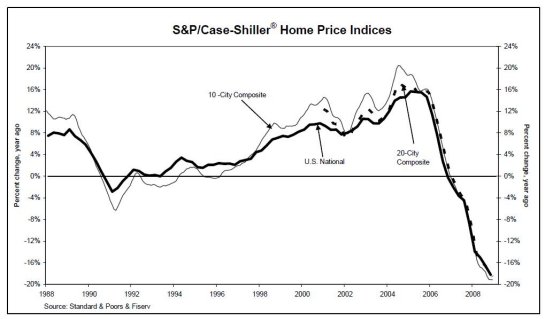
Thus the three perverse incentives distorted not just the U.S. housing market but the entire global economy. With housing down 40% and a bottom nowhere in sight (unless you're being paid to pump out propaganda for the Treasury or real estate industry), the middle class is reeling from an unprecedented destruction of wealth: some $13 trillion has been lost in housing and its dependent cousin, the stock market.

With corporate profits ultimately dependent on a free-spending consumer funded by the extraction of home equity (the same also true in Ireland, Spain, et al.), the stock market's collapse was inevitable. Despite the manic 24/7 propaganda about "green shoots," it is easy to predict that consumption is crippled for a generation: utterly reliant on easy cheap credit and housing appreciation, the U.S. consumer is now hobbled with high debt, falling appreciation and the destruction of his/her wealth and confidence in future wealth.

With the "low-risk" housing market destroyed, the securities markets have also been destroyed.

Unfortunately, the mis-investment of trillions of dollars has already occurred. Trillions that might have funded productive assets and research-development have been squandered, and now a massively indebted U.S. citizen and government are facing the unenviable prospect of actually having to save up the trillions needed for productive investment.

The feckless, irresponsible leaders of the U.S. government are attempting to paper over this reality with an unprecedented orgy of new debt. (Let's borrow $2 trillion a year until things get better--but wait--how can they get better when interest rates are rising due to our stupendous borrowing, and as a result we're paying $1 trillion a year in interest?) This effort to replace housing-bubble fueled consumer spending with government spending will fail, especially since much of the "stimulus" went to protect the financial Plutocracy from it's own self-inflicted losses.

The way out of the hole is obvious: eliminate perverse incentives and incentivize savings and investment in productive assets. Get rid of the housing tax shelter entirely and the mortgage interest deduction above $50,000 a year. Eliminate the perverse incentives to dump trillions in unproductive capital traps, incentivize saving over debt-based consumption, and maybe the U.S. economy can heal itself before the final implosion becomes unstoppable.


A few titles worth borrowing from your local library:

The first chapter of The Future of Life is the best short piece written on China in the past decade. Academic studies loaded with statistics on China's GDP, etc. miss the point: China is facing environmental collapse, sooner rather than later. Quantitative financial data cannot possibly capture this as the environmental data points are lacking/massaged for political purposes. The economy is not some free-floating entity disengaged from the rivers running dry.

On Peak Oil:

Beyond Oil: The View from Hubbert's Peak

The Party's Over: Oil, War and the Fate of Industrial Societies

The End of Oil: On the Edge of a Perilous New World

Twilight in the Desert: The Coming Saudi Oil Shock and the World Economy

On chemical/toxins overload:

Our Stolen Future: How We Are Threatening Our Fertility, Intelligence and Survival

On the demographic time bomb about to explode:

Fewer: How the New Demography of Depopulation Will Shape Our Future

The Coming Generational Storm: What You Need to Know about America's Economic Future

On collapse of advanced civilization:

Collapse: How Societies Choose to Fail or Succeed (Jared Diamond)

The Collapse of Complex Societies

A realistic appraisal of alternative energy:

Sustainable Energy - Without the Hot Air

Our previous lists of hot reading and viewing can be found at Books and Films.


Of Two Minds is now available via Kindle: Of Two Minds blog-Kindle

Of Two Minds reader forum (hosted offsite, reader moderated)

Thank you, Peter J. ($25), for your extremely generous contribution to this site. I am greatly honored by your support and readership.