Saturday, June 20, 2009

Saturday Haiku and More on Spoiled Brat Syndrome

Three new haiku from contributors, and reader commentary on Spoiled Brat Syndrome.


I feel blessed to have receive new haiku from frequent contributors Jed H. and Steven R.:

Jed H.:

Clowns, chimps, crooks, cheats, thieves;
Smoke, mirrors, wizards, MAGIC;
The U.S., goin' BROKE!!


Steven R.:

Manipulate truth
One green shoot portends rebirth
dead on arrival

EAUEW!
you are so cynical
but you are correct


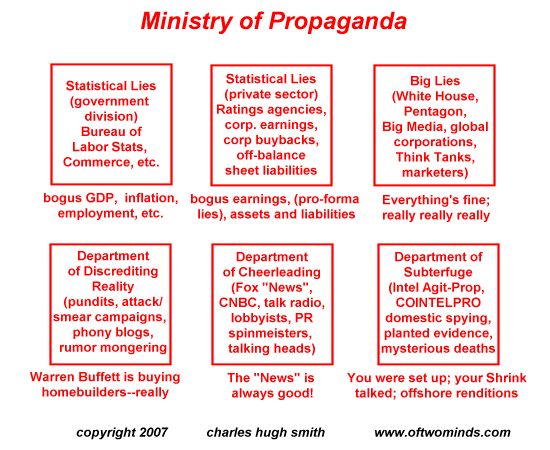
You may reckon it is tempting to only reprint reader comments which parallel my own views, but for me the opposite is actually true: I try to reprint those which make an opposing case because I think everyone needs to make up their own mind. After all, there are plenty of propaganda sites where you can go and predictably find what you already know you'll agree with. That does not create an informed public or informed voters. As for the Mainstream Media--it too is propaganda of the most blatant sort, always talking up "green shoots," "the worst is over," "the recovery is underway," etc.

The value of reader commentary to me is that it always opens a new understanding of the full range of the problem/challenge at hand. With that in mind, please read these diverse and thought-provoking commentaries in response to Incentives, Disincentives and Spoiled Brat Syndrome (June 17, 2009).

No one wrote to make the opposing case, i.e. that Americans were not spoiled. That in itself speaks volumes. Certainly not all Americans are spoiled brats, but the mindset of entitlement and self-aggrandizement has conquered the culture.

Laura I.

I enjoy all of your essays, but I really enjoyed the one about the Spoiled Brat Syndrome. I completely agree with everything you said and would like to add one more thing I don’t think you touched on very deeply, something that I see as the worst consequence of the positive reinforcement, everyone is a star culture. That is, few people know how to think; to figure out a way for themselves. Few people know how to recognize the causal relationships that help them understand a situation or recognize an opportunity and few people have the ability to observe/realize the intricate details/ process flow of a situation.

As you said in your essay, your construction foreman got jobs by first observing and targeting another worker on the job site. His ability to produce output kept him the job, but his ability to observe the workings (process flows, who was responsible for what, etc.) and locate an opportunity within those workings is what got him the job.

How many people do you meet nowadays who still have this ability? I meet very few. If you never experience cause and effect in your own life (including the negative effects), how would you ever learn to recognize it in the world at large? I have observed this consistently in young adults making the choices of what college to go to, what to major in, what jobs to apply for. They spend 4+ years obtaining a psychology degree or history degree never wondering what their potential for work/job/career will be when they graduate. Or never contemplating a scenario other than best case. Nor do they ever undertake a return on investment analysis when making the decision on which college to attend. They have no ability to calculate potential consequences of any action including those that obligate them for 20, 50 or 100 thousand dollars. When they search for a job their only criteria is what they “want” to do; not what will the job require, how much do they need to make to pay their bills, support themselves or (gasp!) save for future goals, not to mention position themselves for future career goals.

The ability to strategize, to sacrifice one’s “wants” for a better outcome later has been eliminated. There is a colleague at my work place who openly admitted to a group of his peers including his boss and boss’s boss that he chose his present job over the same job at a different company because he knew here he wouldn’t have to work as hard. (Say what?!?!)

It’s the rare employee now who when finished with an assigned task, tells their boss they are available for a new task. Most sit at their desks or bum around, waiting for their boss to psychically realize their availability. Considering most people don’t like to be micromanaged, you’d think they’d figure out if they volunteered such information, their boss would bug them much less, but that would mean understanding the mechanics of a process and many don’t have that ability.

Worse, they have lost the meaning of what a job is; I employ you to complete tasks for me. If there are no more tasks, then essentially the necessity of that employee has ended as well. Actually accomplishing something at work has become the side-story, not the main idea of being employed.

The other consequence of the spoiled-brat syndrome is a complete inability to assign self-blame, to honestly self-reflect on what could have been done differently, how actions/words were perceived, how could they have been better conveyed. When something doesn’t go right (jobs, relationships, etc), it’s always someone else’s fault. In an effort to nurture self-esteem we have developed a society of people who are all right all of the time. “It’s okay that I am 300 lbs and 5’2” because that’s who I am. It’s okay that I don’t have any idea how take care of my house and car because that’s who I am. It’s okay that my bank account is constantly over-drawn because that’s who I am. I am never wrong.”

All logic and cause and effect has been eliminated in favor of self-esteem. But self-respect, happiness, emotional connectedness and lives with meaning seems to have been lost too. We have become a nation of zombies, having never felt the wretchedness of regret (when did that word become so taboo?) we never experience the true inner satisfaction, the true self respect, the true confidence of a self-earned victory. We have no passions worth sacrifice, no character worth enduring and no sorrow at separation.


Marc B.

I enjoyed your piece today on "spoiled brat syndrome". It's entrenched, but perhaps a contributing factor is that so much of the work today is unnecessary and without meaning.

I've pondered the future of work too. Sadly, under the current system, I see misery ahead for the majority of Americans due to globalization and automation (not to mention crushing debts).

Many rail against the "service" economy, but I don't see how any other outcome could have been expected. Sure we've outsourced much of our manufactuing, but we've automated much of it too. Despite the massive outsourcing, we manufacture far more today than ever and we do so with fewer employees. Just wait until we really start automating away our service jobs. Stores such as Home Depot already have automated/self checkout! Banking is now largely automated too - I haven't dealt with a teller in years.

Another blogger asked me what George Jetson did for a living. His point was that he knew George had a job, but since everything was automated, exactly what did he do? After a little "work" researching the issue, I sent him this link:

The Jetsons

Again, (imo) so much of today's "work" is not only unnecessary, it is also completely without meaning. If you remove vanity from the equation, I'm quite certain we could get by (and possibly be much happier) with less than half our current work force.

The viability of a debt based money system is suspect when supply exceeds demand. I'm not sure it can handle the trend towards a Jetson's type future.

One more thought. I'm short vanity and long free time. Bernanke better hope my mindset doesn't become a trend.


Gene M.

I loved your rant, for one, because I once was a carpenter too. Not a custom worker, I learned my trade building tract houses and 4-plex condos. The burden of the physical work was really hard at first, coming from a university professor's life. The foreman did not have to watch you; he could tell at the end of the day how much you had done. It was produce or you were gone, simple as that. My partner and I finally got so good we could do the work of 3 guys. Then we went into business for ourselves--at the worst possible time, when interest rates were sky high.

Recently when we had some work done at our house, I asked the caucasian contractor about his Mexican workers, who were working pretty hard. He said you can't find Anglos who would work like that. I was pretty shocked, since that was pretty much the norm in my day (the 70's and early 80's).

I know my old friends still in academia recount similar stories about the spoiled brat syndrome. One told me about the female student who wanted to turn her paper in well after the deadline. He said it was probably the first time in her life someone ever said "No" to her. In fact this oldest and dear friend serves up the most F's and C's in his department. Nobody else even gives grades this low.

I've always told my own grown children and anyone else who would listen that you earn your badge as a parent by saying "No." Saying yes is easy. The spoiled brat syndrome and your comments are well expressed by the most current parenting practices, which seem to spread like a virus. I see it in my own daughter and her children, as well as her friends.


K.K.

When you mentioned “gaming the system” it reminded me of the CHP/Cop/Firefighter scam where “most” are now retiring as “disabled” since they get more money and a big chunk of the retirement payments tax free forever.

Caltax.org

KGO News: More Questions In CHP Disability Fraud Probe

80 percent of assistant chiefs retired on disability. Almost as many deputy chiefs did the same.

Pat Macht, Calpers Spokesperson: "If they have a disability retirement and they reach over age 50, we really don't have any enforcement tools to go against them for that kind of fraud." Specifically, state law forbids Calpers from requiring disabled retirees who are 50 or older to submit to another medical evaluation, even if there is evidence of possible fraud.

"Outgoing State Senator Jackie Speier says powerful lobbying interests killed pension reform bills, including her legislation that would have given Calpers that kind of leverage."

As I have mentioned I’m in my mid 40’s and I have firefighter and cop friends who (except one) never finished college and ALL (according to the SF Gate search feature) are now pushing $200K (the one that finished college made almost $300K last year and really does work hard, he is planning to “retire” at 50 then take another job heading another department and then “retire” again at 60 with two pensions of over $500K a year.

The cops don’t have an easy job, but most of my firefighter friends’ work just 10 days a month and are paid big money to sleep (when was the last time you heard of a major fire in a wealthy suburb?). You have to hand it to the guys who keep getting big raises when there are THOUSANDS of people that try out for every open position.


Dave E.

You wrote:

There are many reasons for the ascendency of Spoiled Brat Syndrome, but one is the notion that a job or entitlement is deserved by reason of one's existence.

Heck, this is the attitude I see in government workers. In California now they're talking about slashing all kinds of services to the public, but nary a word about cutting government jobs, many of which are superfluous and wouldn't be missed. The people running the government seem to have the attitude that the purpose of government is to provide them with a job and retirement benefits, I guess just because they are such darn great people. Unless government actually provides a benefit to society, there is no point in having one.


Ken R.

I've been in management a long time and your statement -- In other words, disincentives can be more effective than incentives. That is so wildly un-PC that it truly is "that which cannot be spoken, but only whispered. -- could not be truer. We have another saying that is about "rewards" -- "No good deed goes unpunished."


Thank you, readers. I am working on updating Readers Journal with more excellent reader commentary.

ENDNOTE: What strikes me as the purest form of misleading propaganda is the MSM's shrill insistence that "everything will come back": housing valuations, jobs, tax revenues, etc.

Sadly, this is completely unfounded: None of these things are coming back, not housing, not jobs, and certainly not tax revenues. The structures which supported abundant credit and government-backed mortgages (and thus the housing bubble) are gone. The structures which supported abundant consumer credit and spending (and thus millions of service-sector jobs) are gone. The structures which supported high tax revenues (huge capital gains from stocks and housing, the FIRE economy's transactional fees, rampant irresponsible credit and consumer spending) are also gone.

Pundits/think-tankers making the case that "everything's going to come back" never address the structural decay/destruction which prohibits everything from returning to 2005. Thus they are nothing but propagandists, paid cons and shills of a crumbling status quo.

Thank you, Peter K. ($20), for your extremely generous contribution to this site. I am greatly honored by your support and readership.

Friday, June 19, 2009

California's Crisis Will Crush Green Shoots Rally

The California economy and thus its state government are imploding like a star in its death throes. California's fiscal crisis will destroy the fantasy that the U.S. economy is "recovering" and "stocks are a buy."


"Black Swan events" are unexpected shockwaves of instability. What do you call a completely predictable shockwave of instability? California.

That the state of California is a fiscal mess is not news, but the full extent of its implosion has been masked by a complacent and complicit media fearful of telling the truth.

Buried in this bland "press-release passing for journalism" story is the ugly reality:Democratic leaders say they're close to budget deal.

The Democrats' plan includes $1.9 billion in new taxes to help close the $24.3 billion deficit. The Democrats' proposal - which includes $11.4 billion in actual cuts to state spending, according to Democrats - is not nearly enough to solve the crisis. The rest of the proposal closes the gap with revenue accelerations, fund shifts and fees.

By comparison, the governor's plan included $15 billion in cuts to state spending. He also proposed billions in fees and one-time solutions, including a $48 surcharge on all residential and commercial property insurance. In addition, the governor wanted to borrow nearly $2 billion from local municipalities, which the Democrats rejected.

Talk about Tweedledum and Tweedledee parties: the only difference between the two parties is the degree of their reliance on accounting trickery, new taxes and fees and what is essentially fraudulent shifting of revenues and expenses to mask the shortfall.

As if that transparent reliance on slight-of-hand wasn't enough--note the Democrats' plan cuts $11 billion, raises $2 billion is taxes, and then buries the other $12 billion through fraudulent accounting, while the Repubs are hiding "only" $8 billion via tricks-- take a look at this chart and read the state Controller's report. Then you'll understand that the state's "leaders" are chasing a ball downhill: by the time they finish crafting a phony budget which satisfies the state unions and their other special-interest overlords, the deficit will have grown from $24.3 billion to $25 billion--on its way to $30 billion.

The chart is from a report (submitted by correspondent Dan K.) which has spread throughout the blogosphere (but not the MSM): April Is a Cruel Month: Personal Income Tax Revenues Portend Deepening Trouble for Many States (Nelson A. Rockefeller Institute of Government)

Here is a report from the California Controller: Statement of General Fund Cash Receipts and Disbursements April 2009

Anyone who thinks the downtrend in tax receipts will suddenly reverse course should step away from the flickering screen of fantasy and re-enter reality. Personal income taxes bring in almost half of all California tax revenues; us plebian residents pay modest income taxes while high-income folks pay about 10%. Let's consider what generated all the big income which generated all the big tax revenues:

Flipping real estate for huge capital gains: Gone, never to return.

Huge stock option gains from tech and Web2.0 company insiders: Gone, never to return.

Huge incomes reaped by realtors, mortgage brokers and other FIRE economy windfall exploiters: Gone, never to return.

But wait, there's more: structural changes are gutting Hollywood, the music industry, tourism and the vaunted tech industry--the last props left now that the FIRE economy is reduced to cinders.

Meanwhile, as those paying huge taxes go broke, downsize or simply pack up and leave, the Democratic "leadership" refuses to consider even a 5% pay cut for the state work force. Question for both parties' "leaders": where do you think you're going to find $8-$12 billion to fill the shortfall you're masking with tricks? Do you really think the FIRE (finance, real estate, insurance) economy will roar back from the ashes and generate $15 billion in new tax revenue in 2010?

May I introduce a strange new concept, reality, to your calculations? Count on another $10 billion shortfall in 2010, not a $10 billion windfall.

The transparency of their desperation to cling to the status quo is breathtaking: do they really expect the bond market to accept that a $25 billion deficit has been "resolved" with $11 billion in actual expense reductions, $2 billion in new taxes and $12 billion in accounting tricks?

Who is willing to bet money (i.e. give California cash) that the state will not add to the remaining $12 billion deficit for this fiscal year with another $10 billion next year, and so on until the state finally defaults?

Apparently not the Obama administration. As beholden as the Obama administration is to the unions and Democrats of California, they can discern the end-state of bailing out California: any bailout of the Golden State would be followed by 49 other requests for bailouts (as if the $787 billion "stimulus" package wasn't already a bailout of the states.)

Even more dispiriting for the "leaders" of California, the realists in the Obama White House recognize that bailing out California in 2009 will require bailing it out in 2010, 2011, 2012, etc. A state which refuses to deal with a $25 billion deficit has no track record to suggest it will tear itself away from fantasy and political cowardice in 2010 or indeed, any year.

The bond market might just decide enough is enough and refuse to lend money to California to paper over its $8-$12 billion deficit for 2009. Then the state will have no choice but to default on some of its obligations. The clock is running, as the state controller has said that California will run out of cash within 50 days.

If you look at the trendline in the chart above, that appears to be an overly optimistic assessment. I would hazard a guess of 30 days, max, before implosion.

People like to say California is like a nation itself--and in terms of size, population and GDP, it is like a nation: the nation of Zimbabwe, another failed state with failed "leaders."

What do you reckon will happen to the "green shoots" stock market rally when California defaults on its obligations? Even with all the manipulation and propaganda of Wall Sreet and the MSM in full play, I doubt the rally will be able to shirk off the default of California. Maybe the "players" will realize the jig is up, and their rush to the exits has a name: crash.


A few classics in case you missed them:

The Long Emergency: Surviving the End of Oil, Climate Change, and Other Converging Catastrophes of the Twenty-First Century James Howard Kunstler

Depletion and Abundance: Life on the New Home Front Sharon Astyk

The Future of Life E.O. Wilson

Globalization and Its Discontents Joseph Stiglitz

On Peak Oil:

Beyond Oil: The View from Hubbert's Peak

The Party's Over: Oil, War and the Fate of Industrial Societies

The End of Oil: On the Edge of a Perilous New World

Twilight in the Desert: The Coming Saudi Oil Shock and the World Economy

On chemical/toxins overload:

Our Stolen Future: How We Are Threatening Our Fertility, Intelligence and Survival

On the demographic time bomb about to explode:

Fewer: How the New Demography of Depopulation Will Shape Our Future

The Coming Generational Storm: What You Need to Know about America's Economic Future

On collapse of advanced civilization:

Collapse: How Societies Choose to Fail or Succeed (Jared Diamond)

The Collapse of Complex Societies

A realistic appraisal of alternative energy:

Sustainable Energy - Without the Hot Air

Our previous lists of hot reading and viewing can be found at Books and Films.


Of Two Minds is now available via Kindle: Of Two Minds blog-Kindle

Of Two Minds reader forum (hosted offsite, reader moderated)

Thank you, Jim S. ($20), for your most generous (multiple) contribution to this site. I am greatly honored by your support and readership.

Thursday, June 18, 2009

Pavlov's Dog and Jim Cramer's Call of the Bottom in Housing

Like Pavlov's dog, Jim Cramer announces "the bottom is in" every time he sees a housing chart. Sadly, this is a conditioned response, not reality.


In Pavlov's famous experiment, a dog hearing a ringing bell began drooling as if food was present. In a bizarre parallel to the classic experiment, Jim Cramer announces "the bottom is in" every time he sees a housing chart.

Pavlov began his experiment by showing his dog a bowl of food (powdered meat). The dog naturally salivated, what Pavlov termed an unconditioned response. Then Pavlov rang a bell when food was presented; the bell was a neutral stimulus. Finally, he rang the bell without any food present; the dog began salivating. This salivation is called a conditioned response, and the process is called classical conditioning.

Sadly, we can observe this behavior now in Jim Cramer, who nonsensically called a bottom as housing starts leaped. Here's Jim's call, dated 6/16/09:Cramer: Housing Has Officially Bottomed:

According to the Commerce Department, there were 47,000 more housing starts in May than the 485,000 expected, a number 17% higher than the month before. The two regions seemingly in the biggest hole, the South and West, jumped about 17% and 29%, respectively. Building permits, which can predict the market’s future to a certain extent, showed significant growth as well. Now Cramer – and probably the homebuilders, too – sense an end the morass that weighed so heavily on the markets.

What does a bottom look like? It’s the combination of ramping sales, and sales in certain areas are up ten times those of last year, and an end to falling prices. That’s exactly what we’ve seen for the past three months, Cramer said.

Here's how the conditioned response process works:

Since Jim saw viewer statistics jumped every time he called a bottom in housing, now he can't help it: every time he sees a housing chart now, he calls a bottom in housing:

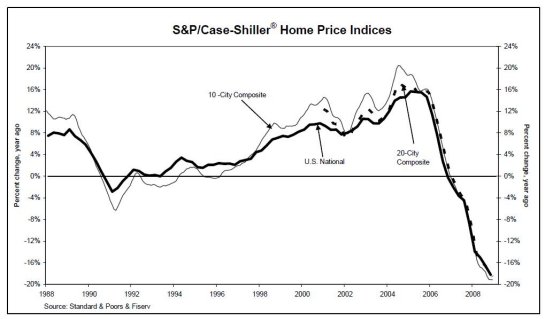
Uh, Jim, we hate to tell you, but building more housing when there's a huge inventory of unsold houses and condos as interest rates are leaping up is not exactly bullish. (Psychotic disassociation from reality would be the official diagnosis.) We know this chart is just going to trigger more of your copious bottom-calling, but look at this and tell us what's so bullish:

This recent "improvement" in sales is a tiny blip up within a massive collapse. To call a bottom based on such a modest increase is truly psychotic disassociation; statistically, both the increase in sales and housing starts are minor enough to qualify as statistical irrelevancies, a.k.a. "noise."

Then there's the little matter of rising mortgage rates. Sales are announced when they're signed, not when they close, so oops, a whole passel of buyers might get bumped or simply bail when they calculate what the half-point rise in rates will do to their monthly nut. So in other words, the glowing sales numbers are highly likely to be revised downward once actual escrow closings are tabulated.

Then there's the little matter of unprecedented levels of debt in the U.S.:

The peak of mortgage resets lies ahead, too, which doesn't bode well for the fantasy the sales will chew through all existing inventory; if history is any guide, inventories will rise even further as resets cull many of the remaining homeowners who still have jobs, never mind those who have yet to lose their incomes, further swamping whatever dwindling sales actually close:

In conclusion: a conditioned response is not a substitute for reality. Just because the dog started drooling, Jim, didn't mean there was any food to chow down. And in a parallel fashion, just because you announce a bottom in housing doesn't mean there is any substance to your call.


A few classics in case you missed them:

The Long Emergency: Surviving the End of Oil, Climate Change, and Other Converging Catastrophes of the Twenty-First Century James Howard Kunstler

Depletion and Abundance: Life on the New Home Front Sharon Astyk

The Future of Life E.O. Wilson

Globalization and Its Discontents Joseph Stiglitz

On Peak Oil:

Beyond Oil: The View from Hubbert's Peak

The Party's Over: Oil, War and the Fate of Industrial Societies

The End of Oil: On the Edge of a Perilous New World

Twilight in the Desert: The Coming Saudi Oil Shock and the World Economy

On chemical/toxins overload:

Our Stolen Future: How We Are Threatening Our Fertility, Intelligence and Survival

On the demographic time bomb about to explode:

Fewer: How the New Demography of Depopulation Will Shape Our Future

The Coming Generational Storm: What You Need to Know about America's Economic Future

On collapse of advanced civilization:

Collapse: How Societies Choose to Fail or Succeed (Jared Diamond)

The Collapse of Complex Societies

A realistic appraisal of alternative energy:

Sustainable Energy - Without the Hot Air

Our previous lists of hot reading and viewing can be found at Books and Films.


Of Two Minds is now available via Kindle: Of Two Minds blog-Kindle

Of Two Minds reader forum (hosted offsite, reader moderated)

Thank you, Ryan R. ($20), for your superbly generous contribution to this site. I am greatly honored by your support and readership.

Wednesday, June 17, 2009

Incentives, Disincentives and Spoiled Brat Syndrome

It is stupendously politically incorrect to note that humans respond to both incentives/praise and disincentives/negative consequences.


There is a great divide in the U.S. economy which will only be bridged by the coming insolvency of the Federal and state governments: those who can be fired/laid off and those who still feel entitled to their job regardless of their output.

One of my carpentry masters was an African-American gent from New Orleans. Back in the early 1970s when I first began working for him and his partner (a Caucasian gent), he told me that how he'd found work in tough times was to approach the foreman of a construction project, point to a worker on the site and say that he could do more work than that guy.

The foreman would give him a once-over and put him to work. The next day, the other guy would be gone and my boss would have his job.

That's called getting and holding a job based on output and nothing else.

Now we have a culture and economy based on Spoiled Brat Syndrome: only incentives and praise are allowed as motivators. One of my correspondents emailed me this reflection of Corporate America management practice:

We are providing management training for our management team and there are four areas that motivate most people:

1. Learning and/or teaching
2. Being creative and/or problem solving
3. Helping others and/or making a contribution
4. Taking risks.

I'm all for positive motivation, but if we read between the lines, here is what's being communicated: since we can't fire you or motivate you with disincentives then we have to offer happy-happy Spoiled Brat Syndrome "positive motivators" to get you to perform.

Every parent knows the ideological "religion" in education now is positive praise, gold stars for showing up, grade inflation (every kid is a genius and deserves an A), etc.

Yet strangely enough, studies have shown that people habituate very quickly to constant praise and regular pay raises and that such positive reinforcement/incentives quickly lose their motivational effectiveness. (Unpredictable "out of the blue" bonuses work far better than scheduled raises.)

Instead, an entitlement attitude takes hold in which pay raises, additional benefits, constant praise and an A for mediocre results are expected, and any reversal is met with resentment and a profound sense of disenchantment: what was owed/deserved was unfairly withheld.

That is, Spoiled Brat Syndrome, in which said Spoiled Brat whines and cries if he doesn't get a new toy every time Mommy takes him into a store.

There are many reasons for the ascendency of Spoiled Brat Syndrome, but one is the notion that a job or entitlement is deserved by reason of one's existence. Perhaps there are faint traces of industrial unionism remaining from much different times, when laborers toiled in low-skill factory positions which were interchangeable--the next guy could tighten the bolt as well as you could, and so a union was necessary to protect the laborers from outright exploitation.

But now the union movement has taken over white-collar/service sectors where output is highly correlated to an individual's training, motivation, attitude, etc. Lazy workers receive the same pay and benefits as highly productive workers, so the incentives to be productive are weakened to near-zero. Disincentives are simply not allowed; workers can be censured or punished for non-politically-correct language or behavior, but not for low productivity/output.

In "protected" fiefdoms, the worker at risk of losing their job due to incompetence, laziness, low productivity/output knows to file a "stress claim" via workers compensation so they can get paid to stay home, and then file a grievance for unlawful termination in the hopes that a fat legal settlement will ease the pain of being laid off. (This is known as "gaming the system.")

Please don't say it isn't so; these accounts come first-hand.

Circumstances are slowly changing because neither local government nor corporate America can print money. Thus as tax revenues and sales plummet, eventually labor costs (fully 3/4 of all local government expenses) have to be trimmed, regardless of union rules. Unfortunately, the rules usually favor seniority over competence or productivity, so once again the laziest and least productive have every motivation to cling on.

I am well aware that simply telling the introductory story will draw accusations of this being a rant. In other words, simply noting that jobs once went to people based solely on their productivity and output rather than on their other attributes, and that not being able or willing to match (or better) others' output would cost you your job, is verboten. Only incentives are allowed now in every sector above field hand. Disincentives are poisonously politically incorrect.

And this is how you get a culture and economy drenched in Spoiled Brat Syndrome. Nothing bad is going to happen to me, so why bother making my best effort? I'm going to get what's coming to me regardless.

Over the past 25 years I have from time to time managed rental properties as a way of leveraging my DIY skills (not that high, but high enough to repair most minor things). I noticed that when the owners attempted to "reward" responsible tenants by returning their security deposit a few days before they actually vacate, the apartments were generally left an untidy mess.

When tenants, excellent and mediocre alike, get the same letter stipulating that the deposit will only be returned in full after an inspection which follows a detailed checklist (an objective metric), then magically, the good tenants leave their units spotless and mediocre tenants either make a good-faith effort to clean up (especially pathetic for many bachelors) or apologetically confess that they know the place is a mess and they won't be getting their deposits back.

In other words, disincentives can be more effective than incentives. That is so wildly un-PC that it truly is "that which cannot be spoken, but only whispered."

The great divide between entitlements (which can't possibly be paid at current levels past about 2014) and "guaranteed jobs" and the real world is about to be bridged. As corporations shrink relentlessly and cities and counties declare bankruptcy, dissolving unaffordable union contracts and pension entitlements, then managers may well find that having hungry and motivated applicants claiming they can do the job better and faster will improve employee output far more effectively than another round of corporate-speak and "facilitators" spouting a threadbare "rah-rah, go team!" line of "motivation."

Yes, I have been "securely" (heh) on the fringes of the U.S. economy since 1971. And yes, I understand many managers/bosses are abusive, dictatorial and unfair and that many workplaces are hellholes. The only boss you can't fault is yourself. When you're your own boss, then your focus is on providing better value than others to your customers/clients, and if there is no demand for your goods or services then you switch to some good or service which is in demand.

I also know our various financial "rights" have been funded by borrowing trillions of dollars from overseas, and our stupendous consumption of tangible goods has been financed by the exchange of paper (dollars) for tangible goods produced overseas.

This trade is not a "right," it is a con. Both cons (borrowing trillions which we can never pay back in equivalent purchasing power, and exchanging paper for tangible goods) will blow up within a year, and our various "rights" will lose meaning as we will face the responsibility of living within our means.

I also know various uninformed voices believe we can satisfy our financial "rights" by "taxing the rich." So let's see how that works. Let's not fool around with taxes; let's just seize $12 trillion from the Plutocracy which owns some 2/3 of the productive wealth of the nation. All that $12 trillion does is back up what the Fed and Treasury have guaranteed/promised/borrowed to bail out the financial sector.

Now let's pay for the $2 trillion annual deficits for another 6 years (until 2015) by seizing another $12 trillion from what's left of the Power Elite's holdings. (If all asset classes other than gold fall in value in the coming years, as I consider inevitable, then our total national wealth will drop from about $48 trillion to some much lower total. Recall it's already declined $13 trillion in the past 18 months.)

So in 6 years we will have seized $24 trillion from "the richest of the rich," the majority of their wealth, and then what will we use to pay the next 6 years of deficits? What exactly have we solved by seizing $24 trillion in wealth to cover a bailout of the rentier-finance sector and a mere 6 years of Federal deficit?

The twin cons are up. The rest of the world has grown tired of the cons: lending us trillions which will never be paid back in equivalent purchasing power, and trading tangible goods and assets for paper which might revert to its intrinsic value, zero.

I think Douglas MacArthur got it right: "There is no security on this earth; there is only opportunity."

That is about as far from Spoiled Brat Syndrome as you can get.


A few classics in case you missed them:

The Long Emergency: Surviving the End of Oil, Climate Change, and Other Converging Catastrophes of the Twenty-First Century James Howard Kunstler

Depletion and Abundance: Life on the New Home Front Sharon Astyk

The Future of Life E.O. Wilson

Globalization and Its Discontents Joseph Stiglitz

On Peak Oil:

Beyond Oil: The View from Hubbert's Peak

The Party's Over: Oil, War and the Fate of Industrial Societies

The End of Oil: On the Edge of a Perilous New World

Twilight in the Desert: The Coming Saudi Oil Shock and the World Economy

On chemical/toxins overload:

Our Stolen Future: How We Are Threatening Our Fertility, Intelligence and Survival

On the demographic time bomb about to explode:

Fewer: How the New Demography of Depopulation Will Shape Our Future

The Coming Generational Storm: What You Need to Know about America's Economic Future

On collapse of advanced civilization:

Collapse: How Societies Choose to Fail or Succeed (Jared Diamond)

The Collapse of Complex Societies

A realistic appraisal of alternative energy:

Sustainable Energy - Without the Hot Air

Our previous lists of hot reading and viewing can be found at Books and Films.

Of Two Minds is now available via Kindle: Of Two Minds blog-Kindle

Thank you, Richard S. ($5), for your much-appreciated generous contribution to this site. I am greatly honored by your support and readership.
Tuesday, June 16, 2009

A Skeptical Look at High Inflation

Two points are often overlooked by those seeing inflation as inevitable: it's neither good for the U.S. Treasury nor for the super-wealthy who influence Congress.


The gospel of inflation is that it's desirable because old debt can then be paid off with hugely depreciated dollars. Maybe, but there are two flies in the ointment.

Let's say you head the U.S. Treasury. (No, this is not a nightmare; it's only a terribly bleak thought experiment.) Now since inflation won't rise from 0% to 100% in an instant, there will a period of rising inflation.

Let's say inflation jumps to 10% a year--similar to the rate in the late 1970s. Now several peculiar things happen when inflation jumps to 10%; the most important one is that all those trillions in Treasury (and other) bonds which are outstanding are now worth a lot less. Why? Because buyers look out 10 years or 20 years or 30 years and quickly reckon at that 10% inflation or so, that long-term bond will be worth approximately a bucket of warm spit when it finally come due.

Another funny thing happens to interest rates. When we try to sell new T-bills to our wonderful friends overseas for a 4% annual return, they observe that they will be losing 6% a year for the full term of the bond--and that's if the dollar doesn't plummet, in which case the new bond might reach "warm bucket of spit" valuation even before it comes due in 10 or 20 or 30 years.

Even our closest, dearest, most gullible friends will conclude that losing 6% at a minimum is not a wise investment. So nobody in their right mind will buy the new Treasury bonds which you have to sell every week in untold billions.

So what rate of return would entice folks to part with their cash? How about a real rate of return of say, 4%, plus a premium in the event inflation in the U.S. continues rising. So let's say a minimum of 15%.

Another funny thing happens to existing bonds paying 3% when new bonds yield 15%. The old bonds drop hugely in value because one way or the other buyers now expect 15% return. So a $10,000 bond paying 3% will drop to $2,000 in value so that its effective yield is equivalent to the new bond yield of 15%.

Now remember that the U.S. Treasury needs to sell a couple trillion dollars of new debt every year from now until doomsday. (Forget the fantasy that the economy is going to recover and tax revenues will skyrocket.) Not only that, but the Treasury also has to roll over trillions in old debt which comes due. That's a heap of trillions, and guess what--there is no Plan B except to print off a couple trillion dollars and "monetize" the debt by buying it with newly printed dollars.

Nobody knows what will happen if the Federal Reserve and the Treasury try to corner the global market in Treasuries with money created out of thin air, but most guess that will nudge up inflation--the very problem that put us in this pickle, i.e. nobody wants to buy our debt at 4% when inflation is 10% and climbing.

You see the point: the idea that inflation is "good" for the Treasury is purely academic. In the real world in which the Treasury has to sell hundreds of billions of dollars of new bonds every year, inflation means interest rates will have to jump high enough to offer a positive return (above inflation) and that will destroy the existing bonds' value and decapitate the housing market all in one swoop.

We might also anticipate that all our dear friends who foolishly invested their hard-earned cash in Treasuries in years gone by might not be too overjoyed to find that their previous investments are now worth 20% of face value. That lack of joy might motivate them to never buy another T-bill again.

So the idea that the Fed and the Treasury are looking forward to a sharp rise in inflation simply does not make sense in the real world of selling tens of billions of new bonds each and every week.

We can also anticipate that corporations will not be too thrilled at having to pay 15% in order to issue new corporate bonds.

Now let's say your family controls $200 million or so in productive assets.(Nice gig, eh?) Yes, you're one of the rentier-financial Power Elite, a.k.a. the Plutocracy. As inflation ramps up, followed by interest rates, does that make you feel all warm and fuzzy? Probably not, because inflation introduces a great uncertainty in your assets and returns. Tangible assets will go up, of course, but then the high cost of money means financing is nearly impossible to get; and no matter how fast your enterprises raise rents and prices, they're always behind inflation.

Yes, you can play around with hedging the dollar and so on, but since nobody knows whether inflation will stabilize, double, or fall, it's difficult to choose high-yield strategies. Meanwhile, your income is rising and so are your taxes (assuming you pay any, heh.)

Now since you give various high-powered congresspeople a couple hundred thousand each, plus a few million dollars to various parties and PACs, the politicos perk up when you call and tell them this inflation is wreaking havoc on your business.

You see the point: inflation is not all that great for the 1% of the citizenry who own/control 2/3 of the productive wealth of the nation. These folks tend to own a lot of everything, and their bonds are getting wiped out. Maybe their timberland is rising in value, but since costs are rising, too, then it's all a wash. Meanwhile, the property taxes are leaping along with valuations, and there's no guarantee that prices will keep up with costs. The same can be said of rental property and other income-producing assets.

The idea that the super-wealthy and super-influential folks who own the politicos will benefit from inflation does not hold water. And so how much pressure do you reckon the politicos will be feeling "to get a handle on this inflation"? I would reckon a tremendous amount--the sort which causes people to lose elections. And since that is the last thing a politico wants, then they will start calling people and demanding that somebody somewhere get a handle on this inflation thing and shut it down.

(Mever mind what happens to the politicos' cherished pork spending when interest rates jump to 15%. The Federal budget will largely go to paying interest, leaving precious little to toss around the home district come election time.)

It seems abundantly obvious that high inflation is not a "solution" to the Treasury's main problem, selling trillions of dollars in new debt, nor is it some sort of windfall for the Plutocracy. And if it's not helpful to the Treasury or the super-wealthy, then why would either allow it to happen? (After all, it's not exactly a mysterious force from space; it's rather terrestrial in origin.) Maybe the answer is: they won't.


A few classics in case you missed them:

The Long Emergency: Surviving the End of Oil, Climate Change, and Other Converging Catastrophes of the Twenty-First Century James Howard Kunstler

Depletion and Abundance: Life on the New Home Front Sharon Astyk

The Future of Life E.O. Wilson

Globalization and Its Discontents Joseph Stiglitz

On Peak Oil:

Beyond Oil: The View from Hubbert's Peak

The Party's Over: Oil, War and the Fate of Industrial Societies

The End of Oil: On the Edge of a Perilous New World

Twilight in the Desert: The Coming Saudi Oil Shock and the World Economy

On chemical/toxins overload:

Our Stolen Future: How We Are Threatening Our Fertility, Intelligence and Survival

On the demographic time bomb about to explode:

Fewer: How the New Demography of Depopulation Will Shape Our Future

The Coming Generational Storm: What You Need to Know about America's Economic Future

On collapse of advanced civilization:

Collapse: How Societies Choose to Fail or Succeed (Jared Diamond)

The Collapse of Complex Societies

A realistic appraisal of alternative energy:

Sustainable Energy - Without the Hot Air

Our previous lists of hot reading and viewing can be found at Books and Films.


Of Two Minds is now available via Kindle: Of Two Minds blog-Kindle

Of Two Minds reader forum (hosted offsite, reader moderated)

Thank you, Arthur B. ($25), for your extremely generous contribution to this site. I am greatly honored by your support and readership.

Monday, June 15, 2009

8800/950 or Bust; The Dollar Set To Rise

A quick glance at the "green shoots" rally is followed by a persuasive analysis of the dollar's strength by correspondent B.C.


The favorite fantasy of the Powers That Be--that the U.S. economy "is improving" and "the worst is over"--requires the "green shoots" Bull Market rally to continue. Yet the melt-up enters its 14th straight week on wobbly legs. Over the past two weeks, the Dow Jones Industrial Average has attempted to close above 8,800 on at least six occasions, and failed to do so each time.

This failure to break through to new technically persuasive highs has been mirrored by the S&P 500, which traded for the past 7 days in an extremely narrow band:

6/4: 942.46
6/5: 940.09
6/8: 939.18
6/9: 942.43
6/10: 939.27
6/11: 944.89
6/12: 946.21

Everyone with even a passing interest in technical analysis has heard that "once the SPX closes above 950 then that will trigger another leg up in this Bull Market." Hence the PTB's (Powers That Be) desperation to stage a close over 8,800 on the DJIA and above 950 on the SPX.

But exactly how much of the "green" in all those shoots have been spray-painted on dying weeds of bad debt? Correspondent U. Doran sent in this article from Bloomberg documenting that the EU has thrown staggering sums at its banking sector: Bank Rescue Costs EU States $5.3 Trillion, More Than German GDP :

European governments have approved $5.3 trillion of aid, more than the annual gross domestic product of Germany, to support banks during the credit crunch, according to a European Union document.

The U.S. government and the Federal Reserve had spent, lent or committed $12.8 trillion, an amount that approaches the value of everything produced in the country last year, as of March 31.

In other words, the gargantuan pillaging of public funds in the EU, an economy larger than the U.S., is not even half the amount looted from the U.S. taxpayers. The central banks of the major trading nations have thrown well over $20 trillion (don't forget Chinese and Japanese "quantitative easing"/stimulus) of public funds into their deleveraging, insolvent banking sectors, all in the vain hopes that the unwary public will see spray-painted weeds as "green shoots" of organic economic recovery.

Have you noticed that every day the market threatens to close lower, a sudden "rally" in the last 20 minutes gooses it higher so that it once again closes within an unprecedented narrow band, day after day?

If that isn't manipulation, then why can you set your watch to the daily "rally"? That is hardly a "random walk down Wall Street," is it?

OK, on to the main topic of the today: could the dollar be set to rise rather than fall? Last week I posited in The Dollar Conundrum: Poison or Cure? (June 11, 2009) that the dollar would have to fall in half if not more just to correct unprecedented imbalances in trade and capital flows.

Knowledgeable correspondent B.C. holds the opposite view, and he states the case for a much stronger dollar very persuasively:

I am one of those rare birds who does not buy the US$ disaster scenario. Consider that from the overvalued cyclical levels in '00-'02, the US$ fell ~53% in CPI-adjusted terms. Adjusted for the price of gold, similarly adjusted for the US$ and CPI, the US$ fell 76%. The US$ fell even more in the early '80s adjusted for CPI and gold. In effect, we've had two colossal US$ crashes in less than 30 years. (emphasis added, CHS)

(While many would say that we have emerged relatively unscathed from each episode to date, a closer examination of the underlying productive structure of the economy, and what the Austrians refer to as the "pool of funding", and the situation is much more dire than it appears on the surface.)

Then consider what would happen to the euro were the US$ Index to fall, say, another 50% from ~80. The euro would effectively double to the 2.80s, plunging the European production and export sectors further into a deeper hole than today. And the doubling or more of commodities prices would very likely imply a further decline in global economic activity.

The value of the US$, as with all fiat, credit-money currencies, is determined by supply and demand but also by the relative supply-demand and flows of "things" the fiat currencies can buy. Note that commodities prices over the long term grow roughly at the rate of overall GDP or population plus replacement and capital deepening and the incremental amount of supply-demand inefficiencies or price signal distortions associated with gov't and bankster mischief in the form of growth of bank loans and gov't deficit spending beyond the economy's sustainable growth rate (again, at around replacement or population and the capital required).

Adjusted for the changes in the fiat credit-money US$, commodities prices as reflected by the CRB Index (overweighted by oil) are no higher than they were 34-35 years ago, including at or near the lows since the US$ was removed from gold. One can infer from this currency-adjusted price profile that the supply-demand situation for commodities is generally speaking at equilibrium.

The Chinese shifting some of their US$ reserves to hoarding commodities is prudent, one might say given China's resource demands and runaway, unsustainable growth; but the action creates distortions and artificially stronger short-term demand for commodities transacted in US$'s, which in turn causes a feedback effect to the US$, requiring relatively more US$'s to purchase a given amount of commodities at spot prices (or forward futures prices).

The Chinese hoarding thus causes incremental downward pressure on the US$ where there otherwise would not be given the extent to which (1) US firms have been repatriating US$'s from China-Asia as a result of reducing investment and thus being the proximate cause of China's collapse in exports (which are really in large part goods being shipped from US subsidiaries operating in China); and (2) the money multiplier and velocity are plunging (and even more pronounced when adjusting GDP for total gov't spending), which historically (and my inference) is not coincidentally bearish for the US$.

This sets up the increasing probability over time (perhaps very shortly hereafter) of the price distortions reaching critical mass with China achieving the desired level of hoarding of resources at current prices, setting up the potential thereafter for another collapse in commodities prices (and corresponding firming and rally in the US$) when slower trend global aggregate demand meets with the higher nominal commodities prices and surplus capacity.

I expect just such a scenario to occur later this year and into early '10, including the potential for another commodities and global stock price plunge and flight to the US$ and Treasuries, suggesting that the US$ could more likely rally 25-30% than fall 25-50%. The emergence of sovereign debt and currency crises in the Baltic states, Eastern Europe, and even Scandinavia, the UK, Ireland, and other countries in Europe suggest that UK and European banks, and thus the euro, might be at more imminent risk at this particular juncture than the US$.

I would also add that Mexico's deteriorating situation, including peak oil production and revenues, collapse in remittances from the US, and increasing violence among drug lords increase the risk of Mexico eventually becoming a failed state, which would also create incremental demand for US$'s by wealthy Mexican nationals.

And as I have shared with you before, GDP PPP and flow equilibria among the three major trading blocs, western, Japanese, and Chinese demographics, and long-term resource constraints, i.e., Peak Oil and Peak Everything, going forward implies that, rather than a US$ crash, the more likely outcome is all major fiat currencies will trend toward or around par with one another, whereas nominal commodities prices sometime after the early to mid-'10s begin an inexorable rise against ALL fiat currencies.

Moreover, in this context, I expect that the Anglo-American (and marginally German and Dutch) Power Elite's goal of a global petro-currency or commodities-based proxy in the form of a basket of major currencies is the likely outcome in the long run.

As a bit of an aside, the negative wealth effect from falling real estate and stock prices has resulted in a GDP growth gap of ~25% from potential, which implies that US real private GDP growth is likely to be 0% for the next 4-5 to 8-9 years. Little or no growth further implies little growth bank lending, private investment, profits, and payrolls, suggesting that any "growth" we see in the US economy in the next 5-10 years will occur as a result of low-multiplier and low-velocity borrowing and spending by the federal gov't in excess of the extent to which the private sector continues to contract as a result of the growth gap.

In this no-growth context, consider that the S&P 500 trailing '09 P/E is now 136 (!!!) for reported earnings, and the '09 and '10 P/E versus earnings estimates is 27 and 38, whereas the dividend payout is again below 3%, now at ~2.3% or 150 bps below the 10-year Treasury yield. Moreover, the P/E on the basis of the Aaa- and Baa-rate corporate bond yields and spreads to Treasury yields is implied to be no higher than ~13.

Thus, based on the reported '09 and '10 earnings estimates, the implicit "fair value" (perpetually elusive in real time) for the S&P 500 is in the 300s-400s (US$ constant). Valuations are again arguably back to the delusional "dot-con" levels of the late '90s and at the most recent "echo-bubble" levels in '06-'07, setting up yet another potential for a crash hereafter.

As for QE and deficit spending, the effects will depend in large part on how much of the central bank credit-money reserves actually end up as bank loans/deposits versus in bank holdings of gov't paper to fund deficit spending, and then to what extent the net spending results in a deceleration or increase in the multiplier and velocity.

Japan's BOJ from '96-'97 expanded the monetary base by 12-20% per annum through '03, but real and nominal private GDP did not grow much at all; bank landing was flat to negative; Japanese banks and the BOJ became the lender of last result to the Japanese gov't; outright price deflation persisted after '97; M2+ grow at only roughly the average rate of net incremental gov't borrowing and spending related to social service transfers; and the money multiplier and velocity plunged.

(BTW, most observers, analysts, and pundits are not aware that Japan did not experience persistent price deflation until after '97, the point at which their peak demographic drag effects on housing, consumption, and asset drawdown took hold, as ours is occurring in the US today.)

With our money multiplier and velocity similarly plunging as occurred in Japan in the late '90s to date, with total industry capacity utilization below 70%, and nominal commodities prices firming and again set to bear down on business input and householders' prices and thus profits and spending, price deflation and its drag effect on nominal GDP growth will likely mean persistent deflation remains the likely outcome for the US, Eurozone, and eventually China-Asia.

Goldman Sachs, Morgan Stanley, and JP Morgan going long commodities and index futures (and doing so with funds received from debt and equity issuances, permitted by the respite via TARP) by way of their trading desks and associated sponsored offshore hedge funds, including their leveraged hot money flows to emerging markets, risks raising struggling businesses' and indebted householders' costs, clipping the "green shoots" before they reach ankle height.

Allow me to end by again stating that you have among the most well-written, insightful, and informed Web sites I read on a daily basis. I don't know how you manage to keep it consistently timely and compelling from week to week. I greatly admire your breadth of knowledge, depth of intellect, writing skills, and tireless efforts.

Thank you, B.C. for the kind words and for sharing a persuasive contrarian analysis. Correspondent Michael Surkin, author of the excellent The case for deflation (PDF and podcast), also offered a dollar-positive view:

After reading your piece on the "dollar conundrum," I just had to point out that not everyone believes the dollar is set for significant near-term devaluation. In fact, a few folks (such as myself), hold to the idea that dollar-denominated debt-deflation has barely even started, and that we will see the dollar appreciate massively against all assets, and other currencies, in the next few years.

By the way, this is not just bullish wishful thinking. If deflation really takes hold, as I think it might, then the economy will be reeling from the collapse in asset values, and spiraling numbers of loan defaults.

It is my belief that the recent weakness we have seen in the dollar of recent months is simply a part of the broader bear market rally which is lifting stock, and asset, prices. Sometime later this year, or in 2010, I expect this rally to peter out, and deflation to once again grip the world’s economy (and America in particular) in a vice.

There you have it: the case for deflation and thus a stronger dollar. As I often note: if it were easy to predict the future, we'd all be millionaires.


A few classics in case you missed them:

The Long Emergency: Surviving the End of Oil, Climate Change, and Other Converging Catastrophes of the Twenty-First Century James Howard Kunstler

Depletion and Abundance: Life on the New Home Front Sharon Astyk

The Future of Life E.O. Wilson

Globalization and Its Discontents Joseph Stiglitz

On Peak Oil:

Beyond Oil: The View from Hubbert's Peak

The Party's Over: Oil, War and the Fate of Industrial Societies

The End of Oil: On the Edge of a Perilous New World

Twilight in the Desert: The Coming Saudi Oil Shock and the World Economy

On chemical/toxins overload:

Our Stolen Future: How We Are Threatening Our Fertility, Intelligence and Survival

On the demographic time bomb about to explode:

Fewer: How the New Demography of Depopulation Will Shape Our Future

The Coming Generational Storm: What You Need to Know about America's Economic Future

On collapse of advanced civilization:

Collapse: How Societies Choose to Fail or Succeed (Jared Diamond)

The Collapse of Complex Societies

A realistic appraisal of alternative energy:

Sustainable Energy - Without the Hot Air

Our previous lists of hot reading and viewing can be found at Books and Films.


Of Two Minds is now available via Kindle: Of Two Minds blog-Kindle

Of Two Minds reader forum (hosted offsite, reader moderated)

Thank you, Elizabeth R. ($50), for your stunningly generous contribution to this site. I am greatly honored by your support and readership.