Saturday, July 04, 2009

Liberty and Liberation: Independence Day and Survival+

I am posting my eBook Survival+ on Independence Day for this reason: we need to liberate ourselves from failed models of debt-based bogus "prosperity" and consumerist "happiness" and face the coming national insolvency head-on.


HTML version: Survival+: Structuring Prosperity for Yourself and the Nation

PDF version (111 pages): Survival+

This eBook is copyrighted but it is available for free distribution and personal-use printing because the subject--understanding the insolvency and unsustainability of the U.S. economy--is important, and I don't want the price of a book to be an issue which inhibits the national discussion we so desperately need to begin.

I don't expect you to agree with everything in this book--my goal is simply to add to the national discussion. Some chapters have been published as entries here, so those will already be familiar to you. What's new is the attempt at what I term anintegrated understanding.

Given that I spent over 5 weeks this year away on family matters, this 74,000-word work has required an extraordinary effort, given I have also written some 150,000 words this year on the blog and another 50,000 in emails to readers and correspondents (rough guesses). So yes, there will be typos and errors which I will be working to resolve as time permits.

This is my attempt at a comprehensive analysis of how we got into the current Depression; solutions are implicit in the analysis, and I will be working to complete an outline of a "Plan B" sustainable/post-financial collapse economy now that the "Plan A" economy is imploding. That section will be published (along with the 74,000-word analysis posted here) in Spring 2010 by Feral House Publishing.

That printed book will cost some small sum of money, as the publisher and author need some modest compensation to continue on.


If you find this eBook worthy, I would be honored by your distribution of the work to your friends and colleagues, and by any link you might post to it on the Web. Thank you, readers, for your kind support and encouragement over the past six months I have devoted to this project. I could not have done it without your contributions of cash, research and critical thinking.

Here are the first pages of Survival+:


Introduction

Since launching my blog www.oftwominds.com in May 2005, nothing seemed more important than warning readers that the unsustainably leveraged credit-mad global financial system was poised to break down. Once the system finally crashed in late 2008, my goal switched to writing a practical guide for not just surviving the coming Great Transformation but prospering: a concept I called Survival+ (Plus). This requires liberating ourselves from failed models of credit expansion, resource depletion, financial looting and a counterfeit prosperity built entirely on debt.

I immediately ran into several great difficulties. Many others had foreseen the same calamity, and their focus narrowed on individual survival: relocating to a remote/sustainable spot and preparing for societal collapse by stockpiling self-defense and food.

While prudent and practical on a short-term timeline, this response struck me as incomplete on several levels. Most importantly, stockpiling six months' supplies would not sustain anyone through a 20-year Crisis and Transformation; their own Crisis was simply being delayed a relatively short time. In other words: "what happens in month seven"?

Secondly, many "survivalist" proponents focus on individual preparation, as if a single person or household can prosper without a stable, caring community for reciprocal support. This notion ran counter not just to my own experience but to all of human history. While I understood the desire to "opt out" and become an Isolationist--a solution to general turmoil which has roots going back to the dissolution of the Roman Empire and the Warring States era in ancient China--I felt a more practical, longer-term option to Isolationism should also be presented.

The second great difficulty is that individuals, households and communities exist in larger units: city-states, counties, nations and continents. Even if nation-states were to break apart, the world would remain tightly interconnected. Events, weather, shortages and surpluses in distant places would continue to impact us all. States (by which I mean all forms of government) will continue to extend control over resources and wealth.

Trade has been a key component of security and prosperity since the dawn of civilization. Long before fossil fuels dominated the global economy, land and sea trade in both goods and innovations bound Asia, the Mideast and Europe. Thus a retreat to isolated islands of self-sufficiency, while understandable and practical on one level, does not align with what history teaches us about prosperity. Prosperity ultimately depends on stable communities, surplus production and trade. These essentials have been largely ignored in analyses of the coming Great Transformation.

Thus our individual survival and prosperity are inextricably bound up in larger contexts: we cannot just ignore community, State and trade forces as if they will cease to exist. Even as they no longer function as they did in the past, it seems wise to influence the larger Transformation rather than view ourselves in an isolation which is ultimately misleading.

That is why I subtitled this book "Structuring Prosperity for Yourself and the Nation." To believe that we can prosper individually without regard for the actions of our fellow citizens and the State (government) is simply not practical. Yes, a handful of very rugged people have the experience required to live in the deepest remains of wilderness; but the wilderness cannot support more than a handful of people, and most of us do not have the requisite skills or ruggedness to survive that splendid isolation.

This, then, is a practical book for the rest of us.

As I organized the book, another great difficulty quickly arose. I realized that the way a problem is phrased implicitly stakes out the eventual solution. As a result, the greatest challenge in understanding our plight, both as individuals and communities, is essentially conceptual. The forces which benefit most from the status quo are pouring all their prodigious resources into framing the "problems" in such a way that the "obvious solutions" leave their own power, influence and wealth intact.

Lest you wonder how this works, recall that all through the initial phase of the financial crisis in 2008, the mainstream media and standard-issue financial punditry (SIFP) blamed the entire crisis on foolish low-income homebuyers who had chosen to finance their purchases with subprime mortgages.

Framed in this way, the "problem" appeared to be caused by credulous citizens in the lower socio-economic levels. The "solution" was thus to eliminate these people from the pool of potential homebuyers, and auction off their foreclosed homes to worthier buyers.

But subsequent events revealed this framing of the problem to be highly selective: the "problem" extended far beyond feckless subprime borrowers into the top rungs of American Capitalism: the money-center and investment banks, and a politically driven absence of oversight by the very governmental agencies tasked with protecting the public.

The status quo's convenient "framing of the problem" insured that any "solutions" would leave their power, wealth and influence entirely intact; only the impoverished subprimers would suffer, not those who profited so immensely from the housing/credit bubble.

It was thus clear that a practical analysis of the crisis and coming Transformation requires a deep understanding of how "solutions" are set in the framing of the "problem." Indeed, what is "obvious" must be questioned on the deepest levels, for what is "obvious" has two powerful characteristics: it can be managed/manipulated via the mass media, and it directs "solutions" which leave the rentier-financial Power Elite (what I call the Plutocracy) intact.

The nature of propaganda in a so-called free State must then be explored in depth as well.

The last great difficulty is also conceptual. It is relatively straight-forward to present the causes of the coming global crisis: Peak Oil, disintegration of the credit bubble, demographics, etc. Many books do a fine job of outlining the nature of these interlocking crises.

The books attempting to present solutions typically focus on either individuals (along the lines of "get rich as the world falls apart") or idealized policy "fixes" based on academic understandings of large-scale structures (articles on G-20 trade policies, etc). The flaw in both approaches is that neither flows from what I call anintegrated understanding of the actual problems. (Key concepts are italicized when introduced.)

Practical solutions must follow from this integrated understanding. Without such a comprehensive conceptual framework, then all proposed solutions will be ungrounded and thus dangerously misleading.

Any "solution" which ignores key elements of the problem is doomed to solve nothing. As in our example of the so-called "subprime crisis," the "solution" of limiting uncreditworthy borrowers did nothing to address the actual problems: highly profitable and highly fraudulent practices riddling every level of the mortgage/rating/securities industries, perverse incentives that created unprecedented opportunities for windfall exploitation, over-reach and looting, etc.

I cannot claim that reaching such an integrated understanding will be easy. Many of the concepts presented here may be unfamiliar and thus difficult to grasp at first. Many are so alien to status quo "explanations" that they may well strike you as the opposite of "obvious." But since I have thought about these concepts and forces for years, they seem "obvious" to me. In the language of our Declaration of Independence: I hold these truths to be self-evident.

So let us begin.

We stand on the threshold of a Great Transformation that will unfold over the next 20 years--a generation. The exact turn and sequence of events is unknown, but a clear-eyed appraisal of the forces, trends and cycles already at work will help us, collectively and as individuals, weather the challenges and turn what could be a catastrophe into a positive transformation.

To the status quo understanding of how our world works, this appraisal will be anything but "obvious." (Sorting out what is "obvious" is a big part of the analysis which follows.)

A number of other writers have addressed preparing for the Depression which has just begun. These books are, within their limited scope, practical and useful. This book aims at a different goal: once we understand the complex forces at work, then we can structure a response on all three levels: household/family, community and nation. For if there is anything we can confidently predict, it's that the nation's crumbling finances will drastically affect every family and every community.


Key concepts in this Introduction:

Plutocracy (rentier-financial Power Elite)

integrated understanding

windfall exploitation

over-reach

Chapter One: An Overview

A great clash between what we are told is unfolding and what is actually unfolding lies just ahead.

The status quo "Powers That Be" and its mainstream media repeatedly insist that:

  • We have abundant cheap energy for a long time to come; Peak Oil is decades away. We have plenty of time for technological wonders to arise and replace petroleum.
  • The Social Security and Medicare entitlements promised to all Americans, though totalling some $50 trillion in excess of projected tax revenues, will be paid; all that is needed are modest policy adjustments.
  • The current financial meltdown was unexpected and could not have been foreseen; it is a temporary "bad patch" which has already been fixed by government intervention and modest policy/regulatory adjustments.
  • Environmental issues such as the stripping of the world's fisheries, dead zones in the Chesapeake Bay, dwindling fresh water acquifers, etc. can all be fixed with modest policy adjustments.
  • The consumerist culture which has evolved over the past 60 years is a natural and highly successful perfection of capitalism, prosperity and American values; Americans are the happiest, most prosperous people on the planet.
  • The fast-growing epidemic of obesity and related chronic diseases in the U.S. are puzzling and worrisome, but we have the finest healthcare system in the world.

    Yet all of the above is demonstrably false. To continue reading, please click on one of the eBook links:

    HTML version: Survival+: Structuring Prosperity for Yourself and the Nation

    PDF version (111 pages): Survival+


    Of Two Minds is now available via Kindle: Of Two Minds blog-Kindle

    Thank you, Craig M. ($30), for your superbly generous contribution to this site. I am greatly honored by your support and readership.

  • Friday, July 03, 2009

    Rumblings and Tremors: Falling Incomes and Housing Price

    Even if housing is bottoming in certain bubble-bust locales, what if incomes are still declining?


    Today we begin with two fascinating reports from readers. We start with correspondent Bob Z.'s report on Las Vegas condos--one of several Ground Zeros for the housing bubble.

    A house is a money pit, but a vacant house is a liability. We have nearly 20 million of these liabilities all over the country and every one of them is looking for cash, whether it be for taxes, insurance, mortgage payments, condo fees, maintenance and repairs or basic standby utility service. With rising unemployment and declining rents, I submit that we are not at bottom yet.

    Those who think the real estate bottom is in should look at real estate markets in Las Vegas, Phoenix or Miami/Fort Lauderdale. In Las Vegas, there is a huge condo complex called Meridian at Hughes Center located 2 blocks from the Strip. 2BR 2BA condos that sold for $540K in fall 2005 were going for about 120K at the beginning of 2009.

    My uncle wanted to invest in a couple of units in January but I told him "not yet." I watched the units drop to $99K around March or April, and thought about buying one, but didn't. Today those 2BR units 2 blocks from the Strip can be had for $75K, or about 15 cents on the peak bubble dollar. Another Vegas complex I follow has units that sold at $191K in 2006 now going for $35K.

    Is this the bottom for Vegas? Well, I lived there for 8 years, and I don't think the bottom is in just yet. We are getting closer, but the bottom will not be in until we see some of these properties going for 10 cents on the peak bubble dollar. I see similar price declines in Phoenix and Fort Lauderdale, and I think those cities are also getting closer to bottom but they're not there yet.

    The reason is simple: We still have rising unemployment and hundreds of thousands of new foreclosures every month. The supply of houses exceeds demand, yet builders are still building new houses!

    This is an economic depression. The difference between this depression and the 1930s is that today we have unemployment payments, welfare payments, Social Security and Medicare. Those government programs are why we don't have armies of hobos wandering around the country and massive lines at soup kitchens.

    But government tax receipts have fallen off a cliff. If we wait awhile, we will see government no longer able to borrow money, at which point it will be forced to print money or cut spending. Either alternative will finally put the lie to Mr. Bernanke's "green shoots" nonsense, and we will see the proverbial stuff hit the fan.

    Thank you, Bob, for this eye-opening account. I would add that there is historical precedent for Bob's estimate of real estate falling to 10% of its bubble heights; in the depths of the Great Depression, some Manhattan buildings sold for less than the installation costs of the elevators.

    Will every area's real estate values drop 90%? Of course there will be variations; the main guide will likely be "reversion to the mean," i.e. a return to the valuations established in the late 1990s before the bubble distorted valuations.

    I would also suggest that prices will stabilize when it's stone-cold cheaper to buy and own than it is to rent an equivalent dwelling. However, that statement comes with two caveats: even buying at condo for $35,000 might be a poor choice if the capital is trapped. That is, if there are hundreds of other units for sale in that price range, then a buyer might not be able to sell their unit should they want to relocate.

    The freedom to move has a price, too.

    Secondly, condos have several potentially troublesome traits: common-area monthly fees and the maintenance of the common areas. If a huge condo complex has few paying owners, then it may deteriorate rapidly as there isn't a large enough "critical mass" of paying residents to support the common-area expenses. The first things to go may be the amenities which might have once been the most attractive elements: pools, landscaping, etc.

    The other issue about those monthly fees is that they can skyrocket without warning if huge legal or maintenance bills arise. The condo association can't print money so it has no choice but to raise rates. The fewer paying owners there are, the higher the rates may rise for the remaining solvent ones.

    Next up: Correspondent Davin D. provided this report on the way incomes can drop without showing up in the headline unemployment statistics:

    My story is somewhat tangential to Saturday’s topic about headline employment. I have a full-time job working for the US Government (lowly GS-8) in Austin, Texas. My wife is employed as a librarian in a local suburban school district. One child attends high school and lives at home, while the other is away college.

    For the past 12 years or so, I’ve supplemented our income by doing contract work for a major textbook publisher. My assignments consist of correlating various state and local curriculum objectives to the textbooks (i.e. make sure the book contains the required subject matter). It’s been a nice part-time gig that and I’ve been able to earn between $15K-25K annually in my spare time.

    Compared to most of the nation, Austin is in reasonably good shape economically. The local unemployment rate is probably around 6%, housing prices never elevated to obscene levels, and I haven’t noticed a surge in foreclosures. Even so, most of the school districts in the area are implementing hiring freezes and/or salary freezes. Apparently budgets are strained everywhere.

    Generally, whenever I complete a project, I submit an invoice and receive payment in two to three weeks; at least that’s been the case until this year. I’ve taken several projects this year, however beginning in February, the payments stopped coming. I’ve corresponded back and forth with my contacts and they’ve done likewise with the payroll division. After several apologies, they finally submitted a few payments in May (a small percentage of what they owe me). After the latest round of correspondence, my contact sent me a reply she received from payroll that basically said the company was delaying payments due to cash flow issues.

    Now I’m thinking that these problems must have been ongoing for 5 or 6 months. Revenue is of course generated by sales made to school districts which are in turn funded either at the local level or the state level. I understand that California is on the verge of issuing IOU’s to creditors, and several states or making various cuts while they pass budgets for the coming year. It seems likely to me, that many of these schools are going to have to make do with old textbooks or perhaps maintaining a classroom set of books without issuing individual books to students, etc.

    If that is the case, independent contractors like myself will be out of luck. In my case, it won’t show up in employment statistics (I’m still employed full-time elsewhere), but I’ll have even less discretionary income, and will have to give up making contributions to my Thrift Saving Plan (the government equivalent to a 403B or 401K). Mine is just one example of shrinking income which does not show up in the statistics. The loss of income will result in our family spending less money in the community on entertainment, dining, and the like.

    Thank you, Davin, for this insightful report. This account raises a number of very interesting points. I would start by noting that the "flexible, free-lance/ independent contractor" model of employment which has been lauded for the past decade as the key to America's rising productivity has some serious downsides--and I should know, as I've been a free-lancer for 20 years.

    1. No I.C. (independent contractor) qualifies for unemployment, so when they lose steady work there is no backup income. There is no 6 or 9 months' grace period where the free-lancer can work on Plan B--they're relying on savings the moment they cash their last paycheck.

    2. We free-lancers pay our own taxes quarterly. Once your income drops then it's dangerously tempting to short-change that next quarterly payment or skip it entirely. Yes, you will owe less because you're making less money, but those with formal jobs don't realize we all pay 15% FICA (self-employed Social Security) on every dollar earned. Toss in state and Federal income taxes and even supposedly low rates (15% Federal, etc.) quickly add up to 35% or more. That means big tax payments, and big tax problems if you fall behind.

    3. As Davin points out, free-lancers' income can drop sharply but that won't be reflected in any employment statistic; it will only show up in declining tax revenues. And voila, income tax revenues at both the Federal and state levels have fallen by as much as 40%.

    4. Laying off I.C.s and free-lancers is the low-hanging fruit for enterprises cutting back. Based on what I've read and heard, most of these initial "easy" cuts to head count have already been made. So the next wave of lay-offs of formal employees is still rolling. This may partially explain why there are still 500,000 new "official" lay-offs every month.

    5. The number of I.C.s and free-lancers in the U.S. economy is simply enormous-- semi-official estimates put the number at 10 million but I would guesstimate the real number is more like double that: 20 million, or about 15% of the entire U.S. workforce of 137 million.

    Many of these are facing zero income, others are scraping by with a few temp gigs and favors from old employers. None show up in official statistics. So when you read that 7 million people are officially unemployed, add in 14 million under-employed (barely scraping by) or totally unemployed I.C.s and free-lancers.

    6. Many of the industries which supported I.C.s and free-lancers have been reduced to mere shadows of their former glories, and they won't be coming back. The print media industry supported tens of thousands of free-lance writers, editors, marketing types, ad agency temps, etc.--that industry is toast. The "creative" industries like music and film have also suffered huge cutbacks; as the Web has creatively destroyed income streams, then the number of jobs those industries can support shrinks dramatically.

    7. "Consulting" is now a synonym for unemployment. Enterprises and government agencies which handed out consulting contracts like candy at Holloween in the good times have slashed consulting contracts to the bone. Many of these consultants had grown accustomed to pulling down $200,000 or more a year; with their incomes now essentially zero, that's a lot of business-class airline seats and fancy restaurant meals which will now go begging.

    8. As regular employees get laid off, some will join the already overflowing ranks of I.C.s and free-lancers in the hope that they can transport their skills and contacts into a free-lance income. Some will, but most will be disappointed; principals and managers are trying to maintain their own income and the only way to do so is not hire and not subcontract out any labor except what is absolutely necessary.

    It is easy to anticipate a "declining headline unemployment number" even as household incomes continue to fall. The government has a vested interest in spray-painting shriveled brown weeds green (as in "green shoots") but the only real metric of value is tax receipts. Those tell the real story: huge declines in real income and thus in spending.

    Our previous lists of hot reading and viewing can be found at Books and Films.

    Of Two Minds is now available via Kindle: Of Two Minds blog-Kindle

    Of Two Minds reader forum (hosted offsite, reader moderated)

    Thank you, Antonius T. ($30), for your extremely generous contribution via mail to this site. I am greatly honored by your support and readership.

    Thursday, July 02, 2009

    What If The (Debt-Based) Economy Never Comes Back?

    July 2, 2009


    The U.S. economy currently has no Plan B in the event the credit/consumer economy never comes back--a scenario which appears not just likely but inevitable.


    Frequent contributor Harun I. brought up several interlocking issues which receive little coverage in the mainstream media: what if the "end of paying work" will bring down the entire credit/consumption-dependent economy and the Federal government which depends on tax revenues from all that financial churn? How long can the dwindling "productive few" support the no-longer productive many?

    Sears Gets Aggressive With Debt Forgiveness
    While economists generally agree the recession has bottomed out, rising energy prices and a high national unemployment rate is prompting the No. 1 appliance retailer in the United States to give concerned consumers a safety net should they lose their jobs.

    This and other debt forgiveness programs and your conversation on the end of paying work (EOPW) (Endgame 3: The End of (Paying) Work) cause me to wonder about the meaning of "work" and "money". Money is just a medium of exchange. In a direct exchange economy money is not needed, however, having a good or service to exchange ensures productive output of some degree by all those who wish to consume goods and services they themselves cannot produce.

    At the point homes and goods are given away, i.e. a man has nothing of value to exchange, what is the meaning of money and work to the 20 million whom have no access and therefore no inherent value and to those who must engage in productive output to support the growing numbers of the aforementioned?

    Is this not what partly spawned the "we pretend to work, they pretend to pay us" mentality?

    When a man knows he will obtain a certain basket of goods and services no matter what his productive output, will not other structural social and economic problems arise that will eventually bring on the collapse of this arrangement?

    I agree that government will not "want to let" millions go homeless and starve, however, I question the ongoing ability of bankrupt governments to prevent it. It is a very unpopular truth that population is a very serious problem that we have not discussed in any meaningful way. We cannot empty the cities and returned to a Jeffersonian agrarian society as resources are limited and declining. Decisions over who gets what and how much (give-aways) in the days of EOPW may prove destabilizing.

    Correspondent Michael S. recommended this story on a parallel line of thinking: Yes, The Web Will Bankrupt The Government:

    Long-argument-short: The explosion of the web created so many new non-financial transactions, non-financial markets, and opportunities to create and enjoy oneself that don't cost a penny, that ultimately we'd move decisively to a more dynamic economy, but one with less actual money. And since we can't pay taxes in "attention", this would cause the government to run short of funds.

    Going back to Harun's comment:

    In a direct exchange economy money is not needed, however, having a good or service to exchange ensures productive output of some degree by all those who wish to consume goods and services they themselves cannot produce.

    In other words: is a high-tax/high-cost economy with tens of millions of people with no prospects of formal paid work sustainable? Can an economy dependent on abundant cheap credit sustain itself once that abundant cheap credit is no longer available? Can an economy with far less money churning through the government tax system sustain a vast entitlement/welfare "Savior State" which "saves" everyone from calamity?

    Clearly, there is no Plan B for the U.S. economy. If tens of millions have no income, and are bartering and drawing welfare to survive, then the question arises: are the remaining employed productive enough to support the tens of millions already drawing Social Security, Medicare, SSI, disability, VA pensions, etc., and all the other "pay as you go" programs?

    What if the Web, which is busily (creatively) destroying print media, the music industry, the movie business, Microsoft and many other rentier-type enterprises, ends up destroying income and profit-based tax revenues? How can the government support a status quo which requires $2 trillion in new borrowing every year just to keep from collapsing? What if that debt load is unsustainable?

    It has long been my thesis that the productive few are increasingly incentivized to "opt out" of the burdensome system they are supporting. I call this mechanism When Belief in the System Fades (March 12, 2008).

    I updated the concept earlier this year: Survival+ 10: When Belief in the System Fades (April 9, 2009).

    Put another way: can everyone drawing an income (job, pension, unemployment, workfare, etc.) from the State (government at all levels) provide the tax revenues needed to pay the interest and all the other costs the government has promised to pay? If not, then who will be left to pay all the taxes if the productive few opt out?

    If jobs and money dry up, so too will the Savior State based on jobs and the churn of money. We need a Plan B economy, one not dependent on cheap, abundant credit, high consumption, high taxes and unsustainable promises.

    Our previous lists of hot reading and viewing can be found at Books and Films.

    Of Two Minds is now available via Kindle: Of Two Minds blog-Kindle

    Of Two Minds reader forum (hosted offsite, reader moderated)

    Thank you, William L. ($30), for your exceedingly generous contribution via mail to this site. I am greatly honored by your support and readership.

    Wednesday, July 01, 2009

    Interlocking Traps

    A number of lethal traps hobble structural reforms to the failing Status Quo.
    NOTE: I apologize for the delays in responding to reader email; yesterday I was away from my desk all day and today our Internet service was down.


    While I often refer here to cycles, trends and feedback loops, there is another class of forces called traps which are self-explanatory: once entered, traps are difficult or impossible to escape due to their inherent (ontological) nature. While all the traps have conceptual elements, each is very much grounded in the real world.

    For example: once a nation misallocates its capital into unneeded malls, office towers and exurban housing which now sit vacant and decaying, that capital can never be recovered.

    Here are few such traps:

    1. Stagnation Trap. A pernicious positive feedback loop is at work as the Plutocracy and State continually increase their share of the national income: their power and influence increase proportionately, which then enables even more wealth acquisition and ever greater influence.

    The primary consequence of this widening gap between the ever-poorer middle class taxpayers and the ever wealthier State and Plutocracy is a structural divergence between the interests of the Plutocracy and the State and those of the middle class. This widening structural imbalance of power and share of the national wealth creates an ontological (inherent) cynicism and profound political disunitywhich is reflected in the blocking of any structural solution by the State and Plutocracy.

    Since the structural problem is State and Plutocracy over-reach, any real solution will necessarily reduce their shares of the national income and limit their joint powers. Loathe to accept even the smallest reduction in their income and power, both the Plutocracy and the State (including all those dependent on its various fiefdoms) resist all structural change with every force at their command.

    The inevitable consequence is a profound structural stagnation in which real reform is betrayed in the name of compromise, the same simulacrum "solutions" which leave the powers and income of the State and Plutocracy fully intact are trotted out under new Orwellian names ("Save the American Homeowner Act," etc.) and all discussions of truly structural solutions are ruthlessly eliminated from the mass media or belittled/undermined in classic propaganda manner.

    Thus the State and Plutocracy prefer stagnation and eventual collapse to any present-day reduction in their income and power. This is the stagnation trap: in resisting structural change, the State and Plutocracy guarantee a stagnation which inevitably leads to collapse of the very system of privileges and powers they seek to maintain.

    2. Scalability Trap. This is a way of describing the inevitability of job losses in any industry as it scales up to technologically optimum (automated) production. Oftwominds.com correspondent K.D. (who coined the term Scalability Trap, as far as I can tell) termed this process a "modernity tax," or the cost of modern productivity.

    Iit might be also be considered a "technology/trade tax on employment." That is, if an economy refused technological production then it could not trade such expensively produced products profitably. Even the lowest-cost labor is more expensive than machines because machinery does not get sick, does not need to be trained, does not spoil production with errors, does not riot when idled, etc.

    Just as the agricultural workforce of the U.S. has fallen to 2% from 50% as mechanization scaled up, any work which can be largely automated (not just manufacturing, but software coding, tax preparation, etc.) will fall into a scalability trap once the technology is available to automate production.

    3. Capital Trap. In my lexicon, there are three distinct applications of this term:

    A. Banking/finance capital trap. As bank assets fall in value (mortgages on foreclosed homes and commercial real estate, credit-default derivatives, mortgage-backed securities, etc.) then banks' capital requirements increase dramatically. Additional reserves are simply trapped capital as the capital constraint will lead to a downward spiral of higher interest rates for borrowers (as banks try to "earn their way out of insolvency"), a slowdown in borrowing (due to higher risk management/qualification standards), more loan defaults (as those who planned to roll over old debt find they no longer qualify to do so), and thus more erosion of bank capital as bad-debt/impaired loan losses keep mounting.

    B. National investment trap. The U.S. as a nation has poured staggering sums of its national wealth into speculatively built, rapidly depreciating real estate: malls nobody wants to rent or own, roads to weedy subdivisions, 20 million empty homes, office towers with 90% vacancy rates, empty storefronts, etc. The capital in all this unnecessary real estate is trapped because it cannot be sold--it is illiquid except at fire-sale prices, at which point the remaining shards of capital are finally freed but the owners have to book catastrophic losses in the capital.

    Rather than be declared insolvent, the owners (often the banks holding foreclosed properties) leave the capital trapped, hoping for some magical rescue via a new real estate bubble.

    This misallocated capital hurts the owner and the nation in another way: trapped in impaired and unneeded real estate, it cannot be invested elsewhere where it might earn a real return. Unfortunately, America's suburbs, malls and office parks are now "capital traps" of national savings.

    C. Homeowner's capital trap. The housing bubble attracted many buyers who either sought a low-down/no-down speculative investment (i.e. buy a super-leveraged house to "flip" for a quick profit) or who were unqualified by prudent pre-bubble standards but qualified via "liar loans" (no-document mortgages) and fraudulent appraisals and mortgages applications. As prices plummeted, the value of their houses soon fell far below the mortgage and these speculators exited via foreclosure, walking away, etc.

    Since these speculators put up little or no capital, there is no capital to be trapped. But those who put down 20% cash or who already owned a home found themselves in a capital trap. When an asset starts depreciating rapidly, the smart investment decision is to sell it quickly and preserve whatever capital you still have--unless it's illiquid, in which case your capital is trapped.

    That is the situation facing homeowners in markets where prices tumbled so far and fast that only fire-sale prices attract buyers--and for the vast majority of mortgage holders, that means they receive none of the capital back.

    In the housing bubble glory days, these homeowners with capital (equity) could extract it via refinancing or HELOCs (home equity lines of credit). But those credit lines have all but dried up, leaving the capital well and truly trapped.

    Though the cliche is that "housing always comes back," the owners of homes in Detroit and other depopulating, de-industrializing locales have found that to be misleading; in hard-hit cities and jobless, service-poor exurbs, house values are dropping toward zero. In these unfortunate situations, the homeowner's capital isn't just trapped; it has vanished entirely.

    In many other locales, the capital in housing will remain trapped for years as sellers refuse to accept less than bubble-era valuations and buyers refuse to pay bubble-era prices. This illiquidity stasis requires either a loss of capital (selling at low prices) or trapping the capital (illiquid assets).

    4. Value Trap. A value trap occurs when an asset such as a stock or house drops to a level which seems to offer a compelling value. But no sooner does the unwary buyer commit capital to the asset than it starts falling in value again.

    The seemingly attractive value caused the buyer to step into the trap. Once snared, the unhappy new owner, drawn to the hope that values will rise again, refuses to sell. As asset values keep slipping, the owner falls into a capital trap: either sell for a stupendous loss of capital or leave the capital trapped in the depreciating asset.

    5. Stranded Debt Trap. As assets fall in value, the debt (mortgages, etc.) cannot be repaid. The debt is stranded/trapped and cannot be sold except at fire-sale prices which require the owner to book stupendous losses. In the case of lenders/bankers, accepting/recognizing such losses would generally lead to a formal recognition of insolvency.

    6. Saturation Trap. A saturation trap occurs when a product or service deemed essential and backed by a large sunk-cost (i.e. already paid for) infrustructure hits a saturated market: there is simply far too much supply and declining demand. Yet the pressure to keep providing the service or product is immense as so many jobs, enterprises and governmental agencies depend on the market's existence. Examples include homebuilding, mortgages, commercial space, retail, hospitality/lesiure/travel, etc.

    In a saturation trap, every attempt to create demand fails as the market is well and truly saturated; there are too many homes for sale, too many mortgages going begging, too many empty hotel rooms, too many garage sales, etc. and the cycle of cutting prices to attract the few remaining customers only extends the losses from weak participants to all participants.

    On the supply side, production or capacity is relentlessly trimmed to no avail; the entire edifice must either be carried at a loss with no end or shuttered at a complete loss since there is no market for either the assets or skills.

    Advanced capitalist economies are replete with over-indebtedness, overcapacity and thus with saturation traps.

    7. Quantification Trap. In many cases, quantifying the situation leads to clarity and thus on to insights. Observation and the accurate logging of quantifiable data is the heart of science.

    But economics, finance and human behavior are not always illuminated by choosing a quantifiable metric and then logging data. In some cases, quantification serves to obscure the actual forces and causal mechanisms at work. For instance, almost all economic activity in advanced economies stem from so-called "animal spirits" or the internal state of confidence which triggers some financial or economic decision.

    If all the economic field's massive data collection and quantification were actually useful, then economists would be empowered to make more accurate forecasts. As it stands, the overwhelming majority of financial downturns are "unexpected" by economists.

    A quantification trap opens when data of questionable value is deployed as an "empirical metric" to support a policy or forecast which then serves to mislead policymakers, enterprises, buyers and sellers. Examples include costly public transport systems justified and constructed with borrowed money based on quantifications which mask the inherent unknowns and risks behind a falsely confident facade of data.

    Another classic example is the data presented on the enormous profits to be gained by the purchase of a building, plant, etc.

    In other cases, well-meaning researchers seek to quantify situations in which data is inherently incoherent, ambiguous or only marginally relevant.

    In other cases, the State or other powerful enterprise presents ginned-up deceptively packaged quantifications which support its policies or propaganda: for instance, the birth-death model of job creation, which magically creates hundreds of thousands of jobs each month in the depths of the current Depression.

    8. Skillset Trap. Similar to a saturation trap: the sunk costs of training and the awarding of degrees creates a force akin to a mighty river behind skillsets for which there is no market. We may find that MBAs now classify as skillset traps as countless business schools seek to milk candidates for tuition even as the market for middle managers dries up. We might even find that the entire college/university degree industry is largely a skillset trap as the skills being taught have no analog in the job market.

    At the lower end of the employment scale, "computer repair" training continues to attract funding even as it becomes ever cheaper to simply replace defective computers with new ones. Such functionally obsolete skills qualify as skillset traps.

    9. Trend Extrapolation Trap. While it can be argued that this is merely a cognitive bias, not a trap, in cases such as the "accidental demographics" behind Social Security then I think it qualifies as a trap, as there is no way out of a policy based on a false trend extrapolation.

    The Social Security system (and indeed, all "pay as you go" entitlements) was founded on a worker-retiree ratio of about 20-to-1 and an average lifespan of about 64 years. The trap was the extension of these demographic trends into the distant future.

    Now the worker-retiree ratio has slipped to about 2.5-to-1 and the average lifespan has risen to 80+ years even as the retirement age has dropped to 63 and numerous other entitlements such as SSI have been added to the once barebones Social Security program.

    Despite official assurances (which ring increasingly hollow), the reality is these programs will go broke far sooner than is politically convenient. Please read The Coming Generational Storm: What You Need to Know about America's Economic Future and Fewer: How the New Demography of Depopulation Will Shape Our Future.

    Another trend extrapolation is "economic growth is only way to expand prosperity." While this trend has the appearance of a permanent "law," never before has humanity been so numerous or so dependent on a dwindling, easily portable high-energy resource, i.e. petroleum for that growth and its attendent prosperity.

    As several billion people aspire to the high-energy consumption lifestyle enjoyed by the advanced economies, we can anticipate an end to the trendline of ever higher energy consumption and ever higher growth based on resource exploitation.

    While it certainly possible that the world's population will enjoy a high-energy consumption lifestyle in 20 years (based on bioengineered algae, or some other "miracle technology" which is scaled up at enermous expense to planetary supply levels) but it certainly won't be enjoying cheap, abundant petroleum-based growth.

    For it is also true that the world faces not just Peak Oil but Peak Coal (anthracite), Peak Uranium, and peak rare metals. Technocrat cheerleaders essentially promise that new technologies will seamlessly arise to replace not just fossil fuels but every material facing depletion, but the more one knows about a specific field the more sustained one's skepticism. Thus it seems that lithium-ion batteries cannot be scaled due to materials limitations. Will some battery emerge which is made from sand (silicon) or salt or some other abundant mineral? If not,then the reality is more sobering--we cannot evade one Peak by substitution because the Peaks are not just in oil but in minerals and metals as well.

    Thus the idea that some new scalable technology will certainly emerge from some obscure lab to rescue the planet from peak Oil, peak uranium, peak iridium, etc., is, evidence to the contrary, a trend extrapolation trap.

    10. Preservation of Institutions Trap. As the payoffs from ever-larger investments and borrowing continue to decline (marginal returns), those bureaucratic institutions which depend on "economic growth" find their own resources shrinking. In defense, each institution and the public unions and technocrats which thrive within its stout walls raise a clarion call that society and the economy will certainly collapse should their institution (or their salaries and benefits) suffer any degradation or diminishment.

    Since such institutions, their dependent suppliers/contractors and their symbiotic unions wield tremendous lobbying powers, their cries of anger and despair will be heeded until the public coffers has been completely drained.

    There are many pernicious reasons why "preservation of institutions" is such a trap. Consider the "early retirement" or other "buyouts" which are offered to reduce head count; the most competent and experienced will quickly accept the offers, knowing they can pocket the settlement and then seek other employment, while those with few other employemnt options will cling to the safety of the institution, leaving the organization weaker and ever more prone to produce ever more marginalized returns on investment.

    Those left behind will be even more strident and desperate in their demands to "save our vital institution" and will thus redouble their lobbying efforts to funnel more of the dwindling tax revenues to their fiefdom. As morale sinks and leadership weakens, the public grows ever more disgusted and dismayed that their taxes are producing such mrginal returns.

    Thus an unresolvable conflict arises: those left within the institutional fiefdom will fight for their entitlements with the zealousness of the resentful and desperate, while the taxpayers will rise up in rebellion against paying such high taxes which produce such pathetic returns.

    There are other forces at work other than self-reservation and myopic entitlement. In many cases those bound up in the institution's bureaucracy suffer a failure of imagination: they literally cannot imagine the institution without endless staff meetings, various layers of management, and all the other trappings of an enterprise which has lost its way but which remains viable because its source of income is no longer accountable to the market or to its output/results.

    Rather than undertake the radical reform all sclerotic, overly complex institutions need, those employed by the fiefdom (or profiting from it indirectly via contracts) will fight to preserve not the institution's purpose but their own entitlements and perquisites. To attempt to preserve the institution in its present high-cost, marginal-returns decline is a trap which will result in complete insolvency/dissolution.

    11. Growth Via Credit Trap. In a previous incarnation of capitalism, wage earners were encouraged to save money, thus creating pent-up demand for products and a pool of capital which couldbe lent to private enterprises.

    In the current incarnation of neoliberal capitalism, consumption requires ever greater borrowing and debt to sustain ever more mrginal growth. Due to Saturation Traps, basic needs are oversupplied in advanced economies, and thus ever more marginal demand must be manufactured via marketing and low-cost credit. "Growth" in GDP has thus become entirely dependent not on savings and what I call organic demand but on marketing and debt-based consumption.

    But as demand and sales rely to an ever-greater extent on ever-increasing borrowing and debt, the trap opens: any reduction in borrowing will cause a near-collapse in demand as the simulacrum of demand falls to organic demand--a level far below what is needed to sustain "growth"as measured in production and consumption.

    This trap deepens with every State attempt to prod the over-indebted and over-indulged consumer (once a proud citizen, now nothing but a debt-serf "consumer") into further borrow-and-spend binges; like all alcoholic/addictive-type traps, this cycle of ever more extreme State stimulus-funded-by-debt campaigns has only one end-state: self-destruction.

    12. Exemption from Free/Transparent Market Trap. As noted earlier, a key defense against erosion of the Plutocracy/State/high-castes' increasing shares of the national income is the Elites mechanism of "innoculating" themselves against disruptive market forces via the political construction of protected fiefdoms (public unions, private risks being backstopped by socialized guarantees, no-bid contracts with parasite firms, etc.)

    The trap is that as each Elite observes another Elites' success is dodging the market forces of change/risk/efficiency/productivity, then its own shrill lobbying efforts to strengthen its own protected fiefdom increase accordingly. The end-state of this process is the Elites' avoidance of market forces except as a simulacrum promoted in officially sanctioned propaganda to persuade the middle class that the destruction of its own wealth and security was the result of "eternal laws" (the invisible hand, etc.) rather than from the complete transfer of risk from the Elites to the middle class taxpayers.


    Our previous lists of hot reading and viewing can be found at Books and Films.

    Of Two Minds is now available via Kindle: Of Two Minds blog-Kindle

    Of Two Minds reader forum (hosted offsite, reader moderated)

    Thank you, Clifford B. ($20), for your much-appreciated generous contribution via mail to this site. I am greatly honored by your support and readership.
    Tuesday, June 30, 2009

    De Facto Socialism, 20 Million Vacant Houses and Squattertown, USA

    June 30, 2009


    Combine rising foreclosures and unemployment with de facto Federal ownership of millions of homes and you eventually get de facto socialized housing.


    Correspondent Richard Metzger and I have been discussing the consequences of rising foreclosures/unemployment and the de facto government ownership of millions of U.S. houses via Fannie Mae/Freddie Mac and direct ownership/control of banks.

    There are a lot of threads to pull together on this topic, so please bear with me as we set up the contexts.

    The party line on the housing bust is that "the market" will solve everything.Millions of foreclosed homes and apartment buildings will be sold to millions of buyers, who will fix them up and rent them out for tidy profits.

    One little problem with that rosy scenario: how can unemployed households pay rent? Like all the other "green shoots" scenarios, this one depends on semi-full employment to pan out. But rather than semi-full employment, we're facing a tidal wave of job losses which is far from being spent.

    Back in January, I posted this analysis which concluded job losses won't stop at today's 6.7 million but proceed on to 21 million or even 30 million: The End of (Paying) Work .

    Meanwhile, house prices continue their relentless decline. Home Prices Continued Their Decline in March (New York Times)

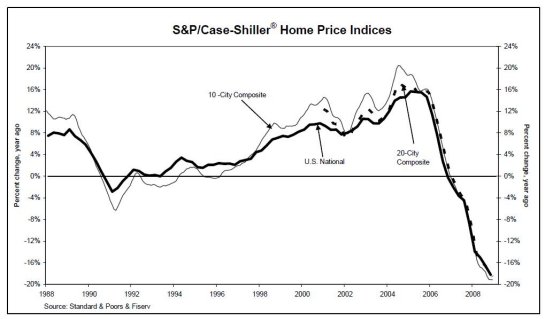
    The S&P/Case-Shiller U.S. National Home Price Index – which covers all nine U.S. census divisions – recorded a 19.1% decline in the 1st quarter of 2009 versus the 1st quarter of 2008, the largest decline in the series’ 21-year history. The 10-City and 20-City Composites recorded annual declines of 18.6% and 18.7%, respectively. These are slight improvements from their returns reported for February. (from the report link in the NY Times story)

    Overwhelmed, the banks are now taking a different approach: dumping the properties to clear their books, making them “extremely motivated sellers,” as Mr. Havig calls them.

    Dumping properties has worked so far because the quantity dribbled onto the market by lenders has been modest and a pool of anxious-to-catch-the-bottom buyers had gathered. But once this shallow pool has been soaked up, then there is no long-term source of buyers.

    Indeed, buyers bidding up prices now will regret their impatience in a year as prices continue their inexorable slide downward.

    Richard also sent me this story on shrinking Rust Belt cities bulldozing suburbs:

    US cities may have to be bulldozed in order to survive: Dozens of US cities may have entire neighbourhoods bulldozed as part of drastic "shrink to survive" proposals being considered by the Obama administration to tackle economic decline.

    While this is a somewhat sensationalist headline, it does raise a number of complex issues.

    1. If an old house has been stripped or left vacant for long periods of time in locales with extreme summers and winters, then it may well be not worth fixing up. Its only value will be for scrap lumber, etc.

    2. If a house is still habitable, but outside the shrinking radius of city services, does that matter to someone unable to pay rent on a nicer, more central house? Perhaps not.

    3. If such free housing (abandoned, foreclosed and unsold, etc.) outside the shrinking city jurisdiction is occupied by informal residents, i.e. squatters, then what authority (if any) is in place?

    I have covered many troubling aspects of the housing bubble's inevitable deflation for years. Just for context, let's glance as the key points in the following stories:

    Can 4% of Homeowners Sink the Entire Market? (February 21, 2007)

    If 4% of all American homeowners fall into foreclosure, could that "small number" cause a collapse in the entire housing market? The Pareto principle says: yes.

    How 4% of Mortgages Have Brought Down the Entire Market (August 21, 2007)

    Back on February 21, 2007, I invoked The Pareto principle to suggest that a mere 4% of U.S. mortgages going bad could bring down the entire U.S. housing and mortgage markets. Seven months later, that call appears to be playing out in spades.

    It now seems likely that the 64/4 (80/20) rule is playing out globally--the "limited" subprime meltdown is set to take down the global mortgage market and the trillions in derivatives which have been written on trillions in real estate-based debt.

    Will Delinquencies Trigger a New American Revolution? (April 7, 2008)

    Two years ago I predicted we'd soon see 5 million foreclosed/distressed homes, 5 million REO/investment/2nd homes languishing on the market and lender/thrift losses of $500 billion. I seem to have undershot the losses...

    Interestingly, there are 20 million vacant dwellings in the U.S., of which only 7 million are vacation homes. So much for any perceived "shortage" of housing, of any type.

    Feedback Loop of Recession: Housing Bust, Debt and Layoffs (March 10, 2008)

    Could 50% of All Homes End Up in Foreclosure? (June 3, 2008)

    Just how bad could the housing bust get? How about half of all urban homes being in foreclosure? As stunning or unbelievable as that may sound, it already happened once in the U.S., in the Great Depression, as documented in this report: Lessons from the Great Depression (St. Louis Federal Reserve).

    The Great Fall: How Suburbs De-gentrify to Ghettos (November 20, 2007)

    A disturbing number of mainstream media stories are documenting the appearance of inner-city plagues such as gangs, drugs and graffiti in what were recently middle-class suburbs.

    The Company Store, Debt and Serfdom (October 24, 2008)

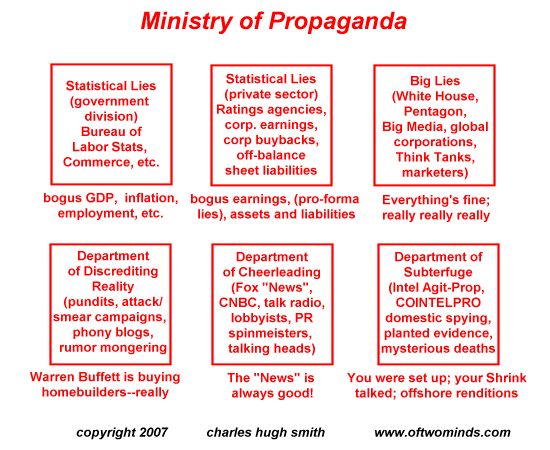
    Most astonishingly, the Ministry of Propaganda has succeeded in diverting the nation's attention from the Company store/debt-serf realities to a bogus "debate" over "socialism" and "capitalism." As Michael Hudson has pointed out, the rentier class which owns the mortgages, loans and credit card debt is not capitalist at all; it is essentially medieval in structure. It takes no risks, creates no innovations, invests no capital in new enterprises or indeed, performs any classical capitalist functions at all.

    It simply indebts the serfs, convinces them via doublespeak, propaganda and phony statistics that they are still gloriously "middle class" (that is, obscuring or reifying their true nature as mere miserable debt serfs) and then sits back and collects the interest and profits which the debt serfs will be struggling to pay until their last breath.

    This is the real context: a growing army of millions of unemployed, declining housing values and equity, a banking sector bloated with foreclosed/distressed houses which cannot be sold en masse and a Ministry of Propaganda in full-court press on reality.

    Unfortunately for Team Propaganda, Reality keeps sneaking through the full-court press and scoring easy dunks. (Shameless basketball analogy.)

    Let's return to the key issue of no jobs=no income=no ability to pay rent or mortgage. The entire U.S. system of unemployment insurance is based on the premise that no recession can last longer than six months--thus unemployment runs out after 26 weeks. Now, as dark storm clouds gather, this is being extended to 39 weeks--nine months. But few observers are pondering what happens next year when that nine months' of income expires and millions more lose their jobs.

    This raises a fundamental question which Richard poses thusly:

    With the news of California's impending financial implosion, and the buzz about cutting off welfare, etc., in the state, I wonder where are they going to expect the tsunami of future homeless families to go? Under a bridge? Their front yards? The curb?

    I believe that more than 60% in Los Angeles county are renters. Let's say for sake of argument that the non-bubble related, non-FIRE related industries can only really sustain 75% of CA workers and that there is 25% who are unable to find work. It's not that far off from that now. No one believes the official statistics. When the state resources really get run down, will they still evict unemployed people unable to pay their rent or will there be something like "rent vouchers" like they had in the U.K. pre-Thatcher?

    We have no history of widespread government housing here unlike many European countries. How will concepts of private property --and laws-- have to change to deal with something like "rent vouchers" being injected into the picture? It's difficult for me to imagine any other practical method of keeping unemployed renters in their homes, but what of the landlord's obligations to the banks with their mortgages? Does the voucher convert into money at some stage of the game?

    This seems to be a pretty toxic string to pull on the already threadbare sweater of the banking system. But for the life of me I cannot think of another way they can handle this situation without riots in the streets.

    And suppose if nothing is done and they are allowing evictions and the sheriff's deputies still carry them out... picture up to 10% of renters and their landlords clogging up the courts system. Imagine the news stories about landlords hiring goons to crack the heads of tenants they want out, etc.

    When the landlords start walking away, too, that's going to get interesting. It may be that "widespread government housing" in the US of A takes the form of abandoned properties being taken over by the nationalized banking system...

    It seems inevitable to me that as jobs vanish and incomes drop, rents will decline and vacancies will rise. This will trigger a wave of foreclosures of landlords who bought rental properties based on full occupancy and high (full employment) rents.

    As noted here before, that raise all sorts of other "interesting" issues; readers have recalled living in foreclosed apartment buildings during the late 1980s savings & loan bust and not knowing who even owned the building. There was thus no one to ray rent to.

    One key feature of the present is completely unprecedented in American history: the Federal government essentially owns millions of dwellings via its takeover of the GSEs Fannie Mae and Freddie Mac. These two lenders were once quasi-governmentally owned; now the quasi has been dropped. Fannie and Freddie own $5 trillion in mortgages; so when the owner walks away or defaults, guess who ends up owning the house?

    You and me: the taxpayers.

    Add in trillions of dollars of FHA and VA loans which arein default/distressed--also government guaranteed and thus in a sense government-owned--and direct Federal ownership of shares in major banks (which absorbed mortgage lenders like Countrywide, WAMU and Wachovia in Federally overseen shotgun marriages) and you end up with Federal ownership of a significant portion of the entire U.S. mortgage/housing stock. (Fannie and Freddie alone account for half of all outstanding mortgages.)

    Back to Richard's question: so exactly what will the U.S. do with 10 or even 20 million unemployed/low-income households? As noted above, there are already 20 million vacant dwellings. Even bulldozing 2 million of them won't change the big picture, and it certainly won't address the core issue of housing and feeding 10 million households with essentially zero prospects for formal employment in an economy burdened by staggering debt, losses and interest payments and a FIRE (finance, real estate and insurance) economy which has imploded and wil never come back.

    The Ministry of Propaganda has an ironic task before it: it must continue its relentless cheerleading and its relentless attacks on "socialism" (whatever that means) even as the Federal government must somehow prepare to deal with 10 or 20 million homeless, broke households on a long-term basis.

    Even more ironically, that same Federal government now owns, via Federally backed mortgages, some 20 million dwellings. Now put all this together. Either we face up to 20 million households living in Squattertown, U.S.A. or the Federal government faces up to the obligations it now carries as reluctant owner of 20 million foreclosed/distressed/defaulted dwellings.

    Is providing low-cost housing for 20 million homeless people "socialist"? If so, bring it on, Ministry of Propaganda be damned.


    Our previous lists of hot reading and viewing can be found at Books and Films.

    Of Two Minds is now available via Kindle: Of Two Minds blog-Kindle

    Of Two Minds reader forum (hosted offsite, reader moderated)

    Thank you, David Z. ($25), for your most-welcome generous contribution to this site. I am greatly honored by your support and readership.

    Globalization and China: Neoliberal Capitalism's Last "Fix"

    June 29, 2009


    Rather than being the new leader of the global economy, China is the bag-holder in global Capitalism's last 'fix": exploitation passed off as globalization.


    What's going to pull the global economy out of deep recession? The current story requires only one word: China. China's massive domestic stimulus is going to spark a sustained domestic demand for Chinese-made goods, lessening China's dependency on exports. Further good news: China's domestic growth will spur demand for commodities and grains, driving prices much higher.

    Before we accept this account, perhaps we should step back and look at the larger context of globalization, in which China is only one part. From at least one perspective, the opening of China was simply part of neoliberal Capitalism's last "fix" of a structurally failing system.

    From this point of view, China's productive output (largely foreign-owned and controlled, mind you) enabled vast profits to be reaped by global capital even as it opened new markets for advanced economies like Japan and Germany which had literally run out of new markets to exploit for machinery, toolmaking equipment, etc.

    More cynically, China offered a low-cost was to evade the West's stringent environmental regulations.

    From this point of view, China is not the world-beating leader of the global economy: it is the bag-holder: the last big market ruthlessly exploited and the one which will now be left behind as global capital exists, leaving China to deal with the social rubble and dire ecological consequences of rapid, unconstrained industrialization.

    This is a contrarian view--did you expect anything else?--but read on for a longer-term perspective on "the China Miracle." (I know this is heavy lifting, but stick with me for at least a few more paragraphs--CHS.)

    One more point to consider before we begin: the history of global trade stretches back thousands of years because it was mutually profitable to both ends of the trade. Globalization proports to be a continuation of such mutually beneficial exchange, but this is only a simulacrum: the reality is that much of globalization is not mutually beneficial exchange of goods but exploitation on the industrial grab-and-run or Plantation models.

    In essence, globalization was neoliberal Capitalism's attempt to save itself from the endgame of advanced capitalism foreseen by Marx: overcapacity which leads to a collapse in profits and thus a decline in capital and the overall economy.

    Marx's insight was straightforward: the dynamic of capitalism is for production to rise to meet demand--and then keep rising. As demand is sated, capacity continues to grow because Capital is like a shark--it must move forward or it dies, and it moves toward what was immensely profitable in the recent past.

    This is how we get overbuilding of office and retail space: as demand (and profits) soar, then everyone with capital rushes in to enjoy the profit spree. But ironically, this massive rush to the most profitable return guarantees overbuilding and overcapacity.

    As Marx noted, supply soon overshoots demand and sales plummet, wiping out profits. The end result is a move to monopoly capital, in which a handful of the strongest players squeeze out or buy out all the weaker players who fold as the retrun on capital goes negative (losses). The last players standing then consolidate and shutter most of the capacity, setting up a monopoply which then lowers supply below demand to maintain outsized profits.

    All the workers laid off as capacity is shuttered no longer have income so they stop spending, which lowers demand even further. This cycle of boom and bust was inherent to Capitalism and Marx expected them to steadily become ever more extreme.

    But capitalism "solved" this cycle of overcapacity and crashing demand/income/profits by turning to new overseas markets. Those with a military-backed Empire (for instance, Great Britain) could simply force new markets for domestic goods into existence overseas: by requiring consumers in India to buy cloth manufactured in England, for instance.

    In other cases, advanced capitalist states opened new markets by forcing less developed economies to "offer" their low-cost manufactured goods, which quickly took market share from the more informally produced local goods.

    The heyday of colonialism was driven by a simple "virtuous cycle" (virtuous for the advanced economy, not for the subjegated colony) in which the colony was forced to ship its raw materials to the colonial power at low cost while at the same time it was forced to pay a premium for the advanced economy's output/surplus goods.

    Since the colonial power's domestic workforce benefitted immensely from this "global trade" (low commodity prices thanks to the exploited colonies and plentiful jobs to make the goods forced onto the colonies) then the Colonial Power's Elites received great political suport for the their one-sided "globalization" policies.

    Apologists are quick to point out the supposedly stupendous benefits of this globalization for the "natives": high-quality advanced goods and paying work in an economy with little formal employment. Yet the reality is not so happy-happy: only economies with locally owned productive capacity such as Japan and Korea become wealthy economies. Those former colonies where foreign capital dominates the productive capacity and commodity extraction are in essence still exploited colonies.

    Government ownership is also no panacea. When less-developed economies' primary assets (including commodities like oil) are owned and operated by the government, then the nation actually becomes poorer, not wealthier, due to the perverse dynamic of the State (government) and capital.

    As profits roll in, the State, unlike private capital, defers investment in favor of political patronage and the spoils of "leadership." The incentives to politicians and the State's technocrat managers is thus to eat their seed corn whenever possible, where private capital understands that surplus capital must be invested or deployed in search of high returns lest it dwindle to zero as all profits are extracted and spent.

    This mechanism is called the paradox of plenty in which resource-rich nations such as Venzuela and Argentina grow progressively more impoverished under State control of the nation's assets.

    A corollary of this mechanism is the impoverishment of oil-exporting nations who find redistributing the wealth created by fossil fuels much easier than creating a productive labor force and infrastructure. Thus as the income from oil gyrates (and as oil inevitably enters the depletion phase) then the nation has no cultural or economic Plan B to generate national income and wealth.

    With these mechanisms in mind, we can see that the advanced economies have attempted to save Capitalism by colonizing China for production and their own domestic populations for forced consumption.

    Of the many misconceptions about China's spectacular economic growth, perhaps none is more misleading than the assumption that the capital and surplus profits being made in China will stay in China. Despite the much-touted public ownership of joint-venture companies, much of the profitable production in China is owned by non-PRC (People's Republic of China) companies based in Taiwan, Japan, Korea and the West.

    From a more clear-eyed perspective, China has been colonized by advanced economies to lower the cost of production and to establish a dumping ground for environmentally unsound production which their domestic citizenry will no longer tolerate. As with all colonies, the profits are extracted and sent elsewhere while apologists are hired to tout the glories of employment for China's teeming millions.

    Until, of course, Marx's overcapacity cycle kicks in. Now that China's stupendous production capacity exceeds the potential demand of the entire world, including its own mostly impoverished domestic populace, then capital is fleeing China in its usual pursuit of higher returns, leaving behind tens of millions of unemployed workers and a toxic landscape.

    The Chinese State is now attempting to counter this cycle by spending its own capital on stimulus, but State spending is not a replacement for capital or organic demand. Even worse, the Chinese State saddled its own banks with hundreds of billions of dollars in uncollectible debt in a vain attempt to prop up thousands of State-owned enterprises which racked up gigantic losses even during the boom.

    The Chinese State attempted to staunch this open wound by closing thousands of its factories but the uncollectible debts remain, buried by accounting tricks within the books of its four major banks and government finance ministries.

    The bloom is off the rose now that the overcapacity in China is no longer profitable to global capital and in essence the Chinese State is left holding the bag: stupendous losses in its own financial system, horrendously costly environmental damage and an industrial infrastructure which is losing value as capital shifts elsewhere.

    Meanwhile, advanced Capitalism expanded due to two key innovations: the colonization of its own domestic consumers and the exponential increase in speculative debt instruments.

    The essence of colonization is the forcing opening of new markets for surplus production. Frustrated by the poverty of 80% of the Chinese and Indian populaces--people with almost no surplus income cannot consume much in the way of surplus production--global capitalism turned to its own domestic populaces.

    By lowering the cost of money to near-zero and generating a gigantic asset bubble in the one asset every middle class consumer already owned--a house--then global capital in essence colonized its own domestic populaces by opening a heretofore limited market for surplus production: a consumerist blow-off of unprecedented scope fueled by limitless credit and a rising asset base (real estate) inflated by the same limitless credit, all extended by a State propelled by the need for the sort of domestic economic growth which maintains political support for the State's leadership elites.

    Now that game has expired as the advanced-economy consumers finally reached the limits of their ability to service their rapidly expanding debts. Even the U.S. government's massive meddling and the printing/borrowing of trillions of dollars is not re-inflating the real estate bubble, and thus there is no collateral left to support the limitless credit global capital now requires for growth.

    Advanced Capitalism is thus facing a crisis of unprecedented scale and scope: the globalization/colonization "escape" from overcapacity has come to a dead end. While some eternally hopeful capitalists look to the former colonies of Africa as the growth engine for global capitalism, a quick look at the capacity of China and Asia to produce goods quickly reveals that hope as baseless: if we add up the remaining production in the West and developed East Asia with China's monumental new capacity, we find that the global capacity outstrips all potential demand.

    The world could easily ship 20 million new autos a year to Africa, but unfortunately for the advanced capitalist nations, there isn't enough income in Africa to support 100 million autos and the vast infrastructre they require. The same can be said of the billion impoverished residents of China and India. Global capital would be delighted to sell them all its surplus production but for the sad fact they have no money or collateral on which to base consumer borrowing.

    Now that the global real estate bubble has burst, global capital is facing a real dilemma: it has colonized and exploited virtually every populace available, and there is no one left to exploit. Their lackeys in the governments have eliminated moral hazard (that is, go ahead and speculate wildly, we'll save you all regardless of risk or the size of your losses) and expanded credit exponentially, but never-ending exponential growth is simply not possible.

    And so now with the destruction of the bogus real estate bubble and speculative "wealth," global capital has screeched to a halt at the edge of an abyss it has avoided for a hundred years: finally, there is no place left to sell overproduction, and the domestic populaces it depends on for political support are restive as they sense the ground beneath their "prosperity" has fallen away.

    Thus global capital is desperately demanding the State print/borrow trillions of dollars in a futile effort to either inflate new bubbles and thus create new markets. The reinflation will fail, even as they push governments into insolvency and fail to save neoliberal capitalism.

    Globalization also has a host of other pernicious features.

    1. Concentration of resources and political power. Global capital, armed with virtually unlimited access to capital via the capital markets and various exotic instruments such as derivatives, can always outbid local owners/capitalists for resources. Once the forest, oil field, etc. is owned (or joint-ventured with local crony capitalists or Oligarch families) then it is promptly stripped/exploited/depleted.

    2. No accountability for enviromental damage. Any environmental damage that results is of no consequence because the local political Elite can be bought for relatively modest sums. There is no profit in cleaning up the site and so to do so would be "irrational" in a rational-market metric.

    Perhaps this distance from the environmental consequences of resource/wealth extraction is globalization's most pernicious feature. Mine owners never live near the tailings, and the coal plant's owners never live downwind of the sooty plume, either.

    The more distant the owner, the less accountable they are for local consequences.

    In today's Internet-savvy world, global capital places some modest value on corporate image, and thus some sort of simulacrum of environmental concern is made and then hyped via company propaganda. In a handful of cases, wise stewardships is not just a propaganda talking point; but the circumstances behind these exceptions are not easily codified.

    3. Redistribution of income to capital from labor or local ownership is "necessary" to encourage "investment." Even in Empire States like the U.S., foreign capital is given numerous tax loopholes and other redirections of income to capital. This is always explained as necessary to encourage "investment."

    But this greater income did not appear out of thin air; it was redistributed from labor and local owners via tax loopholes and credits. But since global capital is driven to seek the highest returns possible, the income exracted from Locale A is rarely reinvested in Locale A. This justification for the income redistribution--to encourage "investment"--is thus a cover for resource/profit extraction.

    In the U.S., global companies like General Motors have received taxpayer bailouts in the tens of billions, supposedly to keep their production and workforce in the U.S., when the demand of global capital for higher returns forces the company to expand in Brazil at the expense of domestic U.S. jobs.

    In one sense, the company has no choice. It must deploy its remaining capital at the highest return or simply close down. In the Chinese model the State owns the factories and continues to operate them at a loss. But as China's own state-owned enterprises show, permanent losses are simply not sustainable, even for the government.

    4. As middle class jobs are cut, demand falls, exacerbating overcapacity.Global capital shifts away from high cost production (except where that opportunity is limited by the State), replacing middle class employment in advanced economies with lower-cost labor in less-developed economies.

    Ironically, this lowers demand for the global companies' goods even as their overseas capacity expands. The net result is that financial speculation becomes an increasingly attractive use for capital. Thus selling consumers credit with which to buy cars becomes more profitable than selling them cars. Additional profit is reaped by bundling these consumer loans into packages--securitization--and selling the newly minted securities to credulous imvestors around the world.

    Thus speculative leveraged credit and securitization can vastly increase profits even as production falls.

    5. As its own income falls, the middle class follows the lead of global capital by increasingly relying on credit-based speculation rather than production for income. No one is more anxious to pursue speculative gains than someone whose income from labor is declining. Thus homeowners or prospective homeowners were delighted to follow global capital's forays into credit-based real estate speculation.

    Unfortunately, speculation is no substitute in the long run for producing actual goods and services, and once the exponential blow-off was reached and the bubble popped, global capital simply sold off (or got bailed out) and moved on, while the middle class speculators were left with staggering losses in real wealth or capital traps (assets declining in value which could not be sold).

    6. Due to its global nature, capital is no longer accountable for the consequences of its choices. Here's how it works: global capital gets huge tax credits (incentives that are basically nothing more than redistribtion of income from labor and local entreprenuers to global capital) for "investing" in the local economy. It them mines the local labor and/or resources of profits until overcapacity or depletion strikes. Then it shutters the factory or mine and move its machinery elsewhere, leaving the local economy a shambles. Next it hypes the need for "investment" elsewhere, moving production to wherever offers the highest tax benefits, the least environmental restrictions and the lowest labor costs. Final step: repeat.

    From the point of view of global capital, this is "obviously" the only model which "works." Local residents, workers and small-scale enterprise owners will disagree once their locale has been stripmined of profits and wealth.

    In sum: globalization is a key driver in the end of paying work and the impoverishment of local labor, resources and enterprise via the redistribution of profits and income to global capital.


    Our previous lists of hot reading and viewing can be found at Books and Films.

    Of Two Minds is now available via Kindle: Of Two Minds blog-Kindle

    Thank you, Don E. ($15), for your ongoing film recommendations, wry humor and other generous contributions to this site. I am greatly honored by your support and readership.