
Friday, October 02, 2009

Rights, Lies and Losing Legitimacy

Readers respond to this week's entry on rights, lies and the "threat" posed by truthful accounting and honest dialog.

The central point of When Honesty Becomes "Threatening" (September 30, 2009) was the need for a open, honest dialog in this nation on what constitutes a sustainable "social contract." In essence, who gets what from the central government and who pays what to the central government. Such a dialog has yet to occur.

Such a dialog must begin from a foundation of factual accounting of financial obligations and tax revenues. But the government (central and local alike) is attempting to bypass the "pain" of an adult discussion of unsustainable obligations via lies, massaged data, slippery statistics, deceptively rosy projections and a vast host of other delegitimizing half-truths.

Reality is not being fooled. We as a nation will eventually have to face the dismaying fact that "free money" is never truly free.

Kevin S.

Right on the heels of When Honesty Becomes "Threatening"(September 30, 2009):

"Cambridge Runs Amok" (Forbes.com)

"Those who believe that "what you don't know won't hurt you" are about to discover that most municipal governments have kept knowledge from residents that will not only hurt them, but future generations as well.

According to the U.S. Department of Commerce, when benefits are included in the compensation packages, federal worker compensation in 2008 averaged $119,982: more than double the private sector average of $59,909. The same report reveals that this compensation gap has been increasing every year since the year 2000.

This trend is no different at the local level and is clearly recognizable in the workforce of nearly every American municipality. The devastating impact on residential and business property owners in these municipalities seems to be a tightly held secret by most municipal governments."

The Commentary goes on to detail Cambridge's looming and unfunded city employee pension disaster. A very scathing and detailed piece, very uncharacteristic of the MSM.

It read as it were right out of Survival+, if find it ironic that such an example is home to our nations most prestigious institution of higher education.


Chuck D.

Please pass along my compliments to my fellow correspondent Harun I. for his brilliant commentary (complete with that kick-in-the-gut final sentence) that you posted along with your own comments on the blog today. It is not often I have the pleasure reading something that so well combines depth of content with conciseness and an easy to read writing style. I read it over and over just for the pleasure of reveling in good content combined with good writing. I confess that I was so moved that on a couple of passes through it I found my eyes were starting to well up. I took the liberty to forward the link to the page to Ron Paul's office -- not just because he would agree with the content, but because I can tell that he appreciates and knows good content combined with good writing. I guess I simply wanted to share it.

The discussion of honesty caused me to flip it around and consider how pervasive lying has become in our culture. Not just government lying, but everyone -- the business world, culture mavens, historians, ordinary people in their ordinary lives. The list goes on. No one is ever wrong, no one accepts responsibility for their actions, everyone is justified in whatever they do or fail to do.

No one stops to consider how destructive and pernicious this is to human interaction on both a personal or public level.

Hannah Arendt pointed out that once events emerge from the sea of infinite possibilities they exist in before their emergence, they become facts and have a sort of stubborn "thereness" or "otherness". They are what they are instead of being something else. Unfortunately facts can be maneuvered out of existence by lies and deceits that are made to look to be facts. But the liars then have a problem. The act of lying casts them back into that sea of infinite possibilities that facts (or lies dressed up as "facts") emerge from. The lie they tell can just as easily have been or become something else. This is why liars need to have long memories and usually trip themselves up in their own inconsistencies.

The problem is that we as human beings can only get through life and the world we live in by being able to believe that what we perceive around us actually real and factual. We have to be able to believe that what we sense actually exists as we sense it, that our fellow men are actually doing what they say they are doing. The moment we cannot believe these things, we literally lose our bearings and sense of position in the world for nothing is as it seems to be. We become like Yates' falcon who cannot find his falconer, where things fall apart and the center cannot hold.

When lying becomes so pervasive that we can no longer believe we are hearing the truth, a peculiar danger arises. It is not that being told black is white, we will believe it or disbelieve it. It is that we won't believe anything at all. Think about it for a moment. Confronted by a "he said-she said" event, our tendency is to discount everything the people actually say and look for some external piece of evidence to help us determine which version seems more credible.

I suppose this looks like a good deal if you are TPTB and you want to confuse the Sheeple into docility. But the damage it does to the social structure and its institutions and government is incalculable. They lose their legitimacy as people begin to sense they are being lied to. The result is the progress of corruption that we see today, and if it goes on long enough the collapse of the government, economic and social structure itself. What replaces it depends upon how well TPTB are able to preserve their positions of privilege from the old regime.


Gene M.

It's way too much to deal with all that he wrote, but I wanted to make a few comments about freedom. I think Harun shares the common American idea of freedom as freedom "from" this or that. The ideal expression of this would be to live alone on an island. Is that really freedom? The very notions he talks of about of "my property" and "the fruit of my labor", does he think these things exist in isolation? Could any of these fruits appear without the cooperation of dozens if not hundreds of other people, no matter what their motivation? Could he even walk down the street without the silent cooperation of everyone he met, that they will obey laws and respect another human being instead of waylaying him?

Fundamental: freedom is a gift of others. We may institutionalize this and we may express it as a "right" but it doesn't change the origin. It begins and ends in personal relationships.This is freedom "to" do something or be someone. To be yourself. It is most clearly expressed in a relationship of love. Because when loved, you are free to be whomever and whatever you are. No need for lies, deception, axes to grind, etc.This is fundamentally the same motivation by which we allow and encourage others to do their thing on a societal basis. The love of two people is the basis of all social relations.

There are two forces that bind society together: a spirit of cooperation and law, which is based on fear. It would be difficult to conceive any real society based on one on these alone. They are yin and yang. And they have always fought like the devil in American history, and the balance has usually tilted toward fear. In Europe, I would say, there is much more a sense of social cooperation that binds the societies there together. In any case, you could say we are dominated by law and fear now, and I think we passed a threshold in the Reagan years, when the message from on high was clearly every man for himself. That can only produce fear, lots of it, as Hobbes knew full well. The result is this momentum toward oligarchy.

And yet one looks at the service awards and the sheer amount of volunteer work that goes on, and one can only conclude that this kind of cooperation (love) is what really binds us together and keeps the whole damned thing from becoming a hell. (My Dad tells many a story about the Depression, where people who had so little helped those with even less.) But it is diluted and confused by all the things Harun and you have pointed out recently in the press and the lies from our elected officials, which sows more fear by not confronting fear. They simply bury it and it eats away at the other good forces, just as it does in the human psyche.

Yes, nature has limited resources and some of its actions are harmful. No revelations there. Hobbes, called it the state of war of all against all, where life is nasty, short and brutish. Is that freedom? No, that is exactly one reason why humans decided to cooperate, to survive. Another reason is that it is actually pleasant to cooperate. We thrive and become more of ourselves. Hobbes thought it was the Leviathan, the state, that bound us together. He was only half right. There is no yin with a yang. But the balance now is very skewed.

As an ex-soldier, Harun knows full well that survival in war depends on relying on and cooperating with your mates. And you, Charles, have written eloquently about the various forms of social cooperation the future might bring.


Ernesto M.

Your comments on "magical thinking" are instructive to the modern age.

In the "Sovereign Individual" which I mentioned to you before as well as in their predecessor work The Great Reckoning, Davidson and Reese-Mogg make a comparison which I find amusing between the Medieval church and modern politics. They make the same comments about the magical thinking which most people think existed then and the absurd faith in politics which the typical person has now. They also mention that centuries from now, future historians are equally likely to think that the contemporary belief in politics is as absurd as "modern" thought considers prior belief systems to be.

If ever there was an example of magical thinking, the modern belief in politics as the solution to all of our problems is it. Every time I watch an election celebration or a big political speech and see the crowds deliriously cheering, the question I always ask myself is this. (And the more ridiculous the promises, the more delirious the crowd.) Are those people really that gullible and naive to believe the complete claptrap which is coming out of that politician or candidate's mouth? I believe that a substantial proportion are that gullible and this true regardless of the party candidate giving the speech.

The sad fact is that there are many people who would willingly rather believe a lie than accept the truth. And it isn't just because they have been fooled but because they prefer self-deception.

Thank you, readers for a variety of views on vitally important topics.

Permanent link: Rights, Lies and Losing Legitimacy


Check out my article in American Conservative Magazine No Easy Money: The case for raising interest rates.

I've been invited to join the writers contributing to Seeking Alpha. You can also find my work on AOL's Daily Finance.


If you want more troubling/revolutionary/annoying analysis, please read Free eBook now available: HTML version: Survival+: Structuring Prosperity for Yourself and the Nation (PDF version (111 pages): Survival+)

"Your book is truly a revolutionary act." Kenneth R.

Of Two Minds is now available via Kindle: Of Two Minds blog-Kindle

Thank you, Earl M. ($15), for your much-appreciated generous donation to this site. I am greatly honored by your support and readership.

Thursday, October 01, 2009

Pain, Addiction, Anxiety, Flu, Malpractice, Meds and More

Prescription drug use is rampant, and complexities abound. Ishabaka, M.D. shares some experiences from the real world of medicine.

Correspondent Ishabaka, M.D. recently shared some of his experience and knowledge about prescription drugs and pain management. Our tort-liability system seeks to pin a percentage of "blame" on various parties, and with the "rewards" (settlements and legal fees in the millions of dollars) and the dangers (of addiction, side-effects and even death) both high, then there is a mad rush for "clarity" and a "solution."

Unfortunately, there are no easy answers when it comes to assessing the safety of various powerful medications, or when they should be prescribed or consumed.

Absurdly high costs for meds is only one issue; the other is that extremely powerful drugs are prescribed in tremendous quantities (and sometimes in response to patients demanding prescriptions for drugs they've seen in Big Pharma advertisements).

So the pharmaceutical industry is "the bad guy," right? It's not always that easy.

Since my father, who passed away this May, suffered from severe pain due to multiple myeloma and osteoporosis, I have seen the relief provided by very addictive narcotics. When you're in the last years of your life and you're in severe pain, addiction is the least of your concerns.

As the doctor notes, I address pain here from time to time based on my own experiences. Since I am still active at 55, I am (after a lifetime of physical toil and injury) often in some low-level (or occasionally worse) pain. There is a big difference between this sort of "I lifted too much stuff" pain and the kind suffered by people with cancer or migraines. Pain is part of life, so the doctor's comments will be of interest to us all.

Here are Doctor Ishabaka's commentaries. the first is on pain management, and the second on drugs, cancer vaccines, lawsuits and much more. The good doctor has a wide variety of experience-- he's worked in emergency rooms and also serves in a free clinic--so his report is from "the front lines" of medicine in the U.S. Many of his views may be controversial in some circles, but he's speaking from experience, so it behooves us to listen carefully.

Something that you comment on frequently, and an issue that intrigues and vexes me is our society's attitude towards pain.

Although they overlap considerably, I'd divide the topic into psychic and somatic pain. Psychic first. You tend to rail against the widespread use of pyschotropic drugs, here are a few things to think about:

- first, imagine a drug was invented that made regular people just feel a little "better", maybe the way you feel after a week's nice vacation. Not "smiley faced automatons" - things would still make people upset/angry/sad, but just a little better. It would definitely be unnatural, but would it be a bad thing? Things such as child and spousal abuse would probably go down. Productivity would probably rise. People would probably be more civil towards each other. Something to ponder, isn't it?

- I doubt you have any reservations against treating severely mentally ill patients (this illustrations in this letter are from my book, so please don't publish them verbatim). For example, I had a man in his 50's who shot himself in the chest with a .38 caliber revolver right in front of the E.R. doors in a suicide attempt - he just missed his heart, and survived. I can't imagine you objecting to giving him antidepressant drugs. You see, it's a question of degree - where do we draw the line between normal life experiences, and pathological conditions?

- depression, and it's counterpart anxiety seem to have been around since the dawn of mankind (and even earlier, I've had pet dogs and parrots suffer from depression and anxiety at times). More gun deaths are in the U.S. are due to suicide than all other forms of gun violence combined. In fact, one of the most important questions to ask a patient when assessing the potential for suicide is "do you have a gun in your home?".

- the first formal medical treatment for depression/anxiety was Freudian pyschoanalysis/psychoanalytic therapy, which is now regarded almost with contempt - "everything is chemical". I think the baby has been thrown out with the bathwater in this case, I imagine we can all recall episodes in our lives where talking about problems with someone with a sympathetic ear helped greatly.

- the next, which again is now regarded with contempt, again; I think, erroneously, was electroshock therapy. There is nothing, I repeat, nothing, that has such a rapid, beneficial effect on depression as electroshock therapy. The drawback is it causes short term memory loss (it's hard to remember things that happened in the two to three months leading up to the shock(s) - I often wonder if this is part of the reason why the therapy works).

I will give you one example. We had a woman in he forties admitted to the pyschiatric ward for depression. She would not eat, and barely slept. Whenever any attempt was made to talk with her, she cried uncontrollably - so talk therapy was useless. We started her on antidepressants and pushed the doses higher and higher - up to and beyond the maximum recomended. After six weeks on the psych ward she had not improved one iota, and was starving - possibly to death. The decision was made to try electroshock therapy. Unlike the therapy depicted in the movie "One Flew Over the Cuckoo's Nest", shock therapy is administered under general anesthesia. After ONE SHOCK the woman was talking, participating in group therapy, and eating. I will never forget it, it was miraculous.

- finally, antidepressant pills were invented. The first, and most widely used were the tricyclic antidepressants. They worked pretty well, but had two big problems. First, they had a lot of side effects. Not dangerous, but very unpleasant for patients (blurred vision, dry mouth, tremor, constipation, difficulty urinating, sedation, and others). The real problem was, they caused horrendous, life threatening problems in overdose - and it didn't take more than ten or twelve pills to cause a bad overdose. I recall numerous episodes of fighting to keep these folks alive in the E.R., and death by overdose of tricyclics was not uncommon. Therefore they were used sparingly.

- then, Prozac, the first of the SSRI's (subacute serotonin reuptake inhibitors) was invented. Prozac was a real step forward. Side effects were minimal, and it's almost impossible to kill yourself with Prozac - you can take a jarful, and you'll feel kind of ill for 24 hours, but you won't die. At this point, prescriptions for antidepressants exploded. The question is - where do you draw the line? This involves some deep philosophical and ethical problems, such as - is suffering good for your soul? - if so, how much? As this (long email) will tend to illustrate, I believe the pendulum tends to swing back and forth, and at this moment in time, Americans tend to believe, on the whole, that suffering of any degree is intolerable, and should be banished.

- one more thing before I finish with antidepressants - it's a popular missconception, and just plain wrong, that they are addictive - they aren't.

Let's move on to anxiety. Anxiety is a normal, and sometimes beneficial response experienced by virtually all higher life forms. Once again, the question is: where to draw the line? Some people are anxious all the time, for no discernable reason - in psychiatry this is called "free floating anxiety".

- undoubtedly the first drug discovered for the treatment of anxiety was alcohol. It works - but I wouldn't recommend it for daily treatment.

- the next were the barbiturates - they worked, but had tremendous addictive potential, and were extremely lethal in overdose (Marilyn Monroe was an addict, and died of an overdose).

- at this time, the benzodiazepines are the drugs of choice. They too have tremendous addictive potential - especially the shorter acting ones (as a general rule, the shorter the action of an addictive drug, the more addictive it is - this is why cigarrettes are so addictive - the effect comes on within an minute, and is gone in 15 - 20 minutes. Same reason why crack cocaine is more addictive than powder cocaine). The advantage is, in pure overdose they are virtually innocuous. You can take a jumbo bottle of Valium, and you'll probably sleep for three days - but that's it. Xanax (alprazolam) is the fastest acting benzodiazepine that can be taken by mouth, and it has the major market share - and addiction problems are rampant. "Addictive personality" is probably at least part a genetic traiy. It's interesting that the first President Bush became addicted to Xanax while President (eventually his physician made him stop taking it), and his niece, the daughter of ex-Florida Governor Jeb Bush has been in and out of jail many times for Xanax addiction, and forging prescriptions.

- the newest form of psychotropic medications, which again, are gaining huge market share, are the so-called "mood stabilizers", such as Lamictal (lamotrigine), and Seroquel. Unlike the antidepressant and antianxiety agents, these drugs don't banish emotions - they make them less intense. In this way, they are EXACTLY like the most despised psychiatric treatment of all (and again, one which I think should still be used in certain very limited cases - you'll have to read my book to read a description of one) - the pre-frontal leukotomy, popularly known as the "lobotomy". People who have had this surgery feel emotions - they just don't feel them as powerfully. There are no other significant effects (contrary to popular belief, the surgery does not affect intelligence or judgement). So essentially, THE up and coming pyschiatric treatment of the day is a "chemical lobotomy". Incidentally, use of these drugs is more dangerous (some serious/life threatening side effects), and far more expensive than the old operation.

Finally - somatic pain. During my career, I've seen the pendulum swing from way to far to one side, to way too far the other. When I started medical school, the concept that even patients dying of terminal disease should have only limited access to narcotics due to the dangers of addiction was still the general belief. As a third year medical student, I treated a young man dying of multiple myeloma - a cancer of blood cells that invades the bones all over the body, causing excruciating pain. I "took care" of him for three months, and his pain was never adequately relieved. Reasonable relief for all pain can be effected with adequate doses of narcotics. Is pain good for the soul? My wife is Filipina, and every Easter dozens of Filipinos have themselves crucified and paraded through the streets - this felt to be an extremely pious, honorable thing to do.

- at this point in time, medicine, and American society, tend to believe that any physical pain is intolerable. I read an article about pain last night saying that "the patient is always right" when it comes to complaints of pain, and doctors MUST give pain medication until the patient feels their pain is relieved. At the same time, abuse of prescription drugs (mostly narcotics) has become the number one drug abuse problem - not only in the U.S. - but in the entire WORLD (per Health Minister of the United Nations last year). I've had two friends - a surgeon and a nurse - die of prescription narcotic addiction. "Pain Clinics" have sprung up everywhere - some of them well-meaning, others simply money for scripts joints - legalized drug pushing.

- a personal example - I have fairly flat feet. After a busy twelve hour shift in the E.R. (almost all of which have linoleum over concrete floors), my feet hurt bad. Arch supports, orthotic shoes - I've tried 'em all, nothing really works. One day I saw an electrician as a patient. He was about my age, and wanted me to re-certify him as disabled and refill his Percocet prescription. He had been on complete disability for about ten years. His problem, he told me, was that he had flat feet, and standing on the job for long periods of time caused him pain.

- I'd like to point out that all narcotics are extremely addictive (as the horrors of Oxycontin have demonstrated), and all are deadly in overdose.

Day by day, I muddle through, trying to come up with answers to these problems. I think there needs to be a national dialogue about these issues, especially if the general public are going to be paying for treatment. It's often not easy to decide where to draw the line.(Emphasis added: CHS)


The first malpractice trial against Merck regarding their drug Fosamax ended in a misstrial when jurors wound up shouting and throwing chairs at each other (I couldn't make this up).

This is an excellent example of why medications cost so bloody much here. While I have little respect for Big Pharma, it isn't all their fault.

Osteoporosis is one of the most common and serious diseases of our elderly. THIRTY percent of patients who fall and break a hip die within the year - mortality far higher than heart attack or stroke - or even most common cancers.

A couple of years ago Merck came out with a truly revolutionary drug - Fosamax - that seriously slowed, and in some cases reversed osteoporosis. One serious side effect was discovered - if it stayed in the esophagus instead of going into the stomach it could cause serious esophageal burns. Merck publicized this risk widely in ads to docs and patients.

It was a blockbuster seller. I'm not sure when, but it was over a year after the drug was released was is discovered that a very small percentage of woman who took the drug had part or all of their jawbones die. So now there are lawyers advertising on TV that if you took Fosamax and got jaw problems, contact them.

Charles, the jaw problem is so rare that Merck couldn't have found out about it unless they tested millions of women. Furthermore, there is no evidence of a cover-up. As soon as Merck got new of the jaw problems it promptly notified doctors (they sent a letter to my house). Even with the serious jaw problem, the benefit of the drug is so great that I would let my wife take it if she should get osteoporosis.

EVERY drug has side effects - did you know that the class of drugs that kill the most patients year after year after year are the "nonsteroidal anti-inflammatory drugs" - these include Motrin (ibuprofen), Naprosyn (Naproxen) Aspirin, and others?

Cover-ups are wrong. Not releasing side effects found in pre-release studies is wrong. No releasing side effects found in post relief studies is wrong. But someone has to say "the line stops here" when it comes to suing drug makers.

You may or may not remember Bendectin. This was a drug used for vomiting in early pregnancy, which occasionally is so severe it puts the mom in the hospital for IV fluids. Bendectin worked, and was a blockbuster. Some children born to mother who took it had malformations, and the suit-mania against the Bendectin manufacturer (I believe it was Warner-Lambert - this was in the 70's) was on. The manufacturer lost tons and tons of money - it's easy to persuade a jury to give money to a mom with a seriously deformed child.

Then the test results started coming in. A certain percentage of women will have malformed children for reasons unknown. The percent deformed children of mothers who had taken Bendectin was EXACTLY the same as the percent of deformed children whose mothers took no medications during pregnancy.

Did the manufacturer get any money back from the settled lawsuits? No. And they decided they were sick and tired of being sued so they made the decision to not resume making Bendectin, although it had been PROVEN 100% safe. This left doctors and mothers NO medication whatsoever to use for vomiting during early pregnancy, and more women admitted to the hospital for dehydration (which IS proven to increase the risk of fetal malformations).

- one of the greatest drug swindles of our lifetimes was Vioxx. This drug, made by Merck, was released in 1999. Remember I told you the non-steroidal antiinflammatories drugs cause the most deaths every year? There are three reasons why: they irritate the stomach lining, and may cause ulcers or gastritis, which may bleed - more often in the elderly, and sometimes at a catastrophic rate. They are taken by many people, and many of them are available over the counter. For years docs have been searching for ways to give NSAIDS safely. They tried giving them with antacids - didn't work. Tried giving them with misoprotol (a drug which thickens the protective mucus lining of the stomach) - didn't work. Tried giving them with drugs that decrease the secretion of acid by the stomach, such as Zantac or Prilosec - didn't work.

- then Vioxx came along. It worked against inflammation and did NOT cause irritation of the stomach lining. It was precribed by the jillions - it's estimated 80 million people took it at one time. Docs (including me), thought it was great. Turned out there was a cover-up - it increased significantly the risk of stroke and heart attack, and it has been proven Merck tried to cover this up.

- so often, it seems the cover-up is what really bugs people. I wonder what would have happened if Pres. Nixon had said "Yes, I authorized the burglary of the Watergate Hotel. It was a very serious mistake. I apologize to all the American people" - instead of covering things up. What if Pres. Clinton had said "Yes, I had sex with that woman. I'm not proud of this, it was wrong, and I apologize to all the American people, and especially to my family."? Merck has lost jillions in Vioxx lawsuits, I wonder what would have happened if they'd said "Hold the phone! We just found out Vioxx can cause strokes and heart attacks!".

An old time malpractice lawyer of mine tells the story of a prominent local pediatrician who needed to operate on a young boy who had kidney cancer. He opened the child up (you do this from the back), and should have found the kidney with a big tumor stuck to it. Instead the kidney was normal. Luckily, he hadn't removed the kidney. He'd operated on the wrong side. He went right out of the operating room and told the parents what he had done. He offered to find another surgeon to complete the operation. The parents said "No, we want you to do it" and never sued the doctor.

- on another subject, one thing that really frosts me is hearing "Oh yeah, the AMA has a cure for _____ but they won't tell anyone about it because they make so much money off it. Charles - pick ANY disease - if it were eliminated, we would still make money because everyone gets sick and dies. The best is "a cure for cancer". There will; in my opinion, never be a cure for cancer because cancer consists of a whole bunch of illnesses with all sorts of causes. What I hope to see is cures found for more and more types of cancer. Of course, we do have a cure for 90% of the #1 cancer killer of Americans, male and female - it's called quitting smoking (lung cancer is the #1 cancer killer of male and female Americans, 10% of lung cancers occur in non-smokers). Asking for a "cure for cancer" is like asking for a "cure for infection".

- Charles - the two greatest revolutions in preventative care are sanitary sewage and vaccines. We don't have thousands of children die every year because we don't get our drinking and cooking water from ditches that other people pour their waste in. We separate our dirty from our clean water, and cleanse the dirty water - although; interestingly enough, not enough for today. There's a fungus called cryptosporidium whose spores are not killed by normal sewage processing. Prior to the late 70's this was not a problem, as it caused no disease in most people, and a little diarrhea in a few. Then came AIDS - cryptosporidium causes severe, life threatening, often bloody diarrhea in a lot of AIDS patients.

- Vaccines have prevented so many cases of serious disease it isn't funny. Smallpox has been ELIMINATED from the human race due to vaccination. Polio is on the verge of being eliminated. Yet, nutjobs come up with every possible reason not to be vaccinated, from the kooks who say thimerosal in vaccines causes autism, to the Taliban, who claimed polio vaccination was "Non-Islamic" because the aid workers in their territory giving the vaccine were not Muslim. Extreme Islamism is the reason polio has not been eliminated yet. Influenza kills thousands of people a year in the U.S., and probably results in the hospitalization of tens of thousands, yet only 40% of people for whom the vaccine is recommended get it.

People have all these "marches or runs against cancer", yet we've come up with a CURE for a common cancer - cancer of the cervix, via a vaccine - Gardasil. Prevents 90% of cancer of the cervix. Supposed to be given to women and girls from age 9 to 26. The religious right claims it will promote pre-marital sex, and campaign against it. Again, less than 30% of females who are candidates for the vaccine get it. The month it came out I paid $340 cash for the three doses you need and gave them to my daughter (she was 10). I didn't even talk about sex, I just said "It's a vaccine that prevents some cancers". That seemed enough for her. Man, I am SURE that if an effective vaccine against HIV was invented, people would find reasons not to take it, and HIV is one of the most miserable ways to die I have seen.

- by the way, a study was recently published about the H1N1 flu outbreak in Mexico last winter. THE #1 most effective preventative was waterless hand sanitizer. I suggest buying a pocket size container to carry all the time, and several big bottles cause if H1N1 gets bad you won't be able to buy any, except for grossly inflated prices on the black market. The #2 most effective method was for people with flu symptoms to JUST STAY HOME. Nothing else worked - face masks, closing schools and other public places, taking preventative antibiotics (antibiotics were effective in treating severe cases in the hospital).

Thank you, Doctor Ishabaka. Your comments are fascinating and instructive. The more we know, the more informed our healtcare decisionmaking will be.

Permanent link: Pain, Addiction, Anxiety, Flu, Malpractice, Meds and More


I've been invited to join the writers contributing to Seeking Alpha. You can also find my work on AOL's Daily Finance.


If you want more troubling/revolutionary/annoying analysis, please read Free eBook now available: HTML version: Survival+: Structuring Prosperity for Yourself and the Nation (PDF version (111 pages): Survival+)

"Your book is truly a revolutionary act." Kenneth R.

Of Two Minds is now available via Kindle: Of Two Minds blog-Kindle

Thank you, Bart D. ($20 AU), for your most interesting and generous donation of an Australian $20 bill (vinyl!) to this site. I am greatly honored by your support and readership.

Wednesday, September 30, 2009

When Honesty Becomes "Threatening"

Do we as a nation now fear the truth so much that we prefer deception and lies?

Correspondent Harun I. recently wrote about the necessity in a democracy for an open and honest discussion of the sacrifices and trade-offs which must be made. I found his comments deeply disturbing because they clarified my sense that our government's policies are fundamentally based on the opposite of open honesty. Virtually every policy with any fiscal or financial consequence is shrouded in lies, deception, obfuscation, disinformation and propaganda.

Yes, there is outrage in some quarters, and this is a positive sign. Even more positive is the growing demands for transparency and an honest accounting of our government's (and the Federal Reserve's) backstops, guarantees, actions and obligations.

Yet I also sense a great fear of honesty, as if we don't really want to know how bad it is. On one level, this is understandable. Many of us sense something is terribly wrong, but like people who sense they might have cancer, we don't go to the doctor to receive the diagnosis: we react with denial and magical thinking, thus dooming our chances of recovery. (I've had melanoma, so I'm sympathetic to this feeling.)

I see plentiful evidence that honesty is extremely threatening to the status quo. The Federal Reserve is in a full-blown panic that its machinations might be revealed to the public it claims to "serve."

Here in California, a newspaper had to go to court and sue the local governments to release the salaries and total compensation of public union employees. Why would the unions and their employers be so terrified of transparency, of actually allowing the taxpayers who pay their salaries a glimpse of where their money is going?

We all know the answer: because the public would be outraged to see the $200K salaries and double-dipping, the fat "consultant fees" paid the day after the employee retired, and on and on and on.

The Fed is terrified of transparency for the exact same reason: that the citizenry will be outraged by the squandering of trillions of dollars, the machinations to protect the wealthy few at the expense of the many, and perhaps most damning of all, the utter failure of the Fed's manipulations, prevarications and obfuscations.

The average American does not want to hear the "diagnosis" that Medicare and Medicaid are doomed to insolvency in a few short years, as is their entire government. They prefer soothing lies that nothing need be done except borrow another $2 trillion a year from now until Doomsday, which is but a few short years away. The truth is that Medicare is doomed and we shall not get the lavish care "promised" by our government. What year this becomes apparent I cannot say; it might be 2012, 2014 or 2019. Regardless, that year will come, and sooner than most think possible.

The great sad irony is the fearful patient who refuses to even go to the doctor expires not from the cancer but from their unwillingness to get the truth early on and have an open, honest discussion about treatment options.

I am saddened by the prospect that this describes our nation at a fundamental level. For it is insecurity and a total lack of confidence and faith that drives people to choose denial and magical thinking over truth, honesty and an open dialog. If one is confident that one can restore one's health, then the diagnosis, no matter how terrible, is welcomed so the treatment can begin immediately.

Thus the current preference for lies, deception, propaganda, magical thinking and denial is deeply troubling, for it suggests America has lost its faith and confidence that it can solve its pressing financial/fiscal problems.

I preface Harun's comments by noting that he served his country at the tip of the spear (U.S. Armed Forces) for many many years, serving in harm's way at the behest of this nation's civilian leadership, deploying in some of the most sensitive circumstances with some of the nation's most advanced technologies. Thus his words carry great weight, at least to me.

Here is Harun's commentary:

Civilization is a tenuous social arrangement at best. People bandy about the word "rights" as if it is some universal principle like physics. Any warrior would tell you that, outside of civilization, one only has a right to what he is strong enough to take and hold.

A right is defined as a moral or legal obligation. Quaint.

I read comments posted on a blog that everyone has a "right" to the basics and that we should work to establish a "Star Trek" world. Well to all the socialists out there I offer that Nature did not get that memo. Nature mocks "rights" with famine, plague, pestilence and floods, and all such natural events harmful to our existence. It mocks "rights" by giving us limited resources. Katrina showed us vividly what happens to "rights" when resources are scarce and survival is threatened.

Socialists even mock rights. If I own myself then it would follow that my labor and the fruit of it is my own property. But they would insist that others have a moral and legal obligation to my property (fruits of my labor) and therefore to me. Without consent, I would say that this defines the term slave. While it may be immoral to watch someone starve when it can be prevented it is equally immoral to enslave someone (deprive them of their freedom) to prevent it.

That Obama wants to raise taxes on the wealthy because "they can afford it" is not the point. The point is freedom. The canon of this country holds that my body and mind belong to me and not the state. Since the labor (expenditure of energy physically or intellectually) of an individual and its fruits cannot be separated, socialism creates a state of slavery. Whether this arrangement is acceptable to a society is another matter but according to the body of law for our country, it is not freedom.

If words are to have meaning and through logic convey truth then we must follow in the footsteps of Socrates and Plato and take the journey that leads to truth, however unpleasant.

We must look at our words as we use them to define our beliefs. This is not about good and bad. If the truth is a thing we can all agree on (sure, I will work twice as hard to give up part of my pay to help a struggling family) then great. It is when we are not in agreement and graft and deception are used under the guise of law that problems arise.

In South America there is a tribe that has an interesting concept. They are hunters. If you are successful, no problem. If you are unsuccessful either you starve or a successful hunter provides for your family. In doing so he gets to share in everything you have -- even your wife.

Some would think this barbaric, I think it is one heck of an incentive to be a successful hunter! Regardless, it is unambiguous and agreed upon in that society.

Traders I know are some of the greatest philanthropists, giving away millions every year to charities on top of paying taxes. A couple of my friends do not deduct these contributions on their taxes. No one forces them. That is freedom.

There is no perfect society. Solving the problems of poverty in an industrial or post-industrial society is no trivial matter. What does one do when there is no work to be had and no land readily available upon which a man can grow his own food and livestock to provide for the basics for himself and his family?

I do not have that answer but I do know that we should have an open and honest discussion and come to an agreement (what assistance will be given and how it will be funded). (Emphasis added: CHS) Dissembling and stealing, running up debts that can never be repaid and enslaving under the guise of law and sending the country lurching toward economic ruin are exactly what we should not do.

We are entering an age where we will have to deal with facts instead of ignoring them. We can no longer afford to exist and function at low psychological levels associated with limbic responses. We can no longer afford a government that believes lies are necessary to maintain order. (Emphasis added: CHS) In the times to come we must know that it is in our best interest to do what is right and just despite our fear. And if one does not know what that means, go talk to a Vet whose buddy threw himself on a grenade to save his friends.

Thank you, Harun. What we know about our government's responses to this entirely predictable financial meltdown is that truth and honesty are nowhere in sight. The government's top financial officers lied to Congress that the nation would implode if they didn't give extraordinary powers and extraordinary sums of money to Treasury officials working behind cloaks of secrecy and deception.

A year later, the deceits, disinformation, half-truths, statistical conjuring and behind-the-scenes manipulations continue apace, with catastrophic results. The Treasury sells debt to the Fed which buys the debt with money created out of thin air, and we are told there is great demand for our new debt.

Yes, the world is delighted to lend us $2 trillion a year, or perhaps it will be $3 trillion soon, or perhaps $10 trillion. There is no limit on the largesse--or on the lies.

Permanent link: When Honesty Becomes "Threatening"


I've been invited to join the writers contributing to Seeking Alpha. You can also find my work on AOL's Daily Finance.


If you want more troubling/revolutionary/annoying analysis, please read Free eBook now available: HTML version: Survival+: Structuring Prosperity for Yourself and the Nation (PDF version (111 pages): Survival+)

"Your book is truly a revolutionary act." Kenneth R.

Of Two Minds is now available via Kindle: Of Two Minds blog-Kindle

Thank you, Justin L. ($15), for your much-appreciated generous donation from Oz to this site. I am greatly honored by your support and readership.

Tuesday, September 29, 2009

Inflation, Commodity Prices and the Dollar

Inflation is not a given, and neither are stable commodity prices.

Correspondent Angry Saver noted that deflation /price stability has occurred on a regular basis. Indeed, according to The Great Wave: Price Revolutions and the Rhythm of History , prices in 19th century Great Britain hardly varied. A loaf of bread fetched the same price in 1803 and 1893.
Here is Angry Saver's commentary:

Inflation is immoral. The notion that deflation will bring eCONomic ruin is a ruse to justify theft. Economies can function fine with deflation, although with all our ponzi debt it would be very painful now. It's kleptocracies and ponzi finance that don't fare so well under deflation.

"Friedman and Schwartz estimated that prices in general fell from 1869 to 1879 by 3.8 percent per annum. Unfortunately, most historians and economists are conditioned to believe that steadily and sharply falling prices must result in depression: hence their amazement at the obvious prosperity and economic growth during this era." -- Murray Rothbard

A few "random" points of reference. From 1871 through 1900, annualized CPI inflation was negative 1.56%. From 1871 until 1934, annualized CPI inflation was +0.09% (and this period included a substantial inflation centered around WW1). 1934 is significant as this is when the U.S. confiscated gold from its citizens. From 1934 through 1971, annualized CPI inflation was 3.04% (welcome to the nanny state).

1971 is significant as this is when Nixon officially abandoned the gold standard. I say "officially" as the tether had long since been broken its just that the market ignored this reality. From 1971 to 1983, annualized CPI inflation was 7.78% (welcome to inflation driven exponential debt growth)!

1983 is critically important although few realize its significance. What's so special about 1983? Well, that's the year we started phasing out actual house price increases from CPI and incorporating Owner's Equivalent Rent (OER). And OER was implemented under Volcker, an alleged inflation fighter (there are no good central bankers, although some are clearly worse than others).

What's important to keep in mind is that inflation volatility is a financial killer. Annualized CPI inflation from 1871 to the present has only been 2.08%, yet many have been devastated by its theft (WWI, WW2, 1970s). And to add insult to injury, our official policy of inflation (and the spectre of high inflation) drives people towards Wall St. (risk) and their venomous investments which all but guarantee losses in real terms for the majority.

It's hard for me to accept that an eCONomic policy based on theft and volatility will lead to the best outcome. Bernanke is sure though. Just like he was sure that a light regulatory touch would lead to the best outcome. Just like he was sure that there was no housing bubble to go bust. How much pain will we be forced to endure before Bernanke admits that more debt IS the problem?

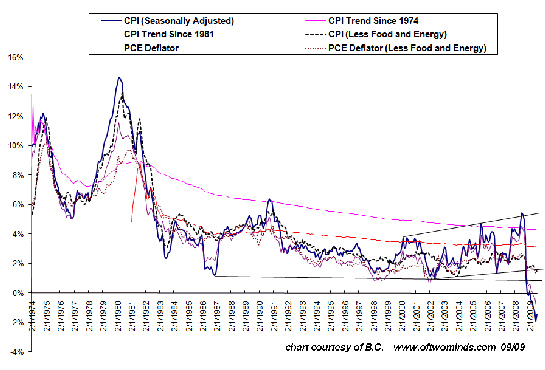
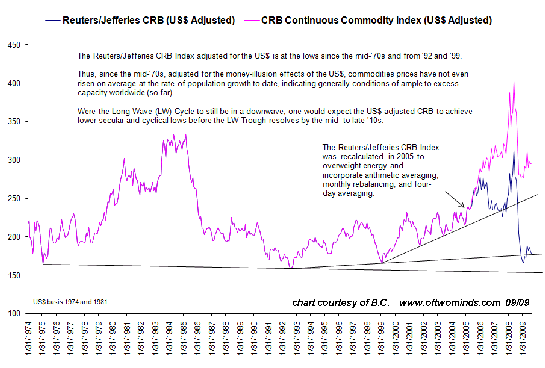
Since inflation, consumer and commodity prices all share the same space in the public awareness, let's turn to correspondent B.C. for some charts of the CPI (consumer price index) and commodities.

B.C. explains:

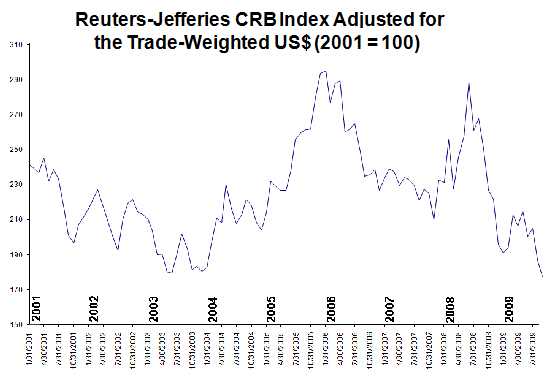
The CCI is the old index, whereas the Reuters/Jeffries CRB is the new index reweighted with energy in '05:

The weighting scheme is related in detail below, showing the recalculation using arithmetic averaging, monthly rebalancing, and a four-day rollover:

www.jefferies.com-index-materials

www.jefferies.com-index-calculation

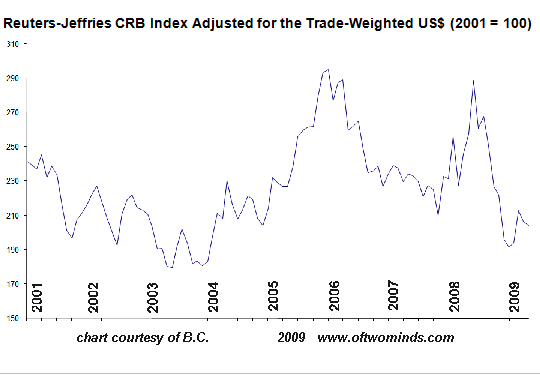
Here is a chart of the new CRB index 2001-2009. Is it just coincidence that this peaked along with the global housing bubble in 2006? The second spike in 2008 reflects the rise of oil to $149/barrel.

Next: here is B.C.'s annotated chart of the CPI from 1974-2009. This is a content-rich chart so click on the thumbnail to see the full chart in a new browser window.

And here is B.C.'s annotated chart of the CRB and the "old" CCI commodity indices from 1974-2009. Note the effects of the overweighting of energy. Click on the thumbnail to see the full chart in a new browser window.

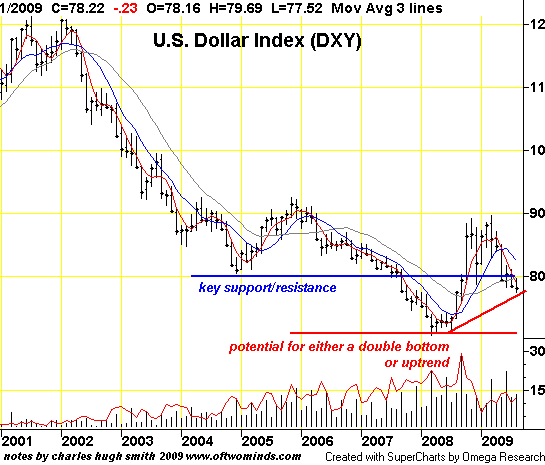
In analyzing these charts we must remember that the commodities are priced in U.S. dollars. That of course is what makes understanding commodity price fluctuations akin to a 3D chess game: if the dollar snubs the 97% bearish pundits who are calling for its demise and rises significantly, then each dollar buys more commodities, even if that commodity is rising when priced in gold or another currency.

But if the dollar tanks as widely expected, then even commodities which were stable in value when priced in gold or other currencies would cost much more in dollars.

Speaking of the dollar: correspondent David B. sent in this intriguing chart of the U.S. dollar ETF, UUP with these comments:

Check that volume out on the weekly ... If I was looking for something conspicuous to mark a possible capitulation low on the dollar (like last year's low) it might be ramping volume.

(Click on the thumbnail to see the full chart in a new browser window.)

Thank you, Angry Saver, B.C. and David B. for your commentaries and charts.All of which remind us that attempting to "price" commodities or understand consumer prices without accounting for the dollar is a doomed enterprise.

Put another way: the basis of stable consumer prices is a stable, sound currency. Speaking of which: here's an idea whose time has come: End the Fed by Ron Paul. This book is currently #6 on amazon.com, so we can surmise that many other citizens are concluding it is indeed time to end the experiment of State manipulation of money supply, liquidity and interest rates, all of which have led to endless and endlessly destructive asset bubbles, inflation and financial fraud.
Permanent link: Inflation, Commodity Prices and the Dollar


I've been invited to join the writers contributing to Seeking Alpha. You can also find my work on AOL's Daily Finance.


If you want more troubling/revolutionary/annoying analysis, please read Free eBook now available: HTML version: Survival+: Structuring Prosperity for Yourself and the Nation (PDF version (111 pages): Survival+)

"Your book is truly a revolutionary act." Kenneth R.

Of Two Minds is now available via Kindle: Of Two Minds blog-Kindle

Thank you, Kathy P. ($5), for your much-appreciated generous donation to this site. I am greatly honored by your support and readership.

Monday, September 28, 2009

The Politics of Inflation: Theft by Other Means

A little inflation is supposed to be "good." From the perspective of the wage earner and taxpayer, it's simply "theft by other means."

Deflation is supposed to be horrible and awful, and a steady dose of inflation is supposed to be "good." So your cash gaining value is awful, and it's great when it is robbed by inflation. How "good" is that?

I've been pondering the politics of inflation. Here are the dynamics I discern:

1. Politicians need to distribute swag to the electorate every two years. Their perspective is thus necessarily short-term as no politician dares care about what transpires a decade or two hence.

As a result politicians must favor inflation, which enables them to borrow/print money and distribute it as swag to self-absorbed greedy voters now and then pay interest on the new debt with "cheaper" future dollars.

2. Voters possess the built-in human bias for present gain over future gain."One in the hand is worth two in the (future) bush" is the default human response, and future insolvency is meaningless to those expecting and desiring swag in the present.

Indeed, politicians have noted that those who demand sacrifice in the present to address a long-term crisis lose elections while those who distribute the most swag now while ignoring the gathering storm on the horizon win elections.

3. Inflation is thus "good" for politicians and the government as it enables paying off obligations assumed in the present with devalued future currency.But is it "good" for the voters who actually earn income?

As Paul Volker recently observed (I paraphrase), is a policy which robs a third of your money every decade a worthy policy? For that is precisely what "low" inflation of 2.5-3% annually does: it reduces your dollars' values by a third every decade.

Will the swag "given" to you (is it "given" when it's your own future earnings?) now in the form of government benefits and tax cuts add up to more than a third of your future earnings over a decade? Unlikely, to say the least.

4. So politicians exploit the human bias for short-term gain even as they rob the taxpayers via inflation over the long term. Inflation is tolerable as long as you're a wage earner and your income rises at the same rate as inflation.

But income from labor (wages/salaries) have been flat to down since the early 70s for most Americans, and so inflation has only been "good" for those holding assets which have risen more or less in lockstep with inflation.

For those whose earnings might rise nominally by 15% a decade while inflation robs 30% of their wages' purchasing power, then "a little inflation" is a long-term disaster.

5. The usual argument in favor of inflation is debt-based. That is, inflation is wonderful because it enable us to pay off our debts with future "cheaper" dollars. But if our incomes are being robbed by inflation, then is that "benefit" of inflation really so valuable? If I lose a third of my purchasing power in a decade does being able to pay down my mortgage with depreciated dollars offset my loss of purchasing power? No--unless my mortgage payment exceeds my income by a fair margin, which is essentially impossible.

6. Deflation is excellent for those with cash and earnings and awful for kleptocracy governments and those with overleveraged debt. The entire idea that "inflation is good" masks a perverse incentive: take on as much debt as you possibly can because interest will become "cheaper" to pay in the future (assuming yuor earnings keep up with inflation).

If your earnings don't keep up with inflation, well, too bad.

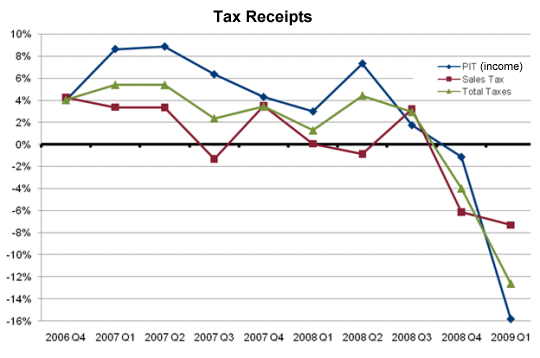
7. The government's "earnings" are tax revenues. As we all know, these are in absolute freefall:

So as the purchasing power of its taxpayers' wages are stolen via inflation--truly "theft by other means"--then the government's ability to collect ever-larger sums of money via taxes is crimped. Unless, of course, the government can create asset bubbles via loose credit and unlimited liquidity which then generate huge capital gains for asset-owners which can then be taxed.

8. The entire "inflation is good" idea is a self-reinforcing noose. To enable distribution of swag to voters and special interests, the government/kleptocracy offloads the payment for the swag into the future, and by creating inflation then the government guarantees (or so it reckons) that it will be able to pay the interest on that money with "cheaper" money collected from taxpayers in the future.

But as taxpayers find the purchasing power of their earnings declining (theft by other means) then they respond to the incentives presented by the government: borrow to the hilt and speculate in asset bubbles as the only way left to maintain purchasing power.

This dependence by both goverment and citizenry on asset bubbles to maintain purchasing power leads to over-leverage and over-indebtedness which then leads inevitably to a collapse of asset values (which were based on exponential credit expansion) and the tax revenues which were dependent on a constant series of asset bubbles.

Now the taxpayers find their assets decimated and their purchasing power diminished while government finds its tax revenue base has been decimated. Paying interest on all that debt while distributing unlimited swag was predicated on rising tax revenues. That plan has now been revealed as fantasy.

Inflation is nothing but a "theft by other means" scheme which leads to impoverishment and insolvency.

Permanent link: The Politics of Inflation: Theft by Other Means


I've been invited to join the writers contributing to Seeking Alpha. You can also find my work on AOL's Daily Finance.


If you want more troubling/revolutionary/annoying analysis, please read Free eBook now available: HTML version: Survival+: Structuring Prosperity for Yourself and the Nation (PDF version (111 pages): Survival+)

"Your book is truly a revolutionary act." Kenneth R.

Of Two Minds is now available via Kindle: Of Two Minds blog-Kindle

Thank you, Tony M. ($20), for your third stupendously generous donation to this site. I am greatly honored by your support and readership.