
Wednesday, August 10, 2022

A Most Peculiar Recession

So what are conventional pundits missing today? I would start with three dynamics.

Only old people experienced real recessions--those in 1973-74 and 1980-82. Recessions since then have been shorter and less systemic.

In the good old days, a recession laid waste to entire industries which never recovered their previous employment. People who were laid off couldn't find another job. Major sectors of the economy dried up and blew away. Jobs were scarce and there was an oversupply of people looking for work.

We're told consumer confidence is in the dumps and everyone expects the worst: recession! Oh Lordy. Interestingly, there isn't much evidence of this near-panic behaviorally. Everyone's tightening their belts and battening down the hatches, but it's not the cliff-dive we see in a real recession.

There's certainly a lot of froth to be scraped off the latte, but what I'm curious about are the armatures of the economy and what I'm seeing is the crowd ignoring key dynamics because they're so busy pushing the Recessionary Play-Doh into the old playboard.

The entire notion that there is a hard and fast line indicating "recession" is not realistic or useful. The economy dropped 1% for two quarters in a row, quick hit the alarm, go to DefCon 1. Uh, OK, right.

The more useful approach is to look at data points as mostly signal noise that fail to reflect or illuminate the core dynamics of the economy. Here's an example: the stagflation of the 1970s is a hot topic as the financial punditry compares then to now, seeking evidence of similarities strong enough to predict a Lost Decade ahead.

One key factor that's rarely (if ever) mentioned was the staggering cost of cleaning up America's industrial sector and polluted skies and waterways at the same time that the Cold War required the U.S. to strengthen its allies by allowing them unfettered access to the U.S. marketplace--exports to the U.S. that had a price advantage due to the dominance of the dollar and the relative weakness of allies' currencies.

1972 exchange rates indicate that the Japanese yen was 302 to $1--an enormous advantage when compared to recent exchange rates of around 110 yen to the USD.

What few current pundits seem to grasp is the dominant dynamic of the entire era of 1945-1992 was the Cold War with the Soviet Union and its client states and allies. Strengthening allies' economies was a core goal and so the costs to the domestic economy had to be absorbed: there was no choice.

The costs of cleaning up the nation and its vast industrial base was an enormous drag on the economy. The value of the trillions of dollars (in current dollars) invested was not in boosting profits, it was in restoring what had been heedlessly destroyed and damaged by rampant dumping of waste and pollutants and improving the health and well-being of the citizenry.

Check out the smog in early 1970s TV series filmed in Los Angeles for a taste of what was cleaned up.

But in a mind-boggling failure of conventional economics, our financial punditry is blind to the impact of the most consequential economic realities of the 1970s--the Cold War and the lengthy, painful, costly clean-up of the nation and its industrial base--on stagflation.

One reason for this abject failure is these dynamics were difficult to measure, so they weren't measured. We only manage what we measure and so if we don't measure it, it doesn't exist. If we measure things in a no-longer-relevant manner, for example GDP, we continue to act as if this misguided measure is of supreme importance when the reality is it's dangerously misleading.

So what are conventional pundits missing today? I would start with three dynamics:

1. For the first time in multiple generations, there is a structural scarcity of labor. For a variety of reasons, there are fewer people willing to do the work at the offered wage than there are jobs. This is not temporary, it is demographic and social, not simply economic. All the supposedly easy fixes-- automate everything, etc.--are not that easy.

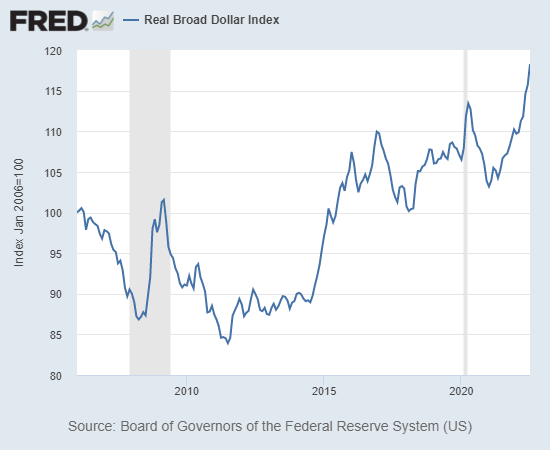
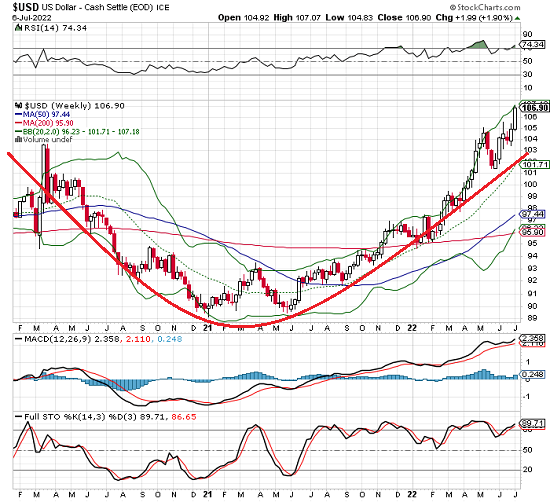
2. The strength of the U.S. dollar is exporting inflation, to the benefit of the domestic economy. After offshoring critical supply chains--a disaster that will take years to reverse--now the U.S. is offshoring inflation and the resulting demand destruction.

3. Global capital flows are reversing. capital flowed from the Core to the Periphery to reap the gains of globalization. Now the flow is reversing and capital is flowing from the Periphery to the Core to preserve capital and lock in lower-risk returns. What looks expensive to those earning U.S. dollars may look cheap and secure to those fleeing depreciating currencies and assets.

In my analysis, these are consequential dynamics that merit little attention in conventional financial analysis.

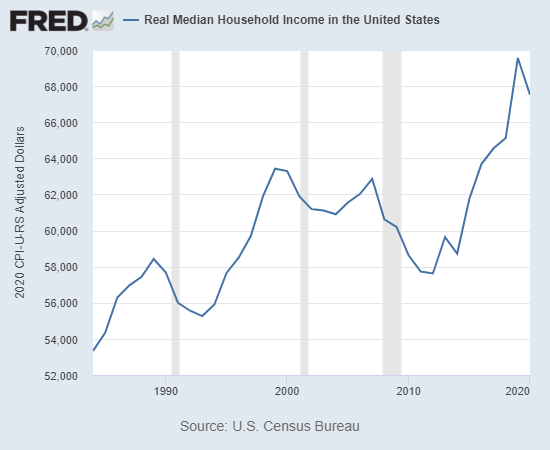
There is much more to say but glance at these two charts: real (i.e. adjusted for official inflation) median household income and real Broad U.S. Dollar Index.

If we're not measuring or pondering the core structural dynamics of the economy, we're not going to make sense of no-longer-relevant data. This is a most peculiar recession, and few seem to be asking if the reason is we're missing what's changed structurally.

Charts courtesy of St. Louis Federal Reserve Database (FRED))


Recent podcasts/videos:

Save Money On Food, Get Free Gold & Silver, Beat Price Inflation (1:08 hrs)

It's Time To End The Fed & Return To A Decentralized Currency (X22 Report, 38 min)

Charles Hugh Smith On Inequalities And The Distortions Caused By Central Bank Policies (FRA Roundtable, 30 min)

Tectonic Shift of Mercantilism Revalued (Gordon Long, Macro-Analytics, 42 min)


My new book is now available at a 10% discount this month: When You Can't Go On: Burnout, Reckoning and Renewal.

If you found value in this content, please join me in seeking solutions by becoming a $1/month patron of my work via patreon.com.


My recent books:

Global Crisis, National Renewal: A (Revolutionary) Grand Strategy for the United States (Kindle $9.95, print $24, audiobook) Read Chapter One for free (PDF).

A Hacker's Teleology: Sharing the Wealth of Our Shrinking Planet (Kindle $8.95, print $20, audiobook $17.46) Read the first section for free (PDF).

Will You Be Richer or Poorer?: Profit, Power, and AI in a Traumatized World
(Kindle $5, print $10, audiobook) Read the first section for free (PDF).

Pathfinding our Destiny: Preventing the Final Fall of Our Democratic Republic ($5 Kindle, $10 print, ( audiobook): Read the first section for free (PDF).

The Adventures of the Consulting Philosopher: The Disappearance of Drake $1.29 Kindle, $8.95 print); read the first chapters for free (PDF)

Money and Work Unchained $6.95 Kindle, $15 print)
Read the first section for free


Become a $1/month patron of my work via patreon.com.


NOTE: Contributions/subscriptions are acknowledged in the order received. Your name and email remain confidential and will not be given to any other individual, company or agency.

Thank you, Christoph P. ($100), for your outrageously generous contribution to this site -- I am greatly honored by your support and readership.


Thank you, Unseen Domains ($10/month), for your monumentally generous pledge to this site -- I am greatly honored by your support and readership.

Read more...

Monday, August 08, 2022

Are Older Workers Propping Up the U.S. Economy?

Are 55 and older workers propping up the U.S. economy? The data is rather persuasive that the answer is yes.

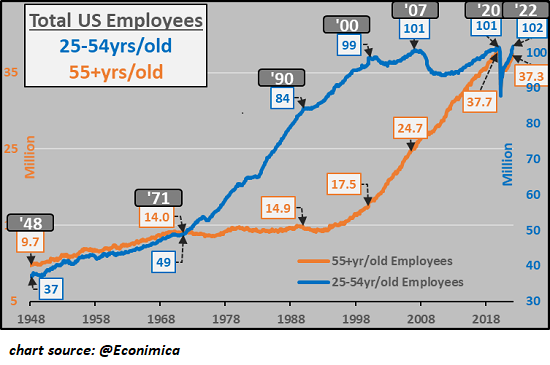
The chart of U.S. employment ages 25 to 54 years of age and 55 and older reveals a startling change.

There are now 20 million more 55+ employed than there were in 2000, an equivalent of the entire workforce of Spain. This unprecedented demographic / employment transition is worth a closer look.

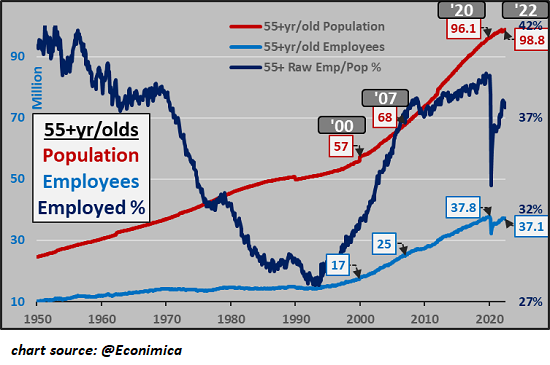
As the second chart shows, some of this increase is due to the rising population of Americans over 55 years of age--an increase of 42 million. In 2000, 30% of those 55 and older were employed. Today, over 37% are employed--a significant increase in the percentage of 55+ people who are working.

An increase of 20 million employees age 55 and older is so large that it's difficult to grasp. An increase equivalent to an entire nation's workforce is one way to make sense of it. Another is to look at the increase of America's total population from 2000 to 2022, which is about 48 million people (282 million in 2000, 330 million today).

The total U.S. population increased by 17%. The 55+ population increased by 42 million (from 57 million in 2000 to 99 million today), a 74% increase. Total employment in the 55+ cohort increased by 113%.

In 2000, only 17.6% of the 55 and older populace had a job. Now the percentage is 37.5% A 20% increase in the percentage of 55+ who are employed in a 20-year span is unprecedented.

If the percentage of employed 55+ had stayed the same, there would only be 17 million 55+ workers today. Instead, there are over 37 million. This raises a question: why are so many older workers continuing to work longer than they did in 1990 and 2000?

I doubt there is one cause or answer. We can attribute this dramatic shift to a number of causes: older households that never recovered from the financial damage wrought by the 2008-09 Global Financial Meltdown; older workers (like me) who only have Social Security for retirement income who can't get by on just their SSA check; those who enjoy their work and see no reason to stop; people who retired and became bored out of their minds so they returned to the workforce; parents who keep working to help their offspring and/or elderly parents; people who keep working to maintain healthcare coverage until they qualify for Medicare; older entrepreneurs who can dial back their workload but who still love their work, and so on.

All of these reflect structural changes in the U.S. economy: a steady decline in the purchasing power of wages and financial security, systemic exposure to the risks of financial bubbles bursting, etc. The bottom line is that nest-eggs that were deemed adequate are no longer adequate, and the only way to fill the gap is to keep earning money.

These changes are reflected in the decline in the percentage of employed 55+ people from 28% in 1970 to 18% in 1990 and 2000, and the subsequent rise to 37%. In an economy with an expanding workforce of young employees and rising productivity, more older workers could retire early. This is no longer the case.

In many cases, there is no nest-egg due to bankruptcy via huge medical bills, the heavy burdens of student loans, or the costs of helping children and grandchildren or very elderly parents. (Many of us aged 65-70 are taking care of parents 90+ years of age and helping out with active 3-year olds. Retirement? You're joking.)

As a result, expenses have risen rather than dropped for the 55+ cohort, requiring an income to stabilize household finances. (Have you looked at childcare (grandchildren) and elderly care (parents) costs recently?)

Another important structural change is the demand for workers of any age who are reliable and able to do the work. People who are accustomed to the structures of work by virtue of 40 or 50 years of employment are generally reliable workers and thus valued by employers beset by a scarcity of reliable, productive employees. (My first formal paycheck was issued by Dole Pineapple in 1970. That's 52 years of getting accustomed to the demands of employment. I'm pretty well broken in now.)

There are also demographic and cultural dynamics in play: the continuing satisfactions of work and the loss of purpose many feel in retirement, the decline in age discrimination, longer lifespans, etc.

Whatever the causes, 37 million workers 55 and older are earning money that's flowing into the economy and providing stable productivity--20 million more 55+ workers than 20 years ago. These 20 million jobs generate income that isn't just funding cruises and RVs. In many cases, it's supporting several generations on either side of the 55+ cohort.

Are 55 and older workers propping up the U.S. economy? The data is rather persuasive that the answer is yes.

Charts courtesy of CH @Econimica)


Recent podcasts/videos:

Save Money On Food, Get Free Gold & Silver, Beat Price Inflation (1:08 hrs)

It's Time To End The Fed & Return To A Decentralized Currency (X22 Report, 38 min)

Charles Hugh Smith On Inequalities And The Distortions Caused By Central Bank Policies (FRA Roundtable, 30 min)

Tectonic Shift of Mercantilism Revalued (Gordon Long, Macro-Analytics, 42 min)


My new book is now available at a 10% discount this month: When You Can't Go On: Burnout, Reckoning and Renewal.

If you found value in this content, please join me in seeking solutions by becoming a $1/month patron of my work via patreon.com.


My recent books:

Global Crisis, National Renewal: A (Revolutionary) Grand Strategy for the United States (Kindle $9.95, print $24, audiobook) Read Chapter One for free (PDF).

A Hacker's Teleology: Sharing the Wealth of Our Shrinking Planet (Kindle $8.95, print $20, audiobook $17.46) Read the first section for free (PDF).

Will You Be Richer or Poorer?: Profit, Power, and AI in a Traumatized World
(Kindle $5, print $10, audiobook) Read the first section for free (PDF).

Pathfinding our Destiny: Preventing the Final Fall of Our Democratic Republic ($5 Kindle, $10 print, ( audiobook): Read the first section for free (PDF).

The Adventures of the Consulting Philosopher: The Disappearance of Drake $1.29 Kindle, $8.95 print); read the first chapters for free (PDF)

Money and Work Unchained $6.95 Kindle, $15 print)
Read the first section for free


Become a $1/month patron of my work via patreon.com.


NOTE: Contributions/subscriptions are acknowledged in the order received. Your name and email remain confidential and will not be given to any other individual, company or agency.

Thank you, Daniel L ($50), for your splendidly generous contribution to this site -- I am greatly honored by your steadfast support and readership.


Thank you, Brian O'D. ($50), for your monumentally generous contribution to this site -- I am greatly honored by your support and readership.

Read more...

Friday, August 05, 2022

Rather Than Focus on What You Don't Control ("The News"), Focus on What You Do Control: What You Grow, Eat and Own

Now that globalization and financialization are finally unraveling, people are slowly awakening to the national security foundations of localizing production.

What exactly is "the news" other than an inducement to passivity, despair and derangement? Since we exert zero control over what happens in distant lands and global economies, why waste time passively consuming "if it bleeds it leads" offal designed to addict us to a steady stream of despair and derangement?

Why not ditch "the news" in favor of focusing on what we do control: what we grow, eat and own? It's almost a binary choice: either focus on screens of addictive offal for hours every day or act on our own behalf in the real world.

Food inflation is highlighting the financial value of home gardens. Paul of the Silver Doctors and I discuss turning gardening savings into more ownership of something we control (for example, precious metals) in Save Money On Food, Get Free Gold & Silver, Beat Price Inflation (1:08 hrs).

I've been posting about the value of gardening for over a decade, describing the financial and health benefits. I Dig Dirt: The Remedy for Derealization (July 23, 2011)         The Hidden Value of Gardens (September 13, 2014)

Food inflation simply increases the gains: One Solution to Soaring Food Prices: Start Your 2022 Garden Now (November 6, 2021).

Municipalities can either encourage or hinder local food production. Cities once grew between a third and a half of their own food within city limits: Could Urban Gardens Supply 1/3 of a City's Food? Yes. (March 13, 2010).

If we're not allowed to grow food, that's a problem that can be solved by local lobbying or moving to a place where there are fewer restrictions on growing our own food. Local authorities can either lead (by encouraging community gardens for apartment dwellers, for example) or get out of the way.

Which makes more sense--air freighting tomatoes thousands of miles or growing your own? Globalization and financialization have so distorted our economy that if it's cheaper to fly in tomatoes then that's the "most profitable choice."

But is maximizing profit really the only "value" we should be calculating? Thanks to an obsessive focus on maximizing profits, our economy has been stripmined of essential production because it's always cheaper to produce stuff somewhere else where labor and bribes are cheap and environmental controls non-existent.

Now that globalization and financialization are finally unraveling, people are slowly awakening to the national security foundations of localizing production. Home gardens were called Victory Gardens in World War II for a reason. Reducing dependency and increasing local production is national security in a nutshell.

Gardening is the antidote to the toxic tsunami of despair and derangement sweeping the land and one expression of self-reliance and ownership of what we can control.

There are health benefits, too: the nutritional value of the food we consume has plummeted by a third as the soils are depleted of micro-nutrients. By boosting the health of the soil in your own garden, you are supplying your household with higher quality food than you can buy at the store.

If we consider the tragic decline in the health of the American public since the 1980s, the decline in the nutritional value of food and the consumption of real food (as opposed to processed "food", much of which is inedible) are factors that we can control in our own lives: grow healthy food, eat what you grow.

The money saved by a home garden can be invested in assets we control: new skills, new tools, and assets that we control such as gold and silver.

The food we grow tastes better, too. Local chefs prefer locally raised food for many reasons, and taste is one. We recently turned a batch of our heirloom tomatoes into an amazing tomato soup (served with fresh basil leaves, croutons and grated Romano cheese) that was nothing like the over-salted canned variety. Our inspiration was Marcella Hazan's Oven-Browned Tomatoes (page 527 from her cookbook Essentials of Classic Italian Cooking) and this recipe: The Best Homemade Tomato Soup.

This isn't a difficult recipe. Even a beginner can chop up veggies, roast them and pulp them in a blender or food processor. Cuisine that's just as good as that produced in a fancy restaurant is within reach of home gardeners. Truly refined cuisine is simple. It doesn't take celebrity chefs with a half-dozen assistants to make. Preparing your own healthy home-cooked meals saves a bundle, too.

As I've been saying for years: "A healthy homecooked family meal and a home garden are revolutionary acts." If these don't seem revolutionary yet, just wait a few years: their revolutionary nature will become self-evident.

Gardening is a process of experiments and failures. Like any enterprise, it's not a commercial, it's real life.

Please join Paul and I for an enthusiastic look at taking control of what we can control and the joys of growing food and saving money: Save Money On Food, Get Free Gold & Silver, Beat Price Inflation (1:08 hrs).


Recent podcasts/videos:

Save Money On Food, Get Free Gold & Silver, Beat Price Inflation (1:08 hrs)

It's Time To End The Fed & Return To A Decentralized Currency (X22 Report, 38 min)

Charles Hugh Smith On Inequalities And The Distortions Caused By Central Bank Policies (FRA Roundtable, 30 min)

Tectonic Shift of Mercantilism Revalued (Gordon Long, Macro-Analytics, 42 min)


My new book is now available at a 10% discount this month: When You Can't Go On: Burnout, Reckoning and Renewal.

If you found value in this content, please join me in seeking solutions by becoming a $1/month patron of my work via patreon.com.


My recent books:

Global Crisis, National Renewal: A (Revolutionary) Grand Strategy for the United States (Kindle $9.95, print $24, audiobook) Read Chapter One for free (PDF).

A Hacker's Teleology: Sharing the Wealth of Our Shrinking Planet (Kindle $8.95, print $20, audiobook $17.46) Read the first section for free (PDF).

Will You Be Richer or Poorer?: Profit, Power, and AI in a Traumatized World
(Kindle $5, print $10, audiobook) Read the first section for free (PDF).

Pathfinding our Destiny: Preventing the Final Fall of Our Democratic Republic ($5 Kindle, $10 print, ( audiobook): Read the first section for free (PDF).

The Adventures of the Consulting Philosopher: The Disappearance of Drake $1.29 Kindle, $8.95 print); read the first chapters for free (PDF)

Money and Work Unchained $6.95 Kindle, $15 print)
Read the first section for free


Become a $1/month patron of my work via patreon.com.


NOTE: Contributions/subscriptions are acknowledged in the order received. Your name and email remain confidential and will not be given to any other individual, company or agency.

Thank you, Frank E. ($100), for your outrageously generous contribution to this site -- I am greatly honored by your steadfast support and readership.


Thank you, Guy T. ($50), for your monumentally generous contribution to this site -- I am greatly honored by your steadfast support and readership.

Read more...

Wednesday, August 03, 2022

China at the Crossroads

Watch where capital is flowing. That's pretty much all you need to know to predict the future.

The word "China" evokes strong emotions, so let's set it aside in favor of a simple syllogism:

1. Certain things matter in all economies.

2. China is an economy.

3. Therefore these certain things matter in China.

Four things matter to all economies:

1. The flow of capital and talent in or out of an economy.

2. The productivity of that capital and talent.

3. The availability and cost of energy.

4. The stability of the primary foundation of the majority's wealth.

Capital and talent flowing into an economy and being productively invested generates prosperity. Capital and talent squandered on unproductive speculation generates bubbles of phantom wealth that eventually pop, destroying the illusion of wealth.

Capital and talent fleeing an economy generates stagnation and collapse. Capital and talent are democratic in the most basic form: both vote with their feet. Dictators can strut around ordering everyone to wear their underwear on the outside of their clothing, but if people can vote with their feet, he soon finds he's talking to himself and a handful of clueless cronies.

The cliche is that capital goes where it's well-treated. What does that actually mean? It turns out capital and talent both want what the average citizen / participant in the economy wants: stability and predictability. Every participant wants the rules to be visible and predictable, so they can make decisions about where to invest their capital and talent with some confidence that the rules won't change tomorrow.

If everything you've worked for can be taken from you or you're no longer able to sell and deploy your capital and talent elsewhere, then why gamble your capital and talent in such an unstable, unpredictable economy at all?

The more restrictions that are applied to keep capital and talent from fleeing, the greater the incentives for capital and talent to flee. Those that can't flee just give up and lay down, doing the minimum to survive.

Capital and talent invested in unproductive bridges to nowhere and speculative bubbles generate a brief explosion of illusory wealth. The workers and enterprises building the bridges to nowhere spend their earnings, boosting consumption, and the incoming tide of capital chasing speculative gains boosts the value of the assets being chased.

But bridges to nowhere and speculative frenzies don't actually boost the productivity of capital or labor; they are mal-investments that bleed the economy dry behind a flimsy facade of phantom wealth, a facade generated by the enormous tide of capital gushing into the economy.

Once the tide recedes as capital votes with its feet, the facade of phantom wealth collapses.

When energy is cheap and abundant, all sorts of things become possible. When energy becomes scarce and costly, all sorts of things are no longer financially viable.

Economies that only function if energy is cheap and abundant unravel when energy becomes scarce and costly.

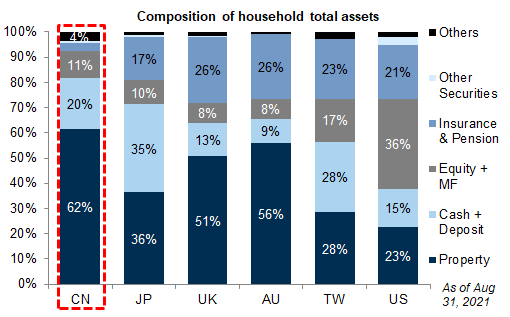
People want to become wealthier, and they will follow whatever trails are open to them to do so. If the economy is structured to funnel most of the majority's wealth into one asset class, that economy becomes highly dependent on the stability of that asset class for its financial, social and political stability.

If, for example, the people's wealth is channeled into real estate to the degree that owning empty flats is considered a form of secure savings as well as a stake in an investment bubble that will never pop, then that economy is extremely vulnerable to the resulting speculative excess collapsing under its own weight.

When an asset class owned solely by the super-wealthy collapses under its own weight--for example, fine art--the damage to the economy is limited. But when an asset class that is the primary foundation of the majority's wealth collapses, that is extremely consequential because too much of the economy's capital has been sunk in an unproductive speculative bubble.

As strategist Edward Luttwak observed, the funny thing about force is how limited it is in actual efficacy. Forcing capital and talent to stay put doesn't make people productive. It simply forces a choice: find a way to flee or just give up and stop working hard. After all, what's the point?

Every economy in which capital and talent can no longer count on predictability is an economy at the crossroads. As Luttwak explained, force is not the same as power, though many confuse the two. Power attracts capital and talent because they're being offered stability and predictability. Force tries to shove instability and unpredictability down everyone's throat and compels then to declare their undying loyalty for instability and unpredictability.

But capital and talent vote with their feet. If they can't vote with their feet, they just give up. Any economy in which capital and talent either flee or give up has only one possible end-point: stagnation and collapse.

In other words, watch where capital is flowing. That's pretty much all you need to know to predict the future.

China Is Pariah for Global Investors as Xi's Policies Backfire (Bloomberg)


Recent podcasts/videos:

It's Time To End The Fed & Return To A Decentralized Currency (X22 Report, 38 min)

Charles Hugh Smith On Inequalities And The Distortions Caused By Central Bank Policies (FRA Roundtable, 30 min)

Tectonic Shift of Mercantilism Revalued (Gordon Long, Macro-Analytics, 42 min)


My new book is now available at a 10% discount this month: When You Can't Go On: Burnout, Reckoning and Renewal.

If you found value in this content, please join me in seeking solutions by becoming a $1/month patron of my work via patreon.com.


My recent books:

Global Crisis, National Renewal: A (Revolutionary) Grand Strategy for the United States (Kindle $9.95, print $24, audiobook) Read Chapter One for free (PDF).

A Hacker's Teleology: Sharing the Wealth of Our Shrinking Planet (Kindle $8.95, print $20, audiobook $17.46) Read the first section for free (PDF).

Will You Be Richer or Poorer?: Profit, Power, and AI in a Traumatized World
(Kindle $5, print $10, audiobook) Read the first section for free (PDF).

Pathfinding our Destiny: Preventing the Final Fall of Our Democratic Republic ($5 Kindle, $10 print, ( audiobook): Read the first section for free (PDF).

The Adventures of the Consulting Philosopher: The Disappearance of Drake $1.29 Kindle, $8.95 print); read the first chapters for free (PDF)

Money and Work Unchained $6.95 Kindle, $15 print)
Read the first section for free


Become a $1/month patron of my work via patreon.com.


NOTE: Contributions/subscriptions are acknowledged in the order received. Your name and email remain confidential and will not be given to any other individual, company or agency.

Thank you, Adam G. ($5/month), for your splendidly generous pledge to this site -- I am greatly honored by your support and readership.


Thank you, David E. ($60), for your monstrously generous contribution to this site -- I am greatly honored by your steadfast support and readership.

Read more...

Monday, August 01, 2022

Can We "Export Inflation?" Yes We Can, Yes We Are

A strong currency exports inflation to those nations which do not issue the currency.

Though it's difficult to be confident of anything in the current flux, I am pretty confident of three things:

1) price is set on the margins

2) currencies are the foundation of every economy

3) the financial forecasts issued to calm the public do not reflect operative geopolitical goals.

Every national government has "global interests." Governments naturally do whatever they can to boost dynamics favorable to the state and nation, and obstruct or hinder dynamics injurious to the state or nation.

As a general rule, nations have relatively few levers they can pull to influence global finance, trade, growth, currencies or the geopolitical balance of power. One such lever is the interest the state pays on its sovereign bonds.

If a central bank/state increases the interest it pays on its bonds, that attracts capital seeking higher return (presuming the bond is perceived as safe from default). This inflow of capital strengthens demand for its currency, because the bonds are denominated in the state's currency.

As the currency strengthens vis a vis other currencies, it buys more goods and services. Imports become cheaper and the nation's exports become more costly to those using other currencies.

Another lever is to reduce the exports of commodities, especially essential commodities like energy and grains. If this reduction reduces the global supply, the price leaps.

If allies get the exports and enemies don't, this punishes enemies and rewards allies.

A third lever is to limit imports. A consumer nation can limit imports from specific exporters, or make do with domestic supplies, or only buy from allies.

A fourth lever is to meet with allies and reach an agreement about finance and commodities to stave off imbalances that threaten the stability of the alliance.

An example of this is the 1985 Plaza Accord that weakened the U.S. dollar at the expense of the Japanese yen and European currencies. The strong dollar was crushing U.S. exports and generating destabilizing trade deficits in the U.S.

Each of these levers has geopolitical consequences.

Financial actions such as raising interest rates are presented as purely financial, but their geopolitical consequences are not lost on the nation's political / military leadership.

Boosting or trimming exports of commodities can be presented as financial as well, even when the real purpose is geopolitical.

In other words, events which are presented as solely financial can also serve geopolitical aims beneath the domestic-centric rah-rah..

Consider how the price of oil contributed to the collapse of the Soviet Union.

In the mid-to-late 1980s, the price of oil fell and stayed relatively low for years.

In 1986, oil fell under $10/barrel. Adjusted for inflation, this was lower than prices paid in the late 1950s.

Although this ample oil supply was fundamentally a result of super-major oil fields discovered in the 1960s and 1970s coming online, it had a geopolitical consequence few fully appreciate: it pushed the Soviet Union over the fiscal cliff into collapse.

Oil and natural gas exports were the primary source of the Soviets' hard cash it needed to buy goods and commodities from other nations.

Once the oil revenues dried up, the Soviet Union was no longer financially viable.

Was this lengthy "glut" of oil just good luck for the U.S., or was a policy agreement with Saudi Arabia and other oil exporters that "nudged" the price lower also a factor?

What do you reckon--pure luck or luck "nudged" to achieve a geopolitical goal? Given the high stakes and the vulnerability of the USSR to low oil prices, is it plausible that it was entirely happy happenstance?

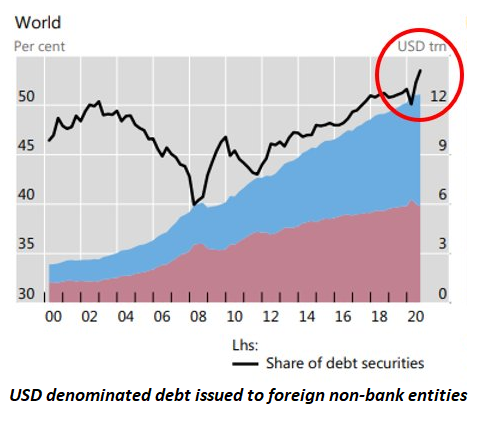
In the 35 years since the Plaza Accord, the U.S. has endeavored to keep the dollar relatively weak for a number of reasons: to limit trade deficits, and avoid putting undue pressure on emerging countries with debts denominated in USD and nations that imported commodities priced in USD, which is virtually all commodities.

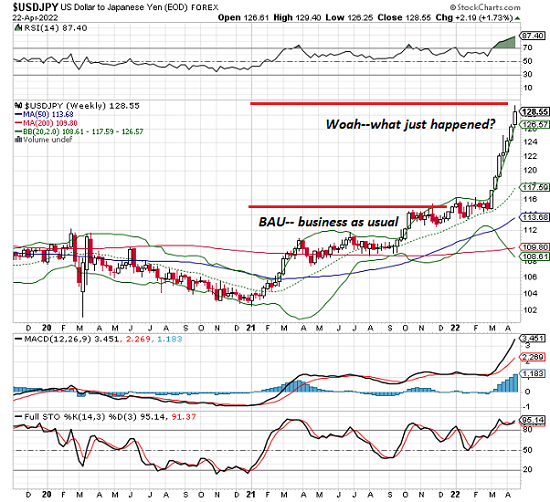
This weak-dollar policy has changed, with profound implications. The soaring USD is adding a currency "surcharge" on top of rising prices for commodities such as oil and grain.

Take Japan as an example: the yen has weakened 20% against the USD. This means every commodity priced in USD is 20% higher in price for those using yen.

Add the increase in cost due to global scarcities and that's a double-whammy hit of inflation.

These sharp increases in inflation / price of essentials are recessionary, as demand craters. People simply don't have enough earnings to pay higher costs for essentials and maintain their discretionary spending on goods and services.

Recall that price is set on the margins. If supply of oil falls 5 million barrels per day (BPD), price rises. But if demand falls 10 million BPD, the price of oil plummets.

As the price of oil falls, oil exporters receive much less money, and so they compensate by pumping more oil. This serves to further depress prices.

Who would benefit from a rising US dollar and a global recession, and who would be hurt? The US would benefit from a higher USD because that lowers the cost of all imports. Everyone else using weaker currencies would pay more for imported commodities.

As demand for oil falls, price plummets. That helps consumer nations and hurts oil exporters.

As the USD rises, it drags every currency pegged to the USD higher with it, making their exports more expensive. That would pressure China's exports, forcing China to adjust its currency peg, reducing the purchasing power of everyone using yuan/RMB.

Is the looming global recession merely "bad luck" or could an unavoidable global recession be "nudged" to serve geopolitical aims? The forces that have been unleashed (higher interest rates, scarcities, strong dollar) will take time to work through the global economy. The USD may drop and oil may rise over the next few months, but where will global demand and oil be in a year?

Many people expect the dollar to weaken and the Federal Reserve to lower interest rates back to zero once the recession becomes undeniable.

I am not so sure. A case can be made that interest rates have completed a 40-year cycle of decline and are now in a secular cycle higher.

A case can also be made that the weak-dollar policy has ended and the dollar will move higher, accelerating the financial and geopolitical consequences described above.

A strong currency exports inflation to those nations which do not issue the currency. Luck, coincidence, or "nudge"? Maybe it doesn't matter. maybe what matters is that it's happening.

A version of this essay was first published as a weekly Musings Report sent exclusively to subscribers and patrons at the $5/month ($54/year) and higher level. Thank you, patrons and subscribers, for supporting my work and free website.


Recent podcasts/videos:

It's Time To End The Fed & Return To A Decentralized Currency (X22 Report, 38 min)

Charles Hugh Smith On Inequalities And The Distortions Caused By Central Bank Policies (FRA Roundtable, 30 min)

Tectonic Shift of Mercantilism Revalued (Gordon Long, Macro-Analytics, 42 min)

My new book is now available at a 10% discount this month: When You Can't Go On: Burnout, Reckoning and Renewal.

If you found value in this content, please join me in seeking solutions by becoming a $1/month patron of my work via patreon.com.


My recent books:

Global Crisis, National Renewal: A (Revolutionary) Grand Strategy for the United States (Kindle $9.95, print $24, audiobook) Read Chapter One for free (PDF).

A Hacker's Teleology: Sharing the Wealth of Our Shrinking Planet (Kindle $8.95, print $20, audiobook $17.46) Read the first section for free (PDF).

Will You Be Richer or Poorer?: Profit, Power, and AI in a Traumatized World
(Kindle $5, print $10, audiobook) Read the first section for free (PDF).

Pathfinding our Destiny: Preventing the Final Fall of Our Democratic Republic ($5 Kindle, $10 print, ( audiobook): Read the first section for free (PDF).

The Adventures of the Consulting Philosopher: The Disappearance of Drake $1.29 Kindle, $8.95 print); read the first chapters for free (PDF)

Money and Work Unchained $6.95 Kindle, $15 print)
Read the first section for free


Become a $1/month patron of my work via patreon.com.


NOTE: Contributions/subscriptions are acknowledged in the order received. Your name and email remain confidential and will not be given to any other individual, company or agency.

Thank you, Sue W. ($5/month), for your splendidly generous pledge to this site -- I am greatly honored by your support and readership.


Thank you, Hector G. ($100), for your outrageously generous contribution to this site -- I am greatly honored by your steadfast support and readership.

Read more...

Terms of Service

All content on this blog is provided by Trewe LLC for informational purposes only. The owner of this blog makes no representations as to the accuracy or completeness of any information on this site or found by following any link on this site. The owner will not be liable for any errors or omissions in this information nor for the availability of this information. The owner will not be liable for any losses, injuries, or damages from the display or use of this information. These terms and conditions of use are subject to change at anytime and without notice.

RE: European Union AI Act, and Our Use of Generative AI Tools and Agents Policy

All text on this site is composed by Charles Hugh Smith or by a credited guest-author. No Generative AI Tools are used in the composition / writing of any text or graphic content created by Charles Hugh Smith. This site deploys no AI agents or generative AI tools. This site is not responsible for the disclosures, use or non-use of AI agents or generative AI tools in advertisements displayed by Investing Channel or other ad placement services.

Audio files generated by text-to-audio transcription tools are identified as such.

Our Privacy Policy:

Correspondents' email is strictly confidential. This site does not collect digital data from visitors or distribute cookies. Advertisements served by third-party advertising networks such as Investing Channel may use cookies or collect information from visitors for the purpose of Interest-Based Advertising; if you wish to opt out of Interest-Based Advertising, please go to Opt out of interest-based advertising (The Network Advertising Initiative) If you have other privacy concerns relating to advertisements, please contact advertisers directly.

PRIVACY NOTICE FOR EEA INDIVIDUALS

This section covers disclosures on the General Data Protection Regulation (GDPR) for users residing within EEA only. GDPR replaces the existing Directive 95/46/ec, and aims at harmonizing data protection laws in the EU that are fit for purpose in the digital age. The primary objective of the GDPR is to give citizens back control of their personal data. Please follow the link below to access InvestingChannel's General Data Protection Notice.
https://stg.media.investingchannel.com/gdpr-notice/

Notice of Compliance with The California Consumer Protection Act

This site does not collect digital data from visitors or distribute cookies. Advertisements served by a third-party advertising network (Investing Channel) may use cookies or collect information from visitors for the purpose of Interest-Based Advertising. If you do not want any personal information that may be collected by third-party advertising to be sold, please follow the instructions on this page: Do Not Sell My Personal Information.

Regarding Cookies:

This site does not collect digital data from visitors or distribute cookies. Advertisements served by third-party advertising networks such as Investing Channel may use cookies or collect information from visitors for the purpose of Interest-Based Advertising; if you wish to opt out of Interest-Based Advertising, please go to Opt out of interest-based advertising (The Network Advertising Initiative) If you have other privacy concerns relating to advertisements, please contact advertisers directly.

Our Commission Policy:

Though I earn a small commission on Amazon.com books and gift certificates and gold (BullionVault) purchased via links on my site, I receive no fees or compensation for any other non-advertising links or content posted on my site.

Copyright Notice:

All original images (Drawings and Photographs), text (essays, books and works of fiction), audio and video recordings, musical compositions, graphic design, graphic design elements and HTML coding on this site are the copyrighted work of Charles Hugh Smith unless otherwise credited or noted. They are published as information for the private use of site visitors, and any reproduction or redistribution of this content or coding in any media in any format or distribution channel (text, audio, video/film, web) without the written permission of the copyright holder is strictly prohibited. All rights in all media reserved globally.

  © Blogger templates Newspaper III by Ourblogtemplates.com 2008

Back to TOP