


Tuesday, May 06, 2025

It Was 20 Years Ago Today I Started this Blog: What Surprises Me

I've managed to maintain a sense of humor and curiosity--or at least the comforting delusion that I've maintained them.

It was 20 years ago today--well, actually, yesterday--that I launched this blog into the swirling rapids of the Web. As we know, time flies when you're having fun. In these two decades, I've written 4,854 posts and 745 Musings Reports for my supporters / subscribers, and further amused myself by publishing a number of books and posting a number of original songs.

I started with nothing and have reached a state of grace peculiar to the media realm. I am an Untouchable to the Brahmins of the mainstream media, but far from the Media Shambala of being an influencer with hundreds of thousands or millions of avid followers whose devotion generates pasha-scale incomes.

Betwixt and between, I've managed to maintain a sense of humor and curiosity--or at least the comforting delusion that I've maintained them. I can relate to Emperor Norton in old San Francisco, who declared himself Emperor and was treated with amusement and respect, a heady combination. I am emperor of the Of Two Minds empire, which exists solely in the confines of my own mind and as an ephemeral dot in the Great Oort Cloud of innumerable websites www.oftwominds.com.

Like Emperor Norton, I depend on the financial support of kind supporters--in my case, my subscribers.

I've survived the rapids of the Web which began with a Wild West burst of freedom and a sense that anything was possible, to the present domination of a handful of corporate platforms, a peculiarly oppressive mix of Kafka and Orwell--(you have violated our community standards but we won't divulge what triggered your algorithmic trial; you are hereby sentenced to Digital Siberia)--and Huxley (we love your servitude to our platforms, and so do you).

The scramble to cash in is the coin of the realm. This offers its own amusements. An attractive person on Only Fans shared the fact that her earnings exceeded $43 million. How can we not gaze in wonderment?

I should be cynical enough by now to find nothing surprising, but alas, a number of things still surprise me. I'm still surprised how creating more money is all it takes to keep the status quo from falling apart, a travesty of a mockery of a sham that's been playing to full houses for 17 years.

I'm surprised that so great is our fear of losing whatever we have that we accept that the vast majority of this newly created "wealth" flows upward into the hands of the wealthiest few-- $1 Trillion of Wealth Was Created for the 19 Richest U.S. Households Last Year (WSJ.com, paywalled) (Yahoo News)--while 41.7 million American workers (31.3% of the workforce) earn under $12 an hour.

The average rent for an apartment in the U.S. is $1,750 per month, which exceeds the take-home pay of full-time workers earning $12 an hour.

As the article notes, and I documented in The Winners and Losers in 21st Century America, the top 1% of households own 31% of the net worth and the bottom 50% of American households own 2.5%.

Fear is a powerful motivator. So too is hyper-normalization: we all know the system is broken and rotten to the core, but we don't see any alternative or way to change the system, so we play-act that everything's fine as a means of not going crazy.

But of course we go crazy anyway. It's just the craziness manifests in ways that are acceptable.

I shouldn't be surprised, but I am still surprised at the appeal of simplistic solutions. This is of course a primary feature of hyper-normalization: now that life is so interconnected and complex, there's no way to make sense of it, much less reform it, so we cling to something that does make sense.

So if we just returned to sound money, the system would automatically right itself and we'd all be good to go. This sounds reasonable except for one hitch: the system is terminally rotten and corrupt, and so sound money would serve the corrupt, just like unsound money.

I'm surprised I have an audience. This is a continuing source of surprise, for I have no credentials, no institutional seal of approval, and I'm indistinguishable from the old guy in front of you in the checkout line who you hope doesn't fumble around with coins to pay the exact amount.

A very dear reader in San Francisco posted on social media that he thought he saw me fumbling around in confusion with my phone by a BART subway ticket machine. He kindly went over to help. It wasn't me, though it might have been. I happened to see the post and thanked the reader for his kindness--an increasingly rare treasure--and sent him a copy of my latest book as a gesture.

Though my empire-of-the-mind appears disheveled, I do manage to keep up with the technology needed not to tip over in the rapids. In the cut-throat digital media realm, a sufficient grasp of evolving technologies is necessary for our survival. There's always room on the train to Digital Siberia, and always a way to stumble off the cliff into the bottomless canyon of de-monetization.

We hear your screams briefly, and then the endless scroll distracts us from your fate.

I have found great truth in former Intel CEO Andy Grove's dictum that only the paranoid survive. I don't trust either the state or Corporate America, the married couple who we see feuding in the parking lot over who forgot to buy broccoli but who are absolutely committed to their power marriage.

I confess to being surprised by the durability of the duct tape keeping the machinery from flying apart. The fragilities and risks are hidden, but that's not the same as saying they don't exist.

It's good to be industrious. It's good to be a producer and not just a consumer. It's good to learn some useful skill, or improve a useful skill. It's good to be curious, especially as things get curiouser and curiouser.

I thank you for your kind readership and indulgence. I would be honored if you consider me like the old gent in line fumbling with loose change, mumbling to himself, who suddenly turns to you and says something that you think about afterward.


Onward to the next 20--


My recent books:

Disclosure: As an Amazon Associate I earn from qualifying purchases originated via links to Amazon products on this site.

The Mythology of Progress, Anti-Progress and a Mythology for the 21st Century print $18, (Kindle $8.95, Hardcover $24 (215 pages, 2024) Read the Introduction and first chapter for free (PDF)

Self-Reliance in the 21st Century print $18, (Kindle $8.95, audiobook $13.08 (96 pages, 2022) Read the first chapter for free (PDF)

The Asian Heroine Who Seduced Me (Novel) print $10.95, Kindle $6.95 Read an excerpt for free (PDF)

When You Can't Go On: Burnout, Reckoning and Renewal $18 print, $8.95 Kindle ebook; audiobook Read the first section for free (PDF)

Global Crisis, National Renewal: A (Revolutionary) Grand Strategy for the United States (Kindle $9.95, print $24, audiobook) Read Chapter One for free (PDF).

A Hacker's Teleology: Sharing the Wealth of Our Shrinking Planet (Kindle $8.95, print $20, audiobook $17.46) Read the first section for free (PDF).

Will You Be Richer or Poorer?: Profit, Power, and AI in a Traumatized World
(Kindle $5, print $10, audiobook) Read the first section for free (PDF).

The Adventures of the Consulting Philosopher: The Disappearance of Drake (Novel) $4.95 Kindle, $10.95 print); read the first chapters for free (PDF)

Money and Work Unchained $6.95 Kindle, $15 print)
Read the first section for free


Become a $3/month patron of my work via patreon.com.

Subscribe to my Substack for free


NOTE: Contributions/subscriptions are acknowledged in the order received. Your name and email remain confidential and will not be given to any other individual, company or agency.

Thank you, John K. ($100), for your outrageouslu generous subscription to this site -- I am greatly honored by your steadfast support and readership.


Thank you, Robert B. ($32), for your marvelously generous subscription to this site -- I am greatly honored by your steadfast support and readership.


Thank you, Joseph R. ($32), for your magnificently generous subscription to this site -- I am greatly honored by your support and readership.


Thank you, Lucky Lizard ($32), for your superbly generous contribution to this site -- I am greatly honored by your support and readership.

Read more...

Monday, May 05, 2025

The Terminal Rot in Corporate America

Corporate America took advantage of the Covid shortages and fiscal largesse to profiteer on a scale criminals could only dream of.

One of humanity's most pernicious traits is the ease with which we habituate to conditions over time that we would have rejected out of hand if the transition had been sudden. This is the essence of what I term Anti-Progress: over time, what was solid melts away into thin air, what worked no longer works, but we no longer notice because wretchedness and decay have been normalized, i.e. accepted as "the way things are," or hyper-normalized: everyone knows things no longer work but we're unable to change the system, so we play-act that everything's fine as a means of not going crazy.

Which brings us to the terminal rot in Corporate America, a rot so deep and pervasive that few recall that Corporate America once had some purpose other than increasing profits next quarter to boost "shareholder value."

The moral rot in Corporate America goes unnoticed in a society in terminal moral decay. Why should corporate fraud, profiteering, deception and extortion attract our attention when self-service is the norm, lobbyists write regulations, legislators tell us we'll find out what's in the bill after they pass it into law, tax fraud by the wealthy is accepted practice, and so on in an endless stream of avarice and corruption?

But the rot isn't just moral; it's also the rot of reducing the entirety of enterprise to one goal: increase profits by any means available.

Correspondent Bruce H. neatly summarized the decay of "the business class":

"This is the culture that created the McNamara fallacy (also known as the quantitative fallacy), named for Robert McNamara, the US Secretary of Defense from 1961 to 1968, that one can make policy decisions based solely on quantitative observations (or metrics) and ignoring all others.

The Atlantic ran an interesting piece a few years ago, which documented the destruction of the middle class and the disparate wealth imbalance between the top 10% and the rest of the population.

It began in the late 1960s with the rise of business schools and how those graduates were hoovered up by consultants who then sent these newly-minted efficiency experts out into the desperate businesses suffering from the stagflation of the '70s to help them become profitable again.

Their preferred solution was to fire 'extraneous' staff. The net result of this was the elimination of the lower middle class. The foremen who managed a team of six to ten workers, the lower managers who managed four or five foremen, and so on.

Skip to the 80s. The corporations had trimmed employment costs, managers now directly managed between 50 and 100 people and the formerly well-paid foremen and mangers were now unemployed and no longer part of the economy, which started to deflate.

At the same time, Jack 'chainsaw' Welch was gutting General Electric and creating 15% ROI for shareholders, year after year. For his tenure, he was hailed as the ne-plus-ultra of business geniuses, regularly on the cover of business magazines and anyone who didn't follow suit was ousted from every other business. Thus the change in orientation from running a business to profit-at-all-costs.

The second problem was the hiring of the chainsaw consultants by the very companies they had just cut into, directly into the upper-management level. Thus began a noxious process of business-school graduates going straight into consultancy jobs, then from there into the upper-echelons of businesses without every having worked for those businesses.

Thus the people running the businesses were hired for their ability to make money, not their understanding of the purpose and goals of the businesses. My own experience was the quarterly reports stopped talking about what awesome service we were providing while making a profit to gloating over what great profits we were making, and thus it has remained largely so to this day.

As a wise businessman said, if you want to make money, you can go do anything, but the business will be a hollow shell. You need to have a sense of purpose, some service to the community to exist to truly have a good business with happy employees.

The result of this change can be seen in the people at the top: in the 1960s, 90% of corporate CEOs had started on the shop floor and worked their way up to the top. By the late 1990s, only 10% had done so. The ones in the middle of the 20th Century saw their roles as providing a service or product, by the end of the century, the ones at the top saw their job as making profits and the business was just a means.

We don't need a new way of living, we need an old way of living."


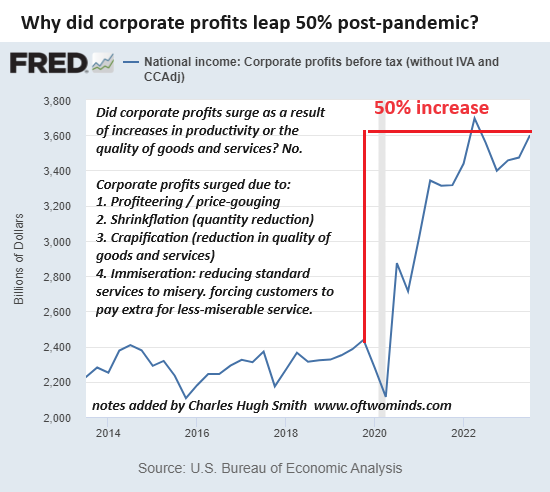
Thank you, Bruce. Well said. Here we see corporate profits, which leaped 50% (+$1.2 trillion) virtually overnight as Corporate America took advantage of the Covid shortages and fiscal largesse to profiteer on a scale criminals could only dream of. But this stripmining wasn't illegal; it was all legal, of course, as corruption isn't just legal in America, it's celebrated.

Did corporate products and services improve in quantity and quality? No, they shrank in quantity and quality declined--but the price went up, and unprecedented profits resulted. "Shareholder value" increased smartly.


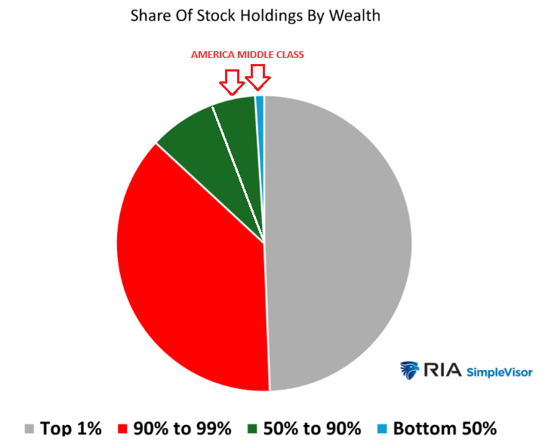
And who are these "shareholders" who are benefiting so mightily from corporate profiteering? I know you're shocked, shocked, that the top 1% own half of all the shares, and the top 10% own around 90%.


No wonder CEOs and corporate "innovators" are busy building private bunkers to protect themselves from the banquet of consequences they've laid out. To say this out loud is unacceptable, for those running the show are, well, shareholders.


My recent books:

Disclosure: As an Amazon Associate I earn from qualifying purchases originated via links to Amazon products on this site.

The Mythology of Progress, Anti-Progress and a Mythology for the 21st Century print $18, (Kindle $8.95, Hardcover $24 (215 pages, 2024) Read the Introduction and first chapter for free (PDF)

Self-Reliance in the 21st Century print $18, (Kindle $8.95, audiobook $13.08 (96 pages, 2022) Read the first chapter for free (PDF)

The Asian Heroine Who Seduced Me (Novel) print $10.95, Kindle $6.95 Read an excerpt for free (PDF)

When You Can't Go On: Burnout, Reckoning and Renewal $18 print, $8.95 Kindle ebook; audiobook Read the first section for free (PDF)

Global Crisis, National Renewal: A (Revolutionary) Grand Strategy for the United States (Kindle $9.95, print $24, audiobook) Read Chapter One for free (PDF).

A Hacker's Teleology: Sharing the Wealth of Our Shrinking Planet (Kindle $8.95, print $20, audiobook $17.46) Read the first section for free (PDF).

Will You Be Richer or Poorer?: Profit, Power, and AI in a Traumatized World
(Kindle $5, print $10, audiobook) Read the first section for free (PDF).

The Adventures of the Consulting Philosopher: The Disappearance of Drake (Novel) $4.95 Kindle, $10.95 print); read the first chapters for free (PDF)

Money and Work Unchained $6.95 Kindle, $15 print)
Read the first section for free


Become a $3/month patron of my work via patreon.com.

Subscribe to my Substack for free


NOTE: Contributions/subscriptions are acknowledged in the order received. Your name and email remain confidential and will not be given to any other individual, company or agency.

Thank you, John K. ($100), for your outrageouslu generous subscription to this site -- I am greatly honored by your steadfast support and readership.


Thank you, Robert B. ($32), for your marvelously generous subscription to this site -- I am greatly honored by your steadfast support and readership.


Thank you, Joseph R. ($32), for your magnificently generous subscription to this site -- I am greatly honored by your support and readership.


Thank you, Lucky Lizard ($32), for your superbly generous contribution to this site -- I am greatly honored by your support and readership.

Read more...

Friday, May 02, 2025

25 Years of Higher Interest Rates Ahead?

Interest rates are linked to inflation, but they're also linked to risk.

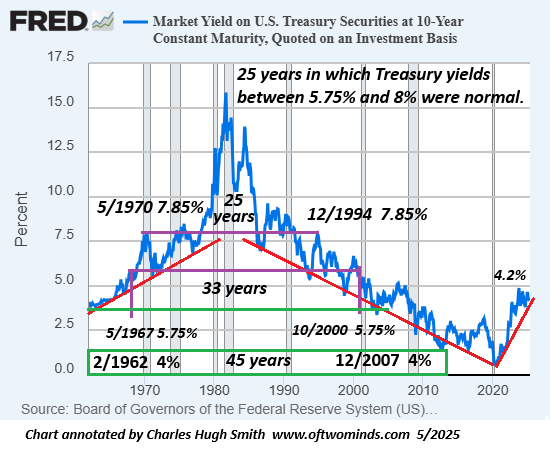
As a result of recency bias, where we assume the recent past is a permanent state of affairs, many believe near-zero interest rates are "normal." They aren't. As the chart of 10-year US Treasury yields--a proxy for interest rates throughout the economy--illustrates, rates in the 3% or lower were an anomaly that only occurred in the relatively brief period of 2011-2022.

For the five decades between 1960 and 2007, interest rates of 4% and higher were the norm. These included the glorious decades of stable growth and rising stocks / housing valuations--the 1960s, 1980s, 1990s and up to 2007, just before the financial crisis of 2008-09.

For 33 of those years, interest rates of 5.75% or higher were the norm, from 1967 to 2000. No one said that the economy would collapse if interest rates didn't drop to 3%, for it was understood that super-low interest rates would ignite inflation and incentivize destructive speculative excesses.

For the 25 years between 1970 and 1994, rates between 5.75% and 8% were normal. The 10-year Treasury yield is now around 4% to 4.2%--far lower than what was considered normal for 25 years.

It's long been noted that interest rate cycles tend to run for decades, not years. Interest rates rose for around 25 years, and then declined for 40 years from 1981 to 2020--a period that was longer than average, thanks to the dominance of central bank monetary policies, or perhaps more accurately, the growing dependence of economies on extraordinarily low interest rates for their "growth."


If history is any guide, interest rates will rise back to the historic range between 5.75% and 8% and linger there for the better part of two decades. Alternatively, rates break above that range and skyrocket into the realm of debt / inflationary crises.

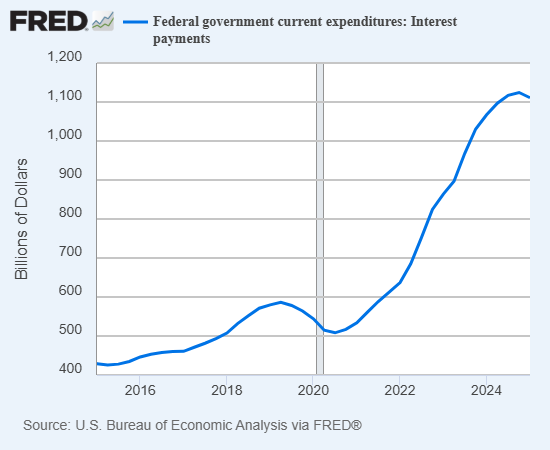
The return of Treasury yields to the historically "normal" range of 4% and higher has doubled the Federal interest payments on Federal debt. It was easily predictable that super-low interest rates would encourage an orgy of borrowing and spending of all that "nearly free money," which is precisely what happened.


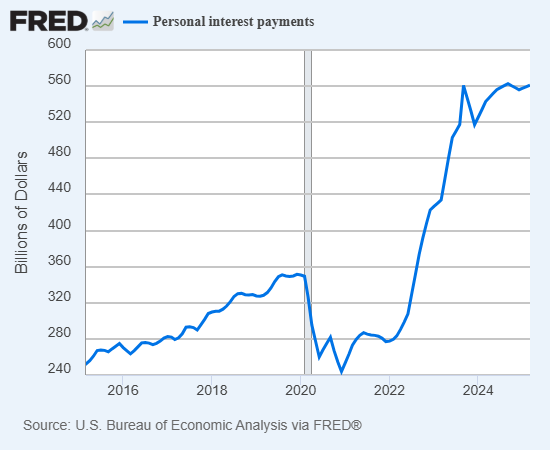
The interest paid by households has also soared for the same reason: not just because interest rates rose, but because the borrowed money (debt) being serviced exploded higher due to low interest rates.


Higher debt / interest payments squeeze out other spending. Debt payments come first, or the entity defaults on its debts and enters bankruptcy--a bankruptcy that tends to bankrupt the lenders who will be lucky to collect pennies on every dollar they lent out.

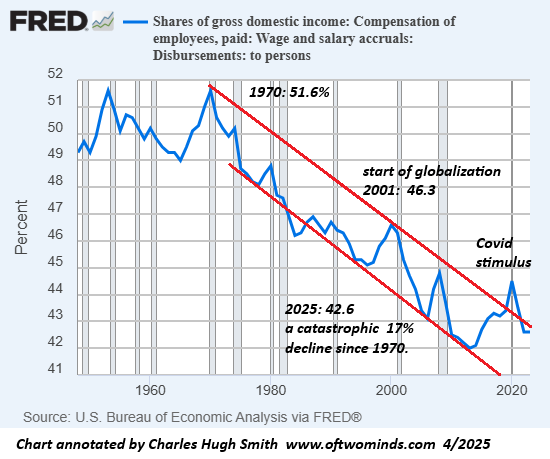
Households are going to have a hard time servicing debt and spending more as rates rise, for wage earners' share of the economy has been in a freefall for 50 years. Less income + higher debt service payments = lower discretionary income to spend + inability to borrow more money to spend = recession.


Interest rates are linked to inflation, but they're also linked to risk. The cost of money isn't simply tied to inflation expectations--it's also tied to speculative excesses blowing credit-asset bubbles which implode, destroying the phantom wealth generated by the bubble.

The lenders that survive the implosion are wary of lending money to all but the most conservative, risk-averse, creditworthy borrowers backed by ample collateral. That excludes the majority of households and enterprises.


New podcast: Adaptability: The Key to Future Success, with the Contrarian Capitalist (53:40 min)

New podcast: Trade, Tariffs and Globalization with Richard Bonugli (35:51 min)


My recent books:

Disclosure: As an Amazon Associate I earn from qualifying purchases originated via links to Amazon products on this site.

The Mythology of Progress, Anti-Progress and a Mythology for the 21st Century print $18, (Kindle $8.95, Hardcover $24 (215 pages, 2024) Read the Introduction and first chapter for free (PDF)

Self-Reliance in the 21st Century print $18, (Kindle $8.95, audiobook $13.08 (96 pages, 2022) Read the first chapter for free (PDF)

The Asian Heroine Who Seduced Me (Novel) print $10.95, Kindle $6.95 Read an excerpt for free (PDF)

When You Can't Go On: Burnout, Reckoning and Renewal $18 print, $8.95 Kindle ebook; audiobook Read the first section for free (PDF)

Global Crisis, National Renewal: A (Revolutionary) Grand Strategy for the United States (Kindle $9.95, print $24, audiobook) Read Chapter One for free (PDF).

A Hacker's Teleology: Sharing the Wealth of Our Shrinking Planet (Kindle $8.95, print $20, audiobook $17.46) Read the first section for free (PDF).

Will You Be Richer or Poorer?: Profit, Power, and AI in a Traumatized World
(Kindle $5, print $10, audiobook) Read the first section for free (PDF).

The Adventures of the Consulting Philosopher: The Disappearance of Drake (Novel) $4.95 Kindle, $10.95 print); read the first chapters for free (PDF)

Money and Work Unchained $6.95 Kindle, $15 print)
Read the first section for free


Become a $3/month patron of my work via patreon.com.

Subscribe to my Substack for free


NOTE: Contributions/subscriptions are acknowledged in the order received. Your name and email remain confidential and will not be given to any other individual, company or agency.

Thank you, Keith S. ($100), for your outrageously generous subscription to this site -- I am greatly honored by your support and readership.


Thank you, Lar ($7/month), for your marvelously generous subscription to this site -- I am greatly honored by your support and readership.


Thank you, Julius L. ($50), for your magnificently generous subscription to this site -- I am greatly honored by your steadfast support and readership.


Thank you, Daniel L. ($50), for your superbly generous contribution to this site -- I am greatly honored by your steadfast support and readership.

Read more...

Tuesday, April 29, 2025

The Potential Winners and Losers in Reshoring Supply Chains

Until values, priorities and incentives change, "the lifestyle you ordered is currently out of stock and on back order, with no estimate of a future delivery date."

The ultimate winners and losers in reshoring supply chains to North America have yet to be determined, and may change depending on the time frame. In the short-term, there are ample reasons to reckon consumers will be the losers as shortages and price-gouging ("it's the tariffs" will be the excuse given for profiteering) take their toll.

Matt Stoller has posted two comprehensive essays on these topics:

How Monopolies Could Exploit the Tariff Shock

How to Prepare for the Coming Supply Chain Shock

In the longer term, however, consumers could be winners as reshored supply chains will be more stable and predictable than globalized supply chains. Stability has a value that isn't recognized until it's absent--as do durability and quality.

One set of potential winners might be large retail corporations that choose to switch from "horizontal" global supply chains to vertically integrated domestic production, in which raw materials are turned into finished products in one production facility.

Ford Motor Company was an early adopter of this model, constructing the immense Ford River Rouge complex from 1917 to 1928 that turned iron ore into finished automobiles in one integrated production process.

"With its own docks in the dredged Rouge River, 100 miles (160 km) of interior railroad track, its own electricity plant, and integrated steel mill, the titanic Rouge was able to turn raw materials into running vehicles within this single complex, a prime example of vertical-integration production."

While it can be argued that vertical integration is less efficient in terms of cost, once again the value of complete control, stability and predictability is not included in spreadsheets, though it becomes readily apparent when long single-source global supply chains break down or are crippled by bottlenecks, artificial scarcities triggered by geopolitical blackmail or a host of other causal factors.

Establishing domestic sources for materials, tooling, robotics, etc. would remove many of the uncertainties that are inherent in a global supply chain breaking down along geopolitical, regional and national lines.

Were unions to regain wide public support, industrial unions might be winners should the public support unionizing new production facilities. The sustained erosion of labor's share of the nation's income over the past five decades might finally gain recognition as a core driver of wealth-income inequality and unionized labor might be understood as a necessary rebalancing of an economy that has favored finance and capital over labor for nearly three generations.


Were the public to begin valuing local production and jobs over "lower prices" and equally low quality, local supply chains might become winners. Note that I've mentioned the public's values and priorities as key drivers changing economic incentives and policies. In the current zeitgeist, the public is assumed to be "rational economic robots" who respond solely to price.

Once the full banquet of consequences of rampant hyper-financialization and hyper-globalization has played out, the public might begin to grasp the importance of valuing something other than low prices (and the low quality that comes with low prices). As a general rule, the public leads the private sector and government, not the other way round.

For example, the public might start valuing national security, which is ultimately dependent on stable, predictable domestic production supply chains owned and controlled by domestic companies.

Until values, priorities and incentives change, the lifestyle you ordered is currently out of stock and on back order, with no estimate of a future delivery date.


New podcast: Adaptability: The Key to Future Success, with the Contrarian Capitalist (53:40 min)

New podcast: Trade, Tariffs and Globalization with Richard Bonugli (35:51 min)


My recent books:

Disclosure: As an Amazon Associate I earn from qualifying purchases originated via links to Amazon products on this site.

The Mythology of Progress, Anti-Progress and a Mythology for the 21st Century print $18, (Kindle $8.95, Hardcover $24 (215 pages, 2024) Read the Introduction and first chapter for free (PDF)

Self-Reliance in the 21st Century print $18, (Kindle $8.95, audiobook $13.08 (96 pages, 2022) Read the first chapter for free (PDF)

The Asian Heroine Who Seduced Me (Novel) print $10.95, Kindle $6.95 Read an excerpt for free (PDF)

When You Can't Go On: Burnout, Reckoning and Renewal $18 print, $8.95 Kindle ebook; audiobook Read the first section for free (PDF)

Global Crisis, National Renewal: A (Revolutionary) Grand Strategy for the United States (Kindle $9.95, print $24, audiobook) Read Chapter One for free (PDF).

A Hacker's Teleology: Sharing the Wealth of Our Shrinking Planet (Kindle $8.95, print $20, audiobook $17.46) Read the first section for free (PDF).

Will You Be Richer or Poorer?: Profit, Power, and AI in a Traumatized World
(Kindle $5, print $10, audiobook) Read the first section for free (PDF).

The Adventures of the Consulting Philosopher: The Disappearance of Drake (Novel) $4.95 Kindle, $10.95 print); read the first chapters for free (PDF)

Money and Work Unchained $6.95 Kindle, $15 print)
Read the first section for free


Become a $3/month patron of my work via patreon.com.

Subscribe to my Substack for free


NOTE: Contributions/subscriptions are acknowledged in the order received. Your name and email remain confidential and will not be given to any other individual, company or agency.

Thank you, David E. ($7/month), for your splendidly generous subscription to this site -- I am greatly honored by your steadfast support and readership.


Thank you, Smurf77 ($7/month), for your marvelously generous subscription to this site -- I am greatly honored by your support and readership.


Thank you, RemfBowHunter ($70), for your magnificently generous subscription to this site -- I am greatly honored by your support and readership.


Thank you, Gabriel B. ($70), for your superbly generous contribution to this site -- I am greatly honored by your support and readership.

Read more...

Monday, April 28, 2025

The Winners and Losers in 21st Century America

Statistical games can be played to mask the realities of our neofeudal economy, but "narrative control" can't obscure the facts or the banquet of consequences that these realities have set.

Not everyone in America gained ground as a result of the rampant hyper-financialization and hyper-globalization of the 21st century. Let's begin our analysis of who gained ground and who lost ground in the year 2001, when China entered the WTO (World Trade Organization) and offshoring / globalization shifted into high gear and when the Federal Reserve began ramping up its financialization / monetary manipulation--oops, sorry, policy interventions.

The top 1% and the top 10% gained ground. The bottom 90% lost ground, especially the bottom 50%. Wage earners lost ground, while corporate insiders, financiers, speculators using leverage and those lucky enough to be born long enough ago to buy assets at pre-bubble valuations gained ground.

If you want to argue with these facts, argue with the Federal Reserve Database. All these charts are drawn from the St. Louis Federal Reserve FRED Database.

Let's start with the varying multiples generated by asset bubbles since 2001.

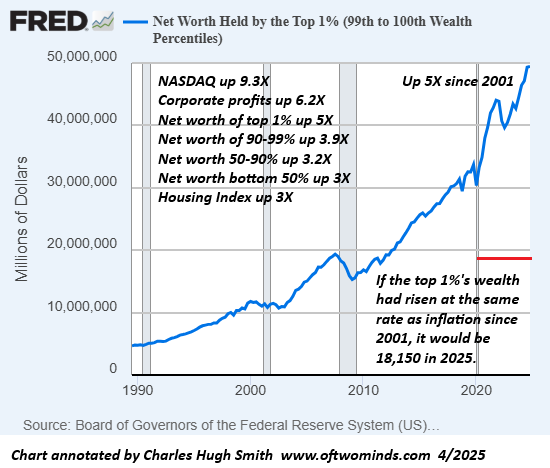
NASDAQ up 9.3X
Corporate profits up 6.2X
Case-Shiller Housing Index up 3X

Those are some serious bubbles, given that $1 in 2001 is $1.80 in today's currency.

If the NASDAQ index had risen at the same rate as inflation since 2001, it would be 3,340, not 17,166.

Corporate profits would be $1.26 trillion annually, rather than $4.3 trillion.
Hmm, $3 trillion a year is a nice chunk of extra change for gutting national security, quality and durability by offshoring essential industries.

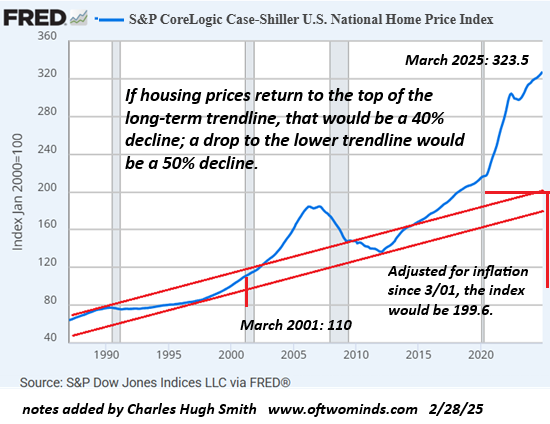
The Case-Shiller Housing Index would be up from 110 in 2001 to 200 today, rather than 323.

So how did each household sector do since 2001?

Net worth of top 1% up 5X
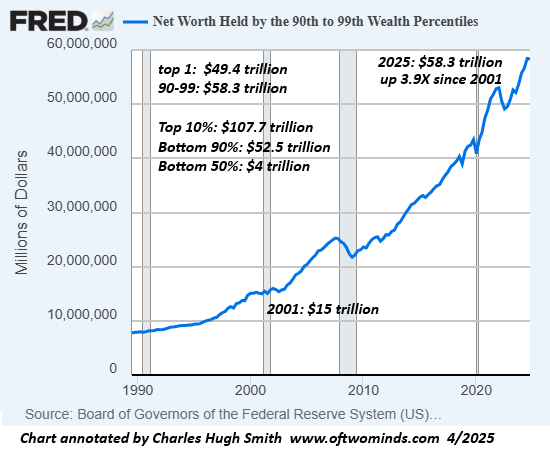
Net worth of 90-99% up 3.9X
Net worth 50-90% up 3.2X
Net worth bottom 50% up 3X

How much of the nation's total household net worth does each sector own now in dollars?

Total net worth: $160.2 trillion
top 1%: $49.4 trillion
90%-99%: $58.3 trillion
Top 10%: $107.7 trillion
Bottom 90%: $52.5 trillion
Bottom 50%: $4 trillion


Note that the top 1% own roughly the same net worth as the bottom 90%.

How much of the nation's total household net worth does each sector own now as a percentage of total net worth?

Total net worth: $160.2 trillion
Top 1%: 31%
90%-99%: 36.5%
TOP 10%: 67.5%
Bottom 50%: 2.5%
50%-90%: 30%
BOTTOM 90%: 32.5%

Since wealth is concentrated in the top layer of each sector--the top 1% own the lion's share of the top 10%'s net worth, and the top 10% of the 50% to 90% sector own the lion's share of that sector's net worth--we can say with confidence that the top 20% own roughly 80% of the net worth--in line with the Pareto Distribution (the 80/20 rule).

What's lost in this aggregate number is the extreme concentration of income-producing wealth (and thus political power) in the top 0.1% of the citizenry and the mere crumbs left to the bottom 60%. As many of us have pointed out over the past 15 years, the only accurate description for this system is neofeudal, where a New Nobility owns the wealth and political power, the bottom 80% are modern-day debt-serfs and the "middle class" is now the 90% to 99% sector, with those in the 80% to 90% sector having just enough home equity to fancy themselves "middle class" in name if not in ownership of income-producing assets or political influence.

What do we call a system in which the top 1% own roughly the same net worth as the bottom 90%? Neofeudal. Any other description is misdirection / propaganda aimed at protecting the interests of the Nobility at the expense of the serfs.

The NASDAQ stock market index: up 10X at its recent peak.


Corporate profits up 6.2X as surveillance pricing, monopoly price-gouging, crapification, planned obsolescence and extortion have worked marvelously well in stripmining the citizenry to enrich the top 10% who own 90% of all stocks, the "shareholders."


Wage earners' share of the nation's income has been slashed over the past five decades. Unsurprisingly, hyper-financialization and hyper-globalization did nothing to reverse this decline of American labor in favor of global capital.


If housing fell 40% from its current valuation, it would return to the trend line.


Here's a chart of net worth since 1950. Approximately $100 trillion was added above and beyond what inflation dictated.


Some percentage of the bottom 50% benefited from the housing bubble, but even with the bump to $4 trillion in net worth, the bottom 50% owns a grand total of 2.5% of total net worth.


Here's the 50% to 90% sector:


Here's the 90% to 99% sector:


Here's the top 1% sector:


Statistical games can be played to mask the realities of our neofeudal economy and society. But narrative control by the well-paid apologist-punditry class--everyone's doing great because I'm doing great--can't obscure the facts or the banquet of consequences that these realities have set.

A simple request of those who copy any of these charts: could you please publish the chart with the annotation credit intact rather than lop it off? Thank you.

New podcast: Adaptability: The Key to Future Success, with the Contrarian Capitalist (53:40 min)

New podcast: Trade, Tariffs and Globalization with Richard Bonugli (35:51 min)


My recent books:

Disclosure: As an Amazon Associate I earn from qualifying purchases originated via links to Amazon products on this site.

The Mythology of Progress, Anti-Progress and a Mythology for the 21st Century print $18, (Kindle $8.95, Hardcover $24 (215 pages, 2024) Read the Introduction and first chapter for free (PDF)

Self-Reliance in the 21st Century print $18, (Kindle $8.95, audiobook $13.08 (96 pages, 2022) Read the first chapter for free (PDF)

The Asian Heroine Who Seduced Me (Novel) print $10.95, Kindle $6.95 Read an excerpt for free (PDF)

When You Can't Go On: Burnout, Reckoning and Renewal $18 print, $8.95 Kindle ebook; audiobook Read the first section for free (PDF)

Global Crisis, National Renewal: A (Revolutionary) Grand Strategy for the United States (Kindle $9.95, print $24, audiobook) Read Chapter One for free (PDF).

A Hacker's Teleology: Sharing the Wealth of Our Shrinking Planet (Kindle $8.95, print $20, audiobook $17.46) Read the first section for free (PDF).

Will You Be Richer or Poorer?: Profit, Power, and AI in a Traumatized World
(Kindle $5, print $10, audiobook) Read the first section for free (PDF).

The Adventures of the Consulting Philosopher: The Disappearance of Drake (Novel) $4.95 Kindle, $10.95 print); read the first chapters for free (PDF)

Money and Work Unchained $6.95 Kindle, $15 print)
Read the first section for free


Become a $3/month patron of my work via patreon.com.

Subscribe to my Substack for free


NOTE: Contributions/subscriptions are acknowledged in the order received. Your name and email remain confidential and will not be given to any other individual, company or agency.

Thank you, John D. ($100), for your splendidly generous subscription to this site -- I am greatly honored by your steadfast support and readership.


Thank you, Sparx ($30), for your marvelously generous subscription to this site -- I am greatly honored by your longstanding support and readership.


Thank you, James N. ($70), for your magnificently generous subscription to this site -- I am greatly honored by your steadfast support and readership.


Thank you, Richard S. ($70), for your superbly generous contribution to this site -- I am greatly honored by your steadfast support and readership.

Read more...

Terms of Service

All content on this blog is provided by Trewe LLC for informational purposes only. The owner of this blog makes no representations as to the accuracy or completeness of any information on this site or found by following any link on this site. The owner will not be liable for any errors or omissions in this information nor for the availability of this information. The owner will not be liable for any losses, injuries, or damages from the display or use of this information. These terms and conditions of use are subject to change at anytime and without notice.

RE: European Union AI Act, and Our Use of Generative AI Tools and Agents Policy

All text on this site is composed by Charles Hugh Smith or by a credited guest-author. No Generative AI Tools are used in the composition / writing of any text or graphic content created by Charles Hugh Smith. This site deploys no AI agents or generative AI tools. This site is not responsible for the disclosures, use or non-use of AI agents or generative AI tools in advertisements displayed by Investing Channel or other ad placement services.

Audio files generated by text-to-audio transcription tools are identified as such.

Our Privacy Policy:

Correspondents' email is strictly confidential. This site does not collect digital data from visitors or distribute cookies. Advertisements served by third-party advertising networks such as Investing Channel may use cookies or collect information from visitors for the purpose of Interest-Based Advertising; if you wish to opt out of Interest-Based Advertising, please go to Opt out of interest-based advertising (The Network Advertising Initiative) If you have other privacy concerns relating to advertisements, please contact advertisers directly.

PRIVACY NOTICE FOR EEA INDIVIDUALS

This section covers disclosures on the General Data Protection Regulation (GDPR) for users residing within EEA only. GDPR replaces the existing Directive 95/46/ec, and aims at harmonizing data protection laws in the EU that are fit for purpose in the digital age. The primary objective of the GDPR is to give citizens back control of their personal data. Please follow the link below to access InvestingChannel's General Data Protection Notice.
https://stg.media.investingchannel.com/gdpr-notice/

Notice of Compliance with The California Consumer Protection Act

This site does not collect digital data from visitors or distribute cookies. Advertisements served by a third-party advertising network (Investing Channel) may use cookies or collect information from visitors for the purpose of Interest-Based Advertising. If you do not want any personal information that may be collected by third-party advertising to be sold, please follow the instructions on this page: Do Not Sell My Personal Information.

Regarding Cookies:

This site does not collect digital data from visitors or distribute cookies. Advertisements served by third-party advertising networks such as Investing Channel may use cookies or collect information from visitors for the purpose of Interest-Based Advertising; if you wish to opt out of Interest-Based Advertising, please go to Opt out of interest-based advertising (The Network Advertising Initiative) If you have other privacy concerns relating to advertisements, please contact advertisers directly.

Our Commission Policy:

Though I earn a small commission on Amazon.com books and gift certificates and gold (BullionVault) purchased via links on my site, I receive no fees or compensation for any other non-advertising links or content posted on my site.

Copyright Notice:

All original images (Drawings and Photographs), text (essays, books and works of fiction), audio and video recordings, musical compositions, graphic design, graphic design elements and HTML coding on this site are the copyrighted work of Charles Hugh Smith unless otherwise credited or noted. They are published as information for the private use of site visitors, and any reproduction or redistribution of this content or coding in any media in any format or distribution channel (text, audio, video/film, web) without the written permission of the copyright holder is strictly prohibited. All rights in all media reserved globally.

  © Blogger templates Newspaper III by Ourblogtemplates.com 2008

Back to TOP