
The immense literature on the decline and collapse of civilizations tends to overlook a simple but profound dynamic: the tunnel-vision created by the fusion of an unquestioned belief in the permanence of the status quo and a narrow focus on maintaining and/or expanding the perquisites we're siphoning off of the empire.
The list of causes / sources of decay, decline and collapse is long indeed, but most are external factors: environmental changes such as drought, plagues and pandemics, invasions by barbarians, and so on. Internal sources of decay are often dismissed or given short shrift: for example, the Western Roman empire did not collapse due to moral decay, it was overwhelmed by the invasions of tribes pushed westward into Roman territory by warriors from the steppes of Asia.
The focus on externalities benefits from an easily traceable if-then causality, but it misses the critical importance of the social-economic-political milieu, the mindset of what's assumed, what is "known," what is unrecognized (and therefore "unknowable" in the mindset of that era), and the unseen decay wrought by enduring success.
Yes, enduring success is self-liquidating, as the impressively convenient idea that the empire is so durable that everyone with the means to do so can siphon off as much wealth as they can manage with absolutely no systemic consequences.
The possibility that this narrow focus on maximizing self-enrichment might weaken the empire in aggregate never occurs to any of those amassing private fortunes at the expense of imperial stability.
As I explain in my new book Investing In Revolution, success slowly corrodes our ability to adapt to rapidly changing circumstances. Whatever the challenge, it is assumed that the empire has the resources and systems to make the problem go away, and do so without demanding any sacrifices of its higher classes of aristocrats, patricians, clerisy and functionaries.
In other words, let them eat cake: there's always a solution that somebody else will make happen.
This decay of adaptive muscle goes unnoticed, for no one other than a few elders has any experience of a crisis or overlapping series of crises that demanded society-wide sacrifices and risky decisions to avoid failure. The systems that had evolved to maintain the empire had been up to the task for so long that the sclerosis of adaptive capacity is unseen and thus "unknowable."
That the empire could fail and collapse is beyond the realm of what's conceivable. The enduring success of the imperial structures fosters both:
1) a self-absorbed focus on accumulating as much private wealth as possible with no regard whatsoever for the eventual systemic consequences of everyone focusing on amassing their own fortune, and
2) a blindness to the erosion of the society's capacity to adapt to conditions that are so novel that the existing responses are inadequate and doomed to fail.
This blindness extends to the failure of the status quo responses: everyone watches the system do more of what's failed and assumes that devoting even more resources to the failing policies of the past will magically work again.
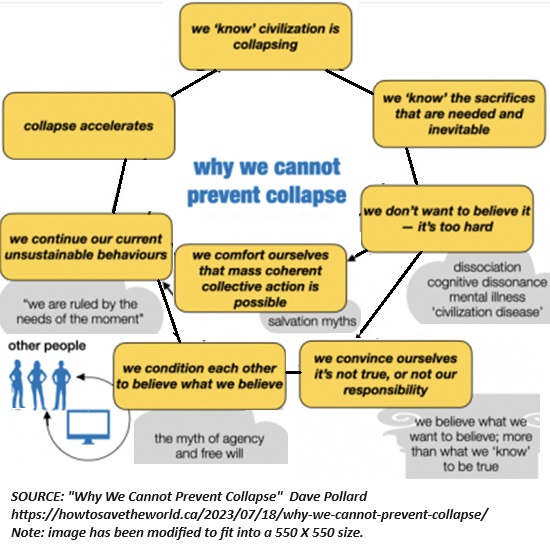
This is how we fail: externalities are relatively easy to identify and measure. The internal forces of self-liquidating success--the loss of adaptive capacity and a self-absorbed blindness to the eventual consequences of moral decay generated by tunnel-vision greed and the sclerosis fostered by enduring success--go unnoticed as they are not easily measured and are as hidden from view as the melting ice beneath the snowpack that makes an avalanche not just likely but inevitable.
Tunnel-vision greed and blindness to what is unseen and therefore "unknowable" is self-reinforcing:
My new book Investing In Revolution is available at a 10% discount ($18 for the paperback, $24 for the hardcover and $8.95 for the ebook edition). Introduction (free)
Check out my updated Books and Films.
Become a $3/month patron of my work via patreon.com
Subscribe to my Substack for free
NOTE: Contributions/subscriptions are acknowledged in the order received. Your name and email remain confidential and will not be given to any other individual, company or agency.
|
Thank you, Tom ($200), for your beyond-outrageously generous subscription to this site -- I am greatly honored by your support and readership. |
Thank you, Mike H. ($70), for your marvelously generous subscription to this site -- I am greatly honored by your support and readership. |
|
|
Thank you, Ramon M. ($7/month) for your superbly generous subscription to this site -- I am greatly honored by your support and readership. |
Thank you, Kirk C. ($7/month), for your splendidly generous subscription to this site -- I am greatly honored by your support and readership. |