
Thursday, February 07, 2008

Why I Hope Hillary Is Not The Democratic Candidate for President


At the grave risk of alienating readers who are keen supporters of Hillary Clinton's campaign for the Presidency, I would like to explain my opposition to her bid.


As harsh as this may sound to her supporters, I believe her campaign--and thus her governing style--combine the very worst of her husband Bill's Presidency with the worst of George W. Bush's Presidency.

To wit: Hillary combines Bill Clinton's poll-driven emptiness with Bush's attack politics.

I am not a fan of either Bill Clinton's or George Bush's presidencies. Clinton accomplished very little, given the Democrats' initial control of Congress, and his most enduring accomplishment-- ending welfare as we know it--was a Republican platform plank which he glommed onto once his polls indicated the public supported it.

He did oversee a reduction in the relative size of the Federal Government and the Federal deficit--accomplishments the Republicans only paid lip-service to but never actually pursued--and he did stand up at several key foreign policy junctures: the stabilization of Haiti and the NATO bombing of Serbia (four years too late for all those slaughtered while he dithered, but nonetheless he finally agreed to use force).

His efforts at a comprehensive peace between Israel and Palestine were clearly sincere and well-intentioned. He was unlucky to draw Arafat as a negotiating partner, but lucky in drawing a booming economy which carried him through eight years of prosperity.

His inability to keep his trousers zipped up was the least of his failures as a leader. For he pioneered the "poll-driven presidency," in which a desire for approval is the leader's single propelling goal. Clinton succeeded in being a popular president, but he was the classic "empty suit": what exactly did he believe in that can be traced directly to policy? It is fair to say he believed deeply in trying to broker peace in the Mideast; but this was an easy thing to support because virtually every American favors peace in the Mideast.

What did he push which was deeply unpopular but vitally important? Medicare reform? Yes, his administration trimmed a bit of fat here and there, putting off the day of reckoning a few years; but what deeply divisive issue did Clinton oversee but welfare reform, which was essentially pushed on him by the Republican Revolution of 1994, when the Democrats' pandering and squabbling was rejected by voters?

As for George Bush, he has excelled at empowering hatchet men like Cheney and Karl Rove to do his "attack-politics" dirty work. His administration's contempt for the media (free press) is legendary, as is their obsessive control of "message."

I don't read material hatched in the "vast right-wing conspiracy," preferring mainstream political journals like The New Republic. It seems Hillary Clinton's campaign has learned all too well from the Bushies: like the Bush Administration, Hillary's campaign is run by a small circle of fanatical loyalists, and lower-rung staffers are terrified of being caught "off-message." Both the Bushies and Hillaryites treat the press to robotic "on message" events which are tightly managed and controlled.

How is this different from any political campaign? Of course the "message" is controlled in every campaign, but you need some sense of history to see just how far we have come from a healthy relationship between the press and the candidates.

There were few tougher, more paranoid politicos than Richard Nixon, but even Nixon could sit down with Hunter S. Thompson (gonzo journalist) and discuss college and pro football at length. This simply doesn't happen in either the Bush or Hillary camps, where sycophants and control freaks essentially rule the roost.

I keep trying to ascertain what core beliefs are powering Hillary's quest for the Presidency, but her positions are constantly "nuanced" into favorless pablum by her "poll-driven politics" machine, depending on her audience of the moment.

Good Ole Bill has been recruited as attack-dog, something which raised a few eyebrows even among Democratic stalwarts. Bill took time out of his busy schedule making millions as a huckster oops, I mean speaker, to remind Hispanic voters that their interests might not align with an African-American candidate's. Thanks, Bill, we as a nation desperately needed you to spout some Karl-Rove-like innuendo.

Bill wasn't the first president who eagerly sought popularity to salve his deep insecurities; Lyndon Johnson famously wanted to be popular, too. But he pushed through civil rights legislation which was extremely unpopular with southern politicians and their constituents, and he did so ruthlessly and at great political risk.

Bush and Hillary aren't the first politicians to surround themselves with a Praetorian Guard of fanatic loyalists; like Hillary, who feels abused by a "vast right-wing conspiracy," Richard Nixon felt abused by a "vast left-wing conspiracy" which he sought to identify with "Enemies Lists" and the like.

It seems crossing Hillary in Bill's White House was a good way to lose your kneecaps, or access to the President. By some insider accounts, V.P. Al Gore somehow fell out of favor with Hillary towards the end and as a result he was quickly marginalized.

Is Hillary as brilliant a strategic thinker as Nixon? You can be closed and controlling, of course, and yet bring nothing in the way of grand strategy to the table. The Watergate Crisis has overshadowed Nixon's other accomplishments, which become even more impressive when you consider he was opposed by an overwhelmingly Democratic Congress and faced with spiraling inflation and an unpopular war.

Here is Hillary's long piece in Foreign Affairs on her global views:

Security and Opportunity for the Twenty-first Century. The other candidates' pieces are roughly equivalent: more or less "restore America's standing in the world" plus other easily-supported positions. After all, who doesn't want to see America's standing in the world improve?

Nixon made horrendous mistakes, of course--not accepting a negotiated end to the Vietnam War in 1969, and imposing wage and price controls--but he also managed some innovative domestic policies such as block grants, and set the wheels in motion ("triangulating" the Soviet Union and China) to limit nuclear weapons for the first time (SALT I Treaty) and engage the Soviet Union and China in ways which led to the collapse of the USSR and the emergence of China.

To his credit, Bush doesn't seem to care much if he is popular or not. He is apparently drawing lower poll numbers than Richard Nixon just before he resigned.

What has Bush accomplished with his hatchet men and attack-politics? He has overseen the rot of the American economy, the ballooning of unsustainable deficits (he never used his veto to cut spending), the severe erosion of civil liberties via the excesses of The Patriot Act, etc., and the miring of the U.S. Military in the quagmire of Iraq.

Does George Bush have a Grand Strategy in Iraq a la Nixon's triangulation? It is difficult to tell, but judging by the incompetence of the occupation and the ineffective diplomacy his administration has pursued in the area, an objective observer finds precious little persuasve evidence of a brilliant Grand Strategy. The story has changed again and again as the need for support waxes and wanes; first, it was trumped-up "evidence" of WMD (weapons of mass destruction), then it was democracy, and now it is oil--oops, I mean, regional stability.

In fairness, I should note that Bush's diplomacy in Asia has been far more successful: Winning Asia: Washington's Untold Success Story by Victor D. Cha.

I fear Hillary has learned all the wrong lessons from her husband and from George Bush. From her husband she has clearly learned the value of "nuancing" every position to death, and using polls to massage her beliefs and policy stances to generate the desired results, i.e. "popularity."

From George Bush she has learned the value of suppressing media access, surrounding herself with fanatically protective sycophants and deploying hatchet-men to do her political dirty-work.

Like Nixon, she views any skepticism or probing of her campaign or positions as orchestrated attacks by a vast conspiracy, rather than evidence that some people don't like her, just as millions didn't like Nixon and thought him a dangerous phony. To counter this "right-wing conspiracy," she maintains rigid control over her entire staff, and woe to the staffer who speaks out of turn or "off-message."

Unlike Nixon, she does not have the redeeming quality of being a grand strategist; her platform is long on muddled, easy populism (universal healthcare) and short on vision--what President Bush I dismissed as "the vision thing." Like George W. Bush, she is an expert in partisan domestic politics, and in raking opponents over the coals via proxies.

From everything I have read--and precious little leaks out of her campaign that isn't pure "on-message" pablum--I conclude she has learned all the wrong lessons, and is the ideal candidate for "more of the same"-- more poll-driven "nuance" and more attack-politics, the very tools of governing most of us find most appalling and tiresome after sixteen long years of the Clinton-Bush administrations.

Could I be wrong, and Hillary is poised to become a great president? Of course I could be wrong; but little in her Senate career (which can be summarized as "keep your head down, go along to get along"), writings or very public history suggests that is likely.


NOTE: contributions are humbly acknowledged in the order received. Your name and email remain confidential and will not be given to any other individual, company or agency.

Thank you, John F. B. ($25), for your ongoing generous support of this humble site, and for your many contributions of sources and ideas. I am greatly honored by your contribution and readership. All contributors are listed below in acknowledgement of my gratitude.

Read more...

Wednesday, February 06, 2008

The Drugs Which Drive You Crazy


Long-time readers know there are several "deep background" big-money sponsors of this site: Kroika! cookies
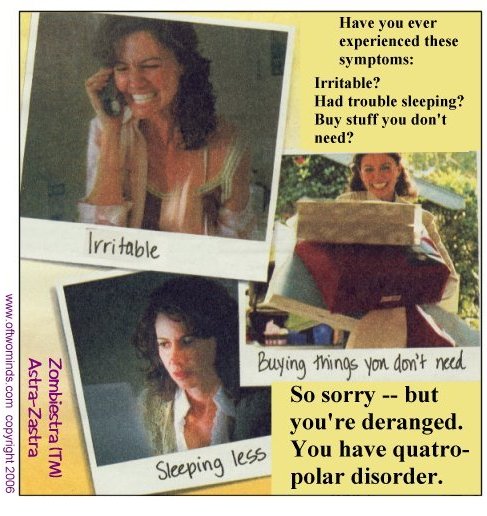
(for instance, Kroika and Starsbuck Take a Hit), Jank Coffee and everyone's favorite pharmaceutical behemoth, Astra-Zastra.

Here we have Astra-Zastra's latest ad:


Just for fun, let's peruse the latest news of pharmaceutical wonder drugs with either dubious value and/or horrendous side-effects.

My favorite is the "stop-smoking" drug which makes you suicidal--as a side-effect, of course:
FDA Issues Health Advisory On Pfizer's Chantix Tablets


WASHINGTON -- The Food and Drug Administration said it is "increasingly likely" that Pfizer Inc.'s smoking-cessation drug Chantix may be tied to serious psychiatric symptoms. The FDA's comment is part of a public health advisory issued Friday.
The public health advisory highlighted warnings issued by Pfizer last month stating that Chantix users should be monitored for suicidal behavior, depressed mood and other changes in behavior. (emphasis added--CHS)

There is a terrible irony here: in an effort to stop your suicidal habit of smoking, you are driven to suicide by the medication you were prescribed to help you. With "help" like this, who needs enemies?

Next up: the "blockbuster billion-dollar profits drug" which is either worthless or dangerous: Do Cholesterol Drugs Do Any Good?


"Research suggests that, except among high-risk heart patients, the benefits of statins such as Lipitor are overstated."

The article goes on to describe the nasty side effects which many users experience. This would be pathetic if it wasn't such a common story: blockbuster drug's value overstated, horrible side-effects understated. How many times have you read this?

We've skewered the fake syndromes which the pharmaceutical industry creates to hype sales of their drugs--restless leg syndrome, etc. Fake drugs for fake syndromes include Discolegato, Euphorestra and Zombiestra, which attempts to cure (with hideous side-effects) the dreaded quattro-polar disease.


The entire psychiatry/psychology industry is also guilty of inventing diseases, so that their pals in the pharmaceutical industry can rush new dangerous drugs to market to "help" the poor patient: in this case, just a typical teenager:

How Teenage Rebellion Has Become a Mental Illness


Big pharma has some new customers. Not complying with authority is now, in many cases, labeled a disease.

Disruptive young people who are medicated with Ritalin, Adderall and other amphetamines routinely report that these drugs make them "care less" about their boredom, resentments and other negative emotions, thus making them more compliant and manageable. And so-called atypical antipsychotics such as Risperdal and Zyprexa -- powerful tranquilizing drugs -- are increasingly prescribed to disruptive young Americans, even though in most cases they are not displaying any psychotic symptoms.

Many talk show hosts think I'm kidding when I mention oppositional defiant disorder (ODD). After I assure them that ODD is in fact an official mental illness -- an increasingly popular diagnosis for children and teenagers -- they often guess that ODD is simply a new term for juvenile delinquency. But that is not the case.

Young people diagnosed with ODD, by definition, are doing nothing illegal (illegal behaviors are a symptom of another mental illness called conduct disorder). In 1980, the American Psychiatric Association (APA) created oppositional defiant disorder, defining it as "a pattern of negativistic, hostile and defiant behavior." The official symptoms of ODD include "often actively defies or refuses to comply with adult requests or rules" and "often argues with adults." While ODD-diagnosed young people are obnoxious with adults they don't respect, these kids can be a delight with adults they do respect; yet many of them are medicated with psychotropic drugs.

Your kid isn't a dutiful robot yet? Then get him on some heavy pyschotropic drugs, man, and get him robotic ASAP. Of course, side effects may include suicidal thoughts, but hey, no pain, no gain, right?

Allow me to state emphatically who is truly insane: the American public, for demanding (and blindly accepting) solutions to complex problems (i.e. life) in the form of a pill. Yes, we could press for regulatory relief (and you already know how effective that will be), but the real solution is to just refuse to fill the prescriptions which don't do anything positive. Stop trusting "the experts." Do your own research into side effects. Find out for yourself that maybe 3% of all the pill-poppers actually extract some meaningful results from the horrendously costly pills. The other 97% either suffer from horrific side-effects or get no value out of the pill. (These numbers are massaged/guesses, just like the drug trials statistics on safety and efficacy.)

And don't fall victim to the fear hype. Big Pharma knows how to do one thing well, and that's scare the bejabbers out of you.

For example, there's the "big scare" that every middle-aged woman's bones are about to turn to dust via runaway osteoporosis: Bones of Contention: Drugmakers are stoking fears of fracture among middle-aged women. But experts say the risk is low (Good reporting, BusinessWeek)


"Up to half of women over age 50 will break a bone due to osteoporosis in their lifetime." Consumers likely have heard such claims hundreds of times in commercials for drugs to treat osteoporosis, a bone-thinning disease primarily afflicting women. As a result, sales of drugs such as Merck's Fosamax, Procter & Gamble's Actonel, and Eli Lilly's Evista totaled some $7 billion last year.

But the medical community is hardly of one mind about how many women over 50 should be taking these drugs.

The odds of having an osteoporosis-related fracture before age 70 are low: Half of all hip fractures occur after age 80. And in a paper just published in the Jan. 19 issue of the British Medical Journal (BMJ), a group of researchers concluded after combing through several drug-company-sponsored studies that the benefits of osteoporosis meds for prevention were overstated. It's a classic case of disease-mongering, according to the researchers: "A risk factor has been transformed into a medical disease in order to sell tests and drugs to relatively healthy women."

The pharmaceutical industry is an out of control monster, spitting out fake diseases, hyping minor conditions into major diseases, invoking fear via billion-dollar ad campaigns, and selling drugs with little proven efficacy and proven terrible side-effects.

How do you stop the monster? Pull the plug. Don't give it any of your money, or your insurer's money, or Medicare's money, unless the results from your own experience and tests support the claim that this pill is truly extending your life or curing your debilitating condition. Maybe it is--but find out if it is. Monitor your own tests and side-effects.

Lagniappe: Another fact which is under-reported is that many medications lose whatever effectiveness they might have had at the start of treatment after a few months or years. Recall that all those Phase III drug trials which are supposed to prove efficacy and safety only run for a year or so. Beyond that, nobody knows.


Readers Journal has been updated! There are great ideas and experiences in Readers Commentaries, and four different writers have submitted thoughtful, fascinating essays on four very different subjects:
Growing Up in Cuba (A.R.)
A Rising Standard Lifts All Boats: Employment and a Better Life (Eric Andrews)
Spendthrift Americans (M. Goodfellow)
Reading the Bible and the Koran (Protagoras)

RS also has two new poems for your pondering:

In memory of Shafilea Ahmed (poem, Protagoras)
The Geometry of Passion (poem, Verona U.)


NOTE: contributions are humbly acknowledged in the order received. Your name and email remain confidential and will not be given to any other individual, company or agency.

Thank you, Patricia and Darrin W. ($50), for your very generous donation in support of this humble site. I am greatly honored by your contribution and readership. All contributors are listed below in acknowledgement of my gratitude.

Read more...

Tuesday, February 05, 2008

Media Meltdown: Unreporting the Housing Bubble


Need some comic relief?
Check out the alarmist cover of BusinessWeek which shouts,Meltdown: for housing the worst is yet to come.
Uh, can you say "Duh!"? Where were these clowns in 2005 or even 2006, when the bubble was expanding and they could have warned readers to stay out of the market? Indeed--where was the entire mainstream media? Missing in action, at every step of the way.

Now that the horses have long left the barn, BusinessWeek is on top of the story: "Barn door left wide open, horses have vanished into the night! Woe is us! Who could've predicted an open barn door would lead to this catastrophe?"


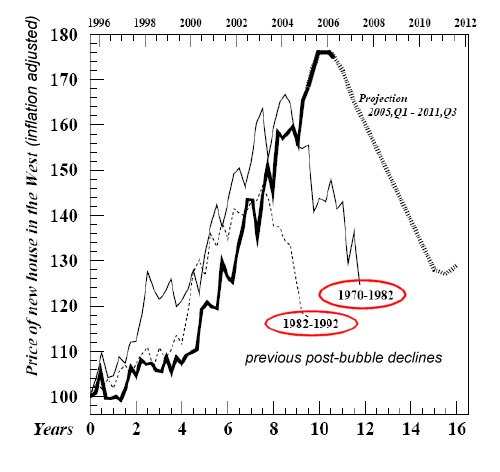
The Standard & Poor's/Case-Shiller 20-city home price index fell 7.7% in November from the year before, the biggest decline since the index was created in 2000.
And that could be just the start. Brace yourself: Home prices could sink an additional 25% over the next two or three years, returning values to their 2000 levels in inflation-adjusted terms.

You mean just like all of us housing bloggers have been saying--and providing charts to support the case--for years? Were housing blogs some sort of secret which was unavailable to BusinessWeek editors?


A Harris Interactive survey for Zillow.com in December found that 36% of homeowners thought their homes had increased in value over the past year, vs. 23% who thought they had decreased. That willful optimism translates directly into the record overhang of unsold existing homes: more than 4 million.

Golly, I wonder where the average American got the idea that his/her house is still climbing in value. Could it possibly be the relentless cheerleading about housing's never-ending rise they saw on TV, heard on radio, read in newspapers and magazines, and saw on MSM Websites?


A 20% decline in home prices would wipe out the equity of 67% of people who bought last year, Zillow.com estimates.


And where were you, "watchdog press"? Protecting the citizenry with hard, skeptical reporting on the housing boom's inevitable bust? Warning readers in front-page stories that a reversion to trend was inevitable? Hardly. To quote Mogambo: hahahahahahahahaha.
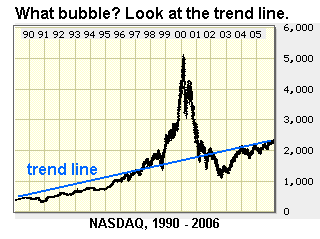
BusinessWeek ran a chart of the S&P 500 stock index to illustrate how bubbles revert to trendlines. Sorta like my chart from over two years ago, which used the Nasdaq to illustrate the same point.

Exactly how difficult was it in 2004 to suggest that this trend was unsustainable and would likely reverse?


How difficult would it have been to explore the historical declines which followed previous, less extreme housing bubbles?


We all know the government regulators were asleep at the wheel; so what's the media's excuse? Why wasn't the financial media reporting the dangers so visibly inherent in no-document, no-down loans, and all the other chicanery which enabled the lending bubble which then begat the housing bubble? Isn't educating the public about the dangerous lack of regulation, and being skeptical of government and "received wisdom" from those business interests reaping huge gains the fundamental purpose of the Free Press? Yes.

Bottom line: the mainstream and financial media failed the American public, completely, utterly, inexcusably. Their coverage of the inevitable collapse of the housing bubble and the dangers inherent in the lending bubble was a travesty of a mockery of a sham (to quote Woody Allen).

I have subscribed to the Wall Street Journal, Barrons and BusinessWeek for years, as well as the San Francisco Chronicle and major magazines of opinion like The Atlantic Monthly, The New Republic, and The National Review. I do not recall a single feature (front-page) story which called into question or predicted the obvious ruin which would inevitably result from 1) the lending bubble and 2) the housing bubble, nor did any major publication question whether the past seven years of "prosperity" created by this debt explosion was in fact a false prosperity.

Yes, there were occasional glimmerings of reality, if you have read very widely; Alan Abelson over at Barrons has been a skeptic, and on occasion that publication and the Journal offered up some decent reporting. But it was never consistent, or on page one.

I would forgive the corporate media if they had set out to argue, with statistics and solid reporting, how past bubbles in stocks and real estate always ended in dramatic, long-term declines, but "this time was different." Perhaps it was understood no such argument could be made, unless it was a satire of blind buffoonery.

Meanwhile, over in the blogosphere, the consequences of the housing bubble were being reported daily, and in great detail. It's not as if the Coming Bust was some obscure secret; the mainstream media was perfectly aware of what was being reported in the blogosphere, and the editors and management chose to ignore what was being reported, in favor of relentless cheerleading and brain-dead reporting of government-distorted "facts."

Does anyone think the mainstream media will report the Bust any better than they reported the Boom? Whose interests were served by the MSM's seven years of cheerleading? Aren't those same interests being served by underplaying the Bust?

Readers Journal has been updated! There are great ideas and experiences in Readers Commentaries, and four different writers have submitted thoughtful, fascinating essays on four very different subjects:

Growing Up in Cuba (A.R.)

A Rising Standard Lifts All Boats: Employment and a Better Life (Eric Andrews)
Spendthrift Americans (M. Goodfellow)

Reading the Bible and the Koran (Protagoras)

RS also has two new poems for your pondering:

In memory of Shafilea Ahmed (poem, Protagoras)

The Geometry of Passion (poem, Verona U.)


NOTE: contributions are humbly acknowledged in the order received. Your name and email remain confidential and will not be given to any other individual, company or agency.

Thank you, William R. ($20), for your thoughtful donation in support of this humble site. I am greatly honored by your contribution and readership. All contributors are listed below in acknowledgement of my gratitude.


Thank you, Charles W. ($20), for your much-valued donation in support of this humble site. I am greatly honored by your contribution and readership. All contributors are listed below in acknowledgement of my gratitude.


Read more...
Monday, February 04, 2008

American Empire III: Imperial War and Guilt

Thoughtful reader Ralph recently posed this topic:

"Could you address the growing guilt our society faces, concerning the current imperial war in the middle east, by using as a vantage point, the guilt most German citizens faced after WWII with Hitler. Are we not experiencing the same emotions as a society that they did? Will not history judge us harshly in the future for our apathy and collusion now?"

Here is an emotion rarely discussed or commented on in the mainstream media. Guilt? On the surface, and perhaps deep inside, Americans seem to reject guilt as an emotion with intrinsic meaning and focus on its depreciated useage as a goad to "meeting your goals in life." For instance: "Stop feeling guilty about what you eat," "stop feeling guilty about your kid, they are who they are," "stop feeling guilty about not exercising."

What's missing from "guilt over human failings," of course, is the concept of sin, or having done wrong. Was eating a chocolate sundae "wrong" in the sense that fire-bombing Dresden and Tokyo might have been "wrong"? And how might fire-bombing have been wrong when we were facing implacable, fanatic enemies in a global conflict to the death?

It might have been wrong in the sense that it was militarily ineffective. Germany's war manufacturing machine (and Japan's, too) had already been largely hidden; the bombing of cities left the manufacture of V-2 missiles and aircraft untouched; all it did was kill civilians. The idea there was such widespread destruction would break the will of the people to resist; but alas, as the British themselves knew from the Battle of Britain in 1940 and the firebombing of London, such "terror from the skies" only increased civilians' will to resist.

Do Americans feel guilty about the war in Iraq--what Ralph terms an "Imperial War"? If so, there is precious little evidence of it. Perhaps one reason is Americans have been trained since World War I to believe that the U.S. only pursues just wars, wars to defend liberty against fascism or Communism, or to free the oppressed from a brutal dictatorship. From this perspective, Vietnam was a just war in defense of democracy against global Communism, and Iraq is a just war freeing the Iraqi people from an insanely oppressive dictatorship.

Thus it appears the primary emotion Americans feel about Vietnam was shame in losing the war, not guilt over the death of 2 million Vietnamese citizens, hundreds of thousands of Vietnamese combatants and over 50,000 Americans.

The parallels between Vietnam and Iraq are either facile or fabricated. If you are a student of the Vietnam conflict as I am, then you know the time, place, players, culture and strategic value are all wildly divergent between Vietnam and Iraq. Try as they might, opponents of the Vietnam War (myself included) could never pin down the Imperial strategic "value" of Vietnam: yes, it sits astride sea lanes, but Vietnam was a poor agricultural land with little strategic value to the U.S. or the West.

Iraq, on the other hand, sits squarely in the center of the world's reserves of petroleum. To deny its immense strategic value is specious in the extreme.

Vietnam was a common culture crudely divided by fiat into North and South after World War II. Iraq was an arbitrary nation-state creation of the British after World War I. Therein lies much of what fundamentally separates the two situations: Vietnam had a national identity for two thousand years, and a history of resenting foreign domination, be it Chinese, French or American. Iraq is a cobbled-together assembly of very different tribes: Kurds, Shi'ites and Sunnis, stuffed uncomfortably into an ersatz "nation" held together by the brutal hand of dictatorship.

Ironically, the U.S. and South Vietnamese scored a great military victory in the 1968 Tet Offensive--yet the intensity of the fighting turned Americans against the war. The definitive account is now out of print (no irony, there, eh?): Big Story: How the American Press and Television Reported and Interpreted the Crisis of Tet 1968 in Vietnam and Washington.

In the decades since the 1975 end of the Vietnam War, some commentators have argued that the U.S. could have won the war militarily by using other tactics. It is undoubtedly true that some tactics (and bombing campaigns) were more effective than others; for a detailed account of such combat tactics--more or less deploying the very techniques mastered by the Viet Cong against North Vietnamese regular troops--please read About Face/the Odyssey of an American Warrior by Colonel David Hackworth.

But what such analyses fail to consider was the endemic political corruption of the South Vietnamese puppet regime and its essential lack of political support amongst the populace. To "win," the U.S. would have had to allow an actual democracy, as opposed to a simulacrum of democracy controlled by puppet wires behind the scenes. Such a government might have ended up as a coalition of Viet Minh and Buddhist parties, or some other representative amalagam of South Vietnamese citizenry.

Recall that the U.S. could have agreed to a coalition government in 1969, ending the war. In this interview with John Negroponte, he states the U.S. could have withdrawn from Vietnam in 1969; we only needed to agree to replacing the corrupt, venal Thieu government in Saigon with a coalition government which included the Viet Cong (who were South Vietnamese).

Was the effort to prop up a corrupt but non-Communist regime in South Vietnam a worthy, noble sacrifice made in defense of liberty, or a failed Imperial War? There is no doubt that North Vietnam was aggressively supporting full-scale campaigns of terror (assassinations of teachers and village chiefs, etc.) in the south, and invading the South with a well-equipped regular Army. Its goal was, from the North Vietnamese perspective, noble and just: to reunite their Imperially divided nation. The means mattered less than the end.

Can the same be said of Iraq? No. The swirling political, tribal and religious forces at work in Iraq are not so neatly condensed.

Is Operation Iraqi Freedom a cynically cloaked Imperial ploy to gain strategic control of the globe's largest remaining petroleum reserves, or a noble war of liberation? Can it be both at the same time? Perhaps the choice is a false one; for those who have lost good friends or sons and daughters in combat, the idea that it was all about providing cheap gasoline to fuel their neighbors' Tundra or SUV is unsavory, if not outright infuriating.

But to say the battle for Iraq is "the same" as the war in Vietnam is simply unsupportable. In the big picture, Vietnam was largely a domestic political decision of President Lyndon Johnson, who feared "losing Vietnam" would politically damage his re-election chances and his party. That the war ended his chances of re-election anyway was an irony lost on those whose son or father was killed or wounded in the war.

Americans have endless guilt over failed diets and dusty exercise machines; should they feel true guilt for the deaths of 600,000 Iraqis? I think it is fair to say those deaths should weigh upon our calculations of "just war"; and what of the lives Saddam would have taken in our absence? Are we not responsible for those, too, having been in the position to topple Saddam in 1991?

Could the entire Iraqi invasion and conflict reflect a deep ambivalence in America's will and conscience? Could we feel that control of events and resources is our "natural birthright," even as we also feel that spreading, or even imposing, liberty is also our duty?

It is easy, very easy, to dismiss all of this as the workings of a guilty national conscience, as frothy fig leafs which cover the sordid Imperial Truth: we want to control the oil, and all the talk of liberty and democracy is mere propaganda to persuade the American people to continue supplying the treasure and military personnel to enable the power-grab.

Such skepticism is healthy, but it doesn't tell the whole story, either. The Kurds have prospered in their freedom from Saddam's Sunni yoke; from their view, the war was indeed liberating. To dismiss the aspirations and experiences of millions of Iraqi Kurds is not skepticism--it is blindness to the complexities of Iraq, and of U.S. actions.

There is also the experiences of the U.S. military personnel on the ground in Iraq to consider. Are they as cynical and despairing as the draftees of 1969 fighting in Vietnam? From my personal contacts within active duty personnel, I would say they are not, though of course there are as many opinions in the military as there are in the civilian populace. But my point is this: even if you see the cynical hand of Empire in the White House and Pentagon, those actually conducting the war have a different perspective.

Should they have been sent there in the first place? The question is less important now than listening to their reports and experiences. For the ultimate question of American guilt comes down to what is yet to happen in Iraq. Many who have served there believe, based on their contact with Iraqis, that the U.S. mission is doing good in the sense of liberating Iraqis and opening the doors to a much brighter future for residents.

Was it worth 600,000 deaths and millions of refugees, not to mention the 4,000 U.S. deaths and hundreds of billions of dollars? In one sense nothing is worth such a high cost. But the conflict continues, regardless of what might have been. Will history judge the Iraq War as a failed Imperial War,a cynical grab for the region's oil, or as a great transforming event which finally addressed the damage created by earlier Imperial manipulations of borders and nation-states?

Perhaps Chou En-Lai was right, and it is too early to tell. Just as it was inevitable that Vietnam would be reunited in some way, perhaps it is inevitable that the false nation-states created in a London map room in the 1920s would fall apart, and that the U.S. would be drawn into the unpredictable re-ordering.

Readers Journal will be updated later today!


NOTE: contributions are humbly acknowledged in the order received. Your name and email remain confidential and will not be given to any other individual, company or agency.

Thank you, Scott M. ($35), for your much-appreciated donation in support of this humble site. I am greatly honored by your contribution and readership. All contributors are listed below in acknowledgement of my gratitude.


Thank you, John R. ($30), for your very generous donation in support of this humble site. I am greatly honored by your contribution and readership. All contributors are listed below in acknowledgement of my gratitude.

Read more...

Friday, February 01, 2008

American Empire II: What Constitutes a 21st Century Empire?


The word "empire" usually conjures up an image of a vast military and bureaucratic machine which forces the world's peoples to do its bidding by force.
Rome, Imperial China, Great Britain in the 19th century . . . But the truly enduring empires of history actually operate on a much different principle: offer a stable trading system which enables participants to live better than they could in the previous regime, or in any alternative regime.

This is, in effect, what the West has offered China and Russia, and China in particular has opted in with spectacular results. By results, I don't mean creating Shanghai millionaires, I mean lifting hundreds of millions from extreme rural poverty to a much higher and more hopeful standard of living.

Does opting into the West's stable trading system offer a better life than either Maoist Communism or the Soviet alternative? Clearly, those systems failed their people and were effectively bankrupt dead-ends. (Yes, Natural Selection occurs in culture and economy, too.)

Foreign Affairs magazine (which I have long recommended to you) ran a brilliant exposition of this very mechanism: The Rise of China and the Future of the West: Can the Liberal System Survive?


The rise of China will undoubtedly be one of the great dramas of the twenty-first century. The U.S.-Chinese power transition can be very different from those of the past because China faces an international order that is fundamentally different from those that past rising states confronted.

China does not just face the United States; it faces a Western-centered system that is open, integrated, and rule-based, with wide and deep political foundations. The nuclear revolution, meanwhile, has made war among great powers unlikely -- eliminating the major tool that rising powers have used to overturn international systems defended by declining hegemonic states. Today's Western order, in short, is hard to overturn and easy to join.

This unusually durable and expansive order is itself the product of farsighted U.S. leadership. After World War II, the United States did not simply establish itself as the leading world power. It led in the creation of universal institutions that not only invited global membership but also brought democracies and market societies closer together. It built an order that facilitated the participation and integration of both established great powers and newly independent states.

(It is often forgotten that this postwar order was designed in large part to reintegrate the defeated Axis states and the beleaguered Allied states into a unified international system.) Today, China can gain full access to and thrive within this system. And if it does, China will rise, but the Western order -- if managed properly -- will live on.

Put another way: China is prospering by joining the Empire, not overthrowing it. If we view stable trading networks as the lifeblood of Empire, then we realise chaos, disorder and conflict are stable trading's--and thus Empire's--natural enemies. To the degree that China is wlling to support and maintain stable trading routes and systems, China is in this sense a partner in an Empire essentially established in the ruins of World War II by the U.S. and its exhausted Allies.

An enduring Empire is also based on ideas. While it may seem the "Big Idea" in Empire boils down to, "do what we say or we kill you," (and this certainly a compelling, if terribly coercive, notion), there has to be some intellectual structure which is compelling beyond force.

Great conquerers, after all, usually see their empires melt into the sands of time within their own lifetime. (Alexander, Napoleon, Hitler, et. al.)

Turning yet again to Foreign Affairs, we find a review of a book which outlines the four big ideas which have enabled the American-Western Empire to shape the modern world: God and Gold: Britain, America, and the Making of the Modern World

Here is the review: Anglo-Saxon Attitudes: The Making of the Modern World


Walter Russell Mead laments at the beginning of God and Gold, "The study of British history and culture has about vanished from American schools today; as a result, many Americans are unaware of just how deep the connection between the two countries go."


Mead sets out to dispel that ignorance, but his deeper purpose is to expound a thesis: that the modern world is the creation of the United Kingdom and the United States.This, Mead writes, is "the biggest geopolitical story in modern times: the birth, rise, triumph, defense, and continuing growth of Anglo-American power despite continuing and always renewed opposition and conflict."

In his view, militarily, politically, economically, and culturally, their will has prevailed, first with the United Kingdom leading, then with the United States taking over. To describe the United Kingdom and the United States as Anglo-Saxon countries is to describe not their ethnic makeup but their culture -- to underline how it differs from that of the world at large and even from that of the rest of the West.

Mead sees Anglo-Saxon culture and its success across the globe as the product of four elements:

1. a slowly evolved liberal political system amenable to compromise, adjustment, and innovation;
2. a Protestant religious tradition that has become tolerant enough to accommodate different sects and accept the separation of church and state while retaining a strong sense of purpose;
3. a capitalist system preoccupied with material wealth not for its own sake but because of "a passion for growth, for achievement, for change";
4. a maritime strategy, initially borrowed from the Dutch, that has used both the freedom of action provided by detachment from the European mainland and ready access to the rest of the globe to manipulate the world's balance of power.

Each of these four elements has in itself been a powerful force for change. And each has supported and reinforced the others, constituting a virtuous circle whose impact has been dynamic and self-perpetuating.


It is popular to focus on the U.S. military's global presence and declare the burdens of Empire too great to sustain. While I understand the underlying motive for this view--a desire that the Empire would or should crumble--it is largely unsupported by facts.

The fact is the U.S. Military consumes a historically modest percentage of the U.S. GDP (roughly $500 billion from $14 trillion, with about $100 billion of that being spent directly on the Iraq war) and the U.S., despite a horrendously unpopular war, maintains a volunteer Armed Forces. (We are not yet recruiting Hessians to stamp out rebellions in the colonies.) The entire U.S. Armed Forces are about 1% of the adult population-- hardly an unbearable burden for a nation of over 300 million citizens.

(Note: If the U.S. slides into a Great Depression, the current Military budget will indeed become unsupportable.)

Most of the hundreds of bases dotted around the globe are modest in scope. Recall that Britain dominated India not with a vast army (their entire force numbered around 35,000) but by politically and economically controlling those who ruled the Indian states. This is not to say that Empire is a "good thing," but merely to note the burdens of Empire are not as great as is popularly stated.

The key to military domination is power projection. This is the Dutch Maritime Strategy, which remains the fundamental element of U.S. strategy: maintain a mobile sea-based force which can sail anywhere in the world in a matter of days.

In the 1600s, this meant large, well-armed sailing ships. Today, it means carrier task forces which can bring an entire air force (Navy and Marine aircraft) to bear virtually anywhere in the world. (Recall the planet is mostly ocean.) Large, costly concentrations of troops are only required for active warfare or regional stability (i.e. maintaining troops in South Korea, Japan and Germany).

I have often decried the lack of impact the Iraq War is having on the American populace at large, i.e. those who do not have family members or friends "In Theater," but I have to confess that it does not; the burdens of the war are falling almost exclusively on combatants and their loved ones. People don't like the war, but it has no impact on them unless they know someone who is serving in Iraq or Afghanistan.

So what's my point here? Just to suggest that Empire is far more than military dominance, and it has always been more about "opting in" to a regime which offers better opportunities than any alternative regime. Has much of the world's populace truly opted in, or have they been coerced? Undoubtedly some of both. But the Grand Experiments in alternative systems-- Maoist China, the Soviet Union, Vietnam, et. al.--have failed to attract anyone to "opt in." Instead, people "opted out" of those systems once given a chance.

When we speak of enduring Empire, we need to keep that choice in mind.

NOTE: contributions are humbly acknowledged in the order received. Your name and email remain confidential and will not be given to any other individual, company or agency.

Thank you, Lloyd L. ($50), for your very generous donation in support of this humble site, and for your many intellectual contributions (book recommendations, etc.). I am greatly honored by your contribution and readership. All contributors are listed below in acknowledgement of my gratitude.

--------------------------------------------------------------------------------

Thank you, Steven W. ($100), for your astonishingly generous donation in support of this humble site. I am greatly honored by your contribution and readership. All contributors are listed below in acknowledgement of my gratitude.


Read more...

Terms of Service

All content on this blog is provided by Trewe LLC for informational purposes only. The owner of this blog makes no representations as to the accuracy or completeness of any information on this site or found by following any link on this site. The owner will not be liable for any errors or omissions in this information nor for the availability of this information. The owner will not be liable for any losses, injuries, or damages from the display or use of this information. These terms and conditions of use are subject to change at anytime and without notice.

RE: European Union AI Act, and Our Use of Generative AI Tools and Agents Policy

All text on this site is composed by Charles Hugh Smith or by a credited guest-author. No Generative AI Tools are used in the composition / writing of any text or graphic content created by Charles Hugh Smith. This site deploys no AI agents or generative AI tools. This site is not responsible for the disclosures, use or non-use of AI agents or generative AI tools in advertisements displayed by Investing Channel or other ad placement services.

Audio files generated by text-to-audio transcription tools are identified as such.

Our Privacy Policy:

Correspondents' email is strictly confidential. This site does not collect digital data from visitors or distribute cookies. Advertisements served by third-party advertising networks such as Investing Channel may use cookies or collect information from visitors for the purpose of Interest-Based Advertising; if you wish to opt out of Interest-Based Advertising, please go to Opt out of interest-based advertising (The Network Advertising Initiative) If you have other privacy concerns relating to advertisements, please contact advertisers directly.

PRIVACY NOTICE FOR EEA INDIVIDUALS

This section covers disclosures on the General Data Protection Regulation (GDPR) for users residing within EEA only. GDPR replaces the existing Directive 95/46/ec, and aims at harmonizing data protection laws in the EU that are fit for purpose in the digital age. The primary objective of the GDPR is to give citizens back control of their personal data. Please follow the link below to access InvestingChannel's General Data Protection Notice.
https://stg.media.investingchannel.com/gdpr-notice/

Notice of Compliance with The California Consumer Protection Act

This site does not collect digital data from visitors or distribute cookies. Advertisements served by a third-party advertising network (Investing Channel) may use cookies or collect information from visitors for the purpose of Interest-Based Advertising. If you do not want any personal information that may be collected by third-party advertising to be sold, please follow the instructions on this page: Do Not Sell My Personal Information.

Regarding Cookies:

This site does not collect digital data from visitors or distribute cookies. Advertisements served by third-party advertising networks such as Investing Channel may use cookies or collect information from visitors for the purpose of Interest-Based Advertising; if you wish to opt out of Interest-Based Advertising, please go to Opt out of interest-based advertising (The Network Advertising Initiative) If you have other privacy concerns relating to advertisements, please contact advertisers directly.

Our Commission Policy:

Though I earn a small commission on Amazon.com books and gift certificates and gold (BullionVault) purchased via links on my site, I receive no fees or compensation for any other non-advertising links or content posted on my site.

Copyright Notice:

All original images (Drawings and Photographs), text (essays, books and works of fiction), audio and video recordings, musical compositions, graphic design, graphic design elements and HTML coding on this site are the copyrighted work of Charles Hugh Smith unless otherwise credited or noted. They are published as information for the private use of site visitors, and any reproduction or redistribution of this content or coding in any media in any format or distribution channel (text, audio, video/film, web) without the written permission of the copyright holder is strictly prohibited. All rights in all media reserved globally.

  © Blogger templates Newspaper III by Ourblogtemplates.com 2008

Back to TOP