



Wednesday, February 13, 2008

System Instability, Redundancy and the Domino Effect

The potential for a systemic collapse of the global financial system is finally hitting the mainstream
. For instance, this from the Wall Street Journal: New Hitches In Markets May Widen Credit Woes :

"A widening array of financial-market problems threatens to trigger a new phase in the global credit crunch, extending it beyond the risky mortgages that have cost banks and investors more than $100 billion in losses and helped push the U.S. economy toward recession.

In the past few days, low-rated corporate loans -- the kind that fueled the buyout boom of recent years -- have plummeted in value. As a result, banks are expected to try to unload some of those loans this week at fire-sale prices.

Nervous buyers also have retreated in recent days from the market for securities backed by student loans and municipal bonds, roiling some corners of the short-term money markets. Similarly, investors have recoiled from debt backed by commercial real estate, such as office buildings."

In the blogosphere, many analysts have warned of this possibility. For example, Nouriel Roubini posted this on rgemonitor.com: The Rising Risk of a Systemic Financial Meltdown: The Twelve Steps to Financial Disaster. Michael Panzner over at Financial Armageddon has written a sobering book on the topic and provides blog updates on the meltdown's progress.

Even your amateurish correspondent here at OTM could see it coming a few years ago:
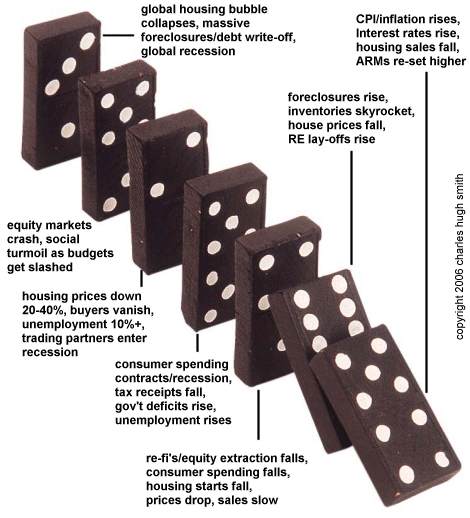


As we discussed yesterday, the entire system is built on a series of incentives to obfuscate or hide risk and then pass the risky asset on to the next player.

--The borrower lies about income and creditworthiness, hiding the true risk.
--The broker happily goes along, otherwise the loan won't fund and he won't get paid.
--The lender goes along in order to reap a fat profit from selling the loan to Wall Street.
--The ratings agencies go along in order to earn their fat fees for masking risk-laden debt with a AAA rating.
--Wall Street goes along to sell the bundled loans and derivatives constructed from the loans to investors seeking a "safe, AAA investment."
--Traders and sales reps distribute the asset as "safe" around the globe in order to reap huge commissions/trading profits.
--Politicians look the other way as Wall Street ponies up big-bucks contributions.
--The Mainstream Media gloss over the layers of risk so as not to offend their big-bucks real estate/banking advertisers.

These incentives to cloak the true risks of loans aren't just built into the home mortgage market--they're built into all loans which have been bundled and sold as "low-risk": student, auto, commercial real estate, corporate buy-outs, you name it.

Consider a spacecraft as a metaphor for a system which is designed not to fail. There are two basic ways the spacecraft can fail: a single essential component can fail, or a single failure can trigger a domino-like cascade which leads to the entire craft failing.

If the craft's single oxygen tank ruptures, the crew dies. 99% of the spacecraft is still working perfectly, but the system failed in its primary purpose: keeping the crew alive.

If an electrical failure causes a cascade of subsystem failures, you end up with the same result: a powerless craft and a dead crew.

Redundant systems--as in Nature, two eyes, etc.--are one safeguard against catastrophic system failure. Thus having the oxygen in two separate tanks minimizes the risk that a tank leak could kill the crew.

Inserting breaks in dependent systems, e.g. "spacing the dominoes far apart" also works to stop a subsystem failure from cascading into others. Thus an electrical breaker wills top a short circuit from bringing down the entire electrical system.

In a way, this is the idea behind the "checks and balances" of modern republics. A bicameral legislature provides a kind of "breaker:" if one legislative body passes some harebrained scheme, hopefully the other house will kill it or at least water it down. Similarly, the President can veto the lamebrained idea. If he/she fails to do so, then as a final "breaker" the Supreme Court is supposed to step in and protect the Constitution and the Republic by striking down the law. (The Patriot Act shows how even this system can fail.)

So where is the redundancy in the global financial debt machine? Where are the checks and balances, or breakers? There are none. Here and there, you find a bit of redundancy, but nothing on a global scale.

For instance, there are still small local banks and credit unions in the U.S. which fund and service their own home mortgages. (Yes, they do exist.) But the number of mortgages funded and serviced by such responsible lenders is small compared to the trillions in risky mortgage debt dumped on the world markets.

Theoretically, there are government regulators who are supposed to act as checks or breakers against abuses or fraud in the system. But in the past seven years we have seen a wholesale surrender of responsibility by the Federal Reserve, the SEC, the FDIC, etc. Individuals within each agency issued clarion calls of concern, but their political masters didn't want to rock the boat. The breakers failed to go off, insuring systemic failure.

There is little or no regulation which requires transparency of risk or even the market valuation of loan-based assets such as CDOs. The ratings agencies were supposed to objectively assess risk, but with their fees dependent on issuing AAA ratings to 90% of all debt instruments, this supposed "check" failed catastrophically.

Here then is a system close to the perfection of instability: the risks are cloaked, and there is no redundancy or breakers in place to stop the dominoes once the first one falls. The subprime domino fell last year, and now other dominoes are falling rapidly, as described in the above quote from the Wall Street Journal article.

Roubini's article describes 12 dominoes; you can choose whatever number you prefer, but they're all falling, and there is nothing to stop them except more attempts at masking the risks of default or masking the defaults themselves.

All such attempts will of course eventually fail.

It would be better for all of us if the whole rotten structure collapsed in a month: Moody's, Fitch, et. al. confessed their liability and declared bankruptcy, investment and money-center banks admitted their insolvency by marking all the "off-balance sheet" assets they've been hiding to actual market, 10 million homeowners who can't afford their mortgages demanded market valuations on their houses and lower rates from lenders, monoline bond insurers gave up the delusion they will ever be solvent and declared bankruptcy, etc.

Yes, trillions would be lost/written off. But the trillions have already been lost. All we're doing is stretching out the pain. Such a confession of reality by all players would clear the decks of bad debt and allow regulators to start from scratch. No more appraisers paid by those whose only interest is a falsely high appraisal; another model would be put in place.

No more ratings agencies paid by investment banks for masking the real risks of debt being packaged. A new rating system could be put in place, perhaps based on the subscription model which worked well until the SEC abolished it. No more CDOs, CLOs, etc. No more hiding of assets off-balance sheet, "marked to myth"; all assets will have to be stated and marked to market at the end of each trading day.

Such reforms are just common sense; nothing fancy or arcane is required.

Will it happen? No. There are too many powerful players hoping the trillions can be restored with some fancy footwork, i.e. "restoring faith in the system." They will continue to obfuscate the risk and mask the bad debt, for years if necessary. Only when the entire system finally implodes will a reckoning take place.

When will that occur? Nobody knows. Some think it might happen soon, in a matter of months. My best guess is four or five years hence, for it will take that long for the "crew" to try twirling every useless knob in the hopes of staving off system failure.

You can't restore stability to an inherently unstable system.


NOTE: contributions are humbly acknowledged in the order received. Your name and email remain confidential and will not be given to any other individual, company or agency.

Thank you, Banyan Ocean LLC ($20), for your much-valued support of this humble site from N.Z. I am greatly honored by your contribution and readership. All contributors are listed below in acknowledgement of my gratitude.

Read more...

Tuesday, February 12, 2008

Greed, Fraud and Duplicity: How the Housing/Lending Bubble Inflated


Author Richard Bitner was kind enough to send me a copy of his new book Greed, Fraud & Ignorance: A Subprime Insider's Look at the Mortgage Collapse which I can recommend to you as a concise account of the entire subprime lending bubble and implosion.

Bitner has a unique view of all the players, as he was a major subprime mortgage broker for many years prior to the implosion. He was unashamed to describe himself as a subprime mortgage broker before the excesses consumed the business, as he felt that even though the system was less than perfect, the subprime market served a valuable purpose to those with impaired credit. With proper vetting and risk management, the higher-risk borrowers were rejected and those whose credit history supported their ability and willingness to pay could buy a house by paying higher interest rates.

I can't summarize a 191-page book in a few paragraphs, but this is my primary take-away from this very clearly written account:

When everybody from the borrowers to Wall Street began gaming the system, all credibility was lost. It is still lost, and will remain lost until the entire model of payment for all players is radically restructured.

Bitner reports that up to 80% of all subprime loan applications were rejected by honest subprime mortgage brokers. This stunning statistic suggests the frenzy which overtook the nation as people who were clearly below-average credit risks stormed the housing market, trying to get in and get rich just like everybody else.

While there is nothing remarkable about this human behavior--we all want to get in on the Get Rich Quick Scheme of the Day--what is remarkable is that Wall Street and the credit ratings agencies went for the Get Rich Quick scheme in the same frenzied fashion. (OK, so there's nothing remarkable about that, either.)

But unlike a subprime borrower, Wall Street and the rating agencies (Moodys et. al.) could approve their own terms and grant themselves a high rating. In Bitner's memorable description, "Not only was the fox guarding the henhouse, he hired a contractor and built a separate wing so he could feast at his convenience."

Bitner describes how Wall Street's securitization of mortgages fragmented what was once an integrated process. The granting of a mortgage used to be--and still is, in smaller local banks--an integrated process within the bank. The loan officer verifies employment and income of the borrower, hires a trusted local appraiser, confirms the loan meets all underwriting requirements, confirms the down payment wasn't borrowed, etc.

As Bitner writes:

"In addition to creating a renewable source of capital, mortgage securitization helped fragment the industry. An entire process originally performed by one entity was divided into separate components. This fragmentation gave each player a claim of plausible deniability."

A great strength of this book is its clearsighted exploration of the greed, fraud and duplicity which was engineered by every player. Interestingly, the automation of the mortgage process via computer risk modeling--a credit score of 580 enabled this mortgage product to be approved, while a score of 620 gained approval for this product, and so on--allowed brokers to fudge and finesse applications to squeak in and get approved.

With the help of a less-than scrupulous mortgage broker, the borrower could "forget" items which might lower his credit score. The broker, knowing the underwriting rules, might write the loan only in the wife's name, as her credit score was 20 points higher. There were innumerable ways to game the system and get a loan approved.

The entire system flourished because the incentives were all wrong. The borrower got the money by lying,"forgetting" or fudging. The broker only made money by getting a lender to fund the loan, while the lender only made a fat profit if the mortgage was sold to Wall Street for securitization, and Wall Street only made money if they sold the mortgage-backed security to an investor with a high rating from Moodys or Fitch, who only made money if they rated the MBS as AAA regardless of its true risk.

It wasn't always this way. As Bitner explains, the ratings agencies in the 1970s received income on an entirely different subscription model. The SEC (securities and Exchange Commission changed the model: "Instead of buying a subscription, the companies would pay the agencies for rating their debt. In hindsight, this may have been the single greatest mistake in the history of the SEC."

Back in the early 90s, private investors were the only buyers of subprime debt. Obviously, if you sold a poor-risk loan to an investor who was subsequently burned, that was your last sale to that investor. Word would get around and your business would dry up and blow away. But once Wall Street got into the act, according to Bitner the demand for mortgages to securitize was insatiable.

And to feed this ravenous, supremely profitable maw, the mortgage industry conjured up a raft of new products to sell--products which were scored for risk like traditional mortgages. Only the new "exotic" loans were highly risky--a fact which every player from the broker up to the rating agencies cloaked for their own benefit.

The rating agencies played a huge part. Bitner quotes two sources as snapshots of the agencies' power to manipulate the system:

"Only slightly more than a handful of American non-financial coprorations get the highest AAA rating, but almost 90% of collaterialized debt obligations (CDOs) that receive a rating are bestowed such a title. Are we willing to believe that these securities are as safe as those of our most honored corporations?" (Josh Rosner)

"There are two superpowers in the world today in my opinion. There's the United States and there's Moody's Bond Rating Service. The United States can destroy you by dropping bombs, and Moody's can destroy you by downgrading your bonds. And believe me, it's not clear sometimes who's more powerful." (Thomas Friedman)

Bitner does an excellent job of describing the inherent conflicts of interest in the entire mortgage lending and selling of MBS process:

"In some ways, the investment firm-rating agency relationship mirrors the dysfunctional nature of the broker-lender relationship. If the broker is having trouble getting a deal approved, his account executive will tell him how to structure the loan. When the investment bank has a security filled with garbage loans, the agencies advise then how to structure the deals in order to maximize profit.

The agencies defend themselves by issuing 100-page disclaimers to go with the ratings. It's equivalent to building a car and sticking a label on the inside that reads, "We want you to know we can't stand behind anyone who had anything to do with the assembly of this vehicle. If the steering wheel falls off, motor falls out or any bodily injury comes to you as a result of driving this car, just remember, we told you so."

You have probably read about each piece of the subprime lending puzzle somewhere, but this book puts the puzzle together in admirably clear fashion. You can download the first chapter for free on the website The Mortgage Insider where you can of course buy a copy as well.

As with all books I discuss here: I receive no compensation, fee, commission, etc. from the author or publisher. I decide whether to discuss the book on its merits to readers. If you purchase a copy of Greed, Fraud & Ignorance: A Subprime Insider's Look at the Mortgage Collapse via this amazon.com link, I receive a 3-4% slice which costs you nothing (amazon pays me, your price is the same whether you buy it from this site or not.) If you prefer to buy a copy from the author's site or another bookseller, I receive nothing, which is fine with me.

This book provides the most succinct account of the subprime complex I have found. Others have done great jobs with one slice or another, but this book covers it all, from appraisers who have to play ball if they want to survive to duplicious brokers all the way up to the Federal Reserve's role.

Bitner concludes with some suggestions on fixing the mess. While I generally agree with his ideas, I don't think trust can rebuilt without the entire edifice being rebuilt from the ground up. The entire inherently conflicting models of payment for the rating agencies, appraisers, brokers, lenders, and Wall Street all have to be radically changed.

The model will simply blow up again unless appraisers are paid for the accuracy of their appraisals, not by those with a vested interest in the highest appraisal. Ditto for the ratings agencies and everyone down the line. As long as everyone only gets paid by foisting off high-risk debt onto the next chump, the system is destined to fail, and can never regain the trust of global investors.

Is such a rebuild from the ground up possible? Not at this time. The entire edifice will have to fail catastrophically before the players will accept a new regulatory world.


NOTE: contributions are humbly acknowledged in the order received. Your name and email remain confidential and will not be given to any other individual, company or agency.

Thank you, Richard M. ($20), for your gracious support of this humble site from N.Z. I am greatly honored by your contribution and readership. All contributors are listed below in acknowledgement of my gratitude.

Read more...

Monday, February 11, 2008

Advice and Predictions


Every once in a while you see a photo which deserves to be in either National Geographic or a museum photography exhibit
. Correspondent John U. was kind enough to send this photo he took at the Burning Man event in Nevada:


I asked John for a caption suggestion, and he came up with the perfect one: Somewhere under the Rainbow.

As John put it, "it's a right-click world," meaning anyone can grab this for their own use. As my colleague Jeff Blair noted, the Web is a giant copy machine.

Isn't this a great photo? Thank you, John, for enabling others to enjoy it. It inspires me to offer up some advice, but unfortunately I don't have any. I do have some predictions, though, which are easier.

1. U.S. Unemployment will hit 15% within the next four years. The general consensus at the moment is unemployment might inch up from 5% to 6% before everything returns to "growth" wonderfulness.

The whole "unemployment" number is suspect, of course, for it only measures people who have laid off/quit and who are "actively seeking employment" at their local unemployment office. "Discouraged workers" or those out of work longer than six months aren't even counted.

Most people on the unemployment rolls are "between jobs," and so a stable unemployment rate suggests the unemployed are finding other jobs.

Other twists include: self-employed people whose income drops to near-zero are not counted, and a laid-off full-time worker who accepts a part-time job at much lower pay is counted as employed. The non-legal workers in the U.S. aren't counted either, of course. though it is estimated there are 6 to 10 million or even more undocumented workers.

The number of employed in the U.S. is about 138 million. Add in about 7 million officially unemployed and at least 5 million cash/illegal workers, and you get a total workforce of about 150 million. A 6% unemployment rate suggests about 8 million "officially counted" workers would be out of work in the "short, shallow recession" the punditry is predicting.

It's easy to see how the true unemployment rate can be fudged/massaged in a deep recession. All those out of work longer than six months--not counted. Self-employed (Realtors, mortgage brokers, etc.) no longer working or making an income, not counted. "Discouraged workers" (i.e. anyone who stops reporting to the unemployment office) aren't counted, either.

So in predicting 15% unemployment, I am saying 22 million people who would like to be working won't be able to find a real job. But the "official" rate of unemployment at this dire moment may well be 9% or so, as millions of unemployed won't even be counted.

This may sound like a return to the Great Depression. For me, it's simply a return to 1982. Are you 26 years old? Well, the year you were born, 1982, was a nadir for the U.S. economy and its workers. Unofficial unemployment was estimated to be 15%, while the "official rate" hit 10.8%.

While there are significant differences between the early 80s and the present, several conditions are quite similar:

1. Few could borrow money, choking off business expansion and auto and real estate sales.
2. A real estate bubble (modest by current standards) was popping.
3. Energy costs had risen enough to inflict damage on the economy.
4. Global competition was forcing laggard U.S. firms into bankruptcy.
5. Purchasing power was dropping like the proverbial stone.
6. Financial institutions were failing.
7. Cities were edging toward bankruptcy.

So why am I predicting such a high unemployment rate? Basically, the bigger the bubble, the longer and deeper the unraveling/unwinding. Take the biggest real estate bubble in global history and the biggest lending/financial bubble in history, toss in declining purchasing power, a public sector veering toward a cliff of insolvency, a banking sector heading for the same cliff, and a bunch of other negatives covered here and elsewhere in the blogosphere, and it's easy to predict this will not be a "short, shallow recession."

I live in a college town of 120,000 residents (about 35,000 are students). Here are some fine retailers who seem like naturals for this college environment: Ross Dress for Less, Barnes and Noble bookstore, an independent bookstore or two, Eddie Bauer (for the upscale students), and Gap.

Yes, they were all here, but they've all closed. Yes, every one of these "natural" retailers folded shop and left town. So did the local Burger King. If the recession hasn't even started, and a college town has already been gutted by businesses leaving, what do you reckon will happen when the recession deepens? How many other chain stores will be closed as "insufficiently profitable" by corporate HQ desperate to maintain a profit?

And how about when those 10% across-the-board cuts our Governor has proposed to ease the state's "fiscal crisis" (which is basically permanent except during bubbles) hit the University and other agencies? Unfortunately, these government entities' primary expense is employees. There won't be any way to trim the budget without lay-offs. Those 10% cuts will be very painful to those losing their jobs/contracts.

Sadly, it's all too easy to predict a tripling of unemployment. Fewer paychecks leads to reduced spending which leads to reduced taxes which leads to reduced headcount which leads to fewer paychecks, and so on.

Now we get a double-whammy: a consumer recession and a business-investment recession. We all know about the consumer's back against the wall; it's the BusinessWeek cover story Over the Limit. But what about business investment?

Internet: built out.
Software: built out.
Office space: overbuilt.
Retail space: overbuilt.

The same issue has a story entitled, Capital spending hangs in, but for how much longer? Even more interesting is the story: $1.6 Trillion. Now We're Talking Stimulus: That's how much is just sitting on U.S. company books. And for what? Corporations with fat cash reserves aren't doing much for investors—or the economy.

Allow me to explain to the mystified writer of the piece: corporations are holding onto their cash because they don't see any investment opportunities worthy of risking the capital. These folks aren't morons; who would be dumb enough to sink money into anything just as recession is about to grab the throats of consumers, businesses and government? Even Big Oil is worried high oil prices won't last--and they have a point.

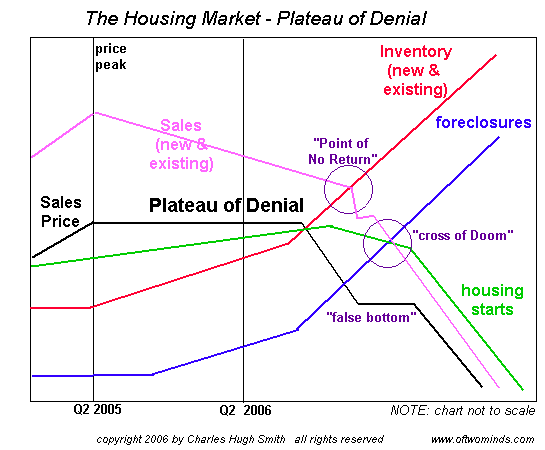
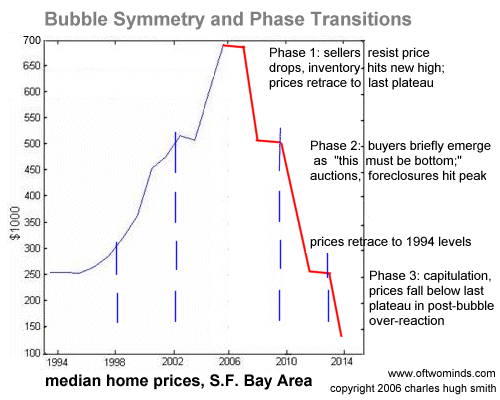
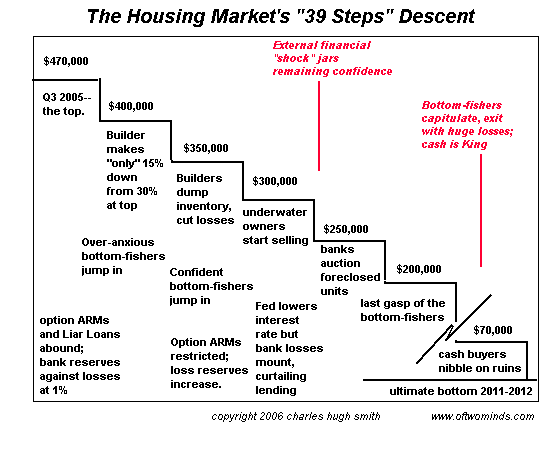
2. Housing will continue down the path I laid out in 2006. I still think these little charts are a good roadmap to the future:


I think we may finally be exiting "The Plateau of Denial" though this is unconfirmed. Continued sharp price declines would be confirmation.


And if that isn't negative enough, then here's one last one to ponder as "impossible":


Back in the good old days of deflating real estate bubbles (say, 1981), many owners had enough equity in their homes that they could "seller finance," i.e. offer the buyer a private mortgage, usually for five years or so, with the idea being the buyer would get a bank mortgage and pay off the private loan once lending to return to normal.

While about 20% of all homeowners own their houses free and clear, and these folks could offer seller financing, the general trend for the remaining 80% is declining equity. If you have to sell, but few can borrow, then what happens to price? If you expect, like many of us do, that the entire global financial markets will remain frozen/in shock/implode, then you don't really know how low prices will go because you won't know when the mortgage market will return to "normal."

If you believe all the financial issues (liquidity crisis, freeze-up of CDO market, etc.) are about to get resolved, then you will find my predictions as absurd today as they were in 2006.

All I can say is: real estate and housing are totally dependent on a freely accessible flow of capital for lending/borrowing. If for any reason people can't borrow $500,000, or decline to borrow $500,000, then houses listed for $500,000 will not sell. Their price will decline to what people will willingly borrow.

The question then becomes: what if few can borrow, or are willing to borrow huge sums? Then the price will have to drop to the point the house makes sense as a business proposition, i.e. market rents enable a better return on capital (investment) to a cash buyer of the house than any other potential investment.

I submit that investment matrix supports my prediction that housing has a long way yet to fall in most global markets. Remove appreciation, add in periods of vacancies, operating expenses, taxes, maintenance and all the other expenses of a rental property and you get a much different investment valuation for housing than you would with a "market appraisal."

Wait a minute, I do have something which might pass for advice, taken from Lao Tzu: The way of the Tao is reversal.


NOTE: contributions are humbly acknowledged in the order received. Your name and email remain confidential and will not be given to any other individual, company or agency.

Thank you, Alexander P. ($20), for your generous support of this humble site from N.Z. I am greatly honored by your contribution and readership. All contributors are listed below in acknowledgement of my gratitude.

Read more...
Saturday, February 09, 2008

Saturday Quiz and More on the Mis-Use of Pyschotropic Drugs


Who is this man?


--Born in Minnesota in 1861 (3 years after MN statehood)
--Died in California in 1947 at the age of 88
--Little formal education, began his career at age 14 as a scout in the Southwest.
--Worked as a mounted messenger for the Western Union Telegraph Company in California and Arizona.
--Traveled in northern Mexico and the American Southwest, including Texas and Oklahoma, earning a living as a buffalo hunter, cowboy, and prospector.
--Served as Deputy Sheriff of Pinal County, Arizona, barely escaping with his life from the Tonto Basin Feud.
--Married in 1884 and settled down to tend to an orange grove in Pasadena, California.
--Moved to South Africa in 1893 and joined the British South Africa Company as a scout. He became well known in Africa for his ability to track, even at night, and the Africans dubbed him He-who-sees-in-the-dark
--While in Africa he fought in four wars, including the Second Boer War as a British soldier. He was awarded the Distinguished Service Order by Britain.
--Traveled to Alaska to prospect in the Klondike Gold Rush.
--Was befriended by Teddy Roosevelt and was an early ardent conservationist.
--Engaged in counterespionage for the Allies in World War I.
--Struck oil 1923 at Dominguez Hill, California, becoming wealthy.
--Much of his later life was spent supporting conservation organizations he had helped found such as American Committee for International Wildlife Protection (now a committee of the World Conservation Union).
--Provided inspiration to the Scouting movement.


Here's the Answer.

Special thanks to long-time contributor John U. for bringing this amazing life to my attention.


Correspondent L.S. sent in this personal account of the wanton distribution of powerful psychotropic drugs, their side effects, and also suggested a book on the topic.

I had wanted to respond to your essay on prescription drugs the other day. My 86 year old mother recently spent 2 days in the hospital due to a bad reaction to Fosamax. That little adventure cost Medicare (i.e., the taxpayers) $16K. After querying the doctor about the effectiveness of this drug, I suspect exercise with light weights would be more beneficial.
And the doctor’s "give it a try" attitude with anti-depressants for may dad was so disastrous I had to demand the doctor take him off the stuff. My mom would call me at work in tears, saying dad had become a monster and could I please come over right now and help.

A good friend with two ruptured disks in his back was prescribed anti-depressants because "some of the pain might just be in his head". After a miserable 6 months he took my advice and threw the stuff in the trash. Another friend was in counseling trying to deal with her mother’s affliction with Alzheimer’s, and the family problems this brought about. By the second session, the counselor wanted to prescribe anti-depressants to my friend. I said to her, "let me get this straight, you are going to alter your brain chemistry in order to deal with a transitory problem?". I’m sure you know of some similar cases too.

There’s a book I’ve been meaning to read on the subject which sounds pretty good:
Artificial Happiness: The Dark Side of the New Happy Class

Thank you, John U. and L.S. for these contributions to our understanding.


Readers Commentaries has been updated, with plenty of dissent and interesting perspectives on Hillary, pharmaceuticals, Big Media Meltdown, and more.


NOTE: contributions are humbly acknowledged in the order received. Your name and email remain confidential and will not be given to any other individual, company or agency.

Thank you, William S. ($10), for your very gratifying support of this humble site. I am greatly honored by your contribution and readership. All contributors are listed below in acknowledgement of my gratitude.

Read more...
Friday, February 08, 2008

One Reader's Account of Psychiatry and Drugs


Reader S.W. sent in this personal account of one family's experiences with American psychiatry and its "default setting" prescriptions of powerful, potentially dangerous psychotropic drugs.
Some readers of my Wednesday entry, The Drugs Which Drive You Crazy felt I had veered over the edge to hyperbole. Please read this account, which is hardly unique in today's U.S.A., and then tell me the American system of mental health via pharmaceuticals is healthy.


The reason I'm writing is that today's entry causes me to recall a personal nightmare with my teenage son and big pharma a few years ago. I don't like to think about it, it was a very harmful and painful experience. Happily I can say it is all behind us now. I want to thank you for warning people about the psych drug racket. From my personal experience I can only conclude that psychiatrists are nothing more than sales reps for pharmaceutical companies. (Emphasis added--CHS)

My son was having big trouble by the time he hit High School. Instead of doing schoolwork he sat in class memorizing japanese alphabets and pi. He just didn't care about the curriculum or anything else and because of his bizarre behavior he was referred for counseling. Then he was referred to a psychiatrist, and they immediately diagnosed him with paranoid schizophrenia and started him on a long series of drugs that had heartbreaking side effects and made no real improvement in his 'affect'. I had to pull him out of school. I am ashamed to say we had him warehoused in the back room, and it seemed there was no hope.

I would never have questioned the experts, and this could have gone on forever if it were not for the fact that a very similar child in the family was identified as being on the autistic spectrum. I made a great effort to have him diagnosed properly, and for over a year I never talked to my son about what I suspected as I didn't want to influence the process. I took my son to no less than three neurologists, and after a lot of testing he was diagnosed with a neurological disorder called asperger's syndrome.

When I went back and explained this to the shrinks, they refused to consider the new diagnosis and were very resistant to discontinuation of meds. There seems to be a disconnect between neurology and psychiatry when it comes to autism. Although my experts trumped their experts, they were insistent that the new diagnosis was a 'fad' and that I was just grasping at straws.

I was surprised at their opposition, as I had done everything right to get a second diagnosis. My son had just turned 18 and when I went with him to his appointments to discuss this, they treated me as if I was meddling in the affairs of an adult patient, and recommended that he needed 'case management'. I found out from reading the shrink's reports that my son's original diagnosis was based on 'negative' symptoms (i.e., flat affect, depression) and their opinion that he was concealing paranoid and delusional ideation, which he had never admitted to having.

They did not want to help with discontinuation, and when they finally relented and agreed to a 'trial' discontinuation, the prescription for the tapering was very rapid. I learned from reading a book on the subject that this is a common trick they use to cause discontinuation to fail, because you must taper from anti-psychotics very slowly or you can actually cause psychosis. I used a different formula for discontinuation, based on a self-help book. I was unsure throughout this period that I was doing the right thing, as I had no support. I had nothing to follow but pure intuition.

After discontinuing, my son shed all the horrible side effects. Over time his personality reappeared, after years of being a zombie. He is now healthy, happy, and pursuing his special interests, such as teaching himself Japanese and enjoying fine tea. I hope one day he can go back to school, but that's up to him.

I know there are some people who may need medication for real mental illnesses, and I am not anti-treatment. I am not a scientologist. All I am saying is that when faced with such a critical issue, parents must educate themselves, trust their intuition, and get another opinion before blindly accepting diagnoses and drugs from shrinks. Prescribing drugs is how psychiatrists make their $$$.

In my view, this reader's experience reflects the terrible dilemmas in the American mental health complex which have been accepted as "normal"--until you or your family are caught up and badgered to comply. Then your perspective rapidly undergoes a revolution.


The responsible parties include not just a medical profession all too enamoured of prescriptions and a pharmaceutical industry all too eager to push the prescriptions and not eager at all to test drugs in combination with other drugs, e.g. OxyCotin and Valium, which recently killed actor Heath Ledger--but the American public, too.

For the public all too often demands a "pill-fix" for their medical problems, and demands the impossible of medical professionals pressured to "do something" when all too often the "first, do no harm" step would be to eliminate all adverse environmental influences such as high-sugar and junk food diets, TV and video games, sedentary lifestyles, etc., all of which are in the direct control of the patients and their families. Doctors can prescribe such "treatment" but the patient all too often ignores this "prescription" in favor of a simple (but often horrendously costly and ineffective) "pill solution."

Clearly, S.W. did the right thing: she pursued a correct diagnosis of a difficult-to-diagnose condition in the face of opposition, and then sought to educate herself on treatments, side-effects, etc. In other words, there really is no alternative to taking responsibility for your own health and the health of your family.


NOTE: contributions are humbly acknowledged in the order received. Your name and email remain confidential and will not be given to any other individual, company or agency.

Thank you, Philip P. ($10), for your much-appreciated support of this humble site. I am greatly honored by your contribution and readership. All contributors are listed below in acknowledgement of my gratitude.

Read more...
Terms of Service

All content on this blog is provided by Trewe LLC for informational purposes only. The owner of this blog makes no representations as to the accuracy or completeness of any information on this site or found by following any link on this site. The owner will not be liable for any errors or omissions in this information nor for the availability of this information. The owner will not be liable for any losses, injuries, or damages from the display or use of this information. These terms and conditions of use are subject to change at anytime and without notice.

RE: European Union AI Act, and Our Use of Generative AI Tools and Agents Policy

All text on this site is composed by Charles Hugh Smith or by a credited guest-author. No Generative AI Tools are used in the composition / writing of any text or graphic content created by Charles Hugh Smith. This site deploys no AI agents or generative AI tools. This site is not responsible for the disclosures, use or non-use of AI agents or generative AI tools in advertisements displayed by Investing Channel or other ad placement services.

Audio files generated by text-to-audio transcription tools are identified as such.

Our Privacy Policy:

Correspondents' email is strictly confidential. This site does not collect digital data from visitors or distribute cookies. Advertisements served by third-party advertising networks such as Investing Channel may use cookies or collect information from visitors for the purpose of Interest-Based Advertising; if you wish to opt out of Interest-Based Advertising, please go to Opt out of interest-based advertising (The Network Advertising Initiative) If you have other privacy concerns relating to advertisements, please contact advertisers directly.

PRIVACY NOTICE FOR EEA INDIVIDUALS

This section covers disclosures on the General Data Protection Regulation (GDPR) for users residing within EEA only. GDPR replaces the existing Directive 95/46/ec, and aims at harmonizing data protection laws in the EU that are fit for purpose in the digital age. The primary objective of the GDPR is to give citizens back control of their personal data. Please follow the link below to access InvestingChannel's General Data Protection Notice.
https://stg.media.investingchannel.com/gdpr-notice/

Notice of Compliance with The California Consumer Protection Act

This site does not collect digital data from visitors or distribute cookies. Advertisements served by a third-party advertising network (Investing Channel) may use cookies or collect information from visitors for the purpose of Interest-Based Advertising. If you do not want any personal information that may be collected by third-party advertising to be sold, please follow the instructions on this page: Do Not Sell My Personal Information.

Regarding Cookies:

This site does not collect digital data from visitors or distribute cookies. Advertisements served by third-party advertising networks such as Investing Channel may use cookies or collect information from visitors for the purpose of Interest-Based Advertising; if you wish to opt out of Interest-Based Advertising, please go to Opt out of interest-based advertising (The Network Advertising Initiative) If you have other privacy concerns relating to advertisements, please contact advertisers directly.

Our Commission Policy:

Though I earn a small commission on Amazon.com books and gift certificates and gold (BullionVault) purchased via links on my site, I receive no fees or compensation for any other non-advertising links or content posted on my site.

Copyright Notice:

All original images (Drawings and Photographs), text (essays, books and works of fiction), audio and video recordings, musical compositions, graphic design, graphic design elements and HTML coding on this site are the copyrighted work of Charles Hugh Smith unless otherwise credited or noted. They are published as information for the private use of site visitors, and any reproduction or redistribution of this content or coding in any media in any format or distribution channel (text, audio, video/film, web) without the written permission of the copyright holder is strictly prohibited. All rights in all media reserved globally.

  © Blogger templates Newspaper III by Ourblogtemplates.com 2008

Back to TOP