





Wednesday, May 07, 2008

Fragility, Bottlenecks and Brittleness


Three analogies, same idea: our industrialized, globally interlaced economy is extraordinarily dependent on a handful of resources and supply chokepoints which are highly vulnerable to disruptions.

I have touched on this before ( Brittleness, January 29, 2007) and now longtime contributors Albert T. and Riley T. have each submitted further examples.

We might recall the the Pareto Principle (February 19, 2007) here, which expresses the truism that 20% of the causal factors/actors bring about 80% of the consequences. Put another way, the "vital few" (20%) influence effects more than the "trivial many" (80%). The corollary, the 4/64 rule, indicates that a mere 4% can trigger 64% of the effects.

"This is a special case of the wider phenomenon of Pareto distributions. If the parameters in the Pareto distribution are suitably chosen, then one would have not only 80% of effects coming from 20% of causes, but also 80% of that top 80% of effects coming from 20% of that top 20% of causes, and so on (80% of 80% is 64%; 20% of 20% is 4%, so this implies a "64-4 law")."

That suggests that a mere 4% decline in oil production could create massive consequences-- ditto for 4% shortfalls in corn, wheat, soybeans, etc. Indeed, the grain shortgages sweeping the globe appear to have been launched by just this sort of seemingly modest gaps between demand and supply.

We all know we're virtually enslaved to petroleum, but Riley T. suggested a scenario which depicts a vulnerability few contemplate:

For years I have been thinking of our large cities as large heavily populated islands. All things to do with modern civilization are imported, ( electricity, food, petroleum products, water and most every thing else ) and all waste products have to be exported.

The large eastern cities have infrastructure that is 100-150 years old.

This is going to be a lot of fun to watch. My favorite scenario is New York or Chicago in the winter as an Arctic Clipper brings temperatures down to -25 F. for only two days while the power is out. The buildings freeze, the pipes burst and millions of homes become uninhabitable. This from a small problem that lasted only two days. (emphasis added)

Riley followed up this list of oil importers and producers, drawn from the energy shortage website:

I compared the top 15 producers to the top 15 consumers and made a list of the countries that were on the consumer list and not on the producer list. The countries that were on the second list and not on the first by order of total consumption are:


CONSUMERS
3. Japan
5. Germany
6. India
9. S. Korea
12. France
14. Italy

The countries on both the top production list and consumption list were:

CONSUMERS
1. United States
2. China
4. Russia
7. Canada
10. Saudi Arabia
11. Mexico
15. Iran

I did this to support my observations;
Japan, the largest oil user with zero oil production and considering they import most of their food is on borrowed time.

Germany, France and Italy are on the verge of crashing, big oil users almost zero oil production. As go these three goes Europe.

The United States imports about 11-12 million barrels a day. Why any one would continue to take dollars is hard to figure until you look at this list. What else would be good to take. Euros?
I think this exercise points out the precarious position that the industrial countries are in, oil consumption is a good indication of true industrialization and these 15 countries are it.
Having tens of millions of low paid workers doesn't make you an industrialized country.

Thank you, Riley. Just as a lagniappe, here is a list of the top 15 sources of U.S. imported oil:

Total Petroleum Imports Top 15 Countries (EIA, 5/28/08)
Total petroleum is about 11 million barrels a day (thank you, Venezuela, #4) which presumably includes gasoline (yes, we also have to import that, too) but not natural gas.

Albert T. checked in with this report on the absolutely essential commodity you probably never heard of: potash:

China caught in potash crunch:
(Excerpt:)
"The global trade in potash is even more concentrated than OPEC for oil, with just two syndicates dominant: Sinagpore-based Canpotex, which manages sales of the three North American majors (Potash Corporation, Mosaic, and Agrium), and Minsk-based BPC, a joint venture combining Uralkali and Belaruskali."

"As population growth drives demand for foodstuffs, and the arable land available to supply food shrinks, it is the mineral fertilizers farmers use that help cover the gap between consumer demand for calories and the productivity of farm land to supply it. Thus, the biggest consumers of potash are the hungriest - China and India, followed by Brazil.

Nature has not endowed these countries with the sub-soil resources of potash to meet their own requirements. But with just two syndicates in control of trade, and just three major importers, the global feast of foodstuffs is driving potash demand far faster than the miners can produce it. "
In an announcement on April 17, it was revealed that Chinese importers of potash have agreed on a price of about US$650 per tonne, delivered from Russia by sea. This is higher than the Indian benchmark price of $625 agreed just weeks ago. It is $400 per tonne above the price of the expiring Chinese contract, signed a year ago. The term of the new pricing deal is just eight months. The volume of deliveries for this period will be just 1 million tonnes, half of the 2007 contract volume over a 12-month period.

"This week in Moscow, Petrov claimed that a price of $1,000 per tonne was approaching "rather fast". He intended Chinese potash buyers to understand that they may have to outbid the Indians with a premium. If they don't, the potash will sail elsewhere."

(End excerpt.) This is Albert's comment:

Ergo, not enough for all, so bid against each other. What if exports were banned, and the ban was enforced? Considering the concentration of resources it would be doable, ergo Russia/Belarussia ban exports while Canada and US initiate some sort of a subsidy for farmers at $800 or so a ton while imposing export taxes on it at a rate of say $400 dollars making it necessary anyone bidding outside the countries to pay at least $1200+. Even without all this the harvest yields on the margins will be reduced by higher costs/lower supply.

Thank you, Albert, for alerting us to the shortage in a critical agricultural commodity.

Is fertilizer all that important? According to a variety of sources, the average yield for maize/corn in developing countries (i.e. those who can't afford fertilizer or can't get it logistically to farmers) is 30 bushels of corn per acre, compared to 150 bushels per acre in the heavily-fertilized U.S.

Five times the yield suggests a "green Revolution" entirely dependent on a limited supply of fertilizer ingredients (which include oil) that must be shipped across the globe by burning petroleum.

One of the "essential books" on my list (found in the books/film link at the top of the page) is The Future of Life E. O. Wilson. Wilson uses the analogy of a bottleneck to communicate the fact that environmental degradation is causing widespread extinctions of species. As the world industrializes and burns through its remaining rain forests and oil, pollutes rivers, paves over habitats with developments, etc., then only some species will emerge on the other side, so to speak, of Peak Oil/peak human population/peak food/peak everything.

This is a sobering concept, for surely humanity itself will have to pass through this same bottleneck, and pass through it with dwindling supplies of the very commodities which enabled our population to explode from less than abillion to over 6 billion in a historically brief time period.

In summary:

1. The Pareto Principle suggets a mere 4% of causal conditions can leverage huge consequences on 64% of a market.

2. The smaller the number of sources and suppliers, the longer the supply chain and the more "just in time" that supply chain is, the more vulnerable end consumers are to even minor disruptions in that supply chain.

3. Bottlenecks can become chokepoints. The Strait of Hormuz and the Strait of Malacca are well-known (oil supply) shipping chokepoints. Other bottlenecks include refineries, natural gas ports, large ports for the shipment of fertilizer, grain and oil, key electrical grid nodes, etc.

Devil's Advocate department (and an important one it is here at OTM): Frequent contributor J.F.B. sent in this story on the unregulated oil futures and derivatives markets, which may be a key driver behind the recent spikes in oil prices:

PERHAPS 60% OF TODAY'S OIL PRICE IS PURE SPECULATION (Financial Sense)

For more on Riley's concept of mega-cities as islands, please see the excellent book on the rapid growth and staggering vulnerabilities of mega-cities/mega-slums: Planet of Slums by Mike Davis.

Two new wonderful recipes have been added to What's for Dinner at Your House?: Simple Chicken Tajine (Morocco) and Beef and Barley Vegetable Soup. Check them out.
Readers Journal has also been updated: new insights and a mysterious, strangely engaging poem.

Thank you, James M. ($25), for your much-appreciated contribution via U.S. Mail to this site. I am greatly honored by your on-going support and readership.

Read more...
Tuesday, May 06, 2008

Has the Faltering Dollar Reached Maximum Pessimism?

Pessimism on the U.S. dollar is extremely high. Many commentators/analysts are talking up a doomsday scenario in which the dollar loses its status as reserve currency and plummets 50% or even 2/3 from its current value against other currencies (euro, yen pound, Chinese RMB, etc.)

Why do we care if the dollar plummets? Since the U.S. imports $500 billion petroleum and $2 trillion in other goods, then a collapse in the dollar would require exporters to raise prices in dollars lest they go bankrupt. Fom the U.S. side, we would experience stupendous price jumps in everything we import--most importantly, petroleum, which fuels our entire economy from agriculture to transportation.

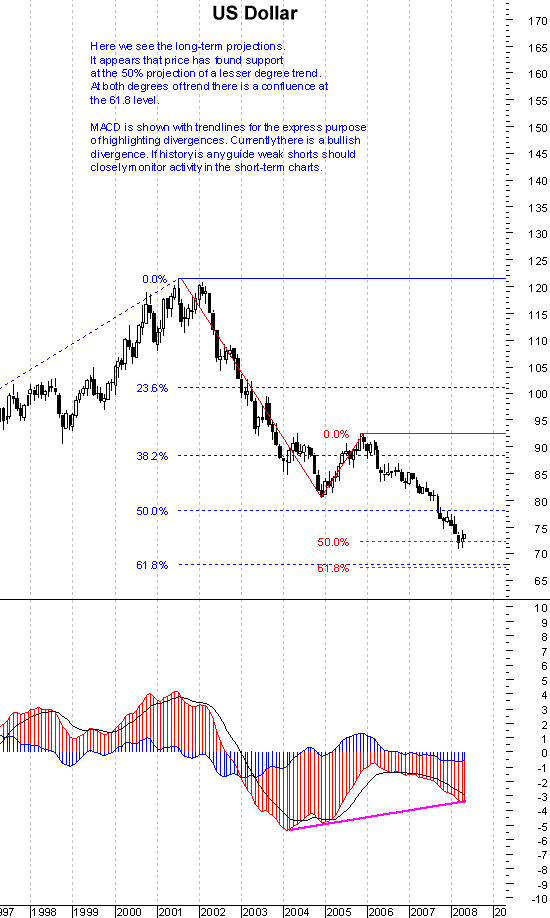
As the dollar has lost 40% of its value in the past few years (falling from 120 to 72 relative to other currencies, as measured by the DXY Dollar Index), the pernicious effects have extended far beyond the obvious prices increases in imports. Astute reader Viperbear observed that the dollar's depreciation played a part in the U.S. housing bubble:

"One of the keys to keep an eye on is the value of the dollar. Home prices skyrocketed on a declining dollar over the last decade and if the dollar regains much of the strength that it lost over the last 10 years, I expect home prices to plummet accordingly.

I am not expecting any sort of real estate bottom until at least 2012. "

There are only two fundamental economic conditions which would cause the dollar to rise relative to other world currencies:

1. The economies of the European Union, Japan, Britain and China fall even faster and harder than the U.S. economy, making the dollar a relative safe haven (the key word being "relative")

2. Interest rates rise in the U.S. to the degree that real yield (interest minus inflation) exceeds the inflation-adjusted interest available in other currencies and nations.

Since neither of those conditions appear to be operative at this point, I am skeptical of announcements that this is the bottom of the dollar's long painful fall. But then fundamental conditions don't always translate into price or relative value, so I asked frequent contributor Harun I. for a technical view of the notion that the pessimism stalking the U.S. Dollar was so extreme that it was signalling a reversal.

Of the many charts Harun was kind enough to submit, I have selected four to illustrate the points made in his commentary. All four charts are linked below; here are Harun's comments:

"Like all things pessimism is relative. If we are long and prices are rising those short the market are pessimistic about the outcome of their trade and vice versa. For the trend-following trader/investor there is no pessimism, only opportunities to profit from others emotionally driven mistakes.

I have provided charts with some commentary. A complete discussion of the dollar wouldn't have been complete without a review of at least some of the major components of the index.
Clearly currencies are at historical extremes to the dollar. Momentum indicators in some instances show divergences that may suggest a reversal at the primary level. It is critical to remember that price must confirm (divergences do fail).

While currencies are at relative extremes it is not necessary for them to retreat. They could go to further extremes. Contrary to the spin there are some very serious structural problems. These problems will persist longer than anyone expects, such is the nature of trends.
April's bar ended as a spinning top denoting indecision. If anything we have reach a significant level of uncertainty rather than pessimism.

That speculators are extremely bearish is not supported by actual positions reported in the COT report. Net percent speculative open interest is net short and was increased last week but as you review the chart it is evident that a divergence has occurred and may indicate a shift in psychology. With that said, trader positions correlate to price movement but not to the extent price may move.

From a pure price perspective, at the primary level, no overwhelming evidence of trend reversal is apparent. As summer arrives traders will unwind positions in preparation for vacations. This unwinding may cause a swing. Combine this with an election in November and we may find that not much happens between now and then. However, do not follow the majority, stay vigilante, surprise is the nature of the markets. "

Thank you, Harun, for sharing your analysis and charts. Some readers have noted that these charts are so large they don't fit in typical monitor screens. It's a tradeoff, and I reckon the detail of the charts in large format offsets the requirement to scroll around a bit.


long-term Dollar chart 1
long-term Dollar chart 2
Taking just one of the currencies which has risen against the dollar, here is the yen:
Yen-Dollar
Even though the yen has risen markedly against the dollar, relative to gold it has lost value--as have all other currencies:
Yen-Gold

NOTE: contributions are acknowledged in the order received. Your name and email remain confidential and will not be given to any other individual, company or agency.

Thank you, Roger H. ($25), for your extremely generous third contribution to this site. I am greatly honored by your on-going support and readership.

Read more...
Monday, May 05, 2008

Is Pessimism Extreme Enough to Mark a Housing Bottom? No.

Frequent contributor Harun I. recently posed this question: has the housing market reached the point of "maximum pessimism"? If not, then it isn't the bottom.

Today's post ( More on Catching the Bottom in Housing) was excellent as usual.

My gauge for spotting bottoms is far less sophisticated. The principle of maximum pessimism is a term I thought I had coined but I googled it just to be sure and found Sir John Templeton beat me to the punch.

"Sir John, 92 and retired from money management, calls it the "principle of maximum pessimism." In a nutshell: Don't ask which markets or sectors look attractive; ask which ones look awful and invest your money there. Since most investors don't have the guts to make those tough calls, most haven't enjoyed the success Templeton's firm has over its 50-year history."
As I mentioned in my comments that you used in one of your missives, we are not the the maximum point of pessimism in anything. People are feeling squeezed but are still in a hopeful state. This "hope" is distracting many from responding appropriately in the present moment to reality.

Hope refers to a non-existent future and despair a non-existent past. One cannot not act now in either the past or future but this is where the majority focus their minds.

It is when hope fades and is replaced by despair and loathing, or when the majority of people are fearful about the future because of the past that a bottom will be in.

As a technical trader I can appreciate and use mathematical formulae, however, I still remember Einstein's wisdom:

"As far as the laws of mathematics refer to reality, they are not certain, as far as they are certain, they do not refer to reality."

Few had the courage to buy in 1979 when the true valuation bottom occurred in stocks. In 1998 no one believed a commodity bull market was getting underway. In 2000 very few had the wisdom to sell their equities.

All of these elegant mathematical formulae existed then as they do now, how many will have the discipline to execute rationally when the time comes?"

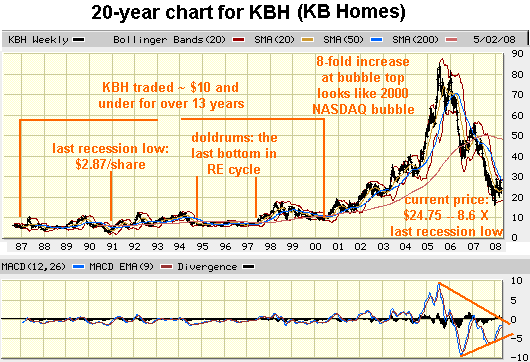
Let's look at homebuilder KB Home as a proxy of the housing market for signs of maximum pessimism.


What is this chart telling us?

1. There are two cycles at work in housing: a macro-economic recession/expansion cycle, and a real-estate appreciation-depreciation cycle. They are not necessarily aligned, as the "doldrums" of the last housing cycle occurred during the white-hot tech boom of 1995-mid-1998.

2. At the last recession low, KBH traded for under $3 a share. It's current price of nearly $25/share is a long way from either the 1991 recession low or its last real-estate cyclical low of under $10.

3. Real estate cycles are long. KBH touched $10/share back in 1987 but did not break decisively above that resistance/support for 13 long years.

4. Housing "bottoms" are "saucer-shaped" and marked by years of doldrums. Lows in the stock market are often marked by sharp spikes of selling called capitulation, which quickly recover as traders and investors realize the world is not coming to an end.

This simply isn't the case with real estate and housing, which are far more widely distributed across the economy and far more illiquid than stocks.

The recent volatility in KBH and other housing stocks are not at all like the flat-lined doldrums that marked previous bottoms; the volatility alone suggests hope is still very much alive. Traders/investors are buying now in the hope that the "bottom" is in--but history and the principle of "maximum pessimism" does not support their optimism.


Two new wonderful recipes have been added to What's for Dinner at Your House?: Caesar Salad and Kofta (Indian-style meatballs).

NOTE: contributions are acknowledged in the order received. Your name and email remain confidential and will not be given to any other individual, company or agency.

Thank you, William S. ($15), for your outrageously generous fourth contribution to this site. I am greatly honored by your on-going support and readership.

Read more...
Saturday, May 03, 2008

Inventory and Foreclosures: Is The Bottom Really In?

The cheery prospect of a "bottom" in housing prices is already being anticipated. Will the bottom be next quarter, or (gasp) all the way out in 2010?

Perhaps one way to tell is to look at the inventory of unsold/vacant houses. (Recall that a vacant house in a declining market is not an rising asset--it's a capital trap.)

Let's start with a snapshot of current trends (Bloomberg): U.S. Home Vacancies Rise to Record on Foreclosures :

A record 18.6 million U.S. homes stood empty in the first quarter as lenders took possession of a growing number of properties in foreclosure.

The vacancy rate, the share of homes empty and for sale, rose to 2.9 percent, the highest since the bureau started keeping count in 1956. About 2.3 million empty homes were for sale, compared with 2.2 million a year earlier, the report said.

There were 129.4 million homes in the U.S. in the first quarter, the study said. In addition to homes for sale, the report counted 4.1 million vacant homes that are for rent and 4.7 million that are seasonal.

Most foreclosures are contained in the report's 'other' category, which includes homes tied up in legal proceedings as well as homes that are empty because the owner is renovating and living somewhere else, according to the Census Web site. There were 7.5 million such homes that were vacant, up from 7.3 million a year earlier, the report said.

Now let's review some basic data I assembled in Will Delinquencies Trigger a New American Revolution? (April 7, 2008)
population of the USA: 303 million (as per US Census website)
number of households: 105 million
Housing units: 126 million
primary residence single-family houses: 75 million (25 million owned free and clear, 50 million mortgages)

An examination of 2003 data from the Census Bureau shows there are 43.8 million second homes in the United States, including 6.6 million vacation homes and 37.2 million investment units, compared with 72.1 million owner-occupied homes. Put all this together and what can we conclude?

1. Perhaps 7 million of the vacant 19 million empty dwellings are true second homes.
2. The other 12 million are vacant but the owners would like to either sell or rent them out.
So how many other homes are in the foreclosure/inventory/vacant pipeline? From my previous entry (link above):
The delinquency rate for all mortgages climbed to 5.82 percent in the fourth quarter. That was up from the 5.59 percent in the third quarter and was the highest since 1985. Payments are considered delinquent if they are 30 or more days past due.

The percentage of subprime adjustable-rate mortgages that entered the foreclosure process soared to a record of 5.29 percent in the fourth quarter. That was up from 4.72 percent in the prior quarter, which had marked the previous high. Late payments skyrocketed to a record high of 20.02 percent in the fourth quarter, up from 18.81 percent — the previous high — in the third quarter. U.S. Foreclosure Filings Double in First Quarter

Almost 650,000 properties were in some stage of foreclosure during the quarter, or 1 in every 194 U.S. households, Irvine, California-based RealtyTrac Inc., a seller of foreclosure data, said today in a statement. The number was 112 percent above a year ago. Nevada, California and Arizona had the highest rates.

Now let's ask: how many more homeowners are at risk of being foreclosed/walking away? I've looked at this question twice in the past two years, and since the data is still valid, so are the conclusions:

Can 4% of Homeowners Sink the Entire Market? (February 21, 2007)
How Many Foreclosures Will Hit the Market? (May 1, 2006)
I know an additonal 5 million homes dumped into inventory of unsold/abandoned/vacant dwellings seems like a lot, but that's only 10% of existing mortgages (50 million) and only 5% of U.S. households (105 million).
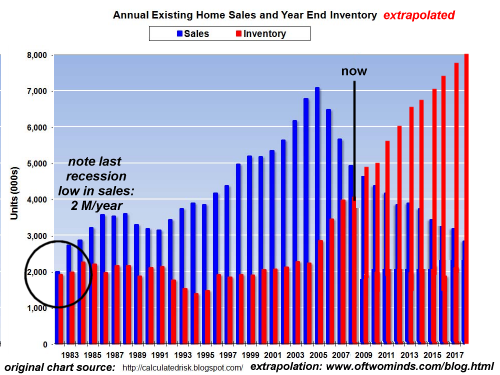
Let's consider a chart I've prepared of inventory and sales, and cover the trends which are firmly in place which make this scenario so likely:

The "happy story" that a bottom is in sight being bandied about is based on fantasies unsupported by powerful trends with a lot more room to run. The happy story requires a belief that sales will stay high enough to absorb inventories that are stabilizing.

Nice, but what if the trends are precisely the opposite? In fact, sales are plummeting and inventories are rising.

Let's consider other trends that are rarely noted but extremely powerful.
1. Most buyers are selling their existing house. New buyers entered the market in the bubble for two reasons: cheap no-down, no-doc lending, and the desire to speculate. (Recall that 40% of all the homes/condos purchased in the bubble years were bought by speculators, some of whom offered the fig-leaf of a "second home" to secure better mortgage terms.)

If buyers are adding another home to inventory, then how does inventory drop? As I detailed in Can 4% of Homeowners Sink the Entire Market?, virtually everyone who is above the poverty line in the U.S. already bought a house. The notion that population growth will magically produce millions of new home buyers is unlikely for two reasons:

2. Stricter lending guidelines and the need for 20% down removes most people from the buying pool. With homeownership at record highs (68% or so), the idea that millions of young people and immigrants will a) find good-paying work in a recession b) have 20% down and c) have a good credit history is assuming a tremendous amount. There is very little data or even anecdotal evidence to support this thesis.

3. Density can rise in recession. As I demonstrated in Brain-Dead Predictions about Housing (January 2, 2008), 5% upswings in population can and do occur without any increase in the number of dwellings. It's called moving back home, doubling up, renting out a room.
This means 5 million U.S. households could quite easily no longer require a separate dwelling. That would push another 5 million units onto the vacant/for-sale/rental markets.


Take 5 million foreclosures (5 million recession-downsized households) and you can easily add another 5 million vacant units to the current 12 million.

Meanwhile, over on the sales side of the ledger, let's look at what happened to sales in the last "real" recession of the early 1980s:

4. Sales dropped to 2 million units a year. And what data suggests this isn't the end-point of the current downtrend?

Put together an inventory of vacant dwellings that could easily top 20 million and a sales per year figure which could easily drop in half and what do you get? A gigantic supply-demand imbalance which will have large effects on price.

I am also surprised few if any commentators note these other factors:

5. There is nothing sacrosanct about a "second home." It can easily become a primary dwelling. As Baby Boomers retire, many will sell their primary residence and move to the second home they already own. And what does that trend do to inventory? It increases it.

6. As Baby Boomers retire, they will liquidate assets to pay for the niceties of life, like "gap" health insurance and a new knee/hip. And what will they sell? How about Mom and Dad's old house, which is currently a capital trap, sitting empty now that they're gone. And how about that rental house we bought in the bubble? Being a landlord is such a hassle. Dump it. The vacation condo? Dump that too before it loses any more value.

The millions of investment properties purchased in the bubble will be offloaded for any number of reasons. Owners will tire of the losses, or tire of being absentee landlords or they'll need to money for retirement or medical costs. Or they'll go bankrupt and the property will be liquidated/handed over to creditors.

And last but not least:

7. Home builders and developers will continue to build more homes, even in a recession. It's build or die, and with the permits pulled and the property sitting there requiring interest payments, there are still incentives to build and dump new homes and condos in "still strong" markets. Let's say new homes drop from almost 2 million a year down to 500,000 a year in the recession. That's still another half-million homes added to inventory.

In conclusion: there is plentiful evidence that sales will continue heading down, perhaps to their previous recession low of 2 million (existing homes) sold per year, and that the inventory of vacant dwellings waiting to be sold or rented will keep rising for a long time to come.
I haven't even mentioned the nightmare scenario, which is money for mortgages becomes scarce. Interest rates may still be low, but if investors no longer care to risk buying mortgages--why gamble your money on the slim chance housing will stop declining in value?--then loans will be increasingly unavailable, regardless of the low Fed Funds Rate. Without cheap, easy credit, very few can afford to buy a house at any price.

All evidence suggests the demand-supply imbalance in housing will only worsen for many years to come. As the saying goes in the stock market: beware trying to catch a falling knife (e.g. falling prices).

Readers Journal has been updated! Just click on the link at the top of the page for a wonderfully diverse array of commentaries on the housing "bottom" and other topics. I received 15 valuable responses about accepting advertising on the site, which I have posted as a separate link.
RS also has a new and utterly fascinating essay by Michael Goodfellow
Hoping Not to Find Life in Space which explores themes of interplanetary exploration, science fiction and artificial intelligence.

Two new wonderful recipes have been added to What's for Dinner at Your House?: Caesar Salad and Kofta (Indian-style meatballs).

NOTE: contributions are acknowledged in the order received. Your name and email remain confidential and will not be given to any other individual, company or agency.

Thank you, James N. ($10), for your much-appreciated contribution to this site. I am greatly honored by your support and readership.

Read more...
Thursday, May 01, 2008

Garbage In, Garbage Out

Our experience is shaped by what psychiatrist R.D. Laing identified as politics. While Laing's initial focus was on family dynamics (his book Sanity, Madness and the Family: Families of Schizophrenics ) and how conflicting demands (contradictory political "necessities") within a family can trigger a breakdown in children, his insights also apply to society at large: Politics of Experience.

Such irreconcilable psychic demands were characterized by Gregory Bateson as a double-bind: Steps to an Ecology of Mind: Collected Essays in Anthropology, Psychiatry, Evolution, and Epistemology.

(I'm showing my age here, as these two titles were on every college reading list in the period 1969 - 1973).

More recently, Noam Chomsky examined the complicity of the media in framing our experience for political/financial gain: Manufacturing Consent: The Political Economy of the Mass Media.

Now let's turn to the real subject of today's entry:


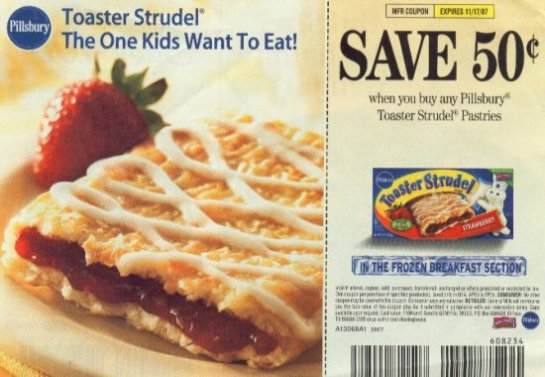
So what does toaster (fake) strudel have to do with these weighty philosophic ideas? Just this: garbage in, garbage out. This "product" is marketed as "food," but it's not food if food is defined as nutritional. This product is "food" in the sense that the human body can process the salt, sugar, fat and refined flour ingredients, but as nourishment this product is worse than eating grass or stems, which at least would do little harm: the high salt, fat and sugar and zero fiber and nutrients in this product actively create ill health.

Simply put: this product is garbage. Garbage in (processed non-nutritious calories), garbage out (obesity, high blood pressure, diabetes, heart disease, ADD, illness, early death).

Here's the Politics of Experience: Through the magic of billion-dollar advertising /marketing budgets and the perfection (via painstaking research and testing) of a toothsome "mouth-feel," the processed "food" industry has created "The one the kids want to eat."

Never mind the post-consumption experience of feeling sick; the "experience" that counts is the one of desire and fulfillment of craving. Thus the actual experience created by consuming this garbage--a mind-bending sugar high followed by a spike in insulin which soon crashes, leaving the poor kid lethargic with an attention-deficit-disorder reading that's off the charts--is overridden by the manufactured, deeply political experience of wanting a sugary gooey mess and the satiation of manufactured desires.

It doesn't take much understanding of natural selection to grasp the fiendish appeal of this type of garbage: as hunter-gatherers, humans were seeking sugar in fruits and salt anywhere we could find it. (Salt was so precious in distant-from-the-sea Tibet that it was once valued like gold.)

So what's the primary ingredient in sugary garbage-"food"? Sugar, of course, along with some highly refined flour as binding for the sugar and plenty of fat to make the whole thing crispy/crunchy--again, mimicing the crunch of actual fructose-heavy fruit.

And what's the primary ingredient in greasy chips? Salt, of course, and lots of fat to give it that "mouth-feel" crunch and snap.

So where's the double-bind? It's been created within each consumer and in each family. As a parent/guardian, it warms your heart to see your children happy; marketers know this, of course, and hence they flood the airwaves and media with chirpy ads for sugar-glop "cereal" (I guess there is some actual refined cereal in there to bind the sugar), the latest idiot's-delight toy or electronic gadget, and the latest ghetto-inspired fashion.

Here we have the divided self and the divided family. Want to cause anger, distress, pouting, wails of anguish, cries for mercy, long, convoluted arguments about repression and freedom worthy of a third-year law student? Then deny your kids the products they have been brainwashed to want and crave--from cold cereal to XBoxes to iPods--and also deny them access to the media (mostly TV, TV shows on the Internet and online gaming) which does the brainwashing.

But the insidiously careful manufacture of innately satisfying mouth-feel also creates a double-bind in each of us. Does ice cream taste satisfyingly rich and creamy? You bet. And how about those yummy salt-encrusted torilla chips? Don't you want another one? And those french-fries--oops, I mean "Freedom Fries"--that saturated fat is irresistable.

The resolution of the double-bind so profitably manufactured by the processed-food/fast-food complex is obvious: just don't buy those products. I personally find temptation is greatly lessened by the absence of the temptation: there is no ice cream or chips or fake-food items in our house, and as a result we don't consume them.

Do I cave in when ice cream, chips or fries are in front of me? Of course I do; I have the same innate taste for fat, salt and sugar as anyone else.

But the more you "consume" the media, especially television and its seductive Internet spawn, then the more likely it is that the incessant marketing/ brainwashing will trigger an "impulse buy" of some manufactured product whose sole consequence is ill-health.

And so here we have a double-bind which, just as Laing described, leads to social and physical schizophrenia. Even as we cave in and "indulge" in garbage products designed to mimic food, we feel guilty knowing that we are sickening ourselves and shaving years off our lives. But we can't stop ourselves, because the message from our taste buds (Salt! Sugar! Fat!) is so powerful, the emotional desire for consumption-based solace is so powerful (buy something, eat something, go shopping, you'll feel uplifted) and the brand-name appeal to our craving for status is so complete (I only drink Jank Coffee--how about you, peon?).

This schizophrenia is tragi-comically visible on the cover of women's magazines which line the supermarket checkout aisles: one bold-face headline screams "new diet sheds pounds in one week!" while the cover model is a gangly young thing who eats only brown rice and pickles, and the cover inset is of a gorgeously appealing chocolate cake.

If you set out to drive women insane, isn't this precisely the sort of double-binding messages you would plant everywhere in the media?

If you think I am over-reaching in describing the consumption of manufactured fake-food as deeply political, then consider the consequences of such a perniciously unwholesome diet.
What is the largest expense in your local city/county/state/agency budget? Payroll. Employees and their benefits account for between 75% of most government institutions. And what employee-expense is rising at a budget-busting double-digit pace? Healthcare benefits.
And what is the primary cause of America's ill-health? Poor diet and lack of exercise. Study after study has shown that heredity accounts for perhaps a third of our health and lifespan; the rest is environmental/behavioral.

This sort of social schizophrenia is unfortunately not unique to the U.S. In China, smoking tobacco causes 1 million early/needless deaths every year--but smoking is essentially encouraged because the government reaps billions in taxes from the sale of cigarettes.
Does this make sense? Hey, we need those revenues, pal; the health consequences are somebody else's department.

So how much of our national healthcare bill ($2 trillion and rising faster than GDP) is related to illnesses and chronic diseases which are largely behavioral in cause? Many will claim that most of the expenses result from new drugs and technologies and the demographic truth that advanced medical care has greatly lengthened our lifespans.

But before we write off diet as a trivial factor in our nation's astoundingly expensive and increasingly unaffordable healthcare system, let's ask: how prevalent was diabetes in the U.S. in 1930? How prevalent was morbid obesity in 1930? When did ADD (attention deficit disorder) become the catch-all for hyperactivity and poor learning capacity? Does improving diet and reducing TV/videogaming to zero have any clinical impact on ADD?

To claim that diet has little impact on health is to deny the obviousness and science of GIGO: garbage in, garbage out.

Check out the advertising flyers you get in the mail; how many of the items with coupons are low-salt, low-sugar, low-fat, high-fiber products which might actually retain some modest nutritional value? None.

How many supermarkets place unsalted raw sunflower seeds, whole-grain bread and dried natural fruit (no sugar added) on the ends of the aisle? None; those are low-profit items. The "impulse buy" high-traffic areas of the store are loaded with diet colas, salty snacks and other non-food being passed off as food--immensely profitable non-food.

The consumption of garbage media and garbage food are highly correlated. If you rarely watch TV (it's the visuals, baby) or its Internet cousins (music videos, etc.), then you probably don't share the same cravings and double-binds of those who consume hours upon hours of junk programming.

And if you don't consume mountains of pseudo-food, junk food and utterly unhealthy snacks and drinks, then you probably have fewer chronic diseases and disorders, and probably need less expensive medical care, too.

Exactly how are we any different from China, where millions of smokers are killed off for the sake of profits/taxes? Here, we have substituted the obvious dangers created by tobacco-pushers for the schizophrenic-inducing profit centers of the manufactured-food, fast-food, snack and beverage industries, and the "sick-care" system which profits from the diseases engendered by the fake-food/beverage industries.

Who else profits from this schizophrenia? An entire boatload of other industries: supermarkets, the media, the diet/lose-weight industry, etc.

We'd like to be well, but there's simply no money in it.

All of which led me to launch "what's for dinner at your house?" and coin this slogan: "A healthy homecooked family meal is a revolutionary act."

Readers Journal has been updated. Just click on the link at the top of the page for a wonderfully diverse array of commentaries on the housing "bottom" and other topics. I received 15 valuable responses about accepting advertising on the site, which I have posted as a separate link.

NOTE: contributions are acknowledged in the order received. Your name and email remain confidential and will not be given to any other individual, company or agency.

Thank you, Amy C. ($20), for your very kind encouragement and generous contribution to this site. I am greatly honored by your support and readership.

Read more...

Terms of Service

All content on this blog is provided by Trewe LLC for informational purposes only. The owner of this blog makes no representations as to the accuracy or completeness of any information on this site or found by following any link on this site. The owner will not be liable for any errors or omissions in this information nor for the availability of this information. The owner will not be liable for any losses, injuries, or damages from the display or use of this information. These terms and conditions of use are subject to change at anytime and without notice.

RE: European Union AI Act, and Our Use of Generative AI Tools and Agents Policy

All text on this site is composed by Charles Hugh Smith or by a credited guest-author. No Generative AI Tools are used in the composition / writing of any text or graphic content created by Charles Hugh Smith. This site deploys no AI agents or generative AI tools. This site is not responsible for the disclosures, use or non-use of AI agents or generative AI tools in advertisements displayed by Investing Channel or other ad placement services.

Audio files generated by text-to-audio transcription tools are identified as such.

Our Privacy Policy:

Correspondents' email is strictly confidential. This site does not collect digital data from visitors or distribute cookies. Advertisements served by third-party advertising networks such as Investing Channel may use cookies or collect information from visitors for the purpose of Interest-Based Advertising; if you wish to opt out of Interest-Based Advertising, please go to Opt out of interest-based advertising (The Network Advertising Initiative) If you have other privacy concerns relating to advertisements, please contact advertisers directly.

PRIVACY NOTICE FOR EEA INDIVIDUALS

This section covers disclosures on the General Data Protection Regulation (GDPR) for users residing within EEA only. GDPR replaces the existing Directive 95/46/ec, and aims at harmonizing data protection laws in the EU that are fit for purpose in the digital age. The primary objective of the GDPR is to give citizens back control of their personal data. Please follow the link below to access InvestingChannel's General Data Protection Notice.
https://stg.media.investingchannel.com/gdpr-notice/

Notice of Compliance with The California Consumer Protection Act

This site does not collect digital data from visitors or distribute cookies. Advertisements served by a third-party advertising network (Investing Channel) may use cookies or collect information from visitors for the purpose of Interest-Based Advertising. If you do not want any personal information that may be collected by third-party advertising to be sold, please follow the instructions on this page: Do Not Sell My Personal Information.

Regarding Cookies:

This site does not collect digital data from visitors or distribute cookies. Advertisements served by third-party advertising networks such as Investing Channel may use cookies or collect information from visitors for the purpose of Interest-Based Advertising; if you wish to opt out of Interest-Based Advertising, please go to Opt out of interest-based advertising (The Network Advertising Initiative) If you have other privacy concerns relating to advertisements, please contact advertisers directly.

Our Commission Policy:

Though I earn a small commission on Amazon.com books and gift certificates and gold (BullionVault) purchased via links on my site, I receive no fees or compensation for any other non-advertising links or content posted on my site.

Copyright Notice:

All original images (Drawings and Photographs), text (essays, books and works of fiction), audio and video recordings, musical compositions, graphic design, graphic design elements and HTML coding on this site are the copyrighted work of Charles Hugh Smith unless otherwise credited or noted. They are published as information for the private use of site visitors, and any reproduction or redistribution of this content or coding in any media in any format or distribution channel (text, audio, video/film, web) without the written permission of the copyright holder is strictly prohibited. All rights in all media reserved globally.

  © Blogger templates Newspaper III by Ourblogtemplates.com 2008

Back to TOP