The U.S. Economy: Increasingly Marginal Returns
"Marginal returns" refers to ever greater inputs being required to boost output. It also describes the way in which the U.S. economy is investing ever greater resources in regulatory and paperwork structures which have little or no measurable value.
The concept of "marginal returns" is intuitive. We all know the feeling of working ever harder on something just to keep it going. (That's the way I feel about this blog, actually...) Measurable increases in output require ever-larger inputs of energy, time and effort, eventually exhausting the resources available.
Author/thinker Jeremy Rifkin describes this mechanism extremely well in his fascinating book The Hydrogen Economy .. He illustrates the concept on a global scale by using the Roman Empire as an example.
Rome's early conquests yielded huge returns on "investment": large tracts of fertile cropland, significant treasure, productive populaces, etc.
But as time progressed, more and more of the Empires' wealth flowed to the citizenry of Rome, and conquests of distant lands such as Britain yielded less and less return; garrisoning these distant territories began costing more than they produced.
Eventually even holding onto the now-exhausted croplands and restive populations exceeded Rome's dwindling wealth, and the Empire collapsed. There are many ways of accounting for empire-collapse, be it Roman or Mayan, but certainly "marginal returns" describes one element.
Here is how Rifkin applies the concept to U.S. farming practices:
"The pesticides also destroy the remaining soil. The soil contains millions of microscopic bacteria, fungi, algae, and protozoa, as well as worms and anthropods. These organisms maintain the fertility and structure of the soil. Pesticides destroy these organisms and their complex habitats, hastening the process of soil depletion and erosion.
American farms lose more than four billion tons of topsoil annually, much of it because of the high-tech farming practices introduced over the past half century. By the 1970s, the U.S. had lost more than one-third of its agricultural topsoil. The depletion and erosion, in turn, have required the use of ever-increasing amounts of petrochemical fertilizers to maintain agricultural output. Marginal returns have set in. More and more energy inputs are required to produce smaller gains in net energy yield..."
My friend A.G. uses the steam locomotive as an example of the same idea. Toward the end of the steam locomotive's era of dominance, manufacturers were expending ever greater sums on ever smaller refinements to a system whose top efficiency was very low.
When the diesel-electric locomotive came on the scene with efficiencies far higher than the old steam behemoths could ever achieve, the entire steam locomotive industry faded away as quickly as the buggy whip. The steam-based manufacturers were so focued on squeezing an ever smaller marginal return out of their antiquated technology that they completely missed the advent of a far-superior technology.
Here is an example of diminishing /marginal returns run amok. A friend is currently engaged in a huge renovation of a two-story hillside home, the key feature of which is a new concrete foundation. The city required him to hire a special private-industry inspector during the concrete pours to ensure that the concrete was being laid down in such a fashion that it would reach the specified strength (3000 psi, etc.).
Now this makes sense when you're constructing a 20-story building, but a wood-frame two-story house is a comparatively lightweight structure. The concrete and reinforcing bar (rebar) in this foundation was massively over-engineered (i.e. easily enough to support a 4-5 floor structure), so the question arises: what benefit accrued from the hundreds of dollars spent to hire this inspector?
One way to answer this is to ask:
1. how many two-story wood-frame dwellings collapsed in the past two major earthquakes due to catastrophic failure of their concrete foundations or retaining walls due to failure of the actual concrete? (i.e. not if the walls did not have enough rebar due to faulty engineering.)
Answer: zero.
2. how many residents were killed by the failure of foundations beneath two-story wood-frame dwellings in the past 100 years? How many were injured?
Answer: zero and zero.
So exactly what benefit results when the problem supposedly "solved"--loss of life due to collapsing foundations of two-story wood-frame homes due to failure of the concrete to reach specified strength--does not even exist?
This "overkill" is endemic to governmental regulations which have no feedback mechanism, either price (price is no object because the government isn't paying) or utility (we say this over-engineering is a good thing because it "lowers risk", even when we can't quantify the risk, because it's "free" for government to specify it).
I submit that this feedback-free mechanism of marginal returns has burrowed into the very heart of the American economy and government. Blinders (the steam locomotive analogy) work in private industry (let's spend $70 per barrel extracting shale oil, and then $80, $90 and $100/barrel in ever more marginal oil exploration/production) while price/utility-feedback-free government loads every remaining industry in the U.S. down with ever-more extensive and confusing, overlapping regulations until either that industry is driven out of business or becomes uncompetitive with non-U.S. suppliers.
Correspondent Michael Goodfellow provided an example with this comment:
Interesting reading. Everyone gripes about foreign competition and low salaries in places like China. Sometimes they add "and they have no environmental laws." But I don't think people really realize what American regulation has come to.
Clark foam/surfboards closes its doors.
Think this is extreme? Think again. A recent story here in town described a resident who was fined $3,000 for erecting a greenhouse on his roof without obtaining a proper permit. OK, fair enough; life safety issues are legitimate concerns. But then the city demanded a $4,000 non-refundable fee to review his permit application, all for a 12-foot square greenhouse which cost far less than the non-refundable deposit--which is not the actual permit fee, of course, just a review fee the city keeps even if they don't issue a permit.
All this needs to be a completely All-American story is a couple of lawsuits which cost ten or twenty times the value of the offending greenhouse--lawsuits which completely miss the irony of the "green" intent of the owner.
Thank you, Lawrence C. ($20) for your most generous donation to this site. I am greatly honored by your support and readership.
Thank you, Faith A. ($20) for your generous donations of books and cash to this site. I am greatly honored by your support and readership.
Thursday, January 15, 2009
Wednesday, January 14, 2009
Innovation Comes in Many Forms
At long last: What's for dinner at your house has been updated with four new readers' recipes.My sincere apologies for the long inexcusable delay.
The idea that technological innovation of the sort which revolutionized the 20th century will solve our current energy/financial/demographic woes has as many detractors as believers. Perhaps what needs to change is the expectation that the innovations which can "save" us will be mostly technological in nature.
I receive a lot of reader email expressing appreciation for the generally optimistic stance of this site. Despite its longstanding focus on "doom and gloom" financial realities like the housing bubble, this site also attempts to highlight solutions.
Americans like the material new. Modifying an existing model of vehicle to get 10% greater fuel efficiency does not excite Americans. An entirely new vehicle with a snazzy "cool" look and a "hot" new technology which leapfrogs the ICE (internal combustion engine) entirely would wow the public and spark major trends/sales.
This model of a leapfrogging innovation generating huge benefits has many antecedents: recently the iPod, before that the Apple Macintosh OS, antibiotics produced in bulk, industrial mass production assembly lines, etc.
So rather naturally many expect that the energy shortfall which will result from oil declining (post-Peak Oil) will be resolved with some technological "miracle" which enables civilization to seamlessly move from fossil fuels to X and Y (algae-based fuels, nuclear plants the size of an SUV, fusion, etc.)
Many are skeptical that any such solutions will scale up to the immense size and energy content of fossil fuels. For example, I often note here that the limitless tar sands/shale oil in North America which is supposed to replace the 14 million barrels of oil the U.S. imports daily actually hits numerous physical limits at about 3 million barrels a day: it requires vast quantities of natural gas or other energy source, it uses huge amounts of fresh water, and it tears up square miles of terrain for a very modest return in net energy.
If we separate fact from fantasy, then shale oil/tar sands cannot scale up to produce the 19 million barrels a day of oil the U.S. consumes each day. (Down about 1 MBD or so in the past six months as the recession has cut demand.) As a net energy provider, it simply isn't that great; it takes bulldozers the size of houses to move all the gooey soil/shale/sand, millions of BTUs from burning natural gas, huge refineries and scrubbers, etc. etc.
So maybe it will be 10% of the solution, but it can't be much more than that.
As for algae, many feel that genetically engineering algae to produce oil-equivalent fuels may well be a major advance/innovation which can create millions of gallons of fuel. That is certainly possible, but again, the actual scaling up of lab equipment to industrial plants capable of producing millions of barrels of fuel is a non-trivial undertaking.
What is the feedstock of the algae? What is the energy source? (The sun, but obviously in temperate climes only.) How will the waste products be distributed? (As fertilizer? What will the composition of the waste be?) It turns out no such technology is quite as "easy" as pumping oil from the ground and refining it--and that is only "easy" because there is a century's worth of technical advances and trillions of dollars invested in a vast global network.
Scaling up anything to replace oil/natural gas will be a stupendously costly venture.
Civilization could squeeze a lot more out of the energy we already consume, but various pernicious feedback loops make this difficult. As noted here recently, 5% of the entire electricity of the U.S. is wasted by electronics in standby mode. It would cost about 50 cents in circuitry to greatly improve the efficiency of standby mode, but why spend that when consumers aren't demanding it? And why would consumers care about a few cents worth of electricity wasted in their household?
Should government step in and require such simple, cheap improvements in efficiency for the good of the nation? The air quality issues around burning coal in 140 huge power stations just to waste the output on crappy standby electronics are non-trivial.
Many ideologues spring forth to bash any and all such "impositions" on the market. But why would consumers demand a technology which seemingly delivers such trivial returns? Yet add up 100 million households and offices, and 140 power plants do nothing but keep a nation's gadgets in power-wasting standby mode.
Maybe we need some intellectual innovations as much as we need technical innovations. Perhaps every regulatory system should be required to undergo an energy audit--how much energy and time will this require on an economy-wide basis? Will the proposed benefits actually be worth the energy and effort, which otherwise could be devoted to more pressing problems?
Such an audit would lead to the total repeal of Sarbanes-Oxley. This utterly misguided, if well-intentioned, system of regulation is essentially a 5-10% "tax" on corporate America and thus the nation as a whole. As financial scandals unfold one after the other, it is clear SOX has done virtually nothing to stop fraud and legerdemain, but it has proven horrendously costly and ineffective.
Can we as a nation afford to have tens of thousands of people toiling away on such a stupendous make-work project with virtually no tangible, measurable results?
Can't the same be said of the tens of thousands of people devoted to figuring out who pays what share of an inflated medical bill, inundating the system with paperwork and emails and adding up to 50% to the cost of the actual care? Is the energy and human investment really generating useful returns?
The answer to both questions is obviously no. We as a nation are rather obviously fiddling while Rome burns, expending staggering sums of money (which is merely a placeholder for energy consumed and human capital invested) on gigantic make-work projects which are widely seen as enormous wastes of time and energy like SOX compliance and billing/invoicing etc. the bloated, Kafka-esque "healthcare" system.
While it is easy to say the "market" would clear all this up if only government got out of the regulatory business, the example of the 140 power plants burning millions of tons of coal to keep tens of millions of gadgets in needlessly wasteful standby mode illustrates that there is a limited but real need for government oversight of just such gaping holes in "the market."
But I do not mean to suggest this as an excuse for over-regulation or regulation whose purported benefits are mere shadows compared to the real cost to the nation. As absurd as this sounds, perhaps the "solution" to the "healthcare crisis" in the U.S. is to bill one person and one person only for any and all care: the patient. I know, I know, this couldn't possibly work--even though it once worked, in my lifetime.
This type of thinking can be applied to many endeavors, including national defense. We now have a bizarre system of weapons procurement with spec sheets eight feet tall, and as a result we get fighter aircraft which cost $300 million each.
The story of the F-16 is easily romanticised, but it does illustrate an "innovation" which was not technological. In essence what happened is this: some "fighter jocks," i.e. former pilots and their "skunkworks" buddies got frustrated by the lengthy, bloated, politicized and horrendously costly procurement system for military aircraft, so they designed their own fighter--lean, mean, fast, capable, nothing too fancy and not designed to do everything for everyone (land on aircraft carriers, etc.)
By some miracle, the plane--the F-16--was eventually accepted by the Pentagon and entered production. It was much, much cheaper than the "standard-procured" F-15, and though it was less capable in certain areas (night bombing, etc.) it was superior in other ways--and much, much cheaper, and much, much faster to take from initial design to production.
We as a nation seem to have completely lost the "innovative ability" to assess the true cost in energy and human capital of vast projects like Homeland Security, healthcare, Sarbanes-Oxley, and on and on--the ability to weigh the benefits against these staggering costs and decide it isn't worth it.
We as a nation are enamored of the technological fix--but maybe a lack of new technology isn't our problem at all. In one field after another, the insane cost structure is supposed to come down in price via some new technology, and in the vast majority of cases, the supposed savings/efficiencies end up as mere chimera.
We as a nation have avoided any hard choices or audits by borrowing trillions of dollars. Once we are unable to do so, then perhaps we'll make a more concerted effort to invest our energy and human capital in projects with measurably efficient and important payoffs.
We would do well to keep ESSA in mind: eliminate, simplify, standardize and automate.
RE: public pensions and Introducing Denial Journal: Here is a link sent in by correspondents Dan K. and Craig M. from Bloomberg: State Pensions’ $865 Billion Loss Affects New Workers:
State and local governments contributed $64.5 billion to pension plans in fiscal 2005-06, according to data from the U.S. Census Bureau. That’s about 57 percent of the $113.2 billion spent on police and fire services.
Attempts to reduce benefits also face opposition.
A survey of state funds found they owed $2.35 trillion to pension payments over 30 years, a December 2007 report by the Pew Center on the States found.
For state plans, which weren’t covered by that mandate, the funding issue is complicated by 12 percent growth in membership since 2002, with 23.1 million now participating, according to census data.
Excluding Social Security, public employers’ pension costs are three times the retirement costs of their private counterparts, according to a June 2008 report by the Washington- based Employee Benefit Research Institute.
There are only two outcomes to this disparity between 110 million private-sector workers and 23 million government workers: a national taxpayer rebellion or insolvency of all government on all levels. How is it possible that a nation with a population which grew two percent manage to expand its public employees by 12% in a mere six years? That is the very acme of unsustainable growth. Did taxes rise by 12% in those six years? And if so, based on what? The housing/assets bubbles, which boosted property taxes and capital gains taxes.
Supposedly states can't go bankrupt; OK, so they will just be unable to pay their bills and obligations. If there is no Federal bankruptcy laws for states yet, perhaps there will be when the money runs out and the screaming starts. The operant phrase will be "you can't get blood from a turnip," i.e. you can't tax businesses which have closed and citizens who have lost their jobs. The end-game for governments which added 12% more employees in a bubbly bogus "prosperity" is already in sight: the more they try to raise taxes, the more businesses and jobs will vanish into thin air.
Here are three frontline reports from readers:
Peter
I just want to thank you again for yesterday’s blog…as a small business owner with 5 employees and former federal govt. employee, I have seen both sides…I am struggling, but I have my honor, something I did not always feel as a federal employee (and a high level one too)…we need to demand the same sacrifice from federal govt. employees…I am telling you I am a direct witness, you would not believe the double dipping, and complete ripoff being done at taxpayers’ expense by the federal workforce…boggling pay levels, $350K, $450K in retirement with double dipping, perqs, health plan, etc. etc….thousands and thousands of people are doing this…I am not exaggerating…
Brad G.
California is not the only place where this exists. Here in Martin County, Florida, we have ~ 850 county employees and ~140k residents. There are 140 employees making over $100k per year........140 employees. That's almost 17% of the workforce. The % in the private sector is more along the lines of 3%. It is getting out of control.......no, make that --- it is already out of control. I'm sure your readers have more horror stories.
big salaries on county payrolls rub some wrong.
Joe H.
I had a conversation with a fire fighter who is on the force's pension board. In round numbers, their outflow is $20M per month and the current funding can support $8M-$10M. Like everybody else, all their assets got pounded over the last year.
One of the areas the board is targeting is "disability pensions". Disability pensions have been a tool used by management and union to address the failures of human resources. Or, once hired, never fired...give him a disability pension/leave if he cannot cut-it or if he cannot get along with the other guys at the station. These pensions/leaves are funded out of the pension fund.
The force plans to hire private investigators (big business opportunity) to determine if the physical health issues are a pretext or are for real. Most of the pretenders are incredibly dumb or naive. The are active members of bowling leagues, golf leagues, play soft ball, etc. These leagues leave paper trails. These leagues are public venues where a person with a camera can easily verify that the Bob Smith on the Smedley Smelting bowling team is the Force's Bob Smith.
Bob Smith thinks he is bullet proof. The union steward suggested the disability leave as a graceful exit (wink, wink).
Management did not want to do the least pleasant part of their jobs and put the malfeasant on an improvement plan, and then perform all the follow-up. Finally, the bone-head who does not fit is also the likeliest guy to engage in workplace violence. The disability leave looks like a win-win for all the decision makers. So management/human resources goes with the flow and approves the disability leave.
And it appears to work great until the pension fund is paying out 250% of what it can afford. And now the Empire Strikes Back.
Thank you, readers, for these unvarnished reports.
Thank you, William T. ($45) for your stupendously generous donation to this site. I am greatly honored by your support and readership.
Thank you, Peter M. ($20) for your much-appreciated generous donation to this site. I am greatly honored by your support and readership.
Tuesday, January 13, 2009
Introducing Denial Journal
The first issue of Denial Journal focuses on one of the capitals of denial, California.
Welcome to the state of Denial, oops, I mean California, where the state government is poised to run out of money even as public employee unions sue the state to stop employee furloughs and the state legislature bickers over drastic cuts in services which leave state wages, pensions and benefits essentially untouched. As the state's economy slides ever deeper into recession, tax revenues plummet, opening a projected $41 billion deficit which widens by the week. This is denial on a scale so grand that it borders on psychosis or alcoholic delusion.
Drum roll, please--here's Denial Journal:
The state of denial pervades every crevice of government and the media. The disconnect between the crumbling economy and the wringing of hands over spending that is completely out of alignment with what the state can support is painfully obvious to everyone except the media and those in charge of the state's spending.
The headlines on page one of the San Francisco Chronicle on January 10 illustrated this disconnect:
U.S. Jobless rate at highest level since '93
State offices to shut 2 days every month; governor's move to save $1.3 billion in salaries meets resistance from treasurer, labor union
Perhaps the state treasurer and public employee union chiefs would like to print up $40 billion in nice crisp $100 bills so the state wouldn't have to live within its means?
Unfortunately, the consensus of labor leaders and their political supporters is that the solution is to weigh down a tottering economy with sharply higher taxes.
Meanwhile, in the real world, i.e. private enterprise, revenues sagging 25-30% requires massive, immediate belt-tightening, including a reduction in salaries and/or headcount in enterprises (like governments) in which 70% of the expenses are employee-related.
The first step out of denial is for the state and its unions to accept that government is in fact an enterprise, too--a special one, but an enterprise nonetheless. The second step is to face the consequences of this realization and move beyond a focus on "what we were promised."
In the real world, where expenses have to align with revenues, this is called ESSA: eliminate, simplify, standardize and automate. Now many state employees and managers are hard at work on these goals; so then the question becomes: are these workers getting support from their union and elected officials, or are they getting resistance to any change in the status quo?
If I were a public employee like most of my cousins, I know I'd much rather take a 10% salary cut and a rollback in my pension and benefits to the pre-bubble era circa 1995 rather than get laid off along with 30% of my colleagues so the luckier 70% could cling on without any reduction in pay and bennies.
Just for context, let's recall the pervasive abuse of overtime, disability, and overly generous pensions: Double dipping rises despite outrage.
The state and local governments are heavily dependent on three kinds of taxes: 1. capital gains taxes on stock and real estate profits. Those are history. 2. income taxes on high-wage earners ($100K+). Fewer of those around now as Hollywood and Silicon Valley take huge hits. 3. sales tax, which is likely to be raised from 8.5% to 10% and widened to a variety of services. As people spend less, sales taxes decline. Raising the rate actually raises the incentives to save and not spend.
As for raising taxes, here are some questions for elected officials, the media and public union leaders:
1. Will nailing car buyers with a minimum of $3,000 in license and sales taxes increase auto sales, or actually provide one more reason for consumers to avoid buying a new car?
2. Will laid-off private-sector employees and those getting their hours cut look kindly on your tax-raising desires to leave your own salaries, head counts and benefits untouched during a prolonged Depression?
3. Why does the media love to focus its hand-wringing on the cuts facing widows and orphans and completely avoid the skyrocketing costs of public pensions and benefits? Could it be related to the fact that the newspaper employees are also union members, and it's considered unsporting to examine why public employee pension costs are rising by 380% for local cities and counties?
Here in Berkeley, the pension costs are rising at geometric rates and thus threatening the entire budget, even before the Depression hit. Please see Changing Tides II: Could Municipal Bonds Become Risky? (November 13, 2007):
My local city's pension contributions have risen 384% in a few years. In fiscal year 2005, $15 million of Berkeley’s $115 million general fund will pay for contributions to the California Public Employees System (PERS). Last year, the city spent $8 million on retirement benefits. The year before, the city spent only $2.8 million.
For more coverage of the national pension crisis, I recommend Pension watch, which aggregates news articles addressing this pressing, poorly reported issue.
If state and local government leaders think they can avoid cutting salaries and pension benefits by raising taxes in a rapidly declining economy, they are delusional. I am sorry to say this, but the state's elected officials and public union leaders are as delusional as a full-blown alcoholic staggering down the sidewalk, begging for loans against future lottery "earnings" to ward off the DTs.
With auto sales, capital gains, $100K+ private-sector jobs and jobs in general all spiraling downward, the idea that you can raise billions in revenue by raising taxes is only incentivising state residents to save/spend less or move away.
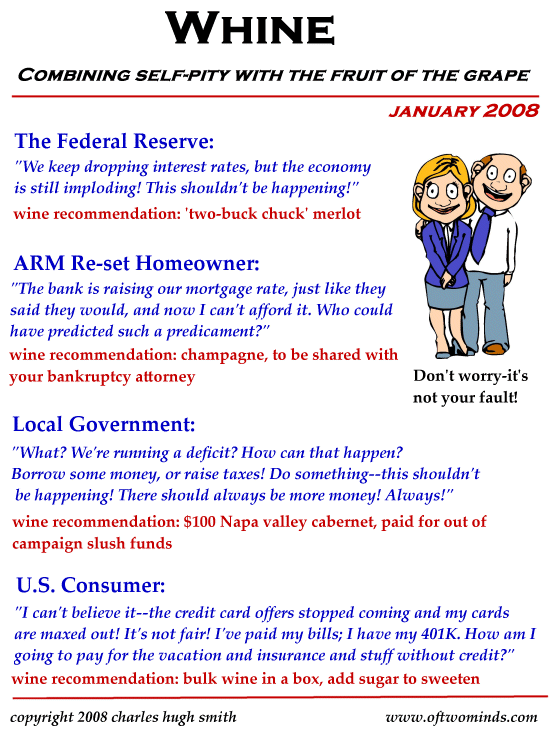
I expect Denial Journal to find a place next to Whine:

P.S.: Bank of America responded to my coverage by promptly plummeting 12%, proving once again how wrong I can be--at least so far.
Thank you, James R. ($40) for your extremely generous donation to this site. I am greatly honored by your support and readership.
Thank you, Francis I. ($25) for your much-appreciated generous donation to this site. I am greatly honored by your support and readership.
Monday, January 12, 2009
A Chartist Speculation: DJIA and Bank of America
As the economy continues deteriorating, it's natural to assume the stock market will follow suite. Natural, but perhaps wrong. History clearly shows that the market operates virtually independently of the economy.
Thank you, readers, for the wealth of ideas and cash donations you sent in response to Status Report on this Site (January 10, 2009). I will be slowly modifying the site as time and energy permits.
In keeping with the notion that individuals can maintain or improve their purchasing power via hedging and some modest but informed speculation, here are some charts and my amateur's musings.
Some readers are tired of charts, some only read investment-related entries. Assuming that most readers are connected to the market via their 401K or IRA or their pension plan (CALPERS and other public-employee pension funds lost a bundle and will thus be tapping cities, counties and agencies--and perhaps employees, too--for billions in contributions), then this might be of interest even if you don't actively manage your pension or capital.
As a sidenote, what I like about the market is that it is open to speculators of modest means such as myself. A couple hundred dollars is enough of a stake to trade options, for example, though of course I don't recommend that, or anything else, for that matter: please re-read the HUGE GIANT BIG FAT DISCLAIMER below that nothing here is intended as investment advice.
The point is simply this: one does not need a stake of mega-thousands to protect some of one's purchasing power.
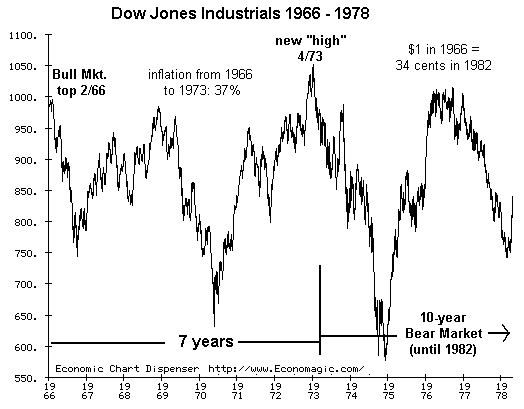
Once again, let's note how this chart drives a stake right through the heart of the quaint idea that the stock market is somehow related to the economy:
While the economy meandered aimlessly in stagflation and malaise for a decade, note that the stock market gyrated wildly, offering savvy speculators 40% gains up and down again and again. If the market had tracked the economy, it should have traced a steady decline from 1969 to 1982; at no point was the economic news good enough to power a 40% rise in the market. The news was uniformly dismal for the entire period 1971-1982, interrupted briefly by periods of even worse news.
So any and all attempts to predict market action based on the economy have little historical backing in Bear markets such as the one we're in now.
OK, so let's look at a one-year chart of the Dow Jones Industrial Average:
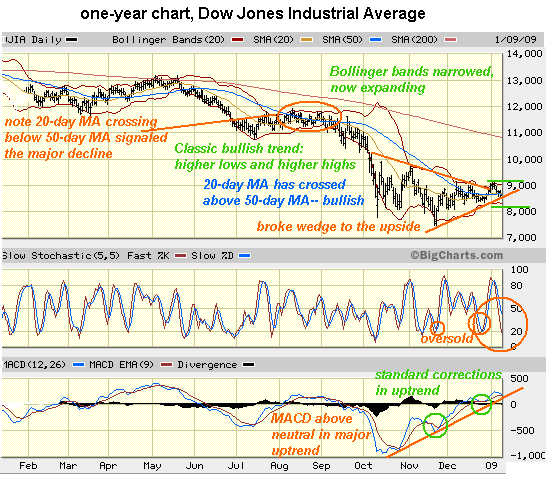
Is this the chart of a market about to fall another 20%-40%? Maybe, but all the technical evidence I see looks bullish--for instance:
1. the Bollinger bands have narrowed in a classic "basing" pattern in which volatility declines and a base is formed for the next leg up or down.
2. MACD has been in a strong uptrend for months, predating the actual moves higher.
3. As per the classic ABCD patterns of trends, small corrections have occured, allowing overbought signals to sink to oversold, setting up the next upleg.
4. The pattern since November has been higher highs and higher lows.
5. The flag/wedge was broken to the upside and is correcting as would be expected in any trend up or down.
6. The 20-day moving average has crossed above the 50-day MA--a classic "bullish cross." For those who doubt the value of these crosses, note how the Bearish cross in September presaged the huge decline.
Most pundits and market analyst-types seem skeptical that a really major rally could develop here. Some are saying the rally is over, others are calling for a weak continuation for a few more weeks, etc. Virtually no one is calling for a major rally through April or May which will reach my targets of 10,400 and beyond.
I don't find it helpful to attempt to align the market with the headlines about the economy or earnings or anything else. I am looking for some Bearish indicators in this chart and am having a hard time finding any of equal weight to the bullish trend signals.
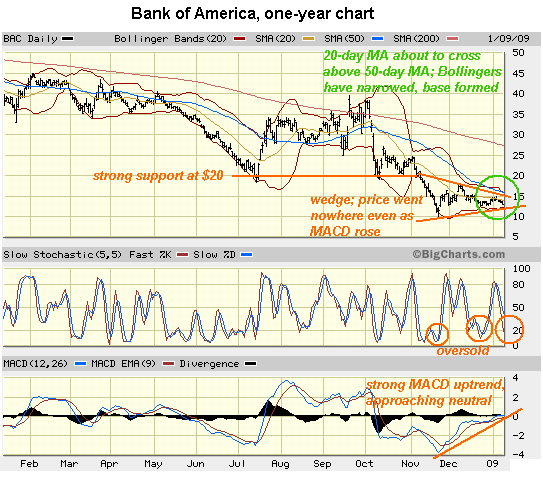
Let's look at a stock in the "doomed" financial sector, Bank of America:
I should mention here by way of disclosure that I called for a rally on Dec. 1, and the markets have risen 15-20% since then. I also pointed to bullish trends in oil/gas stocks, and a top in the TLT ETF for Treasury bonds; I made a few bucks following those calls. On Friday 1/9/09 I bought some option calls on BAC (Bank of America), speculative bets that the stock (which closed at $12.99) will be significantly higher than $12.50 at some point between now and February 20th.
Once again, nothing here is investment advice; it is merely the free musings of an amateur.
So what's Bearish about this chart of BAC? I tried to find something and came up short. (heh) It all looks bullish: a narrowing of the Bollinger bands, a base of ever-tighter trading ranges even as MACD rises to the bullish neutral line, a compressed wedge setting up a big move up or down and a bullish cross for the 20-day above the 50-day looming.
Yes, banking is a lousy business, yes, the global financial meltdown is in full swing, etc. etc. But as noted above, headlines and economies correlate poorly if at all to market swings in Bear markets. But of course I could be wrong about everything here.
HUGE GIANT BIG FAT DISCLAIMER: Nothing on this site should be construed as investment advice or guidance. It is not intended as investment advice or guidance, nor is it offered as such. It is solely the opinion of the writer, who is NOT an investment counselor/professional. All the content of this website is solely an expression of his personal interests and is posted as free-of-charge opinion and commentary. If you seek investment advice, consult a registered, qualified investment counselor (As with any other professional service, confirm their track record and referrals).
Thank you, Ari S. ($20) for your generous donations of excellent technical advice and cash to this site. I am greatly honored by your support and readership.
Thank you, Charles W. ($25) for your most generous donation to this site. I am greatly honored by your support and readership.
Saturday, January 10, 2009
Status Report on this Site
Several longtime readers have requested a status report on this site's advertising and other matters.
In response to inquiries from several steadfast readers/contributors, here is a brief status report.
Unique Visitors:
2005: 20,649
2006: 197,971
2007: 380,370
2008: 667,223
Number of Visits:
2005: 27,823
2006: 453,793
2007: 878,065
2008: 1,416,266
Pages viewed:
2005: 87,220
2006: 1,162,517
2007: 2,682,908
2008: 4,113,617
Advertising revenue:
Last monthly payment received from Forbes.com ad network: $82.86
(for display ads)
Last monthly payment received from Amazon Associates: $90.05
(referral fees on amazon purchases made through oftwominds.com)
These may seem like trivial sums to people with wages and benefits in the thousands per month, but to this poor dumb scribe those add up to $1,000 a year each which he wouldn't get from any other source.
Donations received from readers in 2008:
Approximately $7,550, from approximately 250 contributors, a number of whom made multiple donations.
In another display of the Pareto Principle, the number of contributors is about 4% of the monthly readership of the blog, which fluctuates between 51,000 and 76,000 per month (average around 60,000).
So if you 60,000 readers constitute The Remnant, then those who donated actual cash were the Remnant of the Remnant.
The Remnant, the Pareto Principle and You (June 25, 2008)
Are You Part of an Elite, and Don't Know It? (July 21, 2008)
While the near-doubling of this site's readership is both mystifying and gratifying, it is placing some strains on my time. Since I do have a small livelihood to earn doing other things (my total gross income is about $26,000/year, by way of full disclosure), plus a number of time-consuming if financially worthless writing projects, I am searching for some way to limit the time needed to keep this site functioning to 5-6 hours a day.
The key to the blog's success is the readers, who contribute topics, questions, books, data and commentary as well as actual money (also stamps, art, and even peanut butter). I have long contemplated the desirability of adding a forum for reader comments, along the lines of Karl Denninger's highly successful Market Ticker forum, but alas, my technical skills are nowhere near as high as Karl's and I don't have the time or ability to figure out how to install a forum such as the one from simplemachines.org.
I have even pondered asking if some reader with lots of technical moxie and extra server space would be willing to host such a forum, but I hesitate because I am a control freak when it comes to the site.
A friend set up a WordPress blog interface for me, but I could not bring myself to use a system which I don't fully understand. Since then, it appears that WordPress's very popularity has attracted hordes of hackers.
Though I host a mirror site on blogger.com for the RSS feed and for backup purposes, I also hesitate to entrust my site to a network/corporate entity, no matter how devoted it may be to not doing evil, etc. So as of now I continue plodding along with my 10-year old horribly dated HTML skillset and no reader forum.
Perhaps I prefer to play editor, posting a selection of reader comments, because I wrote free-lance for years. An editor does play a useful role, and I have had to learn over the decades to edit myself, not always successfully. But I've had other professional editors to show me how it's done.
Recently I've experimented with posting selected reader comments at the end of each day's entry, rather than consolidating them into Readers Journal pages. If your comment does not get posted, it's nothing personal; I often run out of time and energy, and due to the volume of email and research material I also often lose track of things. Sometimes I archive comments and use them months later. It's a one-man band here, with all the limitations that implies.
The actual fruition of the global financial meltdown I have long predicted has skewed the sites' focus a bit. Since I've been ranting about the housing bubble and the inevitability of the global financial meltdown since starting this blog in May 2005, the unraveling is no surprise to me. I feel a certain responsibility to keep addressing the issues of how readers can survive/prosper in such volatile, insecure times.
Keeping current requires hours of reading a day, and I have to be careful not to allow all my time go to the Web, as reading full books and print journals like Foreign Affairs and Scientific American (among others) is part of what grounds the site in practicality as opposed to ideological dead-ends. (I often get accused of holding right-wing and left-wing positions in the same day, week or month, which suggests I'm doing a pretty fair job of avoiding ideological pigeonholes.)
But the speed and gravity of events has put so much pressure on my time that I've neglected What's for Dinner at Your House and the occasional zaniness which I enjoy (even if you consider it sophomoric) such as Kroika! Tower: World's Tallest Bamboo Structure (March 12, 2007), Introducing Whine Magazine (January 12, 2008) or the ongoing adventures of uber-capitalist Ron Dump: Turning a Profit on Abandoned McMansions and SUVs (July 10, 2008) .
Instead, I've focused on topics such as Where the Rubber Meets the Road (July 17, 2008)
My wife has suggested that I list each donor's state or nation of origin to reflect the broadness of the site's readership. If nobody objects, I may do so, as I am always surprised by the diversity of this site's readership.
After all, I am just an unknown scribbler covering things I'm interested in.
One area of interest I'm devoting some energy to now is eBooks. Though I prefer a dead-tree book, it seems obvious that print media will live within a growing digital universe. So I am currently preparing digital versions of my books for Amazon's Kindle reader and eBooks via the Mobipocket (free) reader which works on computers and PDAs.
Every day I assume whatever I write will have no readers and encourage no contributions. It's the only way to remain focused on doing my best.
Though it sounds cliched, it's true: thank you for your readership and your many contributions of intelligence, critiques, accolades, books, ideas and of course quatloos/cash.
Thank you, Kevin F. ($50) for your outrageously generous donation to this site. I am greatly honored by your support and readership.
Thank you, Kurtis P. ($50) for your exceedingly generous donation to this site. I am greatly honored by your support and readership.
Terms of Service
RE: European Union AI Act, and Our Use of Generative AI Tools and Agents Policy
All text on this site is composed by Charles Hugh Smith or by a credited guest-author. No Generative AI Tools are used in the composition / writing of any text or graphic content created by Charles Hugh Smith. This site deploys no AI agents or generative AI tools. This site is not responsible for the disclosures, use or non-use of AI agents or generative AI tools in advertisements displayed by Investing Channel or other ad placement services.
Audio files generated by text-to-audio transcription tools are identified as such.
Our Privacy Policy:
Correspondents' email is strictly confidential. This site does not collect digital data from visitors or distribute cookies. Advertisements served by third-party advertising networks such as Investing Channel may use cookies or collect information from visitors for the purpose of Interest-Based Advertising; if you wish to opt out of Interest-Based Advertising, please go to Opt out of interest-based advertising (The Network Advertising Initiative) If you have other privacy concerns relating to advertisements, please contact advertisers directly.
PRIVACY NOTICE FOR EEA INDIVIDUALS
This section covers disclosures on the General Data Protection Regulation (GDPR) for users residing within EEA only. GDPR replaces the existing Directive 95/46/ec, and aims at harmonizing data protection laws in the EU that are fit for purpose in the digital age. The primary objective of the GDPR is to give citizens back control of their personal data. Please follow the link below to access InvestingChannel's General Data Protection Notice.
https://stg.media.investingchannel.com/gdpr-notice/
Notice of Compliance with The California Consumer Protection Act
This site does not collect digital data from visitors or distribute cookies. Advertisements served by a third-party advertising network (Investing Channel) may use cookies or collect information from visitors for the purpose of Interest-Based Advertising. If you do not want any personal information that may be collected by third-party advertising to be sold, please follow the instructions on this page: Do Not Sell My Personal Information.
Regarding Cookies:
This site does not collect digital data from visitors or distribute cookies. Advertisements served by third-party advertising networks such as Investing Channel may use cookies or collect information from visitors for the purpose of Interest-Based Advertising; if you wish to opt out of Interest-Based Advertising, please go to Opt out of interest-based advertising (The Network Advertising Initiative) If you have other privacy concerns relating to advertisements, please contact advertisers directly.
Our Commission Policy:
Though I earn a small commission on Amazon.com books and gift certificates and gold (BullionVault) purchased via links on my site, I receive no fees or compensation for any other non-advertising links or content posted on my site.
Copyright Notice:
All original images (Drawings and Photographs), text (essays, books and works of fiction), audio and video recordings, musical compositions, graphic design, graphic design elements and HTML coding on this site are the copyrighted work of Charles Hugh Smith unless otherwise credited or noted. They are published as information for the private use of site visitors, and any reproduction or redistribution of this content or coding in any media in any format or distribution channel (text, audio, video/film, web) without the written permission of the copyright holder is strictly prohibited. All rights in all media reserved globally.