




Saturday, March 05, 2011

The Great Stagnation, and Innovation as Savior

Can a new cycle of technological innovation save the U.S. from stagnation?


Longtime contributor Michael Goodfellow recently shared his summary and critique of Tyler Cowen's ebook on how innovation can save the U.S. economy.


The book made a brief splash a few weeks ago: The Great Stagnation: How America Ate All The Low-Hanging Fruit of Modern History, Got Sick, and Will (Eventually) Feel Better.


The topic of innovation needs careful analysis because all too often Americans place what amounts to quasi-religious faith in technology without bothering to understand its limitations and uncertainties.


Most important is this question: will it scale up to serve hundreds of millions of people, and become faster, cheaper and better with every product cycle? If not, then it is doomed to remain "interesting" rather than useful in the real world.


Here is Michael's commentary:

Here's the gist of The Great Stagnation:


- The "low hanging fruit" is the transition from agrarian/rural to industrial/urban. The U.S. went through that transition from 1880 to 1970 and had the same high growth rates that China is enjoying now. It's a one-time event though. Going from a population with no education to one with 80% high school and 25% college has huge gains. Going from one with 80% high school to 100% has fewer gains (and we haven't even managed that -- graduation rates peaked decades ago.)


Same thing with technology -- adding electricity, telephones, radio, movies, TV, cars, planes, etc. to the economy has huge gains. Adding the internet and some biotech since 1970 does not.


- He thinks technological progress is slowing and becoming more difficult. It takes more training before you can make a contribution, the age of first contribution is increasing (eating up those young-and-daring years of a scientists career) and patents per researcher is falling.


- Our politics and social network were greased by those ever-increasing productivity gains. Now that those have slowed, we're fighting over a more slowly growing pie, making our politics more acrimonious and gridlocked.


- We overpromised on things like pensions because of an expectation of growth rates which have not materialized. He has a graph showing that if pre-1973 growth rates had continued, the average income would be $90,000 in the U.S. today, instead of in the $50,000 range.


- The financial crisis happened, and happened world-wide, because we were overconfident, due to that pre-1970s expectation of growth. The previous housing bubble in the 1980s popped, we'd had the Savings and Loan crisis as a result, but without any real damage to the economy. So people didn't take the current run-up seriously. He thinks housing was affected not because of any decisions by the Fed, but because it was the weakest link, depending on the most marginal borrowers. As the economy runs out of easy growth and things get tight, the marginal borrowers are the people affected first.


- Modern growth rates are depressed by the kinds of things that are growing. Instead of more factories, we are spending more on education, health care and government. These contribute to GDP, but only because we count costs, not benefits. Education spending per pupil has doubled since 1970 with no increase in test scores. Spending on health care shows no correlation with life expectancy around the world. Government is mostly transfer payments, which have no effect on productivity.


- Eventually, new technology will come along and increase growth rates again. He feels we're at a temporary plateau, not the end of the line. And he calls for increased social status for scientists, so that more people will go into science in the U.S.


That's the basics, and you can finish the book in an hour. I didn't really feel it was worth $4, but oh well.


As for my reaction:


- The improvements in computers since 1970 have been nothing sort of miraculous -- improvements by factors of 1000, exceeding any other technology ever. And this has had an effect on the economy. I don't think you can have "just in time" manufacturing, or a world-wide supply chain without computers. You also need the cheap communications that microprocessors made possible. So all of globalization and outsourcing is enabled by computers.


The same is true for automation. Without processors, you couldn't have factory robots, but you also couldn't have ATMs, supermarket checkout scanners, phone system menus and other labor-saving changes. The pressure on the low end of job skills and drop in factory employment is all due to technology, and has been a huge change since 1970.


Without computers and software, you couldn't have the existing world financial system, which moves amazing amounts of money around every day. For good or bad, that's enabled by computers.


The internet is just starting to chew through existing industries, from newspapers to publishing to music and movies and TV. Amazon and eBay are changing retail, greatly increasing productivity. I have no idea how that ends up, but it's clearly a big change under way. Something like the "Minecraft" game, where a single person writes a piece of software and makes $15 million dollars in six months, just wasn't possible before. He didn't even need a publisher or ad agency or retail outlet. He just wrote the thing and sold it himself on the internet. Even a 1960s famous author, rock star or movie star would have needed to give 95% or more to the publisher/studio.


Biotech has already changed U.S. agriculture, with some huge percentage of crops already being genetically modified. I think it's mostly for pesticide resistance, but it is increasing yields and dropping costs. I think changes in livestock are just starting. Biotech is also starting to affect drug production.


- He's ignoring the changes in society and a lot of history. He doesn't seem to buy the standard argument that the Great Depression and WWII increased the size of government, which eventually led to more regulation and stagnation.


He feels that since organizations of all kinds grew in size (including the new giant industrial corporations like GM), and government grew everywhere, that this is an effect of a global change, like improvements in communications and record keeping, not a social change in just the U.S.. I kind of doubt that, since the growth in governments was so abrupt, and really seems to be a reaction to events, not just "grow because we can."


- I've been getting more and more skeptical of education in general over the years. Most adults I run into seem to have basically a third grade education. They can read, if it's nothing complicated or subtle. They can write, if all you want is simple sentences and don't care about grammar or spelling. Forget about getting a coherent essay out of most people! And they can do basic arithmetic, although I'm not sure about long division.


The rest of their education, even for the college educated, is never used, so it's forgotten. None of the high school math or science or history is retained, from what I can tell.


So although going from uneducated 19th century to third-grade 20th century might be worth a lot, I'm not convinced that we've maxed out on education. I think the current school systems actually destroy the desire to learn for a high percentage of the population. They come out of school hating lectures, study and tests. They feel it's all been a complete waste. The average adult never reads for pleasure, and I assume, never reads anything non-fiction. Some percentage of the population is out there taking night classes, but I think the average person avoids classrooms for the rest of their lives.


I agree most health care spending is a waste, from the larger social point of view. Health care is divided into public health measures (clean water, food, vaccinations and other disease control measures), primary care (esp. prenatal and childbirth) and all other high-tech medicine. Public health is a huge bargain and separates the first and third worlds. Primary care is affordable and has big benefits. High tech care is mostly a waste of money. Unfortunately, that's where all the money goes, and what all the arguments are about.


Tyler also doesn't mention demographics, which I think are key. The U.S. had that huge boomer generation, and now they are retiring. That both increased the average age of Americans, and increasing the size and cost of government. Demographics (including low birthrates) are changing things in the U.S., Europe, Japan, and (soon) China. Immigrations in Europe and the U.S. is changing the culture. This is all relatively recent and I don't see how you can ignore it.


My bottom line is that technology is still moving quickly, and poised to move even quicker, and that is benefiting the tiny percentage of the world population prepared to use it. There are very reasonable scenarios where the world changes out of all recognition in the next 100 years.


China and India are in catch-up mode and growing fast as a result. But as soon as automation starts replacing all those entry level jobs (when cheap robots have decent eye-hand coordination), it's all going to stop. China is the last country that's going to get rich off manufacturing for export.


The stagnation isn't caused by a drop in productivity improvements. Instead, we have a mismatch between skills and jobs. We have far too many people in the U.S. who have no skills beyond hand-eye coordination and basic English. They are getting crushed between massive amounts of competition from poor countries and automation.


So although I buy some of his argument, overall, I think it misses the point. And I think optimism about the future is misplaced. Technology is improving faster than skills, widening the gap. There are going to be a lot of people left by the side of the road.


Thank you, Michael, for the excellent precis and the analysis. Here are my initial thoughts on the notion that technical innovations will "save" us from a vast re-ordering of an unsustainable system.


1. What we need even more desperately than some new techno-wonder is institutional innovation. The Ratchet Effect (costs and payrolls go up without friction but only decline with great force) has caused the cost of the largest institutions such as "healthcare" and the Pentagon to skyrocket with little visible performance improvements. Medicare/Medicaid and the Pentagon spending alone are dooming the nation's finances to implosion.


The machinery of governance is still operating in the 1940s, if not the 1840s. Technology has made incremental improvements (i.e. electronic voting machines, heh) where it has the potential to revolutionize the machinery of government.


What we have is a bloated network of fiefdoms and cartels, all of whom are hoping that some new technology will enable their continued siphoning of the nation's wealth and income stream.


2. As Michael has pointed out here before, any technology that will scale up in the next few years has already been in the lab and initial production for 10 years. In other words, the fabulous, world-saving lab innovations touted in breathless magazine and Web articles are more than 10 years away from real-world applications abd 20 years away from scaling up to useful levels of production.


Other "savior technologies" such as nuclear fusion and algae-based biofuels have been "five years away from production" for 20 years. That history suggests just how few technologies are truly scalable.


3. A tremendous quantity of critical technology is ignored because it is incremental and therefore boring/unsexy. Ten years ago I was involved in a microchip startup that designed small cheap processors that improved the power management of multiple-battery rechargable arrays, like the kind that power laptops and tablets. It went nowhere, despite some interest from the Pentagon.


As I have noted here many times before, inefficient power management in "standby" or "sleep" modes for TVs, computers, printers, etc.--hundreds of millions of devices--consume all the electricity generated by 140 power plants. That's a lot of power wasted for no payoff at all.


The market fails in instances such as this. The manufacturers have no incentive to spend 50 cents more on an effective power management chip, and the consumer isn't going to insist, either. So the Central State has to impose regulations for incremental technological solutions like this. Without regulations, it will never happen, and we have 140 power plants spewing CO2 etc. into the air and burning valuable fuel for nothing.


Our economy is chockful of these kinds of inefficiencies--some can be addressed with regulation, other by market forces. One size does not fit all.


In other cases, the consumer doesn't care right now because energy is still too cheap. When oil is $300/barrel, then small turbo-diesel cars of the type sold in Europe that get 50 miles per gallon of fuel may yet be demanded by consumers, as will small electrical vehicles charged by distributed (i.e. small-scale, privately owned) solar arrays.


My point is simply that technology already offers us many ways to consume less and produce the same output. But rather than seek ways to reduce consumption, we currently prefer to hope for some magical new source of energy.


Why? Partly because we can--the level of pain is nowhere near high enough--and partly because we've always been "saved" in the past 40 years: by the discovery of the North Sea, West Africa and North Slope oil fields, by the emergence of desktop computers, by the Internet, etc.


These "saviors" enabled our consumption to continue rising and our productivity to make significant gains, decade after decade. Those new energy sources and quantum jumps in productivity may well be one-time events.


4. I agree with Michael that education is still stuck in the mass-production factory era and sorely needs real institutional innovations on a systemic scale. Is Our Education System Based on a Factory Metaphor? (November 15, 2005). Like all the other fiefdoms and cartels with a stranglehold on the machinery of governance and the national income, the Education Industry is resisting "threats" (i.e. innovation) to its power and income with every fiber of its being.


Continuous failure doesn't draw attention; only sudden failure attracts a crowd.That's the U.S. Status Quo in a nutshell. As long as the fiefdoms, cartels and the Central State can stave off any visible implosions, then the nation will continue to habituate to continuous failure as "the new normal."


If you would like to post a comment, please go to DailyJava.net.


Order Survival+: Structuring Prosperity for Yourself and the Nation (free bits) (Mobi ebook) (Kindle) or Survival+ The Primer (Kindle) or Weblogs & New Media: Marketing in Crisis (free bits) (Kindle) or from your local bookseller.

Of Two Minds is also available via Kindle: Of Two Minds blog-Kindle


Thank you, Scot M. ($500), for your unimaginably generous contribution to this site -- I am greatly honored by your support and readership. Thank you, Robert B. ($50), for your many splendidly generous contributions to this site -- I am greatly honored by your support and readership.

Read more...

Friday, March 04, 2011

How to Buy Complicity: A Rising Stock Market Bails Out Everyone

A rising stock market buys near-universal complicity.


How can the Status Quo bail out pension funds without having to give them cash? It's easy--goose the stock market ever higher. Since pension funds are heavily invested in the stock and bond markets, the presto-magico way to inject hundreds of billions of dollars into the pension system was to generate an 80% leap in stocks and lower interest rates to zero, effectively goosing bondholders' equity as bonds rose in value.


No politically messy bailouts are needed--all you need is a permanently rising stock market. If the Federal Reserve can just goose the S&P 500 from 1,300 to 2,000, underwater pension plans will be "saved" without any visible sacrifice.


Thus is complicity bought and paid for.


Corporate management loves a rising stock market--it's the ideal setting for dumping one's stock options.


Politicians love a rising stock market--since the vast majority of one's campaign contributions flow from wealthy people who own stocks, then the "wealth effect" of a rising market makes one's contributors happy and fattens their contributions.


And as a bonus, this "wealth effect" is great PR for the unwashed masses who don't get much of a direct benefit because they own at best a few thousand bucks of mutual funds in an IRA. But hey, that warm fuzzy feeling of a rising market makes everyone feel like "good times are here again," even if they're only marginally attached to the trillions of dollars in "new wealth" being generated.


Government employees love a rising stock market, too, because it means they won't have to contribute much to their own pensions. What every employee wants is a return to 1995-1999, when the stock market enabled a quantum leap up in their "sweetened" benefits packages.


The financial media loves a rising stock market, because it helps generate positive buzz and more readership and advert sales.


Wall Street loves a rising stock market, because it masks the entire panoply of fraud and embezzlement that is the beating heart of Wall Street, from high-frequency skimming to the "never have a losing day" trading desks.


The Fed loves a rising stock market, of course, because it makes the Fed look successful and omnipotent.


The President and his administration love a rising stock market, too, because it offers up a welcome sheen of economic "growth" that extends the promise of the mythical "self-sustaining recovery" just around the corner.


Politicos also love a rising market because the capital gains generate rising tax receipts. If there was ever financial magic, it's tax receipts increasing even while the real economy tanks. You just gotta love that permanently rising market!


Everybody benefits from a permanently rising stock market, and as a result they don't really care how it is engineered or at what eventual cost. The Fed has a free hand as long as it's enriching pension funds, insurance companies, politicos, corporate management, the media--what's not to like?


Thus is complicity bought and paid for.


But there are signs that this skyscraper rising to the stratosphere is built on swampy muck. The stock market looks impressively robust as it rises toward the outer atmosphere, but that strength and power may be masking vulnerabilities that are rising side by side with the market.


The game of driving down the dollar to goose stocks seems to be running out of oxygen. Despite the best efforts of the Fed to keep it heading to zero, the dollar is tracing out a long-term uptrend.


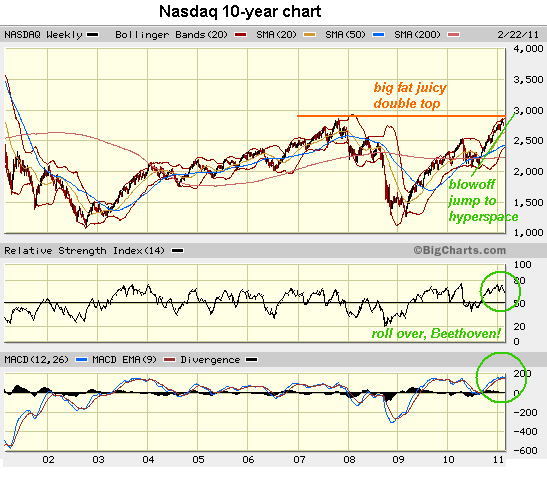
Then there's that massive double-top in the market's star performer, the NASDAQ:


If the Fed can't blast through that resistance to a new high soon, that could signal the end of the entire "everybody loves a permanent rally" project.


The problem is that this project is a one-time deal: once faith in the Fed's ability to permanently game the stock market is lost, the Fed will have used up its three wishes. And when that brittle delusion of Fed omnipotence expires, it will do so with breathtaking speed.


NOTE: I will have zero time online other than posting blog entries for the next few days--unfortunately I will be unable to respond to email.

Please do not consider it a slight if you receive no acknowledgement; I read and value each email, as I know it comes from a real individual with pressing demands of their own. This entire enterprise, if it can be called that, is imperfect, and will always be so. I keep it afloat, but barely. That's the best I can do.


Note to mobile device users: I've launched a new mobile version of the oftwominds.com weblog which features a simplified, fast-loading single column with a larger font size. While I am unable to optimize the mobile version for all mobile devices (Blackberries, smart phones, iPhones, etc.) I hope this version will provide you an easier reading experience. Please bookmark the new mobile version page if you prefer it to the full-sized blog.


If you would like to post a comment, please go to DailyJava.net.


Order Survival+: Structuring Prosperity for Yourself and the Nation (free bits) (Mobi ebook) (Kindle) or Survival+ The Primer (Kindle) or Weblogs & New Media: Marketing in Crisis (free bits) (Kindle) or from your local bookseller.

Of Two Minds is also available via Kindle: Of Two Minds blog-Kindle


Thank you, Jim S. ($5/mo), for adding a subscription to your stupendous ongoing generosity-- I am greatly honored by your support and readership. Thank you, Lynn M. ($60), for your phenomenal generosity to this site in ideas and financial contributions-- I am greatly honored by your support and readership.

Read more...

Thursday, March 03, 2011

You Want Small Business to Start Hiring? Here's What To Do

To incentivize small business, we have to fix the structural imbalances in the U.S. economy.


Everyone wants to know how the Central State can "help" small businesses so they will start hiring again. The answer is simple: fix the structural imbalances in the U.S. economy and start favoring real production over financial speculation.


Please note the question at hand is "what should be done," not "what can be done politically." Politically, everything I propose here is impossible. The Status Quo's stupendous power and share of the national wealth is based on preserving those structural imbalances. The last thing the toadies and parasites in Washington want is to upend the structural imbalances which feed their Masters, the Financial Power Elites and crony-Capitalist cartels.


The great value in asking what should be done is that it lays out for all to see the vast gulf between the present doomed system and where the nation should be heading.


To fix anything as systemic as small business, you need to begin with anintegrated understanding of the system. This "to do" list is based on my Survival+critique.


The Status Quo wants everyone to believe that all that ails small business can be fixed with tiny tweaks, such as increasing the depreciation rate on equipment. Those kinds of solutions are about as effective as band-aids over cancer.


If we start by asking cui bono, to whose benefit, then we discern the system is currently ordered to incentivize speculation by those Financial Elites who effectively control the institutions nominally under the control of the Central State: the Federal Reserve, the regulatory agencies, Congress, etc. Given their influence over the machinery of governance, then their private losses are simply transferred to the taxpaying public, which then borrows trillions of dollars on the bond market--and pays ever more interest on that rising debt--to cover the losses of the Financial Elites.


The conventional scheme of things is to distinguish between corporations, small business and employees. I would make a different distinction: between speculative financial churning and skimming and production of tangible goods and real-world services.


I would further make a distinction between domestic and global corporations. Global corporations are akin to empires, while domestic corporations are akin to nation-states. Global corporations now concentrate so much capital that they sit astride nation-states, moving capital and assets around to suit their own goals, and buying political power where doing so is a "wise investment."


With that general backdrop, here's my list of what needs to be done to incentivize small business formation and hiring:


1. Restore sound money. How can any business flourish when its money is being depreciated? Global companies can hedge against this "hidden tax" but small business (and wage earners) cannot.


2. Raise the cost of borrowing money and incentivize capital formation. If the Million-Price Project pegs inflation at 3%, then savings and checking accounts should pay 7%--a 4% real return--and it should cost 10% to borrow money.


Zero interest rate money available to Wall Street and the Too Big to Fail banks only encourages speculation and misallocation of capital on a grand scale. If an investment can't justify a 10% cost of borrowing, it's a poor investment and it shouldn't be made.


3. Offer corporations a choice: since they're legally considered "persons" now,then they have a simple choice:


A. Pay the individual "persons" tax rate on all income, and have all corporate-specific tax breaks stripped away, or


B. Renounce their Supreme Court-granted rights to "personhood" and pay 0% income taxon all non-financial-related income.


Right now most global U.S.-based corporations pay around 3% effective tax rates because they game the system (which they own/influence). So eliminating the corporate tax rate for all non-financial-related income would wipe out the hidden "tax" of paying lawyers and lobbyists to game the system. It would also make the U.S. attractive globally.


Many people want the clock to be turned back to when corporations paid significant Federal taxes. Since capital and assets can be shifted anywhere now, this is wishful thinking. Better to eliminate the wasted energy gaming the system and lower the tax rate on productive capital to zero, and tax individuals who receive income from the corporations--dividends, bond yields, salaries and bonuses, stock options, etc.


There is a caveat, of course:


4. Set the income tax on all finance-derived income for individuals, small business and corporations at 50% above the first $100,000, and 75% above $1 million. All income gained from churning, skimming, selling of "financial innovations," trading, derivatives, loaning money, any and all sources of income derived from financial sources, is taxed at 50% above the first $100,000 and 75% above $1 million.


If an individual is able to generate $2 million in short-term churning, then they can afford to pay $1 million in tax. If a hedge fund skims $100 million, then they can afford to pay $75 million in tax.


There is an alternative: quit skimming and start investing in productive assets.


the $100,000 set-aside enables small-business money managers and the like to make a living by paying the same tax rates as everyone else. But once they start making more than $100,000 annually, then they pay 50% tax on all finance-derived income.


The point here is to provide a disincentive to speculation and financialization and an incentive to production of tangible goods and real-world services. Once an economy has been incentivized in favor of financial speculation and gaming at the expense of producing real wealth, it is effectively doomed.


5. Set the long-term capital gains holding period at three years. All finance-derived income would be taxed at 50%, but truly long-term gains--three years or more--would be taxed at 25%. That incentivizes actual investments in productive assets as opposed to short-term (in high-frequency trading, mere seconds) churn and skimming.


6. Lower the Federal tax rate for sole proprietor/partnership enterprises to 7.65% up to $50,000 annually. Right now, the sole proprietor pays 15.3% self-employment tax and 15% regular income tax (on the first $34,000), an effective rate of 30%. The wage earner pays 7.65% plus the 15%. This disparity doesn't exactly encourage enterprise. Lowering the effective tax rate on the first $50,000 (the average income in the U.S. is $49,777 annually) to that of employees would level the playing field for those trying to earn their living as sole proprietors.


7. Fix the broken healthcare (a.k.a. sickcare) system in the U.S. How can any small business thrive when sickcare siphons off 17% of the U.S. GDP, compared to 8% in other developed nations such as France, Japan and Australia?


I have proposed two ways to fix the system--both are acceptable in my view, which I have outlined here many times:


A. Eliminate the entire system of private insurance, Medicaid and Medicare. Everyone pays cash for all healthcare. This is effectively a reset to 1965. Please note the U.S. was a developed nation in 1965 and that by some metrics, was actually healthier then than we are now. Longevity has barely budged. In other words, a non-spin analysis would find we're getting precious little for 17% of our GDP.


Such a reset would eliminate all the corruption, fraud, skimming and Central State- cartel controls that have created a monster which delivers decreasing health and costs that are double that of our global competitors.


B. Institute a national system based on the Veterans Administration: the entire system is opt-in (you don't have to go to the VA, you are free to pay cash and go wherever you want) and owned lock, stock and barrel by the Central State (Federal government).


The VA is not perfect--what large bureaucracy is?--but it has provided innovative solutions to large-scale care. Yes, there are lines, and yes there are limitations, but the system costs a fraction of the cartel-crony Capitalist quasi-private system that costs 17% of GDP. Since doctors are employees of the VA, there is no crushing burden of "defensive medicine" and malpractice, nor are there opportunities for gaming the system for millions of dollars, for example, owning the MRI machines and giving every patient an MRI test at your own lab.


8. Streamline Federal regulations down to one page (two sides) for all enterprises except nuclear materials or equivalent. Central State fiefdoms and their Cartel-crony Capitalist partners love 1,000-page regulatory schemes because they are extremely effective "moats" to small business competition.


The vast majority of businesses could be regulated by two pages of common-sense, straightforward regulations--two sides of one sheet of paper.


This would mean paring the armies of bureaucrats who are currently incentivized to increase the regulatory load on small business because more regulation is highly effective job security.


lagniappe/bonus reform: Impose a Federal regulation that caps any form of local government/state annual business license or business tax at 10 times the hourly minimum wage (e.g. 10 X $8.65 = $86.50).


Local government has taken the implicit point of view that small business is a treasure trove of ill-gotten wealth and a cash cow with endless reserves of "fat" to be taxed. If you want to encourage small business to expand and hire people, then you can't saddle them with thousands of dollars a year in junk fees, the most pernicious of which is the local "business license fee" that is based on a percentage of gross revenues: even if your business is losing money and has no net income, you still have to pay a tax based on gross revenues.


Until you close down, of course, which is what the system currently incentivizes.


NOTE: I finished my messy plumbing job, but am still peeling the ABS glue from my fingers. Your forbearance is greatly appreciated.


Note to mobile device users: I've launched a new mobile version of the oftwominds.com weblog which features a simplified, fast-loading single column with a larger font size. While I am unable to optimize the mobile version for all mobile devices (Blackberries, smart phones, iPhones, etc.) I hope this version will provide you an easier reading experience. Please bookmark the new mobile version page if you prefer it to the full-sized blog.


If you would like to post a comment, please go to DailyJava.net.


Order Survival+: Structuring Prosperity for Yourself and the Nation (free bits) (Mobi ebook) (Kindle) or Survival+ The Primer (Kindle) or Weblogs & New Media: Marketing in Crisis (free bits) (Kindle) or from your local bookseller.

Of Two Minds is also available via Kindle: Of Two Minds blog-Kindle


Thank you, David H. ($20), for your most-excellent generous contribution to this site-- I am greatly honored by your support and readership. Thank you, David K. ($50), for your ongoing extraordinary generosity to this site-- I am greatly honored by your support and readership.


Read more...

Wednesday, March 02, 2011

Snatching Tiger Cubs and Cherished Delusions

"There is danger for him who taketh the tiger cub, and danger also for whoso snatches a delusion from one who trusted false promises."


My longtime friend and fellow iconoclast G.F.B. recently observed that the U.S. is in the throes of a historically unprecedented loss of faith in the implicit promise that life will be better and easier for future generations. G.F.B. cited Arthur Conan Doyle's conclusion to his Sherlock Holmes' story, A Case of Identity, as the encapsulation of the dynamic we will collectively experience.


In the story, a young woman's secretive lover, Hosmer Angel, fails to appear on their wedding day. Mr. Angel turns out to be a fictitious character, a duplicitous ploy designed to access the young lady's substantial income. Holmes declines to reveal this sordid truth to the young lady, and offers this explanation to Dr. Watson:


"If I tell her she will not believe me. You may remember the old Persian saying, "'There is danger for him who taketh the tiger cub, and danger also for whoso snatches a delusion from a woman.'"


I am rewriting the line slightly to apply to a nation drunk not on love but on financial promises which cannot be kept: "There is danger for him who taketh the tiger cub, and danger also for whoso snatches a delusion from one who trusted false promises."


The promises Americans cling to so adamantly and naively are many, both explicit and implicit. That the public employee pension will be paid in full. That Social Security will pay out "what I was promised." That Medicare will be able to fund $1 million+ for the last year of life interventions for ecah of the 65 million Baby Boomers.


Then there are the implicit promises. That the dollar will not go to zero. That there will always be gasoline at every gas station. That the gasoline won't cost $10/gallon (in today's dollars). That the government will remain in control of its own institutions (hahahahahaha). That the Central State, a.k.a. the Savior State will somehow "fix" whatever problems arise in the U.S. economy and society.


This list of promises, and thus the list of delusions about to be snatched, is long indeed. The key promise may well be the one identified by G.F.B.: that life will always get better and better in every way and every day for Americans.


The idea that life in the coming years will be more like an endless camping trip for tens of millions of people is not just anathema, it is not in the realm of possibility.


And so the tiger will lash out at those who snatched her cub. Americans are as naive and desperate as a young jilted lover: they've been stood up, but don't want to know that they have put their cherished faith in impossible promises. They cling with frantic energy to their delusions, and are ready to uncork anger to express their fear of a future stripped of quasi-religious promises. By that I mean Americans' faith in their Savior State is near-religious: most cannot grasp that the Savior State itself is not Too Big To Fail, but rather Too Big To Survive.


In Public Pension and Healthcare Costs and Financial Common Sense (February 28, 2011) I explained why the Savior State's promises to public employees--and by extension, all citizens--cannot be met: the cost of the promises is growing by 11% a year, year after year, regardless of which flavor of political parasite is nominally "in power," while the underlying economy is growing by 2% a year at best. In the past three years, it has not grown at all, but has been kept afloat by $6 trillion in Federal borrowing and spending.


That Federal spending has leaped 60% in a mere 6 years and 35% in a mere 3 years. Compare those growth rates with 2%, and you have to conclude the promises cannot be met, unless the Federal government prints dollar signs on toilet paper and ships everyone a roll as "payment for what you were promised."


Hence the popularity of the hyper-inflation meme.


But getting a roll of toilet paper in place of the $2,000 a month you were promised is still breaking the promise.


Here is the central delusion that will be snatched: that the U.S. is a wealthy nation capable of paying all its promises. In fact, the U.S. has been spending beyond its means for at least a decade. Here is what nobody wants to hear: The U.S. consumes more than it produces.


It's balance sheet and income statement are both negative.


The most readily accessible metric for this bleeding is the current account--the trade deficit or surplus. The U.S. has been running trade deficits that would have crushed any other nation long ago.


How have we managed to take so much more than we produce? This is not an easy concept to grasp, but in effect the U.S. has arbitraged its currency to the detriment of its trading partners and those accepting dollars as payment for real goods.


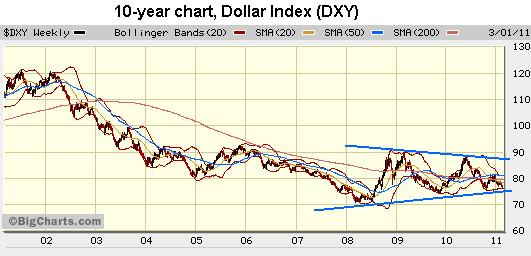
We can see this arbitrage at work in a 10-year chart of the DXY (dollar index):


By lowering the value of the dollar by one-third since 2001, the U.S. has extracted trillions of dollars in wealth from those who sold tangible goods in exchange for dollars.


As you can see on the chart, this arbitrage appears to be ending. The dollar is in a long-term uptrend, and is forming a pennant or megaphone pattern, which suggests a narrowing of trading range and an eventual breakout up or down.


If the pattern breaks down, then the dollar will be destroyed, as many expect. If it breaks out to the upside, as I expect, then the dollar arbitrage which has enbled us to live far beyond our means will be destroyed.


Either way, the dollar will no longer be a "secret" source of living beyond our means, consuming far more than we actually produce in the real world.


There is another phenomenon at work, one described in the tremendously vital 3-volume history of Capitalism by Fernand Braudel:


The Structures of Everyday Life (Volume 1)

The Wheels of Commerce (Volume 2)

The Perspective of the World (Volume 3)


The specific tale I refer to is Venice, Italy, circa 1500-1700. Venice was once the dominant trading power in the European Mediterranean. Its wealth flowed from its vast merchant fleet and its dominance as a trading center for goods and trading debts/credit and gold/silver.


But over time, competition from other trading centers and merchant fleets erode the immense profitability of the trading sector, and the financial Elites of the city moved their capital into the more profitable domain of farming on the Italian mainland.


At that point, Venice lost its position astride the commercial/trading world and began its long slow decline to a tourist haven.


The U.S. is now on a similiar trajectory to decline, as its financial Elites have abandoned investing in productive enterprises and trade for the more profitable trade in financial duplicity and fraud, a.k.a. "financial innovative instruments" which arbitrage risk to the immense gain by the financial houses originating the arbritrage.


The game is simple: create instruments which supposedly lower risk, but which really only mask risk behind complexity. Then, when the trade blows up, the traders transfer the stupendous private losses to the taxpaying public via sovereign debt.


Once their debts and losses have been cleared, then they start the game over again.Why bother with risky productive assets when this financial gaming is so profitable and risk-free?


Indeed. And there you have the dynamics of decline: the immutable math of a slow-growing economy and fast-rising costs of promises, and a financial Elite which has abandoned productive enterprise in favor of financial manipulation and illusory "products."


You can't consume more than you produce for long, and that's the "promise" that will be broken: that we can heedlessly consume more than we produce forever, with no consequences.


And so we're left with the tiger's response to its cub being snatched: a mob enraged by the snatching of its delusions. Frequent contributor Harun I. neatly summed up this dynamic in a recent email, and it offers a sobering conclusion to this entry:

RE: Public Pension and Healthcare Costs and Financial Common Sense:

Outstanding post as usual. However, I found your request to check ideologies at the door quite amusing.


Forgive my cynicism, but these are the same people who would not run a spreadsheet or money management program (Quicken or such), or use a amortization calculator on the web to see if they could afford those exotic mortgages that are blowing up. These are the same people that while making the biggest financial decision of their lives would not spend the extra money to have an attorney examine and explain to them the documents they were signing. These are the same people who owned their homes but were easily convinced it was a strange sort of piggy bank that you had to borrow to pull the money out. These are the same people who found the SNL skit, If you Cannot Afford It, Don't Buy It, challenging.


Intellect and logic have left the building. These people are id driven. The suffer from the Copernican syndrome. No matter what proof you give -- no matter how mathematically irrefutable it may be, they will choose to believe that the earth is the center of the universe.


While they will all show up for a demonstration when their piece of the pie is on the line, if you were to sit them down with a state or municipal budget with the mandate to balance it, they would fail.


Everyone wants change so long as it doesn't effect them. Politicians who clearly understand that reducing spending to what is taken in as taxes would condemn to death many afflicted by conditions that are curable. They are not going to cut spending in any significant way.


And this is why it all must catastrophically fail.


History is very clear about ideologies and the legitimacy to rule. When governments could no longer feed them, even the most devout citizen was willing to drag their deified ruler from their palace and cut off their head. What god they may be offending at the moment was not even a fleeting thought.


In time, the legitimacy of the oligarchy to rule here in America will be questioned. It will be interesting to see how that plays out.


But as for any hope of rationality from the folks running around waving signs and like a belligerent Oliver demanding, MORE! because of the irrefutable facts you have given, I think you will be disappointed. In fact, were this a different time, they would be screaming heresy and demanding your Inquisition.

Thank you, Harun. I also received an email from a public employee proving Harun's point. This gentleman promised to "riot in the streets" if the promises made to him weren't kept.


If everyone who finds the promises made to them are being broken responds by "rioting in the streets," then we can anticipate roughly 300 million citizens all rioting in the streets at the same time, all seeking someone to blame for their loss, someone, anyone but themselves.

NOTE: I am occupied this week with a messy plumbing job, so email replies have dried to a trickle. Your forbearance is greatly appreciated.


Note to mobile device users: I've launched a new mobile version of the oftwominds.com weblog which features a simplified, fast-loading single column with a larger font size. While I am unable to optimize the mobile version for all mobile devices (Blackberries, smart phones, iPhones, etc.) I hope this version will provide you an easier reading experience. Please bookmark the new mobile version page if you prefer it to the full-sized blog.


If you would like to post a comment, please go to DailyJava.net.


Order Survival+: Structuring Prosperity for Yourself and the Nation (free bits) (Mobi ebook) (Kindle) or Survival+ The Primer (Kindle) or Weblogs & New Media: Marketing in Crisis (free bits) (Kindle) or from your local bookseller.

Of Two Minds is also available via Kindle: Of Two Minds blog-Kindle


Thank you, Tony S. ($5/mo), for your exceptionally generous subscription to this site-- I am greatly honored by your support and readership. Thank you, Alex H. ($10), for your ongoing remarkable generosity to this site-- I am greatly honored by your support and readership.


Read more...

Tuesday, March 01, 2011

The Counterfeit Economy

The U.S. has a deeply counterfeit economy.


Counterfeit money exploits trust by presenting a facsimile of authenticity. A high-quality counterfeit bill (for example, the $100 bills exported by North Korea) are facsimiles of authentic paper notes which then gain the trust of users.


A counterfeit gold bar is a piece of lead coated with a layer of authentic gold. The mechanism is the same: a veneer of integrity tricks the buyer into trusting the validity of the entire bar.


The U.S. has a deeply counterfeit economy.


The predatory mortgages of the subprime era were presented as legitimate mortgages similiar to time-honored 30-years fixed notes with a few "minor differences." These were in effect counterfeit mortgages designed to fool the borrowers and buyers. They were mere simulacra of "safe investments."


Like the counterfeiter who plates the lead bar with a thin coating of gold, the ratings agencies coated the lead bar of toxic, high-risk mortgages with the gold veneer of a AAA rating.


The buyers of the securitized mortgages were promised gold but they were actually buying lead--and the sellers knew it. The trust engendered by the AAA rating and the veneer of authenticity issued by Wall Street was exploited in a vast counterfeiting scheme of breathtaking depth and range.


The budget of the U.S. government as presented by the Office of Management and Budget (OMB) is a counterfeit budget, inauthentic and riddled with blatantly false projections. As late as 2009, in the midst of the Great Recession, the OMB was projecting surpluses in the Federal budget by 2012.


By 2009, the OMB had plenty of data on the recession and the opportunity to revise their previous estimates to more realistic levels.


But instead, the OMB continued issuing pie-in-the-sky estimates which grossly underestimated future deficits:


2009 estimate: receipts: $2.7 trillion outlays: $3.1 trillion deficit: $–407 billion


2010 estimate: receipts: $2.93 trillion outlays: $3.09 trillion deficit: $–159.9 billion


2011 estimate: receipts: $ 3.07 trillion outlays: $3.17 trillion deficit: $–94 billion


2012 estimate: receipts: $ 3.26 trillion outlays: $3.22 trillion deficit: $+48 billion


The reality is that the 2012 deficit is expected to hit $1.6 trillion, a sum that equals 11% of the nation's gross domestic product (GDP).


In other words, the OMB and the rest of the Federal machinery issues simulacra of authentic budgets--counterfeits designed to fool the people and win their trust via artifice and facsimiles of authenticity.


As Bernie Madoff recently observed--and we can suppose he is an expert in manufacturing facsimiles, fraud, embezzlement and counterfeiting authenticity out of lies--the U.S. is a giant Ponzi scheme.


The financial "reforms" are counterfeit reforms.


The "balancing the budget cuts" are counterfeit.


The projections of future growth are counterfeit.


The unemployment numbers are counterfeit.


The inflations statistics are counterfeit.


And of course, the "news" which drives the stock market ever higher is also counterfeit.


When everything is counterfeit, then what's left that's authentic and trustworthy? Essentially nothing.


Note to mobile device users: I've launched a new mobile version of the oftwominds.com weblog which features a simplified, fast-loading single column with a larger font size. While I am unable to optimize the mobile version for all mobile devices (Blackberries, smart phones, iPhones, etc.) I hope this version will provide you an easier reading experience. Please bookmark the new mobile version page if you prefer it to the full-sized blog.


If you would like to post a comment, please go to DailyJava.net.


Order Survival+: Structuring Prosperity for Yourself and the Nation (free bits) (Mobi ebook) (Kindle) or Survival+ The Primer (Kindle) or Weblogs & New Media: Marketing in Crisis (free bits) (Kindle) or from your local bookseller.

Of Two Minds is also available via Kindle: Of Two Minds blog-Kindle


Thank you, Anders A. ($30), for your phenomenally generous contribution to this site-- I am greatly honored by your support and readership. Thank you, Jonathan S. ($10), for your much-appeciated generous contribution to this site-- I am greatly honored by your support and readership.

Read more...

Terms of Service

All content on this blog is provided by Trewe LLC for informational purposes only. The owner of this blog makes no representations as to the accuracy or completeness of any information on this site or found by following any link on this site. The owner will not be liable for any errors or omissions in this information nor for the availability of this information. The owner will not be liable for any losses, injuries, or damages from the display or use of this information. These terms and conditions of use are subject to change at anytime and without notice.

RE: European Union AI Act, and Our Use of Generative AI Tools and Agents Policy

All text on this site is composed by Charles Hugh Smith or by a credited guest-author. No Generative AI Tools are used in the composition / writing of any text or graphic content created by Charles Hugh Smith. This site deploys no AI agents or generative AI tools. This site is not responsible for the disclosures, use or non-use of AI agents or generative AI tools in advertisements displayed by Investing Channel or other ad placement services.

Audio files generated by text-to-audio transcription tools are identified as such.

Our Privacy Policy:

Correspondents' email is strictly confidential. This site does not collect digital data from visitors or distribute cookies. Advertisements served by third-party advertising networks such as Investing Channel may use cookies or collect information from visitors for the purpose of Interest-Based Advertising; if you wish to opt out of Interest-Based Advertising, please go to Opt out of interest-based advertising (The Network Advertising Initiative) If you have other privacy concerns relating to advertisements, please contact advertisers directly.

PRIVACY NOTICE FOR EEA INDIVIDUALS

This section covers disclosures on the General Data Protection Regulation (GDPR) for users residing within EEA only. GDPR replaces the existing Directive 95/46/ec, and aims at harmonizing data protection laws in the EU that are fit for purpose in the digital age. The primary objective of the GDPR is to give citizens back control of their personal data. Please follow the link below to access InvestingChannel's General Data Protection Notice.
https://stg.media.investingchannel.com/gdpr-notice/

Notice of Compliance with The California Consumer Protection Act

This site does not collect digital data from visitors or distribute cookies. Advertisements served by a third-party advertising network (Investing Channel) may use cookies or collect information from visitors for the purpose of Interest-Based Advertising. If you do not want any personal information that may be collected by third-party advertising to be sold, please follow the instructions on this page: Do Not Sell My Personal Information.

Regarding Cookies:

This site does not collect digital data from visitors or distribute cookies. Advertisements served by third-party advertising networks such as Investing Channel may use cookies or collect information from visitors for the purpose of Interest-Based Advertising; if you wish to opt out of Interest-Based Advertising, please go to Opt out of interest-based advertising (The Network Advertising Initiative) If you have other privacy concerns relating to advertisements, please contact advertisers directly.

Our Commission Policy:

Though I earn a small commission on Amazon.com books and gift certificates and gold (BullionVault) purchased via links on my site, I receive no fees or compensation for any other non-advertising links or content posted on my site.

Copyright Notice:

All original images (Drawings and Photographs), text (essays, books and works of fiction), audio and video recordings, musical compositions, graphic design, graphic design elements and HTML coding on this site are the copyrighted work of Charles Hugh Smith unless otherwise credited or noted. They are published as information for the private use of site visitors, and any reproduction or redistribution of this content or coding in any media in any format or distribution channel (text, audio, video/film, web) without the written permission of the copyright holder is strictly prohibited. All rights in all media reserved globally.

  © Blogger templates Newspaper III by Ourblogtemplates.com 2008

Back to TOP