






Tuesday, March 06, 2012

Welcome to Year Five in the Crazy House

For four long years, the financial and political Status Quo has masked pervasive structural decay with artifice, pretense and lies. It's like we're living in a rotting mansion run by delusional megalomaniacs.


For four long years, the power-drunk Status Quo Elites have piled on pretense and illusion at the expense of truth. Welcome to the Crazy House. The entire rotten edifice of global financialization was visibly crumbling by early 2008, and yet here we are, four long years later, still under the jackboots of artifice and lies. Instead of the cruel illusions of TARP, now we have HAMP, LTRO, The Troika, and assorted other acronyms and inanities passing for policy.

Welcome to the Crazy House, a rotting McMansion ruled by power-drunk megalomaniacs suffering from delusions of invulnerability and god-like powers. Why are we here, you ask? Because the drunks who run the household make it so darned easy: just keep quiet, listen politely to their ravings, and you get subsidized meals, free rent, a houseful of techno-gadgetry and nonstop entertainment--and that's not even counting the amusement value of their delusional, sloppy-drunk ramblings out by the rust-stained pool.

It takes a while to habituate to the Crazy House; at first, all the artifice, illusions, delusions and lies are disorienting. The dysfunctional "family" that runs the place acts like the money is endless, as if borrowing money was the same as actually producing something of value.

Meanwhile, you hear whispers that everything's paid with credit, and some of the vendors are threatening to cut the mansion's credit. That would be curtains for the whole charade, of course, but the "leaders" pontificate about the magnificence of the rotting mansion as if still having credit was the same as having productive wealth.

It doesn't take long before you start noticing the whole mansion is actually falling apart. The surface grandeur is totally illusory: the handrails are held together with duct tape, painted to match the background; the dry-rotted steps have been patched with putty and covered with fresh paint (step on the rotted parts and they crumble); the roof leaks are masked by pans placed in the attic, and the foundation is buckling.

Once you see enough of this decay covered by slipshod repairs, you wonder how much longer the mansion can last before it simply collapses under its own rotting weight.

From a distance, the expansive pool looks inviting, but that's also illusion; the power-drunk "leaders" and their Elite guests have dropped so many wine glasses on the deck that the bottom of the pool is now littered with shards of essentially invisible glass. At first you wonder why nobody ever goes in the pool, and then a whispered explanation fills you in on the sordid truth.

The truth must be whispered, lest the "family" overhear some shred of truth; any challenge to their account of limitless, god-like powers sends them into a spittle-flecked rage. Rage, denial and fear rule the household: fear of the truth, fear of vulnerability, fear of having to face the real world.

Residents' meetings are bizarre, for the "facts" presented about the mansion's upkeep are so blatantly false that you wonder how anyone present can even keep a straight face. Yet they all do; eventually you get used to the complete disconnect between the "official reports" and reality, and you just shrug it off and seek out other more engaging distractions.

It takes much longer to learn how to stomach the "lectures" by the "family leaders," as the subject matter is once again totally disconnected from reality. The "lectures" always extol the glorious wealth the "family" controls, its equally glorious past, and all the "innovations" that are currently increasing the mansion's already immense wealth and reach.

Yet there is no sign of any meaningful innovation being put in place; there are only endless surface repairs and paint jobs to mask the underlying rot, and a front yard that is maintained specifically to display a completely artificial veneer of wealth and solidity.

Will we ever get sick enough of the lies to leave the security offered by the Crazy House? Probably not, because it's too easy to stay: the food is greasy and sugary but tasty, the rent is basically free, and there's plenty of meds, booze and drugs to fix whatever "healthcare" issues you might have. Of course none of the meds actually restores your health; they only treat the symptoms of ill-health and ruin.

The sad thing about living in the Crazy House for four years is how living a life of illusory security saps the will and perhaps even the ability to function in the real world. The grease-soaked sugar bomb food they serve has left everyone obese and malnourished, and all the electronic toys and entertainment has rendered them mentally and physically unfit and terminally distracted.

They know the reassurances of the "leaders" are false, and that beneath the surface, everything in the mansion is either squalid and falling apart or ripe with the rot of corruption and lies. But leaving opens a Pandora's Box of uncertainty and sacrifice; it's easier to stay and listen to the absurd claims of godhood and endless wealth, and phony exhortations of the mansion's mythical "can-do" spirit.

As long as the vendors keep letting the mansion's delusional megalomaniacs run up their credit tab, then it's easier to passively stay put than to face the challenges of truth and reality outside the rotting palace of illusion and lies.


One week special: 15% off MaxiPack of vegetable garden seeds: a 3.5 gallon bucket of non-hybrid seeds, enough to share with neighbors, friends and fellow farmers! 


Thank you, Dennis C. ($50), for your splendidly generous subscription to this site -- I am greatly honored by your support and readership.Thank you, Frank S. ($100), for your magnificently generous contribution to this site -- I am greatly honored by your support and readership.

Read more...

Monday, March 05, 2012

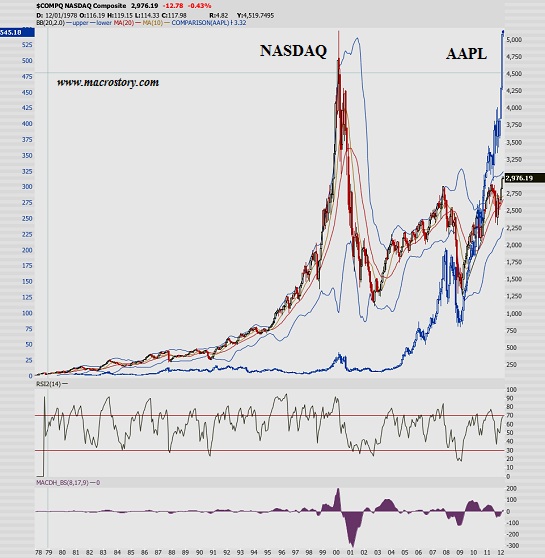
The One Chart That Shows Where AAPL and the Market Are Heading

Is Apple going to $1,000 per share and dragging the market higher with it?


Sometimes one chart tells us more than a thicket of charts. Every analyst and punter seeks an "edge" by plotting and comparing innumerable indicators, ratios, correlations and data points. Sometimes all this complexity pays dividends, but if it did so consistently then 90% of hedge funds and mutual funds wouldn't be underperforming index funds. Sometimes a single chart says it all.


Chart courtesy of the Macro Story.

Any questions?

Yes. Doesn't this mean that AAPL (Apple) is on its way to $1,000 per share based on iPad 3 sales, and with strong growth in GDP and corporate profits, the Dow Jones Industrials are going to 15,000 and the S&P 500 is heading for 1,500?

Answer: If that's what you see in this chart, then that's what the chart means to you.


One week special: 15% off MaxiPack of vegetable garden seeds: a 3.5 gallon bucket of non-hybrid seeds, enough to share with neighbors, friends and fellow farmers! 

Thank you, Tony M. ($25), for your prodigiously generous subscription to this site -- I am greatly honored by your steadfast support and readership.Thank you, Ronald L. ($50), for your splendidly generous contribution to this site -- I am greatly honored by your support and readership.


Read more...

Saturday, March 03, 2012

Has Housing (Finally) Become an Attractive Investment?

According to cheerleaders, housing supposedly bottomed in 2008, 2009, 2010 and 2011; is it finally an attractive investment, or just another knife that's still falling?


In a previous report, Headwinds for Housing, I examined structural reasons why the much-anticipated recovery in housing valuations and sales has failed to materialize. In Searching for the Bottom in Home Prices, I addressed the Washington and Federal Reserve policies that have attempted to boost the housing market.

In this third series, let’s explore this question: is housing now an attractive investment? 

At least some people think so, as investors are accounting for around 25% of recent home sales.
Superficially, housing looks potentially attractive as an investment. Mortgage rates are at historic lows, prices have declined about one-third from the bubble top (and even more in some markets), and alternative investments, such as Treasury bonds, are paying such low returns that when inflation is factored in, they're essentially negative.

On the “not so fast” side of the ledger, there is a bulge of distressed inventory still working its way through the “hose” of the marketplace, as owners are withholding foreclosed and underwater homes from the market in hopes of higher prices ahead. The uncertainties of the MERS/robosigning Foreclosuregate mortgage issues offer a very real impediment to the market discovering price and risk. And massive Federal intervention to prop up demand with cheap mortgages and low down payments has introduced another uncertainty: What happens to prices if this unprecedented intervention ever declines?

Last, the obvious correlation between housing and the economy remains an open question: Is the economy recovering robustly enough to boost demand for housing, or is it still wallowing in a low-growth environment that isn’t particularly positive for housing?
Factors Affecting Housing Demand
The demand from investors can be roughly bifurcated into two distinct camps: those buying distressed homes to “flip” them for a profit as market conditions improve, and those buying homes and multi-unit buildings for rental income and future appreciation.

The “flippers” are counting on continued demand by non-investor buyers, such as first-time buyers. The rental housing investors are counting on continued strong demand for rentals from those who lose their homes to foreclosure and must now rent, as well as from household formation resulting from population growth.

Both lines of reasoning are implicitly based on continuing Federal and Federal Reserve support of the housing market via first-time buyers’ incentives, such as low-down payment FHA and VA-backed mortgages, and the Fed’s continuing support of mortgages via low interest rates and the roughly $1 trillion in mortgages that the Fed purchased in 2009-10.

The assumption behind any forecast of improving demand and higher prices is that private demand for housing and mortgages will slowly replace government-stimulated demand. 
If either of these conditions deteriorates -- that is, if government support of the housing/mortgage markets declines due to the rising pressure to trim fiscal deficits, and private demand does not appear to replace it -- then the forecast of steadily improving markets weakens.

While direct government support of the housing market via ultra-low rates and guaranteed FHA/VA mortgages is well-known, the rental housing market is also implicitly supported by government transfers; i.e., cash distributed by the federal government in Section 8 rent subsidies, extended unemployment benefits, etc.

These transfers now make up an unprecedented share of household income, as this chart shows:


Common sense suggests that the pressure to trim unprecedented (in peacetime) Federal deficits -- roughly 8%-10% of the nation’s gross domestic product (GDP) for four years running -- will eventually impact all government spending, including transfers and housing/mortgage subsidies.

Combine the prospect of declining government transfers with the deterioration in household disposable income since 2007, and the household income picture darkens considerably. 

Why these factors matter to investors is self-evident: If households receive less income, then they will be less able to afford either a mortgage or high rent.

The fact that inflation has outpaced disposable income should also give real estate investors pause. If rents have by and large kept pace with inflation (rental markets are local, so any national figures are generalizations that may not apply), then this divergence between income that has flat-lined and rents that have risen with inflation suggests a future convergence: Either incomes rise to align with higher rents, or rents decline to align with flat-lined income.

Though most believe the Fed has the power to counter deflationary forces, it is worth recalling that in the early 1930s, rents declined by roughly 40% as demand and incomes fell. Prudent investors should ponder the possibility that incomes won’t rise to align with higher rents but that rents will decline to align with flat-lined income.


The general expectation in the real estate market is that whatever declines in home and rental prices could happen, have happened. This is reflected in this composite chart of the home price futures market:


Clearly, the futures market is anticipating a bottom in home prices in mid-2012 and a gradual improvement in home valuations from then on.

On the “not so fast” side of the ledger is the possibility that both home valuations and rents have been artificially inflated or propped up by government intervention and stimulus, and that the positive effects of those gargantuan transfers of cash and risk have run their course.

Though the Fed has publicly stated its goal of keeping interest rates near-zero until 2014, investors should ask what might happen when that prop under the housing market is removed; i.e., what possible consequences might flow from higher mortgage rates?

Some believe that housing demand will surge as rates start to rise, driven by potential buyers who were waiting for the bottom in prices and rates to re-enter the housing market. Once the bottom is clearly in for mortgage rates, as this line of thinking goes, these buyers will flood back into the market.

Others worry that rising rates could crimp affordability, especially if housing prices resume their climb, as anticipated by the futures market.

Though the general assumption is that the Fed can engineer super-low rates essentially forever, investors should be wary of assuming that an omnipotent Fed can control the mortgage market. 

The Fed only sets the Fed Funds rate; it does not directly set mortgage rates. Its only other lever over mortgages is direct purchases of mortgages and mortgage-backed securities in order to prop up the market, and many observers believe there are now political limits on what the Fed can do. In other words, the Fed could theoretically buy another $1 trillion of mortgages on top of the $1 trillion it already owns, but the unprecedented expansion of the Fed’s balance sheet is already drawing criticism.

Thus the future trend of mortgage rates is an unknown. If housing values take another dive, then the availability of mortgages may decline even if rates stay low. Buyers of mortgages will have to factor in the risk of default and/or declining rental income, and that calculation is especially sensitive when the rate of return is already paltry.

The thesis for higher demand for housing and rentals is based on these assumptions:
  1. The economy is on a sustainable uptrend of growth
  2. Employment is also on a sustainable uptrend
  3. Inflation will remain low
  4. Household income will soon resume an uptrend
  5. The Federal government will continue issuing unprecedented amounts of cash transfers to households
  6. The Federal government will continue to fund housing subsidies and mortgage guarantees
  7. The Federal Reserve’s plan to keep interest rates low for the foreseeable future will also apply to mortgage rates
  8. The MERS/robosigning Foreclosuregate issues will all be settled without disrupting the housing market
  9. The bulge in inventory will be liquidated as new supply (i.e., newly built homes) stays well below demand (sales)
  10. New household formation will drive demand for rentals and homes
While it is widely assumed that new household formation parallels population growth (which is remarkably consistent), the following chart reveals that household formation is more correlated to recessions and periods of prosperity.


We can see that peaks in household formation correspond rather well with peaks in economic growth, while the valleys correlate with recessions or periods of slow, uneven expansion.

While household formation has returned to the trendline, the long-term trend is clearly down. Other than the euphoric outlier of the housing bubble, the series displays the classic signs of a downtrend — lower highs and lower lows.

If the US economy turns out not to be decoupled from the sagging global economy, then this chart suggests another bout of recession could cause household formation to fall below its 2008 nadir. That would not be supportive of demand for housing, either home purchases or rentals.
Conclusion
The picture for housing is decidedly uncertain, and confirmation of the ten trends listed above will be needed to establish a clearer forecast.

In Part II: Key Insights for Those Buying Real Estate as an Income-Generating Investment, we inspect the specific factors that most frequently determine whether a real estate investment is successful or not.

Too often, when buying real estate for its income-generating potential, small investors make costly underestimations or miscalculations that materially handicap the returns on their invested capital. In this type of sector, being forewarned is forearmed.

Click here to access Part II of this report (free executive summary; enrollment required for full access).
This entry was previously published on chrismartenson.com

Thank you, Venkatesh P. ($60), for your astonishingly generous subscription to this site -- I am greatly honored by your steadfast support and readership.Thank you, Gunnar A. ($50), for your remarkably generous contribution to this site -- I am greatly honored by your continuing support and readership.


Read more...

Friday, March 02, 2012

If This Is Such a Strong Economy, Why Does This Chart Look Recessionary?

Is the U.S. really a post-oil economy?


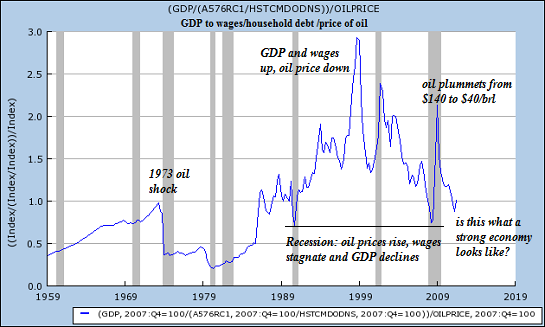
One way to gauge the real economy is to look at charts of the GDP, wages, household debt and the price of oil; another way is to correlate all of these on one chart. The following chart (courtesy of frequent contributor B.C.) plots these four metrics thusly: GDP/(wages/household debt)/price of oil.

What pops out of the chart is what happens when oil spikes higher or declines. In 1973, the first oil shock sent the economy off a cliff. Conversely, when oil fell to $12/barrel in the late 1990s while wages were rising strongly, the plotline peaked, reflecting a strong economy.
In 2008, oil spiked to $140/barrel in 2008, household debt reached record heights and wages began stagnating, and the economy fell into a sharp recession. When oil plummeted back to $40/barrel in early 2009, the plotline spiked up.

When oil prices and household debt are high while wages stagnate or decline, the economy sinks to recessionary levels.


Here are B.C.'s observations:
This chart utterly discredits the economics profession and those who claim that the post-industrial economy ("deindustrialization" and "financialization") is not oil-constrained and the service economy is what the rest of the world should adopt as the normative standard at $100+/barrel oil.
The current plotline is hovering just above the recessionary levels of late 2008. Does this reflect a strong economy, or one that is weak? If oil keeps climbing, what will that do to a visibly weak economy?

The Bulls are convinced that the U.S. has decoupled from the rest of the world and from the price of oil. This chart makes the opposite case: the price of oil matters, especially when wages are declining and household debt is elevated. '

Thank you, Jeroen T. ($10/mo), for your astoundingly generous subscription to this site -- I am greatly honored by your steadfast support and readership.Thank you, Vernon R. ($25), for your remarkably generous contribution to this site -- I am greatly honored by your support and readership.


Read more...

Thursday, March 01, 2012

If The Market Rolls Over Here....

If this rally runs out of steam, history suggests the next move down could plumb depths not seen in years.


If the market rolls over here, the next bottom might be a lot lower than most players think possible. After all, the "news" is all positive: Europe's debt crisis is now resolved; employment in the U.S. is trending up, GDP is growing nicely, etc. etc. etc.

As food for thought, here are two charts, courtesy of frequent contributor B.C., that suggest the good news might not only be priced in, but it might abruptly cease flowing.

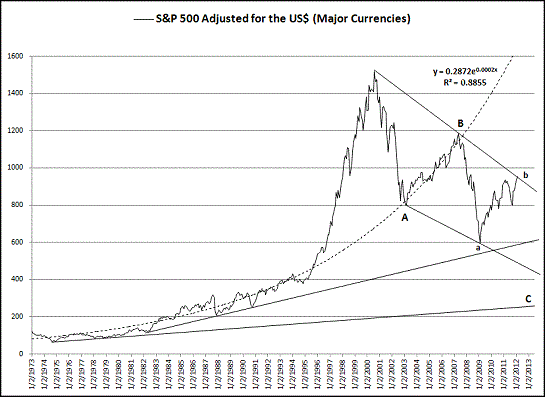
The first chart is of the S&P 500 from 1973 to the present. The current rally has stalled right at a multi-year line of resistance, and a potential A-B-C pattern in a long-term channel suggests a return visit to the March '08 lows around 666, or perhaps even lower.


Here are B.C.'s observations:
If a C wave is imminent, a typical pattern is 2 (or 2.382-2.764) x A or a target of the '02-'03 and fall '08 lows, or even as low as the 500s-600s eventually. C = A would imply an idealized target in the 460s and nominal SPX 600s (US$ constant at the current level).
Such a decline in a period of "growth" seems impossible, but we should keep in mind the possibility that four conditions could cause growth to roll over and corporate profits to compress:
1. Rising energy input costs
2. Rising U.S. dollar decimates overseas earnings of U.S. corporations
3. Tapped-out consumers run out of gas (literally)
4. Federal government stops borrowing and blowing 10% of GDP every year

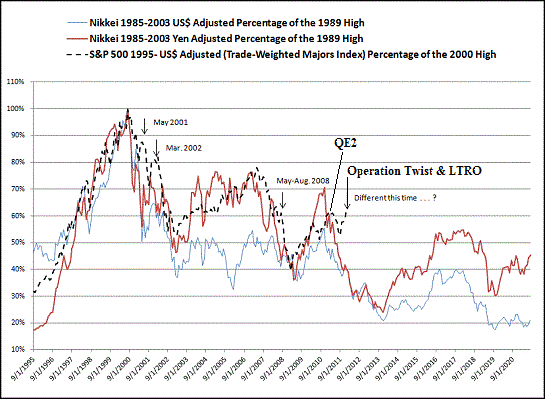
Next up, an analog chart of the Nikkei and the S&P 500 (SPX). To align apples to apples, this chart tracks the dollar-adjusted Nikkei from its top in 1989 and the dollar-adjusted SPX from its top in 2000. (For reference, the yen-adjusted Nikkei is also plotted.)

Interestingly, the SPX has tracked the Nikkei rather closely--at least until the extraordinary monetary interventions by the Federal Reserve known as QE2 and Operation Twist put booster rockets on the market (with some recent aid from the ECB's LTRO injection of about $1.5 trillion into the banking sector since December).

If the SPX were to continue tracking the Nikkei, the next bottom won't occur until late 2013 or early 2014--two years hence.


Here are B.C.'s notes on this chart:
Note how relatively closely the SPX was tracking the currency-adj. corollary with the Nikkei until QE2 and "Operation Twist". Coincidence . . .? I suspect not. Had the SPX tracked the corollary as in '01 and '08, the SPX would be in the 800s-900s by now.Can the Fed and shadow banksters prevent for the next 18-24 months the historical tendency for the SPX to follow the self-similar cyclical and secular patterns? I suspect we are going to witness their ongoing desperate attempts to do so.
The problem for the Fed is that interest rates are already zero, and playing around with bonds and buying more mortgages (the Fed already owns $1 trillion) is ultimately pushing on a string: the Fed can't force all the free money into productive investments, nor can it force banks to lend or consumers to spend.

The cliche is "don't fight the Fed;" there is no need to "fight the Fed" because they're busy self-destructing, and all we have to do is watch.

Maybe the market will follow Apple in a trajectory to the moon here. If it doesn't, a variety of other models suggests the wheels may fall off the "growth and rising profits forever" story and the market will decline to test recent lows or even hit new lows.

That's not what the Fed or the politicos want, but events on stage may be slipping beyond their off-stage control. 

Thank you, James M. ($60), for your astoundingly generous contribution to this site -- I am greatly honored by your support and readership.Thank you, Alfred V. ($50), for your exceptionally generous contribution to this site -- I am greatly honored by your support and readership.


Read more...

Terms of Service

All content on this blog is provided by Trewe LLC for informational purposes only. The owner of this blog makes no representations as to the accuracy or completeness of any information on this site or found by following any link on this site. The owner will not be liable for any errors or omissions in this information nor for the availability of this information. The owner will not be liable for any losses, injuries, or damages from the display or use of this information. These terms and conditions of use are subject to change at anytime and without notice.


Our Privacy Policy:


Correspondents' email is strictly confidential. This site does not collect digital data from visitors or distribute cookies. Advertisements served by a third-party advertising network (Investing Channel) may use cookies or collect information from visitors for the purpose of Interest-Based Advertising; if you wish to opt out of Interest-Based Advertising, please go to Opt out of interest-based advertising (The Network Advertising Initiative). If you have other privacy concerns relating to advertisements, please contact advertisers directly. Websites and blog links on the site's blog roll are posted at my discretion.


PRIVACY NOTICE FOR EEA INDIVIDUALS


This section covers disclosures on the General Data Protection Regulation (GDPR) for users residing within EEA only. GDPR replaces the existing Directive 95/46/ec, and aims at harmonizing data protection laws in the EU that are fit for purpose in the digital age. The primary objective of the GDPR is to give citizens back control of their personal data. Please follow the link below to access InvestingChannel’s General Data Protection Notice. https://stg.media.investingchannel.com/gdpr-notice/


Notice of Compliance with The California Consumer Protection Act
This site does not collect digital data from visitors or distribute cookies. Advertisements served by a third-party advertising network (Investing Channel) may use cookies or collect information from visitors for the purpose of Interest-Based Advertising. If you do not want any personal information that may be collected by third-party advertising to be sold, please follow the instructions on this page: Limit the Use of My Sensitive Personal Information.


Regarding Cookies:


This site does not collect digital data from visitors or distribute cookies. Advertisements served by third-party advertising networks such as Investing Channel may use cookies or collect information from visitors for the purpose of Interest-Based Advertising; if you wish to opt out of Interest-Based Advertising, please go to Opt out of interest-based advertising (The Network Advertising Initiative) If you have other privacy concerns relating to advertisements, please contact advertisers directly.


Our Commission Policy:

As an Amazon Associate I earn from qualifying purchases. I also earn a commission on purchases of precious metals via BullionVault. I receive no fees or compensation for any other non-advertising links or content posted on my site.

  © Blogger templates Newspaper III by Ourblogtemplates.com 2008

Back to TOP