Saturday, April 13, 2013

Part 45: Ah, Romance: Once Burned, Twice Shy (serialized fiction)

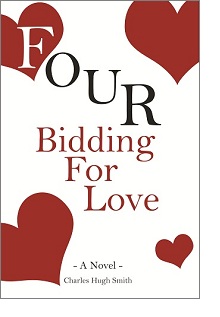
Here is this week's chapter of my serialized comic novel "Four Bidding For Love."(Those who find absurdist humor and adult situations offensive, please read no further.)


     Fearing a retreat would raise Alexia's suspicions, Ross returned to her bedroom just as she exited the bathroom in a cloud of steam, her hair wrapped turban-style in a bright yellow terry-cloth and a matching egg-yolk colored towel wrapped around her waist. Gazing at him with a conspiratorial half-smile, her expression faded and she said, "You look like you've just seen a ghost."
     Grasping for a plausible explanation of his shaken state, Ross muttered, "It was just a bit of bad news from my old neighbor. An apartment I was hoping to get fell through."
     Drawing close, Alexia murmured, "You don't have to be in such a rush to find another place to stay."
     Looking down, Ross stammered, "Well, I just . . . don't want you to tire of me. You know how easily that can happen."
     "You've just been burned out of your home, and I have a spare bedroom," she countered sympathetically. "You're very quiet and tidy, and look at the fabulous meals you've made for me. And Hanover likes you."
     "I like Hanover, too," Ross noted with a hint of regret.
     In a way he could not have predicted, his visible concern for overstaying his welcome touched Alexia as clear proof of his sensitivity and sincerity, and her appreciation of his finer qualities leaped to a new higher state of energy.
     A hesitancy to expose tender vulnerabilities colored her voice and she playfully tugged at his towel, saying, "We're having fun, aren't we? I like having you around."
     With a pained expression he slowly traced a line from her damp bare shoulder down to her hand and said, "Maybe that's why I feel like I should move out while you still feel that way."
     "I know the feeling," she replied quietly. "What's the expression—once burned, twice shy?" With a faint chagrin she added, "With me, it's thrice burned."
     Though curious what had led her to offer herself as freely as Kylie reported, Ross looked down at her long shapely legs and stammered, "Given your, um, experiences, I do marvel how uncynical you are."
     "I think you bring out my hopeful side," she confided. "Even someone with my history still wants . . . you know, to share something special."
     That her vulnerabilities and disappointments had driven her to desperate acts of faux affection and offering herself up for envelopes of cash struck the deepest chords of sympathy in Ross, and he impulsively embraced her.
     "You're very sweet," he murmured, and was struck a few seconds later by a gong of alarm at the realization she might have slept with half of Green Street's heterosexual male residents.
     Clearing his throat, he said, "I suppose we owe it to each other to get, um, tested, you know, just to be safe."
     Alexia chuckled with mild derision. "Don't worry, I won't get pregnant. The doctor told me that a long time ago, when I wanted to have a baby. As for infections, I've only had one lover in the past three years."
     Swallowing a desire to ask, is that not counting the sofa-based clients?, Ross said, "That's one more than I've had."
     "My, you're skittish tonight," she chided him good-naturedly. "Is the moon full? Don't worry, I've been a very careful girl with everything but my heart."
     Awash with jealousy over her secret clientele and the pressing financial need which must have driven her to the sofa, Ross turned to meet her bemused gaze. "You won't have to worry about money once you pay off your mortgage, will you?"
     "Do I look like I'm worried about money?" she replied with a small smile.
     "No, but I wish you didn't have to do anything for money other than sell shoes."
     Moving close so their noses almost touched, she murmured, "You've only been with me for two days and you're already worried that I'm working too much? That is sweet of you, but really, I like my little side business."
     With his fevered imagination filled with painful images of her undressed on her sofa with some undeserving client, Alexia's reference to assembling and selling collectables struck Ross as proof of some terrible emotional vacuum. His voice tight with anguish, he asked, "Would you let go of it for love?"
     Perplexed, Alexia studied his expression and said, "Don't worry. You're not competing for my time. There's enough of me to go around."
     Recalling Kylie's description of Alexia, Ross thought, Great Zeus, maybe she is a sex addict; that was Kylie's first intuition, and that's often accurate. His anguish grappled with what seemed to him a terribly unhealthy desire, and forcing a smile of reassurance he did not feel, Ross said, "Would you like me to sleep here or in my bedroom?"
     "Here," she murmured, "unless you make me too hot."
     As she demurely loosened her yellow towel and handed it him, Ross's eyes widened and he gulped nervously at the realization she expected him to perform his manly duties for a second time that evening. Raising her arms and arching her back in a very feline stretch, Alexia smiled and slipped beneath the comforter with an inviting sigh.
     To his great relief Ross managed to fulfill his duties with imminently satisfactory results for Alexia, and as her labored breathing subsided, he pondered the necessity of bolstering his vitality with herbal supplements. I just hope this holds her until tomorrow morning, he thought worriedly; I can't swing a third home run.

Next: An unstable elixir ready to boil over (Chapter 12)

To read the previous chapters, visit the "Four Bidding For Love" home page. 


Read more...

Thursday, April 11, 2013

Don't Ask--It's Magic

Any sufficiently advanced cartel's actions are indistinguishable from magic.


You may be surprised to learn that a marginalized, lowly blogger (me) has magical powers. It's not something I display in public, for self-evident reasons, but when two young friends, M.K. and K.K., expressed extreme skepticism, well, I was forced to display some wushu magic. Oh ye of little faith....


Don't ask--it's magic. The technique will be familiar to anyone who has practiced the esoteric Taoist arts, and after much pleading and cajoling, I revealed one basic technique to the young ladies.

To my chagrin, they both quickly mastered what had taken me years of arduous effort. M.K. shows me how it feels to be on the receiving end--ouch:


K.K. blasts her sister big-time:


OK, it's not quite magic. Like many other cutting-edge fads, such as money-printing to infinity, this type of faux manga-style martial arts began in Japan:


But let's talk a bit about real magic. Science fiction author Arthur C. Clarke's Three Laws famously include this one:

Any sufficiently advanced technology is indistinguishable from magic.

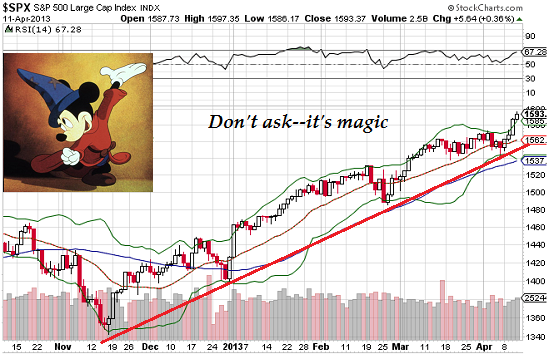
As evidence, I present the S&P 500 from January 1, 2013 to the present, April 12, 2013:


Don't ask--it's magic. Some of the potions and incantations have been leaked, of course, for example POMO and the pre-open purchase of E-Mini contracts, but like any good magic, the real techniques are secret.

As a result of the stupendous rally in the SPX, I propose a Fourth Law:

Any sufficiently advanced cartel's actions are indistinguishable from magic. 


Special "the end of the world as we know it" sale on seeds from our longtime supplier Everlasting Seeds:TEOTWAWKI SALE! 20% OFF!
In light of the calamitous predictions regarding the Global Coastal Event [Clif High], Korean Nuclear tensions, and Solar/EMPs “Kill Shot” {Ed Dames}, we thought we'd offer folks the largest discount we've ever given. We're not 'fortune tellers' here, or Seers, or 'Intuitives': but if even ONE of these predictions come to pass, it'll definitely make for a 'bad hair day' {week/month/year...} for all of us... 


Things are falling apart--that is obvious. But why are they falling apart? The reasons are complex and global. Our economy and society have structural problems that cannot be solved by adding debt to debt. We are becoming poorer, not just from financial over-reach, but from fundamental forces that are not easy to identify or understand. We will cover the five core reasons why things are falling apart:

go to print edition1. Debt and financialization
2. Crony capitalism and the elimination of accountability
3. Diminishing returns
4. Centralization
5. Technological, financial and demographic changes in our economy

Complex systems weakened by diminishing returns collapse under their own weight and are replaced by systems that are simpler, faster and affordable. If we cling to the old ways, our system will disintegrate. If we want sustainable prosperity rather than collapse, we must embrace a new model that is Decentralized, Adaptive, Transparent and Accountable (DATA).

We are not powerless. Not accepting responsibility and being powerless are two sides of the same coin: once we accept responsibility, we become powerful.

Kindle edition: $9.95       print edition: $24 on Amazon.com
To receive a 20% discount on the print edition: $19.20 (retail $24), follow the link, open a Createspace account and enter discount code SJRGPLAB. (This is the only way I can offer a discount.)


Thank you, Bejoy O. ($5/month), for your wondrously generous subscription to this site -- I am greatly honored by your support and readership.Thank you, David C. ($20), for yet another splendidly generous contribution to this site -- I am greatly honored by your steadfast support and readership.

Read more...

Wednesday, April 10, 2013

The Eroding Premium on Truth and Trust

The premium in America has shifted from truth to self-serving distortion, and from trust to manipulation.


The premium we place on truth and trustworthiness is self-evident. Truth is uniquely productive feedback from the real world. Truth (including factual data) is indispensable,  for it alone enables us to correct errors, learn from mistakes and improve our effectiveness and communication.

We pay a premium for trust because the cost of dishonesty and artifice is steep.Would you pay more to buy a used car from someone you trust? If you place no premium on trustworthiness, then you buy the "great deal" used car you found online: oops, the "new" battery was spray-painted black, the crankcase leaks, the engine is shot and doesn't pass smog, and the certificate of ownership is forged.

The premium on truth and trust is eroding under the constant onslaught of officially manipulated data and markets, and a vast array of distortions and propaganda designed to serve the interests of ruling Elites and key constituencies.

We all know the negative premium placed on fact: telling the truth will get you fired. And not just in the corporate world: politicians from the President on down all worship at the altar of the carefully distorted unemployment rate.

The officially sanctioned lying and manipulation are now shameless. Never mind that millions of people have become statistical phantoms (i.e. not in the workforce) to generate that low rate, and college graduates working 3 hours a day (if they're called in at all) are gleefully counted as employed, as if there is no difference between a full-time job and a marginal one.

President Obama is touting rising auto sales as proof of the "recovery" (and implicitly, of his wise stewardship), studiously avoiding the fact that these stupendous auto sales are the result of offering low-interest rate auto loans to marginal borrowers with near-zero collateral (i.e. skin in the game).

How did blowing a credit bubble and securitizing the debt turn out last time?

Never mind: here we go again. Via Doug Nolan at Prudent Bear:

Springleaf Finance Corp., the lender to borrowers with poor or limited credit, sold $604 million of bonds last month backed by personal loans secured by household goods from furniture to electronics, its first such deal. Demand for riskier asset-backed bonds has grown as the Federal Reserve holds its benchmark interest rate at almost zero for a fifth year. Sales of securities linked to subprime auto loans doubled to $4 billion in January from a year earlier.

Manipulation and carefully crafted distortion erode trust, not just in the individuals employed to repeat the lies but in the institutions that issue them. The ruthless pursuit of self-interest is now the norm; truth is a terribly risky disruptor that must be hidden, masked or countered with plausible lies.

As a nation, we're like the obese person who looks at himself in the mirror and sees his body as normal--the distortion of truth is so complete that we literally no longer recognize reality. Untruth no longer arouses any moral indignation; we are either too jaded to care, or our moral compass now spins aimlessly from one manipulation to the next.

There can be no trust if there is no truth. How can we trust people who lie to us constantly, who issue one self-serving justification after another for their own parasitic predation? We cannot. How can we trust institutions whose credibility now rests on the continuation of lies that are so embedded in our financial sector and State that their collapse will bring down the entire house-of-cards debtocracy? We cannot.

The premium in America has shifted from truth to self-serving distortion, and from trust to manipulation. This spiritual and moral rot will end gloriously, have no doubt, for the stock market's permanent ascendancy dissolves all other narratives. 


Special "the end of the world as we know it" sale on seeds from our longtime supplier Everlasting Seeds:TEOTWAWKI SALE! 20% OFF!
In light of the calamitous predictions regarding the Global Coastal Event [Clif High], Korean Nuclear tensions, and Solar/EMPs “Kill Shot” {Ed Dames}, we thought we'd offer folks the largest discount we've ever given. We're not 'fortune tellers' here, or Seers, or 'Intuitives': but if even ONE of these predictions come to pass, it'll definitely make for a 'bad hair day' {week/month/year...} for all of us... 


Things are falling apart--that is obvious. But why are they falling apart? The reasons are complex and global. Our economy and society have structural problems that cannot be solved by adding debt to debt. We are becoming poorer, not just from financial over-reach, but from fundamental forces that are not easy to identify or understand. We will cover the five core reasons why things are falling apart:

go to print edition1. Debt and financialization
2. Crony capitalism and the elimination of accountability
3. Diminishing returns
4. Centralization
5. Technological, financial and demographic changes in our economy

Complex systems weakened by diminishing returns collapse under their own weight and are replaced by systems that are simpler, faster and affordable. If we cling to the old ways, our system will disintegrate. If we want sustainable prosperity rather than collapse, we must embrace a new model that is Decentralized, Adaptive, Transparent and Accountable (DATA).

We are not powerless. Not accepting responsibility and being powerless are two sides of the same coin: once we accept responsibility, we become powerful.

Kindle edition: $9.95       print edition: $24 on Amazon.com
To receive a 20% discount on the print edition: $19.20 (retail $24), follow the link, open a Createspace account and enter discount code SJRGPLAB. (This is the only way I can offer a discount.)


Thank you, Miles H. ($100), for your outrageously generous contribution to this site -- I am greatly honored by your steadfast support and readership.Thank you, Stephen L. ($30), for yet another splendidly generous contribution to this site -- I am greatly honored by your steadfast support and readership.

Read more...

Tuesday, April 09, 2013

Which Dominoes Are Next to Fall in Europe?

If things fail from the periphery to the core, perhaps dominoes fall that way, too.


Wondering which dominoes are next to fall in Europe? Correspondent David P. provides a list based on a simple but powerful precept: follow the smart money. In this case, the smart money entered the at-risk banking sector of a particular nation to skim the fat premium offered by its higher interest rates--rates that reflected the higher risk. The smart money then exits the nations' banking sector before the inevitable solvency crisis triggers capital controls and depositor expropriations (the comically misleading "bail-in").

Why is any money left in at-risk periphery banks? David and I discussed two dynamics.
David describes the first--chasing yields:

1. "The Chasing of Yield in a Time of Financial Repression. People chase those nickels, and since nobody (had) yet been hit by the steamroller, it was all fun and games. A good chunk of them are in time deposits, and now they can't escape. And a decent chunk is local money, too."

2. The assumption that small depositors would be protected from losses in the event of a bank failure. There was little reason for anyone to doubt that even in the worst-case scenario, depositors would be protected by one central authority or another.

3. The crisis has been averted or pushed forward into the future. Large depositors undoubtedly recognized the risk but likely reckoned that the European Central Bank's remarkable success at kicking the debt-crisis can down the road would stave off any real crisis indefinitely.

As we saw in The Real Cyprus Template (the one you're not supposed to notice), once the smart money exits the at-risk banking sector, it is allowed to fall. This suggests that one way to identify which dominoes are likely to fall next is to look at the smart money's deposits in each nation's banks.

If the smart money has pulled most of its capital out, ECB and Eurozone authorities have a diminishing stake in propping up the domino. As a result, its fall becomes increasingly likely.

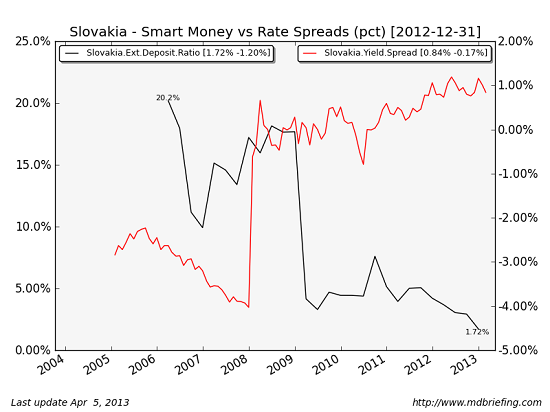
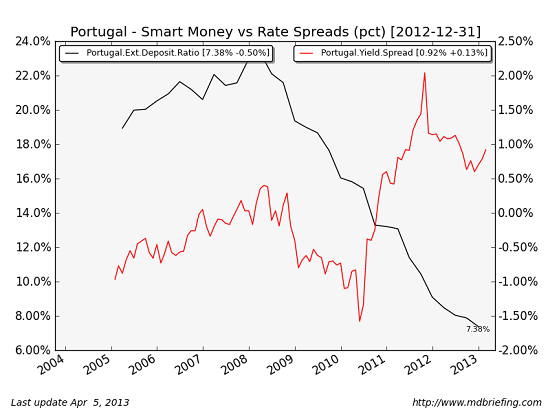
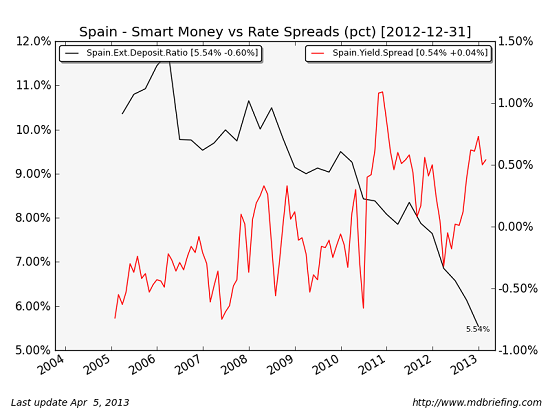
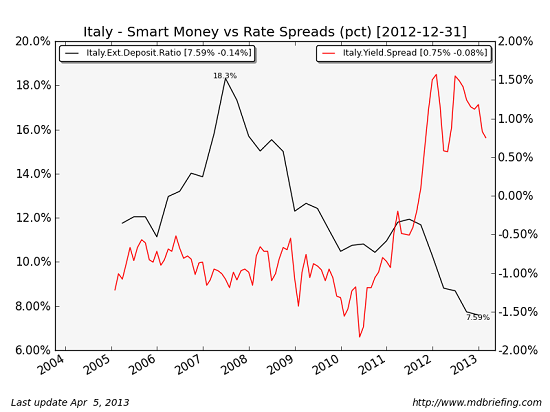
Here is David's commentary and accompanying charts of seven European nations. I have arranged David's charts in a roughly periphery-to-core order. 

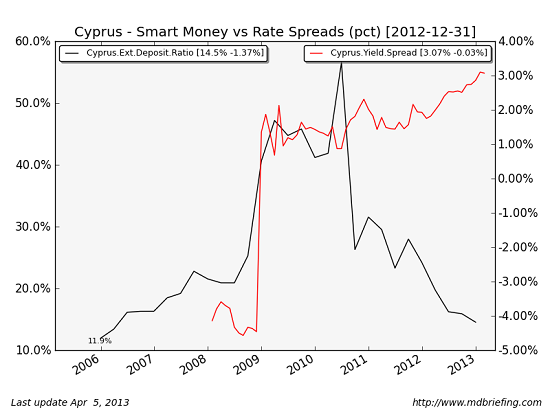
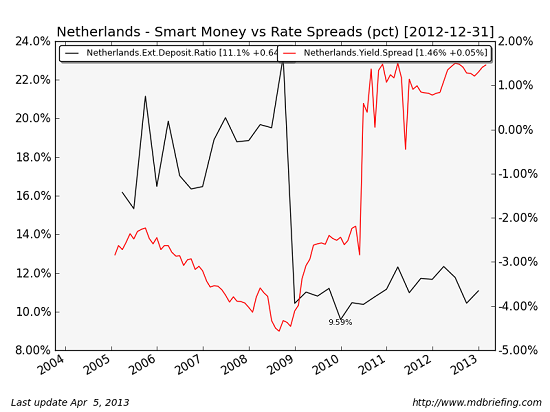
In Cyprus, one group of depositors seemed to have the inside track on the danger of remaining as an "uninsured depositor" in the two big Cypriot banks. That group, for Cyprus, is classified by the ECB's statistics group using a long and incomprehensible ECB series name - BSI.Q.CY.N.A.L20.A.1.U5.1000.Z01.E. Here's a link if you are interested in the raw data. Translated into English, this is basically "Eurozone Banks outside Cyprus." Or more succinctly put, Smart Money.

So what is that group is doing in other eurozone nations? We are not going to monitor every nation, rather, only the ones where Smart Money could conceivably make a decent profit by being there. This is quantified by the interest rate differential.

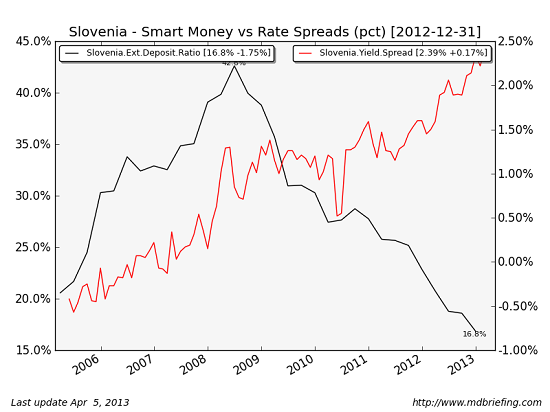
In the charts below, the black line represents the percentage of total deposits in that country that come from Smart Money. The lower the percentage, the lower the damage to Smart Money from any default. And one thing we've learned since 2008 is, core nation politicians will not hesitate to throw any peripheral nation under the bus in order to avoid any losses to Smart Money. The red line is the interest rate spread - the higher the number is above 0, the more profitable it is for Smart Money to remain. So if its profitable, and Smart Money is for some reason fleeing, you might want to pay attention! Regardless, if Smart Money is mostly gone, that means the people in charge of the Eurosystem can pull the plug on the country's banking system at any time without fear of loss to their own banking system.

First is Cyprus, to provide an example of what a deposit situation looks like when the core system political class feels comfortable torpedoing a periphery banking system.


Thank you, David, for the commentary and charts. As David observed in our email exchange, "Things fail from the periphery to the core." With this in mind, we might arrange the dominoes in this order: Slovenia, Portugal, Malta, and then Spain.

Though Spain and Italy are considered core E.U. nations, we should probably differentiate between political and financial cores and peripheries. Should a self-reinforcing crisis of liquidity, solvency and loss of trust gather momentum, Italy's debt situation could reach critical mass, regardless of its political status as a core nation.

Similar political and financial crises could arise in The Netherlands and France,too, though these crises will probably not be triggered by an exit of core-EU mobile capital. 


Special "the end of the world as we know it" sale on seeds from our longtime supplier Everlasting Seeds:

TEOTWAWKI SALE! 20% OFF!
In light of the calamitous predictions regarding the Global Coastal Event [Clif High], Korean Nuclear tensions, and Solar/EMPs “Kill Shot” {Ed Dames}, we thought we'd offer folks the largest discount we've ever given. We're not 'fortune tellers' here, or Seers, or 'Intuitives': but if even ONE of these predictions come to pass, it'll definitely make for a 'bad hair day' {week/month/year...} for all of us... 


Things are falling apart--that is obvious. But why are they falling apart? The reasons are complex and global. Our economy and society have structural problems that cannot be solved by adding debt to debt. We are becoming poorer, not just from financial over-reach, but from fundamental forces that are not easy to identify or understand. We will cover the five core reasons why things are falling apart:

go to print edition1. Debt and financialization
2. Crony capitalism and the elimination of accountability
3. Diminishing returns
4. Centralization
5. Technological, financial and demographic changes in our economy

Complex systems weakened by diminishing returns collapse under their own weight and are replaced by systems that are simpler, faster and affordable. If we cling to the old ways, our system will disintegrate. If we want sustainable prosperity rather than collapse, we must embrace a new model that is Decentralized, Adaptive, Transparent and Accountable (DATA).

We are not powerless. Not accepting responsibility and being powerless are two sides of the same coin: once we accept responsibility, we become powerful.

Kindle edition: $9.95       print edition: $24 on Amazon.com
To receive a 20% discount on the print edition: $19.20 (retail $24), follow the link, open a Createspace account and enter discount code SJRGPLAB. (This is the only way I can offer a discount.)


Thank you, David K. ($100), for your outrageously generous contribution to this site -- I am greatly honored by your steadfast support and readership.Thank you, Quentin V.T. ($5/month), for your splendidly generous subscription to this site -- I am greatly honored by your support and readership.

Read more...

Monday, April 08, 2013

Good Banker, Bad Banker

It's important to draw a line between two very different flavors of banker: "restrained" (Dr. Jekyll) and "unrestrained" (Mr. Hyde).


Those who read The Proper Use of Credit (April 4, 2013) know that I see a vital role for credit and yes, banks, in a sustainable economy. But as many observers have pointed out, banks must be controlled lest the predatory, parasitic Mr. Hyde replaces the proper Dr. Jekyll role of providing capital to worthy enterprises and households.

In response to Debt = Serfdom (April 2, 2013), longtime correspondent Jeff W. delineated the difference between Good Banker (restrained) and Bad Banker (unrestrained). Unfortunately, as Jeff explains, it is Mr. Hyde (unrestrained banker) who has captured the political and regulatory machinery of governance.

Here is Jeff's commentary:

"I distinguish in my mind two different kinds of bankers: I'll call them "restrained" and "unrestrained."

The restrained banker loads up the debt serfs with debt up to their Plimsoll Lines or credit limits. Then he stops. He knows that if he keeps loading more debt onto them, they may go bankrupt, and he wants to avoid the mess and losses that come with that.

The unrestrained banker has a completely different skill set. He will make high-interest loans (Payday Loans) to insolvent borrowers. He is not afraid of bankruptcies; bankruptcies are part of his business model. He knows how to take advantage of borrowers who are desperate, ignorant, or impulsive (or all three). He knows all about asset stripping. He knows how to unload bad loan paper on suckers. He thrives in an environment of chaos and desperation, where his customers are often at the end of their ropes.

In the old days, the restrained bankers and community-minded Americans used to put controls on the unrestrained bankers. There were usury laws that made it illegal to charge interest above a certain rate, such as 15%. Unrestrained bankers were not welcomed into polite society, and people were warned against doing business with them.

Which of the two kinds of bankers operate the Federal Reserve and have seized control of the Federal government? I say it is the unrestrained variety. I say that the securitization of mortgages was, all along, a scheme to unload bad mortgage paper on suckers, such as pension funds and the U.S. taxpayer.

Obama's stimulus was the work of unrestrained bankers. The Obama deficits have been the work of unrestrained bankers. The Simpson-Bowles Commission was an effort by the restrained bankers to keep the U.S. debt below its Plimsoll Line, which Reinhart and Rogoff have put at 80% of GDP. But the unrestrained bankers have not hesitated to blow right past that.

If my observation is correct that the U.S. government has now been subverted by unrestrained bankers, it means that:

- Our nation's fiscal policy is being dictated by people who are not afraid of the chaos of bankruptcy, but who thrive in that environment.

- Federal policies are being dictated by people who like to deal with debtors who are desperate and at the end of their ropes.

- Federal policies are being dictated with a view of future asset stripping.

- With this group in power it means that In a future bankruptcy scenario, everyone is going to come out a loser except the unrestrained bankers.

Where restrained bankers might be compared with bloodsucking fleas or lice, who are parasites on healthy bodies, the unrestrained bankers can be more aptly compared with maggots, who feast on the bodies of the dead.

So I say it is important to know what kind of bankers you are dealing with. If you are dealing with unrestrained bankers, it can bring nothing but bad luck."

Thank you, Jeff. As correspondent Lew G. noted, the key feature of a sustainable, non-parasitic banking sector is that banks and bankers have "skin in the game," i.e. they personally suffer losses when their loans and bets go bad.

This is the essence of moral hazard: the separation of risk from consequence. Put another way, those who are insulated from risk will have an insatiable appetite for risky bets because any gains will be theirs to keep but any losses will be covered by the central bank or government: this is known as "privatizing profits and socializing losses."

As Lew G. also observed, if players (in this case, bankers, legislators and regulators) "have a choice of games, they will play the one with the best payoff," i.e. the one in which they have no skin in the game and the Central State/bank will backstop/ socialize their losses to the Tax Donkeys (taxpayers) while they keep the ill-gotten gains.

The Federal Reserve, the Obama Administration, the housing agencies and the U.S. Treasury are all offering bankers and financiers high-payoff tables that require no skin in the game. No wonder our system is dominated by the unrestrained bankers, sociopathological Mr. Hydes who offer a few coins in compensation for running down the nation.

For more on these topics, please read:

The Great Reset (July 7, 2011)


Special "the end of the world as we know it" sale on seeds from our longtime supplier Everlasting Seeds:TEOTWAWKI SALE! 20% OFF!
In light of the calamitous predictions regarding the Global Coastal Event [Clif High], Korean Nuclear tensions, and Solar/EMPs “Kill Shot” {Ed Dames}, we thought we'd offer folks the largest discount we've ever given. We're not 'fortune tellers' here, or Seers, or 'Intuitives': but if even ONE of these predictions come to pass, it'll definitely make for a 'bad hair day' {week/month/year...} for all of us... 


Things are falling apart--that is obvious. But why are they falling apart? The reasons are complex and global. Our economy and society have structural problems that cannot be solved by adding debt to debt. We are becoming poorer, not just from financial over-reach, but from fundamental forces that are not easy to identify or understand. We will cover the five core reasons why things are falling apart:

go to print edition1. Debt and financialization
2. Crony capitalism and the elimination of accountability
3. Diminishing returns
4. Centralization
5. Technological, financial and demographic changes in our economy

Complex systems weakened by diminishing returns collapse under their own weight and are replaced by systems that are simpler, faster and affordable. If we cling to the old ways, our system will disintegrate. If we want sustainable prosperity rather than collapse, we must embrace a new model that is Decentralized, Adaptive, Transparent and Accountable (DATA).

We are not powerless. Not accepting responsibility and being powerless are two sides of the same coin: once we accept responsibility, we become powerful.

Kindle edition: $9.95       print edition: $24 on Amazon.com
To receive a 20% discount on the print edition: $19.20 (retail $24), follow the link, open a Createspace account and enter discount code SJRGPLAB. (This is the only way I can offer a discount.)


Thank you, Charles C. ($200), for your stupendously generous contribution to this site -- I am greatly honored by your steadfast support and readership.Thank you, W. Thomas D. ($55), for your superlatively generous contribution to this site -- I am greatly honored by your support and readership.

Read more...

Terms of Service

All content on this blog is provided by Trewe LLC for informational purposes only. The owner of this blog makes no representations as to the accuracy or completeness of any information on this site or found by following any link on this site. The owner will not be liable for any errors or omissions in this information nor for the availability of this information. The owner will not be liable for any losses, injuries, or damages from the display or use of this information. These terms and conditions of use are subject to change at anytime and without notice.

RE: European Union AI Act, and Our Use of Generative AI Tools and Agents Policy

All text on this site is composed by Charles Hugh Smith or by a credited guest-author. No Generative AI Tools are used in the composition / writing of any text or graphic content created by Charles Hugh Smith. This site deploys no AI agents or generative AI tools. This site is not responsible for the disclosures, use or non-use of AI agents or generative AI tools in advertisements displayed by Investing Channel or other ad placement services.

Audio files generated by text-to-audio transcription tools are identified as such.

Our Privacy Policy:

Correspondents' email is strictly confidential. This site does not collect digital data from visitors or distribute cookies. Advertisements served by third-party advertising networks such as Investing Channel may use cookies or collect information from visitors for the purpose of Interest-Based Advertising; if you wish to opt out of Interest-Based Advertising, please go to Opt out of interest-based advertising (The Network Advertising Initiative) If you have other privacy concerns relating to advertisements, please contact advertisers directly.

PRIVACY NOTICE FOR EEA INDIVIDUALS

This section covers disclosures on the General Data Protection Regulation (GDPR) for users residing within EEA only. GDPR replaces the existing Directive 95/46/ec, and aims at harmonizing data protection laws in the EU that are fit for purpose in the digital age. The primary objective of the GDPR is to give citizens back control of their personal data. Please follow the link below to access InvestingChannel's General Data Protection Notice.
https://stg.media.investingchannel.com/gdpr-notice/

Notice of Compliance with The California Consumer Protection Act

This site does not collect digital data from visitors or distribute cookies. Advertisements served by a third-party advertising network (Investing Channel) may use cookies or collect information from visitors for the purpose of Interest-Based Advertising. If you do not want any personal information that may be collected by third-party advertising to be sold, please follow the instructions on this page: Do Not Sell My Personal Information.

Regarding Cookies:

This site does not collect digital data from visitors or distribute cookies. Advertisements served by third-party advertising networks such as Investing Channel may use cookies or collect information from visitors for the purpose of Interest-Based Advertising; if you wish to opt out of Interest-Based Advertising, please go to Opt out of interest-based advertising (The Network Advertising Initiative) If you have other privacy concerns relating to advertisements, please contact advertisers directly.

Our Commission Policy:

Though I earn a small commission on Amazon.com books and gift certificates and gold (BullionVault) purchased via links on my site, I receive no fees or compensation for any other non-advertising links or content posted on my site.

Copyright Notice:

All original images (Drawings and Photographs), text (essays, books and works of fiction), audio and video recordings, musical compositions, graphic design, graphic design elements and HTML coding on this site are the copyrighted work of Charles Hugh Smith unless otherwise credited or noted. They are published as information for the private use of site visitors, and any reproduction or redistribution of this content or coding in any media in any format or distribution channel (text, audio, video/film, web) without the written permission of the copyright holder is strictly prohibited. All rights in all media reserved globally.

  © Blogger templates Newspaper III by Ourblogtemplates.com 2008

Back to TOP