

Thursday, November 07, 2013

Could Bitcoin (or equivalent) Become a Global Reserve Currency?

It's a worthy thought experiment to ask if a digital currency could also act as a reserve currency.

Could a non-state issued digital currency like Bitcoin become a global reserve currency? The idea came up in my recent conversation with Max Keiser on the Keiser Report during our discussion of reserve currencies.

The idea is intriguing on a number of levels. In terms of retaining value though thick and thin, the ultimate reserve currency cannot be printed (and thus devalued) with abandon by a government. Gold and silver have served as the ultimate reserve currency, as precious metals can be traded for commodities and services, provide collateral for debt and serve as reliable stores of value.

While many observers believe gold is still the only reliable reserve currency (or if you prefer, the only reliable backing for government-issued paper money), it's a worthy thought experiment to ask if a digital currency could also act as a reserve currency.

Since there is no real-world commodity backing the digital currency, its value must be based on scarcity and its ubiquity as money. The two ideas are self-reinforcing: there must be demand for the digital money to create scarcity, and the source of demand is the digital currency's acceptance as money that can be used to buy commodities, goods, services and (the ultimate test) gold.

It follows that the first step in a non-state issued digital currency becoming a reserve currency is that it isn't created in quantities that dwarf demand. If the digital currency is issued with abandon, it cannot be scarce enough to gain any value. If I own one quatloo (our hypothetical digital currency) and a trillion new quatloos are issued tomorrow, the value of my one quatloo will decline to near-zero.

The second step is its widespread acceptance globally as money, i.e. a store of value and something which can be traded for goods and services.

There is a bit of a built-in conflict in these two requirements. To be useful in the $60 trillion global economy, the quatloo must be issued in size: there must be enough of it around to grease transactions large and small in all sorts of markets. Using the U.S. dollar as a guide (since the USD is the primary reserve currency), we can estimate that a minimum of $1 trillion in quatloos would be needed to become a practical global currency.

To act as a reserve currency, another trillion or two would be needed, as nations would hold these quatloos as reserves. (Nations hold an estimated $7 trillion in USD reserves, about $3 trillion euros and $1 trillion or so in yen, pounds and other currencies.)

But issuing quatloos in these quantities would remove any scarcity value. Thus the issuer of the quatloo would have to carefully issue more quatloos only when demand justified the need for more monetary "grease" for the global economy.

If on the other hand skyrocketing demand/scarcity drove the value to the stratosphere, holders of the quatloo would rejoice, but this volatility would present its own set of risks for those seeking to use the quatloo as a reserve against currency volatility in the home-country currency. If a digital currency can leap ten-fold in a short time, then might it not drop with equal volatility?

Volatility is the enemy of reserves; the holder of reserves needs a liquid (meaning it can easily be sold or traded in size) currency that predictably retains its value. A volatile currency poses risks, as do currencies that cannot be traded in size without drastically influencing the market value of the currency.

These conditions pose a steep challenge for any digital currency, but they are not insurmountable. Even as a niche currency, non-state issued digital currencies could play a role in the global economy, especially if government-issued fiat currencies destabilize/ devalue due to massive money creation by desperate central banks and state treasuries.

Is scarcity enough to back a non-state issued currency? Bitcoin offers a real-world experiment.

Keiser Report: State Sanctioned Profits Max, Stacy and guest CHS cover a wide range of topics... 


The Nearly Free University and The Emerging Economy:
The Revolution in Higher Education

Reconnecting higher education, livelihoods and the economy
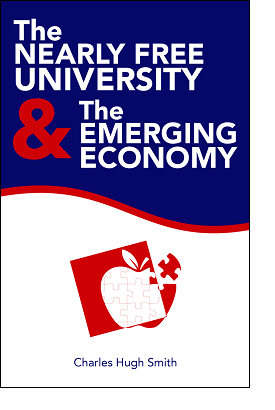
With the soaring cost of higher education, has the value a college degree been turned upside down? College tuition and fees are up 1000% since 1980. Half of all recent college graduates are jobless or underemployed, revealing a deep disconnect between higher education and the job market.

It is no surprise everyone is asking: Where is the return on investment? Is the assumption that higher education returns greater prosperity no longer true? And if this is the case, how does this impact you, your children and grandchildren?

go to Kindle edition
We must thoroughly understand the twin revolutions now fundamentally changing our world: The true cost of higher education and an economy that seems to re-shape itself minute to minute.

The Nearly Free University and the Emerging Economy clearly describes the underlying dynamics at work - and, more importantly, lays out a new low-cost model for higher education: how digital technology is enabling a revolution in higher education that dramatically lowers costs while expanding the opportunities for students of all ages.

The Nearly Free University and the Emerging Economy provides clarity and optimism in a period of the greatest change our educational systems and society have seen, and offers everyone the tools needed to prosper in the Emerging Economy.

Kindle edition: list $9.95 


Things are falling apart--that is obvious. But why are they falling apart? The reasons are complex and global. Our economy and society have structural problems that cannot be solved by adding debt to debt. We are becoming poorer, not just from financial over-reach, but from fundamental forces that are not easy to identify. We will cover the five core reasons why things are falling apart:
go to print edition1. Debt and financialization
2. Crony capitalism
3. Diminishing returns
4. Centralization
5. Technological, financial and demographic changes in our economy

Complex systems weakened by diminishing returns collapse under their own weight and are replaced by systems that are simpler, faster and affordable. If we cling to the old ways, our system will disintegrate. If we want sustainable prosperity rather than collapse, we must embrace a new model that is Decentralized, Adaptive, Transparent and Accountable (DATA).

We are not powerless. Once we accept responsibility, we become powerful.

Kindle: $9.95       print: $24


Thank you, Michael J. ($50), for your stupendously generous contribution to this site-- I am greatly honored by your support and readership.


Read more...

Wednesday, November 06, 2013

The Generational Injustice of Social (in)Security

Forcing young workers to pay into a Ponzi Scheme is generational injustice on a vast scale.

Why should young workers pay into a retirement system that will give them nothing, a system that will dissolve in insolvency long before they're old enough to retire? This is a question that Max Keiser posed in our conversation on Peak Retirement, and I think it deserves an answer.

I think the core issue here is the generational injustice of pay as you go social programs, which boil down to unsustainable Ponzi schemes. As I noted yesterday in The Problem with Pay-As-You-Go Social Programs (November 5, 2013), all pay as you go programs funded by payroll taxes--Social Security and Medicare in the U.S.--are only sustainable if the number of workers rises faster than the number of beneficiaries, because it takes multiple full-time workers' payroll taxes to fund each beneficiary.

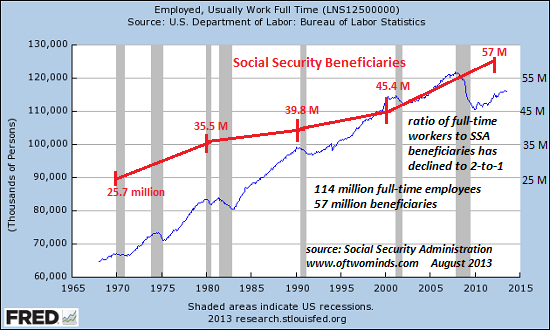
As I showed yesterday, it takes about ten low-wage (and hence low-payroll tax) workers to fund one retiree. At this rate, Social Security's 57 million beneficiaries (on its way to 70+ million as the Baby Boom retires en masse) would need 500 million workers paying into the system for it to be sustainable.

It takes only a few high earners (those making $85,000 or more annually) to fund one retiree, but there are too few high earners to support the system (13 million workers earn $85,000 or more, while beneficiaries will soon top 60 million).

While the number of beneficiaries will soar for the next decade as 60+ million Baby Boomers retire, the number of full-time jobs has stagnated, as this chart shows:


If the system doesn't change, the young workers currently paying payroll taxes to fund their elders' retirements will get little to nothing out of the system. This is ordained by two trends: demographics and the end of (paid) work. Global Reality: Surplus of Labor, Scarcity of Paid Work (May 7, 2012).

A huge cohort of retirees requires an even larger cohort of workers to support its retirement in pay as you go systems. This is what renders Social Security a Ponzi Scheme: a Ponzi Scheme only works as long as the number of new marks is substantial enough to pay the promised riches. Once the number of marks declines below a threshold, the Ponzi Scheme implodes.

The soon-to-be 70 million beneficiaries of Social Security would need roughly 210 million full-time workers earning decent money to sustainably fund their benefits. The U.S. economy is short about 100 million full-time jobs, and given the end of work realities I have often covered here (just type end of work into the custom search box on the main blog page), the number of full-time jobs with decent pay may well decline sharply, even in "good times," i.e. periods of expansion.

We can expect widespread destruction of paid work as technology creatively destroys one sector after another.

Why should young workers pay into a retirement system that cannot possibly offer them any benefit? The conventional answer is a lie: "Social Security is essentially eternal and will be here forever."

The other conventional answer is pure self-serving, self-justification by retirees: "We wuz promised." Well guess what, Boomers (I am 59 and a Boomer), things change in pay as you go systems. When the number of full-time workers falls to 2-to-1 or less and the number of retirees drawing benefits skyrockets, the system is no longer sustainable, regardless of what was promised by feckless politicos and their toadies.

The Social Security system could be made sustainable, but it would take radical reform. The constituencies that would oppose these reforms are among the most political powerful in the nation, so there is no chance these would ever be aired, much less approved:

1. Eliminate Social Security benefits for double and triple-dippers, i.e. those drawing pensions from other private or government sources. Re-engineer Social Security into a system for those with no other retirement benefits or pensions.

2. Tax all income, not just earned income. Lower the total Social Security tax from 12.4% to 10% but apply it equally to all income. Why should someone earning $1,000,000 pay less a percentage than someone earning $10,000? Why should I pay nothing on $100,000 I skimmed in a stock trade? Lower the tax but tax all income. Simple, fair, no loopholes.

3. Ditch the bogus Trust Fund of lies and set up a real Trust Fund that is outside the Federal Budget and Congressional avarice. Any surplus (i.e. when taxes collected exceed benefits paid in that year) would go into a true Trust Fund that uses the cash to buy Treasuries, other government bonds and AAA corporate bonds. This fund would thus help keep interest rates low, and the interest generated by the bonds would be real, not borrowed.

Congress would not be allowed to appropriate the Trust Fund for any purpose (bridges to nowhere, discretionary wars, etc.). It would be managed by trustees elected by the citizenry.

With a true Trust Fund, young workers would actually have some hope that the fund would still have real assets to liquidate to fund their retirement.

Radical transformation is necessary if Social Security is to become something other than a massive wealth transfer scheme from the young to the elderly.

Forcing young workers to pay into a Ponzi Scheme is generational injustice on a vast scale. Self-serving justifications of the status quo by those benefiting from this transfer of wealth should be outed for what they are: justifications of exploitation, avarice and injustice.

Keiser Report: State Sanction Profits Max, Stacy and guest CHS cover a wide range of topics... 


The Nearly Free University and The Emerging Economy:
The Revolution in Higher Education

Reconnecting higher education, livelihoods and the economy

With the soaring cost of higher education, has the value a college degree been turned upside down? College tuition and fees are up 1000% since 1980. Half of all recent college graduates are jobless or underemployed, revealing a deep disconnect between higher education and the job market.

It is no surprise everyone is asking: Where is the return on investment? Is the assumption that higher education returns greater prosperity no longer true? And if this is the case, how does this impact you, your children and grandchildren?

go to Kindle edition
We must thoroughly understand the twin revolutions now fundamentally changing our world: The true cost of higher education and an economy that seems to re-shape itself minute to minute.

The Nearly Free University and the Emerging Economy clearly describes the underlying dynamics at work - and, more importantly, lays out a new low-cost model for higher education: how digital technology is enabling a revolution in higher education that dramatically lowers costs while expanding the opportunities for students of all ages.

The Nearly Free University and the Emerging Economy provides clarity and optimism in a period of the greatest change our educational systems and society have seen, and offers everyone the tools needed to prosper in the Emerging Economy.

Kindle edition: list $9.95 


Things are falling apart--that is obvious. But why are they falling apart? The reasons are complex and global. Our economy and society have structural problems that cannot be solved by adding debt to debt. We are becoming poorer, not just from financial over-reach, but from fundamental forces that are not easy to identify. We will cover the five core reasons why things are falling apart:

go to print edition1. Debt and financialization
2. Crony capitalism
3. Diminishing returns
4. Centralization
5. Technological, financial and demographic changes in our economy

Complex systems weakened by diminishing returns collapse under their own weight and are replaced by systems that are simpler, faster and affordable. If we cling to the old ways, our system will disintegrate. If we want sustainable prosperity rather than collapse, we must embrace a new model that is Decentralized, Adaptive, Transparent and Accountable (DATA).

We are not powerless. Once we accept responsibility, we become powerful.

Kindle: $9.95       print: $24


Thank you, Emily M. ($5/month), for your superbly generous subscription to this site-- I am greatly honored by your support and readership.

Read more...

Tuesday, November 05, 2013

The Problem with Pay-As-You-Go Social Programs: They're Ponzi Schemes

Ignoring the facts won't help us address the insolvency of pay-as-you-go social programs.

I was fortunate enough to be invited back on Max Keiser's Keiser Report for a wide-ranging discussion of Peak Retirement, currency wars and more. Since the topics Max raises are profound and not always that easy to summarize (if there is another media host who covers complex topics in such profusion and with such a diverse range of guests, he/she is unknown to me), I'm devoting the next few blog entries to offer context for the topics Max and I discussed.

Max's first question related to my entry on Peak Retirement (October 15, 2013) in which I showed that the ratio of full-time workers to Social Security beneficiaries has dropped to 2-to-1.


Why does this matter? It matters because our social programs are pay as you go, meaning that current workers pay current retirees' benefits. There is no "trust fund" and the proof is simple: now that Social Security is operating at a deficit, i.e. payroll tax revenues no longer cover benefits paid out, where does the U.S. Treasury get the money to pay the benefits not covered by tax revenues?

Social Security Ran $47.8B Deficit in FY 2012

It sells bonds, just like it does to fund any other deficit spending of the federal government. The Trust Fund is a politically useful fiction, period, end of story. The bonds in the bogus Trust Fund are non-negotiable, i.e. worthless. The Treasury funds Social Security deficits by selling Treasury bonds.

(Social Security reports "interest earned" on the phony non-negotiable bonds, but where does the U.S. Treasury get the money to pay the interest? It sells T-Bills, adding to the national debt. No matter how you slice it, the programs' deficits are funded by selling debt, i.e. T-Bills, just like all federal deficit spending.)

I bobbled my response to Max's question, so he helpfully stepped in and explained that social programs like Social Security and Medicare are paid by payroll taxes, not income or other taxes. Employers and employees both pay 7.65% of earned income/wages to fund these two monster programs--a total payroll tax of 15.3%. (12.4% is for Social Security and 2.9% is for Medicare.)

Those who receive no earned income (self-employment earnings, wages, salaries, tips, etc.) and only receive unearned income (dividends, capital gains, rents, etc.) pay no Social Security/Medicare payroll taxes. That's one reason why unearned income is so sweet: it avoids the 15.3% payroll tax right off the top.

(Those of us who are self-employed pay the entire 15.3%.)

This means these programs depend entirely on payroll taxes from employed people. The taxes collected are non-trivial: Social Security brought in $725 billion in cash and paid $773 billion for benefits and overhead expenses in 2012.

The Social Security Administration (SSA) publishes a helpful chart of all earned income reported on federal tax returns: Wage Statistics for 2012. This data will help us understand why the system depends not just on those with any old job but those with good-paying full-time jobs.

(Recall that high-income earners only pay payroll taxes on the first $113,700 in 2013 and $117,000 in 2014. So someone earning $1,000,000 a year pays the same Social Security tax as someone making $113,700.)

Let's illustrate the importance of the full-time job/beneficiary ratio by asking: how many workers does it take to fund one retiree's annual benefit? Since even a low-lifetime earnings debt-serf like me can get $2,100 a month in Social Security bennies (if I wait until 70 to collect), and higher lifetime earnings folks get $25,000 a year at full or even early retirement, let's ask: how many workers' payroll taxes does it take to fund one retiree getting $25,000 a year from Social Security?

Over 23 million people reporting earned income made less than $5,000 a year. The SSA reports their average compensation was around $2,000. The Social Security payroll tax is 12.4%, so 12.4% of 2,000 is $248 a year in Social Security payroll tax.

It takes 100 of these workers' Social Security payroll tax to fund one retiree.
Another 14 million workers earn between $5,000 and $10,000, with an average of $7,400. At $7,400, each worker pays $917 in Social Security payroll tax. It takes 27 of these workers' payroll taxes to fund one retiree.

About 12 million workers earn between $10,000 and $15,000 a year, with an average of $12,460. Their Social Security payroll tax works out to $1,545 annually. It takes 16 of these workers to fund one retiree.

Cumulatively, that's around 50 million workers, or a third of the entire workforce.These 50 million people earn about the same amount ($153 billion) as the 1.8 million people who earn between $85,000 and $90,000 a year ($156 billion) and considerably less than the 890,000 folks who earn between $200,000 and $250,000 a year ($197 billion).

Those earning $85,000 a year pay $10,540 a year in Social Security payroll tax, so it takes 2.5 of these workers to fund one retiree.

Those 1.8 million people pay as much Social Security payroll tax as the 50 million low-compensation workers. This reveals how the system depends on full-time, high-paying jobs to fund the program. Adding millions of low-paying part-time jobs simply won't generate the payroll tax revenues needed to keep up with the rising number of beneficiaries (57 million total).

If you want to be in the top 10% of those with earned income, you need to earn about $85,000 a year. Out of 153 million people reporting earned income, 140 million make less than $85,000 a year.

To make it into the top 5%, you need to earn $115,000 or more, and to reach that oft-mentioned 1% (it's really the 1/10th of 1% who holds the power), you need to make $250,000 or more.

As noted earlier, those earning rarefied compensation aren't paying any more Social Security payroll tax than someone earning the limit of $113,000.

We don't have enough workers earning enough and paying enough Social Security payroll tax to support 57 million retirees. There are only 13 million high-wage earners (above $85,000 annually), and those with very high incomes pay no more Social Security payroll tax than those earning $113,000.

This is not sustainable. The average Social Security benefit is $1,230 a month or about $15,000 a year. It takes the payroll taxes of roughly 10 million low-wage workers to fund 1 million retirees receiving $15,000. The system needs another 57 million decent-paying full-time jobs to be sustainable in it's current form, i.e. the ratio of full-time workers to beneficiaries needs to rise back up to 3-to-1.

Unless 57 million Martian workers agree to kick in 12.4% of their quatloos (and assuming quatloos are convertible into dollars), the system is a doomed Ponzi scheme.

System costs will be rising fast as the Baby Boom retires en masse. There is no guarantee Social Security payroll taxes will rise at the same rate. Indeed, a recession or stagnation in the job market could cause payroll taxes to decline even as benefit costs soar.

Ignoring the facts won't help us address the insolvency of pay-as-you-go social programs. 


The Nearly Free University and The Emerging Economy:
The Revolution in Higher Education

Reconnecting higher education, livelihoods and the economy

With the soaring cost of higher education, has the value a college degree been turned upside down? College tuition and fees are up 1000% since 1980. Half of all recent college graduates are jobless or underemployed, revealing a deep disconnect between higher education and the job market.

It is no surprise everyone is asking: Where is the return on investment? Is the assumption that higher education returns greater prosperity no longer true? And if this is the case, how does this impact you, your children and grandchildren?

go to Kindle edition
We must thoroughly understand the twin revolutions now fundamentally changing our world: The true cost of higher education and an economy that seems to re-shape itself minute to minute.

The Nearly Free University and the Emerging Economy clearly describes the underlying dynamics at work - and, more importantly, lays out a new low-cost model for higher education: how digital technology is enabling a revolution in higher education that dramatically lowers costs while expanding the opportunities for students of all ages.

The Nearly Free University and the Emerging Economy provides clarity and optimism in a period of the greatest change our educational systems and society have seen, and offers everyone the tools needed to prosper in the Emerging Economy.

Kindle edition: list $9.95 


Things are falling apart--that is obvious. But why are they falling apart? The reasons are complex and global. Our economy and society have structural problems that cannot be solved by adding debt to debt. We are becoming poorer, not just from financial over-reach, but from fundamental forces that are not easy to identify. We will cover the five core reasons why things are falling apart:

go to print edition1. Debt and financialization
2. Crony capitalism
3. Diminishing returns
4. Centralization
5. Technological, financial and demographic changes in our economy

Complex systems weakened by diminishing returns collapse under their own weight and are replaced by systems that are simpler, faster and affordable. If we cling to the old ways, our system will disintegrate. If we want sustainable prosperity rather than collapse, we must embrace a new model that is Decentralized, Adaptive, Transparent and Accountable (DATA).

We are not powerless. Once we accept responsibility, we become powerful.

Kindle: $9.95       print: $24


Thank you, Karsten O. ($110), for your outrageously generous contribution to this site-- I am greatly honored by your support and readership.

Read more...

Sunday, November 03, 2013

Why Is Predicting Crisis/Reset So Difficult?

Here are ten possible factors in why it's so difficult to predict crisis/reset.

Doom-and-gloomers (myself included) have been wrong for four years. The financial markets continue higher, and the excesses of the status quo continue expanding with little ill effect (so far).

Why is it so difficult to predict the onset of crisis/collapse? The question is equally valid for both bears and bulls; how could all the boosters of housing be so wrong in 2008 when they asserted that "housing is not a bubble"?

I've assembled ten possible factors in why it's so difficult to predict crisis/reset:

1. Everyone in the status quo has a stake in its survival. Every one of us wants to get our social security, our disability, maintain the freedom of a personal vehicle, have access to clean water and all the other goodies, and those becoming (or maintaining) wealthy and powerful in the current system want to retain their wealth and power.

There are titanic forces that will bend whatever needs to be bent to keep their share of the swag flowing to them. This is just as true of the welfare recipient as it is the global corporation or politico. We shouldn't underestimate the power of this desire to maintain the status quo and bend perceptions to make that appear as if it is not just possible but inevitable.

Consider the housing bubble and bust. Look at the forces benefiting from the bubble: the 2/3 of all U.S. households that owned homes, the entire financial/mortgage/Wall Street investment bank complex, mortgage brokers, realtors, the media that profited from housing/mortgage-related adverts, and last but not least the government, which reaped huge gains in property and income taxes as a direct result of the bubble.

On the other side of the bubble: a handful of marginalized analysts and bloggers, virtually none of whom would profit from the bubble's implosion. Guess which side had the momentum to inflate the bubble for years after it became obvious that a vast credit/real estate bubble was already in place?

2. Self-referential systems with numerous feedbacks are inherently difficult to predict because the forces we extrapolate into the future are adapting under various selective pressures that feed back into each other. Innovations that seem small can trigger outsized consequences (for example, the web, fracking, etc.).

In this context, it's worth recalling an anecdote about Bertrand Russell. A young critic detailed a previous position Russell had taken and noted an inconsistency with his current position. Russell declared, "Young man, I changed my mind." We're allowed to do that as new dynamics emerge and what we extrapolated as critical turns out to be less critical than some other factor we dismissed as minor.

3. Systems feed on the herd instinct of humanity. Real estate was visibly in a bubble in 2004, at least in key markets, yet the bubble continued expanding for 3 more years as the herd drew in skeptics. Those of us who declared the bubble in 2004 were wrong for three long years. The dynamics of the herd overpowered rationality and prudence. Humans will thunder over the cliff just like other herding animals. Just keeping the ability to make independent judgments and sort data without ideological filters should be a key goal.

4. There is a body of sociological study that looks at how what we perceive as risks defines our ideological/sociological world view. Risk assessment by groupthink is very powerful: we are moved by what we perceive to threaten our world view. Hierarchical types see different risks than egalitarian types, for example. This line of analysis goes by the academic name of "cultural cognition of risk."

5. The status quo is a dynamic system with many players. As I have often noted, just for one example, the US military/national security state does not necessarily share the same world view and priorities as other chunks of the empire. Various conspiracy theories neatly tie up the entire system with a bow, but I don't think it's that static and simple. If it was, it would be easier to predict. If we look at systems with few feedbacks, i.e. the sort of systems dominated by small cliques of the sort that all conspiracy theories require, we find systems like the former USSR. It imploded because it lacked the intrinsic ability to reform/adapt for systemic reasons.

6. As a result of #1, alternative systems have very little leverage. Why bust our behinds getting a local farmer's market going when every supermarket is bulging with produce and products engineered to satisfy our reward centers? Everything is an uphill battle to reach the critical 4% threshold of influence in terms of establishing alternative systems. Our own personal resilience only goes so far, but getting people to invest in systems beyond themselves is difficult for any number of reasons, including active suppression by those benefiting from the status quo. The need for real alternatives just isn't strong enough to change world views.

These systems are still nascent. We're still feeling our way forward in revolutionary alternatives (such as "accredit yourself" as an alternative to $100K college degrees in theater studies).

7. Nobody fully understands these complex systems such as the reserve currency, even though the systems have been functioning for decades. If we add up certain dynamics, we would feel very confident in saying this system should not exist--it should implode right now. Yet it continues on year after year. It is not just being perverse--it's very difficult to understand these systems because of the self-referential feedbacks and the motivations of the players to keep it going by whatever means are at hand.

I have been looking at the USD reserve currency for years and am humbled to realize nobody really has a firm grasp of all its dynamics. (At least I haven't found any such source.) There are widely disparate descriptions of its mechanisms and costs/problems, none of which totally accounts for its continued resilience.

8. I tend to think John Michael Greer's concept of catabolic collapse is likely to be the most correct in terms of predicting future dynamics. Things keep following the same vectors for all the reasons stated above until something gives and they reset at a lower level of complexity/energy consumption. Everyone with a stake in the current system takes a hit to their desires but they still retain a meaningful share of the swag. Those who lose their share are too marginalized to threaten the majority who still gain by participating in the status quo.

This stairstep-down process can continue for quite some time, Rome being a pretty good example and various corporate/nation-state failures being more recent examples.

9. It is fairly self-evident that we are in an unprecedented era--just looking at energy, debt and the Internet is enough to reach that conclusion. This means the past is not a very reliable guide. As a result, many people look to behavioral models of economics to explain everything in terms of human emotions and cognitive deficiencies. This also has limits, as systems include forces that may originate in human psychology but psychology and cognitive flaws do not account for the system's full dynamics.

10. New models of doing things are emergent, but that is not a passive process. Some individuals actually have to make this happen by thinking things out, proposing systems, setting up a network of like-minded people, etc. etc. etc. My goal is to part of the process of building alternative structures at least conceptually so people who are completely wedded to the status quo have some alternative framework to grasp when the stairstep down finally breaches their confidence/faith that the system is eternally sustainable as-is.

This occurs when they discover the status quo has deemed them inconsequential enough that their share of the swag can be reduced with no negative consequences to those still at the trough. 


The Nearly Free University and The Emerging Economy:
The Revolution in Higher Education

Reconnecting higher education, livelihoods and the economy

With the soaring cost of higher education, has the value a college degree been turned upside down? College tuition and fees are up 1000% since 1980. Half of all recent college graduates are jobless or underemployed, revealing a deep disconnect between higher education and the job market.

It is no surprise everyone is asking: Where is the return on investment? Is the assumption that higher education returns greater prosperity no longer true? And if this is the case, how does this impact you, your children and grandchildren?

go to Kindle edition
We must thoroughly understand the twin revolutions now fundamentally changing our world: The true cost of higher education and an economy that seems to re-shape itself minute to minute.

The Nearly Free University and the Emerging Economy clearly describes the underlying dynamics at work - and, more importantly, lays out a new low-cost model for higher education: how digital technology is enabling a revolution in higher education that dramatically lowers costs while expanding the opportunities for students of all ages.

The Nearly Free University and the Emerging Economy provides clarity and optimism in a period of the greatest change our educational systems and society have seen, and offers everyone the tools needed to prosper in the Emerging Economy.

Kindle edition: list $9.95 


Things are falling apart--that is obvious. But why are they falling apart? The reasons are complex and global. Our economy and society have structural problems that cannot be solved by adding debt to debt. We are becoming poorer, not just from financial over-reach, but from fundamental forces that are not easy to identify. We will cover the five core reasons why things are falling apart:

go to print edition1. Debt and financialization
2. Crony capitalism
3. Diminishing returns
4. Centralization
5. Technological, financial and demographic changes in our economy

Complex systems weakened by diminishing returns collapse under their own weight and are replaced by systems that are simpler, faster and affordable. If we cling to the old ways, our system will disintegrate. If we want sustainable prosperity rather than collapse, we must embrace a new model that is Decentralized, Adaptive, Transparent and Accountable (DATA).

We are not powerless. Once we accept responsibility, we become powerful.

Kindle: $9.95       print: $24


Thank you, Mary S. ($5/month), for your wondrously generous subscription to this site-- I am greatly honored by your support and readership.

Read more...

Friday, November 01, 2013

Unaffordable Recreation and the Ratchet Effect

What has caused the cost of recreational activities to rise far faster than wages or official inflation? There is not one cause but many.

Recreational activities that were once affordable to just about every family with earned income have slowly but surely become unaffordable to all but the top 10%.

Longtime correspondent Kevin K. responded to my recent blog entry on recreational vehicles with an eye-opening commentary on the skyrocketing costs of what were once working-class and middle class recreations, boating/fishing and skiing:

"I was just talking to a friend about how expensive it is to go boating. As a kid in the late 70s my great uncle took me fishing in Lake Tahoe in his boat and probably spent a total of $5 (including sandwiches and bait). Last year when I borrowed a friend's boat I was amazed what it cost just to use it for one day:


  • Tahoe inspection $55 (NA in the 70's)
  • Tahoe decontamination (guy pouring some bleach in the bilge) $25 (NA in the 70's)
  • Launch Fee $39 (Free in the 70's)
  • Parking with Trailer at Launch $20 (Free in the 70's)
  • Fishing License for one day $14 each person (Not sure of cost, but we didn't get them)
  • Gas for cars around Tahoe $4.60/gallon (<$0.50 in the early 70's)
  • Gas for boats on the lake $7.00/gallon (<$0.65 in the early 70's)
  • Sandwiches and bait (a lot more than the 70's)
  • Today (depending on how far you drive and how much fuel you burn in the boat) it will cost $100 to $300 for just one day on Lake Tahoe fishing with one kid. 
    In the same time period (the late 70s), my Dad (a hero to other parents) would drive me and my sisters and two friends each up to Squaw Valley in our '73 Dodge Van for the day.
    At the time adult lift tickets were $13 and kids under 12 (or who were 13 or 14 and and said they were 12) skiied FREE. We always had peanut butter and jelly sandwiches with dried fruit (that my Mom dehydrated herself with her food dehydrator) and a bag of mini Snickers for lunch. On the way home we would stop at Burger King in Auburn for dinner. 
    Today the average family makes about 3x what they made in the late 70's but if an Adult wants to take 9 kids skiing at Squaw last year (I looked and the new rates are not posted yet) it would cost almost $600!! (46x more) at $99 for Adults and $55 for kids ("peak season" tickets last year were over $100 and over $60 around Christmas). 
    In High School I bought a new pair of ski boots for $53 and used them until well after college when I bought a new pair in the 90's for ~$300. This past winter I went in to the "Surefoot" custom boot shop in Squaw Valley thinking I have had my boots for over 15 years and I'm doing OK maybe I'll look in to some custom boots. When the guy quoted me $1,300 I walked out thinking that even if I was worth $50 million I could not spend $1,300 on a pair of ski boots...."
    What has caused the cost of recreational activities to rise far faster than wages or official inflation? There are many factors in play; let's examine a few of the primary drivers of higher recreational costs.

    In a follow-up email, Kevin referenced the Ratchet Effect, a dynamic I've often covered in the blog: costs advance incrementally with little resistance but any decline faces enormous resistance.

    As noted in the blog entry on RVs, one factor is consumer choice: people could still choose to tent-camp or use a rowboat, for example, but instead the majority have opted for the comfort (and perhaps prestige/status) of large RVs, trailers, boats, pickups, SUVs, etc. This reflects the power of marketing and America's quasi-religious devotion to comfort/convenience as the highest and most desirable good.

    The relatively low cost of air travel may also be a factor, as cheap airfare (in the early 1970s, air travel was strictly regulated and high-cost) has enabled millions of people to pursue recreation far from home. A rowboat launched on a local lake is replaced by a rental boat on a distant lake, for example.

    Recreation has become name-branded and technologically sophisticated, both of which drive prices higher. Equipment for activities such as golf, fishing and skiing have soared in cost as a result.

    An enormous net of regulations designed to increase safety have imposed higher costs on providers, and the out-of-control cost of healthcare in America has further imposed what amounts to a 15% tax on all labor.

    Correspondent Ray W. pointed out three additional factors:

    1. The need for efforts to protect high-demand public resources from environmental degradation
    2. The role of higher population and gains in prosperity in greatly increasing environmental pressure on public resources
    3. the shift from paying for government services such as protecting fisheries, water quality, etc. with broad-based income taxes to use taxes/fees levied on users of the service.

    These are important elements in higher costs for recreation. The water quality in Lake Tahoe, for example, has been deteriorating for decades as a result of development, and action is required to safeguard the lake's beauty and ecosystem--the very traits that fuel recreation.

    Lakes throughout the nation are at risk of invasive species hitchhiking on water craft, and inspections are one of the few ways this potentially devastating threat can be addressed in an even-handed, organized fashion.

    But when do common-sense increases in user fees become revenue-enhancement schemes for state and local governments seeking ways to raise revenues without triggering political blowback? When do regulations stop serving the intended goal and become justifications for increasing agency budgets? These are difficult questions, because any increase in regulations and budget is always "needed" by the agencies receiving the funds.

    Is imposing a multitude of fees for activities that were once free really just a user fee? If so, then why don't we impose the same metric on other government services such as schools (should only people with kids "using" the local schools pay for the services provided? How about those "using" the healthcare system? Should they pay in relation to how much healthcare they're "using"?)

    Affordable recreation may not make the list of entitlement "rights" that many demand, but isn't recreation as much a public good and resource as highways? In terms of jobs created, I suspect recreation is relatively high on the list of jobs created with relatively low government spending.

    I cannot shake the suspicion that recreation is an obvious choice for revenue enhancement because it presumes people with disposable income can afford the higher fees and won't complain in politically meaningful ways. We complain privately but pony up the higher fees without questioning their validity.

    If we add up these dynamics, we find them everywhere in the economy. Recreation is simply one egregious example of how costs rising far faster than wages end up crimping what was once affordable for the majority. Luckily, we still have tent-camping (oops, tents can cost a pretty penny now, too...).

    This essay was drawn from the weekly Musings Report 43. 


    The Nearly Free University and The Emerging Economy:
    The Revolution in Higher Education

    Reconnecting higher education, livelihoods and the economy
    With the soaring cost of higher education, has the value a college degree been turned upside down? College tuition and fees are up 1000% since 1980. Half of all recent college graduates are jobless or underemployed, revealing a deep disconnect between higher education and the job market.

    It is no surprise everyone is asking: Where is the return on investment? Is the assumption that higher education returns greater prosperity no longer true? And if this is the case, how does this impact you, your children and grandchildren?

    go to Kindle edition
    We must thoroughly understand the twin revolutions now fundamentally changing our world: The true cost of higher education and an economy that seems to re-shape itself minute to minute.


    The Nearly Free University and the Emerging Economy clearly describes the underlying dynamics at work - and, more importantly, lays out a new low-cost model for higher education: how digital technology is enabling a revolution in higher education that dramatically lowers costs while expanding the opportunities for students of all ages.

    The Nearly Free University and the Emerging Economy provides clarity and optimism in a period of the greatest change our educational systems and society have seen, and offers everyone the tools needed to prosper in the Emerging Economy.

    Read the Foreword, first section and the Table of Contents.

    print edition (list $20, now $18)

    Kindle edition: list $9.95 


    Things are falling apart--that is obvious. But why are they falling apart? The reasons are complex and global. Our economy and society have structural problems that cannot be solved by adding debt to debt. We are becoming poorer, not just from financial over-reach, but from fundamental forces that are not easy to identify. We will cover the five core reasons why things are falling apart:

    go to print edition1. Debt and financialization
    2. Crony capitalism
    3. Diminishing returns
    4. Centralization
    5. Technological, financial and demographic changes in our economy

    Complex systems weakened by diminishing returns collapse under their own weight and are replaced by systems that are simpler, faster and affordable. If we cling to the old ways, our system will disintegrate. If we want sustainable prosperity rather than collapse, we must embrace a new model that is Decentralized, Adaptive, Transparent and Accountable (DATA).

    We are not powerless. Once we accept responsibility, we become powerful.

    Kindle: $9.95       print: $24


    Thank you, Linda D. ($40), for your marvelously generous contribution to this site-- I am greatly honored by your support and readership.

    Read more...

    Terms of Service

    All content on this blog is provided by Trewe LLC for informational purposes only. The owner of this blog makes no representations as to the accuracy or completeness of any information on this site or found by following any link on this site. The owner will not be liable for any errors or omissions in this information nor for the availability of this information. The owner will not be liable for any losses, injuries, or damages from the display or use of this information. These terms and conditions of use are subject to change at anytime and without notice.

    RE: European Union AI Act, and Our Use of Generative AI Tools and Agents Policy

    All text on this site is composed by Charles Hugh Smith or by a credited guest-author. No Generative AI Tools are used in the composition / writing of any text or graphic content created by Charles Hugh Smith. This site deploys no AI agents or generative AI tools. This site is not responsible for the disclosures, use or non-use of AI agents or generative AI tools in advertisements displayed by Investing Channel or other ad placement services.

    Audio files generated by text-to-audio transcription tools are identified as such.

    Our Privacy Policy:

    Correspondents' email is strictly confidential. This site does not collect digital data from visitors or distribute cookies. Advertisements served by third-party advertising networks such as Investing Channel may use cookies or collect information from visitors for the purpose of Interest-Based Advertising; if you wish to opt out of Interest-Based Advertising, please go to Opt out of interest-based advertising (The Network Advertising Initiative) If you have other privacy concerns relating to advertisements, please contact advertisers directly.

    PRIVACY NOTICE FOR EEA INDIVIDUALS

    This section covers disclosures on the General Data Protection Regulation (GDPR) for users residing within EEA only. GDPR replaces the existing Directive 95/46/ec, and aims at harmonizing data protection laws in the EU that are fit for purpose in the digital age. The primary objective of the GDPR is to give citizens back control of their personal data. Please follow the link below to access InvestingChannel's General Data Protection Notice.
    https://stg.media.investingchannel.com/gdpr-notice/

    Notice of Compliance with The California Consumer Protection Act

    This site does not collect digital data from visitors or distribute cookies. Advertisements served by a third-party advertising network (Investing Channel) may use cookies or collect information from visitors for the purpose of Interest-Based Advertising. If you do not want any personal information that may be collected by third-party advertising to be sold, please follow the instructions on this page: Do Not Sell My Personal Information.

    Regarding Cookies:

    This site does not collect digital data from visitors or distribute cookies. Advertisements served by third-party advertising networks such as Investing Channel may use cookies or collect information from visitors for the purpose of Interest-Based Advertising; if you wish to opt out of Interest-Based Advertising, please go to Opt out of interest-based advertising (The Network Advertising Initiative) If you have other privacy concerns relating to advertisements, please contact advertisers directly.

    Our Commission Policy:

    Though I earn a small commission on Amazon.com books and gift certificates and gold (BullionVault) purchased via links on my site, I receive no fees or compensation for any other non-advertising links or content posted on my site.

    Copyright Notice:

    All original images (Drawings and Photographs), text (essays, books and works of fiction), audio and video recordings, musical compositions, graphic design, graphic design elements and HTML coding on this site are the copyrighted work of Charles Hugh Smith unless otherwise credited or noted. They are published as information for the private use of site visitors, and any reproduction or redistribution of this content or coding in any media in any format or distribution channel (text, audio, video/film, web) without the written permission of the copyright holder is strictly prohibited. All rights in all media reserved globally.

      © Blogger templates Newspaper III by Ourblogtemplates.com 2008

    Back to TOP