Wednesday, November 13, 2013

The Three Types of Politicians

Solving profoundly structural problems by establishing a new foundation of values that most can embrace positively is the hallmark of leadership.

We can usefully classify politicians into three categories: caretakers, practical visionaries and values-transformers.

Caretakers maintain the status quo, a task that boils down to throwing a fiscal bone to every politically powerful constituency and doing so in a manner that does not create career-threatening blowback.

Caretaker politicians may or may not have what President George H.W. Bush famously called "the vision thing," but their actions are all of the caretaker variety, regardless of their soaring rhetoric.

Caretaker politicians take credit for things that would have happened even if they'd lost the election and some other caretaker politician had held the office: the new school would have built anyway, the strike settled one way or another, and the nation would have exited from the unpopular discretionary war.

The signature accomplishments of caretaker politicians always leave the status quo power structure and constituencies firmly in place; ObamaCare is an excellent example.

Practical visionaries use their political capital to push through long-term, unsexy infrastructure projects that do not necessarily have powerful constituencies pushing for them and may have politically potent enemies. Examples include rebuilding or extending sewer systems, systemwide renovation of water works or power transmission lines, etc.

These long-term projects require major commitments of funds and competent long-term management, both of which must be cultivated by the practical visionary politician. They may also require overcoming significant political resistance from constituencies who are not benefiting (at least in their view) from the immense investment of public treasure.

Where the caretaker is happy to glad-hand his/her way through the short-term fray of competing demands, putting our fires and resolving minor battles, the practical visionary must have the vision and fortitude to keep investing effort and political capital in long-term projects that may not be sexy or popular.

The signature accomplishments of practical visionaries tend to be large-scale projects that were not slam-dunks: caretakers do not risk their political capital on long-term, unsexy projects, nor do they have the persistence, vision and character needed to work diligently for years to persuade or cajole doubters and then ensure the project is competently managed to completion.

Practical visionaries have "the vision thing" for concrete projects: revamp teacher education from the ground up, a new water treatment plant, an interstate highway system, etc. Their values are oriented toward improving the basics of civilization: water, waste, transport, education, etc. in fundamental, long-term ways.

Practical visionaries are often under-appreciated in their own time; they may only be appreciated long after they have retired or passed on.

Practical visionaries are also capable of wreaking great damage because they grind through even formidable opposition: those pushing "urban renewal" projects that bulldozed "slums" (i.e. affordable housing for marginalized populations) so freeways could tear the heart out of neighborhoods were convinced that making it easier for suburbanites to drive to their jobs in the city was worth far more than intact neighborhoods. Their confidence in that suburban mindset laid waste to many U.S. urban centers.

The third category of politician is very rare: those who can change the values of the populace and thereby transform the political landscape.

This type of politician is adept at transforming what appears to be unresolvable conflicts by establishing a values-based common ground that enables warring constituencies to bypass the old battle lines. This rare breed is not ideological, as ideologies are what create and solidify the conflicts and battle lines.

Values-transformers find a way to make every constituency feel as if they have participated in the solution, or even better, that the solution arose from their core values. Those constituencies that lose power as a result are treated with respect rather than denigration.

Solving profoundly structural problems by establishing a new foundation of values that most can embrace positively is the hallmark of leadership.

Either those with these leadership skills are avoiding politics or the voters are rejecting them in favor of caretakers who are incapable of challenging political powerful constituencies or finding common ground for desperately needed systemic reforms. 


go to Kindle editionThe Nearly Free University and The Emerging Economy:
The Revolution in Higher Education

If you want to understand:


  • Why higher education is failing students and the nation

  • The parts of the economy that are expanding

  • The future of higher education

  • How to get a practical education and a job without student loans

  • You need this book

    Read the Foreword, first section and the Table of Contents.

    print: $20           Kindle: $9.95 


    go to print editionWhy Things Are Falling Apart and What We Can Do About It 

    If you want to understand:


  • Why the wheels will come off the global economy in 2014 - 2015
  • The five forces that doom the status quo
  • How to change your life and finances to prosper in the coming crisis

  • You need this book

    Read the Introduction and the Table of Contents
    Kindle: $9.95       print: $24 


    Thank you, Stephen H. ($5), for your much-appreciated generous contribution to this site-- I am greatly honored by your support and readership.


    Read more...

    Monday, November 11, 2013

    The Big Lie: Lunch (and Debt) Are Free

    Actions create consequences, and not necessarily the consequences that were planned or expected.

    A central tenet of propaganda is that the Big Lie repeated often enough is accepted with greater ease than small lies. Thus it is no surprise that the leadership and propaganda organs of the Fed, Federal government and the Keynesian cargo Cult of fellow travelers all repeat our era's Big Lie: There is a free lunch after all.

    The common-sense saying that "there's no free lunch" has been refuted, according to the Fed and our political "leadership" (if you call bought-and-paid-for toadies, lackeys and apparatchiks for the monied classes "leaders").

    There are two free lunches, according to our financial and political leaders: free money, in the form of money created out of thin air by the Fed, and almost-free money borrowed into existence by the Federal government.
    With the Fed's free lunch, trillions of dollars are created and distributed to banks and those who can borrow this free money for next to nothing.

    In the Federal government's almost free lunch (it is almost free as a result of the Fed's financial repression of interest rates to zero, the infamous ZIRP - zero interest rate policy), the central state borrows and blows essentially limitless sums on favored cartels and constituencies: sickcare, global empire, bridges to nowhere, etc.

    We are constantly reassured that the Fed can print (and distribute to its banker buddies) $1 trillion a year with nothing but positive consequences for the bottom 99.9%. On the fiscal side, the Federal government borrowing and squandering $1+ trillion a year is heralded as equally positive for everyone--especially the 49% of the populace drawing a direct cash benefit from the Federal government: Census: 49% of Americans Get Gov’t Benefits; 82M in Households on Medicaid.

    Possible blowback? None, or so we're told. If anything, the Keynesian parrots squawk, we need to borrow and blow $2 trillion a year rather than a paltry $1+ trillion. (We're running out of cartels, quasi-monopolies, foreign wars, spy agencies and other ratholes to pour trillions down; yikes, what a problem for Krugman et al. Maybe the Martians can supply us with some more rapacious cartels or a planetary war.)

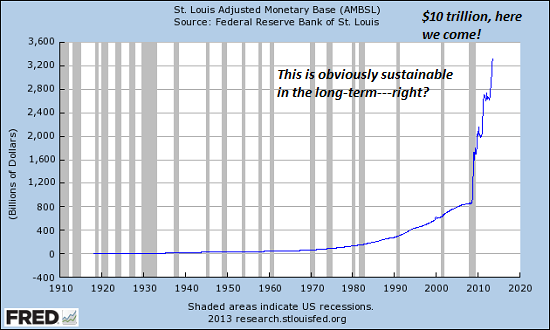
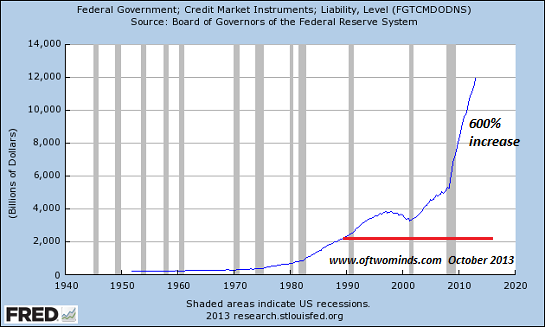
    These two charts raise doubts about the sustainability of the Fed and government's free lunch. The first is the monetary base, which just hit $3.5 trillion.


    The second one is Federal external debt, i.e. the Federal debt not including "intergovernmental holdings," what is "owed" to the fictitious Social Security Trust Funds. Total national debt is $17 trillion, debt we actually have to roll over is $12 trillion and rising by $1 trillion a year. Debt to the Penny (U.S. Treasury site).


    At the start of 2008, before the global financial meltdown gathered momentum, debt owed to the public was $5.1 trillion. Now it is $12.2 trillion, an increase of $7 trillion in less than six years. According to the Big Lie, this is no problem, and entirely sustainable: here's your Free Lunch, America, enjoy!

    Big Lie, meet unintended consequences. The problem with Big Lies is reality has not been disappeared; it still exists. Actions create consequences, and not necessarily the consequences that were planned or expected. 


    go to Kindle editionThe Nearly Free University and The Emerging Economy:
    The Revolution in Higher Education

    If you want to understand:


  • Why higher education is failing students and the nation
  • The parts of the economy that are expanding
  • The future of higher education
  • How to get a practical education and a job without student loans


  • You need this book


  • Read the Foreword, first section and the Table of Contents.

    print: $20           Kindle: $9.95 


    go to print editionWhy Things Are Falling Apart and What We Can Do About It 

    If you want to understand:

  • Why the wheels will come off the global economy in 2014 - 2015
  • The five forces that doom the status quo
  • How to change your life and finances to prosper in the coming crisis

  • You need this book

    Read the Introduction and the Table of Contents

    Kindle: $9.95       print: $24 


    Thank you, Sue K. ($5/mo), for your wonderfully generous re-subscription to this site-- I am greatly honored by your steadfast support and readership.


    Read more...

    Sunday, November 10, 2013

    Our Era’s Definitive Dynamic: Diminishing Returns

    Doing more of what worked well in the past fails in a spectacular fashion.

    We all intuitively grasp the meaning of diminishing returns: Either it takes more effort to maintain a project’s payoff, or the payoff declines even though the effort invested remains constant. This graphic illustrates the two types of diminishing returns:


    Studying is one common example of diminishing returns. When we’re fresh, we learn a great deal from intense study. As our energy and concentration flag, the return on the effort of studying declines until it reaches near-zero. We find ourselves re-reading the same line again and again, and basic errors pile up in our work.

    While it is tempting to identify a political, emotional, or economic factor as the root cause of our structural troubles—human greed, poor enforcement of regulations, Federal Reserve policies, etc.—I think a compelling case can be made that the one dynamic that ties all the other causal factors together is diminishing returns.

    Diminishing Returns and the S-Curve

    The key driver of diminishing returns is easy to understand. We naturally continue to do more of what was successful in the past. As the returns decline, we redouble our efforts, confident that what worked in the past will once again be successful if only we invest more labor, energy, and capital.
    Let’s consider some examples.

    Financialization—relying on expanding debt, leverage and the packaging of debt for growth—pays handsome returns in the early stages of the process. But returns on expanding debt diminish as the low-hanging fruit are plucked and credit expands to buy low-yield, high-risk investments.  Returns also decline as rising interest payments on all of the accumulating debt eat away at yields.

    Eventually, returns decline to zero or even negative territory, and doing more of what worked well in the past fails in a spectacular fashion.


    We can see this same dynamic in this chart of household debt and earnings: The expansion of debt was paralleled by rising earnings until the late 1990s. After that, household earnings continued rising, but the rate of growth was outstripped by debt, which more than doubled from 2000 to 2008.

    In other words, adding debt yielded diminishing returns in terms of household income.


    Efforts to reduce debt (i.e., deleveraging) have barely moved the needle, as shown on this chart of total debt per capita (per person) in the U.S.


    The S-Curve helps us understand the tendency to respond to diminishing returns by redoubling what worked in the past. For example, if regulating the financial sector worked in the past, then let’s do more of it. Thus the Glass-Steagall Act, at 37 pages in length, was the inspiration for the 2,319-page Dodd-Frank Wall Street Reform and Consumer Protection Act.

    Higher education offers another example. While costs have skyrocketed 1100% since 1980, the yield on that investment has declined.  A recent major study, Academically Adrift: Limited Learning on College Campuses, concluded that "American higher education is characterized by limited or no learning for a large proportion of students."

    While student loans have soared to over $1 trillion, with direct Federal loans ballooning from $115 billion to $674 billion in a few short years, only 37% of freshmen at four-year colleges graduate in four years (58% finally graduate in six years), and 53% of recent college graduates under the age of 25 are unemployed or doing work they could have done without going to college.


    Housing offers yet another example of diminishing returns. While the Federal Reserve has pulled out the stops to boost housing by lowering interest and mortgage rates to historic lows and taking the unprecedented step of buying over $1 trillion in mortgages, housing valuations remain far below their bubble levels.


    The $1 trillion F-35 Lightning fighter aircraft program is an excellent illustration of the dynamic. Despite claims by the contractor to the contrary, numerous reports of fundamental inadequacies continue to surface even as delays and cost-overruns have driven the fly-away cost of each fighter to over $200 million each.http://defenseissues.wordpress.com/2013/09/28/actual-f-35-unit-cost/

    Though some published reports assign a cost of $110 million each to the F-35, this grossly understates the true cost, as the research and development costs were paid separately. These might run as high as $50 million per aircraft, if the number purchased globally declines. (Even more absurdly, some published prices for the F-35 neglect to include the engine, which adds $34 million.)

    By comparison, the previous top-line U.S. aircraft, the F-18 Super Hornet, costs $57 million each. In the view of many defense analysts, the F-35 is decidedly inferior to the aircraft it is replacing.

    We might expect that an aircraft that costs almost four times more would be four times more capable than the previous generation. Instead, the complexity of the aircraft is yielding such severely diminishing returns that the new aircraft may prove less capable than upgraded F-18 Super Hornets in real-world air-to-air combat and bombing missions.

    Continuing to do more of what was successful in the initial high-return phase of the S-Curve ends up failing spectacularly when it is applied in the topping phase of the S-Curve: More energy, effort, and capital must be expended just to keep the yield from dropping into negative territory. This is not a static dynamic; as yields plummet, defenders of the status quo divert an ever-increasing share of the national income to feed their diminishing-return sacred cows.

    Sunk Costs, Institutional Culture & Peer Pressure

    Three other factors motivate this devotion to systems beset with diminishing returns: sunk costs, institutional culture, and peer pressure. Sunk costs are the investment plowed into the system over the previous decades that cannot be recovered; abandoning these assets goes against the grain.

    Every institution has a culture built over time of procedures and priorities. Abandoning diminishing-return programs typically requires radically transforming (or jettisoning) the institution’s existing organizational order. 

    From the perspective of those inside the institution, such a radical change looks like a potentially costly gamble; the lower-risk strategy is to do whatever it takes to maintain the existing order.

    Though we may dismiss peer pressure as a teen-era phenomenon, it is just as powerful in adult circles. Anyone pointing out diminishing returns within an organization risks being sacrificed as the messenger of unwelcome news: shunned, demoted, or discredited. There are too many masses of inertia and too many people with stakes in the current system to welcome radical changes and potentially risky attempts at transformation.

    The Accelerating Costs of Diminishing Returns

    This default diversion of treasure to support diminishing returns has two costs: the opportunity costs of what else did not get financed because available resources were poured down the rat hole of failing programs, and the largely hidden increase in systemic fragility as productive investments are starved by the diversion of resources to the rat holes of diminishing returns.
    This dynamic leads to the final phase of doing more of what has failed spectacularly.

    In Part II: How to Overcome Diminishing Returns, we examine the inner workings of diminishing returns and consider strategies to avoid being ensnared in diminishing-return systems.

    Though we have no control over systems such as the Federal Reserve, we do have some control over our exposure to such large-scale systems. This is one definition of resilience and self-reliance; the lower our exposure to failing systems, the greater our resilience and self-reliance. Identifying systems doomed by diminishing returns is a solid first step to reducing our exposure.

    Click here to access Part II of this report (free executive summary; enrollment required for full access).

    This essay was first published on peakprosperity.com 


    The Nearly Free University and The Emerging Economy:
    The Revolution in Higher Education

    Reconnecting higher education, livelihoods and the economy
    With the soaring cost of higher education, has the value of a college degree been turned upside down? College tuition and fees are up 1000% since 1980. Half of all recent college graduates are jobless or underemployed, revealing a deep disconnect between higher education and the job market.

    It is no surprise everyone is asking: Where is the return on investment? Is the assumption that higher education returns greater prosperity no longer true? And if this is the case, how does this impact you, your children and grandchildren?
    go to Kindle edition
    We must thoroughly understand the twin revolutions now fundamentally changing our world: The true cost of higher education and an economy that seems to re-shape itself minute to minute.

    The Nearly Free University and the Emerging Economy clearly describes the underlying dynamics at work - and, more importantly, lays out a new low-cost model for higher education: how digital technology is enabling a revolution in higher education that dramatically lowers costs while expanding the opportunities for students of all ages.

    The Nearly Free University and the Emerging Economy provides clarity and optimism in a period of the greatest change our educational systems and society have seen, and offers everyone the tools needed to prosper in the Emerging Economy.

    Kindle edition: list $9.95 


    Things are falling apart--that is obvious. But why are they falling apart? The reasons are complex and global. Our economy and society have structural problems that cannot be solved by adding debt to debt. We are becoming poorer, not just from financial over-reach, but from fundamental forces that are not easy to identify. We will cover the five core reasons why things are falling apart:
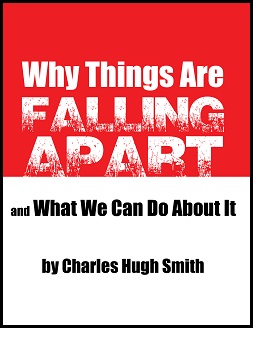
    go to print edition1. Debt and financialization
    2. Crony capitalism
    3. Diminishing returns
    4. Centralization
    5. Technological, financial and demographic changes in our economy

    Complex systems weakened by diminishing returns collapse under their own weight and are replaced by systems that are simpler, faster and affordable. If we cling to the old ways, our system will disintegrate. If we want sustainable prosperity rather than collapse, we must embrace a new model that is Decentralized, Adaptive, Transparent and Accountable (DATA).

    We are not powerless. Once we accept responsibility, we become powerful.

    Kindle: $9.95       print: $24


    Thank you, Donald & Patricia S. ($100), for your outrageously generous contribution to this site-- I am greatly honored by your ongoing support and readership.


    Read more...

    Saturday, November 09, 2013

    What Stanley Kauffmann Taught Me About Film

    A tribute to the late film critic.

    Stanley Kauffmann, The New Republic's film critic for 55 years, recently passed away. As a subscriber to TNR since the early 1980s, I came to rely on Kauffmann not just for reviews of films that would otherwise be unknown to me but for a continuing education in film.

    The conventional reviewer aims at passing judgment on a movie with an eye on helping you decide whether to see the film or not. These reviews seek to answer the question, does the movie work or not? This is of interest, of course, as are the usual mechanics of filmmaking: the acting, direction, cinematography, plot, music score and so on.

    It is quite another thing to see in film a vital genre of art. Kauffmann's reviews were a pleasure to read not just because they were neatly crafted, but because his intellectual range was presented without snobbery or apology.

    Kauffmann's reviews taught one not just about a film, but all film. What he taught me about film was everything beyond describing the mechanics of casting, acting, direction, technique, and to some degree the storytelling itself.

    I recently met a fellow (and much more professional) musician who handcrafts guitars as a hobby. He observed that the musicians of his acquaintance were also drawn to either photography or film, and so it seemed to him that music and film were two inter-related strands of artistic DNA. I do not know if this is universally true, but I can report that film and music are bound up with writing in my own DNA.

    Poverty and competing demands on my limited time preclude me from making a film, and so I have made the films on the cheap, in my own mind, by writing screenplays--seven, at last count.

    Here is a selection of excerpts from Kauffmann's reviews. Though he often reviewed obscure foreign or limited-release domestic films, I have purposefully chosen (mostly) widely released films that you may have seen.

    Rambo
    Helped by a Vietnamese girl who had been secretly briefed to guide him, Rambo escapes. (The girl is soon killed, so Rambo is left uncluttered by affection.)
     
    The Great Gatsby (1974)
    Besides the tininess of ear he shows, he insists on an utterly inappropriate atmosphere of quasi-expressionist grotesquerie—sweaty faces, fish-eye lenses, Gatsby’s parties as somewhat degenerate debauches—an atmosphere that stupidly controverts the reticence of Fitzgerald’s novel. To make it all just a little worse, Clayton slam-slam-slams an enormous number of enormous close-ups at us, quite pointlessly, which is rather as if a composer worked steadily in loud chords.
     
    Where Soldiers Come From
    Where Soldiers Come From is unique. It is about war, about Afghanistan in particular, but it is more about civilization than about combat. An American woman named Heather Courtney, experienced in documentary, was struck some four years ago by the sight of high school seniors joining the armed services in upper Michigan where she lives. She resolved to film some of them as time touched these youngsters. We prepare ourselves for inevitabilities--death and harsh injuries. These do not come. We see bits of combat, and one young man gets a Purple Heart for an endurable wound. We see training camps and military leaves and returns to duty and discharges. But what we really see is a basic hard fact, integral to civilization. Peace and peacemaking are common enough terms, easy to sing about and lofty in tone; yet peace, as anyone can see, is an interval in history. The patterns we are watching are more usual--the patterns of conflict.
     
    The Princess of Montpensier
    How helpfully gifted Bertrand Tavernier is. To watch one of his films is to have the world clarified: we see a street, a room, a corridor as more itself than we might have seen it on our own. Like other sterling directors, this French master begins, so to speak, with the intent of revealing the secrets that lie around us, unperceived— and in that rarefied world, he sets his story.
     
    I Was Born, But...
    Ozu (1903–1963) began to direct in 1927 and made a total of fifty-four features. He is best known here for the group of pictures that began in 1949 with Late Spring and concluded with An Autumn Afternoon in 1962. Couched in differing subtleties, these later films share, in some degree, one quality. The poet and dance critic Edwin Denby said often that what he prized most in ballet was stillness, which I take to mean the recovery through motion of a resident serenity, an apprehension behind the dancing of quiet pure existence. This view relates to Ozu. The best among his last films, Tokyo Story, has a certain stillness behind all that we see and hear, a hushed apprehension of human mystery.
     
    Vicky Cristina Barcelona
    But the film is considerably schizoid. All the gifts of the cast and of Allen, all the little insights that are scattered along the way, are expended on a screenplay that is mostly contrivances. The best deviation from dreamy plotting is the finish. A conventional romance would have had a knitted-up ending. Vicky Cristina Barcelona simply untangles. Its most up-to-date aspect is that it does not formally conclude. The American women have some warm experiences; then they travel on. The same is true for the viewer.
     
    The Lives of Others
    The cast of this film stokes that perversity. Sebastian Koch, as Georg, has the sort of good looks that bespeak an interesting man. Martina Gedeck, as Christa-Maria, is lovely and, in all shades, compelling. Ulrich Muhe makes Wiesler the kind of rigidly strict, thoroughly convinced officer who shows no hint of breach and therefore makes us suspect the possibility. Thomas Thieme, as Minister Hempf, provides lechery coaxed along by power. Thus, despite the fact that parts of this film remind us of past pictures with comparable themes, the director and his actors make it immediate, gripping.
     
    Lila Says
    Sex can be very helpful. For a screenwriter who wants to treat a subject that might seem insufficiently interesting to some viewers, a strong sexual element can serve as hook and medium. As multiple instances have shown, that sexual element can bring along the background material that may have been the first reason for making the picture. The latest example is Lila Says.
     
    The Bourne Identity
    But it is incredible chiefly in retrospect; it is much less incredible as the film speeds on. This contradiction is typical of most thrillers and is wrapped in the phenomenon of film itself. In a thriller novel, questionable events are often handled assumptively--the assumption that a game is being played and only a spoilsport would demur. I haven't read this Ludlum book, but I have read some like it--years ago I even edited a few--and the credibility blips just need careful tooling. But when a comparable event occurs in a thriller film, something almost awesome, almost thaumaturgic, transmutes the matter. Assumption disappears: actuality reigns through innate cinematic power.
    Kauffmann on the Oscars:

    I watch the Oscars every year, and I have more or less the same reaction: that everything is in character. And every year, regular as a sort of intellectual clockwork, knowledgeable critics are ready to scorn: to disclose the industrial ogre beneath the artistic hoopla, to rip open the pretensions, to excoriate the lengthy and unexciting familial tributes and embraces. Each year I wonder what these critics expected. A coronation by the Muses on the slopes of Olympus, perhaps?
    Kauffmann on the need to review films that most readers will not see at their local multiplexes: (Februaty 7, 2005)

    A letter from a reader in the Pacific Northwest asks wryly: "Do you invent some of the films you write about?" The question prompted a Borgesian temptation to invent, but I was soon calmed down by a sober fact—hardly new, still sobering. The reader's faintly desolate question underscored it. In terms of filmgoing possibilities, this country is schizoid. I, in New York, confront a fairly full range of available films. Only in a few large cities is anything like that range available; and those cities are only a small slice of this country's possible audience. Most people, like that reader, have the chance to see only the major Hollywood products—not even all the American films, let alone foreign ones. 
    Harold Rosenberg, who in his time did a good deal of lecturing around the country, once described the cultural situation in America, apart from the biggest cities, as a wilderness dotted with stockades. Those stockades were mostly the lively colleges and universities. In my own lecturing days, I found Rosenberg's comment a shade too reductive but healthily blunt. Radio and television and paperbound books and, latterly, the Internet were all regarded for a time as chances for cultural spread. Little proof of this is so far forthcoming. The reverse could easily be argued: that these increments have chiefly given more power to those who have no interest in, say, (director) Jill Sprecher. 
    Why, then, do critics--at least on some magazines and newspapers--continue to review films that will probably not reach wide audiences? For myself, it is partly because, as a democrat, I believe that the rights of the minority must be respected, including the filmgoing minority. It would be an offense to that minority, whether or not they knew it, to omit reviews, positive or otherwise, of films that are part of contemporary culture and of value to their cultural conspectus. Equally importantly, it would be an offense to the art of film to ignore those who, often through much travail, keep reaching upward. I don't think that seriously intended films will save this sorry world, but I do think that their absence, even ignorance that they exist, would make it sorrier.
    Adieu, Stanley; you are sorely missed.


    The Nearly Free University and The Emerging Economy:
    The Revolution in Higher Education

    Reconnecting higher education, livelihoods and the economy
    With the soaring cost of higher education, has the value of a college degree been turned upside down? College tuition and fees are up 1000% since 1980. Half of all recent college graduates are jobless or underemployed, revealing a deep disconnect between higher education and the job market.

    It is no surprise everyone is asking: Where is the return on investment? Is the assumption that higher education returns greater prosperity no longer true? And if this is the case, how does this impact you, your children and grandchildren?

    go to Kindle edition
    We must thoroughly understand the twin revolutions now fundamentally changing our world: The true cost of higher education and an economy that seems to re-shape itself minute to minute.

    The Nearly Free University and the Emerging Economy clearly describes the underlying dynamics at work - and, more importantly, lays out a new low-cost model for higher education: how digital technology is enabling a revolution in higher education that dramatically lowers costs while expanding the opportunities for students of all ages.

    The Nearly Free University and the Emerging Economy provides clarity and optimism in a period of the greatest change our educational systems and society have seen, and offers everyone the tools needed to prosper in the Emerging Economy.

    Kindle edition: list $9.95 


    Things are falling apart--that is obvious. But why are they falling apart? The reasons are complex and global. Our economy and society have structural problems that cannot be solved by adding debt to debt. We are becoming poorer, not just from financial over-reach, but from fundamental forces that are not easy to identify. We will cover the five core reasons why things are falling apart:

    go to print edition1. Debt and financialization
    2. Crony capitalism
    3. Diminishing returns
    4. Centralization
    5. Technological, financial and demographic changes in our economy

    Complex systems weakened by diminishing returns collapse under their own weight and are replaced by systems that are simpler, faster and affordable. If we cling to the old ways, our system will disintegrate. If we want sustainable prosperity rather than collapse, we must embrace a new model that is Decentralized, Adaptive, Transparent and Accountable (DATA).

    We are not powerless. Once we accept responsibility, we become powerful.

    Kindle: $9.95       print: $24


    Thank you, Michael M. ($50), for your stupendously generous contribution to this site-- I am greatly honored by your support and readership.


    Read more...

    Friday, November 08, 2013

    Can We Support 75 Million Retirees in 2020?

    All financial schemes for retirement are misdirections of the real challenge, which is creating enough real-world surplus to support 75 million retirees.

    I received a number of interesting comments on my recent series on the insolvency of the Social Security Ponzi Scheme:

    The Generational Injustice of Social (in)Security (November 6, 2013)

    The Problem with Pay-As-You-Go Social Programs: They're Ponzi Schemes (November 5, 2013)

    There are two questions here:

    1. How can we sustainably pay for 75 million beneficiaries in 2020?

    2. Are there sufficient resources, labor and capital to support 75 million beneficiaries in the manner that they were promised?

    The first question presumes there are limits on the creation of 'free money," and the second presumes there are limits on the surplus generated by the economy that can be devoted to supporting retirees.

    As a quick primer on Social Security: the program, paid by payroll taxes on earned income, has two funds: one for worker/retirees and survivors of workers, and another for disabled workers and their dependents.

    As of 2011 ( Annual Report of the Trustees of the Social Security Trust Funds), there were 38 million retirees, 6 million survivors and 11 million disabled and their dependents drawing benefits from the program. The latest numbers from the Social Security Administration (SSA) show 57 million beneficiaries as of 2012.

    Since there will be 53 million people 65 and older in 2020, and the number of survivors and disabled are rising as fast or faster than the number of retirees, we can project the program will have around 75 million beneficiaries in 2020, seven short years away.

    (Given that the number of people choosing to retire early at 62 rather than wait for full benefits at 66 is exceeding SSA projections, this estimate is probably conservative.)

    Reader D.L.J. proposed a solution that many believe would be sustainable: dispense with payroll taxes, illusory trust funds and borrowed money entirely, and just print the money and transfer it directly to retirees:

    Now set aside your traditional view of 'how the system now works'.What if each of the 50,000,000 retirees received a monthly check for $2500 for $30,000 per year. It doesn't come from a trust fund and it doesn't come from a working member of the workforce; it comes directly from the US Treasury. There are no bonds issued to raise the money, no interest to pay and no maturity schedule--just money credited to the accounts of the seniors. 
    Now, what if at the same time, there is no payroll tax to fund the, well, trust fund. 
    The 50,000,000 retirees would/could spend their $30,000 each into the economy to support the production of goods and services of 50,000,000 active workers providing an average contribution to income of $30,000 each. Of course the workers would actively purchase goods and services from one another as well.
    Over the years, I have received many similiar proposals from readers, the key component being the issuance of cash by the U.S. Treasury rather than the Treasury borrowing money on the bond market via selling Treasury bonds.

    The conventional economic concern with issuing freshly printed "free money" in this way is that this expansion of the money supply would soon trigger inflation that robs every holder of the currency. Expanding the money supply debases the existing stock of currency.

    Since such a proposal has never been tried to my knowledge, we don't have any direct experiential data on the unintended consequences of direct distribution of newly created cash on a large scale. I suppose if an equivalent sum of money were destroyed or removed from the money supply, inflation could be controlled, but destruction of such a large sum of money elsewhere would have negative consequences for those whose capital was destroyed.

    Perhaps there is some dynamic here I am missing, but to the best of my knowledge history suggests that inflating the money supply is only sustainable if the production of goods and services rises in analogous fashion. 

    If the surplus generated by the economy remains flat, inflating the money supply leads to a depreciation of the currency being printed, i.e. inflation or theft by other means.

    I conclude that this idea, however appealing, boils down to a "free lunch." In my view, a nation can only spend what it generates in surplus from labor and the productive investment of capital. Priting money is a short-term shortcut that raises the apparent surplus being generated but does not expand the actual surplus.

    What if the surplus being generated simply isn't large enough to support 75 million beneficiaries in the manner that they were promised? Correspondent Philip C. explains that the money for retirement is the least of our concerns: it's the actual stuff needed for living/consuming that may be insufficient:
    You point out correctly that there is no trust fund for Social Security payments. However it is easy to show that even if there were, the system could still not function. The reason is quite simple: the goods and services that retirees require (food, energy, medical, consumable goods, recreational, entertainment, etc.) in practical terms cannot be stored and therefore must be provided by the current working population. 
    Even if retirees had their Social Security pensions it wouldn’t do them any good because the stuff they needed would be scarce and the good old law of supply and demand would price them out of the market. What young people would tolerate working in such an environment with such an onerous load? 
    It seems to me that the root of the looming disaster is not so much the Ponzi aspect, despicable as it is, but the unrealistic expectation that people can actually retire at age 65 (or whatever age) and continue to consume resources and the productive output of an ever decreasing working population. Trust fund or no trust fund, the working population will be burdened by retirees; an important question is how long will they put up with it? 
    The social disruption will be of major proportions. Retirement ages will have to rise (they are already programmed to rise here in Australia in a couple of years) and expectations will have to be rationalised or there will be enormous stresses in our societies.
    This seems to get at the heart of the matter. Money is after all a claim on real-world resources, goods and services. Printing or borrowing money into existence does not create more resources, goods or services to exchange for the money.

    In this sense, all financial schemes for retirement are misdirections of the real challenge, which is creating enough real-world surplus to support 75 million retirees (not to mention the other 75 million people drawing government benefits). Census: 49% of Americans Get Gov’t Benefits; 82M in Households on Medicaid.

    Printing or borrowing money are both attempts to get a free lunch; alas, there is no free lunch. We can only spend what we extract or generate in surplus, i.e. what's left after subtracting the costs of production, labor and capital.


    The Nearly Free University and The Emerging Economy:
    The Revolution in Higher Education

    Reconnecting higher education, livelihoods and the economy
    With the soaring cost of higher education, has the value a college degree been turned upside down? College tuition and fees are up 1000% since 1980. Half of all recent college graduates are jobless or underemployed, revealing a deep disconnect between higher education and the job market.

    It is no surprise everyone is asking: Where is the return on investment? Is the assumption that higher education returns greater prosperity no longer true? And if this is the case, how does this impact you, your children and grandchildren?

    go to Kindle edition
    We must thoroughly understand the twin revolutions now fundamentally changing our world: The true cost of higher education and an economy that seems to re-shape itself minute to minute.

    The Nearly Free University and the Emerging Economy clearly describes the underlying dynamics at work - and, more importantly, lays out a new low-cost model for higher education: how digital technology is enabling a revolution in higher education that dramatically lowers costs while expanding the opportunities for students of all ages.

    The Nearly Free University and the Emerging Economy provides clarity and optimism in a period of the greatest change our educational systems and society have seen, and offers everyone the tools needed to prosper in the Emerging Economy.

    Kindle edition: list $9.95 


    Things are falling apart--that is obvious. But why are they falling apart? The reasons are complex and global. Our economy and society have structural problems that cannot be solved by adding debt to debt. We are becoming poorer, not just from financial over-reach, but from fundamental forces that are not easy to identify. We will cover the five core reasons why things are falling apart:

    go to print edition1. Debt and financialization
    2. Crony capitalism
    3. Diminishing returns
    4. Centralization
    5. Technological, financial and demographic changes in our economy

    Complex systems weakened by diminishing returns collapse under their own weight and are replaced by systems that are simpler, faster and affordable. If we cling to the old ways, our system will disintegrate. If we want sustainable prosperity rather than collapse, we must embrace a new model that is Decentralized, Adaptive, Transparent and Accountable (DATA).

    We are not powerless. Once we accept responsibility, we become powerful.

    Kindle: $9.95       print: $24


    Thank you, D.M.T. ($100), for yet another outrageously generous contribution to this site-- I am greatly honored by your steadfast support and readership.


    Read more...

    Terms of Service

    All content on this blog is provided by Trewe LLC for informational purposes only. The owner of this blog makes no representations as to the accuracy or completeness of any information on this site or found by following any link on this site. The owner will not be liable for any errors or omissions in this information nor for the availability of this information. The owner will not be liable for any losses, injuries, or damages from the display or use of this information. These terms and conditions of use are subject to change at anytime and without notice.

    RE: European Union AI Act, and Our Use of Generative AI Tools and Agents Policy

    All text on this site is composed by Charles Hugh Smith or by a credited guest-author. No Generative AI Tools are used in the composition / writing of any text or graphic content created by Charles Hugh Smith. This site deploys no AI agents or generative AI tools. This site is not responsible for the disclosures, use or non-use of AI agents or generative AI tools in advertisements displayed by Investing Channel or other ad placement services.

    Audio files generated by text-to-audio transcription tools are identified as such.

    Our Privacy Policy:

    Correspondents' email is strictly confidential. This site does not collect digital data from visitors or distribute cookies. Advertisements served by third-party advertising networks such as Investing Channel may use cookies or collect information from visitors for the purpose of Interest-Based Advertising; if you wish to opt out of Interest-Based Advertising, please go to Opt out of interest-based advertising (The Network Advertising Initiative) If you have other privacy concerns relating to advertisements, please contact advertisers directly.

    PRIVACY NOTICE FOR EEA INDIVIDUALS

    This section covers disclosures on the General Data Protection Regulation (GDPR) for users residing within EEA only. GDPR replaces the existing Directive 95/46/ec, and aims at harmonizing data protection laws in the EU that are fit for purpose in the digital age. The primary objective of the GDPR is to give citizens back control of their personal data. Please follow the link below to access InvestingChannel's General Data Protection Notice.
    https://stg.media.investingchannel.com/gdpr-notice/

    Notice of Compliance with The California Consumer Protection Act

    This site does not collect digital data from visitors or distribute cookies. Advertisements served by a third-party advertising network (Investing Channel) may use cookies or collect information from visitors for the purpose of Interest-Based Advertising. If you do not want any personal information that may be collected by third-party advertising to be sold, please follow the instructions on this page: Do Not Sell My Personal Information.

    Regarding Cookies:

    This site does not collect digital data from visitors or distribute cookies. Advertisements served by third-party advertising networks such as Investing Channel may use cookies or collect information from visitors for the purpose of Interest-Based Advertising; if you wish to opt out of Interest-Based Advertising, please go to Opt out of interest-based advertising (The Network Advertising Initiative) If you have other privacy concerns relating to advertisements, please contact advertisers directly.

    Our Commission Policy:

    Though I earn a small commission on Amazon.com books and gift certificates and gold (BullionVault) purchased via links on my site, I receive no fees or compensation for any other non-advertising links or content posted on my site.

    Copyright Notice:

    All original images (Drawings and Photographs), text (essays, books and works of fiction), audio and video recordings, musical compositions, graphic design, graphic design elements and HTML coding on this site are the copyrighted work of Charles Hugh Smith unless otherwise credited or noted. They are published as information for the private use of site visitors, and any reproduction or redistribution of this content or coding in any media in any format or distribution channel (text, audio, video/film, web) without the written permission of the copyright holder is strictly prohibited. All rights in all media reserved globally.

      © Blogger templates Newspaper III by Ourblogtemplates.com 2008

    Back to TOP