Friday, June 06, 2014

About Those Forecasts of Eternally Rising Corporate Profits...

If corporate profits decline, what will hold up the market's lofty valuations other than the tapering flood of liquidity from the Federal Reserve?

I have often noted that profits of global U.S. corporations have been boosted by the weak U.S. dollar (USD). In a weak-dollar environment, a company need not sell more goods or services or expand margins to book more profit: all a corporation needs to do is book profits earned in other currencies in dollars.


When the euro and the dollar were 1-to-1 back in the early 2000s, 100 euros of profit converted to $100 when stated in dollars. With the euro around $1.36, the same 100 euros of profit earned by the U.S. corporation in Europe converted to a $136 in profit when stated in dollars--a hefty 36% premium gained entirely as a result of the weak dollar.

This explains why the Fed has been so keen to trash the dollar: it magically increases corporate profits and thus drives stocks higher. The mainstream financial media's explanation for the weak-dollar policy is that the Fed is anxious to increase exports, but this is a sideshow; exports make up less than 9% of the U.S. GDP. The real action is in corporate profits, which thanks to the weak dollar are near all-time highs of $2 trillion, about 12% of the nation's entire GDP.
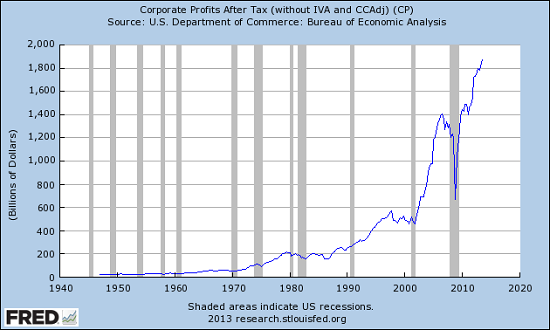


Courtesy of our friends at Market Daily Briefing, here is a chart of the USD and the S&P 500 stock index. Note that when the USD is strong, profits decline, and when the dollar is weak, profits soar:


For a variety of reasons, the dollar is in a long-term uptrend. These reasons include global capital flows, Triffin's Paradox and the need to defend the dollar to prop up the U.S. Treasury bond market and fund the U.S. deficit. I have covered these topics in depth over the past few years:

What Will Benefit from Global Recession? The U.S. Dollar (October 9, 2012)

Understanding the "Exorbitant Privilege" of the U.S. Dollar (November 19, 2012)

Why the Shrinking Trade Deficit Will Choke U.S. Corporate Profits (August 8, 2013)

We can see the uptrend in a chart of the U.S. dollar. There's nothing fancy here; the USD bottomed in late 2011 and advanced into a trading range that has lasted two years. A year-long triangle pattern has been broken to the upside, a move that can be viewed as a continuation of the uptrend from 2011.


Many observers focus on the eventual consequences of large-scale credit/money-printing, i.e. debasement of paper (fiat) currencies. While this may yet occur, the credit issuance/money printing of the Fed is actually modest compared to other issuances of credit/currency, and is tapering as the Fed is forced to defend other parts of the global Empire, for example, the Treasury bond market.

The dynamics and consequences of the various currency players' actions are not linear, and so predictions based on linear projections are often wrong. But I think these two dynamics--the correlation of the weak dollar to global U.S. corporate profits and the dollar strengthening as other players' fundamentals unravel--will be dominant, and the ones to watch in terms of explaining why U.S. corporate profits will weaken, regardless of sales and margins.

And if corporate profits decline, what will hold up the market's lofty valuations other than the tapering flood of liquidity from the Federal Reserve? Answer: nothing.

Complacent punters will discover to their great dismay that liquidity is only one dynamic of many.

Administrative note: due to family obligations, email replies will be near-zero for the next week or so. Thank you for your understanding.


Get a Job, Build a Real Career and Defy a Bewildering Economy(Kindle, $9.95)(print, $20)
go to Kindle edition

Are you like me? 
Ever since my first summer job decades ago, I've been chasing financial security. Not win-the-lottery, Bill Gates riches (although it would be nice!), but simply a feeling of financial control. I want my financial worries to if not disappear at least be manageable and comprehensible.

And like most of you, the way I've moved toward my goal has always hinged not just on having a job but a career.

You don't have to be a financial blogger to know that "having a job" and "having a career" do not mean the same thing today as they did when I first started swinging a hammer for a paycheck.

Even the basic concept "getting a job" has changed so radically that jobs--getting and keeping them, and the perceived lack of them--is the number one financial topic among friends, family and for that matter, complete strangers.

So I sat down and wrote this book: Get a Job, Build a Real Career and Defy a Bewildering Economy.

It details everything I've verified about employment and the economy, and lays out an action plan to get you employed.

I am proud of this book. It is the culmination of both my practical work experiences and my financial analysis, and it is a useful, practical, and clarifying read.

Test drive the first section and see for yourself.     Kindle, $9.95     print, $20
"I want to thank you for creating your book Get a Job, Build a Real Career and Defy a Bewildering Economy. It is rare to find a person with a mind like yours, who can take a holistic systems view of things without being captured by specific perspectives or agendas. Your contribution to humanity is much appreciated."
Laura Y.


Thank you, William P. ($50), for your wondrously generous contribution to this site -- I am greatly honored by your support and readership.Thank you, Helen S.C. ($5, for your most generous contribution to this site -- I am greatly honored by your longstanding support and readership.


Read more...

Wednesday, June 04, 2014

The Purchase of Our Republic (guest essay)

The massive consolidation of wealth, combined with the removal of any limits on money in campaigns, has allowed for the purchase of our government.

Today I am publishing a comprehensive and important guest essay, The Purchase of Our Republic, by longtime correspondent Y. Falkson.


Americans know that something is wrong, deeply wrong. They see signs of the problem everywhere: income inequality, growing concentration and power of mega corporations, political donations/corruption, the absence of jobs with decent salaries, the explosion of the US prison population, healthcare costs, student loan debt, homelessness, etc. etc. 


However, the true causes and benefactors behind these problems are purposely hidden from view. What Americans see is Kabuki Theater of a functioning form of capitalism and democracy, but beyond this veneer our country has devolved into the exact opposite.

Those who benefit from this crony capitalist state go to extreme lengths to paper over the reality and convince Americans that the system works, the American Dream is still a reality and that American democracy is in fact democratic.

Below I hope to begin to outline some of the underlying dynamics and trends that have evolved in recent decades and led us so far from what we once were. As fun as it would be, the answer is not some evil conspiracy by the Illuminati, but rather the unfortunate result of three long term and mutually reinforcing components that have been attacking the fundamental roots of the structure of our Republic.

The first is the increased concentration of corporate and private wealth. Both of which are quickly yelled down in the media as anti-free market and class war hysteria.

The second is the use of this wealth to capture all three branches of government in order to ensure the continued extraction of capital from the many and to the few.The rich might have climbed the ladder because they earned it, but they have then purchased government to pull up the ladder behind them.

The consequence of the first two components is a democracy in name only that represents the very few.


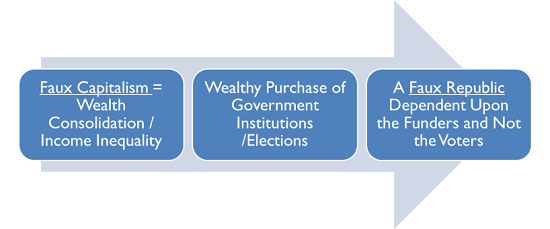
1. Faux Capitalism = Wealth Consolidation / Income Inequality


Corporate Wealth:


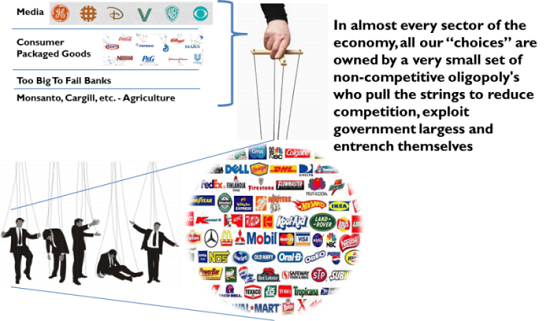
While there is no true beginning to the story, we can start with the incredible build up and concentration of wealth among corporations in recent decades. The USA now boasts a cartel-like set of corporate titans in almost every industry. It goes beyond, but certainly includes, our Too Biggerer To Fail banks, merged from what was 37 banks in 1995 into a Frankenstein’s monster like 5 (Citigroup, JP Morgan-Chase, Bank of America, Wells Fargo and Goldman Sachs).


In agriculture, Monsanto alone controls over 85% of all corn and soy bean crops, four companies control 83% of the beef market, 66% of the hog market and 58% of the chicken market. So while shopping at the grocery store might appear to be the manifestation of capitalism at its finest, it doesn’t take much digging to look behind the curtain to see how little competition truly exists.

When the average American goes to pick up some groceries, they are shopping at Walmart and buying something from P&G that is mostly made of Monsanto corn. Is that true choice?

The same story plays out with our news and media (and other industries) where we have gone from 50 companies in 1983 to the big 6 which control over 90% of all media. Is choosing to watch one of 30 news channels, all of which are owned by News Corp (Rupert Murdoch) a real choice? This is not capitalism and they are not competing, not in the true sense of the word.


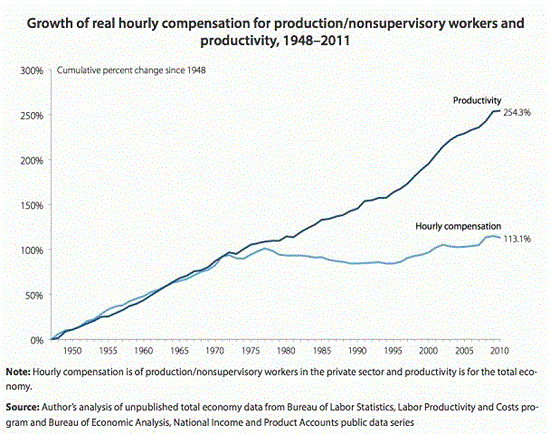
Along with this consolidation of corporations in recent decades, their senior leaders have taken up a larger and larger piece of the pie at the expense of their employees. In particular, the ratio of CEO-to-worker pay has increased 1,000 percent since 1950. Unsurprisingly, Walmart is both the largest employer in the country and the worst CEO pay offender with a ratio of over 1000:1. This is at a time where worker productivity has increased significantly, something that historically correlated with increased pay. But no more. It’s a new twist on the old Soviet saying “we pretend to work and they pretend to pay us”, but now it’s closer to “we do all of the work and they pretend to pay us”.


www.motherjones.com/politics/2010/01/bank-merger-history

illusion of choice

www.payscale.com/data-packages/ceo-income/fortune-100

www.bloomberg.com/news/2013-04-30/ceo-pay-1-795-to-1-multiple-of-workers 


Private Wealth:

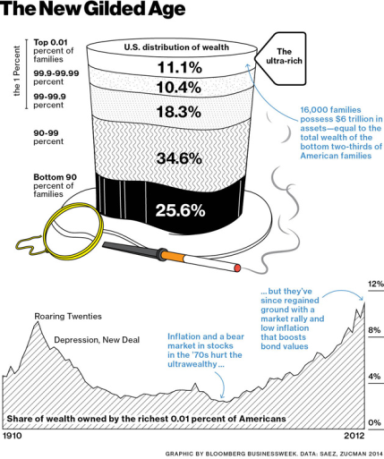
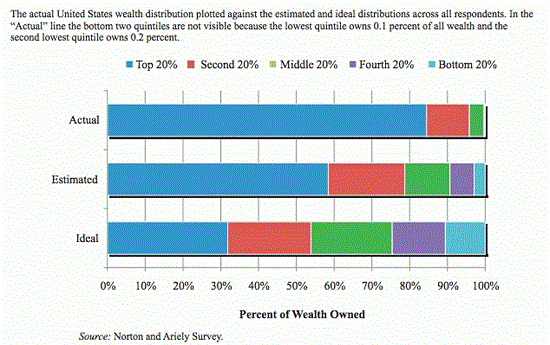
As a consequence of the royal tribute we pay to the C-suite class these days, we have likely surpassed the pre-Depression Roaring Twenties in terms of inequality.


This, amazingly, has only accelerated since the crisis in 2008 in thanks to bailouts, Quantitative Easing and other gifts from Congress and the Fed. The wealthy 1% and in particular the .01% have now grown their fortunes to levels that tax comprehension and even their ability to spend it (the decisions by a few billionaires such as Bill Gates to essentially donate his fortune is a tacit acknowledgement that our current system over provides wealth to a select few).


So what is an incredibly wealthy capitalist CEO of a mega-corporation do once they control their industry and have essentially limitless wealth? Well in a competitive market, the only way to go from the top is down and the only thing that can make that happen is competition. Consequently, competition must be avoided whenever possible.

To squash or prevent competition, the oligopolies and oligarchs target their resources on the one place that can make competition illegal, our government.Something to keep in mind the next time you see a corporate billionaire grandstanding about the importance of “Free Markets” when their strategy is quite the opposite.

As this capture of the government has taken place we have essentially shifted from capitalism and to crony capitalism. So we now have industries that have mastered the art of faking capitalism by turning our government into one that fakes democracy.

This government takeover took time, but the purchase of all 3 branches of government has almost been completed by 2014. You don’t have to take my word for it, luckily that has now been empirically proven in an analysis of over 20 years of government policy where the clear conclusion was that policy makers respond solely to those in the top 90th percentile and essentially ignore the large majority of Americans.

Testing Theories of American Politics: Elites, Interest Groups and Average Citizens


boingboing.net/2014/04/13/study-american-policy

www.washingtonpost.com/blogs/monkey-cage/wp/2014/04/08/rich-people-rule

Wealth Inequality in America (6:23 video) 


2. Wealthy Purchase of Government Institutions / Elections

Purchase of the Executive Branch:


Let’s take a step back and take a glimpse at how the government was purchased, beginning with the executive branch. In 1980, Reagan’s election cost less than $300 million. When Bush beat Kerry in 2004, it cost almost 3x times as much, almost $900 Million. 4 years later, the 2008 election cost a record $1.3 Billion. It was in this election where Obama hammered the final nail in the coffin for government funded for elections.


Obama, more so than any other candidate in recent decades had the widespread support of millions of small donors, but in the end I guess it wasn’t enough. So when Obama “leaned to the green”, it forever set the precedent that you can’t win without the backing of our nation’s oligarchs. Consequently, the money has only gushed in since as the cost of Obama’s reelection in 2012 skyrocketed to an unfathomable $7 billion.

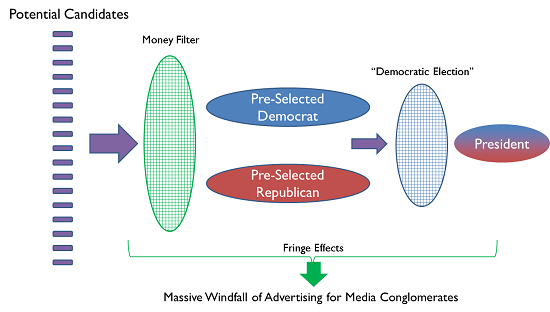
Needless to say this is slightly above the rate of inflation. Our Presidents are now preselected exclusively by a tiny fraction of Americans can have the money to fund what has become necessary for a legitimate run.

Summary: Candidates spend years courting the super-rich to build up a multi-billion dollar war chest. Only those who succeed can actually run a campaign that an average American will be aware of. Then Americans get to choose one of the pre-selected “candidates”. No wonder voter turnout is so low…

Executive branch, check!


– Note that media corporations benefit doubly as they can use their cash to fund elections, but are also the beneficiary of all that money as it is used for campaign spending.


rt.com/usa/seven-billion


Purchase of the Legislative Branch:

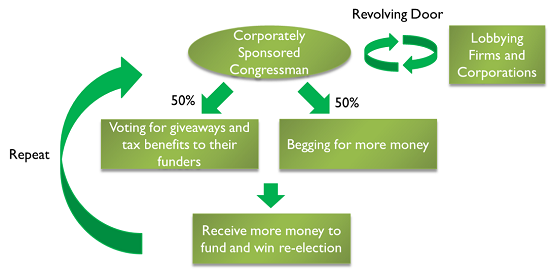
The process has progressed similarly in Congress. In 1978, outside groups spent $303,000 on congressional races. In 2012 that was up to $457,000,000. That is over 1,500 times the level in 1978. It would be funny, if it was so blatant and terrifying. By many accounts, our “leaders” in Congress spend 50% or more of their time working the phones or fundraisers rather than trying (and failing) to actually do the “people’s business”.


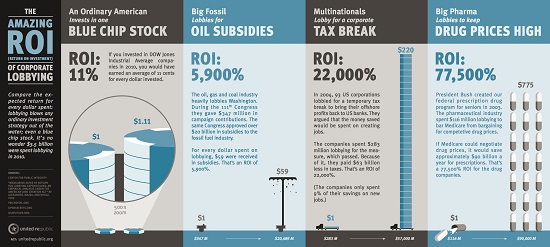
Let’s also take a minute to appreciate the hypocrisy of anyone that pretends that the money doesn’t influence our government. Businesses do not give to politicians for charity. This is a payment for services that has proven exceedingly reliable and profitable. The ROI for money invested in purchasing Congressman is what CEO dreams are made of.

No wonder the incentive is to invest in Congress rather than R&D or marketing. There are very few places in the world or times in history where you can find ROI’s in the thousands, or even the tens of thousands.


In addition, increasingly those who work on Congress (and regulators) were previously employed by these large corporations or expect to work there later. A recent example is Chris Dodd who left the Senate the head lobbyist for Hollywood at the MPAA, the guys behind SOPA and PIPA, but there are many many others.

Review: Congressmen beg for money to get elected, make sure to vote the way your benefactors would like, consequently get more money to get elected again. If at any point they do lose or quit, they take the big payday to work for those who have been paying them all along.

Legislative Branch, Check!

www.cnn.com/2013/07/11/politics/congress-election-costs


Judicial Branch Endorsement of the Purchase of Government:

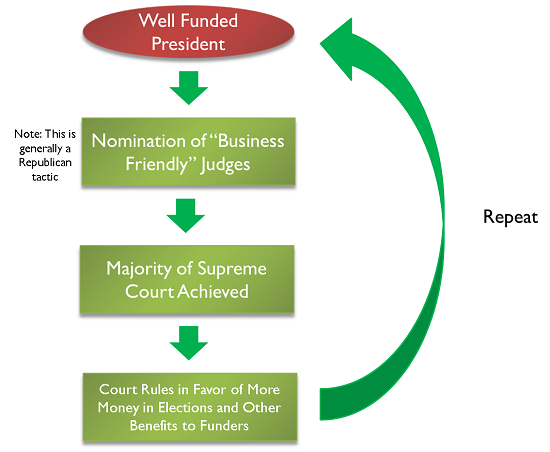
Last but not least, we have the enabling Judicial Branch. It only took a few purchased presidents to ensure the appointment of a majority of “free market” and “pro-business” judges. For instance, and disgracefully, Clarence Thomas was once legal counsel for Monsanto, but has not once recused himself from any cases involving Monsanto and always votes in their favor.


These radicals have now fully endorsed and enabled the influx of money used to purchase the other branches. Specifically, 2 major decisions have completely opened the floodgates, Citizens United and McCutcheon. The first allowed unlimited contributions of corporate money into elections and brought us the notorious declaration that “corporations are people” and that “money is free speech”.

This was more recently followed up with the private wealth equivalent in McCutcheon. In this ruling, Supreme Court Chief Justice John Roberts said as part of his majority opinion (presumably with a straight face) “… nor does the possibility that an individual who spends large sums may garner influence over or access to elected officials or political parties”.

And with this, the Supreme Court has fully endorsed both major sources of immense wealth to purchase our elections and consequently our government.

Review: The rich fund Presidential elections, Presidents nominate “business-friendly” judges and then the bought Congress approves their nominations. New judge then votes to ensure even more money is allowed to purchase elections.

Judicial Branch, CHECK!


3. A Faux Republic Dependent Upon the Funders and Not the Voters

The Founder’s Hope and the Sad Reality:


Acknowledging where we are as a country, it is often helpful to look to where we started for some perspective. Unsurprisingly, this type of problem was not overlooked back in the 18th century. In 1776, James Madison stated that his goal was to design a republic in which “powerful interest groups would be rendered incapable of subdoing the general will”. Madison hoped, perhaps naively, that factions would be thwarted by competing with other factions.


Sadly, we are now in a time where factions (aka wealthy special interests) subdue the will of the people and ensure the government responds to them alone on those issues where they have a “special interest” and consequently asymmetric stakes in the game (Charles Hugh Smith). As a result, these groups essentially collude to allocate their resources to their own issues, but do not “thwart” or compete with other factions as they do the same. It’s a pretty great system, as long as you’re one of the wealthy few who can use their money to drown out the poor and voiceless many.

And just like that, what was once a Republic has become a corrupt shell of its past self. All the signs are still there; votes, elections, campaigns, branches of government, etc., but behind the scenes the only ones represented are those who can afford to be heard.

Summary: This massive consolidation of wealth, combined with the removal of any limits on money in campaigns, has allowed for the purchase of our government, or as Dick Durban once stated, “frankly they [the banks in this case] own the place”. If money = free speech, then those with all the money, have all the free speech.


What Might Help?

Now that I have likely and thoroughly depressed the reader, let’s bounce around some ideas for what can be done. As stated in the beginning, this is not an unknown problem and many people are promoting a number of ways to fix or at least ameliorate the problem. I will briefly describe just a few which I think provide some direction any of us could easily implement or support.


Change the Rules: Laurence Lessig of Harvard Law has put forward a visionary proposal for re-writing the way that campaigns are financed in his book, Republic, Lost: How Money Corrupts Congress--and a Plan to Stop It.

Put simply, he would like to empower every voter with a stipend, say $150 per election to give to whatever candidate or candidates they prefer. If you would like to accept this money, you would need to forgo any other contributions or support (one would hope including the indirect PAC kind). This would actually provide even more money than is used in current elections, but would effectively democratize the funding process. While there would still be a “funding election” that takes place before the actual election, the funding would not be unequally provided.

Lessig’s work has only begun, as this sort of bill or likely constitutional reform is nearly impossible to achieve, but he has undertaken and I assume will continue to implement many brave and creative ways of bringing about the change all American’s should support.

Most recently he has suggested we begin to fund, ironically enough, a Super PAC to end all Super PACs. It would be funded with the solitary goal of changing how money impacts our elections.

Please support them here: www.mayone.us/


Change Our Day-to-Day: At the more micro level, Charles Hugh Smith believes that we will inevitably see our overly centralized and inefficient system erode away as it is replaced by more resilient, local and efficient businesses and societies outside of the current system. With that in mind, he recommends that “all anyone can do is the basic things--lower our energy footprint, stay healthy and avoid unnecessary medications and procedures, support local businesses, organic food growers, etc. In other words, what we can do is support local businesses that are part of the emerging economy rather than support corporate cartels.”

Your Vote Does Matter: Do you live in Ohio, Florida or New Hampshire? Probably not. Despite what we are told every 4 years, there are actually states outside of the “swing states”, and even more surprising, the very large majority of Americans live in those states where your “vote doesn’t matter”. New Yorkers an Californians all know their state will turn Blue no matter who the candidates are and either don’t vote at all, or often vote for the Blue team in order to feel like they are on the winning side.


The truth is that if you see the election as Red vs. Blue, you vote probably doesn’t matter. But here is the trick, if all the people who think their vote didn’t matter decided to vote for whom they might actually believe in, then their votes just might matter.

What if all the growing number of “Independents” (who usually still vote Blue), chose to vote for a third party? What if a third party candidate won a state like New York or California? What if that candidate was one whose primary promise to the voters was to champion a change to the role of money in government (perhaps in line with what Lessig proposes)? Would you vote for such a person?

I would argue you should. If California alone (with 55 electoral votes) were to vote for a 3rd party that would likely prevent either Red or Blue candidate from winning the requisite 270 electoral votes.

Think about the message that would send to both parties. I would predict that both sides would start to bend over backwards for an endorsement from that 3rd party and they would have to get it by taking up the same primary cause for reforming money in government. Consequently, at the root of our corrupted system which is perpetually ignored as both sides might suddenly become the big issue of the election. Then maybe we might begin to turn things around.

Sources: Charles Hugh Smith (oftwominds, Surivival+, etc.), Yves Smith (Naked Capitalism, Econned), Laurence Lessig (Republic Lost, multiple TED Talks), Matt Taibbi (blog at Rolling Stone and now at The Intercept), Zero Hedge, John Robb, Max Keiser, Clay Shirky (Cognitive Surplus), Aldous Huxley (Brave New World, Brave New World Revisited), George Orwell (1984), Michael Lewis, Daniel Kahneman (Thinking Fast and Slow), James Richards (Currency Wars), Han Joon Chang (23 Things They Don’t Tell You About Capitalism) and Joseph Stiglitz (Mismeasuring Our Lives) 


Thank you, Y. Falkson, for a comprehensive presentation on the capture of the political machinery by enormously concentrated financial wealth.

Administrative note: due to family obligations, email replies will be near-zero for the next week or so. Thank you for your understanding.


Get a Job, Build a Real Career and Defy a Bewildering Economy(Kindle, $9.95)(print, $20)
go to Kindle editionAre you like me? Ever since my first summer job decades ago, I've been chasing financial security. Not win-the-lottery, Bill Gates riches (although it would be nice!), but simply a feeling of financial control. I want my financial worries to if not disappear at least be manageable and comprehensible.


And like most of you, the way I've moved toward my goal has always hinged not just on having a job but a career.

You don't have to be a financial blogger to know that "having a job" and "having a career" do not mean the same thing today as they did when I first started swinging a hammer for a paycheck.

Even the basic concept "getting a job" has changed so radically that jobs--getting and keeping them, and the perceived lack of them--is the number one financial topic among friends, family and for that matter, complete strangers.


So I sat down and wrote this book: Get a Job, Build a Real Career and Defy a Bewildering Economy.


It details everything I've verified about employment and the economy, and lays out an action plan to get you employed.

I am proud of this book. It is the culmination of both my practical work experiences and my financial analysis, and it is a useful, practical, and clarifying read.

Test drive the first section and see for yourself.     Kindle, $9.95     print, $20


"I want to thank you for creating your book Get a Job, Build a Real Career and Defy a Bewildering Economy. It is rare to find a person with a mind like yours, who can take a holistic systems view of things without being captured by specific perspectives or agendas. Your contribution to humanity is much appreciated."
Laura Y.


Thank you, Bryce W. ($100), for your outrageously generous contribution to this site -- I am greatly honored by your steadfast support and readership.Thank you, Mark T. ($10/month), for your extraordinarily generous re-subscription to this site -- I am greatly honored by your longstanding support and readership.

Read more...

Nobody Wins Elections Promising to Trim Waste/Fraud and Simplify Regulations

The problem in representative democracy is that every instance of waste, graft, fraud and monopolistic racket is somebody's fat paycheck or government contract.

Promising good governance guarantees a losing campaign for public office. The central irony of representative democracy is similar to the central irony of capitalism: the relentless pursuit of narrow self-interest ends up eroding the shared foundations every self-interested participant relies upon.


The problem in representative democracy is that every instance of waste, graft, fraud and monopolistic racket is somebody's fat paycheck or government contract. Those few who see the systemic damage wrought by unproductive skimming, scamming and churn are motivated by a concern for the foundations of the entire system, while those fighting to retain their share of the swag are driven by a fierce cornered-animal desire to keep their share of the loot regardless of the consequences to the system.

Who wins such conflicts? The people fighting tooth and nail to defend their share of the swag, even if it is unproductive, wasteful churn with high opportunity costs for society as a whole: for example, what else could we do with the hundreds of millions of dollars spent on tax preparation and avoidance were the thousands of pages of tax regulations radically simplified?

Nobody wins elections promising to trim waste/fraud/monopolies and simplify the churn of complex regulations because any such good governance threatens somebody's fat paycheck/contract, and those fearing banishment from the state's feeding trough will go to any lengths necessary to defeat the "good governance" candidate.

The winning candidate promises not good governance for the benefit of all but more swag for enough voters to win the election. Grabbing the lucrative reins of power is the ultimate in private aggrandizement within representative democracy, and as a result there will always be a large pool of individuals willing to promise the moon to get elected and a vanishingly small pool of people concerned enough about systemic risks to suffer the slings and arrows of campaign politics for the common good.

Capitalism shares a similar irony: the relentless pursuit of narrow self-interest (personal profit) drives the stripmining of the seas for high-value fish, killing vast numbers of "worthless" sea life in the process. When the ocean ecosystem has been destroyed, the theory is that a substitute will be found, such as farm fishing.

But farm fishing does not replace the lost ecosystem, any more than planting rows of monoculture trees for paper pulping replaces a native forest. Just as markets do not have any mechanisms to value ecosystems, representative democracy has no mechanism to counteract the systemic consequences of individual aggrandizement within the system.

Once the number of participants in the system drawing politically-protected benefits and paychecks exceeds the number of those paying taxes to fund the swag, the system destabilizes. Since the state is ultimately run to benefit the individuals drawing paychecks, benefits and contracts paid by the state, nobody cares about the systemic consequences of this imbalance or the heavy opportunity costs of supporting innumerable skims, scams and unproductive churn.

To avoid the political pain that would result from trimming waste/fraud/ rackets, the state prints money to keep the swag flowing. Since the state can't create real wealth, it prints claims on wealth and passes off the paper as "money."

As long as the state is judicious in its printing, the resulting inflation is modest enough that participants are more than happy to accept a small decline in purchasing power in return for keeping their share of the swag intact.

But this monetary gaming has systemic dynamics and limits. The hubris of the state, regardless of its ideological basis, is that central planners can tweak the monetary gaming to keep the swag flowing without creating any uncontrollable risk.

But risk cannot be eliminated, it can only be transferred. In representative democracy, the risks are transferred from individuals drawing swag to the system and state itself. The state appears so vast and powerful that it can absorb essentially infinite amounts of systemic risk. But the state is like any other system: its ability to sustain monetary games is finite, as is its ability to fund unproductive churn indefinitely and its control of destabilizing risk.

The only thing that is infinite about the state is the hubris of those at the controls and the narrow self-interest of those at its capacious feeding trough.


Get a Job, Build a Real Career and Defy a Bewildering Economy(Kindle, $9.95)(print, $20)
go to Kindle edition

Are you like me? 
Ever since my first summer job decades ago, I've been chasing financial security. Not win-the-lottery, Bill Gates riches (although it would be nice!), but simply a feeling of financial control. I want my financial worries to if not disappear at least be manageable and comprehensible.

And like most of you, the way I've moved toward my goal has always hinged not just on having a job but a career.

You don't have to be a financial blogger to know that "having a job" and "having a career" do not mean the same thing today as they did when I first started swinging a hammer for a paycheck.

Even the basic concept "getting a job" has changed so radically that jobs--getting and keeping them, and the perceived lack of them--is the number one financial topic among friends, family and for that matter, complete strangers.


It details everything I've verified about employment and the economy, and lays out an action plan to get you employed.

I am proud of this book. It is the culmination of both my practical work experiences and my financial analysis, and it is a useful, practical, and clarifying read.

Test drive the first section and see for yourself.     Kindle, $9.95     print, $20
"I want to thank you for creating your book Get a Job, Build a Real Career and Defy a Bewildering Economy. It is rare to find a person with a mind like yours, who can take a holistic systems view of things without being captured by specific perspectives or agendas. Your contribution to humanity is much appreciated."
Laura Y. 


Thank you, Thomas B. ($100), for your outrageously generous contribution to this site -- I am greatly honored by your steadfast support and readership.Thank you, Bud W. ($50), for your superbly generous contribution to this site -- I am greatly honored by your longstanding support and readership.

Read more...

Tuesday, June 03, 2014

"Buying Time" Doesn't Fix Financial Crises, It Makes the Next One Worse

The strategy of "buying time so the financial system can heal itself" by protecting a systemically destabilizing financial sector has failed because it could only fail.


The core strategy of central states and banks to fix the Global Financial Meltdown of 2008 was to buy time: take extraordinary emergency monetary and regulatory measures to save the parasitic too big to fail banking sector and the rest of the crony-capitalist Wall Street parasites, and initiate an unprecedented transfer of wealth from savers and Main Street to the banks and Wall Street via zero-interest rates and credit funneled to the very players who caused the crisis.

The idea was that the system would "heal itself" if authorities simply "bought time" by saving the financial sector from its own predation. The second phase of "buying time so the financial system can heal itself" was to institute policies (ZIRP, etc.) that restored the financial sector's obscene profits and socialized its losses by transferring them to the taxpayers.

The terrible irony in the official strategy of "buying time so the financial system can heal itself" is the policies prohibit healing and guarantee the next financial crisis will be greater in magnitude than the last one.

There is only one way for any financial system to heal itself: enable the open market to discover the price of capital, credit, assets, collateral and risk. When participants finally discover the market price of their assets and collateral are much lower than the valuations claimed in credit bubbles, the market clears itself of bad credit and overvalued collateral in a market-clearing event in which overpriced assets are marked down, firms that overleveraged weak collateral are declared insolvent and liquidated, and creditors who can no longer afford their loans are declared bankrupt and their remaining assets liquidated to pay their creditors.

There is no other healing process but this one: enable transparent, open markets to discover the price of capital, credit, assets, collateral and risk and let those firms and individuals who overleveraged and made bets that blew up go bankrupt.

What "buying time" has done is destroy the market's ability to price capital, credit, assets, collateral and risk, stripping the system of the essential information participants need to make rational, informed decisions. By crushing the market's ability to generate accurate pricing information, central state and banking authorities have insured the system cannot possibly heal itself while maintaining perverse incentives that guarantee the next financial crisis will dwarf the previous one.

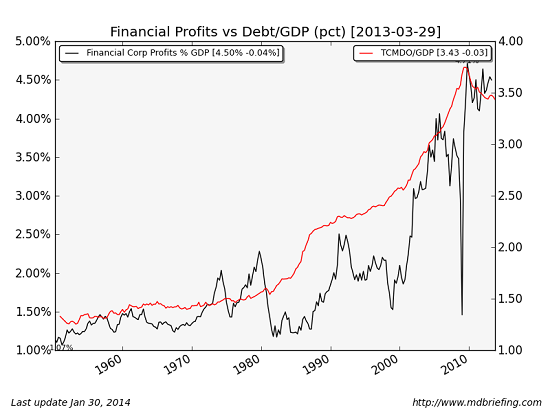
The official policy of "buying time" has another fatal flaw: it maintains a parasitic financial sector that expanded to a structurally unhealthy dominance over both the political and economic sectors. Once financial profits ballooned from a modest share of corporate profits to dominance, this enabled financiers and bankers to buy political protection of their skimming and scamming:

The strategy of "buying time so the financial system can heal itself" by protecting a systemically destabilizing financial sector has failed because it could only fail.The policies that "saved the financial system" only saved it from the healing process of the market discovering the price of capital, credit, assets, collateral and risk. 


Get a Job, Build a Real Career and Defy a Bewildering Economy(Kindle, $9.95)(print, $20)
go to Kindle edition
Are you like me? Ever since my first summer job decades ago, I've been chasing financial security. Not win-the-lottery, Bill Gates riches (although it would be nice!), but simply a feeling of financial control. I want my financial worries to if not disappear at least be manageable and comprehensible.

And like most of you, the way I've moved toward my goal has always hinged not just on having a job but a career.
You don't have to be a financial blogger to know that "having a job" and "having a career" do not mean the same thing today as they did when I first started swinging a hammer for a paycheck.

Even the basic concept "getting a job" has changed so radically that jobs--getting and keeping them, and the perceived lack of them--is the number one financial topic among friends, family and for that matter, complete strangers.

So I sat down and wrote this book: Get a Job, Build a Real Career and Defy a Bewildering Economy.

It details everything I've verified about employment and the economy, and lays out an action plan to get you employed.
I am proud of this book. It is the culmination of both my practical work experiences and my financial analysis, and it is a useful, practical, and clarifying read.

Test drive the first section and see for yourself.     Kindle, $9.95     print, $20

"I want to thank you for creating your book Get a Job, Build a Real Career and Defy a Bewildering Economy. It is rare to find a person with a mind like yours, who can take a holistic systems view of things without being captured by specific perspectives or agendas. Your contribution to humanity is much appreciated."
Laura Y. 


Thank you, Lisa P. ($50), for your splendidly generous contribution to this site -- I am greatly honored by your support and readership.Thank you, Michael G. ($10/month), for your outrageously generous subscription to this site -- I am greatly honored by your support and readership.

Read more...

Monday, June 02, 2014

The Destroyer of Fake "Recoveries": Unintended Consequences

Destroy the market's ability to price assets, risk and credit, and you take away the essential information participants need to make rational, informed decisions.


A correspondent recently summarized why unintended consequences eventually destroy all politically expedient strategies that temporarily prop up a systemically unsustainable Status Quo:

"Unintended consequences almost always equal or exceed the benefits of whatever your temporary gains were in a complex system. We see this over and over again, in all sorts of different complex systems."

In other words, all the "kick the can down the road" strategies being deployed across the globe by central states and banks will inevitably backfire because central planning fixes always trigger systemic consequences that were unintended by the planners, who are fixated on minimizing the political pain of powerful constituencies, not understanding or repairing the real problems.

Example #1: The Federal Reserve "saves the Status Quo" by lowering interest rates to zero, eliminating mark-to-market valuations of collateral and opening the credit spigot to banks and financiers.

Intended consequences: A) transfer wealth from savers who once earned substantial interest on their savings to the banks, which can borrow money for near-zero and loan it out to businesses and consumers at fat spreads, reaping billions of dollars that once flowed to savers.

B) By making cash into trash (i.e. it earns no interest, effectively losing value in a 2% inflation environment), the Fed intended to push everyone with cash and/or credit to put their money in risk assets such as stocks and real estate.

Unintended consequences: A) Now that everyone has been pushed into stocks and real estate, valuations are once again at bubble heights--and bubbles always pop, destroying every participant who has been lulled into believing this bubble will never pop because "the Fed has my back."

B) By allowing mark-to-fantasy valuations of collateral, the Fed hasn't cleared the credit system of impaired debt: it has enabled an expansion of bad debt and eroded the fundamental credibility of the system.

C) By enabling the wealthiest slice of America to borrow essentially limitless sums for free, the Fed has fueled wealth disparity, as the super-wealthy can buy rentier assets for nearly free with Fed-created credit, outbidding everyone in the 99.5%.

D) In becoming the buyer of last resort for Treasury bonds and home mortgages, the Fed has destabilized the bond and mortgage markets and undermined the U.S. dollar. As a result, the Fed has to taper its buying lest it end up owning the entire short-term Treasury market.

E) By buying $2 trillion in mortgage-backed securities, the Fed (in conjunction with Fannie Mae, Freddy Mac and the Federal housing agencies such as FHA) has essentially socialized the mortgage market in the U.S.-- virtually all home mortgages are now backed or issued by the government. less than 5% of all mortgages are privately issued and not guaranteed or owned by the government.

Destroy the market's ability to price assets, risk and credit, and you take away the essential information participants need to make rational, informed decisions. By crushing the market's ability to generate accurate pricing information to save the Status Quo from necessary repricing and reforms, the Fed and the Federal government have generated enormously destructive unintended consequences that will not respond to additional politically expedient fixes.

All the other central planning fixes around the world share the same fatal flaw. 


Get a Job, Build a Real Career and Defy a Bewildering Economy(Kindle, $9.95)(print, $20)
go to Kindle editionAre you like me? Ever since my first summer job decades ago, I've been chasing financial security. Not win-the-lottery, Bill Gates riches (although it would be nice!), but simply a feeling of financial control. I want my financial worries to if not disappear at least be manageable and comprehensible.

And like most of you, the way I've moved toward my goal has always hinged not just on having a job but a career.
You don't have to be a financial blogger to know that "having a job" and "having a career" do not mean the same thing today as they did when I first started swinging a hammer for a paycheck.

Even the basic concept "getting a job" has changed so radically that jobs--getting and keeping them, and the perceived lack of them--is the number one financial topic among friends, family and for that matter, complete strangers.


So I sat down and wrote this book: Get a Job, Build a Real Career and Defy a Bewildering Economy.


It details everything I've verified about employment and the economy, and lays out an action plan to get you employed.

I am proud of this book. It is the culmination of both my practical work experiences and my financial analysis, and it is a useful, practical, and clarifying read.

Test drive the first section and see for yourself.     Kindle, $9.95     print, $20


"I want to thank you for creating your book Get a Job, Build a Real Career and Defy a Bewildering Economy. It is rare to find a person with a mind like yours, who can take a holistic systems view of things without being captured by specific perspectives or agendas. Your contribution to humanity is much appreciated."
Laura Y.


Thank you, Howard R. ($25), for your exceedingly generous contribution to this site -- I am greatly honored by your support and readership.Thank you, Jerzy W. ($10/month), for your outrageously generous subscription to this site -- I am greatly honored by your support and readership.

Read more...

Terms of Service

All content on this blog is provided by Trewe LLC for informational purposes only. The owner of this blog makes no representations as to the accuracy or completeness of any information on this site or found by following any link on this site. The owner will not be liable for any errors or omissions in this information nor for the availability of this information. The owner will not be liable for any losses, injuries, or damages from the display or use of this information. These terms and conditions of use are subject to change at anytime and without notice.


Our Privacy Policy:


Correspondents' email is strictly confidential. This site does not collect digital data from visitors or distribute cookies. Advertisements served by a third-party advertising network (Investing Channel) may use cookies or collect information from visitors for the purpose of Interest-Based Advertising; if you wish to opt out of Interest-Based Advertising, please go to Opt out of interest-based advertising (The Network Advertising Initiative). If you have other privacy concerns relating to advertisements, please contact advertisers directly. Websites and blog links on the site's blog roll are posted at my discretion.


PRIVACY NOTICE FOR EEA INDIVIDUALS


This section covers disclosures on the General Data Protection Regulation (GDPR) for users residing within EEA only. GDPR replaces the existing Directive 95/46/ec, and aims at harmonizing data protection laws in the EU that are fit for purpose in the digital age. The primary objective of the GDPR is to give citizens back control of their personal data. Please follow the link below to access InvestingChannel’s General Data Protection Notice. https://stg.media.investingchannel.com/gdpr-notice/


Notice of Compliance with The California Consumer Protection Act
This site does not collect digital data from visitors or distribute cookies. Advertisements served by a third-party advertising network (Investing Channel) may use cookies or collect information from visitors for the purpose of Interest-Based Advertising. If you do not want any personal information that may be collected by third-party advertising to be sold, please follow the instructions on this page: Limit the Use of My Sensitive Personal Information.


Regarding Cookies:


This site does not collect digital data from visitors or distribute cookies. Advertisements served by third-party advertising networks such as Investing Channel may use cookies or collect information from visitors for the purpose of Interest-Based Advertising; if you wish to opt out of Interest-Based Advertising, please go to Opt out of interest-based advertising (The Network Advertising Initiative) If you have other privacy concerns relating to advertisements, please contact advertisers directly.


Our Commission Policy:

As an Amazon Associate I earn from qualifying purchases. I also earn a commission on purchases of precious metals via BullionVault. I receive no fees or compensation for any other non-advertising links or content posted on my site.

  © Blogger templates Newspaper III by Ourblogtemplates.com 2008

Back to TOP