



Thursday, June 12, 2014

Sorry, You're Not Allowed: Capital Segregation and Rising Inequality

If capital is not treated equally, political equality is an illusion.

In a fully financialized economy, capital grows faster than earned income. We can quibble about the various rates of growth and measures of wealth, but none of this cross-talk/noise changes the fundamentals of a financialized economy: the ability to leverage relatively modest sums of real capital (i.e. cash and cash equivalents) into enormous financial positions that control the income and gains from vast amounts of rentier assets generates wealth for the few granted this privilege.


Earned income from wages has little leverage in such an economy, and wage-earners have little leverage in an economy in which low-interest, highly leveraged borrowed capital can buy labor around the planet at competitive prices.

This is capital segregation writ large: the few with access to the unlimited credit spigot of the Federal Reserve can accumulate assets, rentier income streams and political power that is unavailable to the lower social orders.

Those with access to the near-zero-interest credit spigot of the Federal Reserve have become what I call the New Nobility in a fiercely feudal division of privileges based entirely on capital rather than ethnicity, religion, etc.

The fish tank analogy I've been using this week helps us understand capital segregation. The middle class and lower classes are only allowed to swim in the financial tank where the pellets of gain/yield are scarce and quickly snapped up by those few who are first to the opportunity.

One Overlooked Reason Why the Middle Class Is in Decline

The Stock Market Is Like a Fish Tank

Once the gains have been reaped, all that's left for the majority are toxic risk and losses.

The New Nobility don't swim in that carefully limited pool: they control the distribution of food pellets (gain and yield in our analogy) to the masses thrashing about in the main tank. Regardless of who wins and loses the struggle for the few pellets tossed in the tank, the few who control the pellets profit.

The majority swimming fruitlessly around the barren main tank are unaware of the tanks and wild river beyond. Special tanks--dark pools and similar reserved havens for the wealthy--are off-limits to the middle class in the main tank. In these "New Nobility only" pools, risk is low and gains are plentiful.

The mass of those hungry for any kind of yield on their capital are unaware of the dark pools and the wild river beyond the tank--the untamed market that isn't controlled by the New Nobility and the central bank. Their world is a carefully controlled tank where risk is high and gains are meager and fleeting.

This blatant capital segregation is invisible to the masses starved for yield and gain. The majority are unaware of the pools and rivers they are not allowed to enter. This is part of the control mechanism: you can't question or resist what you don't even see.

If capital is not treated equally, political equality is an illusion, for capital buys political influence and power. Capital that can buy political power gains political protection of its extraordinary privileges to control rentier income streams, income which furthers its political power.


Get a Job, Build a Real Career and Defy a Bewildering Economy(Kindle, $9.95)(print, $20)
go to Kindle editionAre you like me? Ever since my first summer job decades ago, I've been chasing financial security. Not win-the-lottery, Bill Gates riches (although it would be nice!), but simply a feeling of financial control. I want my financial worries to if not disappear at least be manageable and comprehensible.


And like most of you, the way I've moved toward my goal has always hinged not just on having a job but a career.

You don't have to be a financial blogger to know that "having a job" and "having a career" do not mean the same thing today as they did when I first started swinging a hammer for a paycheck.

Even the basic concept "getting a job" has changed so radically that jobs--getting and keeping them, and the perceived lack of them--is the number one financial topic among friends, family and for that matter, complete strangers.


So I sat down and wrote this book: Get a Job, Build a Real Career and Defy a Bewildering Economy.


It details everything I've verified about employment and the economy, and lays out an action plan to get you employed.

I am proud of this book. It is the culmination of both my practical work experiences and my financial analysis, and it is a useful, practical, and clarifying read.

Test drive the first section and see for yourself.     Kindle, $9.95     print, $20


"I want to thank you for creating your book Get a Job, Build a Real Career and Defy a Bewildering Economy. It is rare to find a person with a mind like yours, who can take a holistic systems view of things without being captured by specific perspectives or agendas. Your contribution to humanity is much appreciated."
Laura Y. 


Thank you, Mike G. ($50), for your stupendously generous contribution to this site -- I am greatly honored by your steadfast support and readership.Thank you, Brian L. ($50), for your splendidly generous contribution to this site -- I am greatly honored by your longstanding support and readership.

Read more...

Wednesday, June 11, 2014

One Overlooked Reason Why the Middle Class Is in Decline

The middle class happily accepts high risk in return for temporary gains in the asset bubble of the day, guaranteeing a steady progression of losses.


It's well known that a major reason why the middle class is in decline is the stagnation of wages, a topic I have covered many times, most recently in What's the Source of Soaring Corporate Profits? Stagnant Wages.

But another often overlooked source of middle class decline is the erosion of middle class wealth. The dynamic behind this long-term trend was indirectly described in The Stock Market Is Like a Fish Tankthe middle class is the majority of fish in the wealth tank that arrive after the gains have been reaped.

In effect, the few who skim most of the financial gain need the middle class to pony up the liquidity and wealth to be skimmed.

In terms of risk, the middle class is always late to the asset class feeding frenzy, meaning that the middle class invests its capital when the opportunities for outsized gains is long-gone and the risk of loss has risen to levels that guarantee declines.

Moving with the majority offers an illusion of low risk. Following the crowd into real estate, tech stocks, tulips, etc. seems like a safe bet because "everybody's making money," but like the fish in the pond, what the middle class is seeing is not "everybody making money" but the relative few who invested early making money and selling to the middle class to reap their outsized gains.

The illusory safety of following the crowd feeds the wealth-destroying dynamic of taking on high risk for either zero gains or huge losses once the asset bubble du jour pops.
The 10 million homeowners who are still underwater (their mortgage debt exceeds the value of their home once selling transaction commissions and fees are subtracted) provide an example of this dynamic. Despite the inflation of an echo-housing bubble (a second bubble in housing valuations, driven by cash buyers), around 25% of all homeowners have no home equity or too little home equity to buy another house should they sell their current home.

Another significant percentage of middle-class homeowners is trapped in their current house by the enormity of their debt and their stagnant income: they no longer qualify for a mortgage or refinance.

There are now three asset bubbles to choose from: housing, stocks and bonds. In each asset class, the majority is convinced that there can only be further gains from here. Risk is seen as low and complacency is high, the classic signs that the outsized gains have already been reaped and all that's left in the tank to divvy up are the risks and losses.

No wonder the wealth of the middle class keeps declining: every temporary gain from joining the investing feeding frenzy sets up staggering losses when the bubble du jour pops and there's nobody left to sell to.

Meanwhile, those who bought early have long since sold out and are now buying outlier assets that are viewed as "risky" by the majority who happily accept high risk in return for temporary gains in the asset bubble of the day, guaranteeing a steady progression of losses and an erosion of real wealth.

Administrative note: due to family obligations, email replies will be near-zero for the next week or so. Thank you for your understanding. 


Get a Job, Build a Real Career and Defy a Bewildering Economy(Kindle, $9.95)(print, $20)
go to Kindle edition
Are you like me? Ever since my first summer job decades ago, I've been chasing financial security. Not win-the-lottery, Bill Gates riches (although it would be nice!), but simply a feeling of financial control. I want my financial worries to if not disappear at least be manageable and comprehensible.

And like most of you, the way I've moved toward my goal has always hinged not just on having a job but a career.

You don't have to be a financial blogger to know that "having a job" and "having a career" do not mean the same thing today as they did when I first started swinging a hammer for a paycheck.

Even the basic concept "getting a job" has changed so radically that jobs--getting and keeping them, and the perceived lack of them--is the number one financial topic among friends, family and for that matter, complete strangers.

So I sat down and wrote this book: Get a Job, Build a Real Career and Defy a Bewildering Economy.

It details everything I've verified about employment and the economy, and lays out an action plan to get you employed.

I am proud of this book. It is the culmination of both my practical work experiences and my financial analysis, and it is a useful, practical, and clarifying read.

Test drive the first section and see for yourself.     Kindle, $9.95     print, $20

"I want to thank you for creating your book Get a Job, Build a Real Career and Defy a Bewildering Economy. It is rare to find a person with a mind like yours, who can take a holistic systems view of things without being captured by specific perspectives or agendas. Your contribution to humanity is much appreciated."
Laura Y. 


Read more...

Tuesday, June 10, 2014

The Stock Market Is Like a Fish Tank

Now that the majority is tightly packed into a market devoid of yield/alpha, this concentration sets up the inevitable collapse of valuations perfectly.


I recently had the pleasure of visiting a state fish hatchery. Those of you who fish know that the hatcheries are responsible for raising sports fishing species such as trout and salmon and then releasing them in lakes and rivers to bolster native stocks.

The fish are kept in large concrete tanks where the water temperature and feeding are carefully monitored and controlled. In this particular hatchery, the public is invited to buy a small handful of food pellets (25 cents) to feed the fish when they reach a certain stage of maturity. (Proceeds go to maintaining native fisheries.)

The fish are milling about semi-randomly, seeking whatever food might appear. In the stock market, investors and punters are also milling about semi-randomly, seeking yield and above-average returns (alpha).

When a few food pellets are randomly tossed into the tank, the first fish in the vicinity to respond to the splash get the pellets. In the stock market, the pellets are yield and alpha.

The fish milling around in the tank are highly attuned to the actions of their mates, and those nearest the first fish quickly follow them to the source of the food. This makes good sense, as the food (yield/alpha) might be plentiful and the second wave of fish would be well-rewarded for being second.

These fish attract the attention of virtually every other fish in the area, and within a few seconds the water where the few pellets landed is boiling with fish seeking pellets (yield/alpha).

This pattern can be repeated until one runs out of pellets: toss a few food pellets in a sparsely populated area of the tank, and watch how quickly the majority of the fish rush to the spot where the food has already been consumed.

The few fish wandering around the edges who did not join the majority speeding to the place where the food (yield/alpha) has been exhausted are the likeliest to be closest to the next semi-randomly tossed pellets.

In effect, those who join the majority thrashing around the spot where the food has been consumed are guaranteed to go hungry. I submit that the stock market is like a fish tank, and the majority are thrashing around precisely where the yield/alpha has been consumed and the risk of starving (losing money) is greatest.

The same can be said of the residential rental market, and every other asset class where the majority of participants and betting capital that the food pellets are limitless, when the reality is the yield/alpha in the market has already been consumed by those who got there first and second--those who responded first when no other participants noticed the splash of opportunity.

Now that the majority is tightly packed into a market devoid of yield/alpha, this concentration sets up the inevitable collapse of valuations perfectly.

Administrative note: due to family obligations, email replies will be near-zero for the next week or so. Thank you for your understanding.


Get a Job, Build a Real Career and Defy a Bewildering Economy(Kindle, $9.95)(print, $20)
go to Kindle edition
Are you like me? Ever since my first summer job decades ago, I've been chasing financial security. Not win-the-lottery, Bill Gates riches (although it would be nice!), but simply a feeling of financial control. I want my financial worries to if not disappear at least be manageable and comprehensible.

And like most of you, the way I've moved toward my goal has always hinged not just on having a job but a career.

You don't have to be a financial blogger to know that "having a job" and "having a career" do not mean the same thing today as they did when I first started swinging a hammer for a paycheck.

Even the basic concept "getting a job" has changed so radically that jobs--getting and keeping them, and the perceived lack of them--is the number one financial topic among friends, family and for that matter, complete strangers.

So I sat down and wrote this book: Get a Job, Build a Real Career and Defy a Bewildering Economy.

It details everything I've verified about employment and the economy, and lays out an action plan to get you employed.

I am proud of this book. It is the culmination of both my practical work experiences and my financial analysis, and it is a useful, practical, and clarifying read.

Test drive the first section and see for yourself.     Kindle, $9.95     print, $20

"I want to thank you for creating your book Get a Job, Build a Real Career and Defy a Bewildering Economy. It is rare to find a person with a mind like yours, who can take a holistic systems view of things without being captured by specific perspectives or agendas. Your contribution to humanity is much appreciated."
Laura Y. 


Read more...

Sunday, June 08, 2014

What's the Source of Soaring Corporate Profits? Stagnant Wages

What if all the low-hanging fruit of outsourcing jobs and financialization have already been plucked by Corporate America?

The connection between soaring corporate profits and stagnant wages is both common sense and inflammatory: common sense because less for you, more for me and inflammatory because this harkens back to the core problem with the bad old capitalism Marx critiqued: that capital dominates labor and thus can extract profits even as the purchasing power of wages declines.


(What Marx missed because he was early in the cycle was capital's dominance over the central state's political machinery--a topic covered here in The Purchase of Our Republic.)

New good capitalism generates wealth for everyone via soaring profits which drives the valuations of stocks ever-higher, enriching workers' pension funds and boosting spending, some of which trickles down to those who don't own any stocks, either directly or indirectly.

Bad old capitalism trumps new good capitalism if the soaring profits are basically wages diverted to the few who own most of the financial capital. In Marx's analysis, this gradual impoverishment of labor eventually erodes capital's ability to sell products, undermining capital's ability to reap profits.

The endgame of this is obvious: once capital can no longer make profits selling goods and services and wage-earners can no longer afford to buy goods and services, the system disintegrates.

The magic "solution" of the past 40 years is to enable labor's continuing consumption with debt. And when labor is over-indebted and can no longer service more debt, then the central state (government) borrows and spends trillions of dollars to replace sagging private consumption.

This reliance on debt doesn't void Marx's endgame, it simply give it another twist:the system collapses in a credit/currency crisis rather than a labor/capital confrontation.

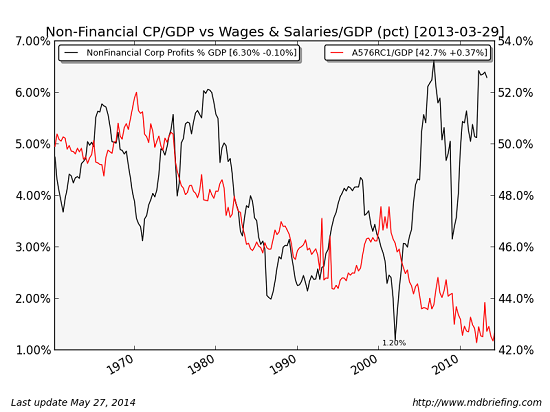
Longtime correspondent David P. recently submitted two charts which reflect the diversion of wages to corporate profits. Here are David's commentary and charts:
John Hussman said something interesting a while back - he was talking about whether or not the current level of corporate profits was sustainable, and he pointed out that in order to have those profits rise as a % of GDP, they had to be snatched from somewhere else. I was intrigued and asked myself, where might they be snatched from? 
Here’s a chart that appears to show at least a chunk of where they came from. Wages & Salaries/GDP dropped from about 47% of GDP in 2001 down to 42.7% of GDP today. At the same time, (non-financial) corporate profits rose from about 2% to 6% of GDP. So wage earners lost 4.3%, while non-financial companies gained 4%. 
There was a very steep climb in corporate profitability from 2001-2008, during the height of the housing bubble, and a brisk drop off in the chunk of the economy provided to wage earners. Perhaps - globalization? Jobs lost to China? That’s the period where China started to really become a powerhouse. Yet after a brief drop during the recession, it's now back up to its peak levels.
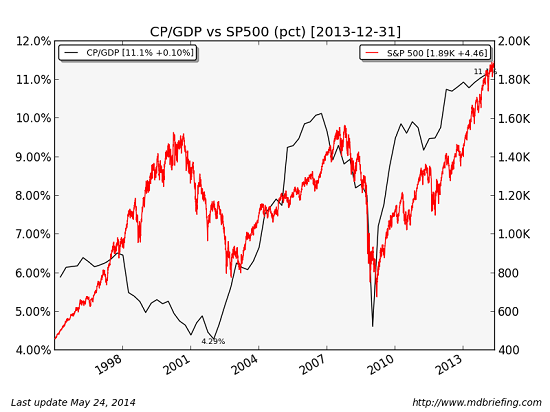
And here’s one more chart, aligning corporate profits (total) as a % of GDP - includes financial companies too. Notice how the S&P 500 (SPX) tends to follow (more or less) the profits skim off the economy. The linkage isn’t there during the 1995-2000 period, but it sure is for the rest of the period. So - unless and until the corporate skim drops as a % of GDP, I think our S&P 500 (SPX) is going to remain elevated. 
Can this Corporate Profits/GDP series grow to the sky? I don’t know. But it is certainly doing pretty well right now. A combination of outsourcing and low rates = a great corporate environment for profits, taken from savers and wage-earners. 
Who do we blame? Debt constructed from the housing bubble (which went to increase financial corp profits) as well as outsourcing, which allowed companies to snatch that % of GDP from workers (increasing non financial corp profits).
So to Hussman’s point - is this sustainable? As long as work continues being outsourced, unemployment is relatively high (i.e. wage pressures are low) and as long as the debt remains intact, I think it is.

Thank you, David, for the charts and commentary. I think David's conclusion raises two further questions:

1. What if all the low-hanging fruit of outsourcing jobs and financialization have already been plucked by Corporate America?

2. What happens when wage-earners can no longer substitute debt for earned income to sustain their consumption?

If these two conditions are running out steam, then the endgame of corporate profit growth is closer than we might imagine.

Administrative note: due to family obligations, email replies will be near-zero for the next week or so. Thank you for your understanding. 


Get a Job, Build a Real Career and Defy a Bewildering Economy(Kindle, $9.95)(print, $20)
go to Kindle edition
Are you like me? Ever since my first summer job decades ago, I've been chasing financial security. Not win-the-lottery, Bill Gates riches (although it would be nice!), but simply a feeling of financial control. I want my financial worries to if not disappear at least be manageable and comprehensible.

And like most of you, the way I've moved toward my goal has always hinged not just on having a job but a career.
You don't have to be a financial blogger to know that "having a job" and "having a career" do not mean the same thing today as they did when I first started swinging a hammer for a paycheck.

Even the basic concept "getting a job" has changed so radically that jobs--getting and keeping them, and the perceived lack of them--is the number one financial topic among friends, family and for that matter, complete strangers.

So I sat down and wrote this book: Get a Job, Build a Real Career and Defy a Bewildering Economy.

It details everything I've verified about employment and the economy, and lays out an action plan to get you employed.
I am proud of this book. It is the culmination of both my practical work experiences and my financial analysis, and it is a useful, practical, and clarifying read.

Test drive the first section and see for yourself.     Kindle, $9.95     print, $20

"I want to thank you for creating your book Get a Job, Build a Real Career and Defy a Bewildering Economy. It is rare to find a person with a mind like yours, who can take a holistic systems view of things without being captured by specific perspectives or agendas. Your contribution to humanity is much appreciated."
Laura Y. 


Thank you, Brian R. ($75), for your stupendously generous contribution to this site -- I am greatly honored by your support and readership.Thank you, Karl L. ($50), for your splendidly generous contribution to this site -- I am greatly honored by your longstanding support and readership.


Read more...

Saturday, June 07, 2014

What's Cooking at our House: Homemade Enchilada Sauce

This homemade enchilada sauce is worth the effort.

Some dishes are difficult to make, others are time-consuming, and some are both difficult and time-consuming. Those are naturally the ones we tend to buy "store-bought" because we're pressed for time and wary of complicated recipes.


Homemade enchilada sauce is so infinitely superior to the "store-bought" kind that it's one of those things that's worth the time and effort every once in a while. We use the recipe from Jacqueline Higuera McMahan's California Rancho Cooking: Mexican and Californian RecipesAuthentic Rancho Chile Sauce.

The ingredients are few: dried guajillo or California peppers, (the recipe calls for mild California peppers, we prefer the spicier guajillo), minced garlic, dried oregano, cider vinegar and oil/flour for the roux.

What the recipe doesn't address is how to deal with the tough skins of the guajillo peppers. One way is to soak and puree the dried peppers and then put the puree through a food mill/sieve to remove all the bits of tough skin, but this is a messy and laborious process.

My wife came up with a much easier and less messy way of separate the pulpy flesh of the soaked peppers from the tough skin:

1. carefully remove the chile stem, and cut down the length of chile to so you can open in flat (kitchen scissors makes this easy/safe) to remove all the seeds and stringy membrane. You can also cut the open chile in half – makes it easier later to scrape off the softened flesh.

2. now rise the de-seeded chiles

3. place chiles in clean bowl with 2-3 crushed garlic cloves, and cover with boiling water only to cover. Don’t use her suggested 2 quarts of water because you will be saving the soaking liquid to puree the chiles – you want the flavor concentrated. Just use enough water to amply cover the chiles – set a place inside the bowl on top the chiles to keep them submerged. Now you can head off to the farm supply store to buy your screen. The chiles are fine soaking/rehydrating for an hour or two.

4. Strain the chiles in a colander being sure to save all the flavorful soaking liquid + the crushed garlic.

5. Place each chile flat on a cutting board and gently scrape all the flesh off the skin into a blender – it’s very easy to do with a small paring knife blade tip.

6. Blenderize the chiles with the crushed garlic + 1 1/2 cups soaking liquid to start – use your judgment; may need more liquid but don’t make the puree too thin.

7. Now heat a cast iron flying pan if you have one, and you’ll be proceeding to prepare the enchilada sauce using a basic “gravy” making technique. Heat 3 tablespoons olive oil in the pan on medium, sprinkle in the flour while whisking so it won’t burn – want this roux to brown nicely (you don’t need to add the minced garlic since the cloves are already in the chile puree).

Whisk in the red chile puree until smooth, then add in the 2 teaspoons oregano and 2 tablespoons cider vinegar. Bring to a boil, cover, lower heat and simmer 20 minutes for flavors to meld – your sauce is ready. If it looks too thick, whisk in more of the chile soaking liquid.

Now we're ready to assemble the enchiladas. Note this recipe calls for sauteed sweet onion filling but you can whatever you want – cheese, olives, shredded chicken, beef, pork. Be sure to sauté at least a whole onion or two for the filling, regardless of other additions.

Here's the sauce:


Assembling the enchiladas:


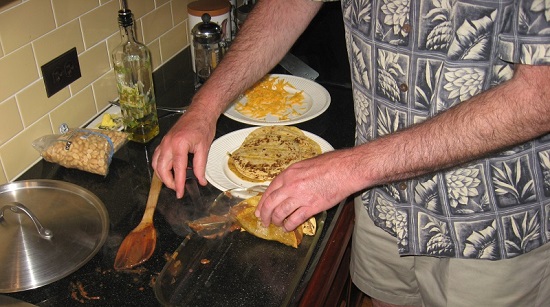
The homemade enchiladas, ready to serve:


Me at work in my buddy's kitchen (we've been pals since the 6th grade):


Like every other time-consuming task in the kitchen, the work goes quick when many hands are helping and convivial conversation makes the time fly by. You'll probably find the leftover enchiladas made with this sauce don't last long.


"A healthy homecooked family meal and a home garden are revolutionary acts."

Administrative note: due to family obligations, email replies will be near-zero for the next week or so. Thank you for your understanding.


Get a Job, Build a Real Career and Defy a Bewildering Economy(Kindle, $9.95)(print, $20)
go to Kindle editionAre you like me? Ever since my first summer job decades ago, I've been chasing financial security. Not win-the-lottery, Bill Gates riches (although it would be nice!), but simply a feeling of financial control. I want my financial worries to if not disappear at least be manageable and comprehensible.


And like most of you, the way I've moved toward my goal has always hinged not just on having a job but a career.

You don't have to be a financial blogger to know that "having a job" and "having a career" do not mean the same thing today as they did when I first started swinging a hammer for a paycheck.

Even the basic concept "getting a job" has changed so radically that jobs--getting and keeping them, and the perceived lack of them--is the number one financial topic among friends, family and for that matter, complete strangers.


So I sat down and wrote this book: Get a Job, Build a Real Career and Defy a Bewildering Economy.


It details everything I've verified about employment and the economy, and lays out an action plan to get you employed.


I am proud of this book. It is the culmination of both my practical work experiences and my financial analysis, and it is a useful, practical, and clarifying read.


Test drive the first section and see for yourself.     Kindle, $9.95     print, $20


"I want to thank you for creating your book Get a Job, Build a Real Career and Defy a Bewildering Economy. It is rare to find a person with a mind like yours, who can take a holistic systems view of things without being captured by specific perspectives or agendas. Your contribution to humanity is much appreciated."
Laura Y.


Thank you, Brian R. ($75), for your stupendously generous contribution to this site -- I am greatly honored by your support and readership.Thank you, Karl L. ($50), for your splendidly generous contribution to this site -- I am greatly honored by your longstanding support and readership.

Read more...

Terms of Service

All content on this blog is provided by Trewe LLC for informational purposes only. The owner of this blog makes no representations as to the accuracy or completeness of any information on this site or found by following any link on this site. The owner will not be liable for any errors or omissions in this information nor for the availability of this information. The owner will not be liable for any losses, injuries, or damages from the display or use of this information. These terms and conditions of use are subject to change at anytime and without notice.


Our Privacy Policy:


Correspondents' email is strictly confidential. This site does not collect digital data from visitors or distribute cookies. Advertisements served by a third-party advertising network (Investing Channel) may use cookies or collect information from visitors for the purpose of Interest-Based Advertising; if you wish to opt out of Interest-Based Advertising, please go to Opt out of interest-based advertising (The Network Advertising Initiative). If you have other privacy concerns relating to advertisements, please contact advertisers directly. Websites and blog links on the site's blog roll are posted at my discretion.


PRIVACY NOTICE FOR EEA INDIVIDUALS


This section covers disclosures on the General Data Protection Regulation (GDPR) for users residing within EEA only. GDPR replaces the existing Directive 95/46/ec, and aims at harmonizing data protection laws in the EU that are fit for purpose in the digital age. The primary objective of the GDPR is to give citizens back control of their personal data. Please follow the link below to access InvestingChannel’s General Data Protection Notice. https://stg.media.investingchannel.com/gdpr-notice/


Notice of Compliance with The California Consumer Protection Act
This site does not collect digital data from visitors or distribute cookies. Advertisements served by a third-party advertising network (Investing Channel) may use cookies or collect information from visitors for the purpose of Interest-Based Advertising. If you do not want any personal information that may be collected by third-party advertising to be sold, please follow the instructions on this page: Limit the Use of My Sensitive Personal Information.


Regarding Cookies:


This site does not collect digital data from visitors or distribute cookies. Advertisements served by third-party advertising networks such as Investing Channel may use cookies or collect information from visitors for the purpose of Interest-Based Advertising; if you wish to opt out of Interest-Based Advertising, please go to Opt out of interest-based advertising (The Network Advertising Initiative) If you have other privacy concerns relating to advertisements, please contact advertisers directly.


Our Commission Policy:

As an Amazon Associate I earn from qualifying purchases. I also earn a commission on purchases of precious metals via BullionVault. I receive no fees or compensation for any other non-advertising links or content posted on my site.

  © Blogger templates Newspaper III by Ourblogtemplates.com 2008

Back to TOP