Wednesday, August 06, 2014

Is This Decline the Real Deal?

Bulls must explain why their rationalizations don’t mark this as the top of an asset bubble.


Is this stock market decline the "real deal"--the start of a serious correction of 10% or more--or is it just another garden-variety dip in the long-running Bull market? Let’s start by looking for extremes that tend to mark the tops in Bull markets.

Extremes Eventually Revert to the Mean
There's little doubt that current measures of valuations, sentiment, leverage and complacency have reached historic extremes. Many analysts have posted charts depicting these extremes, and perhaps the one that distills well multiple extremes into one metric is Doug Short’s chart of the S&P 500’s inflation-adjusted Regression to the Trend, another way of saying mean reversion or reverting to the mean.


I have added two red boxes: one around the peak reached just before the Great Crash of 1929 (81% above the trend line), and one around the current reading (86% above the trend line).
That the current reading exceeds the extreme that preceded the Crash of 1929 should give us pause. And little comfort should be taken that the bubble of 2000 reached even higher extremes, as that should likely be viewed as an outlier rather than the harbinger of the New Normal.

What this chart demonstrates is the market tends to overshoot to the upside or downside before reversing direction and once again reverting to the mean.  Other than a very brief foray below trend line in 2009, the S&P 500 has been at or above the trend line for the past 20 years. While the Gilded Age boom of a century ago stayed above the trend line for over 30 years, more recent history suggests that markets that stay above the trend line for 20 years are getting long in the tooth.

Extremes in Risk Appetite and “Risk-On” Asset Allocation
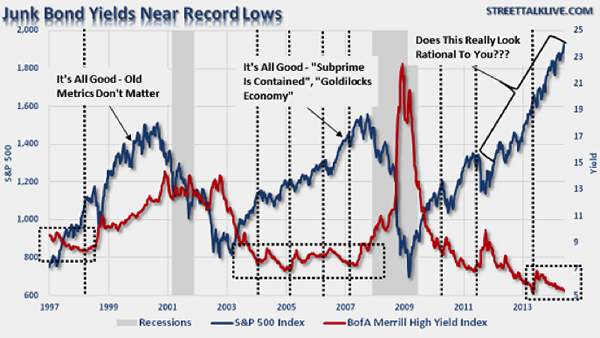
One measure of risk appetite is junk bond yields, which as Lance Roberts shows in this chart, have reached multi-year lows:

Money managers’ appetite for the “risk-on” asset class of equities is similarly lofty:


Previous readings near the current level preceded major stock market declines—though high readings have been the norm for the past few years without presaging a major drop.

Can Extremes Be Worked Off Without Affecting Price?
From the Bullish point of view, these extremes have been worked off in relatively mild downturns in the seasonally weak periods of February to April and August to October:

Let’s look at a chart of the S&P 500 (SPX), with a focus on the seasonally weak periods:


Rather significant declines in indicators such as the MACD have translated into relatively brief, shallow declines.

From the Bull’s perspective, all the extremes in valuations, sentiment, leverage and complacency have been worked off in modest declines that haven’t reached the 10% threshold of a correction. So why should the present period of seasonal weakness be any different?

One potential difference in August 2014 is the sheer number of current financial/market extremes.  Analyst John Hampson prepared a list of all-time records that is impressively long:

Here are some of the all-time records delivered in 2014:
  1. Highest ever Wilshire 5000 market cap to GDP valuation for equities
  2. Highest ever margin debt to GDP ratio and lowest ever net investor credit
  3. Record extreme INVI bullish sentiment for equities
  4. Record extreme bull-bear Rydex equity fund allocation
  5. All-time low in junk bond yields
  6. All-time low in the VXO volatility index (the original VIX)
  7. Highest ever cluster of extreme Skew (tail-risk) readings in July
  8. Highest ever Russell 2000 valuation by trailing p/e
  9. Lowest ever Spanish bond yields
  10. Lowest ever US quarterly GDP print that did not fall within a recession
And this week:
11.  Lowest HSBC China services PMI since records began
12.  Lowest ISE equity put/call ratio since records began

If we had to summarize the current set of extremes in risk appetite, valuations and sentiment, we might state the Bear case as: These extremes characterize the tops of asset bubbles that inevitably deflate in dramatic fashion, despite the majority of participants denying the asset class is in a bubble.

Conversely, we might state the Bull case as: The fundamentals of low interest rates, abundant liquidity, slow but stable growth and rising corporate profits support current measures of value, confidence and risk appetite.

For context, let’s go back in time to the Great Housing Bubble circa 2006-07, when the official and mainstream media narrative denied that housing had reached bubble heights even as the housing market was increasingly dependent on often-fraudulent stated-income (a.k.a. liar loans), interest-only adjustable rate mortgages (ARMs) for sales and mortgage originations.

report by the U.S. General Accountability Office (GAO) found that almost 80% of all interest-only adjustable-rate mortgages (ARM) and Option ARMs nationwide were stated-income in 2006. In effect, prudent risk management had been thrown out the window. But participants chose to focus on the supposedly solid fundamentals of housing to rationalize their confidence in what was an increasingly obvious Ponzi scheme based on fraud and borrowers who were bound to default once the bubble popped.


In other words, even as valuations, risk appetite, complacency and Bullish sentiment were reaching extremes, participants and Status Quo observers were confident that these bubble valuations were the New Normal.

Those who are confident that the current stock market is fairly valued have to explain why the many current extremes are different this time from previous asset bubbles, and provide an explanation of why extremes can continue indefinitely or be worked off without affecting price more than a few percentage points.

Indeed, what characterizes Bull markets is their ability to work off extremes of complacency (i.e. low volatility) and overbought conditions with only modest declines in price (for example, the S&P 500 is currently down 3.4% from its closing high around 1,988).

But the weight of these numerous extremes is significant, and a detached observer would naturally wonder if such a wide spectrum of extremes can be worked off without affecting price much.

The prudent observer would also ask: Have stocks been pushed to their current valuations by these extremes, or are these extremes merely temporary spikes of exuberance that have little to do with the fundamentals driving valuations higher?

It’s a critical question. For if extremes in risk appetite and sentiment have underpinned the market’s rise, then as these tides recede, price will inevitably follow.

If these extremes are merely temporary spikes that can dissipate without effecting price, then we have to ask: If this is the case, then what are participants afraid of?

We know participants are afraid of something, because the Put/Call Ratio—a measure of participants buying hedges (put options) against a downturn—has skyrocketed to a multi-year high in the past week:


This ratio has traced out a declining channel for the past two years. If nothing fundamental has changed, then what are we afraid of right now?

The Challenge To The Bulls
Those who are confident in the Bull case—that rock-solid fundamentals will drive stocks higher—have a daunting task ahead: they need to explain away the obvious spike in fear/caution, and explain why all these extremes in valuations, sentiment, leverage and complacency have no real bearing on the rock-solid fundamentals.

But given that the psychology of bubbles is characterized by precisely this rationalization of why extremes don’t matter,  Bulls must also explain why their rationalizations don’t mark this as the top of an asset bubble that is remarkably similar in terms of extremes to recent bubbles in housing and stocks.

In Part 2: Prepare For The Bear, we take a look at changing fundamentals that may affect the market’s five-year Bullish bias. We’ll look at how the fundamentals of the Bull case have been weakened or threatened, and determine whether indeed we are witnessing a key moment of direction-reversal in the markets.

Click here to read Part 2 of this report (free executive summary, enrollment on Peak Prosperity required for full access)


This essay was first published on peakprosperity.com


Get a Job, Build a Real Career and Defy a Bewildering Economy(Kindle, $9.95)(print, $20)
go to Kindle edition
Are you like me? Ever since my first summer job decades ago, I've been chasing financial security. Not win-the-lottery, Bill Gates riches (although it would be nice!), but simply a feeling of financial control. I want my financial worries to if not disappear at least be manageable and comprehensible.


And like most of you, the way I've moved toward my goal has always hinged not just on having a job but a career.

You don't have to be a financial blogger to know that "having a job" and "having a career" do not mean the same thing today as they did when I first started swinging a hammer for a paycheck.

Even the basic concept "getting a job" has changed so radically that jobs--getting and keeping them, and the perceived lack of them--is the number one financial topic among friends, family and for that matter, complete strangers.

So I sat down and wrote this book: Get a Job, Build a Real Career and Defy a Bewildering Economy.

It details everything I've verified about employment and the economy, and lays out an action plan to get you employed.
I am proud of this book. It is the culmination of both my practical work experiences and my financial analysis, and it is a useful, practical, and clarifying read.

Test drive the first section and see for yourself.     Kindle, $9.95     print, $20

"I want to thank you for creating your book Get a Job, Build a Real Career and Defy a Bewildering Economy. It is rare to find a person with a mind like yours, who can take a holistic systems view of things without being captured by specific perspectives or agendas. Your contribution to humanity is much appreciated."
Laura Y.


Gordon Long and I discuss The New Nature of Work: Jobs, Occupations & Careers (25 minutes, YouTube) 


NOTE: Contributions/subscriptions are acknowledged in the order received. Your name and email remain confidential and will not be given to any other individual, company or agency.


Thank you, James M. ($20), for yet another splendidly generous contribution to this site -- I am greatly honored by your steadfast support and readership.Thank you, Ernie C. ($10/month), for your outstandingly generous subscription to this site -- I am greatly honored by your steadfast support and readership.

Read more...

What Are the Options for Those Who Can't/Won't Get a Corporate/Government Job?

To understand alternatives to conventional corporate/government jobs, we have to understand "the economy we have, not the one we wish we had."

The average jobseeker is hoping to nail down a corporate or government position, for the usual reasons: security, pay and benefits. This is understandable, and it works for those who do manage to nail down a corporate/government job.

But what about everyone else? What do they do for a career? And what about those who take the Corporate America/state job and realize it isn't a good match for who they are and where they want to go?

The conventional options are on the margins of the economy: a low-wage part-time job or risky self-employment. No wonder most people want a secure Corporate America/state gig.

But there aren't enough secure, high-paying corporate/government jobs for everyone who wants one. The conventional (and carefully unstated) view is: tough luck, welcome to the low-wage serfdom basement of the economy. Take a part-time McJob or three if you can get them and spend your life scraping by.

I don't see low-wage serfdom as the only alternative to a shiny Corporate America/government bureaucracy job. To understand the alternatives, we have to understand the economy we have, not the one we wish we had or the one we might have in the future.

I often receive emails asking for job/career advice, and this is to be expected, given my latest book is titled Get a Job, Build a Real Career and Defy a Bewildering Economy.

My first response is to list the four conditions that make finding paying work easier:

1. Living in a place with a diverse range of opportunities for work.
2. Developing a network of people who know I’m looking for work and who trust me to do a good job.
3. Having more than one skill so I can take a variety of jobs.
4. Knowing what kind of work I like doing.

Beyond these common-sense points, job-seekers and those changing careers need to understand the disruptive forces transforming the economy.

The Disruptive Forces Transforming the Economy


There are three fundamental forces disrupting the conventional order, and everyone with their eyes open sees them at work every day:

1.  Essential resources are becoming more expensive.

2.  The system of expanding credit/debt to fund more consumption (i.e. “growth”) has reached marginal returns and is failing.

3.  Networked software, automation and robotics are reducing the need for human labor on a global scale.

As a result of these three structural forces, economic instability is not going to go away any time soon.  Technology leapfrogs the obsolete and inefficient; no wonder conventional sectors and the market for traditional 9-to-5 jobs are both stagnating.

The realization that ever-expanding debt and consumption are unsustainable has given rise to a new understanding of the economy called Degrowth (French: décroissance, Spanish: decrecimiento, Italian: decrescita).

From the perspective of sustainable prosperity, growth based on ever-expanding debt-based consumption is the road to ruin.

This shift from debt-based consumption to a more productive sustainability is bringing profound changes to the nature of work itself and social arrangements in the workplace.
Though we can’t foresee all the ramifications of networked software, automation and robotics, we can predict one aspect of this systemic disruption: technology will disrupt the most expensive, least efficient sectors of the economy because that’s where the greatest reductions in cost can be reaped.

In our economy, these are healthcare, education, government and national defense, all traditionally viewed as stable sectors with guaranteed job security.   That is changing, as the soaring costs of these sectors now exceed the economy’s ability to fund them.  If an economy expands by 2% each year and healthcare costs rise by 5% each year, eventually healthcare runs out of oxygen—there isn’t enough income generated by the economy to fund its continued expansion.

Few “experts”—academics, pundits and advisors—have accepted the reality of these forces or thought through the interacting consequences. As a result, we’re on our own in setting a course and navigating the inevitable storms ahead as the old system lurches from crisis to crisis, weakening further as every politically expedient reform fails to address these structural realities.

Outmoded Career Advice Is the Norm


Though the transformative power of these three forces is self-evident, remarkably, conventional career counseling is still stuck in the past, offering three basic bits of advice:

1.  Choose a career that aligns with your core talents and interests.
2.  Get as many credentials as you can -- degrees, certifications, etc. -- because the gatekeepers who do the hiring require them.
3.  Since the goal is secure employment, try to get a job in the government or a big corporation.

In my view, the conventional advice has it all backward. What worked in the past is no longer working because the economy and the nature of work are both being disrupted by forces that cannot be controlled by those threatened by these fundamental changes. 
In the conventional view, a college degree prepares one to enter the workforce. This is no longer true, as higher education has largely failed to keep pace with technology and a fast-changing economy.

As for adding more credentials to keep ahead of the pack—degree inflation dooms this strategy for all but the few who manage to secure multiple degrees from elite universities. And even this is no guarantee of lifetime security for everyone, as the number of open slots in gatekeeper-dominated institutions is much smaller than the rapidly expanding pool of over-credentialed applicants.

What matters more than credentials is the ability to keep learning new skills over one’s entire productive life.

And while it’s certainly solid advice to align one’s work with one’s talents and interests, even this advice misses the key dynamics of the emerging economy—which I define as  the parts of the economy that are thriving on innovation rather than depending on cheap credit and asset bubbles for their survival.

The thriving parts of the economy rely less on gatekeepers and credentials and more on skills, flexibility, professionalism, mastery and networks of collaboration.

In the emerging economy, security arises not from institutional promises but from a diversity of skills and income streams and a flourishing network of other trustworthy, productive people.

As a result, the goal for jobseekers isn’t just to identify one’s talents and interests but to acquire a diverse suite of flexible skills and a network that enables you to put these skills to good use.

In this view, work isn’t what you do between 9 and 5: it’s a lifestyle informed by a flexible, open perspective and guided by entrepreneurial values.

In terms of values, conventional career advice is based on the idea that happiness and fulfillment require institutional security and ever more consumption. But the more we learn about happiness and fulfillment, the more apparent it becomes that family, community, meaningful work and networks of trustworthy collaborators and friends are the sources of happiness and fulfillment, not the accumulation of institutional promises and more stuff, which turns out to have little impact on happiness or fulfillment.

The Dynamics of Economic Transformation


Capitalism and technology are both disruptive by their very nature.  That mature industries shrink or disappear is not the fault of one policy or another; that process of creative destruction (a term coined by economist Joseph Schumpeter) is the heart of capitalism and technology.

Many have attempted to keep technology safely locked up so it can’t creatively destroy their regime or industry. But technology is a genie that cannot be kept in the bottle. To quote Bob Dylan:  those not busy being born are busy dying.  Every nation or industry that tries to protect itself from technological transformation either stagnates or fails.

One aspect of capitalism that disturbs many people is the mobile nature of capital—that capital will flow to the highest return, regardless of national borders or religious, national and ideological loyalties.

Though many attribute this mobility to base greed, capital that doesn’t seek to expand will fall victim to creative destruction: the only way innovation and productive investment can occur is if less productive investments and quasi-monopolies are dismantled.

This is true not just of financial capital (cash), but of human and social capital—what author Peter Drucker called the new means of production in the knowledge-based economy.

This will have implications for every worker seeking to escape the corporate rat-race or build a career.

One feature of capitalism that is rarely noted is the premium placed on cooperation. The Darwinian aspects of competition are widely accepted (and rued) as capitalism’s dominant force, but cooperation is just as intrinsic to capitalism as competition. Subcontractors must cooperate to assemble a product, suppliers must cooperate to deliver the various components, distributors must cooperate to get the products to retail outlets, employees and managers must cooperate to reach the goals of the organization, and local governments and communities must cooperate with enterprises to sustain the local economy.

Darwin’s understanding of natural selection is often misapplied. In its basic form, natural selection simply means that the world is constantly changing, and organisms must adapt or they will expire. This dynamic is scale-invariant, meaning that it’s true for individuals, enterprises, governments, cultures and economies. Darwin wrote: "It is not the strongest of the species that survives, or the most intelligent, but the ones most adaptable to change."

These new ideas, techniques and processes trigger changes in society and the economy that are difficult to predict. The key survival trait is not so much the ability to guess the future correctly but to remain flexible and adaptive.

Ideas, techniques and processes which are better and more productive than previous versions will spread quickly; those who refuse to adapt them will be overtaken by those who do.

This creates a dilemma: we want more prosperity and wider opportunities for self-cultivation (personal fulfillment), yet we don’t want our security to be disrupted. 

But we cannot have it both ways. Those who attempt to preserve the current order while reaping the gains of free markets find their security dissolving before their eyes as unintended consequences of technological and social innovations disrupt their sources of wealth and mechanisms of control.

The great irony of free-market capitalism is that the only way to establish an enduring security is to embrace innovation and adaptation, the very processes that generate short-term insecurity. Attempting to guarantee security leads to risk being distributed within the system. When the accumulated risk manifests, the system collapses.

Why This Matters


Why do these characteristics of free-market capitalism matter to jobseekers?

  Opportunity is not randomly distributed; it results from what I call the infrastructure of opportunity. If there is no mobility of labor and capital, no transparent markets for labor and capital, no creative destruction of corrupt, obsolete, inefficient systems, weak rule of law, weak property rights, no self-organizing (i.e. transparent, decentralized) access to credit, limited means of cooperation, little room for innovation and no understanding of the essential role of risk in adaptation, opportunities for successful adaptation (what we might call prosperity) are intrinsically scarce. Virtually all bets made in this environment will be lost because there is no fertile ground—it’s a desert for opportunity.

In Part 2: How The Nature Of Work Is Changing, we explore the changing nature of work and what skills and values tilt the odds in our favor. (Free executive summary;Enrollment in Peak Prosperity is required for full access)

THis essay was first published on peakprosperity.com


Get a Job, Build a Real Career and Defy a Bewildering Economy(Kindle, $9.95)(print, $20)
go to Kindle edition
Are you like me? Ever since my first summer job decades ago, I've been chasing financial security. Not win-the-lottery, Bill Gates riches (although it would be nice!), but simply a feeling of financial control. I want my financial worries to if not disappear at least be manageable and comprehensible.


And like most of you, the way I've moved toward my goal has always hinged not just on having a job but a career.

You don't have to be a financial blogger to know that "having a job" and "having a career" do not mean the same thing today as they did when I first started swinging a hammer for a paycheck.

Even the basic concept "getting a job" has changed so radically that jobs--getting and keeping them, and the perceived lack of them--is the number one financial topic among friends, family and for that matter, complete strangers.

So I sat down and wrote this book: Get a Job, Build a Real Career and Defy a Bewildering Economy.

It details everything I've verified about employment and the economy, and lays out an action plan to get you employed.

I am proud of this book. It is the culmination of both my practical work experiences and my financial analysis, and it is a useful, practical, and clarifying read.

Test drive the first section and see for yourself.     Kindle, $9.95     print, $20

"I want to thank you for creating your book Get a Job, Build a Real Career and Defy a Bewildering Economy. It is rare to find a person with a mind like yours, who can take a holistic systems view of things without being captured by specific perspectives or agendas. Your contribution to humanity is much appreciated."
Laura Y.

Gordon Long and I discuss The New Nature of Work: Jobs, Occupations & Careers (25 minutes, YouTube) 


NOTE: Contributions/subscriptions are acknowledged in the order received. Your name and email remain confidential and will not be given to any other individual, company or agency.


Thank you, Amir H. ($100), for your outrageously generous contribution to this site -- I am greatly honored by your steadfast support and readership.Thank you, Daniel G. ($50), for your outstandingly generous re-subscription to this site -- I am greatly honored by your steadfast support and readership.

Read more...

Monday, August 04, 2014

How Economies Collapse: Systemic Friction and Debt Are Self-Liquidating

Paying for unproductive friction with borrowed money has generated the illusion that free to me is actually free--it isn't.

We all understand how friction slows our progress: flatten the tires on a bicycle and it becomes much harder to maintain speed. If a brake pad is rubbing against one wheel, it gets even harder.


If we pile on additional sources of friction, eventually forward motion stops. In systemic terms, the system freezes up and collapses.

Here are some examples of systemic friction in the U.S. economy:

1. College degrees that cost four times as much but yield diminishing value in the job market.

2. Millions of needless medical tests performed to maximize profit or deflect future lawsuits (i.e. defensive medicine).

3. Weapons systems that cost four times as much as the system they replace while being less effective and more costly to maintain/repair.

The list of such sources of friction is essentially endless. Why is this so?

The answer is: rentier skims and offloading risk onto the system are forms of friction, and as noted yesterday in The Slide to Collapse Is Greased with Self-Interest, rational self-interest is best served by transferring personal risk of loss onto the State (i.e. taxpayers). Influencing the State to protect one's private skims, job, income, pension, profits and gains offloads risk onto the taxpayers.

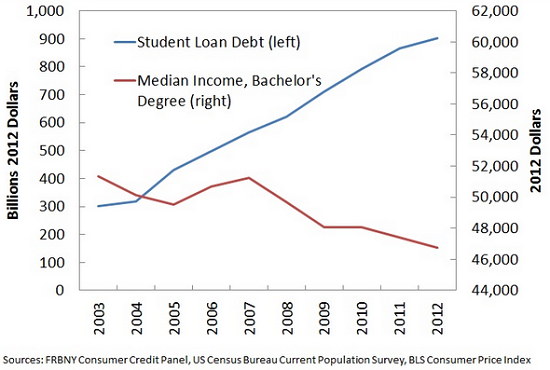
All this systemic friction adds cost and precious little increase in output or productivity. Nobody's actually healthier or more productive because millions of useless tests have been performed, just as nobody actually learned more as a result of their college costs soaring from $25,000 for a bachelor's degree to $100,000 for virtually identical courses, professors, curriculum, etc.

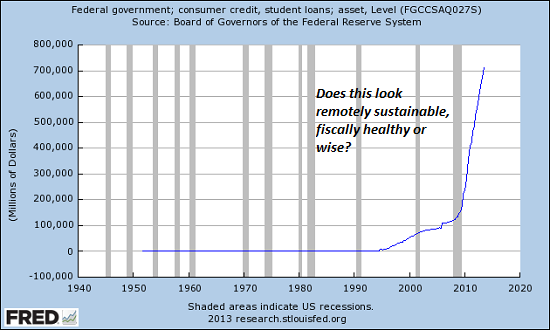
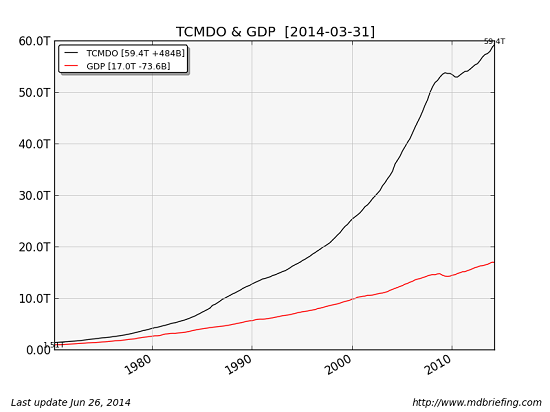
These charts shout diminishing returns and unsustainable expansion of debt borrowed by uncreditworthy borrowers.

In effect, we've paid for all this systemic friction by borrowing vast sums of money--money that has been squandered paying for unproductive friction under the guise of "investing in education, healthcare and national defense." But since there is no systemic mechanism for discovering the price of this friction or disciplining unproductive spending on friction, there is no structural restraint on this Status Quo "solution" other than the debt itself.

The ultimate discipline in using debt to fund friction is the rising cost of interest on all this debt. Even at low rates, interest absorbs an increasing percentage of national income.

As long as the interest rate on debt is low, the path of least resistance is to keep borrowing to support politically untouchable programs, cartels and  constituencies. Eventually, the cost of servicing the debt overwhelms the diminishing returns on using debt to pay the soaring costs of friction.

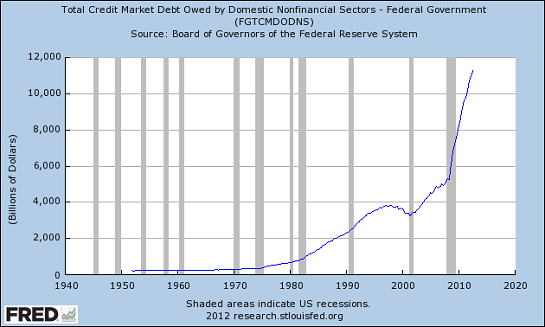
Here is the Federal debt, not including the bogus inter-governmental debts (money owed to the illusory Social Security Trust Fund).


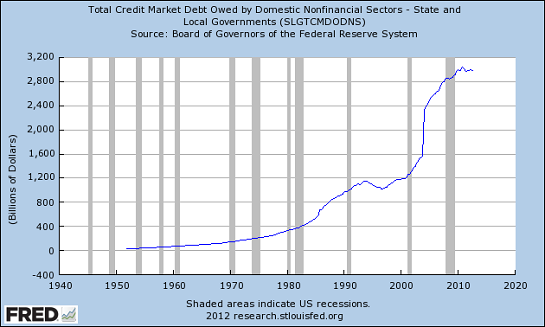
Everyone knows Federal debt has skyrocketed, but so has the debt of state and local governments: state and local government debt has risen by 250% just since 2002.


If we add up all debt--household, finance, corporate and government--we see debt has soared and growth has stagnated: this is a classic case of diminishing returns as more debt is required to add each additional increment of GDP.

At some point, additional debt is taken on to simply make interest payments; at that juncture, there is no consumption/buying taking place with the new debt: it's simply keeping the borrower out of default.

In other words, by using debt to pay the rising costs of friction, we've added another layer of friction: interest payments. In effect, we've "solved" the problem of rising friction by borrowing money that creates its own friction.

Paying for unproductive friction with borrowed money has generated the illusion that free to me is actually free--it isn't. It's also generated the illusion that piling up debt is risk-free as long as interest rates are low and the government backstops all the debt.

The final illusion is that there is no mechanism to brake the expansion of debt: that the "solution" to rising interest costs is to borrow more money.

We will discover, to our detriment, that friction and debt are both self-liquidating:that is, they bring about their own liquidation via systemic collapse.

Related topics:


Get a Job, Build a Real Career and Defy a Bewildering Economy(Kindle, $9.95)(print, $20)
go to Kindle editionAre you like me? Ever since my first summer job decades ago, I've been chasing financial security. Not win-the-lottery, Bill Gates riches (although it would be nice!), but simply a feeling of financial control. I want my financial worries to if not disappear at least be manageable and comprehensible.


And like most of you, the way I've moved toward my goal has always hinged not just on having a job but a career.

You don't have to be a financial blogger to know that "having a job" and "having a career" do not mean the same thing today as they did when I first started swinging a hammer for a paycheck.

Even the basic concept "getting a job" has changed so radically that jobs--getting and keeping them, and the perceived lack of them--is the number one financial topic among friends, family and for that matter, complete strangers.

So I sat down and wrote this book: Get a Job, Build a Real Career and Defy a Bewildering Economy.

It details everything I've verified about employment and the economy, and lays out an action plan to get you employed.

I am proud of this book. It is the culmination of both my practical work experiences and my financial analysis, and it is a useful, practical, and clarifying read.

Test drive the first section and see for yourself.     Kindle, $9.95     print, $20

"I want to thank you for creating your book Get a Job, Build a Real Career and Defy a Bewildering Economy. It is rare to find a person with a mind like yours, who can take a holistic systems view of things without being captured by specific perspectives or agendas. Your contribution to humanity is much appreciated."
Laura Y.
Gordon Long and I discuss The New Nature of Work: Jobs, Occupations & Careers (25 minutes, YouTube) 


NOTE: Contributions/subscriptions are acknowledged in the order received. Your name and email remain confidential and will not be given to any other individual, company or agency.


Thank you, Deborah C. ($20), for your much-appreciated generous contribution to this site -- I am greatly honored by your support and readership.Thank you, William M. ($5/month), for your outstandingly generous re-subscription to this site -- I am greatly honored by your renewed support and readership.

Read more...

Sunday, August 03, 2014

The Slide to Collapse Is Greased with Self-Interest

Self-interest is intrinsically self-liquidating on a systemic level.


One enduring if rarely stated principle of Neoliberal Democracy is that the single-minded pursuit of self-interest magically produces an equilibrium which serves everyone's interests well enough to avoid the destabilization of rebellion or systemic collapse.

Let's start by defining Neoliberal Democracy: neoliberalism sees markets as the only efficient, fair and durable method of organizing resource extraction and the social order: governance, employment, distribution of income, etc. Turning every social and economic function into a marketplace ensures that market forces provide the discipline and transparency participants need to make prudent choices and investments.

Democracy is a political marketplace in which votes replace investor and consumer decisions as the mechanisms that enforce discipline and transparency.

The melding of these two ideologies is clearly natural, as both see a transparent market as the best possible system for both governance and and the economy.

The key characteristic of a market is that all participants exclusively pursue their own self-interest. No one need sacrifice their own self-interest for the good of the whole system because by definition the system of competing interests naturally organizes itself to maximize the choices of each individual and the equilibrium of the system.

The transparency, fairness and stability offered by this ideological system is very compelling: the advantages of a system that transparently discovers the price of everything while offering roughly equal opportunity to all participants to seek self-fulfillment (i.e. the pursuit of happiness) via a dogged focus on self-interest are self-evident.

Looking out for Number One is thus the foundation not just of personal self-aggrandizement but of systemic stability and fairness.


But let's move from ideological abstraction to the pragmatic--what happens in the real world? What we find in the real world is that participants seek to transfer their own risk to others while minimizing their productive work and maximizing their gain/skim.

Risk inevitably introduces the possibility of loss--both fair and unfair. Let's say a participant in the market invests in a scheme to produce the Acme Brand widget. 

Unfortunately, the widget fails to find a market and the enterprise closes its doors. The investors lose their investment: this is fair because any enterprise in a market is at risk of losing favor from changes in fashion or the emergence of more agile competitors.

Unfair risk is loss incurred through no fault of one's own. Let's say an employee of Acme Widget Corporation gave his all to the company, and was laid off anyway--not through some failing in his efforts or talents but as a result of dynamics beyond his control: the marketplace found little value in the Acme Widget.

The rational, self-interested participant will naturally seek to offload risk of loss to other participants. Employees of the state (i.e. the government) transfer most of the risk of being laid off to the larger group of taxpayers: in a recession, the state can raise taxes on everyone in the system to guarantee its employees get paid. In effect, the risk of loss is distributed to everyone paying taxes in order to guarantee the employment of state employees.

Financiers have learned that making bets big enough to render their enterprise too big to fail effectively transfers the risk of loss to the taxpayers. We see the same mechanism in action: those who manage to transfer the risk of loss to others guarantee their self-interest can be pursued risk-free.

The rational, self-interested participant will also naturally seek to minimize his productive contribution while maximizing his income/gain. The state employee will (for example) game the system to retire early on a fake disability claim, or manage to evade work, accountability or responsibility with little risk of loss because the system makes firing a slacker employee almost impossible.

A financier will use free money for financiers issued by the Federal Reserve to buy assets everyone needs to live: private water systems, rental homes, parking meters, etc.--what are known as rentier assets because the financier isn't adding or creating any value in his ownership; he is skimming a fee from those who pass through the gate he owns.

The rational, self-interested participant will minimize his own expenses and maximize his income/gain by exploiting the commons--assets shared by all participants. The rational, self-interested participant will thus let his sheep out into the common pasture to graze for free, dump his waste into the river and the smoke from his works into the air, all free of charge.

This dynamic of everyone pursuing their own self-interest destroying the commons was articulated by Garrett Hardin in his paper The Tragedy of the Commons.

There is another dynamic at work called tyranny of the majority.

Imagine a ship with 100 passengers and crew drifting down a river that eventually cascades over a 1,000 foot waterfall. It's easy to plot the ship's course and the waterfall ahead. You might think 100% of those onboard would agree that something drastic must be done to either reverse course or abandon ship, but before we jump to any conclusion we must first identify what each of the 100 people perceive as serving their self-interest.

If life onboard is good for 60 of the 100, they may well rationalize away the waterfall dead ahead. Why risk the treacherous river currents by abandoning ship? As a result, the majority vote to tweak the ship's course slightly, thus dooming the 40 others who can hear the thundering cascade ahead but who are powerless to change course in a democracy.

This is the tyranny of the majority feared by some of the American Founding Fathers.

If 60% of the voting public is dependent on government spending, then they will vote to continue that spending regardless of its unsustainability, source or unfairness to those who will suffer most when the entire contraption collapses in a heap.

To the degree that government revenue is a form of public commons, then the siphoning of that resource to serve individual gain leads to the loss of the commons, as well as the loss of any notion of the common good.

With 60 of the 100 voting to continue the present course of State borrowing and spending to support their piece of the largesse, the ship is doomed to end up in pieces at the bottom of the waterfall, despite the utter obviousness of the catastrophe just ahead.

In other words, democracy functions when a sustainable equilibrium can be maintained with slight adjustments in course/policy. But when a dramatic change of course is required to save the system, a change that upends all the rentier skims and redistributes risk of loss to all those who reckoned they'd successfully offloaded all risk onto others, then there is no political support for the necessary radical change of course.

Those collecting a piece of State spending will vote to keep the ship firmly heading for the waterfall, because they fear the consequences of changing course or abandoning ship. Any radical change of course reintroduces the risk of loss that each self-interested participant offloaded onto the system itself.

Enterprises that haven't offloaded risk or secured guarantees from the State are forced to make radical changes when their survival demands it. Recent history is full of examples of corporations that were riding high and then failed to change course radically enough; those companies lost their way and were acquired for a sliver of their former value.

The political marketplace of democracy fails when the State has transferred risk and guaranteed the skim of enough voters.

The political marketplace of democracy also fails because self-interest is best served by influencing the State to protect one's private rentier skims and gains.The highest-leverage, highest-return investment is buying political favors and influence from politicos.

If average citizens could buy a semi-permanent escape from taxes for, say, a $20,000 "contribution" to the right politico, anyone with a tax burden of $10,000 or more annually would make this easy calculation: in a single decade, I'm going to pay $100,000 in taxes if I do nothing. If I buy the political favor for $20,000, I will save $80,000 over a decade.

That's a four-fold yield on the initial investment. Where else can you reap that kind of guaranteed return?

It turns out to be remarkably easy to evade the transparency required to make democracy and the market function fairly. The political favor is buried in hundreds of pages of legalese jargon in a legislative bill or regulatory statutes. No one will ever discover the favor unless they know where to look.

Self-interest is intrinsically self-liquidating on a systemic level, something I analyze in depth in Resistance, Revolution, Liberation, for without an understanding of the distorting mechanisms of self-interest, we cannot understand why people will continue supporting a visibly imploding Status Quo: they will do so as long as they are getting a piece of that Status Quo that is free to them.

This is how systems collapse: those who have offloaded risk (a.k.a. skin in the game) to the system itself and guaranteed their job, income, pension or rentier skim via the State will continue to support the Status Quo that has benefited them so handsomely even as the ship tumbles over the waterfall to its destruction.


Get a Job, Build a Real Career and Defy a Bewildering Economy(Kindle, $9.95)(print, $20)
go to Kindle editionAre you like me? Ever since my first summer job decades ago, I've been chasing financial security. Not win-the-lottery, Bill Gates riches (although it would be nice!), but simply a feeling of financial control. I want my financial worries to if not disappear at least be manageable and comprehensible.


And like most of you, the way I've moved toward my goal has always hinged not just on having a job but a career.

You don't have to be a financial blogger to know that "having a job" and "having a career" do not mean the same thing today as they did when I first started swinging a hammer for a paycheck.

Even the basic concept "getting a job" has changed so radically that jobs--getting and keeping them, and the perceived lack of them--is the number one financial topic among friends, family and for that matter, complete strangers.

It details everything I've verified about employment and the economy, and lays out an action plan to get you employed.

I am proud of this book. It is the culmination of both my practical work experiences and my financial analysis, and it is a useful, practical, and clarifying read.

"I want to thank you for creating your book Get a Job, Build a Real Career and Defy a Bewildering Economy. It is rare to find a person with a mind like yours, who can take a holistic systems view of things without being captured by specific perspectives or agendas. Your contribution to humanity is much appreciated."
Laura Y.

Gordon Long and I discuss The New Nature of Work: Jobs, Occupations & Careers (25 minutes, YouTube) 


NOTE: Contributions/subscriptions are acknowledged in the order received. Your name and email remain confidential and will not be given to any other individual, company or agency.


Thank you, Dominick B. ($50), for your fantastically generous contribution to this site -- I am greatly honored by your support and readership.Thank you, Michael N. ($5), for your most generous contribution to this site -- I am greatly honored by your support and readership.

Read more...

Saturday, August 02, 2014

It Doesn't Take Much Land to Grow A Lot of Food

Perhaps time learning in a garden should be considered as important as time spent sitting in a classroom.

The important national discussions about food security and hunger in America rarely seem to mention a critical fact: it doesn't take much land to grow a lot of food. Discussions of food deserts--neighborhoods or communities with limited access to supermarkets and farmer's markets--rarely if ever ask: how much open land is in these communities that could be converted to gardens in the growing season?


We hear much about hunger, poor diets and teaching math and science, but not enough about gardens in schools and how gardens are ideal workshops for learning about the biology of nutrition, health, plants, insects and ecological systems. Even math is a natural subject in a garden: measuring the space allotted to each crop and measuring the output.

The scientific method is also a natural subject in a garden: take the same soil and seedlings, and plant them in a variety of controlled conditions: which ones do better? What does this suggest in terms of improving the garden?

Perhaps time learning in a garden should be considered as important as time spent sitting in a classroom--or perhaps it should be understood as more important than time spent in a classroom because it engages children directly in practical applications of foundational science.

Numerous studies have found that gardening and animal husbandry have a profoundly positive effect on our psychological health and well-being.

Long-time readers may tire of my enthusiasm for gardening and fitness, but these both yield near-miraculous positive yields with relatively modest investments of time.

Perhaps we as a nation need to focus less on manicured lawns and access to corporate supermarkets and focus more on encouraging people of all ages to make the land around them productive. What non-gardeners might not appreciate is how much food can be produced in a small area: a rooftop garden, tomato plants in large pots, hydroponic arrangements that don't even need soil, wall gardens that let climbing plants grow up walls--the possibilities are endless.

I am a lazy gardener. Perhaps "lazy" isn't quite the right word; given my insanely over-scheduled life of 12+ hour days, I don't really have the time or inclination to create a picture-perfect neat garden.

What I focus on is the health of the soil and the vegetables, and providing year-round pollination opportunities (i.e. flowers) for pollinators like bees. I don't disrupt the soil and feed it a lot of compost. Birds and other predators help control insect pests and I use non-poisonous methods to control occasional infestations.

In other words, our garden is as messy as the rest of my life:


This single 3.5-meter (10 foot) row of scarlet-runner climbing green beans supplies multiple households with as many green beans as they can eat for four months. The handful of plants on this trellis could easily be grown on a rooftop, against a school wall or in a front yard against a fence or garage wall.

There are two kinds of tomatoes, a thriving lovage (an ancient leafy vegetable from the Mediterranean), zucchini and crook-necked squash, Russian kale (several left to go to seed), small red potatoes, parsley, thyme, peas, bell peppers, cucumbers and a few sunflowers for fun. Alyssum and California poppies provide random ground cover. (Our peach tree is in the background.)

This 12-foot by 12-foot (4 meter by 4 meter) patch of earth produces an extraordinary quantity of food despite the laziness of the gardeners. We basically stop buying groceries when the garden starts producing, and giving away the surplus becomes a near-daily task.
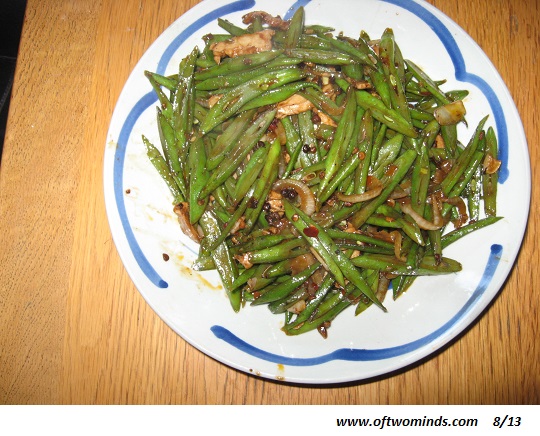
Here's one way to prepare zucchini and yellow squash: stir-fry them with red onion (also from our garden):


Here's another stir-fry, with zucchini, julienned scarlet-runner beans and carrots:


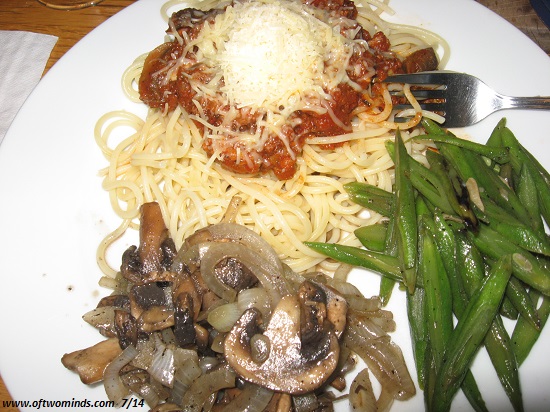
A spaghetti dinner with scarlet-runner beans and fried mushrooms and onions:


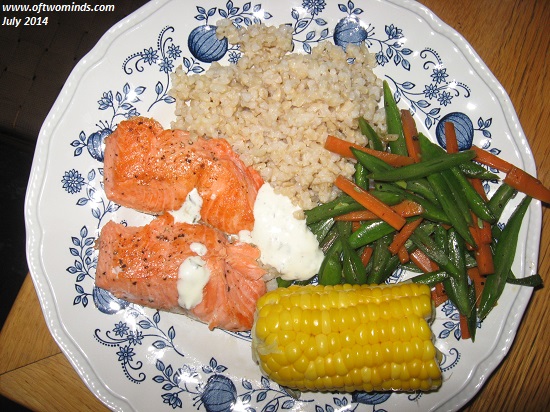
Wild salmon (a rare treat) with brown rice and scarlet-runner beans stir-fried with carrots (organic from Costco, not from our garden):


A classic Chinese dish, Kung Pao chicken with (yes, once again) scarlet-runner beans stir-fried with cabbage and carrots:


These basic garden vegetables are remarkably flexible in terms of making tasty combinations with other vegetables. Throw in a little meat or meat substitute and they easily become the main dish--for example:

A garden naturally leads to a healthy focus on preparing the yield and learning more about different ways to prepare the bounty.

It's worth noting that trendy high-end restaurants make a point of using fresh locally grown produce. Gardeners get that every day. In this sense, gardeners get to eat like kings on a decidedly non-royal budget.

Drought note: our garden is on a very water-frugal dripline. 


Get a Job, Build a Real Career and Defy a Bewildering Economy(Kindle, $9.95)(print, $20)
go to Kindle edition
Are you like me? Ever since my first summer job decades ago, I've been chasing financial security. Not win-the-lottery, Bill Gates riches (although it would be nice!), but simply a feeling of financial control. I want my financial worries to if not disappear at least be manageable and comprehensible.


And like most of you, the way I've moved toward my goal has always hinged not just on having a job but a career.

You don't have to be a financial blogger to know that "having a job" and "having a career" do not mean the same thing today as they did when I first started swinging a hammer for a paycheck.

Even the basic concept "getting a job" has changed so radically that jobs--getting and keeping them, and the perceived lack of them--is the number one financial topic among friends, family and for that matter, complete strangers.

So I sat down and wrote this book: Get a Job, Build a Real Career and Defy a Bewildering Economy.

It details everything I've verified about employment and the economy, and lays out an action plan to get you employed.
I am proud of this book. It is the culmination of both my practical work experiences and my financial analysis, and it is a useful, practical, and clarifying read.

Test drive the first section and see for yourself.     Kindle, $9.95     print, $20

"I want to thank you for creating your book Get a Job, Build a Real Career and Defy a Bewildering Economy. It is rare to find a person with a mind like yours, who can take a holistic systems view of things without being captured by specific perspectives or agendas. Your contribution to humanity is much appreciated."
Laura Y.


Gordon Long and I discuss The New Nature of Work: Jobs, Occupations & Careers (25 minutes, YouTube) 


NOTE: Contributions/subscriptions are acknowledged in the order received. Your name and email remain confidential and will not be given to any other individual, company or agency.

Thank you, David S. ($200), for your super-outrageously generous contribution to this site -- I am greatly honored by your support and readership.Thank you, Mickey B. ($100), for your outrageously generous contribution to this site -- I am greatly honored by your support and readership.

Read more...

Terms of Service

All content on this blog is provided by Trewe LLC for informational purposes only. The owner of this blog makes no representations as to the accuracy or completeness of any information on this site or found by following any link on this site. The owner will not be liable for any errors or omissions in this information nor for the availability of this information. The owner will not be liable for any losses, injuries, or damages from the display or use of this information. These terms and conditions of use are subject to change at anytime and without notice.


Our Privacy Policy:


Correspondents' email is strictly confidential. This site does not collect digital data from visitors or distribute cookies. Advertisements served by a third-party advertising network (Investing Channel) may use cookies or collect information from visitors for the purpose of Interest-Based Advertising; if you wish to opt out of Interest-Based Advertising, please go to Opt out of interest-based advertising (The Network Advertising Initiative). If you have other privacy concerns relating to advertisements, please contact advertisers directly. Websites and blog links on the site's blog roll are posted at my discretion.


PRIVACY NOTICE FOR EEA INDIVIDUALS


This section covers disclosures on the General Data Protection Regulation (GDPR) for users residing within EEA only. GDPR replaces the existing Directive 95/46/ec, and aims at harmonizing data protection laws in the EU that are fit for purpose in the digital age. The primary objective of the GDPR is to give citizens back control of their personal data. Please follow the link below to access InvestingChannel’s General Data Protection Notice. https://stg.media.investingchannel.com/gdpr-notice/


Notice of Compliance with The California Consumer Protection Act
This site does not collect digital data from visitors or distribute cookies. Advertisements served by a third-party advertising network (Investing Channel) may use cookies or collect information from visitors for the purpose of Interest-Based Advertising. If you do not want any personal information that may be collected by third-party advertising to be sold, please follow the instructions on this page: Limit the Use of My Sensitive Personal Information.


Regarding Cookies:


This site does not collect digital data from visitors or distribute cookies. Advertisements served by third-party advertising networks such as Investing Channel may use cookies or collect information from visitors for the purpose of Interest-Based Advertising; if you wish to opt out of Interest-Based Advertising, please go to Opt out of interest-based advertising (The Network Advertising Initiative) If you have other privacy concerns relating to advertisements, please contact advertisers directly.


Our Commission Policy:

As an Amazon Associate I earn from qualifying purchases. I also earn a commission on purchases of precious metals via BullionVault. I receive no fees or compensation for any other non-advertising links or content posted on my site.

  © Blogger templates Newspaper III by Ourblogtemplates.com 2008

Back to TOP