Thursday, February 05, 2015

Greece: Are You Finally Ready to Do the Right Thing and Leave the Euro?

The era of living off borrowed money is over in Greece, and the Greek people now have a choice.


Almost four years ago I wrote Greece, Please Do The Right Thing: Default Now (June 1, 2011). Default remains the only real way forward for Greece and Europe.Consider the destructive "gains" reaped by four years of lies, predation, debt-serfdom and austerity in service to kleptocrats: tremendous suffering by many Greek citizens, all for nothing but propping up the evil of debt-serfdom to the Greek kleptocracy and the financial royalty of Europe.

The truth is Greece squandered four years propping up a patently false illusion that using the euro as a currency was worth everything, when it was always worth nothing. As I have described at length for four long years, the euro created a brief (and highly profitable to the kleptocrats and banks) fantasy that marginal borrowers would magically be transformed into solid credit risks simply because they were now borrowing euros instead of drachmas.

It doesn't matter what is being borrowed--euros, drachmas, quatloos or beads--marginal borrowers are still high credit risks. The entire subprime mortgage fiasco was based on a similar financial fraud: that the housing bubble would enable homeowners with insufficient cash, income and creditworthiness to service gargantuan mortgages--mortgages that were issued with the intent of defrauding buyers of mortgage-backed securities.

Greece is simply an example of the same fraud played out on a larger stage.

The euro is one of the greatest monetary frauds in history, and its managers have waged one of the greatest campaigns of financial terrorism in history. These managers have persuaded (or bamboozled) the majority of Greeks (if polls are to be believed) and just about everyone else on the planet that exiting the euro would be an unmitigated disaster for the Greek people.

This is absolutely opposite of the truth: exiting the euro and returning to its own sovereign currency will be the greatest possible good for the Greek people, for the simple reasons that 1) they will finally be in control of their own destiny and 2) issuing one's own currency disciplines the entire economy in positive ways.

Ask yourself who is more likely to succeed in the world: the spoiled child who lacks even the most basic self-discipline, or the child who has learned that actions today have long-term consequences?

It's not that difficult to lay out a fiscal and monetary plan that would quickly build trust in a new Greek currency. The hard part is breaking the cycle of corruption and lies that is the Status Quo in the Greek economy.

1. Announce that the government can only spend what it collects in taxes and fees. The state will not borrow money, period.

2. Announce a new, simplified tax structure, with tax rates far below those of other European nations. For example, if the value-added tax (VAT) is 17% elsewhere in Europe, the Greek rate would be set at 7%. (Compare that to the sales tax in California, which is 9%.)

3. Explain that the future of Greece depends entirely on everyone paying taxes, since the government will no longer borrow-and-spend.

3. Hire 10,000 currently unemployed accountants (including recent college graduates who have been unable to find jobs in accounting), train them in forensic accounting and auditing and unleash them on the Greek economy, starting with the top 1/10th of 1% (the kleptocracy class) and working their way down to the corner cafe.

3. Make the pain of cheating and non-compliance higher than the pain of paying relatively low taxes.

4. Change the social perception that not paying taxes is acceptable behavior. Publicize the list of tax cheats, etc.

5. Make government spending transparent and auditable by any citizen with an Internet connection.

6. Enforce strict banking laws where lenders that loan money without regard for risk management are forced to absorb their losses and close their doors. Encourage prudent private lending and borrowing.

A nation's currency is a measure of global trust in that nation's fiscal and monetary order. If that order is based on a culture of corruption, lies, fraud and debt, the currency will lose value: why own a currency that is constantly being debased by lies and unpayable debts?

A currency based on transparency, fiscal prudence, little state debt and strictly enforced taxation and risk management will gain trust and value. The people who fear a Greek currency are actually afraid that the current culture of corruption, tax evasion and lies cannot be transformed. They are wrong. That culture can be transformed by strict adherence to simple rules of transparency, low tax rates, prudent state spending and a private banking sector that is held accountable for its risk management (or lack thereof).

In sum, the era of living off borrowed money is over in Greece, and the Greek people now have a choice: they can continue down the path of poverty by leaving their culture of corruption unchanged, or they can grasp the nettle and support a new culture based on transparency, fiscal prudence and strict adherence to the basic rules of monetary management. 


Get a Job, Build a Real Career and Defy a Bewildering Economy(Kindle, $9.95)(print, $20)
go to Kindle edition
Are you like me? Ever since my first summer job decades ago, I've been chasing financial security. Not win-the-lottery, Bill Gates riches (although it would be nice!), but simply a feeling of financial control. I want my financial worries to if not disappear at least be manageable and comprehensible.  And like most of you, the way I've moved toward my goal has always hinged not just on having a job but a career.

You don't have to be a financial blogger to know that "having a job" and "having a career" do not mean the same thing today as they did when I first started swinging a hammer for a paycheck.

Even the basic concept "getting a job" has changed so radically that jobs--getting and keeping them, and the perceived lack of them--is the number one financial topic among friends, family and for that matter, complete strangers.

So I sat down and wrote this book: Get a Job, Build a Real Career and Defy a Bewildering Economy.

It details everything I've verified about employment and the economy, and lays out an action plan to get you employed.

I am proud of this book. It is the culmination of both my practical work experiences and my financial analysis, and it is a useful, practical, and clarifying read.

Test drive the first section and see for yourself.     Kindle, $9.95     print, $20

"I want to thank you for creating your book Get a Job, Build a Real Career and Defy a Bewildering Economy. It is rare to find a person with a mind like yours, who can take a holistic systems view of things without being captured by specific perspectives or agendas. Your contribution to humanity is much appreciated."
Laura Y.

Gordon Long and I discuss The New Nature of Work: Jobs, Occupations & Careers(25 minutes, YouTube) 


NOTE: Contributions/subscriptions are acknowledged in the order received. Your name and email remain confidential and will not be given to any other individual, company or agency.

Thank you, Marvin R. ($50), for your fantastically generous contribution to this site-- I am greatly honored by your support and readership.

Read more...

Wednesday, February 04, 2015

The Lesson of Greece: Only Collapse Makes Real Change Possible

When the illusion that the Status Quo can fulfill all its promises to everybody dies, the Status Quo starts the terminal slide to effective collapse.


Of the many lessons we can learn from Greece's difficult path to rejection of debt-serfdom, the most important is perhaps the most obvious: no real change is possible until the Status Quo can no longer fulfill its promises, i.e. it effectively collapses.

The collapse of the Status Quo has two distinct features: the process is highly variable, and the process affects the social classes in different ways.

The process of collapse is neither sudden nor smooth. Things do not necessarily cease to function overnight; rather, the decline to effective collapse operates much like energy states in physics: systems decay and then drop to a lower energy level, where they are stable until further decay causes the next drop to an even lower level.

Pension payments provide a ready example. The pension payment is reduced, and the recipient tightens his/her belt and gets by. The next reduction (either outright or via inflation) forces drastic changes in consumption, and subsequent reductions reduce the pension to a supplement that cannot possibly support a retiree, much less their family.

The pension is still issued, but the promise of a pension that could support a household at a modest level of consumption has collapsed. Though the system for issuing pensions still exists, it no longer fulfills the original purpose.

In this sense, the collapsed pension system becomes much like the phantom legions of the late Roman Empire: the paymasters and officers still received the legion's pay, but there were no real soldiers; the legion was a bookkeeping entry in a skimming operation, not a fighting unit.

The financial Aristocracy (i.e. the kleptocracy) in Greece avoided much of the pain of debt-serfdom. What's the point of running things if you can't distribute the pain to others? I addressed this is Greece at the Crossroads: the Oligarchs Blew It (January 27, 2015).

The powerless classes were stripmined first. Bamboozled into voting for the Kleptocracy in previous elections, the powerless lower classes felt the brunt of austerity for the simple reason the kleptocracy knew there would be no blowback, as long as a few shreds of swag were being distributed.

This highlights the critical role of complicity in maintaining a corrupt, venal and parasitic kleptocracy: the passivity and silence of recipients of social welfare are bought very cheaply, as these classes will fear the loss of the miserable coins tossed to them.

This fear is a potent form of financial terrorism: any resistance or protest might trigger the loss of the reduced social welfare benefits, and so the powerless choose to remain powerless rather than rise up and take the risk of bringing down the parasitic kleptocracy.

The statist bourgeoisie (a.k.a. state-funded upper middle class) were the last to lose faith in the kleptocracy, for the simple reason that their share of the swag was sufficient to maintain the facade of middle-class comfort. It was also enough to sustain the illusion that the kleptocracy's abject kow-towing to the Lords of the European Central Bank (ECB), the European Union (EU) and the International Monetary Fund (IMF) would magically become a winning strategy for Greece, rather than a one-way ticket to permanent debt-serfdom.

When the kleptocracy lost a significant percentage of this top 20%, they sealed their fate. When the state apparatchiks, institutional functionaries, professionals, small business owners, etc. finally lose faith in the the Status Quo, the Status Quo is doomed, though it can stage a rear-guard action by brutally suppressing this class (see Venezuela for an example of this doomed defense of a failed Status Quo).

In the U.S., the top 10% are doing very well, the next 10% are getting enough to sustain the illusion that they may yet recover their former status and wealth, and the bottom 80% have been bought off with social welfare or the promise of social welfare. Some variation of these percentages are in play in Europe, China, Japan and the emerging economies that haven't already imploded.

When the illusion that the Status Quo can fulfill all its promises to everybody dies, the Status Quo starts the terminal slide to effective collapse.

Unfortunately, no real change in the social order or power structure can occur until the effective collapse of the Status Quo has taken down everyone but the kleptocrats, their high-ranking apparatchiks and the piteously delusional.

Of related interest: Greece Just Blew Up the Empire's Death Star of Debt February 2, 2015 


Get a Job, Build a Real Career and Defy a Bewildering Economy(Kindle, $9.95)(print, $20)
go to Kindle editionAre you like me? Ever since my first summer job decades ago, I've been chasing financial security. Not win-the-lottery, Bill Gates riches (although it would be nice!), but simply a feeling of financial control. I want my financial worries to if not disappear at least be manageable and comprehensible.  And like most of you, the way I've moved toward my goal has always hinged not just on having a job but a career.

You don't have to be a financial blogger to know that "having a job" and "having a career" do not mean the same thing today as they did when I first started swinging a hammer for a paycheck.

Even the basic concept "getting a job" has changed so radically that jobs--getting and keeping them, and the perceived lack of them--is the number one financial topic among friends, family and for that matter, complete strangers.

So I sat down and wrote this book: Get a Job, Build a Real Career and Defy a Bewildering Economy.

It details everything I've verified about employment and the economy, and lays out an action plan to get you employed.

I am proud of this book. It is the culmination of both my practical work experiences and my financial analysis, and it is a useful, practical, and clarifying read.

Test drive the first section and see for yourself.     Kindle, $9.95     print, $20

"I want to thank you for creating your book Get a Job, Build a Real Career and Defy a Bewildering Economy. It is rare to find a person with a mind like yours, who can take a holistic systems view of things without being captured by specific perspectives or agendas. Your contribution to humanity is much appreciated."
Laura Y.

Gordon Long and I discuss The New Nature of Work: Jobs, Occupations & Careers(25 minutes, YouTube) 


NOTE: Contributions/subscriptions are acknowledged in the order received. Your name and email remain confidential and will not be given to any other individual, company or agency.

Thank you, John H. ($60), for your stupendously generous contribution to this site-- I am greatly honored by your steadfast support and readership.

Read more...

Tuesday, February 03, 2015

The USD Bull in the Global China Shop

The long-term consequences of primary FX trends may be entirely unintended.


Indulge me two "I told you so's":

1. That the U.S. dollar (USD) would rise a lot, confounding those busily digging the dollar's grave

2. That the stronger dollar would crush U.S. corporate profits earned overseas, negatively impacting U.S. stock valuations and markets.
My call for a significantly stronger USD goes back four years:

Could the U.S. Dollar Rise 50%? (January 12, 2011)


My call for the stronger dollar impacting corporate profits also goes back four years:


There may be plenty of other people who made the same calls as early and as consistently as I have, but I haven't run across their archives.

More important than the call itself is explaining the causal dynamics that made the stronger dollar inevitable. That's where the rubber meets the road: why will this happen? If we get that right, the call will be right.

More recently, I've discussed the consequences of a stronger dollar globally:


In effect, the failure to address the structural problems that caused the Global Financial Meltdown of 2008-2009 have been transferred to the larger foreign-exchange (FX) market, which is connected to virtually everything in the global economy.

The FX market is not as easy to manipulate as stock and bond markets, due to its size and the inter-connectedness of interest rates, FX, perception of risk and global capital flows.

To understand why the USD bull is destabilizing the global financial system, we have to go back to Triffin's Paradox, which broadly speaking illuminates the tension between the demands of domestic and global markets: one market wants a weaker currency, the other might be pushing the currency higher. Every policy that impacts the value of a currency can have a wildly divergent effect in the domestic and global economies.

I have written extensively about Triffin's Paradox (also called Triffin's Dilemma):


In terms of the USD, the basic idea is that when one nation's fiat currency is used as the world's reserve currency, the needs of the global trading community are different from the needs of domestic policy makers.

Trading nations need dollars to lubricate trading and as foreign exchange reserves that bolster the value of their own currency and provide the asset base for the expansion of credit within their own nation.

U.S. exporters want a weak dollar to spur foreign demand for their products, while foreign holders want a strong dollar that holds its value/purchasing power.

You can't it both ways. That's the dilemma and the paradox.


The long-term consequences of primary FX trends may be entirely unintended. The intention of policymakers may well be stability and growth, but as the stronger USD destabilizes periphery currencies and economies, it has unleashed a self-reinforcing feedback loop as weakening periphery currencies push capital into dollar-denominated assets.

The stronger USD reduces the cost of imports to the U.S., which means fewer dollars are flowing into the global economy, which creates a scarcity of USD that further boosts demand for USD.

All the trades based on a weakening dollar are being reversed, and this covering is adding fuel to the USD rally.

Domestically, strong global demand for dollar-denominated assets is pushing Treasury bond yields down, in effect doing the job of the Fed's quantitative easing programs without the Fed having to issue any new money. Did the Fed engineer this happy dynamic? 

Based on their public mumblings, there is little evidence that the Fed planned this domestic consequence of FX trends. I suspect the economists toiling away in the Fed are as surprised as the mainstream punditry that the rising dollar is giving the Fed the luxury of leeway that is not available to other central banks struggling with deflation, imploding currencies and massive capital flight.

What china will the rampaging USD bull break next? Maybe the Chinese economy. More on that later. 


Get a Job, Build a Real Career and Defy a Bewildering Economy(Kindle, $9.95)(print, $20)
go to Kindle edition
Are you like me? Ever since my first summer job decades ago, I've been chasing financial security. Not win-the-lottery, Bill Gates riches (although it would be nice!), but simply a feeling of financial control. I want my financial worries to if not disappear at least be manageable and comprehensible.  And like most of you, the way I've moved toward my goal has always hinged not just on having a job but a career.

You don't have to be a financial blogger to know that "having a job" and "having a career" do not mean the same thing today as they did when I first started swinging a hammer for a paycheck.

Even the basic concept "getting a job" has changed so radically that jobs--getting and keeping them, and the perceived lack of them--is the number one financial topic among friends, family and for that matter, complete strangers.

So I sat down and wrote this book: Get a Job, Build a Real Career and Defy a Bewildering Economy.

It details everything I've verified about employment and the economy, and lays out an action plan to get you employed.

I am proud of this book. It is the culmination of both my practical work experiences and my financial analysis, and it is a useful, practical, and clarifying read.

Test drive the first section and see for yourself.     Kindle, $9.95     print, $20

"I want to thank you for creating your book Get a Job, Build a Real Career and Defy a Bewildering Economy. It is rare to find a person with a mind like yours, who can take a holistic systems view of things without being captured by specific perspectives or agendas. Your contribution to humanity is much appreciated."
Laura Y.

Gordon Long and I discuss The New Nature of Work: Jobs, Occupations & Careers(25 minutes, YouTube) 


NOTE: Contributions/subscriptions are acknowledged in the order received. Your name and email remain confidential and will not be given to any other individual, company or agency.

Thank you, Daniel B. ($55), for your marvelously generous contribution to this site-- I am greatly honored by your support and readership.

Read more...

Monday, February 02, 2015

Rates Don't Matter--Liquidity Matters

The cure for systemic fragility is not low interest rates forever--it's a market that transparently prices credit and risk for lenders and borrowers, qualified and marginal alike.


One of the most unquestioned narratives out there is that the Federal Reserve raising interest rates from 0% to .25% (or .50%) will crush everything and everybody. But does this make sense? Let's start by putting ourselves in the shoes of actual lenders and borrowers.

From the point of view of the lender, higher rates are positive, as they enable higher margins. 

Perversely, the Fed's zero-interest rate policy (ZIRP) was negative for lenders, as the yields on issuing loans declined. This made legitimate lenders reluctant to issue loans, especially to those with less-than-sterling credit. Why take a chance for pitiful yields?

From the perspective of borrowers, another half-percent of interest is not a dealer breaker for most borrowers--what matters more than the interest rate is the availability of reasonably priced credit. What matters more than the advertised rate on a mortgage is the availability of mortgage money in the real world.

Low rates don't mean anything if borrowers can't actually obtain loans in the real world.

If I only qualify for a mortgage at 3.5% annual interest and a jump to 4% pushes me out of qualifying, I probably have no business buying the house in the first place.

Subprime borrowers, shackled to the debt-serf oars of 24% annual interest for auto loans and credit cards, will not be impacted by a notch up in the Fed rate; they are already paying the maximum rate.


If I'm running a business that needs to borrow money short-term for working capital, I don't care much if rates click up .50%--what matters to me is liquidity--that I can get the money I need with a phone call or email, and roll over my existing short-term debt easily.

What matters is liquidity, not the rate of interest. With rates at historic lows, any increase in rates has a modest impact on qualified borrowers. If a half-percent increase in interest kills a deal, it was a deal that should have been killed anyway, because it was too marginal to be a sound deal.

Yes, higher rates will be bad for those owning bonds, as higher rates depreciate the market value of low-yield bonds. But higher rates will be positive for lenders and minimal-impact for qualified borrowers as long as there is plenty of liquidity to grease new loans.

What we should be worrying about is not a click up in interest rates, but systemic liquidity. If the Fed maintains liquidity, the adjustment to higher rates will be modest for everyone but those who are so marginal that they shouldn't be issuing/taking loans in the first place.

If the U.S. economy is now dependent on marginal lenders and borrowers, then it is exceedingly fragile. The cure for systemic fragility is not low interest rates forever--it's a market that transparently prices credit and risk for lenders and borrowers, qualified and marginal alike. 


Get a Job, Build a Real Career and Defy a Bewildering Economy(Kindle, $9.95)(print, $20)
go to Kindle edition
Are you like me? Ever since my first summer job decades ago, I've been chasing financial security. Not win-the-lottery, Bill Gates riches (although it would be nice!), but simply a feeling of financial control. I want my financial worries to if not disappear at least be manageable and comprehensible.  And like most of you, the way I've moved toward my goal has always hinged not just on having a job but a career.

You don't have to be a financial blogger to know that "having a job" and "having a career" do not mean the same thing today as they did when I first started swinging a hammer for a paycheck.

Even the basic concept "getting a job" has changed so radically that jobs--getting and keeping them, and the perceived lack of them--is the number one financial topic among friends, family and for that matter, complete strangers.

So I sat down and wrote this book: Get a Job, Build a Real Career and Defy a Bewildering Economy.

It details everything I've verified about employment and the economy, and lays out an action plan to get you employed.

I am proud of this book. It is the culmination of both my practical work experiences and my financial analysis, and it is a useful, practical, and clarifying read.

Test drive the first section and see for yourself.     Kindle, $9.95     print, $20

"I want to thank you for creating your book Get a Job, Build a Real Career and Defy a Bewildering Economy. It is rare to find a person with a mind like yours, who can take a holistic systems view of things without being captured by specific perspectives or agendas. Your contribution to humanity is much appreciated."
Laura Y.

Gordon Long and I discuss The New Nature of Work: Jobs, Occupations & Careers(25 minutes, YouTube) 


NOTE: Contributions/subscriptions are acknowledged in the order received. Your name and email remain confidential and will not be given to any other individual, company or agency.


Thank you, Anthony B. ($25), for your excellently generous contribution to this site-- I am greatly honored by your steadfast support and readership.>

Read more...

Sunday, February 01, 2015

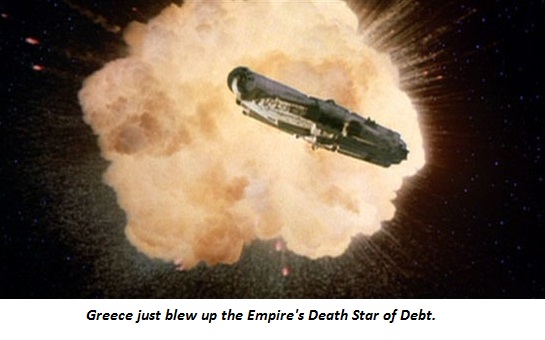
Greece Just Blew Up the Empire's Death Star of Debt

The Greek Elites and kleptocrats are terrified of the discipline that leaving the euro will impose, but the general public should welcome the transition to an economy and society that has been freed from the shackles of Imperial debt and the kleptocracy that has bled the nation dry.


Although the financial media is blathering about negotiations and gamesmanship, the truth is Greece just blew up the Empire's Death Star of debt. There's nothing left to negotiate except the official admission that the Imperial Death Star of debt, the most fearsome threat in the galaxy, has been blown to smithereens.

There are three fundamental points that need to be emphasized, mostly because they've been lost in handwringing, fearmongering and the ceaseless chatter of propaganda shills.

1. Impaired debt and defaults result from imprudent underwriting and lender incompetence/ greed. Since when did it become accepted policy to reward imprudent lending, incompetence and greed?

Classical Capitalism is very clear on what should happen to lenders who ignored risk management; they get destroyed. As imprudently issued loans default, the losses pile up and the lender become insolvent. At that point, Capitalism kicks in and the management is fired, the stock goes to zero, the lender's assets are auctioned off and the creditors are issued whatever remains after wages, taxes, accounts payable, etc. are paid.

There's nothing complicated about it: Capitalism requires the discipline of losses being taken by those responsible, the firing of incompetents and the destruction of imprudent lenders.

Yet somehow the dominant narrative has reversed this essential core of Capitalism into blaming the borrower for the losses.

Look, if someone offers to loan me a billion dollars with no collateral and no assessment of the risks that I might not be able to pay the interest or principal, then who's the fool? The idiot who wants to give me $1 billion without any risk assessment, or the borrower who takes the "free money" being offered?

Yes, no one should borrow money that they can't pay back, blah blah blah, but the primary fiduciary responsibility is on the lender to not offer loans to marginal borrowers and those at high risk of defaulting on their debts.

Yet the official line on debt is "the lenders are blameless, the borrowers are at fault and should pay." The borrowers were imprudent to take on debt they couldn't service, but it is the lenders who made the bad loans who are ultimately are at fault and who should suck all the losses.

Let's set aside the propaganda for a moment and get real: anyone with the slightest knowledge of Greek finances and the power structure of the Greek economy/society knew it was insanely risky to loan Greece billions of euros. No one can deny this, yet somehow the lenders deserve to be paid for their avarice, stupidity, incompetence and total disregard for the standards of prudent lending? No, they deserve to be destroyed--closed down and their assets auctioned off.

2. Greece will not be wiped out by leaving the euro currency--it will be freed to rebuilt itself with prudent fiscal management and policies that reward investment and penalize risky borrowing, speculation and corruption.

Here's the thing about Greece issuing its own fiat currency--it will force fiscal discipline in a way that the euro did not and could not. This is why the Greek Status Quo is quivering with fear--the gravy train of irresponsibility enabled by the euro is ending, and they are terrified of living within their means and having to face the discipline that the market will impose on the Greek fiat currency.

If there's one thing Greece needs more than anything, it's the discipline and the rewards of the market. Any nation that issues its own fiat currency has a choice: it can exercise fiscal prudence and enforce policies that reward entrepreneurism, prudent lending, savings, wise investments, fair taxation, etc., or it can try to prop up its bloated, corrupt kleptocracy by printing rivers of fiat money.

If it chooses the Dark Side and prints money in excess, it will soon drive the value of that currency to near-zero. The kleptocracy that hoped to benefit from money-printing is impoverished or forced to move their capital elsewhere.

In other words, Greece returning to being responsible for its own currency is a good thing. The new currency will be valued cheaply relative to other currencies at first, and this is also a good thing, as imports will be unaffordable for all but the wealthy (kiss BMW sales in Greece good-bye) and everything produced in Greece becomes a bargain globally.

This will attract capital seeking places where it can make a profit and is treated fairly, and it will enable Greece to rebuild its export sector and boost its substantial tourist trade.

The promise that marginal borrowers would be transformed into sterling-credit borrowers by adopting the euro was always a fantasy--and a painfully visible fantasy at that. Anyone with their eyes even partially open could see that the vast differences in productivity, credit, risk and culture between the eurozone nations made the euro unworkable from the start.

It was equally visible that the eurozone's inept policies and loose lending standards would obscure these fundamental differences until the damage would be too great to hide--which is exactly what transpired.

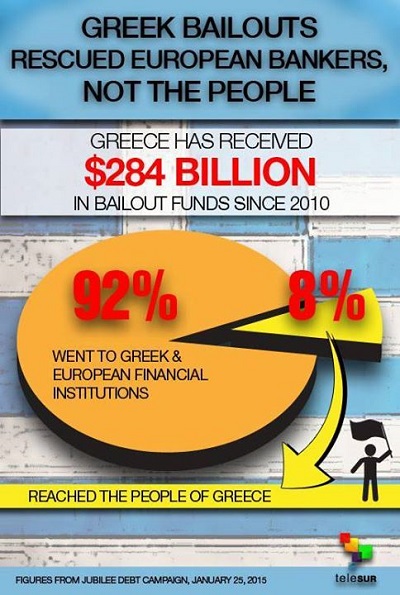
3. The hundreds of billions of euros in so-called bailouts did not help Greece--all they did was bail out imprudent lenders and Euroland Elites. Virtually none of these vast sums helped the Greek nation or its people; what little did stay in Greece flowed to the kleptocrats that continued to rule Greece.


The harsh reality of misrule and corruption was recently spelled out in Misrule of the Few: How the Oligarchs Ruined Greece:
"Greece has failed to address (rising wealth/income inequality) because the country’s elites have a vested interest in keeping things as they are. Since the early 1990s, a handful of wealthy families -- an oligarchy in all but name -- has dominated Greek politics. These elites have preserved their positions through control of the media and through old-fashioned favoritism, sharing the spoils of power with the country’s politicians. Greek legislators, in turn, have held on to power by rewarding a small number of professional associations and public-sector unions that support the status quo. Even as European lenders have put the country’s finances under a microscope, this arrangement has held."
Greece just blew up the Death Star of debt, and now the threat has been lifted from other debtor nations suffering from the yoke of Imperial misrule. The Greek Elites and kleptocrats are terrified of the discipline that leaving the euro will impose, but the general public should welcome the transition to an economy and society that has been freed from the shackles of Imperial debt and the kleptocracy that has bled the nation dry. 


Get a Job, Build a Real Career and Defy a Bewildering Economy(Kindle, $9.95)(print, $20)
go to Kindle edition
Are you like me? Ever since my first summer job decades ago, I've been chasing financial security. Not win-the-lottery, Bill Gates riches (although it would be nice!), but simply a feeling of financial control. I want my financial worries to if not disappear at least be manageable and comprehensible. And like most of you, the way I've moved toward my goal has always hinged not just on having a job but a career.

You don't have to be a financial blogger to know that "having a job" and "having a career" do not mean the same thing today as they did when I first started swinging a hammer for a paycheck.

Even the basic concept "getting a job" has changed so radically that jobs--getting and keeping them, and the perceived lack of them--is the number one financial topic among friends, family and for that matter, complete strangers.

So I sat down and wrote this book: Get a Job, Build a Real Career and Defy a Bewildering Economy.

It details everything I've verified about employment and the economy, and lays out an action plan to get you employed.

I am proud of this book. It is the culmination of both my practical work experiences and my financial analysis, and it is a useful, practical, and clarifying read.

Test drive the first section and see for yourself.     Kindle, $9.95     print, $20

"I want to thank you for creating your book Get a Job, Build a Real Career and Defy a Bewildering Economy. It is rare to find a person with a mind like yours, who can take a holistic systems view of things without being captured by specific perspectives or agendas. Your contribution to humanity is much appreciated."

Laura Y.
Gordon Long and I discuss The New Nature of Work: Jobs, Occupations & Careers(25 minutes, YouTube) 


NOTE: Contributions/subscriptions are acknowledged in the order received. Your name and email remain confidential and will not be given to any other individual, company or agency.

Thank you, Losseinc.com. ($10), for your most generous contribution to this site-- I am greatly honored by your support and readership.

Read more...

Terms of Service

All content on this blog is provided by Trewe LLC for informational purposes only. The owner of this blog makes no representations as to the accuracy or completeness of any information on this site or found by following any link on this site. The owner will not be liable for any errors or omissions in this information nor for the availability of this information. The owner will not be liable for any losses, injuries, or damages from the display or use of this information. These terms and conditions of use are subject to change at anytime and without notice.

RE: European Union AI Act, and Our Use of Generative AI Tools and Agents Policy

All text on this site is composed by Charles Hugh Smith or by a credited guest-author. No Generative AI Tools are used in the composition / writing of any text or graphic content created by Charles Hugh Smith. This site deploys no AI agents or generative AI tools. This site is not responsible for the disclosures, use or non-use of AI agents or generative AI tools in advertisements displayed by Investing Channel or other ad placement services.

Audio files generated by text-to-audio transcription tools are identified as such.

Our Privacy Policy:

Correspondents' email is strictly confidential. This site does not collect digital data from visitors or distribute cookies. Advertisements served by third-party advertising networks such as Investing Channel may use cookies or collect information from visitors for the purpose of Interest-Based Advertising; if you wish to opt out of Interest-Based Advertising, please go to Opt out of interest-based advertising (The Network Advertising Initiative) If you have other privacy concerns relating to advertisements, please contact advertisers directly.

PRIVACY NOTICE FOR EEA INDIVIDUALS

This section covers disclosures on the General Data Protection Regulation (GDPR) for users residing within EEA only. GDPR replaces the existing Directive 95/46/ec, and aims at harmonizing data protection laws in the EU that are fit for purpose in the digital age. The primary objective of the GDPR is to give citizens back control of their personal data. Please follow the link below to access InvestingChannel's General Data Protection Notice.
https://stg.media.investingchannel.com/gdpr-notice/

Notice of Compliance with The California Consumer Protection Act

This site does not collect digital data from visitors or distribute cookies. Advertisements served by a third-party advertising network (Investing Channel) may use cookies or collect information from visitors for the purpose of Interest-Based Advertising. If you do not want any personal information that may be collected by third-party advertising to be sold, please follow the instructions on this page: Do Not Sell My Personal Information.

Regarding Cookies:

This site does not collect digital data from visitors or distribute cookies. Advertisements served by third-party advertising networks such as Investing Channel may use cookies or collect information from visitors for the purpose of Interest-Based Advertising; if you wish to opt out of Interest-Based Advertising, please go to Opt out of interest-based advertising (The Network Advertising Initiative) If you have other privacy concerns relating to advertisements, please contact advertisers directly.

Our Commission Policy:

Though I earn a small commission on Amazon.com books and gift certificates and gold (BullionVault) purchased via links on my site, I receive no fees or compensation for any other non-advertising links or content posted on my site.

Copyright Notice:

All original images (Drawings and Photographs), text (essays, books and works of fiction), audio and video recordings, musical compositions, graphic design, graphic design elements and HTML coding on this site are the copyrighted work of Charles Hugh Smith unless otherwise credited or noted. They are published as information for the private use of site visitors, and any reproduction or redistribution of this content or coding in any media in any format or distribution channel (text, audio, video/film, web) without the written permission of the copyright holder is strictly prohibited. All rights in all media reserved globally.

  © Blogger templates Newspaper III by Ourblogtemplates.com 2008

Back to TOP