Sunday, April 05, 2015

Guaranteed Financial Security Is a Fantasy

Guarantees based on extracting higher taxes, borrowing trillions of dollars and creating trillions more out of thin air only guarantee eventual systemic implosion.


It is difficult for those living through tectonic social and economic shifts to recognize the passing of one era and the emergence of a new era. We are clearly in such a tectonic shift, yet it is slow enough and uneven enough that those who hope the old era will somehow endure despite the erosion of its foundations can find evidence to support their beliefs.

One such cherished belief is the faith that financial security can be guaranteed. This faith has two components:

1. The faith that risk can be identified and managed to the point it cannot disrupt the payment of promised pensions, benefits, yields, etc.

2. The faith that the system can pay what has been promised by one means or another.

If tax revenues are inadequate, taxes can always be raised. If tax revenues fail to rise, then the money needed to pay the promised pensions, benefits, etc. can be borrowed. If the money cannot be borrowed, then it can simply be created out of thin air by central banks or printed by government treasuries.

Before the advent of high finance, lowering risk could only be achieved by spreading the risk over a large populace. To lower the risk to individuals that their house would burn down in an accidental fire, insurance was sold to 1,000 homes. If one or two of the 1,000 homes burned down each year, the insurance could pay the claims and still build up reserves for future claims.

But if a conflagration burns down all 1,000 homes, the insurance is overwhelmed; the guaranteed coverage is rendered worthless.

The creation of a volunteer (or tax-supported) fire brigade will also lower the risk that an accidental fire could spread. But once again, such a brigade can only mitigate very limited fires; a second fire or a windstorm would exceed the capacity of the brigade to extinguish multiple fires.

The faith in guaranteed security is actually a faith that there will be no consequences from borrowing or printing enormous sums of money, and no possible risk to the system that cannot be anticipated and mitigated with some fancy financial footwork.

Is this faith reality-based? We know that borrowing immense sums of money does have consequences: interest must be paid out of future income, reducing the income that can be consumed or invested, and dependence on borrowed money creates moral hazard: rather than make difficult trade-offs, the borrower just borrows more money.

Creating money out of thin air is also not consequence-free. Fancy financial footwork can mask the consequences of creating money to pay promised pensions, benefits, etc., but eventually the reality that creating money does not create wealth intrudes on the fantasy that if tax revenues are insufficient, and borrowing has limits, then we can guarantee incomes, pensions, benefits, etc. by creating money out of thin air.

Those dependent on the promises made in the previous era will support any policy that "extends and pretends" the illusion that financial security can be guaranteed, regardless of seismic shifts in the natural and financial economies.

The irony of "extend and pretend" is these policies only push the system to extremes that guarantee systemic collapse. The more we avoid facing the intrinsic insecurities generated by tectonic shifts, the more we hasten the sudden implosion of old systems pushed beyond their limits.

Real security arises from the constant volatility, friction and insecurity of experimentation, adaptation and dissent. Guarantees based on extracting higher taxes, borrowing trillions of dollars and creating trillions more out of thin air only guarantee eventual systemic implosion.

Put another way: spreading the risk of a house fire amongst the 1,000 homeowners does not actually lessen the risk of a conflagration burning down the entire town. 


Get a Job, Build a Real Career and Defy a Bewildering Economy(Kindle, $9.95)(print, $20)
go to Kindle editionAre you like me? Ever since my first summer job decades ago, I've been chasing financial security. Not win-the-lottery, Bill Gates riches (although it would be nice!), but simply a feeling of financial control. I want my financial worries to if not disappear at least be manageable and comprehensible.  


And like most of you, the way I've moved toward my goal has always hinged not just on having a job but a career.

You don't have to be a financial blogger to know that "having a job" and "having a career" do not mean the same thing today as they did when I first started swinging a hammer for a paycheck.


Even the basic concept "getting a job" has changed so radically that jobs--getting and keeping them, and the perceived lack of them--is the number one financial topic among friends, family and for that matter, complete strangers.


So I sat down and wrote this book: Get a Job, Build a Real Career and Defy a Bewildering Economy.


It details everything I've verified about employment and the economy, and lays out an action plan to get you employed.


I am proud of this book. It is the culmination of both my practical work experiences and my financial analysis, and it is a useful, practical, and clarifying read.


Test drive the first section and see for yourself.     Kindle, $9.95     print, $20


"I want to thank you for creating your book Get a Job, Build a Real Career and Defy a Bewildering Economy. It is rare to find a person with a mind like yours, who can take a holistic systems view of things without being captured by specific perspectives or agendas. Your contribution to humanity is much appreciated."
Laura Y.


Gordon Long and I discuss The New Nature of Work: Jobs, Occupations & Careers(25 minutes, YouTube) 


NOTE: Contributions/subscriptions are acknowledged in the order received. Your name and email remain confidential and will not be given to any other individual, company or agency.

Thank you, Brian S. ($5/month), for your massively generous re-subscription to this site-- I am greatly honored by your steadfast support and readership.

Read more...

Who Would Jesus Shun?

Please glance at this painting and guess its era and the identity of the man.

It was painted in the early 1600s by Valentin de Boulogne, a French painter who spent most of his career in Rome and who was greatly influenced by Caravaggio's dramatic compositions and use of light.

The man is Jesus, and the painting depicts the critical moment of one of my favorite stories of the Bible, John 8:7 -- So when they continued asking him, he lifted up himself, and said unto them, "He that is without sin among you, let him first cast a stone at her."

The artist portrays Jesus as he "bent down and wrote with his finger on the ground." The scribes had brought an adulteress to Jesus as a test, or more correctly, as a trap, hoping his answer would enable them to bring some charge against him.

The artist presents Jesus as a human facing a difficult challenge; his expression is one of uncertainty and perhaps hesitation as he grasps the complex situation. I was immediately transfixed by this painting for reasons that transcend faith; one need not be a Christian or even a theist to understand how different this Jesus is from the thousands of other portrayals of Christ as a child or Savior. Here is first and foremost a human being, beset by human emotions.

The narrative and iconography of this painting were very different from the typical portrayals of Jesus, and they open up a wide range of potential responses and levels of understanding in the viewer.

Of particular interest is the artist's selection of the moment before Jesus rises and delivers his devastating takedown of the hypocritical moralists, the moment of extreme tension and precariousness. This is a very human moment we can all relate to on some level.

Imagine the scene as Jesus tells the adulteress, "Neither do I condemn you; go, and do not sin again." The mob has vanished, dispersed by the truth of Jesus' words.

The Church at various times emphasized or encouraged depictions of specific narratives and iconic moments in the Bible to shape the beliefs of those seeing the artworks, and those portrayals that strayed from the party line, so to speak, were kept private rather than displayed in chapels.

In the secular world, we must always be alert to just this sort of shaping of our belief structure by the careful reinforcement of carefully selected narratives and iconography.

Who would Jesus shun? Who would he refuse to serve? The answer is here: "He that is without sin among you, let him first cast a stone at her."

Those claiming the freedom to shun based on faith may have some religion, but it certainly isn't Christianity. 

Read more...

Thursday, April 02, 2015

The Inevitable Failure of Mechanistic Monetary Policy

Our current faith in central banks' ability to "make the economy all better, all the time" is horrendously misplaced.


We are living in the Cargo Cult Era of Central Bankers. The era began in earnest on December 5, 1996, when Federal Reserve chairman Alan Greenspan cautiously wondered aloud if the stock market was exhibiting "irrational exuberance."

The stock market promptly tanked. In this era, the utterances of central bankers exert more influence over markets than fundamentals.

This simplistic faith in the Cargo Cult magic of central banks is based on the absurd notion that two levers--interest rates and buying debt--can control and guide an immensely complex economy. Central bankers are well-versed in arcane incantations such as Operation Twist and aggregate demand, but if we strip away the mumbo-jumbo we find only two levers: interest rates and the purchase of debt.

Documentary film maker Adam Curtis explored the inherent limits of mechanistic monetary models in Episode 3 of his 6-part series, Pandora's Box (1992).

The wizards of monetary policy make the implicit assumption that monetary policy is the most important factor in an economy's expansion or contraction. But an economy is far more than interest rates, inflation and the purchase of bonds and other assets.

An economy is also the education or mis-education of the next generation of workers, the creative destruction wrought by technologies, the cultural appetite for risk and what I call the infrastructure of opportunity--the complex mix of attributes that either encourage social mobility or preclude it.

Two analogies will help us understand the absurdly simplistic myth of central bank magic. One is the forest fire analogy I discussed in The Yellowstone Analogy and The Crisis of Neoliberal Capitalism (May 18, 2009).

In essence, central banks no longer allow the "fires" of debt writedowns and credit contraction (i.e. recession) to burn away the dead wood that piles up after rapid expansion/good times/ leverage. As a result, the dead wood piles up higher and higher every season, until a chance spark (the infamous Black Swan) ignites the dry tinder and the subsequent conflagration burns down the entire forest.

The second analog is health-related.A fellow in very poor health goes to the clinic for a blood pressure test. He is overweight, dangerously unfit, smokes a pack a day and self-medicates himself with daily overdoses of alcohol. As a result of his disastrously poor health, is blood pressure is through the roof.

In our analogy, the stock market is the blood pressure reading. Markets (stocks, bonds, commodities, real estate, debt, risk, etc.) reflect the realities "discovered" by the interplay of buyers, sellers and information such as profits, debt levels, sales, etc.

Rather than address the underlying causes of the patient's poor health, the doctor (central bank) gives the guy two powerful drugs to slam down his blood pressure reading. This is the equivalent of central banks juicing markets with quantitative easing and zero-interest rates (ZIRP).

Is the guy healthier as a result of the massive injections of drugs? At least temporarily, his chances of dying are reduced by the drop in blood pressure. But over the longer term, this doctoring of one reading of health (i.e. the stock market) is not going to reverse the intensely negative consequences of poor diet, zero fitness, smoking and over-consumption of alcohol.

Our current faith in central banks' ability to "make the economy all better, all the time" is horrendously misplaced. Mechanistic monetary models are fine for manipulating a simplistic measure of economic health, but they are completely inadequate to the task of restoring fundamental health to a very sick patient teetering on the abyss.

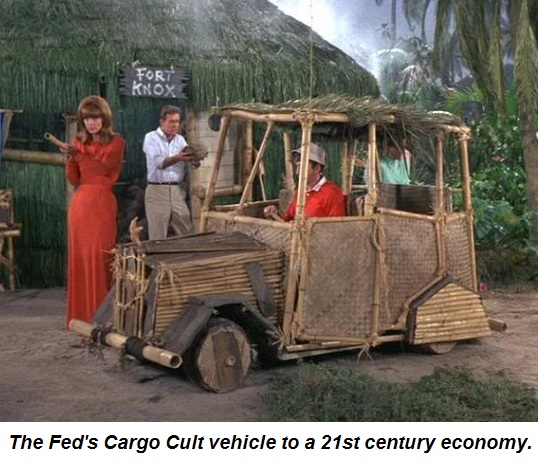
Bonus analogy: here's the Fed's Cargo Cult vehicle to a 21st century economy:


Get a Job, Build a Real Career and Defy a Bewildering Economy(Kindle, $9.95)(print, $20)
go to Kindle edition
Are you like me? Ever since my first summer job decades ago, I've been chasing financial security. Not win-the-lottery, Bill Gates riches (although it would be nice!), but simply a feeling of financial control. I want my financial worries to if not disappear at least be manageable and comprehensible.

And like most of you, the way I've moved toward my goal has always hinged not just on having a job but a career.

You don't have to be a financial blogger to know that "having a job" and "having a career" do not mean the same thing today as they did when I first started swinging a hammer for a paycheck.

Even the basic concept "getting a job" has changed so radically that jobs--getting and keeping them, and the perceived lack of them--is the number one financial topic among friends, family and for that matter, complete strangers.

So I sat down and wrote this book: Get a Job, Build a Real Career and Defy a Bewildering Economy.

It details everything I've verified about employment and the economy, and lays out an action plan to get you employed.

I am proud of this book. It is the culmination of both my practical work experiences and my financial analysis, and it is a useful, practical, and clarifying read.

Test drive the first section and see for yourself.     Kindle, $9.95     print, $20

"I want to thank you for creating your book Get a Job, Build a Real Career and Defy a Bewildering Economy. It is rare to find a person with a mind like yours, who can take a holistic systems view of things without being captured by specific perspectives or agendas. Your contribution to humanity is much appreciated."
Laura Y.

Gordon Long and I discuss The New Nature of Work: Jobs, Occupations & Careers(25 minutes, YouTube) 


NOTE: Contributions/subscriptions are acknowledged in the order received. Your name and email remain confidential and will not be given to any other individual, company or agency.

Thank you, Michael K. ($5/month), for your splendidly generous subscription to this site-- I am greatly honored by your support and readership.

Read more...

The U.S. Economy Slows to Stall Speed

This long-term weakening of the economy is the direct result of financialization and the Federal Reserve's policy of propping up impaired debt with more debt and constantly bringing demand forward with zero interest rates.

The U.S. economy is slowing to stall speed--the point when gravity overcomes the lift provided by central bank free money. This deceleration is evident in a number of indicators such as gross domestic product (GDP), which is now at 0% according to the Federal Reserve Bank of Atlanta's GDPNow model.

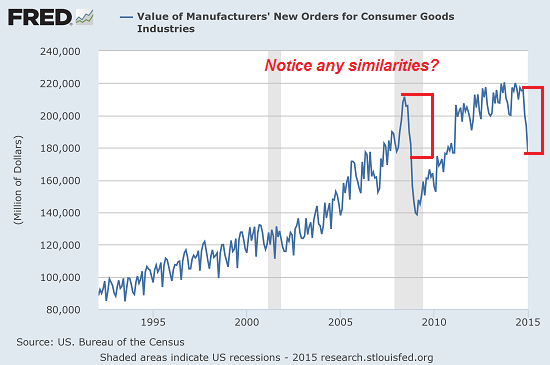
New orders for consumer goods has fallen off a cliff, eerily repeating the freefall of the Great Recession in 2008:


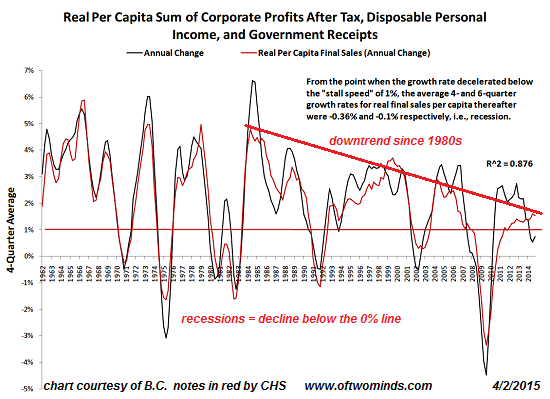
Longtime correspondent B.C. shared two more insightful charts of the economy's deceleration to stall speed. Rather than depict one or two indicators, B.C.'s charts are relational, meaning that data is added together or displayed as ratios.

The first chart shows per capita corporate profits + disposable personal income + government receipts and real final sales. As B.C. notes on the chart: "From the point when the growth rate decelerated below the 'stall speed' of 1% , the average 4- and 6-quarter growth rates for real final sales per capita thereafter were -0.36% and -0.1% respectively, i.e. recession."

I added two notes to the chart: growth rates in both series have been deteriorating since the early 1980s, when financialization began substituting leverage and debt for real growth in the real economy.

Every dip below the zero line aligns with a recession. Once the lines dip below the 1% stall speed line, a negative growth rate follows.


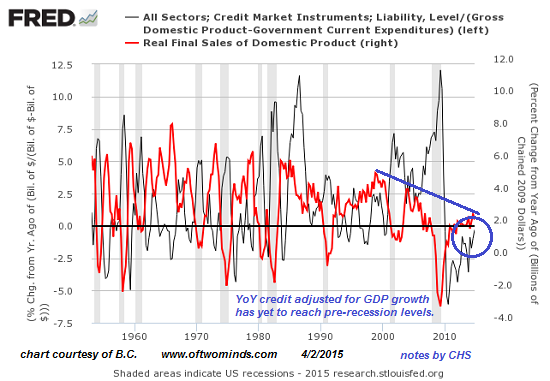
The second chart displays the credit market in a ratio with GDP (minus government expenditures, leaving only the private-sector economy) and real final sales ("real" meaning adjusted for inflation).

Adjusted for GDP growth, the credit market growth has yet to reach pre-Great Recession levels. This reflects debt saturation--adding debt no longer generates much expansion in the economy.

The growth rate of real final sales have been declining since the early 1980s, with each peak and each trough being lower than the previous peaks and troughs. The growth rate in the current recovery has barely edged over the stall speed of 0% and is now rolling over.


B.C. added this commentary on the two charts: The primary inference is that the real, after-tax income component of real GDP decelerated to "stall speed" and then a recessionary rate in Q3-Q4 '14.

With the increase in the US$, net exports will be a drag, even with the collapse in oil imports as a result of the shale oil boom/bubble. That leaves . . . an expansion of the fiscal deficit, all else equal, to prevent recession, or a contraction of nominal GDP with the marked deceleration of CPI and the GDP deflator.

Because we don't have net savings, the Fed will have to resume printing bank reserves for Too Big to Exist (TBTE) banks to resume buying federal bond issuances ("monetization") at some point later this year.

This long-term weakening of the economy is the direct result of financialization and the Federal Reserve's policy of propping up impaired debt with more debt and constantly bringing demand forward with zero interest rates. 


Get a Job, Build a Real Career and Defy a Bewildering Economy(Kindle, $9.95)(print, $20)
go to Kindle edition
Are you like me? Ever since my first summer job decades ago, I've been chasing financial security. Not win-the-lottery, Bill Gates riches (although it would be nice!), but simply a feeling of financial control. I want my financial worries to if not disappear at least be manageable and comprehensible.

And like most of you, the way I've moved toward my goal has always hinged not just on having a job but a career.

You don't have to be a financial blogger to know that "having a job" and "having a career" do not mean the same thing today as they did when I first started swinging a hammer for a paycheck.

Even the basic concept "getting a job" has changed so radically that jobs--getting and keeping them, and the perceived lack of them--is the number one financial topic among friends, family and for that matter, complete strangers.

So I sat down and wrote this book: Get a Job, Build a Real Career and Defy a Bewildering Economy.

It details everything I've verified about employment and the economy, and lays out an action plan to get you employed.

I am proud of this book. It is the culmination of both my practical work experiences and my financial analysis, and it is a useful, practical, and clarifying read.

Test drive the first section and see for yourself.     Kindle, $9.95     print, $20

"I want to thank you for creating your book Get a Job, Build a Real Career and Defy a Bewildering Economy. It is rare to find a person with a mind like yours, who can take a holistic systems view of things without being captured by specific perspectives or agendas. Your contribution to humanity is much appreciated."
Laura Y.

Gordon Long and I discuss The New Nature of Work: Jobs, Occupations & Careers(25 minutes, YouTube) 


NOTE: Contributions/subscriptions are acknowledged in the order received. Your name and email remain confidential and will not be given to any other individual, company or agency.


 Thank you, Melissa C. ($5/month), for your fabulously generous subscription to this site-- I am greatly honored by your support and readership.

Read more...

Wednesday, April 01, 2015

A Shocking Admission: "The Federal Reserve is a Criminal Conspiracy"

A spokesperson assured the assembled media that the Fed Board was "deeply concerned" about the American people, inflation, and the unemployment rate, but he was heckled off the stage.


In an extraordinary admission, the Board of Governors of the Federal Reserve conceded that the Federal Reserve is "at heart a criminal conspiracy of bankers."The Board followed up this revelation with a breezy confession that the Fed "doesn't really give a rat's rear-end about the American people, and we're tired of having to claim we do."

The Fed's role was global, the Board explained; the American people played no part whatsoever in Fed policy or decisions. "Honestly, why would anyone think we waste a moment's thought on the American people?" one commented. "We're here to maintain the power and wealth of the banking sector on a global scale. We have zero interest in John Q. Citizen's travails or his income. Our only interest in Mr. Citizen is that he continue to keep his mouth shut and not make waves."

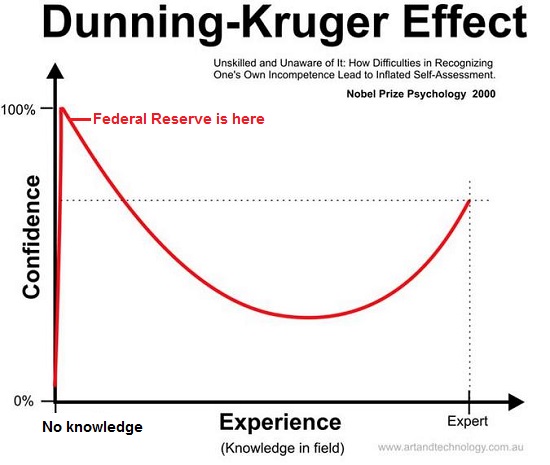
The unprecedented display of bare-knuckled honesty was in evidence throughout the meeting. Asked if the Fed was confident that its policies were appropriate for the nation, one board member snapped, "We don't really think about the nation, but yes, we are 99% confident that our policies are appropriate and correct. In fact, let's dispense with the false modesty: we're 100% confident we are correct."

When a reporter asked if the Board was familiar with the Dunning–Kruger effect, a Board member snapped, "We don't concern ourselves with rare neurological diseases, or whatever that is. We govern the markets and the global economy."


The Dunning–Kruger effect is a cognitive bias wherein unskilled individuals suffer from illusory superiority, mistakenly assessing their ability to be much higher than is accurate.

"If you’re incompetent, you can’t know you’re incompetent. […] the skills you need to produce a right answer are exactly the skills you need to recognize what a right answer is." David Dunning

Rumors quickly spread that the Fed's water supply had been spiked with Ibogaine, which could explain the extraordinary public outburst of truthfulness. As handlers moved in to escort the Board members to their private chambers, some of the Board responded testily. One was heard to mutter, "Keep your grubby little paws off me, peon!"

A spokesperson assured the assembled media that the Fed Board was "deeply concerned" about the American people, inflation, and the unemployment rate, but he was heckled off the stage.

This is our annual April Fool's Day entry. 


Get a Job, Build a Real Career and Defy a Bewildering Economy(Kindle, $9.95)(print, $20)
go to Kindle edition
Are you like me? Ever since my first summer job decades ago, I've been chasing financial security. Not win-the-lottery, Bill Gates riches (although it would be nice!), but simply a feeling of financial control. I want my financial worries to if not disappear at least be manageable and comprehensible.  

And like most of you, the way I've moved toward my goal has always hinged not just on having a job but a career.

You don't have to be a financial blogger to know that "having a job" and "having a career" do not mean the same thing today as they did when I first started swinging a hammer for a paycheck.

Even the basic concept "getting a job" has changed so radically that jobs--getting and keeping them, and the perceived lack of them--is the number one financial topic among friends, family and for that matter, complete strangers.

So I sat down and wrote this book: Get a Job, Build a Real Career and Defy a Bewildering Economy.

It details everything I've verified about employment and the economy, and lays out an action plan to get you employed.

I am proud of this book. It is the culmination of both my practical work experiences and my financial analysis, and it is a useful, practical, and clarifying read.

Test drive the first section and see for yourself.     Kindle, $9.95     print, $20

"I want to thank you for creating your book Get a Job, Build a Real Career and Defy a Bewildering Economy. It is rare to find a person with a mind like yours, who can take a holistic systems view of things without being captured by specific perspectives or agendas. Your contribution to humanity is much appreciated."
Laura Y.

Gordon Long and I discuss The New Nature of Work: Jobs, Occupations & Careers(25 minutes, YouTube) 


NOTE: Contributions/subscriptions are acknowledged in the order received. Your name and email remain confidential and will not be given to any other individual, company or agency.


 Thank you, Scott B. ($5/month), for your wondrously generous subscription to this site-- I am greatly honored by your support and readership.

Read more...

Terms of Service

All content on this blog is provided by Trewe LLC for informational purposes only. The owner of this blog makes no representations as to the accuracy or completeness of any information on this site or found by following any link on this site. The owner will not be liable for any errors or omissions in this information nor for the availability of this information. The owner will not be liable for any losses, injuries, or damages from the display or use of this information. These terms and conditions of use are subject to change at anytime and without notice.

RE: European Union AI Act, and Our Use of Generative AI Tools and Agents Policy

All text on this site is composed by Charles Hugh Smith or by a credited guest-author. No Generative AI Tools are used in the composition / writing of any text or graphic content created by Charles Hugh Smith. This site deploys no AI agents or generative AI tools. This site is not responsible for the disclosures, use or non-use of AI agents or generative AI tools in advertisements displayed by Investing Channel or other ad placement services.

Audio files generated by text-to-audio transcription tools are identified as such.

Our Privacy Policy:

Correspondents' email is strictly confidential. This site does not collect digital data from visitors or distribute cookies. Advertisements served by third-party advertising networks such as Investing Channel may use cookies or collect information from visitors for the purpose of Interest-Based Advertising; if you wish to opt out of Interest-Based Advertising, please go to Opt out of interest-based advertising (The Network Advertising Initiative) If you have other privacy concerns relating to advertisements, please contact advertisers directly.

PRIVACY NOTICE FOR EEA INDIVIDUALS

This section covers disclosures on the General Data Protection Regulation (GDPR) for users residing within EEA only. GDPR replaces the existing Directive 95/46/ec, and aims at harmonizing data protection laws in the EU that are fit for purpose in the digital age. The primary objective of the GDPR is to give citizens back control of their personal data. Please follow the link below to access InvestingChannel's General Data Protection Notice.
https://stg.media.investingchannel.com/gdpr-notice/

Notice of Compliance with The California Consumer Protection Act

This site does not collect digital data from visitors or distribute cookies. Advertisements served by a third-party advertising network (Investing Channel) may use cookies or collect information from visitors for the purpose of Interest-Based Advertising. If you do not want any personal information that may be collected by third-party advertising to be sold, please follow the instructions on this page: Do Not Sell My Personal Information.

Regarding Cookies:

This site does not collect digital data from visitors or distribute cookies. Advertisements served by third-party advertising networks such as Investing Channel may use cookies or collect information from visitors for the purpose of Interest-Based Advertising; if you wish to opt out of Interest-Based Advertising, please go to Opt out of interest-based advertising (The Network Advertising Initiative) If you have other privacy concerns relating to advertisements, please contact advertisers directly.

Our Commission Policy:

Though I earn a small commission on Amazon.com books and gift certificates and gold (BullionVault) purchased via links on my site, I receive no fees or compensation for any other non-advertising links or content posted on my site.

Copyright Notice:

All original images (Drawings and Photographs), text (essays, books and works of fiction), audio and video recordings, musical compositions, graphic design, graphic design elements and HTML coding on this site are the copyrighted work of Charles Hugh Smith unless otherwise credited or noted. They are published as information for the private use of site visitors, and any reproduction or redistribution of this content or coding in any media in any format or distribution channel (text, audio, video/film, web) without the written permission of the copyright holder is strictly prohibited. All rights in all media reserved globally.

  © Blogger templates Newspaper III by Ourblogtemplates.com 2008

Back to TOP