Wednesday, May 06, 2015

Bank Reserves and Loans: The Fed is Pushing On a String

The money multiplier effect no longer works.


As you (hopefully) know, we live in a fractional reserve banking system: if the bank is required to have $1 in cash reserves for every $10 in loans, it means the bank creates $10 of new money when it issues a $10 loan. When the $10 loan is paid off, that money vanishes from the system.

The problem with fractional reserve lending is the leverage. A 10-to-1 reserve ratio means that if the bank issues a $10 loan, the borrower defaults and the borrower's collateral (home, auto, etc.) only fetches $8 on the open market, the bank lost $2, which is more than the bank's cash reserves ($1).

At that point, the bank is insolvent, i,e, its losses exceed its assets.

In credit bubbles, the reserve requirements may reach absurd levels of leverage. At a reserve ratio of 100-to-1, a $2 loss of value in a $100 loan will push the bank into insolvency, as it only held $1 in cash as reserves against the $100 loan.

Reserve requirements and leverage are one set of constraints on new loans; the other constraint is the income, creditworthiness and willingness of the borrower.If households and businesses decide not to borrow more, regardless of the interest rate, then raising or lowering the reserve requirements will have no effect.

This is where the Federal Reserve finds itself today. The Fed is anxious to spark more lending/borrowing, and it has lowered interest rates to near-zero and made it easy for banks to build reserves--two things that in previous eras would have sparked increased borrowing.

But in our debt-saturated, stagnant-income era, the Fed is pushing on a string. Frequent contributor Dave P. explains why with the aid of two of his charts:

Banks can create new money, but only within the limits of the reserve requirements set by the Fed.

This raises the question: what are those reserve requirements? What’s the leverage ratio?

So naturally, I made a chart. This first chart is the total bank credit loan book divided by the reserves required by the Fed for those loans.

(Note: the actual reserves today are quite a bit different - what with the excess reserves and all that.)

The interesting part of this chart is in two places: one in 1960, where the ratio was 10:1, and the other in 2008, where the ratio was 219:1.
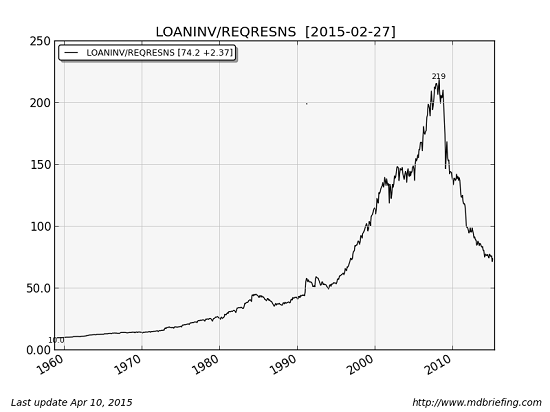
The 10:1 ratio is probably where the “money multiplier effect” textbooks were written. Back then it was true.

By 2008, reserve requirements basically didn’t matter. “Go ahead, make whatever loans you’d like, we’ll just drop the reserve requirements in order to facilitate your loan book.”

Note: the leverage today isn’t as bad as it looks. The next chart, LOANINV/RESBALNS, loans vs actual reserves, is shocking in its own way. The excess reserves at the Fed have the current effective ratio at... are you ready? 3.8:1. There are $3.81 dollars in loans for every $1 in reserves currently. The Fed is pushing on a string. The truth embodied in the next chart: nobody wants to borrow, so the reserves pile up way, way in excess of requirements.
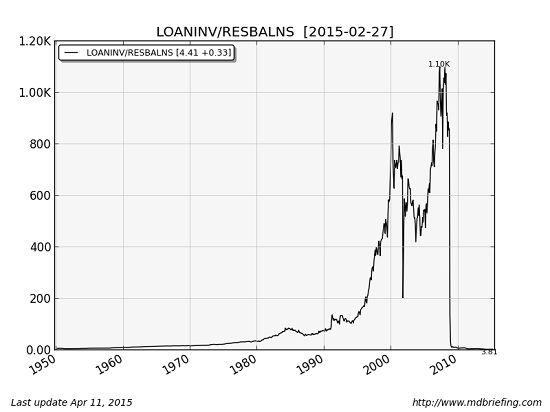
The first chart: “how we got here.”

The next chart: “the Fed’s attempted fix:” Just expand reserves. That should fix everything. Unless of course borrowers are tapped out. Expanding reserves has worked since 1960. It doesn’t work any more.

RE: the chart of LOANINV/RESBALNS: Yes, the 1100 number at the top means a ratio of 1100:1, loans-to-reserves, which was 5x above requirements at the peak. Hard to believe. “What were they thinking?"

Thank you, Dave, for the charts and explanation. At a reserve ratio of 219:1 at the peak of the 2008 bubble, the tiniest loss rendered lenders insolvent. No wonder the losses unleashed by the subprime mortgage fiasco crashed like a tsunami through the global financial system.

But lowering reserve requirements is no longer generating more borrowing, for two basic reasons: those who might want to borrow are no longer creditworthy due to excessive debt and/or stagnant income, or those who qualify to borrow more are not interested in borrowing more at any interest rate: they are done with debt.

As others have noted, the Fed can push interest rates down and make it easy for banks to loan more money, but it can't (yet) force us to borrow money we don't want or need. 


Get a Job, Build a Real Career and Defy a Bewildering Economy(Kindle, $9.95)(print, $20)
go to Kindle edition
Are you like me? Ever since my first summer job decades ago, I've been chasing financial security. Not win-the-lottery, Bill Gates riches (although it would be nice!), but simply a feeling of financial control. I want my financial worries to if not disappear at least be manageable and comprehensible.

And like most of you, the way I've moved toward my goal has always hinged not just on having a job but a career.

You don't have to be a financial blogger to know that "having a job" and "having a career" do not mean the same thing today as they did when I first started swinging a hammer for a paycheck.

Even the basic concept "getting a job" has changed so radically that jobs--getting and keeping them, and the perceived lack of them--is the number one financial topic among friends, family and for that matter, complete strangers.

So I sat down and wrote this book: Get a Job, Build a Real Career and Defy a Bewildering Economy.

It details everything I've verified about employment and the economy, and lays out an action plan to get you employed.

I am proud of this book. It is the culmination of both my practical work experiences and my financial analysis, and it is a useful, practical, and clarifying read.

Test drive the first section and see for yourself.     Kindle, $9.95     print, $20

"I want to thank you for creating your book Get a Job, Build a Real Career and Defy a Bewildering Economy. It is rare to find a person with a mind like yours, who can take a holistic systems view of things without being captured by specific perspectives or agendas. Your contribution to humanity is much appreciated."
Laura Y.

Gordon Long and I discuss The New Nature of Work: Jobs, Occupations & Careers(25 minutes, YouTube)
The Old Models of Work Are Broken 


NOTE: Contributions/subscriptions are acknowledged in the order received. Your name and email remain confidential and will not be given to any other individual, company or agency.

Thank you, Robert B. ($75), for your stupendously generous contribution to this site-- I am greatly honored by your steadfast support and readership.

Read more...

Tuesday, May 05, 2015

No Wrongdoing Here, Just 6,300 Corporate Fines and Settlements

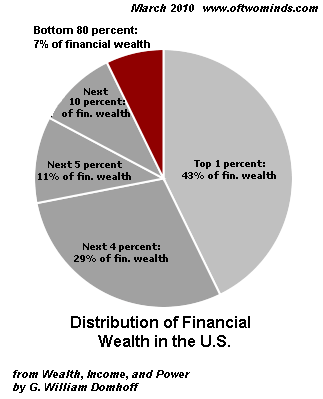
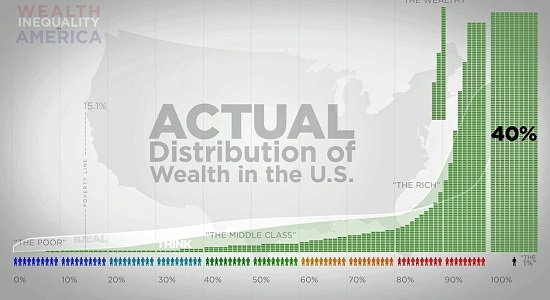
Despite the PR about how corporate profits benefit widows and orphans, this vast wealth is concentrated in the top 1% and the top 5%.


I am honored to share a remarkable data base of Corporate Fines and Settlements from the early 1990s to the present compiled by Jon Morse. Here is Jon's description of his project to assemble a comprehensive list of all corporate fines and settlements that can be verified by media reports:

"This spreadsheet is all the corporate fines/settlements I’ve been able to find sourced articles about, mostly in the period from the 1990’s up to today (with a few 80’s and 70’s). This is by far the most comprehensive list of such things online. At least that I could find, because the lack of any decent list is what made me start compiling this list in the first place."

What struck me was the sheer number of corporate violations of laws and regulations--thousands upon thousands, the vast majority of which occurred since corporate profits began their incredible ascent in the early 2000s--and the list of those paying hundreds of millions of dollars in fines and settlements, which reads like a who's who of Corporate America and Top 100 Global Corporations.

I encourage you to open one of the three alphabetical tabs at the bottom of the spreadsheet on Google Docs and scroll down to find your favorite super-profitable corporation.

Many have a long list of fines and settlements, and many of the fines are in excess of $100 million. Many are for blatant cartel price-fixing, not disclosing the dangers of the company's heavily promoted medications, destroying documents to thwart an investigation of wrong-doing, etc.

In other words, these were not wrist-slaps for minor oversights of complex regulations-- these are blatant violations of core laws of the land.


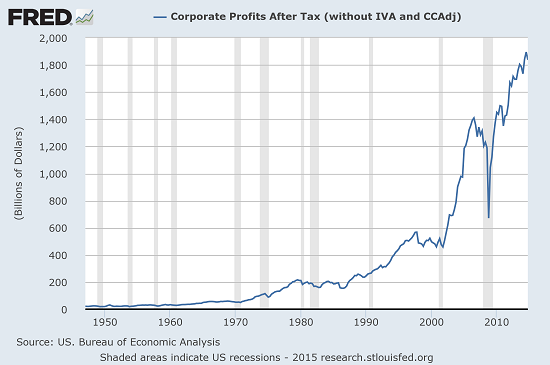
As you can see in the chart of corporate profits, enormous wealth has been concentrated in the hands of corporate managers and owners since 2002. This alignment with the start of the Federal Reserve's easy-credit policies is not coincidental.

Despite the PR about how corporate profits benefit widows and orphans, this vast wealth is concentrated in the top 1% and the top 5%:

I asked Jon for his views on the meaning of this mind-boggling list of corporate malfeasance, price-fixing and other wrongdoing in terms of the concentration of wealth: here is his response.

As for the connection to the concentration of wealth: I see two ways in which they are related, the first one is pretty direct and that is the increasing size of the settlements. You will notice that as the settlement date gets later the average size gets much larger. Corporate profits after tax (without IVA and CCAdj) from 1st quarter to 1947 to 4th quarter 2014 went from $21,900,000,000 to $1,837,500,000,000 which is a 8290% increase, even from 1st quarter 1980 to 4th quarter 2014 went from $211,600,000,000 to $1,837,500,000,000 which is a 768% increase.

The second link is less direct. With the increases in concentration of wealth there has been a culture of idolizing wealth, one example is how prosecutors no longer find it appropriate to put banker’s and CEOs in jail. I think one side-effect of the culture changing has been an increased willingness to break the law to increase profits.

The settlements with the banks along with the ongoing investigations have shown that virtually every market is being manipulated; the stocks, metals markets, LIBOR, FOREX, everything. The companies would only break so many laws if they felt they would have a reasonable chance of getting away with it; they would also need a reason to do it, which is provided by the infinite growth model our economy is based on.

Thank you, Jon, for compiling a tremendously important and valuable database of corporate fines and settlements, and for connecting this staggering list of violations to the cultural worship of maximizing private gains at any cost. I am reminded of socio-economist Immanuel Wallerstein's description of the current world-system of central-state/private-corporation collusion as “a particular historical configuration of markets and state structures where private economic gain by almost any means is the paramount goal and measure of success.”

Wallerstein and four colleagues explored the future of this wealth-concentration/maximizing private gain model in Does Capitalism Have a Future? (Oxford University Press, 2013).

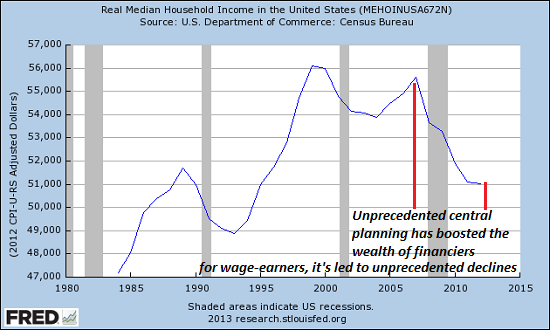
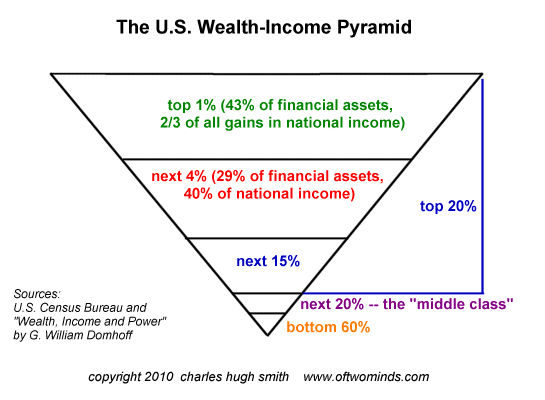
Please consider these charts:


Of related interest:


IN my last year on Wall Street my bonus was $3.6 million — and I was angry because it wasn’t big enough. I was 30 years old, had no children to raise, no debts to pay, no philanthropic goal in mind. I wanted more money for exactly the same reason an alcoholic needs another drink: I was addicted. 


Get a Job, Build a Real Career and Defy a Bewildering Economy(Kindle, $9.95)(print, $20)
go to Kindle edition
Are you like me? Ever since my first summer job decades ago, I've been chasing financial security. Not win-the-lottery, Bill Gates riches (although it would be nice!), but simply a feeling of financial control. I want my financial worries to if not disappear at least be manageable and comprehensible.

And like most of you, the way I've moved toward my goal has always hinged not just on having a job but a career.

You don't have to be a financial blogger to know that "having a job" and "having a career" do not mean the same thing today as they did when I first started swinging a hammer for a paycheck.

Even the basic concept "getting a job" has changed so radically that jobs--getting and keeping them, and the perceived lack of them--is the number one financial topic among friends, family and for that matter, complete strangers.

So I sat down and wrote this book: Get a Job, Build a Real Career and Defy a Bewildering Economy.

It details everything I've verified about employment and the economy, and lays out an action plan to get you employed.
I am proud of this book. It is the culmination of both my practical work experiences and my financial analysis, and it is a useful, practical, and clarifying read.

Test drive the first section and see for yourself.     Kindle, $9.95     print, $20

"I want to thank you for creating your book Get a Job, Build a Real Career and Defy a Bewildering Economy. It is rare to find a person with a mind like yours, who can take a holistic systems view of things without being captured by specific perspectives or agendas. Your contribution to humanity is much appreciated."
Laura Y.

Gordon Long and I discuss The New Nature of Work: Jobs, Occupations & Careers(25 minutes, YouTube)
The Old Models of Work Are Broken 


NOTE: Contributions/subscriptions are acknowledged in the order received. Your name and email remain confidential and will not be given to any other individual, company or agency.

Thank you, Karl L. ($75), for your wondrously generous contribution to this site-- I am greatly honored by your steadfast support and readership.

Read more...

Monday, May 04, 2015

Collaboration, Adaptation and Risk: Innovate or Die

Collaboration, innovation and risk are all intrinsic to adaptation. Without adaptation, every system eventually perishes once conditions change.


One feature of capitalism that is rarely discussed is the premium placed on cooperation and collaboration. The Darwinian aspect of competition is widely accepted (and rued) as capitalism’s dominant force, but cooperation and collaboration are just as intrinsic to capitalism as competition. Subcontractors must cooperate to assemble a product, suppliers must cooperate to deliver the various components, distributors must cooperate to get the products to retail outlets, employees and managers must cooperate to reach the goals of the organization, and local governments and communities must cooperate with enterprises to maintain the local economy.

Darwin’s understanding of natural selection is often misapplied. In its basic form, natural selection simply means that the world is constantly changing, and organisms must adapt or they will expire. The same is true of individuals, enterprises, governments, cultures and economies. Darwin wrote:"It is not the strongest of the species that survives, or the most intelligent, but the ones most adaptable to change."

Ideas, techniques and processes which are better and more productive than previous versions will spread quickly; those who refuse to adapt them will be overtaken by those who do. These new ideas, techniques and processes trigger changes in society and the economy that are often difficult to predict.

This creates a dilemma: we want more prosperity and wider opportunities for self-cultivation (personal fulfillment), yet we don’t want our security and culture to be disrupted. But we cannot have it both ways. Those who attempt to preserve their power over the social order while reaping the gains of free markets find their power dissolving before their eyes as unintended consequences of technological and social innovations disrupt their mechanisms of control.

Yet rejecting free markets also fails to preserve the power structure, for a citizenry denied the opportunity to prosper chafes under a Status Quo that enriches Elites and relegates the masses to stagnation and poverty.

The great irony of free-market capitalism is that the only way to establish an enduring security is to embrace innovation and adaptation, the very processes that generate short-term insecurity. Attempting to guarantee security leads to risk being distributed to others, or concentrated within the system itself. When the accumulated risk manifests, the system collapses.

The core dynamic of free markets is the causal links between the free movement of labor and capital, transparent markets, innovation, risk and adaptation. Every attempt to eliminate risk, hinder the flow of capital, rig markets and limit disruptive adaptation leads to stagnation and eventual collapse as the inefficient, wasteful and corrupt elements of the economy absorb all the oxygen, starving the system of investment, innovation and initiative.

We can follow Darwin’s observation that "It is not the strongest of the species that survives, or the most intelligent, but the ones most adaptable to change,” with a corollary: Eliminating risk eliminates the possibility of successful adaptation.

We can go even further and suggest adaptive advantages are correlated to innovation and risk: the lower the risk, the lower the odds of innovation and the lower the advantages gained.

Adaptation--what we call innovation--is thus a dynamic series of trade-offs between many low-risk experiments that yield marginal losses and gains and occasional high-risk experiments that raise the stakes but which may yield game-changing innovations.

There are lessons here for jobseekers and entrepreneurs alike: playing it safe limits potential losses but it also limits potential gains. Collaboration, innovation and risk are all intrinsic to adaptation. Without adaptation, every system eventually perishes once conditions change.

This is heart of the phrase innovate or die.

Gordon T. Long and I discuss innovation and collaboration in this 32-minute video Learning To Innovate:


Of related interest:


Get a Job, Build a Real Career and Defy a Bewildering Economy(Kindle, $9.95)(print, $20)
go to Kindle edition
Are you like me? Ever since my first summer job decades ago, I've been chasing financial security. Not win-the-lottery, Bill Gates riches (although it would be nice!), but simply a feeling of financial control. I want my financial worries to if not disappear at least be manageable and comprehensible.  


And like most of you, the way I've moved toward my goal has always hinged not just on having a job but a career.

You don't have to be a financial blogger to know that "having a job" and "having a career" do not mean the same thing today as they did when I first started swinging a hammer for a paycheck.


Even the basic concept "getting a job" has changed so radically that jobs--getting and keeping them, and the perceived lack of them--is the number one financial topic among friends, family and for that matter, complete strangers.


So I sat down and wrote this book: Get a Job, Build a Real Career and Defy a Bewildering Economy.


It details everything I've verified about employment and the economy, and lays out an action plan to get you employed.


I am proud of this book. It is the culmination of both my practical work experiences and my financial analysis, and it is a useful, practical, and clarifying read.


Test drive the first section and see for yourself.     Kindle, $9.95     print, $20


"I want to thank you for creating your book Get a Job, Build a Real Career and Defy a Bewildering Economy. It is rare to find a person with a mind like yours, who can take a holistic systems view of things without being captured by specific perspectives or agendas. Your contribution to humanity is much appreciated."
Laura Y.


Gordon Long and I discuss The New Nature of Work: Jobs, Occupations & Careers(25 minutes, YouTube)


The Old Models of Work Are Broken 


NOTE: Contributions/subscriptions are acknowledged in the order received. Your name and email remain confidential and will not be given to any other individual, company or agency.

Thank you, Thomas B. ($250), for your beyond-outrageously generous contribution to this site-- I am greatly honored by your steadfast support and readership.

Read more...

Endangered Species: The Self-Employed Middle Class

Including the professional class, perhaps 3% of the workforce is truly independent.


Being self-employed (i.e. owning your own small business that does not require employees) is an integral part of the American Dream. Many start out dreaming of a corner office in Corporate America, but as they move up the ladder, many become disillusioned by the process and the goal: do I really want to spend my life making big-shots even wealthier?

Bureaucracies (government and corporate) are safe sources of employment, but at a cost: they're often soul-deadening.

Many dream of making a living doing something they actually care about, and that often means striking out on your own, i.e. self-employment.

This raises an interesting question: how many self-employed people in the U.S. actually earn a middle class income? Since all the government statistics have a line at $50,000, and $50,000 might support a minimal middle class lifestyle in areas with a low cost of living, let's use $50,000 in annual income as our minimum.

As you might expect, government agencies count jobs and self-employment in different ways, which makes sorting out the numbers difficult. The Bureau of Labor Statistics (BLS), for example, counts two types of self-employed, the unincorporated and the incorporated. The unincorporated may have employees, but typically do not, i.e. they are sole proprietors. The incorporated have employees, starting with the owner, as the BLS counts the incorporated self-employed as employees of their own corporation.

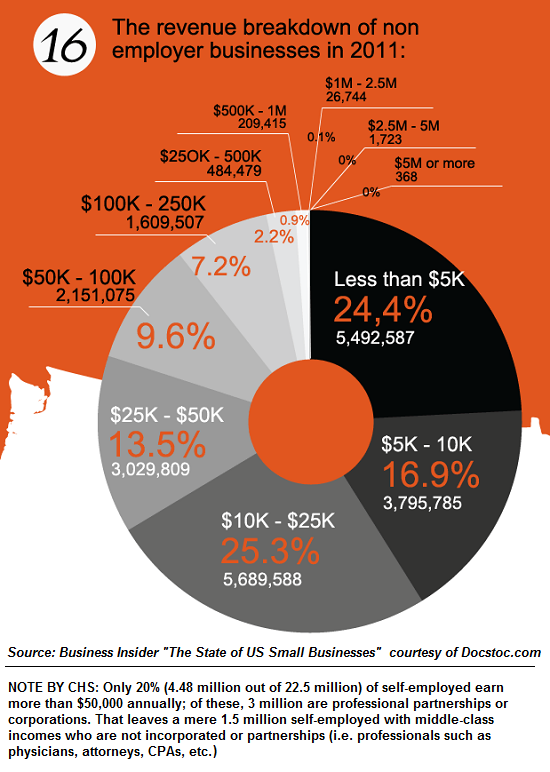
The analysts at Docstoc.com assembled a chart that counts only those sole proprietors, partnerships and corporations with no employees, i.e. the self-employed:The State of US Small Businesses.

They came up with a total number of all self-employed that earned at least $1,000 annually of 22.5 million, of which 3 million were partnerships or corporations. These are overwhelmingly professionals such as attorneys, accountants, physicians, consultants, entertainers, etc.

If we subtract the partnerships and corporations, there are 19.4 million sole proprietors.

For context: there are about 141 million people in the U.S. with some sort of employment according to the BLS: total nonfarm employment.

But this number includes tens of millions of part-time jobs and self-employed earning very little money. According to the BLS, there are about 121 million full-time jobs and 27.3 million part-time jobs.

But how many of these jobs are marginal, i.e. earn less than $10,000 a year? For that, we turn to the IRS data from tax returns (The Social Security Administration also compiles income statistics.)

I prefer the statistics compiled by tax returns, as these numbers are verifiable and precise. There is no seasonal adjustment of tax returns; there is an exact known number of tax returns with taxable income, i.e. net income after credits and deductions.

The IRS site Individual Statistical Tables by Size of Adjusted Gross Income offers a wealth of information that can be downloaded into Excel spreadsheets.

I am referring here to Table 1.1, All Returns: Selected Income and Tax Items for tax year 2012, (the most recent data available) and Table 1.4, All Returns: Adjusted Gross Income, Exemptions, Deductions, and Tax Items for tax year 2012.

If we examine Table 1.1, we find there were about 145 million returns filed, and 93 million had taxable income after credits and deductions. Roughly 46 million earned less than $20,000: 22 million workers earned less than $10,000, 35 million earned less than $15,000, and 46.5 million earned less than $20,000.

While 19.4 million sole proprietors is a big number, it turns out most are side businesses that earn relatively little income. 5.5 million earn less than $5,000 annually, 3.8 million net between $5,000 and $10,000, 5.7 million earn between $10,000 and $25,000, and another 3 million net between $25,000 and $50,000.

Only 4.48 million self-employed earn $50,000 or more, and 3 million of those are partnerships or corporations, i.e. professionals such as CPAs, attorneys, etc. That leaves leaves about 1.5 million people who aren't in the professional class (those with advanced degrees and professional licenses and credentials) who earn a middle class living as sole proprietors.

This is roughly 1% of the workforce of 145 million. It turns out the non-professional self-employed that make enough to maintain a minimally middle class lifestyle are a razor-thin slice of the workforce.


Table 1.4, All Returns: Adjusted Gross Income, Exemptions, Deductions, and Tax Items is a treasure trove of telling statistics. Information junkies will be in hog-heaven as soon as they open the spreadsheet, because these numbers cut through the fog of employment and income.

As many of you know from previous entries on jobs, work, etc., I am self-employed and have no employees. I am one of the 1% who earns more than $50,000 annually via self-employment who is not a licensed professional or equivalent. Since I have to file Schedule C tax returns, I am keenly aware of the deductions that are only available to sole proprietors/self-employed taxpayers.

Only self-employed taxpayers get to deduct half of their healthcare insurance premiums. You have to earn a fair sum to actually afford the sky-high costs of health insurance. We pay $15,300 per year for stripped-down healthcare coverage, which is more than the annual earnings of the bottom 35 million workers in the nation.

Only 3.9 million taxpayers took the self-employed health insurance deduction.That's a pretty good indicator of how many taxpayers are actually living solely on their income, that is, they don't have a spouse who has family healthcare coverage via being an employee for the government or a corporation.

The number of taxpayers who took the deductible part of self-employment tax was 18.6 million. This includes everyone with a net income from a business. According to the IRS tax data, 7.39 million taxpayers reported self-employment of $50,000 or more.

This is almost 3 million more people than counted in the infographic, which shows that it takes cross-checking various agency statistics to sort through all the data.

This means roughly 5% of the workforce is self-employed and earns $50,000 or more annually.

According to the Federal Reserve of St. Louis (FRED) data shown in The Decline of Self-Employment and Small Business (April 22, 2013), there are 5.5 million incorporated self-employed and 9.2 million unincorporated self-employed.

If we assume most of the incorporated self-employed are professionals, this leaves roughly 1.9 million non-professional self-employed who earn more than $50,000 annually (7.39 million - 5.5 million).

However you figure it, there are less than 2 million non-professionals making a middle class living via self-employment. That is roughly 1.5% of the 121 million full-time workers in the nation.

I confess to being astonished at the tiny number of truly independent self-employed people in the U.S. Only 3.9 million of us deduct our healthcare insurance, and only 7 million out of 145 million earn $50,000 or more--and on the left and right coasts, $50,000 is not a middle-class income--it is borderline poverty.

If we only counted the self-employed who earn enough to afford a minimally middle class lifestyle in high-cost urban zones such as greater New York City, Boston, Los Angeles, the San Francisco Bay Area, etc., the number declines to an even thinner slice of the workforce--no more than 4 or 5 million, depending on where you draw the line.

It isn't easy to earn enough to afford a middle class life via self-employment.Including the professional class, perhaps 3% of the workforce is truly independent. 


Get a Job, Build a Real Career and Defy a Bewildering Economy(Kindle, $9.95)(print, $20)
go to Kindle editionAre you like me? Ever since my first summer job decades ago, I've been chasing financial security. Not win-the-lottery, Bill Gates riches (although it would be nice!), but simply a feeling of financial control. I want my financial worries to if not disappear at least be manageable and comprehensible. 


And like most of you, the way I've moved toward my goal has always hinged not just on having a job but a career.

You don't have to be a financial blogger to know that "having a job" and "having a career" do not mean the same thing today as they did when I first started swinging a hammer for a paycheck.


Even the basic concept "getting a job" has changed so radically that jobs--getting and keeping them, and the perceived lack of them--is the number one financial topic among friends, family and for that matter, complete strangers.


So I sat down and wrote this book: Get a Job, Build a Real Career and Defy a Bewildering Economy.


It details everything I've verified about employment and the economy, and lays out an action plan to get you employed.


I am proud of this book. It is the culmination of both my practical work experiences and my financial analysis, and it is a useful, practical, and clarifying read.


Test drive the first section and see for yourself.     Kindle, $9.95     print, $20


"I want to thank you for creating your book Get a Job, Build a Real Career and Defy a Bewildering Economy. It is rare to find a person with a mind like yours, who can take a holistic systems view of things without being captured by specific perspectives or agendas. Your contribution to humanity is much appreciated."
Laura Y.


Gordon Long and I discuss The New Nature of Work: Jobs, Occupations & Careers(25 minutes, YouTube)


The Old Models of Work Are Broken 


NOTE: Contributions/subscriptions are acknowledged in the order received. Your name and email remain confidential and will not be given to any other individual, company or agency.

Thank you, Darren B. ($250), for your beyond-outrageously generous contribution to this site-- I am greatly honored by your steadfast support and readership.

Read more...

Saturday, May 02, 2015

The Cash Value of Home Gardens

The ROI (return on investment) of a home garden can be $1,000 a year and $30/hour.


The benefits of a vegetable garden extend beyond the food being grown and the superiority of that food in nutritional value and quality over agribusiness-grown vegetables. I listed some of these intangible benefits in The Hidden Value of Gardens(September 13, 2014).

But we shouldn't overlook the actual cash value of gardening. The ROI (return on investment) of a productive home garden can be $1,000 a year and $30/hour.

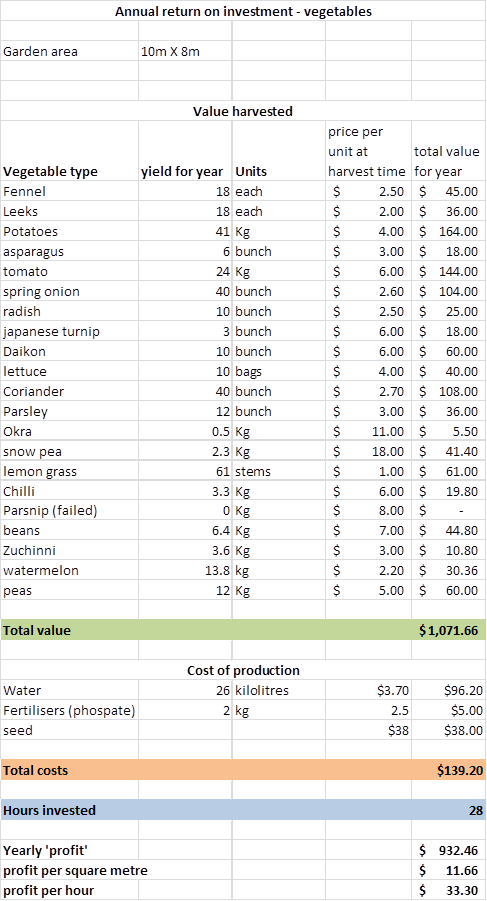
Longtime correspondent Bart D. (Australia) recently shared a spreadsheet of his garden's yields, the cash value of these harvests and his cash/labor costs.

Rather surprisingly (at least to me), his garden produced over $1,000 in cash value and netted him over $30/hour.

"This economic summary excludes my fruit growing and poultry enterprises.
A major point of value that this overview doesn’t show is the huge improvement in the ‘quality’ of the product being consumed as prices are only for ‘supermarket grade’ product. I believe that the real value amount should be raised by somewhere between 50% and 100% of the amount shown to reflect the improved quality.

The quantities are metric. Conversion is 1 square metre is about 10.7 square feet. There are 2.2Lbs to the Kg.

I feel the $33.30 per hour of time invested is a return worth pursuing for anyone in a low to medium income household. Beats the $9.00 per hour being offered by Walmart!

One hour in your own garden means 4 hours you don’t have to spend shifting stock at Walmart to earn money to buy food."


Thank you, Bart, for sharing your calculations. I suspect my time probably nets out at a much lower rate per hour, but I have never attempted to weigh our small garden's harvest or its value. It is certainly over a hundred pounds of vegetables and dozens of pounds of fruit per season.

Here's a photo of our tiny urban garden:


One of the many veggies grown in this small plot--chard:


Our scarlet runner green beans--from the vine to the cutting board to the wok to our dinner plates:


One of our peach tree's annual offerings:


This large bowl of peaches represents a small part of the entire crop:


And the end use of the peaches: pies!


Some of our tomato crop, which I used tomake a delicious home-made pasta sauce:From Home-Grown Tomatoes to Home-Made Pasta Sauce (October 25, 2014)


As always, I need to confess that I am a lazy gardener (and cook). My garden is not picture-perfect; it has weeds, volunteer flowers, and not every experiment is a success. The point is even a lazy gardener like me can obtain a remarkable yield of high quality food with relatively little effort. And there's nothing like cooking with your own veggies and fruit and sharing the bounty with friends and family.

I think Bart is absolutely correct that one of the less quantifiable yields is a better quality of soil and thus of vegetables/fruits. I think it is quite reasonable to double the value of Bart's garden to $2,000 on this basis alone. In effect, every vegetable from a well-tended garden is an artisan product that commands a high price in the marketplace.

Many people live in apartments and condominiums with no yard for traditional gardening. But that doesn't mean growing vegetables is not an option. The Kratky method, developed by Dr. B.A. Kratky at the University of Hawaii (my alma mater) is a hydroponic method that everyone interested in sustainability and/or taking control of at least some of your own food sources should consider: A Suspended Pot, Non-Circulating Hydroponic Method (PDF).

This essay was drawn from Musings Report 46 (2014). The weekly Reports are emailed exclusively to subscribers ($5/month) and major contributors $50+/year). 


Get a Job, Build a Real Career and Defy a Bewildering Economy(Kindle, $9.95)(print, $20)
go to Kindle edition
Are you like me? Ever since my first summer job decades ago, I've been chasing financial security. Not win-the-lottery, Bill Gates riches (although it would be nice!), but simply a feeling of financial control. I want my financial worries to if not disappear at least be manageable and comprehensible. 


And like most of you, the way I've moved toward my goal has always hinged not just on having a job but a career.

You don't have to be a financial blogger to know that "having a job" and "having a career" do not mean the same thing today as they did when I first started swinging a hammer for a paycheck.


Even the basic concept "getting a job" has changed so radically that jobs--getting and keeping them, and the perceived lack of them--is the number one financial topic among friends, family and for that matter, complete strangers.


So I sat down and wrote this book: Get a Job, Build a Real Career and Defy a Bewildering Economy.


It details everything I've verified about employment and the economy, and lays out an action plan to get you employed.


I am proud of this book. It is the culmination of both my practical work experiences and my financial analysis, and it is a useful, practical, and clarifying read.


Test drive the first section and see for yourself.     Kindle, $9.95     print, $20


"I want to thank you for creating your book Get a Job, Build a Real Career and Defy a Bewildering Economy. It is rare to find a person with a mind like yours, who can take a holistic systems view of things without being captured by specific perspectives or agendas. Your contribution to humanity is much appreciated."
Laura Y.


Gordon Long and I discuss The New Nature of Work: Jobs, Occupations & Careers(25 minutes, YouTube)


The Old Models of Work Are Broken 


NOTE: Contributions/subscriptions are acknowledged in the order received. Your name and email remain confidential and will not be given to any other individual, company or agency.


Thank you, Lynn M. ($75), for yet another superlatively generous contribution to this site-- I am greatly honored by your steadfast support and readership.

Read more...

Terms of Service

All content on this blog is provided by Trewe LLC for informational purposes only. The owner of this blog makes no representations as to the accuracy or completeness of any information on this site or found by following any link on this site. The owner will not be liable for any errors or omissions in this information nor for the availability of this information. The owner will not be liable for any losses, injuries, or damages from the display or use of this information. These terms and conditions of use are subject to change at anytime and without notice.

RE: European Union AI Act, and Our Use of Generative AI Tools and Agents Policy

All text on this site is composed by Charles Hugh Smith or by a credited guest-author. No Generative AI Tools are used in the composition / writing of any text or graphic content created by Charles Hugh Smith. This site deploys no AI agents or generative AI tools. This site is not responsible for the disclosures, use or non-use of AI agents or generative AI tools in advertisements displayed by Investing Channel or other ad placement services.

Audio files generated by text-to-audio transcription tools are identified as such.

Our Privacy Policy:

Correspondents' email is strictly confidential. This site does not collect digital data from visitors or distribute cookies. Advertisements served by third-party advertising networks such as Investing Channel may use cookies or collect information from visitors for the purpose of Interest-Based Advertising; if you wish to opt out of Interest-Based Advertising, please go to Opt out of interest-based advertising (The Network Advertising Initiative) If you have other privacy concerns relating to advertisements, please contact advertisers directly.

PRIVACY NOTICE FOR EEA INDIVIDUALS

This section covers disclosures on the General Data Protection Regulation (GDPR) for users residing within EEA only. GDPR replaces the existing Directive 95/46/ec, and aims at harmonizing data protection laws in the EU that are fit for purpose in the digital age. The primary objective of the GDPR is to give citizens back control of their personal data. Please follow the link below to access InvestingChannel's General Data Protection Notice.
https://stg.media.investingchannel.com/gdpr-notice/

Notice of Compliance with The California Consumer Protection Act

This site does not collect digital data from visitors or distribute cookies. Advertisements served by a third-party advertising network (Investing Channel) may use cookies or collect information from visitors for the purpose of Interest-Based Advertising. If you do not want any personal information that may be collected by third-party advertising to be sold, please follow the instructions on this page: Do Not Sell My Personal Information.

Regarding Cookies:

This site does not collect digital data from visitors or distribute cookies. Advertisements served by third-party advertising networks such as Investing Channel may use cookies or collect information from visitors for the purpose of Interest-Based Advertising; if you wish to opt out of Interest-Based Advertising, please go to Opt out of interest-based advertising (The Network Advertising Initiative) If you have other privacy concerns relating to advertisements, please contact advertisers directly.

Our Commission Policy:

Though I earn a small commission on Amazon.com books and gift certificates and gold (BullionVault) purchased via links on my site, I receive no fees or compensation for any other non-advertising links or content posted on my site.

Copyright Notice:

All original images (Drawings and Photographs), text (essays, books and works of fiction), audio and video recordings, musical compositions, graphic design, graphic design elements and HTML coding on this site are the copyrighted work of Charles Hugh Smith unless otherwise credited or noted. They are published as information for the private use of site visitors, and any reproduction or redistribution of this content or coding in any media in any format or distribution channel (text, audio, video/film, web) without the written permission of the copyright holder is strictly prohibited. All rights in all media reserved globally.

  © Blogger templates Newspaper III by Ourblogtemplates.com 2008

Back to TOP