







Thursday, August 06, 2015

Here's the Next Crisis "Nobody Saw Coming"

When borrowing become prohibitive (or impossible) and raising taxes no longer generates more revenues, state and local governments will have to cut expenditures.
Strangely enough, every easily foreseeable financial crisis is presented in the mainstream media as one that "nobody saw coming." No doubt the crisis visible in these three charts will also fall into the "nobody saw it coming" category.
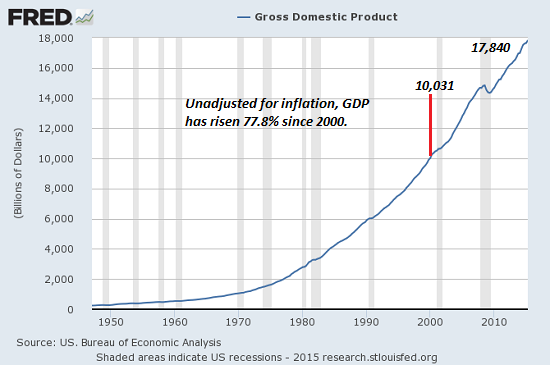
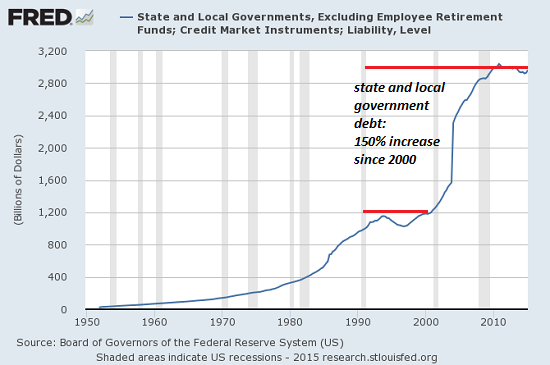
Take a look at this chart of state and local government debt. As we noted yesterday, nominal GDP rose about 77% since 2000. So state and local debt rose at double the rate of GDP. That is the definition of an unsustainable trend.
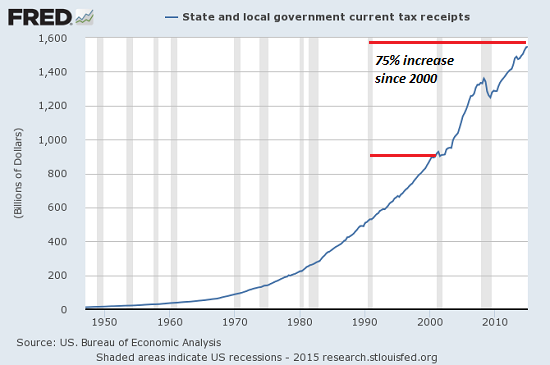
As noted earlier in the week, state and local taxes have soared 75%. While this would be no big deal if wages and salaries had risen by 75% in the same time frame, but earnigns have barely kept pace with inflation (38% since 2000).
So state and local taxes have risen at a rate twice that of wages/salaries. State and local governments can keep raising taxes, but where's the money going to come from?
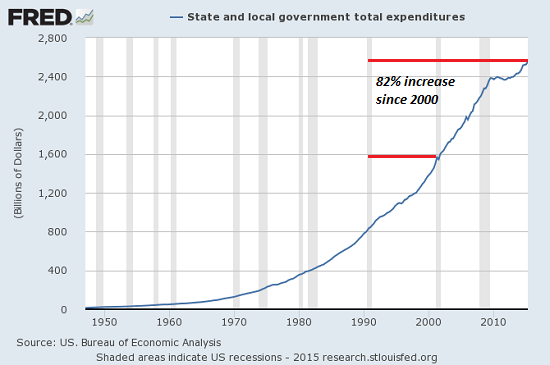
State and local government expenditures have risen faster than inflation or GDP.
Here is the context that matters: household income. This is median real income, i.e. adjusted for inflation.
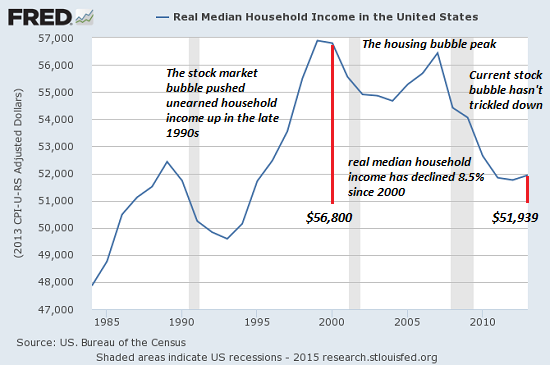
Wages and salaries are barely keeping up with inflation, real household incomes are down 8.5% since 2000 and state and local government taxes and spending are rising at twice the rate of inflation--where does this lead to?
1. The bond market may choke if state and local governments try to "borrow our way to prosperity" as they did in the 2000s.
2. If state and local taxes keep soaring while wages stagnate and household income declines, households will have less cash to spend on consumption.
3. Declining consumer spending = recession.
4. In recessions, sales and income taxes decline as households spending drops. This will crimp state and local tax revenues.
5. This sets up an unvirtuous cycle: state and local governments will have to raise taxes to maintain their trend of higher spending. Higher taxes reduce household spending, which reduces income and sales tax revenues. In response, state and local governments raise taxes again. This further suppresses disposable income and consumption. In other words, raising taxes offers diminishing returns.
At some point, local government revenues will decline despite tax increases and the bond market will raise the premium on local government debt in response to the rising risks.
When borrowing become prohibitive (or impossible) and raising taxes no longer generates more revenues, state and local governments will have to cut expenditures. Given their many contractual obligations, these cuts will slice very quickly into sinews and bone.
If this doesn't strike you a crisis, please check back in a few years. It is easily foreseeable, but very inconvenient. As a result, it too will be a crisis that "nobody saw coming."

NOTE: Contributions/subscriptions are acknowledged in the order received. Your name and email remain confidential and will not be given to any other individual, company or agency.

Thank you, Melissa A. ($50), for your wondrously generous contribution to this site-- I am greatly honored by your steadfast support and readership.

Read more...

Wednesday, August 05, 2015

Where Did the GDP "Growth" Go? Not into Wages

How can the economy grow by roughly one-third in real dollars while real median household income drops like a rock?
Based on gross domestic product (GDP), the U.S. economy has grown smartly since 2000: GDP rose from 10,031 in 2000 to 17,840 in mid-2015. That's an increase of 77.8%.
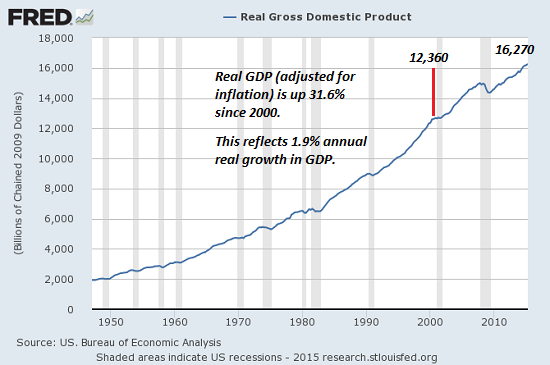
If we adjust GDP for inflation, we get what's known as real GDP, which increased 31.6%: from 12,360 in 2000 to 16,270 in mid-2015. This works out to a real annual increase of about 1.9% annually.
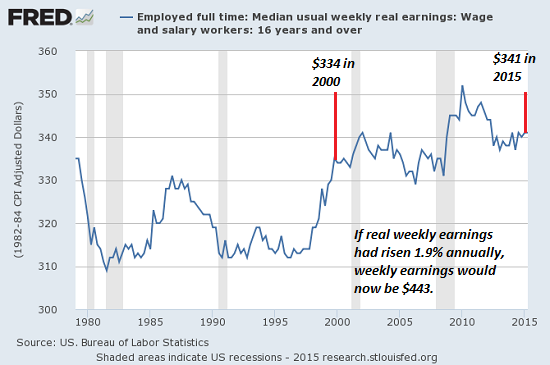
It would be natural to expect full-time employees' wages and salaries to rise at about this same rate as the economy expanded. But real median weekly earnings (wages and salaries) increased a grand total of $7 in the past 15 years: from $334 per week to $341 per week.
If wages and salaries had risen at the same 1.9% annual rate of real GDP growth, median weekly earnings would be $443, not $341. That's $102 more per week. But weekly median earnings for full-time workers rose only $7 per week, not $102 per week.
In other words, the growth in real GDP hasn't trickled down to wages and salaries.
Real household income--which includes both earned income and unearned income such as dividends and interest--has plummeted 8.5% since 2000. This is a striking contrast with real GDP growth of 31.6%: the economy has expanded 31.6% after adjusting for inflation, while real median household income has declined 8.5%.
If real median household income had grown at the same 1.9% annual rate of GDP, it would now be $75,000 a year, rather than $52,000.
So where did all this growth of the economy end up? How can the economy grow by roughly one-third in real dollars while real median household income drops like a rock and real wages/salaries are essentially unchanged for 15 years?
You can check these projections based on 1.9% annual growth for yourself with a simple Excel spreadsheet.

NOTE: Contributions/subscriptions are acknowledged in the order received. Your name and email remain confidential and will not be given to any other individual, company or agency.
Thank you, Larry T. ($150), for your outrageously generous contribution to this site-- I am greatly honored by your steadfast support and readership.

Read more...

Tuesday, August 04, 2015

I Sure Am Glad There's No Inflation

I sure am glad there's no inflation, because these "stable prices" the Federal Reserve keeps jaw-jacking about are putting us in a world of hurt.
We are constantly bombarded with two messages about inflation:
1. Inflation is near-zero
2. This worries the Federal Reserve terribly, because stable prices are deflationaryand deflation is (for reasons that are never explained) like the financial Black Plague that will wipe out humanity if it isn't vanquished by a healthy dose of inflation (i.e. getting less for your money).
Those of us outside the inner circles of power are glad there's no inflation, because we'd rather get more for our money (deflation) rather than less for our money (inflation). You know what I mean: the package that once held 16 ounces now only holds 13 ounces. A medication that once cost $79 now costs $79,000. (This is a much slighter exaggeration than you might imagine.)
Our excellent F-18 Super Hornet fighter aircraft cost us taxpayers $54 million a piece. Now the replacement fighter, the wallowing collection of defective parts flying in close proximity known as the F-35 costs $250 million each--unless you want an engine in it. That'll cost you extra, partner.
Despite all these widely known examples of rampant inflation, every month we're told there's no inflation. Just to reassure myself there's no inflation, I looked up a few charts on the St. Louis Fed's FRED database.
I have to say, I'm scratching my head here because the cost of things has gone up a lot since 2000.
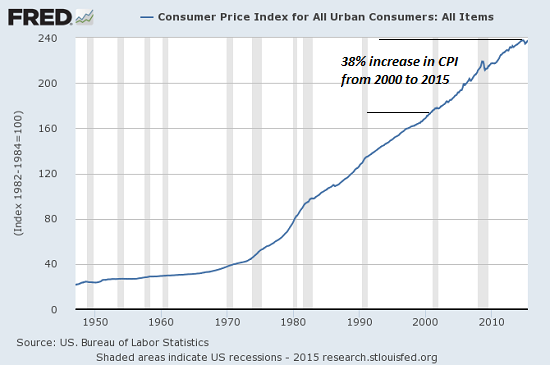
The consumer price index is up 38% from 2000. Now if somebody were to give me a choice between getting 10 gallons of gasoline and 10 gallons minus 3.8 gallons of gasoline, I'd take the 10 gallons. So how the heck can a 38% increase be near-zero inflation?
If I took $38 of every $100 you earned, would you reckon I'd taken next to nothing from you? Do you earn 38% more than you did in 2000? If so, congratulations; most people can't answer "yes."
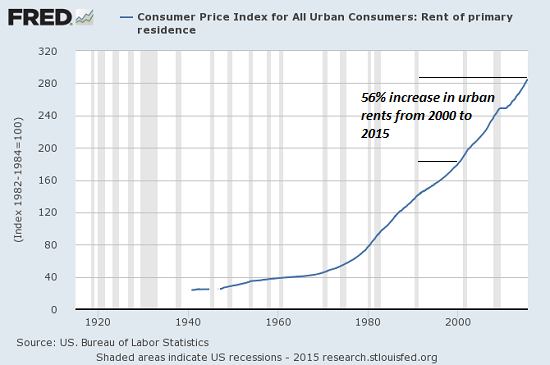
Urban-area rents are up 56% from 2000. Now this is even worse inflation, because you just paid $156 for what used to cost you only $100.
State and local government taxes are up 75% since 2000. And this doesn't even include the rip-off fishing license fees that have gone through the roof, the boat registration fees that have shot to the moon, and the legal-looting parking ticket that used to be $12 and is now $60.
Taxes naturally rise with the economic expansion due to rising population, which has gone up about 13.8% since 2000: from 281 million residents of the USA to 320 million in 2015. So taxes rising a few percentage points each year along with growth and population would make sense. But 75%?
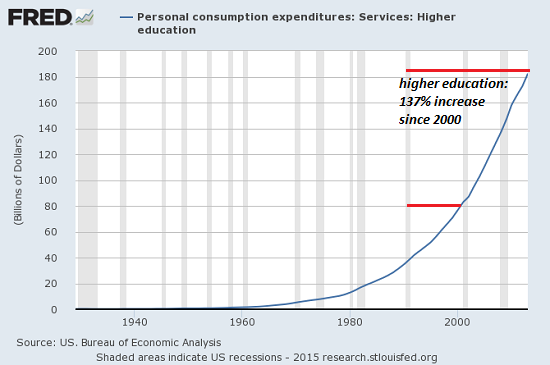
I've got a real treat for all you parents, uncles, aunts and grandparents who are planning to put the kids through college: the costs have only risen about 100% since 2000. That means instead of scraping up $80,000 per kid (assuming they can get all their required classes and grind the thing out in four years) you now need to scrape up $160,000 per kid.
The price index for college tuition grew by nearly 80 percent between August 2003 and August 2013. Now to make this apples to apples with the rest of the data here, we need to add in the nearly 5 missing years: from 1/1/2000 to 8/1/2003 and from 8/1/2013 to 8/1/2015. I'd say putting the increase at 100% is being conservative.
I sure am glad there's no inflation, because these "stable prices" the Federal Reserve keeps jaw-jacking about are putting us in a world of hurt. If we had honest-to-goodness inflation, that would push us right over the edge.

NOTE: Contributions/subscriptions are acknowledged in the order received. Your name and email remain confidential and will not be given to any other individual, company or agency.
Thank you, Julia B. ($50), for your courageously generous contribution to this site-- I am greatly honored by your steadfast support and readership.

Read more...

Monday, August 03, 2015

Billary Clinton and the Perfection of Consumerist Narcissism

In this perfection of consumerist narcissism, the only goal is maximizing private gain by whatever means are available.
I don't think it's coincidence that Bill Clinton's presidency and Christopher Lasch's landmark analysis The Culture of Narcissism: American Life in an Age of Diminishing Expectations both date from the same year, 1993.
Clinton solidified the modern presidency's narcissistic obsession with public approval (the political equivalent of "likes" on Facebook) and the exploitation of that popularity for maximum self-enrichment.
The relentless charm offensive and rapacious exploitation of Billary's proximity to power has yielded a fortune once reserved for tech titans and hedge fund superstars:
This sum doesn't include the tens of millions vacuumed up by the Clinton foundation machine, which distributes tribute to further the interests of the Clinton dynasty under the convenient guise of charity.
This is not to single the Clintons out as bad eggs in an exemplary system; it is to identify them as the stars of a thoroughly corrupt system. The Clintons did not make the political system; they have simply proven themselves the most adept at milking it for fame and fortune.
If the system encourages raking in millions, why not rake in millions? You'd be crazy not to. If we could skim $250,000 for a short speech on the travails of ageing Lotharios (or whatever else we wanted to blather on about), would we turn it down?
In this system, sincerity is what you spray-paint on whatever position that polls identify as popular. Hillary is especially adept at changing her accent to align with what her machine has identified as the dominant class in the audience of the moment.
Presidents in the culture of narcissism are caretakers, not leaders. When bank profits are at risk, the president OKs deregulation or bailouts to insure bank profits are unfettered by capitalism.
If the National Security State needs approval for more drone strikes, the president duly approves whatever the Deep State wants.
The party affiliation of the president makes little difference. The agenda remains the same: further state centralization of political and financial power, and expanding leverage of private wealth over this increasingly centralized power.
A citizenry reduced to narcissistic consumerism is unable to resist centralization and the financial oligarchy that controls the central bank/state machinery.
Lasch saw the rise of consumerism and the resulting rootless cosmopolitanism of the modern economy as the wellsprings of our culture of narcissism. For Lasch, the relentless commoditization of life disrupted the natural social relations of family, social reciprocity and the workplace, depriving individuals of these sources of meaning and replacing them with an empty consumerism that worshipped fame and celebrity.
The marketplace's commoditization of everyday life--both parents working all day for corporations so they could afford corporate childcare, for example--created two alienating dynamics: a narcissistic personality crippled by a fragile sense of self that sought solace in consumerist identifiers ( wearing the right brands, etc.) and a therapeutic mindset that saw alienation not as the consequence of large-scale, centralized commoditization and financialization but as individual issues to be addressed with self-help and pop psychology.
In Lasch’s view, both of these dynamics ignored the loss of authenticity that resulted from the commoditization not just of production but of every aspect of everyday life. In this sense, Lasch’s social analysis is an extension of Marx’s original insight into the alienating dynamics of commoditized wage-work, in which workers and their work were both interchangeable.
Lasch’s analysis brings us to the source of modern alienation: it’s not just employees who are interchangeable--employers are equally interchangeable.The interchangeability of work, employees, employers, products and services is the key characteristic of commoditization.
Politicians and political parties are interchangeable, too. That is the essence of commoditization: all the parts of the system are interchangeable.
Those closest to the sources of money and power reap the gains because proximity to power is the key point of leverage in a system of narcissistic self-absorption and commoditization.
The Clintons' phony sincerity, shameless self-aggrandizement and voracious appetite for cash offered in exchange for political favors is the perfection of a system in which authenticity has been commoditized and all social relations have been reduced to financial transactions.
In this perfection of consumerist narcissism, the only goal is maximizing private gain by whatever means are available.

NOTE: Contributions/subscriptions are acknowledged in the order received. Your name and email remain confidential and will not be given to any other individual, company or agency.
Thank you, Richard F. ($5/month), for your most excellently generous contribution to this site-- I am greatly honored by your steadfast support and readership.

Read more...

Sunday, August 02, 2015

Rent Bubble = Housing Bubble = Rent Bubble

Both bubbles (rents and housing) are vulnerable to popping.
Here is the conventional narrative about rents and housing valuations:
1. Rents have soared because people can't afford to buy a house and have to rent
2. Based on soaring rents, housing is fairly valued
In other words, rents and housing are tautological: rents are rational because housing values are rational, and housing values are rational because rents are rational.
Nice, but wrong: rents and housing are self-reinforcing bubbles: rents are soaring because housing is unaffordable, i.e. echo-bubble valuations. Soaring rents then justify bubblicious home prices.
One way to establish fair value of a home is to multiply the rental income the house can fetch in the open market. Multiply gross rents (before expenses, property taxes, etc.) by 8 to 15 (depending on the desirability of the locale and property) and you get an investment-based valuation.
So if a property earns $50,000 annually in gross rental income, the property is worth around $500,000, with premiums being added for low vacancy rates, desirable neighborhood, well-maintained home, etc.
Another approach is to calculate the net rent (total rent minus all expenses except mortgage) and base the value on the net rental income. Any property yielding 5% after expenses (i.e. 20 times net income) is an attractive investment in a world of negative short-term interest rates and 3% returns on 30-year bonds.
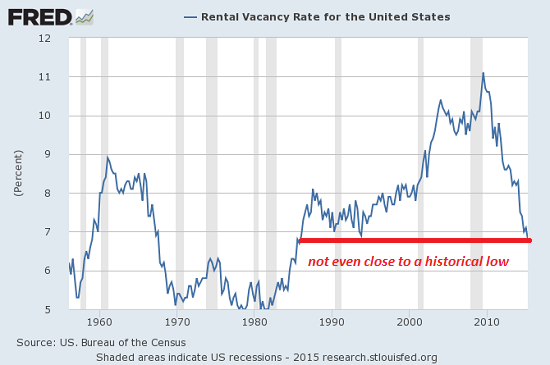
Rental demand is reflected by vacancy rates; low vacancy rates reflects high demand. Vacancy rates are low, but not at historic lows except in certain high-demand urban zones.
Vacancy rates were much lower in the stagflationary late 1970s - early 1980s. The claim that vacancy rates justify unprecedented rents is at odds with the data. (High-demand, limited-supply areas such as San Francisco are atypical; vacancy rates in these areas tend to be very low, in the 1% -2% range.)
Here is the urban-area consumer price index: it's up 38% from 2000:
Here is the urban-area rent index: it's up 56% from 2000--much higher than the rest of consumer prices, and climbing fast.
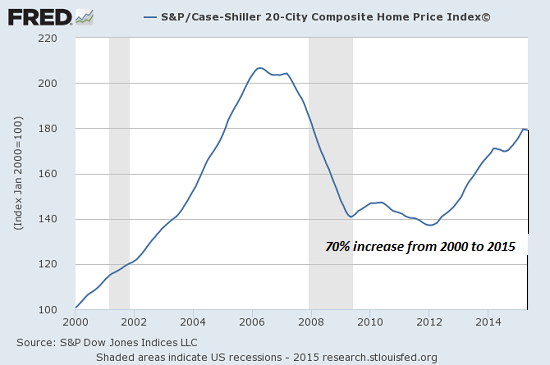
Here is the Case-Shiller home price index: it's up 70% from 2000:
Rents were soaring from 2010-2012, while housing prices stagnated. If housing valuations were based on rents, then they should have risen in lockstep with rents. They didn't.
Housing is in an echo bubble driven by overseas hot money flooding into North America to escape currency devaluations and crackdowns on corruption, and the easy-money policies of the Federal Reserve, which purchased $2 trillion of mortgages (20% of the entire U.S. mortgage market) to push mortgage rates to the floor.
Both bubbles (rents and housing) are vulnerable to popping. The real test of valuation is: what's it worth in a recession, after all the easy money and the jobs that depended on easy money have vanished?

NOTE: Contributions/subscriptions are acknowledged in the order received. Your name and email remain confidential and will not be given to any other individual, company or agency.
Thank you, Wayne H. ($75), for your monumentally generous contribution to this site-- I am greatly honored by your steadfast support and readership.

Read more...

Terms of Service

All content on this blog is provided by Trewe LLC for informational purposes only. The owner of this blog makes no representations as to the accuracy or completeness of any information on this site or found by following any link on this site. The owner will not be liable for any errors or omissions in this information nor for the availability of this information. The owner will not be liable for any losses, injuries, or damages from the display or use of this information. These terms and conditions of use are subject to change at anytime and without notice.

RE: European Union AI Act, and Our Use of Generative AI Tools and Agents Policy

All text on this site is composed by Charles Hugh Smith or by a credited guest-author. No Generative AI Tools are used in the composition / writing of any text or graphic content created by Charles Hugh Smith. This site deploys no AI agents or generative AI tools. This site is not responsible for the disclosures, use or non-use of AI agents or generative AI tools in advertisements displayed by Investing Channel or other ad placement services.

Audio files generated by text-to-audio transcription tools are identified as such.

Our Privacy Policy:

Correspondents' email is strictly confidential. This site does not collect digital data from visitors or distribute cookies. Advertisements served by third-party advertising networks such as Investing Channel may use cookies or collect information from visitors for the purpose of Interest-Based Advertising; if you wish to opt out of Interest-Based Advertising, please go to Opt out of interest-based advertising (The Network Advertising Initiative) If you have other privacy concerns relating to advertisements, please contact advertisers directly.

PRIVACY NOTICE FOR EEA INDIVIDUALS

This section covers disclosures on the General Data Protection Regulation (GDPR) for users residing within EEA only. GDPR replaces the existing Directive 95/46/ec, and aims at harmonizing data protection laws in the EU that are fit for purpose in the digital age. The primary objective of the GDPR is to give citizens back control of their personal data. Please follow the link below to access InvestingChannel's General Data Protection Notice.
https://stg.media.investingchannel.com/gdpr-notice/

Notice of Compliance with The California Consumer Protection Act

This site does not collect digital data from visitors or distribute cookies. Advertisements served by a third-party advertising network (Investing Channel) may use cookies or collect information from visitors for the purpose of Interest-Based Advertising. If you do not want any personal information that may be collected by third-party advertising to be sold, please follow the instructions on this page: Do Not Sell My Personal Information.

Regarding Cookies:

This site does not collect digital data from visitors or distribute cookies. Advertisements served by third-party advertising networks such as Investing Channel may use cookies or collect information from visitors for the purpose of Interest-Based Advertising; if you wish to opt out of Interest-Based Advertising, please go to Opt out of interest-based advertising (The Network Advertising Initiative) If you have other privacy concerns relating to advertisements, please contact advertisers directly.

Our Commission Policy:

Though I earn a small commission on Amazon.com books and gift certificates and gold (BullionVault) purchased via links on my site, I receive no fees or compensation for any other non-advertising links or content posted on my site.

Copyright Notice:

All original images (Drawings and Photographs), text (essays, books and works of fiction), audio and video recordings, musical compositions, graphic design, graphic design elements and HTML coding on this site are the copyrighted work of Charles Hugh Smith unless otherwise credited or noted. They are published as information for the private use of site visitors, and any reproduction or redistribution of this content or coding in any media in any format or distribution channel (text, audio, video/film, web) without the written permission of the copyright holder is strictly prohibited. All rights in all media reserved globally.

  © Blogger templates Newspaper III by Ourblogtemplates.com 2008

Back to TOP