Wednesday, August 12, 2015

Acquire Skills, Not Credentials

Don't rely on the declining value of credentialing signals: demonstrate you have the skills.
My recent conversation with Max Keiser on Summer Solutions (25:45) included three bits of advice:
2. Acquire skills, not credentials
3. Vote with your feet
Today's topic is acquire skills, not credentials.
I have written two books on this topic:
and
There is a place for credentials that act as an entry key to a profession: a dental hygiene credential, passing the bar exam, etc.
But outside these licensed professions, credentials such as four-year college degrees are fundamentally signals: they don't actually authenticate real-world skills, they simply signal that the holder of the credential completed the coursework.
It is remarkably easy to exit a university with a degree and essentially no practical real-world skills of the sort employers want and need.
That's the problem with the signaling value of credentials: in a competitive economy, employers don't want to gamble that the signal in a credential has value, they want evidence of real-world skills, i.e. the ability to profitably solve problems.
That's the problem with signaling: some signals might be noise. Employers don't want a signal, they want hard evidence of skills.
It is assumed that successfully navigating the institutional processes of higher education will impart professional working skills: showing up on time, performing as promised, being accountable, and so on.
This assumption is false: performing well in institutions of higher learning has no correlation to performance in the workplace. This is the conclusion that Google reached after crunching reams of data.
Lazlo Bock, senior vice president of people operations at Google, made the following comments in an interview published by the New York Times in June 2013:
“One of the things we’ve seen from all our data crunching is that G.P.A.’s (grade point averages) are worthless as a criteria for hiring, and test scores are worthless. Google famously used to ask everyone for a transcript and G.P.A.’s and test scores, but we don’t anymore.... We found that they don’t predict anything.
What’s interesting is the proportion of people without any college education at Google has increased over time as well. So we have teams where you have 14 percent of the team made up of people who’ve never gone to college.”
Doing well in college—earning high test scores and grades—has no measurable correlation with being an effective worker or manager. This is incontrovertible evidence that the entire higher education system is detached from the real economy: excelling in higher education has no discernible correlation to real-world skills or performance.
If the higher education system does not explicitly teach these skills, students will not learn them, even if they excel in fulfilling the criteria of higher education.
The ultimate purpose of skills is to profitably solve problems. Problem-solving has become a cliché of sorts, and so we need to ask, what set of skills is required to profitably solve problems?
The set of necessary skills divides into two categories: hard skills in specific technologies and crafts and soft skills that enable ownership of tasks and projects, systematic application of creativity and critical thinking, and professional standards of collaboration and conduct.
These two sets of skills are essential parts of human and social capital. The ultimate purpose of education is to learn how to acquire human and social capital, and the ultimate purpose of human and social capital is mastery of the skills needed to profitably solve problems.
Problem-solving and accountability have been generalized to the point that we need to specify what they actually mean. In my terminology, they mean taking ownership of tasks and projects, i.e. accepting sole responsibility in the same manner as an owner.
Hard skills in the STEM subjects (science, technology, engineering and math) are no longer enough: professional collaboration skills are increasingly essential even in workplaces that demand engineering and scientific proficiency.
The soft skills of collaboration, adaptability, creativity, entrepreneurism and professional accountability are core skills in every sector of the emerging economy.
Soft skills are not learned by osmosis or magic; they must be learned as systematically as hard skills.
The skills needed to establish and maintain a livelihood in the emerging economy are the abilities to:
1. Learn challenging new material over one’s entire productive life
2. Creatively apply newly-mastered knowledge and skills to a variety of fields
3. Be adaptable in all work environments
4. Apply a full spectrum of entrepreneurial skills to any task
5. Work collaboratively and effectively with others, both in person and remotely
6. Be professional, responsible and accountable in all work environments
7. Continually build human and social capital
8. Possess a practical working knowledge of financial and project management
If we step back and consider the abilities needed to succeed in the emerging economy, we marvel that anyone believes the prevailing (but unspoken) assumption that coursework in the conventional fields of language, history, science and the humanities magically instills these essential skills in students who regurgitate factory-model coursework.
Rather than rely on the same signals everyone else has, accredit yourself. Don't rely on the declining value of credentialing signals: demonstrate you have the skills.
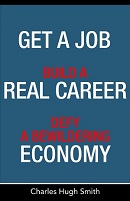
I wrote Get a Job, Build a Real Career to explain how to acquire high-demand skills and accredit these skills yourself.

NOTE: Contributions/subscriptions are acknowledged in the order received. Your name and email remain confidential and will not be given to any other individual, company or agency.
Thank you, Daniel E. ($5.25), for yet another fabulously generous contribution to this site-- I am greatly honored by your steadfast support and readership.

Read more...

Our Government, Destroyer of Jobs

If our government can't destroy all the private-sector jobs directly, it will do so indirectly by borrowing so much money the system collapses.
Conventional economists and pundits are puzzled why jobs growth has been so anemic in this "recovery." Here's one factor they overlook: our government. In theory, our government is supposed to encourage private sector job growth. In reality, all the hundreds of pages of regulations are killing job growth, one small business and one job at a time.
Correspondent/entrepreneur Ray Z. was kind enough to share his experience of trying to open a bagel shop and create six jobs:
"For many years, many of my friends and family who have come to my home and experienced my cooking, have told me that I should "open a restaurant". Of course, I took this with a grain of salt, :0 since many people say this exact phrase, to many other people. There are a lot of people who are able to create very delicious meals.
About five years ago, there was a restaurant for sale, not too far from my home and business. I thought about buying the restaurant, but at that time, the economy was not doing well and I wanted to take a wait and see attitude before I committed to anything. Eventually, the restaurant closed down and a different type of business opened up in the space that had been a restaurant. That business went under in the middle of 2014 and I decided it might be time to open a retail food establishment in the space that used to be a restaurant. How hard could it be?
I signed a lease with the property owner for his 1000 square foot space. I contracted with a general contractor and designed the restaurant floor space on a CAD program I have on my office machine.
Having boot-strapped two seven figure companies from the ground up over the past 25 years, I knew all of the permits needed in order to open a regular business. First, I had to have my attorney file for incorporation in my state. Then, I secured my FEIN (Federal Employer Identification Number) from the IRS, opened a bank account, got my sales and use tax permit (to collect sales taxes) from the State and contacted the person at the state level who is responsible for food establishments at the state level. The department that handles such things is the Nevada Health Department.
The inspector who is responsible for my geographic area (since I live in a sparsely populated county, we don't have a county health department) at the state level told me that since the space had not been a restaurant for a few years, I would need to pay additional fees the first year and my endeavor would be treated as a "new" retail food establishment. The cost was an additional $500, but that's just the way it is. The property already had a grease interceptor (1500 gallons), floor drains, a mop sink, air exchanger on the roof and was mostly plumbed. I'll get back to this later.
I submitted plans to the state contact person and was told that my symbology was not standard for the plumbing and electrical. The suggestion was made that I seek the services of an architect. Very well. I did. I found an architect who has done some restaurants in the area and we got to work. I submitted my floor plan to him, which he said was very detailed and seemed to use the space to its maximum potential. However, he did mention that if I were going to serve one single person as a dine-in customer, I would have to have at least one ADA compliant bathroom. The space had two existing bathrooms that were ADA, but not the latest version. So, those would have to be upgraded. Next, he told me that if I served, in-house, I would need to provide two ADA compliant bathrooms. I was going to remove one of the ADA bathrooms, so I could have more seating, but if I had more seating, I would need two bathrooms. Catch-22.
My architect submitted to the state for review and was told that I would need to expand the hallway. That means that the current hallway walls would need to be completely gutted, with plumbing removed and drains moved.
I guess it really did not matter though, since according to the State of Nevada, I was required to have EIGHT (8) sinks in my 1,000 square foot space. I needed two bathroom sinks (which I had), one dirty sink with three wells, clearly labeled "wash, rinse, sanitize"; this sink needed to have two side-boards of not less than 18 inches etc. I also had to have one prep sink, with a wand facet, one dedicated mop sink, two hand wash stations (that could not be near any other sinks) and a bar sink for smoothies. This meant I had to have an extra floor drain put in, while the others needed to be moved. Great. 8 sinks. Cost to bring the plumbing to code and provide engineered drawings and system? $20-25 thousand.
After six revisions to the plans (to make the state happy), I finally gave the plans to a general contractor. He sent it to his electrical and plumbing sub-contractors. They informed the general that due to code issues, they would have to quote an engineered HVAC system that provided balanced air for the replacement needed by the hood exhaust. The hood exhaust would need to be tied into the HVAC, so that my customers would be in an environment that met the state standards for air quality. OK. The plumber also said that I needed a brand new, engineered waste pipe system, one that could only be installed by jack hammering the entire plumbing system, since the state was requiring a detailed drawing of the pipes in the floor, and since it was put in before they had these requirements, they would want it all dug up and put into a plan. Great. Engineered HVAC cost? $40,000 (even though the place seemed to work fine for 25 years with an evaporative cooler and a gas heater).
Next, I was told that since I would need a 200 amp electrical service panel (which I knew), the power company would have to replace the transformer on the pole outside, since new construction (the buildings are 30 years old, but hey, it's a restaurant) requires new EPA compliant transformers. The power company fee alone would be 12-15 thousand dollars. Cost to upgrade electrical to code? $20,000, including power company costs to install EPA approved transformer.
Next, I was told that I would have to have the gas pipe dug up, jack hammered and replaced with a larger diameter gas line. This would be $20,000 or so dollars. The reason is, of course, that the new code requires a minimum pipe diameter for gas; even though I was only going to have one appliance on gas; the range. Everything else is electric.
Keep in mind that all of this was taking time. In point of fact, from the time I signed the lease in late December, until just this past week, I was doing nothing but getting my paperwork ready and trying to comply with government mandates. Essentially, I spent 7 months trying to not only figure out what I needed to do, while I was paying rent and utilities, but I also spent many hours trying to figure out the complexities of what the state required.
For instance: Each food establishment is required to have at least one Food Service Handling Manager. Each person who serves or prepares food has to take a Food Handler Course. The manager course is about 500 dollars, when all is said and done. The food handler course is about half of that. This is an annual fee.
Aside from what I was being required to do for the construction, the state also required the following:
-- A complete list of vendors. Said vendors must be USDA certified wholesale food suppliers. No farmer's markets, supermarket or home grown.
-- A complete menu, listing calories of each ready-made product.
-- A sample of my labels for prepackaged product showing nutritional data, ingredients, warnings about any allergens (peanut etc).
-- My estimate of how many employees I thought I would need (so they can tax me on each employee, annually, something the county does too)
-- Certificates for any employees who would be handling food, including any managers. My Federal EIN and my State tax ID.
-- Complete plans, contractors, amount of estimated business (so they can PRE TAX me on estimated sales taxes)
It just goes on and one.
The law in Nevada is called the Nevada Revised Statutes, or NRS. The statutes for retail food are about 500 pages thick. That's just the codes that cover food. This does not cover the building, electrical, plumbing and service codes (such as ADA compliance, handicap parking, etc.)
So, I quit. They beat me.
It always amazes me when politicians use the sound bite of how they will "create jobs". Well, I am an entrepreneur and have created thousands of jobs over the past 25 years. I have also be responsible for over 500 million in savings to my customers over that time period. This means that 500 million dollars of wealth that was saved, could be put into new technologies, new business ventures for into savings.
I am a job creator. But here are at least six jobs that I won't be creating.
Government is not a creator of jobs. It's a destroyer."
Thank you, Ray, for this detailed account of what creating a job entails in the real world. Government economists, think-tank pundits and Big Media talking heads prattle on about creating jobs, but they have zero experience in creating even one job. Were they pushed away from the state-cartel trough, they would be clueless about how to start, fund, and profitably operate an enterprise that created jobs.
Every statute, code and regulation has a justification. I've sat in on meetings of engineers and government officials tasked with dreaming up "improvements" to the building codes. Cost never comes up, and neither does cost/benefit analysis.
Yes, a hallway that's a few inches wider might be beneficial. But what are the odds of someone losing their life because the hallway only meets previous codes?
Yes, a 1-inch gas line might have some small advantage over a 3/4-inch gas line, but is that advantage worth $20,000 to a small business or its customers?
Government regulation is supposed to address life safety and the exploitation of workers and the public. But unbeknownst to the status quo, it's supposed to do so with an eye on cost-benefits and diminishing returns.
Would the bagel shop have been demonstrably less safe if it had four sinks instead of eight sinks? The irony here in over-regulating small business food establishments is the vast majority of the tainted food scandals originate in the factory-meat processing plants of Big Ag.
The government's solution to absurdly high costs of opening a small business is: borrow more money. Never mind that the benefits of blowing $120,000 are so marginal they cannot even be calculated; we make the rules, you follow them, and if you can't afford to follow the rules, then don't open the business.
This is how you get an economy of bureaucrats justifying their existence with 500-page manuals regulating private enterprise and abandoned Main Streets and malls. The government assumes private enterprise will jump through an endless number of hoops to operate a business, and that there is an endless supply of willing entrepreneurs who will volunteer to put themselves at risk of bankruptcy.
Back in reality, there is not an endless supply of people willing to jump through an insane number of hoops and risk their capital and health on starting a risky enterprise. (Memo to state regulators: unlike your job, every enterprise is risky. It's called capitalism. You can look it up.)
When the costs of starting and operating a business soar, the odds of succeeding drop accordingly.
Guess what, our government: you forgot that ultimately you live off the private sector. Yes, let's pile on another 500 pages of regulations--no problem--nothing could be easier for those in secure jobs funded by taxpayers. But if the private-sector jobs go away, who's left to pay for state employees to shuffle thousands of pages of regulations and enforce countless "improvements"?
There are ways to ensure public safety and make it straightforward to start a business and create jobs. A few cities/counties have one-stop systems where those willing to start a business can get all the permits and paperwork at one counter. Officials actually work with the entrepreneur to figure out how to meet codes or pehaps get a variance to skirt regs that offer little benefit but would kill the business.
Many others have phony facsimiles of one-stop counters, fake props set up for PR purposes. The process isn't really simplifed; nobody cares if you succeed or not; the purpose was to make the local government appear as if it cares. It doesn't.
Government has the answer, of course: just borrow more money from our kids and grandkids. If taxes aren't enough, just borrow more money.
If our government can't destroy all the private-sector jobs directly, it will do so indirectly by borrowing so much money the system collapses. Good job, regulators; forget costs and cost-benefit analyses; go ahead and add another 500 pages of regs without any regard for costs or consequences. We'll all end up paying for your blindness and cupidity.

NOTE: Contributions/subscriptions are acknowledged in the order received. Your name and email remain confidential and will not be given to any other individual, company or agency.

Thank you, Brandon M. ($10), for your most generous contribution to this site-- I am greatly honored by your support and readership.

Read more...

Monday, August 10, 2015

Stop Financializing the Human Experience

In this financialized hall of mirrors, narcissism replaces identity and the authentic self is rendered incoherent.
Correspondent Dani A.M. (of Removing the Shackles) was kind enough to identify three bits of advice from my recent conversation with Max Keiser on Summer Solutions (25:45): (9:20 min: "We've been brainwashed into financializing the human experience.")
1. Stop financializing the human experience
2. Acquire skills, not credentials
3. Vote with your Feet
These are the themes I'll be addressing this week.
What does financializing the human experience mean? It means turning everything into a financial transaction that profits an enterprise and the state.Since the state needs profitable enterprises to generate its tax revenues (and to pay wages that generate payroll/income taxes), the state is an implicit partner in every financializing the human experience transaction.
In an increasingly cashless, debt-dependent culture, every financial transaction generates income for banks: credit card and debit card fees, interest on credit cards, etc.
Here are some common examples:
-- Mom and Dad work long hours to afford childcare. Maybe they like working for the state or Corporate America more than caring for their kids (or sharing the care of several kids with other parents), but the system incentivizes maximizing income and paying for childcare as a profitable transaction.
In other words, childcare for many has been distilled down to a financial decision.
-- Dinner with friends is purchased, generating income for an enterprise, a bank and taxes for the state. If people no longer learn how to cook, then sharing a meal with friends necessarily becomes a financial transaction.
-- A sense of self must be purchased via signifiers of identity and self-worth.
The obsession with brands and other signifiers of belonging reflects one thing, and only one thing: a pervasive fragility of self. Unsurprisingly, our selfhood is incredibly fragile in a culture that glorifies the impossible (thin, fit, super-smart, witty, personable, creative, wealthy oh and of course humble) and sows insecurity as a means of selling you something.
That each of us remains the same person regardless of what we wear, drive, drink, etc. is obvious but verboten in a culture that profits from insecurity and self-doubt. As Caroline Caldwell observed, "In a society that profits from your self-doubt, liking yourself is a rebellious act."
I would modify this slightly: liking yourself regardless of what you wear, drink, drink, etc. is a rebellious act.
Liking yourself is not the same as narcissism. Narcissism is the result of the consumerist society's relentless focus on the essential project of consumerism, which is "the only self that is real is the self that is purchased and projected."
The narcissism bred by consumerism has nurtured an emotional isolation and immaturity that I call permanent adolescence which leaves many young people without the tools needed to handle criticism, collaboration and the pressures of the workplace.
Personal gratification is the driver of narcissism and consumerism, which are two sides of the same coin. Consumerist marketing glorifies the "projected self" as the "true self," encouraging self-absorption even as it erodes authentic identity, self-esteem and the resilience which enables emotional growth--the essential characteristic of adulthood.
Personal gratification is of a piece with self-absorption, fragile self-esteem and an identity that is overly dependent on consumerist signifiers and the approval of others.
The only way a consumerist economy and the state that depends on it can flourish is to turn every human interaction and emotion into a financial transaction. Just reached a personal goal? Celebrate by going to Disneyland and dropping a packet.
Feeling low? Cheer yourself up by buying a new signifier of self-worth.
Sensing something is terribly wrong with your life? Buy another self-help book that repeats the all-important narrative: It's not the system, it's you.
The problem isn't that the system is deranged, dysfunctional and crippling; no, it's you who are deranged, dysfunctional and crippled. But maybe some costly therapy will help you cope with your bottomless inadequacies.
By holding the system blameless for the fragility of our sense of self and identity, the conventional consumerist narrative fragments any social roles that aren't dependent on financial transactions and consumerist signifiers.
In this financialized hall of mirrors, narcissism replaces identity and the authentic self is rendered incoherent.

NOTE: Contributions/subscriptions are acknowledged in the order received. Your name and email remain confidential and will not be given to any other individual, company or agency.
Thank you, Jeffrey C. ($50), for your magnificently generous contribution to this site-- I am greatly honored by your support and readership.

Read more...

Sunday, August 09, 2015

Forget the Fake Statistics: China Is a Tinderbox

When China's tinderbox economy implodes, who will be left to bid up the world's surplus commodities and real estate?
After 30 years of torrid expansion, perhaps the single most consequential factor in China’s economy is how much of it is a “black box”: a system with visible inputs and outputs whose internal workings are opaque.
There are number of reasons for this lack of transparency:
1. Official statistics reflect what officials want to project, not the unfiltered data.
2. Policy decisions are made behind closed doors by a handful of leaders.
3. There is little institutional history of transparency.
4. Many important statistics are self-reported and prone to distortion.
5. Large sectors of the economy are informal and difficult if not impossible to measure accurately.
6. Endemic corruption distorts critical economic yardsticks.
7. There is little historical precedent to guide policy makers and individual investors.
None of these is unique to China, of course, with the possible exception of #7: few nations in history (if any) have experienced an equivalent boom in infrastructure, credit, housing and wealth in such a short span of time.
Saving Face By Editing Data
As anyone who has lived and worked in Asia can attest, public perception (i.e. "face") is of paramount concern.  There is tremendous pressure to put a positive spin on everything in the public sphere.  Negative publicity causes not just the individual to lose face, but his boss, agency, company and family may also be tarnished.
For this reason, reporting potentially negative numbers accurately may put careers and hopes for advancement at risk.
This accretion of fear of reprisal/disapproval builds as it moves up the pyramid of command.  This process can lead to tragic absurdities being taken as truth.  In one famous example in Mao-era China, officials ordered rice planted in thick abundance along a particular stretch of road, so that when Chairman Mao was driven along this roadway, he would see evidence of a spectacular rice harvest.
In reality, China was in the grip of a horrific famine resulting from disastrous state policies (The Great Leap Forward). But since everyone feared the consequences of telling Mao his policies were starving millions of Chinese people, the fields along the highway was planted to mask the unwelcome reality.
Even the most honest reports reflect the biases of those summarizing feedback for their superiors. As a result, when the feedback finally reaches the top leadership, it may be inaccurate or misleading in ways that are difficult to detect.
The Dangers Of Opaque Leadership Decisions
All leaders have their own biases and experiential limits, and left unchecked by accurate feedback and honest dissent, these have the potential to generate disastrous decisions.
Perhaps the top leadership in China is soliciting honest dissent, but without a vigorously free media and multiple unedited feedback loops, this is unlikely for systemic reasons.
Most people—leaders and followers alike—seek to confirm their own views (i.e. confirmation bias). A system in which key decisions are not aired publicly and the trustworthiness of the data being considered behind closed doors is also unknown is a system designed to reinforce confirmation bias and yes-men.
In this environment, destructive policies may be supported by the chain of command despite the consequences.
Lack Of Institutional History of Transparency
Institutions with a long history of independence and a policy of priding transparency have the potential to counter the tendency of hierarchies to encourage confirmation bias and fudged feedback.
But China’s tumultuous history in the 20th century—invasion, foreign occupation, civil war, revolution, mass famines, the Cultural Revolution’s mass disruptions and purges, the end of Mao’s Gang of Four and Deng Xiaoping’s “to get rich is glorious” reforms—has not been conducive to the establishment of independent institutions.
Developing the independence of institutions in the midst of such unprecedented political, social and economic turmoil is a long-term work in progress. Though no comparison is entirely analogous, we can look at the first equally tumultuous 30 years of the American Republic (1790 – 1820) and the French Republic (1789-1819) for historical examples of the difficulties in establishing enduringly independent institutions.
Self-Reported Statistics
Self-reported data plays a significant role in any economic snapshot that measures sentiment and expectations. But when it comes to income, outstanding loans and other data, there’s no substitute for accurate numbers.
As a general rule, the larger the informal cash economy and the greater the leeway and the incentives to under-report, the lower the quality of self-reported statistics.
Take income as an example. In the U.S., the vast majority of non-cash income is reported directly to the tax authorities: wages, 1099s, sales of securities, etc.  The leeway to fudge income is low, which pushes the incentives to fudge onto the expense/deduction side of the ledger.  For this reason, IRS income data is more trustworthy than self-reported measures of income and employment.
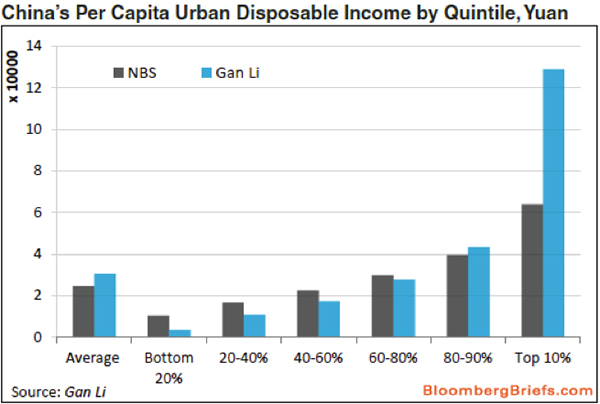
Consider this chart of household income in China.  A survey of households found incomes were much higher than the officially collated numbers. In the case of the top earners, the difference was significant enough to skew a variety of key numbers such as household income as a percentage of GDP.
The differences between official data and data collected by surveys is troubling for a number of reasons. Given the incentives to under-report (to avoid paying higher taxes), why should we trust the accuracy of self-reported income? Who’s to say that wealthy households don’t habitually under-report their true income even to surveys?
Given the ubiquity of the informal economy and shadow banking system in China, official data cannot accurately reflect peer-to-peer lending, private loans outstanding and many other data points that are critical to understanding income, risk and credit flows.
The Informal Economy & Shadow Banking
These discrepancies between actual debt and what’s reported could have monumental consequences should expansion turn to contraction and debts become uncollectible.
It’s been estimated that a third of all Chinese households engage in informal lending to friends and family, as well as to enterprises that pay high rates of interest due to the risky nature of their investments.
Interest can run as high as 34% -- loan-shark rates.
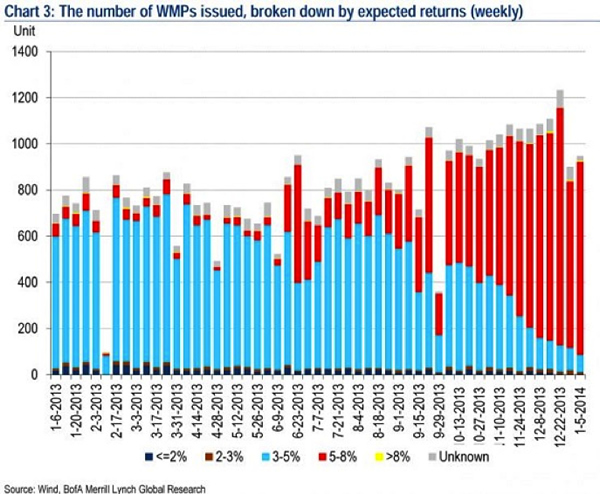
Even the slices of the credit/investment sector that are reported—for example, Wealth Management Products (WMPs)—are more Wild West than staid banking. WMPs are managed off-balance sheet and don’t require any reserves:
“Legally WMPs are not deposits. They are investment products that are managed ‘off-balance-sheet’ by banks, and there is little transparency about where the funds are going,” said Stephen Green, head of Greater China research at Standard Chartered in Hong Kong, in a note.
According to Green, the funds from different WMP products are often mixed and deployed to finance a broad pool of assets that more often than not fall into the sectors of the economy that regulators have attempted to fence off from normal bank lending (real estate, local government infrastructure, etc.), partly because these sectors are deemed to be particularly risky. In addition, the banks hold neither reserves of WMP deposits nor capital against the assets.
In other words, transparency is low while risk is unknown but possibly high.  This volatile mix of opacity and risk is the perfect recipe for cascading defaults and catastrophic losses.
Endemic Corruption Distorts Data
In China, as in many developing economies, problems such as permit applications, tax bills or development rights are solved by greasing the skids of officialdom.  Just received a big tax bill? Maybe a friendly tax official can help reduce the tax in return for promises of favors and an envelope of cash.
While the central government is cracking down on highly visible corruption, the system of buying privileges with influence, favors and cash is too deeply entrenched to be eliminated in a few months or years by high-level policies.
As with all the factors listed here, the impact of corruption is difficult to assess -- and that’s what makes China’s economy such a black box: if what’s known is untrustworthy, and what’s not known is potentially destabilizing, then how reliable is any projection?
Few Historical Precedents to Guide Policy Makers and Individuals
In the U.S., analysts and policy makers can draw upon a long history of economic policies and debate their applicability to the present.  Rising income disparity, for example, is often compared to the Gilded Age of the late 19th century. The financial crisis of 2008 is often viewed as an analog of the 1929 crash that triggered the Great Depression.
China’s recorded history stretches back thousands of years, but in terms of applicable financial and economic parallels to the current economy, there is no precedent.  China’s leadership is truly in uncharted waters.  This in itself heightens the risk of miscalculation and basing policies on faulty premises.
In Part 2: Why China Is Extremely Vulnerable Now, we zero in on China’s real estate bubble, and the outsized risks it poses to China’s economy -- and the world.
As the housing bubble bursts, alongside the trillions of losses already experienced in the Chinese stock market, the flood of capital from China into world assets is going to be substantially compromised. Asset prices are set at the margin: what the highest buyer is willing to pay. For many years now, the world has become accustomed to China's dependable willingness to pay well in excess of everyone else. When China is no longer the highest buyer, how far will prices need to fall in order to match the next highest buyer's ability to pay?
Click here to read Part 2 of this report (free executive summary, enrollment required for full access)
A version of this essay entitled "Is China’s “Black Box” Economy About to Come Apart?" was first published on peakprosperity.com, where I have been a contributing writer since 2011.

NOTE: Contributions/subscriptions are acknowledged in the order received. Your name and email remain confidential and will not be given to any other individual, company or agency.
Thank you, Michael N. ($50), for your fantastically generous contribution to this site-- I am greatly honored by your steadfast support and readership.

Read more...

Saturday, August 08, 2015

Let's Talk About Solutions, Not Fake Fixes

Since the status quo has no workable Plan B to "growth" in an economy in which household incomes have declined 8.5% in a supposedly expanding economy, real solutions must arise outside the status quo.
It's a lot easier to talk about what's wrong with the status quo and fake fixes than it is to talk about real solutions--for a number of reasons.
1. It's clear to virtually everyone who isn't being paid to make absurd claims that everything is peachy that the status quo is failing, so discussing the failings is like shooting fish in a barrel.
2. Grousing indignation (at all the failings) is an easy state to sustain; solving problems is an entirely different and not-so-easy state to sustain.
3. Emotional numbness brought on by financial distress and exhaustion reduces interest in solutions--there doesn't seem to be any when you're exhausted.
4. The predatory, parasitic status quo generates social fragmentation and an incoherence that breeds disassociation and alienation, neither of which are conducive to discussing solutions.
5. Since the status quo has no workable Plan B to "growth" in an economy in which household incomes have declined 8.5% in a supposedly expanding economy, real solutions must arise outside the status quo, which means the vested interests will lose their stranglehold on wealth and power. This is a no-no, so any solutions that lead to this are marginalized, ridiculed, labeled "impossible," etc.
6. To solve a problem we must first diagnose the problem correctly. The correct diagnosis of the current pathological status quo is: the problem is not X,Y or Z--the problem is the system itself.
I am indebted to correspondent Tom R. for extracting what might be the core diagnosis of our ills from my discussion with Max and Stacy: "We've been brainwashed into financializing the human experience." (at the 9:20 mark)
This is not a problem that can be fixed by tweaking state-cartel policies (Obamacare, banking, etc.) i.e. fake fixes. This is a problem that requires a complete rethinking of centralization, money creation, empire, wealth, prosperity, consumption and how we live.
We touch on many of these core problems and outline a few structural solutions in this 25-minute discussion:

NOTE: Contributions/subscriptions are acknowledged in the order received. Your name and email remain confidential and will not be given to any other individual, company or agency.
Thank you, Landmark Promotions ($100), for your outrageously generous contribution to this site-- I am greatly honored by your steadfast support and readership.

Read more...

Terms of Service

All content on this blog is provided by Trewe LLC for informational purposes only. The owner of this blog makes no representations as to the accuracy or completeness of any information on this site or found by following any link on this site. The owner will not be liable for any errors or omissions in this information nor for the availability of this information. The owner will not be liable for any losses, injuries, or damages from the display or use of this information. These terms and conditions of use are subject to change at anytime and without notice.

RE: European Union AI Act, and Our Use of Generative AI Tools and Agents Policy

All text on this site is composed by Charles Hugh Smith or by a credited guest-author. No Generative AI Tools are used in the composition / writing of any text or graphic content created by Charles Hugh Smith. This site deploys no AI agents or generative AI tools. This site is not responsible for the disclosures, use or non-use of AI agents or generative AI tools in advertisements displayed by Investing Channel or other ad placement services.

Audio files generated by text-to-audio transcription tools are identified as such.

Our Privacy Policy:

Correspondents' email is strictly confidential. This site does not collect digital data from visitors or distribute cookies. Advertisements served by third-party advertising networks such as Investing Channel may use cookies or collect information from visitors for the purpose of Interest-Based Advertising; if you wish to opt out of Interest-Based Advertising, please go to Opt out of interest-based advertising (The Network Advertising Initiative) If you have other privacy concerns relating to advertisements, please contact advertisers directly.

PRIVACY NOTICE FOR EEA INDIVIDUALS

This section covers disclosures on the General Data Protection Regulation (GDPR) for users residing within EEA only. GDPR replaces the existing Directive 95/46/ec, and aims at harmonizing data protection laws in the EU that are fit for purpose in the digital age. The primary objective of the GDPR is to give citizens back control of their personal data. Please follow the link below to access InvestingChannel's General Data Protection Notice.
https://stg.media.investingchannel.com/gdpr-notice/

Notice of Compliance with The California Consumer Protection Act

This site does not collect digital data from visitors or distribute cookies. Advertisements served by a third-party advertising network (Investing Channel) may use cookies or collect information from visitors for the purpose of Interest-Based Advertising. If you do not want any personal information that may be collected by third-party advertising to be sold, please follow the instructions on this page: Do Not Sell My Personal Information.

Regarding Cookies:

This site does not collect digital data from visitors or distribute cookies. Advertisements served by third-party advertising networks such as Investing Channel may use cookies or collect information from visitors for the purpose of Interest-Based Advertising; if you wish to opt out of Interest-Based Advertising, please go to Opt out of interest-based advertising (The Network Advertising Initiative) If you have other privacy concerns relating to advertisements, please contact advertisers directly.

Our Commission Policy:

Though I earn a small commission on Amazon.com books and gift certificates and gold (BullionVault) purchased via links on my site, I receive no fees or compensation for any other non-advertising links or content posted on my site.

Copyright Notice:

All original images (Drawings and Photographs), text (essays, books and works of fiction), audio and video recordings, musical compositions, graphic design, graphic design elements and HTML coding on this site are the copyrighted work of Charles Hugh Smith unless otherwise credited or noted. They are published as information for the private use of site visitors, and any reproduction or redistribution of this content or coding in any media in any format or distribution channel (text, audio, video/film, web) without the written permission of the copyright holder is strictly prohibited. All rights in all media reserved globally.

  © Blogger templates Newspaper III by Ourblogtemplates.com 2008

Back to TOP