








Tuesday, October 06, 2015

What Happens to our Economy as Millions of People Lose the Habits of Hard Work?

If we're going to dig our way of what lies ahead, we need people who can work hard and start/operate new businesses.
Simply put, job growth is not keeping pace with population growth--specifically, the growth of the labor force which is generally defined as the population between the ages of 18 and 64.
So what happens to the economy as millions of people never acquire the habits of hard work or lose them due to chronic joblessness?
Yesterday I presented data on not in the labor force, which is defined as "persons aged 16 years and older in the civilian noninstitutional population who are neither employed nor unemployed."
The federal government reckons about 95 million people are not in the labor force. But this doesn't necessarily tell us whether these people could take a job or not.
To get some sense of what this means, let's look at the U.S. population in basic terms. The U.S. Census reckons there are about 322 million residents of the U.S.
About 74 million are under the age of 18, and about 42 million are retired (i.e. receiving Social Security benefits) and almost 11 million receive Social Security disability benefits.
About 2.4 million people are in prison.
Roughly 1.4 million are in active duty in the U.S. Armed Forces.
That totals about 130 million people who aren't in the civilian labor force, with some caveats: workers can draw Social Security benefits and still earn a wages, for example.
That leaves about 192 million people as a base labor force. Out of this total, we need to subtract mentally disabled people who are not institutionalized or drawing Social Security disability benefits (unfortunately, many are homeless or in prison.)
We also need to subtract those who are earning money in the cash economy but not reporting their income--i.e. those who are employed but not showing up as employed in the data.
Then there are people who are raising children, home-schooling their children, etc. as fulltime work.
Others are providing care to elderly parents or relatives without compensation.
It is difficult to estimate the number of people who are performing work but not counted as employed because they're not being paid. According to the BLS (Bureau of Labor Statistics), about 146 million people have some kind of paid job in the U.S. This could be anything from a $100 million hedge fund manager to someone with $100/year in self-employed eBay-sales income.
Roughly 24 million are part time jobs, and 122 million are full-time jobs. (The numbers vary depending on which agency assembles the data.)
Our focus should be on the millions who are not working at unpaid positions at home or at paid positions. Those who fall out of the work force (or never join it in the first place) may lose (or never develop) the habits of hard work and cooperating with others that are necessary to be productive.
As correspondent Kevin K. recently noted, the earlier one acquires the habits of hard work, the more likely it is that those habits will last a lifetime:
"Just like kids that start smoking when they are young tend to keep smoking until they die, people that start working hard when they are young tend to work hard until they die. On the flip side, kids today that don't do any work when they are young and are told what to do every minute of their days are not wired to work hard or think outside the box, which is an essential part of making the kind of decisions necessary to run a business.
I've noticed that the people that work the hardest grew up working hard because they HAD to. The kids that got up early EVERY DAY to feed and water the livestock so it would not die (my cousins in Oregon) are different than the kids who fed and got water for their dog knowing that Mom would feed the dog if they forgot. The guy up late because he needed to turn off the water to 20 units and change the angle stops before he can change a leaking faucet in an apartment where people are moving in the next day is a different person that the guy who spends a year deciding on the new faucet for the wet bar in his "man cave".
Most people know that kids who spend years taking golf, tennis or swimming lessons are not only better than most people at those sports but are FAR more likely to continue to participate in those sports as adults.
What most people don't know is that kids who spend years learning how to cook, maintaining their own cars and performing volunteer work are not only better than most people at those activities, but are FAR more likely to continue to participate in those activities as adults."
We encourage studying hard and playing hard, but how many programs in our educational system give young people an opportunity to learn how to work hard, especially for themselves as entrepreneurs/ self-employed? All too often it's assumed that studying hard and playing hard teach people to work hard. That is not necessarily the case, as work requires another set of attributes and habits. Some of these overlap with study and athletics, but not all.
Personally, I would make hands-on entrepreneurship a required course from intermediate school on, taught solely by people who have started and operated enterprises. Rather than a teaching credential, the qualification would be limited to the instructor has launched and operated enterprises in the real world.
If we're going to dig our way out of what lies ahead, we need people who can work hard and start/operate new businesses. The two go together. Entrepreneurship is not for slackers or those who give up as soon as the going gets difficult. It takes good work habits to persevere and keep learning from others and from one's own mistakes.

NOTE: Contributions/subscriptions are acknowledged in the order received. Your name and email remain confidential and will not be given to any other individual, company or agency.
Thank you, Kurt S. ($50), for your fabulously generous contribution to this site -- I am greatly honored by your support and readership.
Thank you, Lance D. ($10), for your most generous contribution to this site -- I am greatly honored by your support and readership.

Read more...

Monday, October 05, 2015

One True Measure of Stagnation: Not in the Labor Force

This is a stark depiction of underlying stagnation: paid work is not being created as population expands.
Heroic efforts are being made to cloak the stagnation of the U.S. economy. One of these is to shift the unemployed work force from the negative-sounding jobless category to the benign-sounding Not in the Labor Force (NILF) category.
But re-labeling stagnation does not magically transform a stagnant economy.To get a sense of long-term stagnation, let's look at the data going back 38 years, to 1977.
I've selected data from three representative eras:
-- The 20-year period from 1977 to 1997, as this encompasses a variety of macro-economic conditions: five years of stagflation and two back-to-back recessions (1977 - 1982), strong growth from 1983 to 1990, a mild recession in 1991, and growth from 1993 to 1997.
-- The period of broad-based expansion from 1982 to 2000
-- The period 2000 to 2015, an era characterized by bubbles, post-bubble crises and low-growth "recovery"
In all cases, I list the Not in Labor Force (NILF) data and the population of the U.S.
1977-01-01: 61.491 million NILF population 220 million
1997-01-01 67.968 million NILF population 272 million
Population rose 52 million 23.6%
NILF rose 6.477 million 10.5%
1982-07-01 59.838 million NILF (start of boom) population 232 million
2000-07-01 68.880 million NILF (end of boom) population 282 million
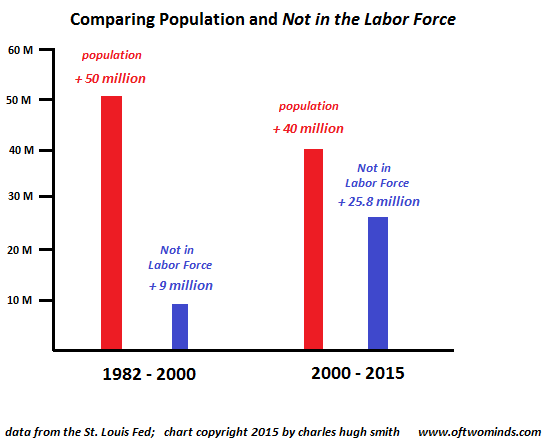
Population rose 50 million 22.4%
NILF rose 9.042 million 15.1%
2000-07-01 68.880 million NILF population 282 million
2015-09-01 94.718 million NILF ("recovery") population 322 million
Population rose 40 million 14.2%
NILF rose 25.838 million 37.5%
Notice how population growth was 23.6% 1977-1997 while growth of NILF was a mere 10.5% As the population grew, job growth kept NILF to a low rate of expansion. While the population soared by 52 million, only 6.5 million people were added to NILF.
In the golden era of 1982 - 2000, population rose 21.5% while NILF expanded by 15%. Job growth was still strong enough to limit NILF expansion. The population grew by 50 million while NILF expanded by 9 million.
But by the present era, Not in the Labor Force expanded by 37.5% while population grew by only 14.2%. This chart shows the difference between the two eras: those Not in the Labor Force soared by an unprecedented 26 million people--a staggering 15.6% of the nation's work force of 166 million. (Roughly 140 million people have some sort of employment or self-employment, though millions of these earn less than $10,000 a year, so classifying them as "employed" is a bit of a stretch).
This is a stark depiction of underlying stagnation: paid work is not being created as population expands. Those lacking paid work are not just impoverished; they lose the skills and will to work, a loss to the nation in more than economic vitality.

NOTE: Contributions/subscriptions are acknowledged in the order received. Your name and email remain confidential and will not be given to any other individual, company or agency.
Thank you, David J. ($100), for your outrageously generous contribution to this site -- I am greatly honored by your support and readership.
Thank you, Donald c. ($50), for your sumptuously generous contribution to this site -- I am greatly honored by your support and readership.

Read more...

Sunday, October 04, 2015

Welcome to the Future: Downward Mobility and Social Depression

If you don't think these definitions apply, please check back in a year.
The mainstream is finally waking up to the future of the American Dream: downward mobility for all but the top 10% of households. A recent Atlantic article fleshed out the zeitgeist with survey data that suggests the Great Middle Class/Nouveau Proletariat is also waking up to a future of downward mobility: The Downsizing of the American Dream: People used to believe they would someday move on up in the world. Now they’re more concerned with just holding on to what they have.
I dug into the financial and social realities of what it takes to be middle class in today's economy: Are You Really Middle Class?
The reality is that the middle class has been reduced to the sliver just below the top 5%--if we use the standards of the prosperous 1960s as baseline.
The downward mobility isn't just financial--it's a decline in political power, control of one's work and income-producing assets. This article reminds us of what the middle class once represented: What Middle Class? How bourgeois America is getting recast as a proletariat.
The costs of trying to maintain a toehold in the upper-middle class are illuminated in these recent articles on health and healthcare--both part of the downward mobility:
This reappraisal of the American Dream is also triggering a reappraisal of the middle class in the decades of widespread prosperity: The Myth of the Middle Class: Have Most Americans Always Been Poor?
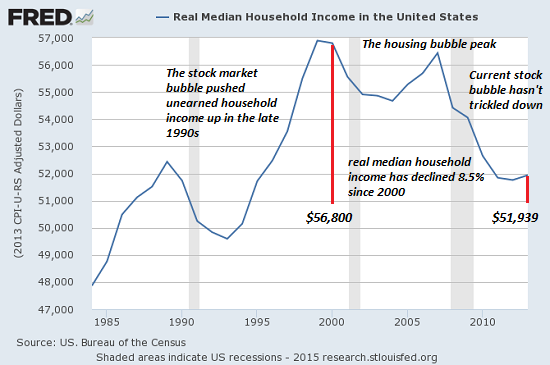
And here's the financial reality for the bottom 90%: declining real income:
Downward mobility excels in creating and distributing what I term social defeat: In my lexicon, social defeat is a spectrum of anxiety, insecurity, chronic stress, powerlessness, and fear of declining social status.
One aspect of social defeat is the emptiness we experience when prosperity does not deliver the promised sense of fulfillment. Here is one example: A recent sociological study compared wealthy Hong Kong residents’ sense of contentment with those of the immigrant maids who serve the moneyed Elites. The study found that the maids were much happier than their wealthy masters, who were not infrequently suicidal and depressed.
The maids, on the other hand, had a trustworthy group – other maids they met with on their one day off – and the coherent purpose provided by their support of their families back home.
Downward mobility and social defeat lead to social depression. Here are the conditions that characterize social depression:
1. High expectations of endless rising prosperity have been instilled in generations of citizens as a birthright.
2. Part-time and unemployed people are marginalized, not just financially but socially.
3. Widening income/wealth disparity as those in the top 10% pull away from the shrinking middle class.
4. A systemic decline in social/economic mobility as it becomes increasingly difficult to move from dependence on the state (welfare) or one's parents to financial independence.
5. A widening disconnect between higher education and employment: a college/university degree no longer guarantees a stable, good-paying job.
6. A failure in the Status Quo institutions and mainstream media to recognize social recession as a reality.
7. A systemic failure of imagination within state and private-sector institutions on how to address social recession issues.
8. The abandonment of middle class aspirations by the generations ensnared by the social recession: young people no longer aspire to (or cannot afford) consumerist status symbols such as luxury autos or homeownership.
9. A generational abandonment of marriage, families and independent households as these are no longer affordable to those with part-time or unstable employment, i.e. what I have termed (following Jeremy Rifkin) the end of work.
10. A loss of hope in the young generations as a result of the above conditions.
If you don't think these apply, please check back in a year. We'll have a firmer grasp of social depression in October 2016.

NOTE: Contributions/subscriptions are acknowledged in the order received. Your name and email remain confidential and will not be given to any other individual, company or agency.
Thank you, Ailene T. ($5/month), for your superlatively generous subscription to this site -- I am greatly honored by your support and readership.
Thank you, Kenneth B. ($10/month), for your outrageously generous subscription to this site -- I am greatly honored by your support and readership.

Read more...

Saturday, October 03, 2015

What's Cooking at Our House: Thai Pumpkin-Chicken Curry

Thai Pumpkin-Chicken Curry is a classic that's very forgiving of minor variations.
At the suggestion of correspondent Paul S., I'm presenting a new What's Cooking at Our House: Thai Pumpkin-Chicken Curry. This is a favorite in our house for several reasons: it's a good main dish for guests, the leftovers are divine and the prep is only modestly trying (mostly getting the skin off the kabocha pumpkin). It's also a fairly forgiving recipe and isn't finicky.
There any number of versions of this classic out there, but I use this recipe Thai Pumpkin-Chicken Curry with some minor changes.
Number 1: use only kabocha (Japanese pumpkin): it has the best taste and texture of all possible choices. Give it a try.
Number 2: you can substitute fish or firm tofu for the chicken, or even leave the meat out entirely if you want, or throw in a handful of green beans. This is a flexible recipe.
Number 3: a slightly less fussy prep works just fine. For example, there's no need to blenderize the curry base. Just stir-fry the shallots, etc., and then add the top few inches of the coconut milk--the creamy part. (Try not to shake the can before opening so the cream remains on top.)
Once this is bubbling, add the tablespoon of red Thai curry paste (not always easy to find if you don't have an Asian store nearby, but absolutely essential) and stir this into the creamy coconut/shallots, etc. mixture.
I actually add 2 tablespoons of the red curry paste, as we like the taste a bit punchier.
While it's better to stir-fy the chicken pieces separately as per this recipe, if you're in a hurry you can toss the chicken pieces in once the shallots are soft and proceed from there.
If I have a good-sized kabocha, I use 2 pounds of chicken instead of one pound. This recipe is very forgiving in that regard.
If you don't have brown sugar, substitute white sugar or honey. (A Thai friend brought us Thai palm sugar, which has a excellent taste.)
I've skipped the Thai basil and the lime when none were available and the dish didn't suffer at all, at least to my taste. If you have them, wonderful, if not, the dish turns out OK without them--though purists will say they're essential.
There are several ways to remove the skin of the kabocha. The skin is actually edible, and some people may prefer to leave it on. We peel it raw with a sharp paring knife and heavy-duty vegetable peeler. This recipe calls for boiling the pumpkin for 7 minutes to soften the skin and make it easier to cut into pieces.
Others foil and bake the pumpkin at high heat (400) for 15 minutes to achieve the same softening.
It's difficult to cut the raw kabocha into slices unless you have a heavy cleaver and some experience. But if you cut the pumpkin into pieces when raw, its cooks quickly once it's been diced into bite-sized pieces. If you've never worked with raw kabocha, it's probably better to boil it as per this recipe.
A quartered kabocha, cleaned of seeds:

Peeled and then cut into small chunks:
The coconut milk added to the stir-fried shallots, etc.
Adding the diced pumpkin to the chicken pieces, coconut milk and shallots, etc.
Reduce the heat and simmer until the chicken is thoroughly cooked and the pumpkin is tender. Enjoy!

NOTE: Contributions/subscriptions are acknowledged in the order received. Your name and email remain confidential and will not be given to any other individual, company or agency.
Thank you, Michael E. ($50), for your superbly generous contribution to this site -- I am greatly honored by your support and readership.
Thank you, Heung-Joo C. ($10/month), for your outrageously generous subscription to this site -- I am greatly honored by your support and readership.

Read more...

Thursday, October 01, 2015

The Dangerous Illusion That Risk Can Be Offloaded Onto Others

This confidence in central banks raises a pernicious systemic risk.
Do you drive carelessly because your auto is equipped with airbags? Perhaps not. But would you drive more cautiously if you were perched on the front bumper? If even the slightest collision would crush the driver's legs to pulp, I think it is safe to say we would all drive with a higher awareness of risk and with greater caution.
The faith that airbags and dashboards protect us in all conditions and times is misplaced. If vehicles were truly safe, how is it that 32,700 people lose their lives in vehicle accidents every year in the U.S. and hundreds of thousands of others are injured?
The risk, we are assured, is statistically low: "only" 21 Fatalities per 100,000 Licensed Drivers (practically zero, eh, except that it adds up to 32,700 people killed each year).
What statistics do not adequately describe, of course, is that most of those accidents occured in high-risk settings in which the drivers' focus and/or ability was impaired, even as they reckoned risk was managed/limited by the equipment, their safe driving record, etc.
In other words, the somewhat inebriated gent who slips behind the wheel on a dark rainy night senses the heightened danger; but reassured by the fact he's never been in a fatal accident, by his car's airbags, by the low statistical odds of getting killed, etc., he roars off into the unlit darkness. The odds of an accident in these conditions are much higher than the average listed in statistical abstracts, yet they are glossed over by the apparent "low odds" of the drive ending badly.
This is the Paradox of Risk: the more risk is apparently lowered, the higher the risk we are willing to accept. If the drunk wheeled off into the darkness on a bicycle, he probably wouldn't get far; he'd more than likely lose his balance and end up scuffed and sore but very much alive in a ditch. The real risks of navigating a dark road while impaired by alcohol are very much exposed on a bicycle.
Ironically, the real danger arises when the driver is reassured by "safety" features and past experiences which appear to limit risk or even make it disappear. This is the situation we find ourselves in today in global financial markets: the central banks are assumed to be the air bags of the system, limiting any losses to a few scratches rather than a complete wipe-out.
This confidence in central banks raises a pernicious systemic risk: assuming the "100-year flood" can't happen every 6 years or so. I have from time to time highly recommended The Misbehavior of Markets and now is the perfect time to check this book out, for the author, fractal pioneer Benoit Mandelbrot, explains in simple mathematical ways how Modern Portfolio Theory, i.e. the management of risk, is based on a faulty conception of risk and statistical chance.
In a nutshell: while modern portfolio management is statistically based (all those "standard deviations" you always see referenced in quantitiative analyses), the markets behave fractally. Fractals are known as the geometry of chaos, for they describe how seemingly stable systems can quickly, and unpredictably, degrade into chaos.
But as Mandelbrot explains, "100-year floods" actually occur with startling regularity in all markets. Put another way: you cannot disappear all risk with fancy statistical models and credit default swaps, etc., that offload the risk onto others, i.e. counterparties.
In other words, all you're really doing is masking the risk--you're not eliminating it. And in hiding the real risk, you are lulling the market participants into a pernicious choice architecture in which their willingness to take riskier and riskier actions is rewarded and encouraged, while caution is punished.
This is how you get a total systemic collapse of the entire choice architecture.And by this I mean not just the financial system, but the backstop provided by central banks and counterparties.
In a system that is now correlated to central bank policies, the idea that some counterparty will cover your losses is illusory. The entire notion that risk can be offloaded onto others is magical thinking: that when the system implodes, the counterparties will magically escape the highly correlated collapse.
This is another Paradox of Risk: central bank intervention/financial repression provides the illusion thay systemic risk has been disappeared, and this pushes all asset classes into correlation. The idea that some assets will escape the implosion is also illusory; what appeared uncorrelated can suddenly correlate overnight, destroying the entire fantasy that risk can be offloaded onto others.

NOTE: Contributions/subscriptions are acknowledged in the order received. Your name and email remain confidential and will not be given to any other individual, company or agency.
Thank you, Arthur T. ($100), for yet another outrageously generous contribution to this site -- I am greatly honored by your steadfast support and readership.
Thank you, Nigel H. ($10), for your most generous contribution to this site -- I am greatly honored by your support and readership.

Read more...

Terms of Service

All content on this blog is provided by Trewe LLC for informational purposes only. The owner of this blog makes no representations as to the accuracy or completeness of any information on this site or found by following any link on this site. The owner will not be liable for any errors or omissions in this information nor for the availability of this information. The owner will not be liable for any losses, injuries, or damages from the display or use of this information. These terms and conditions of use are subject to change at anytime and without notice.

RE: European Union AI Act, and Our Use of Generative AI Tools and Agents Policy

All text on this site is composed by Charles Hugh Smith or by a credited guest-author. No Generative AI Tools are used in the composition / writing of any text or graphic content created by Charles Hugh Smith. This site deploys no AI agents or generative AI tools. This site is not responsible for the disclosures, use or non-use of AI agents or generative AI tools in advertisements displayed by Investing Channel or other ad placement services.

Audio files generated by text-to-audio transcription tools are identified as such.

Our Privacy Policy:

Correspondents' email is strictly confidential. This site does not collect digital data from visitors or distribute cookies. Advertisements served by third-party advertising networks such as Investing Channel may use cookies or collect information from visitors for the purpose of Interest-Based Advertising; if you wish to opt out of Interest-Based Advertising, please go to Opt out of interest-based advertising (The Network Advertising Initiative) If you have other privacy concerns relating to advertisements, please contact advertisers directly.

PRIVACY NOTICE FOR EEA INDIVIDUALS

This section covers disclosures on the General Data Protection Regulation (GDPR) for users residing within EEA only. GDPR replaces the existing Directive 95/46/ec, and aims at harmonizing data protection laws in the EU that are fit for purpose in the digital age. The primary objective of the GDPR is to give citizens back control of their personal data. Please follow the link below to access InvestingChannel's General Data Protection Notice.
https://stg.media.investingchannel.com/gdpr-notice/

Notice of Compliance with The California Consumer Protection Act

This site does not collect digital data from visitors or distribute cookies. Advertisements served by a third-party advertising network (Investing Channel) may use cookies or collect information from visitors for the purpose of Interest-Based Advertising. If you do not want any personal information that may be collected by third-party advertising to be sold, please follow the instructions on this page: Do Not Sell My Personal Information.

Regarding Cookies:

This site does not collect digital data from visitors or distribute cookies. Advertisements served by third-party advertising networks such as Investing Channel may use cookies or collect information from visitors for the purpose of Interest-Based Advertising; if you wish to opt out of Interest-Based Advertising, please go to Opt out of interest-based advertising (The Network Advertising Initiative) If you have other privacy concerns relating to advertisements, please contact advertisers directly.

Our Commission Policy:

Though I earn a small commission on Amazon.com books and gift certificates and gold (BullionVault) purchased via links on my site, I receive no fees or compensation for any other non-advertising links or content posted on my site.

Copyright Notice:

All original images (Drawings and Photographs), text (essays, books and works of fiction), audio and video recordings, musical compositions, graphic design, graphic design elements and HTML coding on this site are the copyrighted work of Charles Hugh Smith unless otherwise credited or noted. They are published as information for the private use of site visitors, and any reproduction or redistribution of this content or coding in any media in any format or distribution channel (text, audio, video/film, web) without the written permission of the copyright holder is strictly prohibited. All rights in all media reserved globally.

  © Blogger templates Newspaper III by Ourblogtemplates.com 2008

Back to TOP