

Monday, June 06, 2016

Bernanke Blew It Big-Time: He Should Have Raised Rates Three Years Ago

Bernanke blew it big-time, letting the "recovery" run seven years without any significant increase in rates.
It is now painfully obvious that Ben Bernanke blew it big-time by not raising rates three years ago when the economy and markets enjoyed tailwinds. The former Federal Reserve chairperson, who has claimed the mantle of savior of the global economy, foolishly kept rates at zero until tailwinds turned to headwinds, at which point he handed Janet Yellen the unenviable task of raising rates as the headwinds are strengthening.
Ben Bernanke is not the savior who rescued the global economy; he is the clueless fool who plunged a poisoned knife in its back. After weathering the spot of bother in Euroland in 2011-2012, the global economy had multiple tailwinds in 2013--tailwinds that enabled Bernanke and the Fed to raise rates in a series of measured steps.
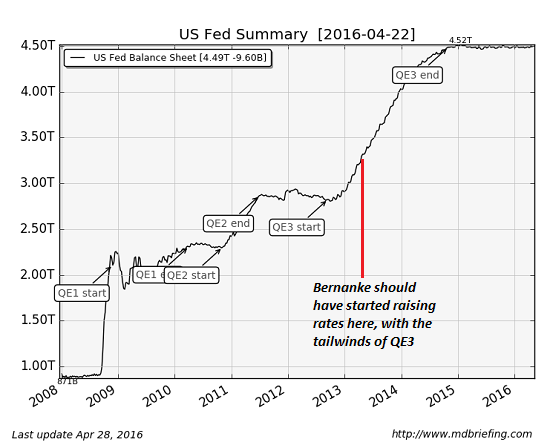
Tailwind #1: the Fed's binge-buying of assets (QE3) was still ramping up in 2013:
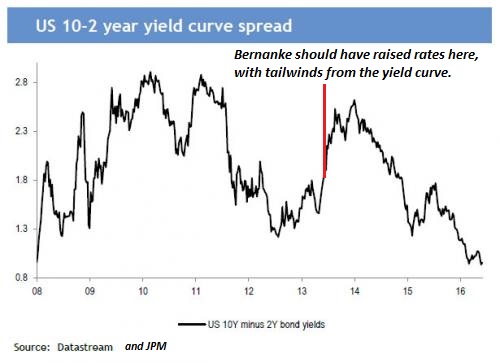
Tailwind #2: the yield curve spread had bounced off its 2012 low:
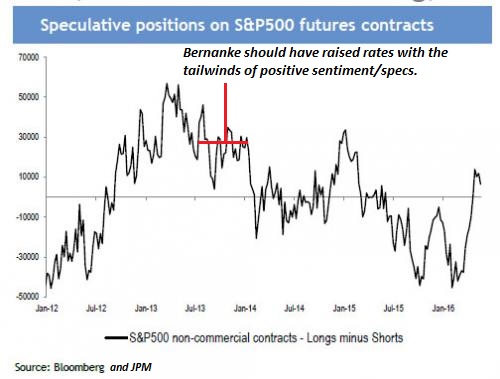
Tailwind #3: market speculative positions and sentiment were solidly positive:
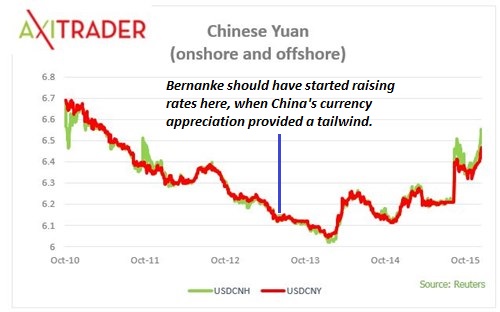
Tailwind #4: China's economy and appreciation of the yuan had not yet weakened:
In April 2013, the market's "recovery" had already been running for four years.By mid-2013, the S&P 500 had soared from 667 in March 2009 to 1,600, exceeding its previous all-time highs around 1,574--a gain of 930 points or 140% off the 2009 lows.
What else did The Bernank want in mid-2013--an infinite line of credit with the Central Bank of Mars? He had literally every tailwind a central banker could want to support higher interest rates--especially rates that could have clicked higher by tiny .25% increments.
Instead, Bernanke blew it big-time, letting the "recovery" run seven years without any significant increase in rates. Now that the "recovery" is in its eighth year, it's starting to roll over. All those tailwinds have reversed into headwinds, especially China, which has seen the RMB (yuan) strengthen by 20% as its currency peg to the U.S. dollar has dragged it higher.
The 20% appreciation in the yuan makes China's exports increasingly costly and thus less competitive globally.
As I explained in Why the Fed Has to Raise Rates (December 4, 2015), the U.S. dollar serves two sets of users: the domestic U.S. economy and the international economy that uses the USD as a reserve currency.
While the Fed poo-bahs are constantly spewing propaganda about how the Fed serves Main Street (well, it does serve Main Street in a manner of speaking--as a tasty snack to Wall Street), the one absolutely critical mission of the Fed in the Imperial Project is maintaining U.S. dollar hegemony.
No nation ever achieved global hegemony by weakening its currency. Hegemony requires a strong currency, for the ultimate competitive advantage is trading fiat currency that has been created out of thin air for real commodities and goods.
Generating currency out of thin air and trading it for tangible goods is the definition of hegemony. Is there is any greater magic power than that?
In essence, the Fed must raise rates to maintain the U.S. dollar hegemony and keep commodities such as oil cheap for American consumers. The most direct way to keep commodities cheap is to strengthen one's currency, which makes commodities extracted in other nations cheaper by raising the purchasing power of the domestic economy on the global stage.
Another critical element of U.S. hegemony is to be the dumping ground for exports of our trading partners. By strengthening the dollar, the Fed increases the purchasing power of everyone who holds USD. This lowers the cost of goods imported from nations with weakening currencies, who are more than willing to trade their commodities and goods for fiat USD.
The loser as the USD strengthens is China, which must devalue its currency or de-peg its currency from the USD to preserve its export-sector competitiveness. Anything that could disrupt China's fragile economy, credit expansion and capital flows is a global worry, and Bernanke blew it big-time by not raising rates when global growth was still a tailwind.
Now that the tailwinds have become headwinds, the global economy is like a cracked glass teetering on a fence post in a rising storm. Every move in interest rates has immediate consequences in currencies, bond yields and capital flows, and each of these winds has the potential to topple the increasingly fragile global economy into recession--or worse.
Ben Bernanke blew it big-time, not just for America, but for the world. This reality cannot be dismissed as the luxury of hindsight; it was clear to many observers that after four years of recovery, it was time to start raising rates in 2013. Leaders must lead; if the Fed chair is so weak-kneed that he/she must ask the market's permission for every decision, that's not leading--it's following a short-term profit-obsessed liquidity junkie off the cliff.


A Radically Beneficial World: Automation, Technology and Creating Jobs for All is now available as an Audible audio book.
My new book is #3 on Kindle short reads -> politics and social science: Why Our Status Quo Failed and Is Beyond Reform ($3.95 Kindle ebook, $8.95 print edition)For more, please visit the book's website.

NOTE: Contributions/subscriptions are acknowledged in the order received. Your name and email remain confidential and will not be given to any other individual, company or agency.
Thank you, Ed M. ($10), for your very generous contribution to this site-- I am greatly honored by your support and readership.

Read more...

Sunday, June 05, 2016

Is the Market Rational After All?

This is the market we have now: dominated by delusional, irrational central planners with unlimited powers to create money out of thin air to fund their manipulations.
For the past decade, attempts to explain the psychology of markets have been dominated by behavioral economics: rather than being rational actors as presumed in classical economic models, humans are often profoundly irrational and prone to cognitive distortions and errors that render their choices anything but rational.
Even the wisdom of crowds--that in aggregate, crowds make better decisions than individuals--is being questioned.
Ironically, while the clinical focus has been on individual irrationalities and frailties, markets have been increasingly controlled by a handful of central planners: central banks and state authorities who are intervening in supposedly free markets (i.e. outright manipulation) to an unprecedented degree.
Central banks are buying trillions of dollars, yuan, yen and euros of assets such as mortgages, sovereign bonds, corporate bonds and stocks to prop up markets in these assets as a means of generating confidence and positive sentiment, and suppressing any downturns by selling volatility (the VIX index).
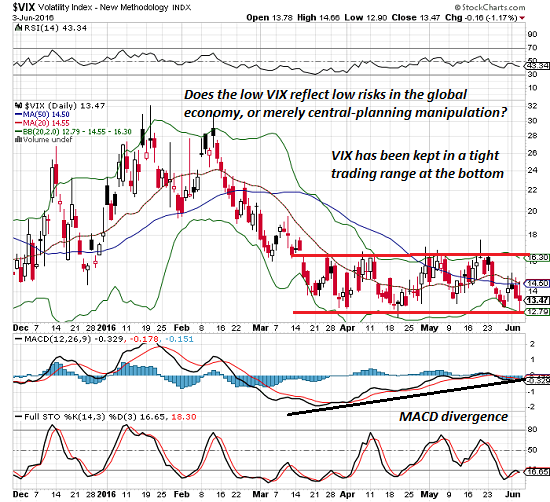
The VIX (volatility) and the stock market are on a see-saw: as volatility leaps higher, markets sell off, and as volatility declines, complacency enables markets to drift higher.
The VIX has been monkey-hammered lower for months. Every time volatility (as reflected by the VIX) starts creeping up into the danger zone, it is sold, effectively pushing the index back down to "safe" complacency ("no worries, mate") levels.
So if individuals and crowds are delusional and irrational, how can a handful of central planners not be equally delusional and irrational? the key to understanding market behavior is not human irrationality. Rather, the key drivers in today's markets are completely rational responses to the incentives created by central planners.
Only an irrational person who wanted to be fired would repatriate billions of dollars in overseas profits to the U.S. and pay 35% in corporate taxes. The only rational response to this disincentive is to find ways to funnel this money into corporate buy-backs that enrich CEOs and other top managers. To do otherwise would be irrational.
if central banks (i.e. central planners) have made it abundantly clear that they will intervene to keep markets aloft, regardless of cost, then the only rational response is buy the dips because central planners will stick-save markets from any panic declines and then push them to new heights.
If central planners routinely hammer volatility down with huge selling, then the only rational response is to align your trades to profit from this ever-present intervention.
This is the market we have now: dominated by delusional, irrational central planners with unlimited powers to create money out of thin air to fund their manipulations.
The only rational response is to trade accordingly: anticipate constant manipulation, anticipate constant bombastic propaganda of the "whatever it takes" variety, and anticipate massive selling of volatility to maintain the ever-so-important illusion that global risks have been disappeared by central banks and central planners.
Until the central planning madness destroys markets' ability to discover price and allocate capital. Then you end up with Venezuela: a failed state and a broken economy that can no longer feed its people despite the nation's vast oil wealth.
Volatility has been chosen as a "signaling device" by central planners. A low VIX signals all is well and risk is non-existent, so central planners suppress VIX.
In a world roiled by staggeringly large risks, can VIX be suppressed forever?That's a difficult question in a market dominated by irrational central planners.


A Radically Beneficial World: Automation, Technology and Creating Jobs for All is now available as an Audible audio book.
My new book is #3 on Kindle short reads -> politics and social science: Why Our Status Quo Failed and Is Beyond Reform ($3.95 Kindle ebook, $8.95 print edition)For more, please visit the book's website.

NOTE: Contributions/subscriptions are acknowledged in the order received. Your name and email remain confidential and will not be given to any other individual, company or agency.
Thank you, Therese T. ($25), for your extremely generous contribution to this site-- I am greatly honored by your support and readership.

Read more...

Thursday, June 02, 2016

The Structure of Collapse: 2016-2019

Leaders face a no-win dilemma: any change of course will crash the system, but maintaining the current course will also crash the system.
The end-state of unsustainable systems is collapse. Though collapse may appear to be sudden and chaotic, we can discern key structures that guide the processes of collapse.
Though the subject is complex enough to justify an entire shelf of books, these six dynamics are sufficient to illuminate the inevitable collapse of the status quo.
1. Doing more of what has failed spectacularly. The leaders of the status quo inevitably keep doing more of what worked in the past, even when it no longer works. Indeed, the failure only increases the leadership’s push to new extremes of what has failed spectacularly. At some point, this single-minded pursuit of failed policies speeds the system’s collapse.
2. Emergency measures become permanent policies. The status quo’s leaders expect the system to right itself once emergency measures stabilize a crisis. But broken systems cannot right themselves, and so the leadership is forced to make temporary emergency measures (such as lowering interest rates to zero) permanent policy. This increases the fragility of the system, as any attempt to end the emergency measures triggers a system-threatening crisis.
3. Diminishing returns on status quo solutions. Back when the economic tree was loaded with low-hanging fruit, solutions such as lowering interest rates had a large multiplier effect. But as the tree is stripped of fruit, the returns on these solutions diminish to zero.
4. Declining social mobility. As the economic pie shrinks, the privileged maintain or increase their share, and the slice left to the disenfranchised shrinks. As the privileged take care of their own class, there are fewer slots open for talented outsiders. The status quo is slowly starved of talent and the ranks of those opposed to the status quo swell with those denied access to the top rungs of the social mobility ladder.
5. The social order loses cohesion and shared purpose as the social-economic classes pull apart. The top of the wealth/power pyramid no longer serves in the armed forces, and withdraws from contact with the lower classes. Lacking a unifying social purpose, each class pursues its self-interests to the detriment of the nation and society as a whole.
6. Strapped for cash as tax revenues decline, the state borrows more money and devalues its currency as a means of maintaining the illusion that it can fulfill all its promises. As the purchasing power of the currency declines, people lose faith in the state’s currency. Once faith is lost, the value of the currency declines rapidly and the state’s insolvency is revealed.
Each of these dynamics is easily visible in the global status quo.
As an example of doing more of what has failed spectacularly, consider how financialization inevitably inflates speculative bubbles, which eventually crash with devastating consequences. But since the status quo is dependent on financialization for its income, the only possible response is to increase debt and speculation—the causes of the bubble and its collapse—to inflate another bubble. In other words, do more of what failed spectacularly.
This process of doing more of what failed spectacularly appears sustainable for a time, but this superficial success masks the underlying dynamic of diminishing returns: each reflation of the failed system requires greater commitments of capital and debt. Financialization is pushed to new unprecedented extremes, as nothing less will generate the desired bubble.
Rising costs narrow the maneuvering room left to system managers. The central bank’s suppression of interest rates is an example. As the economy falters, central banks lower interest rates and increase the credit available to the financial system.
This stimulus works well in the first downturn, but less well in the second and not at all in the third, for the simple reason that interest rates have been dropped to zero and credit has been increased to near-infinite.
The last desperate push to do more of what failed spectacularly is for central banks to lower interest rates to below-zero: it costs depositors money to leave their cash in the bank. This last-ditch policy is now firmly entrenched in Europe, and many expect it to spread around the world as central banks have exhausted less extreme policies.
The status quo’s primary imperative is self-preservation, and this imperative drives the falsification of data to sell the public on the idea that prosperity is still rising and the elites are doing an excellent job of managing the economy.
Since real reform would threaten those at the top of the wealth/power pyramid, fake reforms and fake economic data become the order of the day.
Leaders face a no-win dilemma: any change of course will crash the system, but maintaining the current course will also crash the system.
Welcome to 2016-2019.
This essay was drawn from my new book Why Our Status Quo Failed and Is Beyond Reform.

A Radically Beneficial World: Automation, Technology and Creating Jobs for All is now available as an Audible audio book.
My new book is #5 on Kindle short reads -> politics and social science: Why Our Status Quo Failed and Is Beyond Reform ($3.95 Kindle ebook, $8.95 print edition)For more, please visit the book's website.

NOTE: Contributions/subscriptions are acknowledged in the order received. Your name and email remain confidential and will not be given to any other individual, company or agency.
Thank you, Stephanie & Marc V.-K. ($12.50), for your extremely generous contribution to this site-- I am greatly honored by your support and readership.

Read more...

It's Time to Ditch 4 Years of Costly College for Directed Apprenticeships

Short, intense directed apprenticeships that teach students how to learn on their own to mastery are the future of higher education.
So it turns out sitting in a chair for four years doesn't deliver mastery in anything but the acquisition of staggering student-loan debt. Practical (i.e. useful) mastery requires not just hours of practice but directed deep learning via doing of the sort you only get in an apprenticeship.
The failure of our model of largely passive learning and rote practice is explained by Daniel Coyle in his book The Talent Code (sent to me by Ron G.), which upends the notion that talent is a genetic gift. It isn't--in his words, it's grown by deep practice, the ignition of motivation and master coaching.
Using these techniques, student reach levels of accomplishment in months that surpass those of students who spent years in hyper-costly conventional education programs. The potential to radically improve our higher education system while reducing the cost of that education by 90% is the topic of my books Get a Job, Build a Real Career and Defy a Bewildering Economy and The Nearly Free University and the Emerging Economy: The Revolution in Higher Education.
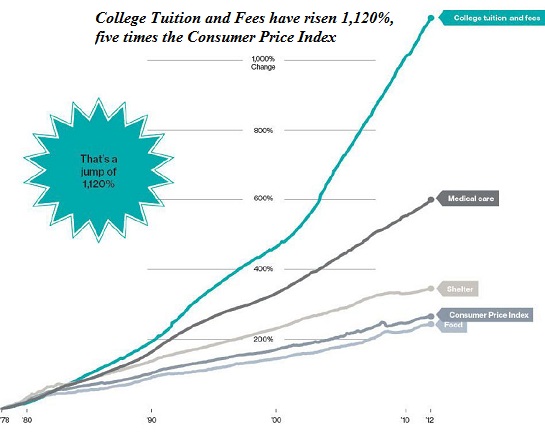
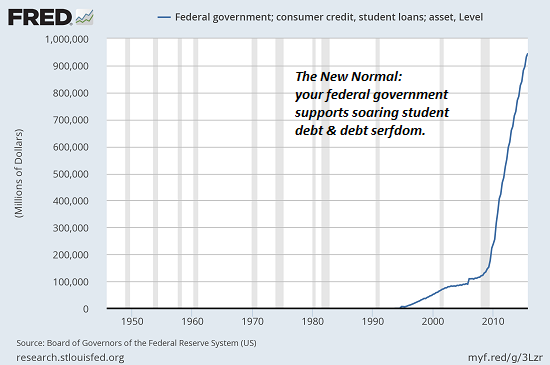
Let's start by admitting our system of higher education is unsustainable and broken: a complete failure by any reasonable, objective standard. Tuition has soared $1,100% while the output of the system (the economic/educational value of a college degree) has declined precipitously.
A recent major study, Academically Adrift: Limited Learning on College Campuses, concluded that "American higher education is characterized by limited or no learning for a large proportion of students."
'Academically Adrift': The News Gets Worse and Worse (The Chronicle of Higher Education)
These two charts are the acme of unsustainability: college tuition has skyrocketed, along with federally funded student loan debt.
The typical graduate of a short, intense directed apprenticeship says "I learned more in a month here than I did in four years of college." This is a statement of fact, and it is the result of the methods deployed in structured on-the-job training.
It is a fact that passively listening to a lecture does not generate the sort of mastery that creates economic value or the sort of deep understanding that is the goal of a classic liberal arts education.
It's also a fact that rote practice also doesn't lead to mastery, and often kills the very passion for a subject that in more productive programs jumpstarts mastery.
Our higher educational system has failed so badly that many students are incapable of writing/communicating effectively. In a world of rapidly changing technologies across every field and an emerging economy that places an ever-higher premium on collaboration and clear communication across multiple time zones and languages, the ability to write clearly is absolutely essential.
To "graduate" students with poor writing skills is completely unforgivable. Yet in the current system, if a student logs the requisite number of credits, a diploma is duly issued, regardless of how little he/she actually learned.
Here's a six-month program that could replace four years of hyper-costly, ineffective university.
1. Teach the students how to learn on their own, for the rest of their lives. This could take as little as a few hours or days. Once a student learns how to pursue deep learning and deep practice on their own, they don't need years of classrooms--they just need the guidance of someone experienced in the field, i.e. a structured apprenticeship.
2. One semester in a wide variety of on-the-job experiences. Once students are given real experience in a variety of fields and industries, it's likely some spark of ignition will occur and they'll find the motivation to pursue real mastery instead of a worthless credential.
3. Directed apprenticeships plus online lectures/workshops by the best lecturers viewed before or after the students' real work. The key to learning deeply and learning fast is to push right up against the current level of competence, where failure occurs and can be addressed one piece at a time.
Interestingly, Coyle notes that the most successful incubators of talent around the world are generally in makeshift or decrepit buildings, not fancy new gleaming buildings of the sort that dot American college campuses. Surrounded by luxury, who feels any hunger to learn anything voraciously?
The entire "campus experience" should be jettisoned, not just as an overly expensive infrastructure but as a detriment to fast, deep learning that is the foundation of mastery.
It isn't that hard to teach students how to improve their writing/communications skills very quickly, and give them a taste of the classic liberal arts education so many people claim is the goal of $120,000 four-year programs that fail to generate a deep understanding of anything remotely leading to mastery.
Give them a single sentence by Melville, Austin, et al. and have them compose a sentence that is like the original in cadence, structure and meaning in one minute flat. Go, go, go. Then break down each phrase and each component and work through each one to improve their first efforts, step by step. Repeat the process, always under intense time pressure.
Then take them out into the real world to report a journalistic story by interviewing people, checking facts, confirming quotes from sources, question the received wisdom around the topic and compose the story in journalistic style. Once again, break down their efforts line by line in comparison with a professional journalists' story on the same topic.
Then, in the second class... more doing the work at a breakneck pace, more being pushed beyond their current level of expertise, more corrections of errors and weaknesses, step by step, in a pressure-cooker of deadlines.
I can pretty much guarantee the students in such a directed apprenticeship will learn more about writing in a week than they would in a year of conventional coursework.
Short, intense directed apprenticeships that teach students how to learn on their own to mastery are the future of higher education. We can continue to squander trillions of dollars on an ineffective system until it finally collapses under its own weight, or we can admit the current contraption is unsustainable and a failure, and move on to a better, cheaper system.

A Radically Beneficial World: Automation, Technology and Creating Jobs for All is now available as an Audible audio book.
My new book is #2 on Kindle short reads -> politics and social science: Why Our Status Quo Failed and Is Beyond Reform ($3.95 Kindle ebook, $8.95 print edition)For more, please visit the book's website.

NOTE: Contributions/subscriptions are acknowledged in the order received. Your name and email remain confidential and will not be given to any other individual, company or agency.
Thank you, Lance D. ($5/month), for your outstandingly generous re-subscription to this site-- I am greatly honored by your steadfast support and readership.

Read more...

Wednesday, June 01, 2016

Flexible Labor Is the Future

Flexible labor is the future for the basic reason that it is the only viable model going forward.
If we can't go forward, then let's go back: this is the guiding philosophy of the labor movement that seeks security via strict work rules. The premise here is simple: employers could provide their employees with secure employment if only they weren't so greedy.
Unfortunately, it isn't this simple. Even the most generous employers--for example, worker-owned co-ops and state-owned enterprises--must generate a profit that can be reinvested to replace obsolete equipment and boost productivity.
To get guaranteed employment security, you must first guarantee profits that can be reinvested to keep the enterprise afloat.
In today's world of global competition and stagnation, guaranteed profits and guaranteed employment security are both scarce. What could be more guaranteed than profits from oil? Oops. How about offering ObamaCare/ACA health plans? Oops. It turns out profits, even in supposedly rock-solid industries, are not guaranteed.
As a result, the entire idea that employers facing a rocky, uncertain future can guarantee employees anything is nonsensical. Flexible labor is the future for the basic reason that it is the only viable model going forward.
Even the most secure employer--the government--will start shifting to flexible-labor models once local government revenues start drying up and generous salaries-pension-benefits packages become unaffordable.
Rather than attempting to go back to a model that has evaporated, we have to move forward to a model in which employment security is not based on any employer. I sketch out just such a model in my book A Radically Beneficial World.
The insanity of basing employees' security on any employer's ability to permanently navigate increasingly treacherous waters is a core reason why healthcare in the U.S. is a mess: the obvious solution is a system in which employees have health coverage regardless of the financial health and stability of their employer of the moment.
I call the model of flexible labor that shifts to fill whatever scarcities arise mobile creatives. In this model, security is generated by multiple income streams from a broad network of clients, customers and collaborators.
Rather than rely on a single industry and employer to provide security, the mobile creative gains security from a dynamic network of paid work across a variety of industries and fields.
Mobile creatives operate by the principle trust your network, not the corporation or the state. Chasing after security by demanding the impossible of corporations or the state only guarantees failure of the entire system.
It would be nice if we could go back to a time in which employees could count on one employer to provide guaranteed employment for life--but we can't. Even the 20% of the work force that works for the government will have to adapt eventually, as the government itself lives off private-sector profits and wages.
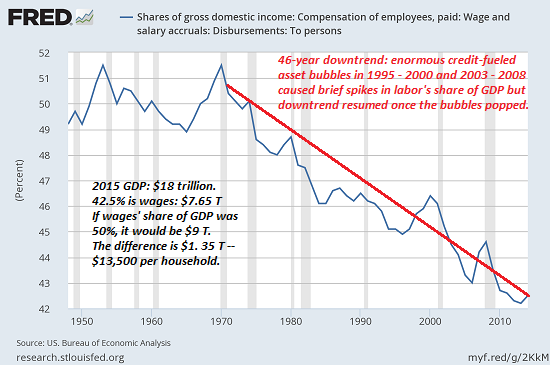
And as this chart shows, wages as a share of GDP have been declining for decades:
We can't go back, so we must go forward. It is possible to create employment security, but it can't be forced by imposing guarantees on employers. If employers can't respond flexibly to a dynamic global economy, their only choice will be to shut down. When that happens, everyone loses.

A Radically Beneficial World: Automation, Technology and Creating Jobs for All is now available as an Audible audio book.
My new book is #2 on Kindle short reads -> politics and social science: Why Our Status Quo Failed and Is Beyond Reform ($3.95 Kindle ebook, $8.95 print edition)For more, please visit the book's website.

NOTE: Contributions/subscriptions are acknowledged in the order received. Your name and email remain confidential and will not be given to any other individual, company or agency.
Thank you, Wilson L. ($50), for your massively generous contribution to this site-- I am greatly honored by your support and readership.

Read more...

Terms of Service

All content on this blog is provided by Trewe LLC for informational purposes only. The owner of this blog makes no representations as to the accuracy or completeness of any information on this site or found by following any link on this site. The owner will not be liable for any errors or omissions in this information nor for the availability of this information. The owner will not be liable for any losses, injuries, or damages from the display or use of this information. These terms and conditions of use are subject to change at anytime and without notice.

RE: European Union AI Act, and Our Use of Generative AI Tools and Agents Policy

All text on this site is composed by Charles Hugh Smith or by a credited guest-author. No Generative AI Tools are used in the composition / writing of any text or graphic content created by Charles Hugh Smith. This site deploys no AI agents or generative AI tools. This site is not responsible for the disclosures, use or non-use of AI agents or generative AI tools in advertisements displayed by Investing Channel or other ad placement services.

Audio files generated by text-to-audio transcription tools are identified as such.

Our Privacy Policy:

Correspondents' email is strictly confidential. This site does not collect digital data from visitors or distribute cookies. Advertisements served by third-party advertising networks such as Investing Channel may use cookies or collect information from visitors for the purpose of Interest-Based Advertising; if you wish to opt out of Interest-Based Advertising, please go to Opt out of interest-based advertising (The Network Advertising Initiative) If you have other privacy concerns relating to advertisements, please contact advertisers directly.

PRIVACY NOTICE FOR EEA INDIVIDUALS

This section covers disclosures on the General Data Protection Regulation (GDPR) for users residing within EEA only. GDPR replaces the existing Directive 95/46/ec, and aims at harmonizing data protection laws in the EU that are fit for purpose in the digital age. The primary objective of the GDPR is to give citizens back control of their personal data. Please follow the link below to access InvestingChannel's General Data Protection Notice.
https://stg.media.investingchannel.com/gdpr-notice/

Notice of Compliance with The California Consumer Protection Act

This site does not collect digital data from visitors or distribute cookies. Advertisements served by a third-party advertising network (Investing Channel) may use cookies or collect information from visitors for the purpose of Interest-Based Advertising. If you do not want any personal information that may be collected by third-party advertising to be sold, please follow the instructions on this page: Do Not Sell My Personal Information.

Regarding Cookies:

This site does not collect digital data from visitors or distribute cookies. Advertisements served by third-party advertising networks such as Investing Channel may use cookies or collect information from visitors for the purpose of Interest-Based Advertising; if you wish to opt out of Interest-Based Advertising, please go to Opt out of interest-based advertising (The Network Advertising Initiative) If you have other privacy concerns relating to advertisements, please contact advertisers directly.

Our Commission Policy:

Though I earn a small commission on Amazon.com books and gift certificates and gold (BullionVault) purchased via links on my site, I receive no fees or compensation for any other non-advertising links or content posted on my site.

Copyright Notice:

All original images (Drawings and Photographs), text (essays, books and works of fiction), audio and video recordings, musical compositions, graphic design, graphic design elements and HTML coding on this site are the copyrighted work of Charles Hugh Smith unless otherwise credited or noted. They are published as information for the private use of site visitors, and any reproduction or redistribution of this content or coding in any media in any format or distribution channel (text, audio, video/film, web) without the written permission of the copyright holder is strictly prohibited. All rights in all media reserved globally.

  © Blogger templates Newspaper III by Ourblogtemplates.com 2008

Back to TOP