





Sunday, January 28, 2018

The Pie Is Shrinking for the 99%

The ensuing social disunity and disruption will be of the sort many alive today have never seen.
Social movements arise to solve problems of inequality, injustice, exploitation and oppression. In other words, they are solutions to society-wide problems plaguing the many but not the few (i.e. the elites at the top of the wealth-power pyramid).
The basic assumption of social movements is that Utopia is within reach, if only the sources of the problems can be identified and remedied.  Since inequality, injustice, exploitation and oppression arise from the asymmetry of power between the few (the financial and political elites) and the many, the solution is a reduction of the asymmetry; that is a tectonic realignment of the social structure that shifts some power—economic and/or political—from the few to the many.
In some instances, the power asymmetry is between ethnic or gender classes, or economic classes (for example, labor and the owners of capital).
Social movements are characterized by profound conflict because the beneficiaries of the power asymmetry resist the demands for a fairer share of the power and privileges, while those who’ve held the short end of the stick have tired of the asymmetry and refuse to back down.
Two dynamics assist a social, political and economic resolution that transfers power from those with too much power to those with too little power: 1) the engines of the economy have shifted productive capacity definitively in favor of those demanding their fair share of power, and 2) the elites recognize that their resistance to power-sharing invites a less predictable and thus far more dangerous open conflict with forces that have much less to lose and much more to gain.
In other words, ceding 40% of their wealth-power still conserves 60%, while stubborn resistance might trigger a revolution that takes 100% of their wealth-power.
History provides numerous examples of these dynamics.  Once the primary sources of wealth-generation shifted from elite feudal landowners to merchants and industrialists, the wealth (and thus the political power) of the landed elites declined. As the industrialists hired vast numbers of laborers drawn from small farms and workshops, this mass industrialized labor became the source of the wealth generation; after decades of conflict, this labor class gained a significant share of the wealth and political power.
The civil rights and women’s liberation movements realigned the political and economic power of minorities and females more in line with their productive output, reducing the asymmetries of ethnic and gender privileges.
In broad-brush, progressive social movements seek to broaden opportunities and level the playing field by reducing the asymmetric privileges of dominant classes defined by power and privilege.  The core mechanism of this transition is the recognition and granting of universal human rights: the right to vote, the right to equal opportunity, and rights to economic security, i.e. entitlements that are extended universally to all citizens for education, healthcare, old-age pensions and income security.
Again in broad-brush, these movements have largely been categorized as politically Left, though many institutions deemed conservative (for example, various churches) have often provided bedrock support for progressive movements.
Social movements which seek to limit the excesses of state power tend to be categorized as conservative or politically Right, as they seek to realign the asymmetry of power held by the state in favor of the individual, family and the traditional social order.
The Expanding Pie Fueled Expanding Entitlements
Writer Ugo Bardi recently drew another distinction between Left and Right social movements: “Traditionally, the Left has emphasized rights while the Right has emphasized duties.”
As rights manifested as economic entitlements rather than political (civil liberty) entitlements, rights accrue economic costs. As Bardi observes: “Having rights is nicer than having duties, but the problem is that human rights have a cost and that this cost was paid, so far, by fossil fuels. Now that fossil fuels are on their way out, who's going to pay?”
I would argue that the cost was also paid by higher productivity enabled by the technological, financial and social innovations of the Third Industrial Revolution, roughly speaking the interconnected advances of the second half of the 20th century.
These advances can be characterized as expanding the economic pie; that is, generating more energy, credit, technological tools, opportunities, security and capital (which includes financial, infrastructural, intellectual and social capital) for all to share in a socio-political-financial allocation broad enough to make everyone feel like they were making some forward progress.
This long-term, secular expansion of the pie naturally generated more demands for additional entitlements and rights, as the economy could clearly support the extra costs of allocating additional wealth and resources to the many.  From the point of view of the few (the elites), their own wealth continued expanding, so there was little resistance to expanding retirement, education and healthcare entitlements.
But in the 21st century, the expansion of the pie stagnated, and for many, it reversed. Adjusted for real-world inflation many households have seen their net incomes and wealth decline in the past decade.
Despite the endless media rah-rah about “growth” and “recovery,” it is self-evident to anyone who bothers to look beneath the surface of this facile PR that the pie is now shrinking. This dynamic is increasing inequality rather than reducing it.
The Shrinking Pie And Stagnant Productivity
It is a truism of economics that widespread increases in productivity are required to generate equally widespread increases in income and capital, i.e. productive wealth. To the consternation of many, productivity has stagnated since 2010; no wonder household income for all but the upper crust has gone nowhere.
If we glance at a chart of productivity, we see a strong correlation with speculative investment bubbles (the dot-com and housing bubbles 1995-2005) and speculative spikes fueled by central bank monetary stimulus (2009-10).  Absent bubbles and monumental excesses of central bank stimulus, productivity quickly sinks to its secular trend line: downwards.
Chart of US productivity growth since 1980
This next chart depicts the long-term trend line of productivity through all four industrial revolutions. Note the decline concurrent with the 4th Industrial Revolution (mobile telephony, the Internet, AI, robotics, peer-to-peer networks, etc.) and the depletion of cheap-to-access-and-refine oil:
Chart of declining GDP per capita over the past 2 centuries
The unwelcome reality is that the economy is changing in fundamental ways that cannot be reversed with policy tweaks, protests or wishful thinking.
Consider the percentage of the gross domestic product (GDP) that goes to employee compensation (wages and salaried). Labor’s share of the GDP has been in a downtrend since 1970, which not coincidentally was the peak of secular productivity:
Chart showing wages becoming a smaller percentage of GDP over time
In this below chart of the distribution of wealth in the U.S., we find the same correlation to the downtrends in productivity and labor’s share of the economy.  The bottom 90% of households' (the many) share of the wealth pie topped out in the early 1980s and has declined precipitously since, while the wealth of the top 0.1% (the few) has more than tripled since the late 1970s:
Distribution of Wealth In the US since 1917
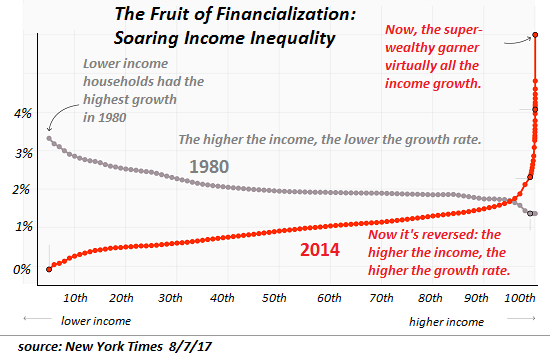
This next chart depicts the remarkable (and recent) spike income growth the few have recently enjoyed, at the expense of everyone else:
Chart showing Soaring Income Inequality
The increase in wealth and income inequality and the decline of productivity and labor’s share of GDP are the result of structural changes in the economy, changes with far-reaching consequences.
While it’s appealing to identify policies endorsed by self-serving insiders and elites as the source of these changes, that is far from the whole story. Much of this growing asymmetry stems from profound changes in the global economy that depreciate labor (as conventional labor is no longer scarce) and increase the gains of the top few in a “winner take most” allocation that benefits speculation, leverage and new ways of organizing labor and capital that reward the organizers far more than the users/participants.
In this new era of a steadily shrinking pie, the sources of inequality and related social problems have also shifted.  As a result, the social movements that were effective in the past are no longer effective today. Attempts to address rising inequality with the old tools are fueling frustration rather than actual solutions.
In Part 2 — Social Unrest: The Boiling-Over Point, we examine why our existing models for social change have slipped into ineffectual symbolic gestures that fuel fragmentation and frustration -- and why that will lead to a dangerous boiling over of the 99% against the elites controlling the system.
When that happens (inevitable on our current trajectory), the ensuing social disunity and disruption will be of the sort many alive today have never seen.
Click here to read Part 2 of this report (free executive summary, enrollment required for full access)
This essay was first published on peakprosperity.com, where I am a contributing writer.

My new book Money and Work Unchained is $9.95 for the Kindle ebook and $20 for the print edition.
Read the first section for free in PDF format.

If you found value in this content, please join me in seeking solutions by becoming a $1/month patron of my work via patreon.com.

NOTE: Contributions/subscriptions are acknowledged in the order received. Your name and email remain confidential and will not be given to any other individual, company or agency.

Thank you, Eugene R.J. ($5/month), for your superbly generous pledge to this site -- I am greatly honored by your support and readership.
Thank you, Clayton G. ($5/month), for your splendidly generous pledge to this site -- I am greatly honored by your support and readership.

Read more...

Thursday, January 25, 2018

Can We Finally Have an Honest Discussion about the Opioid Crisis?

The economy no longer generates secure, purposeful jobs for the working class, and so millions of people live in a state of insecure despair.
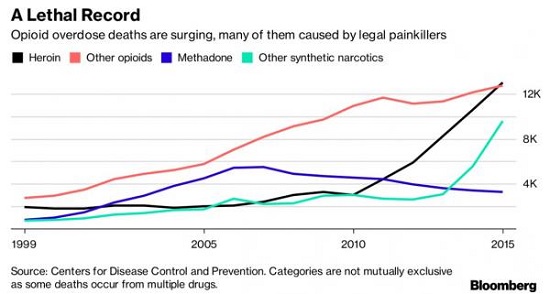
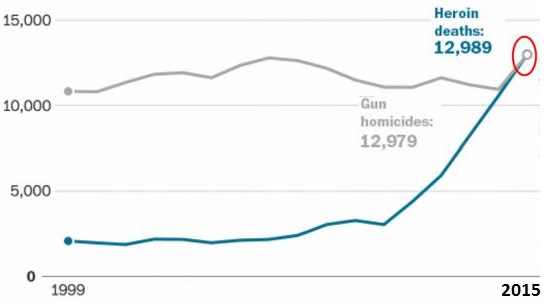
The opioid epidemic is generating a lot of media coverage and hand-wringing, but few if any solutions, and this is predictable: if you don't face up to the causes, then you can't solve the problem. America is steadfastly avoiding looking at the causes of the opioid crisis, which is soberly reflected in these charts of soaring opioid-caused deaths:
If we are going to have an honest conversation about the opioid epidemic, then we need to recognize the real causes of the epidemic:
1. The Pharmaceutical industry falsely claimed synthetic opioids were non-addictive, and a complicit, toothless regulatory system did nothing, egged on by politicians who were bought off by mega-bucks campaign contributions from Big Pharma.
2. Our sickcare system is very good at over-prescribing painkillers as a substitute for treating the source of the pain, which is often complex. Our "healthcare" system, much of which consists of endless TV adverts promoting one costly medication after another, is basically a conduit from Big Pharma to poorly informed "consumers" (quaintly referred to as "patients" to mask the actual dynamic).
This system has trained "consumers" to expect a magic pill for every ailment or pain, and any doctor who refuses to over-prescribe is risking blowback from the "patients" and the rest of the system. Americans have been trained to avoid treatments that require effort and changing their lifestyle; they demand a magic pill that works right away, with no effort required.
3. The economy no longer generates secure, purposeful jobs for the working class, and so millions of people live in a state of insecure despair, a state devoid of purpose, meaning, and ways to contribute to their families and communities. People stripped of meaningful livelihoods are prone to finding escape in destructive addictive drugs and habits.
4. The counterproductive War on Drugs has effectively outlawed cannabis for decades, depriving the public of a pain-reducing natural product. While the law-enforcement status quo, exemplified by Attorney General Jeff Sessions, still makes factually false claims about the dangers of cannabis, the truth is that if cannabis were legal, affordable and easily available, tens of thousands of Americans would still be alive, because cannabis doesn't kill people and you can't overdose on it.
Go ahead and do your own research: I couldn't find a single verified instance of a cannabis-caused death in the U.S. when I sought verifiable statistics on cannabis-caused deaths a few years ago.
So while law enforcement got helicopters and other toys to play with and the War on Drugs Gulags filled up with citizens who should never have been imprisoned, the War on Drugs has killed tens of thousands by outlawing a safe pain-killer and legalizing deadly, highly addictive pain-killers because those deadly, highly addictive pain-killers reaped Big Pharma billions of dollars in profits.
It doesn't have to be this way. We have the means to generate meaningful work in our communities--I've laid out one system to accomplish this in my book A Radically Beneficial World.
We should legalize cannibis immediately at the federal level. While law-enforcement bureaucracies will mourn the slashing of their bloated War on Drugs budgets, the nation will finally put the destructive, failed, counter-productive War on Drugs in the ash heap of history.
You can't just give people and communities a subsistance entitlement like Universal Basic Income (UBI) and expect them to thrive. If we look deeply into the opioid epidemic, we find a crisis of purposelessness fueled by a lack of meaningful work and ways to contribute and earn financial security by serving others in the community.
If we don't face up to the essential role of meaningful work in human fulfillment and security, then we'll never solve our addicition epidemic and all the related social ills.
I explore these issues in my new book Money and Work Unchained.


My new book Money and Work Unchained is $9.95 for the Kindle ebook and $20 for the print edition.
Read the first section for free in PDF format.


If you found value in this content, please join me in seeking solutions by becoming a $1/month patron of my work via patreon.com.

NOTE: Contributions/subscriptions are acknowledged in the order received. Your name and email remain confidential and will not be given to any other individual, company or agency.

Thank you, Bob C. ($5/month), for your marvelously generous pledge to this site -- I am greatly honored by your support and readership.
Thank you, Albert S. ($5/month), for your wondrously generous pledge to this site -- I am greatly honored by your support and readership.

Read more...

Sunday, January 21, 2018

Central Banks: From Coordination to Competition

This is one reason why I anticipate "unexpected" disruptions in the global economy in 2018.
The mere mention of "central banks" will likely turn off many readers who understandably have little interest in convoluted policies and arcane mumbo-jumbo, but bear with me for a few paragraphs while I make the case for something to happen in 2018 that will impact us all to some degree.
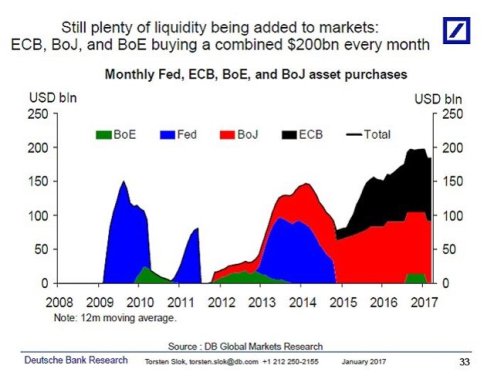
That something is the decay of the synchronized central bank stimulus policies that have pumped trillions of dollars, yuan, yen and euros into the global financial markets over the past nine years. Here are two charts that depict the "tag team" coordinated approach central banks have deployed: when one CB tapers its stimulus, another ramps up its money-creation/asset-purchases stimulus:
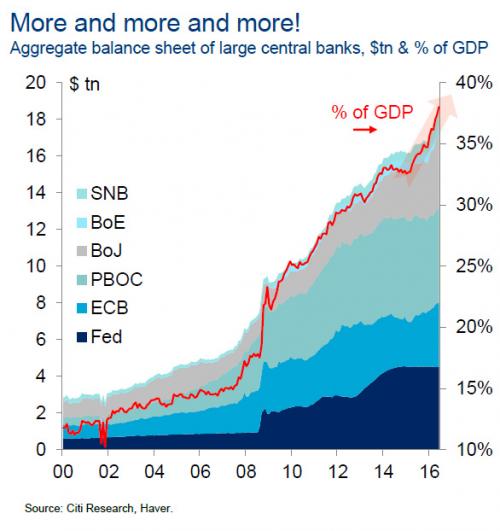
The balance sheets of all the primary central banks added together is astronomical:
This team effort is motivated by self-interest, of course; no one central bank can reflate the entire global economy, and yet that is the only way to reflate each nation/bloc's own economy, given the global connectedness of the modern economy.
But the threads of mutual self-interest are fraying. At this late stage in the credit cycle, the central banks must begin "tapering", i.e. diminishing and then ending their stimulus policies and eventually reducing their balance sheets by selling assets they bought in the stimulus phase (or simply stop replacing bonds they own that mature).
The Federal Reserve was first out of the gate in launching quasi-unlimited bond purchases, and it was the first central bank to cease stimulus (quantitative easing) and raise interest rates. It has now signaled that it will begin selling assets (i.e. stop replacing bonds that mature).
Those currencies/bonds that pay the highest interest (accounting for inflation, of will naturally attract global capital seeking a safe return above zero.
The net effect of this differentiation is that nations/blocs with near-zero yields will experience capital flight as money will flow to higher yields elsewhere.
The coordination of the stimulus phase will give way to nationalist self-interest in the tightening phase.
Those nations/blocs that need super-easy money and near-zero interest rates to keep their "growth" afloat will be drained of capital as capital goes to wherever it can earn more yield.
There's a further complicating factor: the relative strength of each nation's currency. This matters because as a currency appreciates, the issuing nation's exports cost more to buyers using their own currencies, and the nation with the appreciating currency loses the competitive edge of a cheap currency.
Since higher interest rates attract capital, they also tend to strengthen one's currency, as the relative value of currency is set by supply and demand: the more demand there is for the currency, the higher it goes relative the field of competing currencies.
There is a third factor as well: central banks need to reduce their balance sheets and raise interest rates, so they have some "policy accomodation" available to counter the next (and inevitable) recession/financial crisis.
The US has so far managed a hat-trick: it has raised interest rates a number of times, yet its currency, the US dollar, has lost over 15% of its value in 2017 compared to the Euro, which has gained 15+%.
There is a Darwinian twist to all this: any nation/bloc which manages to raise rates and end central bank stimulus without stifling its "recovery" or strengthening its currency to the point it hurts exports, and still be a global magnet for capital due to higher yields/rates, will have a substantial competitive advantage over its peers.
In effect, the self-interest that bound the central banks together in the stimulus phase reverses in the tightening/normalizing phase. Thus I anticipate a slow decay of central bank coordination and a rise of conflict/ competition, though this will of course be kept out of the media.
This is one reason why I anticipate "unexpected" disruptions in the global economy in 2018, as the coordinated stimulus phase ends and the disruptive, messy, Darwinian phase of tightening/ normalizing rates and balance sheets gathers momentum.


My new book Money and Work Unchained is $9.95 for the Kindle ebook and $20 for the print edition.
Read the first section for free in PDF format.


If you found value in this content, please join me in seeking solutions by becoming a $1/month patron of my work via patreon.com.

NOTE: Contributions/subscriptions are acknowledged in the order received. Your name and email remain confidential and will not be given to any other individual, company or agency.

Thank you, Yves V. ($5/month), for your marvelously generous pledge to this site -- I am greatly honored by your support and readership.
Thank you, Juan D. ($5/month), for your wondrously generous pledge to this site -- I am greatly honored by your support and readership.

Read more...

Thursday, January 18, 2018

It's Time to Retire "Capitalism"

Our current socio-economic system is nothing but the application of force on the many to enforce the skims, scams and privileges of the self-serving few.
I've placed the word capitalism in quotation marks to reflect the reality that this word now covers a wide spectrum of economic activities, very little of which is actually capitalism as classically defined. As I have explained here for over a decade, the U.S. economy is dominated by cartels and quasi-monopolies that are enforced by the Central State, a state-cartel system of financialized rentier skims that has no overlap with Adam Smith's free market, free enterprise concept,i.e. classical capitalism.
This is what passes for "capitalism" in modern-day America: the super-rich get super-richer, a thin slice of technocrats, speculators and entrepreneurs advance their wealth and the vast majority lose ground or stagnate:
Here's another snapshot of state-financier "capitalism" in modern-day America: the centralized organs of the state (the quasi-public Federal Reserve) creates trillions of dollars and hands the nearly free money to financiers, insiders and speculators, all of whom benefit immensely as this flood of cash pushes stocks into the stratosphere:
There are other versions of "capitalism" that are equally rapacious, all of which are iterations of crony-capitalism: gangster-capitalism, theocratic-capitalism, colonial-capitalism, and so on.
The key feature of these forms of organized pillage that mask their predatory nature by claiming to be "capitalist" is they ruthlessly suppress the three core dynamics of classical capitalism:
1. Competition
2. Open/free markets
3. Free flow of capital in all its forms (financial, social, intellectual, etc.)
The only way the few can pillage the many is if the many are denied access to competition, open markets and freely flowing capital. All the predatory, parasitic and exploitive systems that hide behind the word "capitalism" skim the wealth of the many into the hands of the few by limiting competition (cartels and monopolies such as sickcare and higher education), controlling markets (you must buy from the state-mandated cartels and monopolies) and and restricting capital to insiders, financial elites and cronies of the state--three terms that describe one elite.
Once the few eliminate competition, open markets and access to capital, the many are enslaved, regardless of how many times the magic words "democracy" and "capitalism" are invoked to cover the systemic exploitation.
I propose we start calling things by their real names: state-financier systems of rentier skims, and all the other predatory, parasitic exploitive systems operated by the few at the expense of the many will no longer get the cover of the word "capitalism." They will be called what they are: exploitive, predatory, parasitic pillaging that enriches a corrupt self-serving elite that is enforced by a corrupt, self-serving state.
I propose we call free-market, free-enterprise, voluntary systems STOC:sustainable, transparent, opt-in, competition.
These dynamics are the antithesis of the state-cartel hierarchies that dominate the global economy and that function by enriching the few at the expense of the many. If a system is a sustainable, transparent, opt-in free marketplace of open competition, no elite could wrest control of the system to benefit itself at the expense of all the other participants.
I've explained why centralized hierarchies have only one possible output: soaring inequality and injustice in my books Resistance, Revolution, Liberation, Why Things Are Falling Apart, Inequality and the Collapse of Privilege and Why the Status Quo Failed and is Beyond Reform
I've sketched out an alternative way of living in my books Money and Work Unchained and A Radically Beneficial World.
If an economic/financial system isn't sustainable, transparent, opt-in, and wide open to competition, it isn't capitalism--it's a self-serving rentier skim trying to mask its predatory, rapacious reality. Remember, good ideas don't require force, and our current socio-economic system is nothing but the application of force on the many to enforce the skims, scams and privileges of the self-serving few.
It's time to retire the word "capitalism" and strip the predatory, self-serving and thoroughly corrupt elite of their phony cover.


My new book Money and Work Unchained is $9.95 for the Kindle ebook and $20 for the print edition.
Read the first section for free in PDF format.


If you found value in this content, please join me in seeking solutions by becoming a $1/month patron of my work via patreon.com.

NOTE: Contributions/subscriptions are acknowledged in the order received. Your name and email remain confidential and will not be given to any other individual, company or agency.
Thank you, Tim B. ($50), for your marvelously generous contribution to this site -- I am greatly honored by your steadfast support and readership.
 
Thank you, Helen S. ($10/month), for your outrageously generous pledge to this site -- I am greatly honored by your support and readership.

Read more...

Sunday, January 14, 2018

The Fascinating Psychology of Blowoff Tops

Central banks have guaranteed a bubble collapse is the only possible output of the system they've created.
The psychology of blowoff tops in asset bubbles is fascinating: let's start with the first requirement of a move qualifying as a blowoff top, which is the vast majority of participants deny the move is a blowoff top.
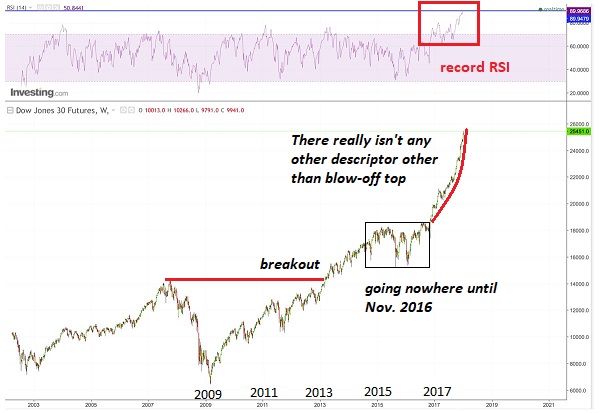
Exhibit 1: a chart of the Dow Jones Industrial Average (DJ-30):
Is there any other description of this parabolic ascent other than "blowoff top" that isn't absurdly misleading? Can anyone claim this is just a typical Bull market? There is nothing even remotely typical about the record RSI (relative strength index), record Bull-Bear ratio, and so on, especially after a near-record run of 9 years.
The few who do grudgingly acknowledge this parabolic move might be a blowoff top are positive that it has many more months to run. This is the second requirement of qualifying as a blowoff top: the widespread confidence that the Bull advance has years more to run, and if not years, then many months.
In the 1999 dot-com blowoff top, participants believed the Internet would grow at phenomenal rates for years to come, and thus the parabolic move higher was fully rational.
In the housing bubble's 2006-07 blowoff top, a variety of justifications of soaring valuations and frantic flipping were accepted as self-evident.
In the present blowoff top, the received wisdom holds that global growth is just getting started, and corporate profits will soar in 2018. Therefore current sky-high valuations are not just rational, they clearly have plenty of room to rise much higher.
Skeptics are derided as perma-bears who've been wrong for 9 long years. This is the third requirement of qualifying as a blowoff top: Bears and other skeptics are mocked and/or dismissed as irrelevant.
Meanwhile, observers who haven't drunk the punch recognize this as the final leg of a 9-year orgy of central bank stimulus. Pump $14 trillion into global financial assets and all sorts of wonderful things happen, especially if the central banks make it clear in public statements that they will "do whatever it takes," i.e. assets will not be allowed to decline.
Consider the psychology in play: central bankers have sought to convince private-sector players that central banks will never let markets decline, and so the smart strategy was to buy the dips, and buy every new high--in essence buy, buy, buy and don't bother hedging long positions, as there was no need to squander money on hedges against declines that would never happen.
Now the central banks are facing runaway asset bubbles that are the direct consequence of their promoting the belief that "central banks will never let markets go down."
So how do central banks deflate the bubbles gently? How do they change the market psychology without triggering a crash? If central banks cut off the stimulus, and send messages that "now we will let markets decline," then what's the rational response?Sell, and sell everything now rather than ride the bubble collapse down.
As I've noted before, "We live in a system of human emotions that masquerades as a science (economics)." Central bankers are deluding themselves if they think they can calibrate and fine-tune human emotions. When the Bullish certainty that "central banks have our backs" erodes, the switch to bearish impulses to sell before everyone else sells will be sudden and irreversible.
In other words, the central banks have guaranteed a bubble collapse is the only possible output of the system they've created.


My new book Money and Work Unchained is $9.95 for the Kindle ebook and $20 for the print edition.
Read the first section for free in PDF format.


If you found value in this content, please join me in seeking solutions by becoming a $1/month patron of my work via patreon.com.

NOTE: Contributions/subscriptions are acknowledged in the order received. Your name and email remain confidential and will not be given to any other individual, company or agency.

Thank you, David H. ($50), for your marvelously generous contribution to this site -- I am greatly honored by your support and readership.
Thank you, James T. ($50), for your splendidly generous contribution to this site -- I am greatly honored by your support and readership.

Read more...

Terms of Service

All content on this blog is provided by Trewe LLC for informational purposes only. The owner of this blog makes no representations as to the accuracy or completeness of any information on this site or found by following any link on this site. The owner will not be liable for any errors or omissions in this information nor for the availability of this information. The owner will not be liable for any losses, injuries, or damages from the display or use of this information. These terms and conditions of use are subject to change at anytime and without notice.

RE: European Union AI Act, and Our Use of Generative AI Tools and Agents Policy

All text on this site is composed by Charles Hugh Smith or by a credited guest-author. No Generative AI Tools are used in the composition / writing of any text or graphic content created by Charles Hugh Smith. This site deploys no AI agents or generative AI tools. This site is not responsible for the disclosures, use or non-use of AI agents or generative AI tools in advertisements displayed by Investing Channel or other ad placement services.

Audio files generated by text-to-audio transcription tools are identified as such.

Our Privacy Policy:

Correspondents' email is strictly confidential. This site does not collect digital data from visitors or distribute cookies. Advertisements served by third-party advertising networks such as Investing Channel may use cookies or collect information from visitors for the purpose of Interest-Based Advertising; if you wish to opt out of Interest-Based Advertising, please go to Opt out of interest-based advertising (The Network Advertising Initiative) If you have other privacy concerns relating to advertisements, please contact advertisers directly.

PRIVACY NOTICE FOR EEA INDIVIDUALS

This section covers disclosures on the General Data Protection Regulation (GDPR) for users residing within EEA only. GDPR replaces the existing Directive 95/46/ec, and aims at harmonizing data protection laws in the EU that are fit for purpose in the digital age. The primary objective of the GDPR is to give citizens back control of their personal data. Please follow the link below to access InvestingChannel's General Data Protection Notice.
https://stg.media.investingchannel.com/gdpr-notice/

Notice of Compliance with The California Consumer Protection Act

This site does not collect digital data from visitors or distribute cookies. Advertisements served by a third-party advertising network (Investing Channel) may use cookies or collect information from visitors for the purpose of Interest-Based Advertising. If you do not want any personal information that may be collected by third-party advertising to be sold, please follow the instructions on this page: Do Not Sell My Personal Information.

Regarding Cookies:

This site does not collect digital data from visitors or distribute cookies. Advertisements served by third-party advertising networks such as Investing Channel may use cookies or collect information from visitors for the purpose of Interest-Based Advertising; if you wish to opt out of Interest-Based Advertising, please go to Opt out of interest-based advertising (The Network Advertising Initiative) If you have other privacy concerns relating to advertisements, please contact advertisers directly.

Our Commission Policy:

Though I earn a small commission on Amazon.com books and gift certificates and gold (BullionVault) purchased via links on my site, I receive no fees or compensation for any other non-advertising links or content posted on my site.

Copyright Notice:

All original images (Drawings and Photographs), text (essays, books and works of fiction), audio and video recordings, musical compositions, graphic design, graphic design elements and HTML coding on this site are the copyrighted work of Charles Hugh Smith unless otherwise credited or noted. They are published as information for the private use of site visitors, and any reproduction or redistribution of this content or coding in any media in any format or distribution channel (text, audio, video/film, web) without the written permission of the copyright holder is strictly prohibited. All rights in all media reserved globally.

  © Blogger templates Newspaper III by Ourblogtemplates.com 2008

Back to TOP