


Tuesday, July 09, 2019

Predatory "Green Capitalism" Is Monetizing the Air, and It's Going to Cost You

You want to reduce CO2? Then trigger a global depression that reduces global consumption of everything by 50% and destroys 95% of the phantom wealth owned by the global elites trying to monetize the air.
I recently asked What's Left to Monetize?, and longtime correspondent Mark G. provided the answer: the air we breathe, via carbon taxes and markets for trading carbon credits, i.e. financializing / monetizing Nature to benefit the few at the expense pf the many.
Here's Mark's commentary:
You asked, "What's left to monetize? It appears the answer is 'very little.'"
I respectfully disagree. The Biggest Enchilada of all is left. Air. Specifically carbon dioxide, CO2. We just have to figure how to get the yokels to agree to pay for that which was formerly free. Got it! First we browbeat them into believing its evil and that we have to tax it to save all life on Earth. Then, following in the finest traditions of the degenerate late medieval Catholic Church, we'll commission sellers of "Indulgences" to allow sinning at ever rising prices. a/k/a "Carbon Credit trading". This doesn't require any value added and the profits on "buy zero sell high" are limitless.
This is the specific outline and the very same agencies that so love financialization of all kinds, $2 trillion dollar student debt to sustain obscenely paid college administrators and academics, endless academic credentialism and huge Hipster Cities sitting on container ports and mediating the China Trade, are all promoting this financialization of CO2 as hard as possible.
This is why a nullity like the Paris Climate Accords continues to be pushed even after its proven every way possible that a) the biggest emitters like China and India won't adhere to them and b) even if they did the prescribed regimes will do nothing anyway.
And its why I "don't believe" in it. Or rather, its why I believe its just the next and biggest financial scam.
Thank you, Mark, for answering my naive question: of course Wall Street and the Davos Crowd are salivating over the hundreds of billions of profits to be skimmed from carbon taxes and trading. Not that corporations, financiers or billionaires will pay the carbon taxes; they will be passed on to consumers of everything that emits CO2, i.e. pretty much everything, including us of course.
Never mind that plant life needs CO2, and that planting trees could soak up the carbon at a fraction of the cost of neoliberal carbon taxes/credits; the goal of the "environmentalists" flying in on their private jets isn't to actually reduce CO2--it's to engineer a new source of rentier profits via monetizing / financializing CO2.
Here's the neoliberal fantasy that's being sold and sold hard: making a market for carbon credits etc. will magically cause those paying more for emitting carbon to emit less.
This is the Neoliberal Skim/Scam: privatizing what was once free and funneling the profits to the few at the expense of the many. Call it rentier, call it exploitation, call it predatory-- all are accurate.
So streets that once offered free parking now have parking meters that have been privatized to benefit private-sector corporations.
The neoliberal predators have come up with a new sales pitch to cover their predation: "green capitalism," the notion that sending all the Bad Things to the landfill and replacing them with very costly (and oh so profitable to global corporations and financiers) Good Things will magically save a status quo dependent on "Growth" while also magically reducing CO2.
Wrong on all counts.If we measure the full lifecycle costs and environmental burdens of the Good Things (all electric vehicles, etc.), we find that replacing all the existing stuff on the planet will actually increase CO2 immensely--the reduction is trivial while the CO2 emitted in the extraction, processing, manufacture, transport and maintenance of the replacement stuff (i.e. "Growth") will vastly increase CO2, as will all the green capitalists' private jets.
As Mark pointed out, the majority of CO2 is emitted by nations that have no interest in reducing CO2, nor will they pay carbon taxes or play Wall Street's game of trading carbon credits.
So the net result of neoliberal "green capitalism" is higher CO2 and hundreds of billions of dollars of wealth skimmed from those who can least afford it while Al Gore and the rest of the Davos / NGO / philanthro-capitalist elites jet in for another "green" conference.
There is nothing remotely capitalist in the traditional sense in this Neoliberal Predation: no new products or services are created, no value is created, and CO2 isn't reduced; it's pure exploitation of the powerless who have been brow-beaten into believing the skim/scam is somehow "environmental."
Longtime correspondent Simon H. submitted a series of links for those who wish to know more about the hijacking of the environmental movement by predatory "green capitalism":
The global movement calling for action on climate change has captured the imagination and enthusiasm of thousands of people who care about the future of our world.
However, alarming evidence has emerged, suggesting that this movement is being manipulated by business interests who aim not to save the planet but to save capitalism, not to halt the environmental crisis but to profit from it, not to protect nature but to commodify it.
We don’t want the powerful positive energy of nature lovers and environmentalists to be shunted into the sterile dead end of 'green capitalism', used as a PR tool to make it easier for governments to raid our collective piggy banks and channel trillions of pounds and dollars into the pockets of venture capitalists who have leapt aboard the 'climate justice' bandwagon in the hope of getting very rich.
For this reason we have put together this page of useful links, so people can study the evidence and come to their own conclusions.
For those who prefer facts to hyperbole in service of predatory private wealth, here's a chart of China's energy production: dirty CO2-spewing coal is the primary source.
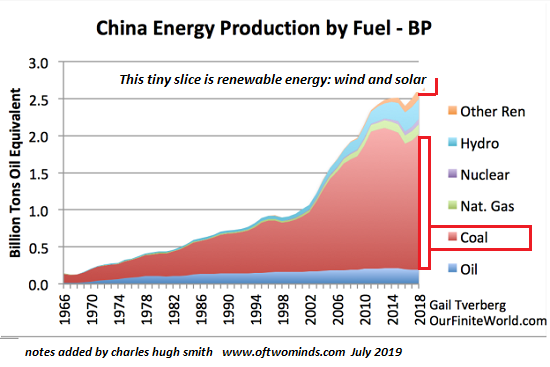
This mirrors the global reality: renewables are still signal noise, and carbon taxes and trading credits will do nothing to change this.
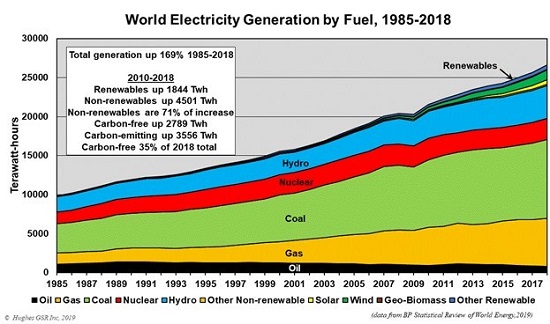
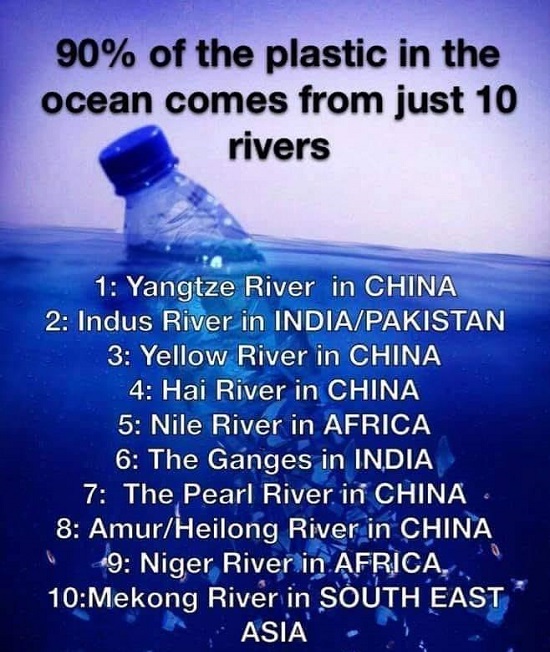
Plastic pollution tracks CO2 and a variety of related environmental burdens:The primary sources are in Asia and developing nations. So enforcing bogus carbon trading in North America and Europe will do essentially nothing to address the actual sources of CO2 and other industrial / consumer pollutants.
You want to reduce CO2? Then trigger a global depression that reduces global consumption of everything by 50% and destroys 95% of the phantom wealth owned by the global elites trying to monetize the air.

Of related interest:

Pathfinding our Destiny: Preventing the Final Fall of Our Democratic Republic ($6.95 ebook, $12 print, $13.08 audiobook): Read the first section for free in PDF format.


My new mystery The Adventures of the Consulting Philosopher: The Disappearance of Drake is a ridiculously affordable $1.29 (Kindle) or $8.95 (print); read the first chapters for free (PDF)
My book Money and Work Unchained is now $6.95 for the Kindle ebook and $15 for the print edition. Read the first section for free in PDF format.


If you found value in this content, please join me in seeking solutions by becoming a $1/month patron of my work via patreon.com. New benefit for subscribers/patrons: a monthly Q&A where I respond to your questions/topics.

NOTE: Contributions/subscriptions are acknowledged in the order received. Your name and email remain confidential and will not be given to any other individual, company or agency.
Thank you, Allison and Donna I. ($120), for your outrageously generous contribution to this site-- I am greatly honored by your steadfast support and readership.

Read more...

Sunday, July 07, 2019

When Everything from Bat Guano to Quatloos Is Soaring, Speculative Euphoria Has Reached an Extreme

The more extreme the speculative euphoria, the greater the risks of a reversal.
When every asset from bat guano to quatloos is soaring, the current speculative frenzy has reached extremes. We all know the quasi-religious faith driving the euphoria: central banks will push all assets higher as they pursue extremes of "easing."
In other words, asset valuations don't need to make any sense; just buy now and you'll be rewarded with guaranteed gains thanks to central banks. This strategy has worked exceedingly well for 10 years, so why won't it work for another decade?
Put another way: central banks have created a speculative monster. The public cover for central bank easing has always been to "stimulate growth" in the real economy, but the real effect has been to concentrate the newly issued currency and leverage ("money") in the few hands that own most of the speculative ("risk on") assets. This pool of new money has been augmented by cheap credit for global corporations, enabling management to buy back trillions of dollars of stock, thereby enriching stock holders and those collecting stock options as part of their management compensation.
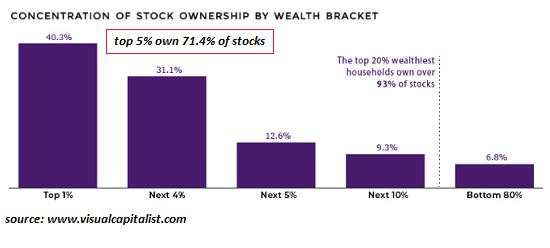
Those reaping billions of dollars in asset gains will not tolerate any reduction in central bank largess. This is the monster the Federal Reserve and other central banks have created: a monster that wields tremendous political power due to its immense wealth and equally potent market power. Any extended sell-off panics the politicos, pundits and peons alike, as everyone has bought into the cargo-cult fiction that a soaring market somehow helps the 95% who own zero or trivial amounts of speculative assets.
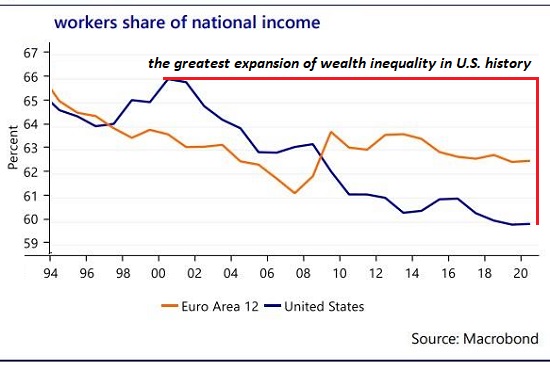
As this chart shows, soaring markets don't trickle down to labor's share of the economy. No matter how high stocks rise, Uber drivers are still scraping by unless they get a generous tip from a Unicorn-went-public millionaire.
Stocks owned by what's left of the middle class are locked up in IRAs, 401ks and other retirement accounts, so the owners have to hope the speculative bubble won't burst before they have a chance to start withdrawing their retirement funds.
The more extreme the speculative euphoria, the greater the risks of a reversal.As Lao Tzu observed, the way of the Tao is reversal, and a fever-pitch extreme of speculative euphoria makes an equally extreme decline inevitable as gargantuan asymmetries unwind.
Until that moment arrives, the confidence of everyone buying bat guano futures, quatloos, stocks, bonds, etc. will be very high, as they trust the Speculative Monster must be fed regardless of the cost.
But speculative extremes eventually reverse, regardless of the monster's agonizing screams.


Pathfinding our Destiny: Preventing the Final Fall of Our Democratic Republic ($6.95 ebook, $12 print, $13.08 audiobook): Read the first section for free in PDF format.


My new mystery The Adventures of the Consulting Philosopher: The Disappearance of Drake is a ridiculously affordable $1.29 (Kindle) or $8.95 (print); read the first chapters for free (PDF)
My book Money and Work Unchained is now $6.95 for the Kindle ebook and $15 for the print edition. Read the first section for free in PDF format.


If you found value in this content, please join me in seeking solutions by becoming a $1/month patron of my work via patreon.com. New benefit for subscribers/patrons: a monthly Q&A where I respond to your questions/topics.

NOTE: Contributions/subscriptions are acknowledged in the order received. Your name and email remain confidential and will not be given to any other individual, company or agency.
 
Thank you, Tim B. (60), for your marvelously generous contribution to this site-- I am greatly honored by your steadfast support and readership.
 

Read more...

Thursday, July 04, 2019

What's Left to Monetize?

What's left to monetize? It appears the answer is "very little."
Advertising has always monetized consumers' time and attention, what we call engagement today. Newspapers and periodicals publish advertisements, radio/TV networks and stations air adverts, movie theaters run trailers/ads, billboards occupy our mental space while driving and websites and apps post adverts. The more media you consume, the more adverts you see/hear, and the more time you spend consuming media, the greater your exposure to advertising.
Monetizing our time and attention has a long history, as does the monetizing encroachment on what was once private time / attention. Time spent on the telephone escaped monetization until the advent of telemarketing, a particularly invasive and galling conquest of what was once a private domain. Now thanks to voicemail and robo-calling, our phones are increasingly the domain of intrusive monetization. (Is anyone else getting endless voicemails pitching services in Mandarin Chinese?)
No visual space has been left unmonetized: shopping carts display adverts, the plastic dividers between customers' groceries in the checkout display adverts, even the floors of stores display adverts.
Many forms of communication have been rendered essentially unusable by monetization. Many people no longer look at their email since it has been taken over by spam, and many of those with landline phones no longer answer their phones due to the constant robo-calls.
Big Tech has generated billions of dollars by monetizing other forms of engagement and privately owned capital/assets. Google has monetized web search, Facebook, Twitter and Instagram have monetized social media, Uber and Lyft have monetized privately owned vehicles, as are on-demand delivery services (Grubhub, DoorDash, Uber Eats) and Amazon. AirBNB has monetized privately owned or leased homes and flats.
Many startups have attempted to monetize other privately owned assets ("it's Uber for bicycles," etc.) with varying results.
The spare time of the under-employed or unemployed has been monetized by Task Rabbit, Fiverr, et al.
As has been widely noted, the net income paid by the monetizing platforms to the owners/providers does not fully compensate costs of ownership or match conventional wages and labor benefits. The benefits of monetizing what was previously unmarketable--a few hours of driving one's own car or performing paid work on a flexible schedule--are obvious, as is the profit potential of controlling the marketplaces of buyers and sellers of these services.
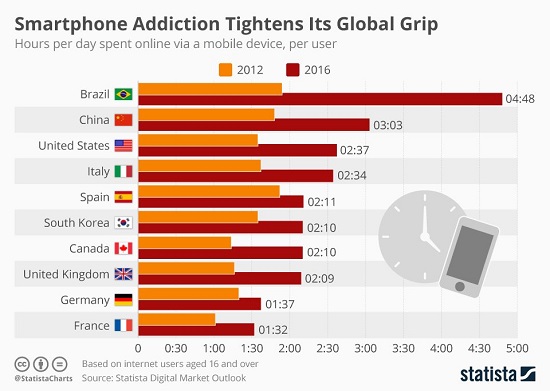
So here's my question: what's left for Big Tech to monetize? Many people already spend more time staring at screens (i.e. "leisure" consumption of media, entertainment, gaming, etc.) than they do at work or school, so in terms of time left to monetize, Hulu, Apple Music, Spotify, Netflix et al. are competing with sleep, meal preparation, reading books, conversation, dinner parties, intimacy and other traditional forms of non-media, non-screen uses of time.
As for privately owned capital/assets, there's a marketplace for sharing or renting privately owned consumer goods, but in a society awash in "stuff" it's difficult to monetize low-value, often informal activity.
So what happens to the lofty valuations currently enjoyed by Big Tech as the asymmetries of monetization start moving political gears and the gold-rush of monetizing engagement and privately owned assets runs out of new territories to conquer? What happens when diminishing returns set in as growth rates slow, marginal costs rise and political blowback builds momentum?
Just as there are only so many hours of the day consumers can stare at screens, so too are there limits on monetizing engagement and privately owned assets. What's left to monetize? It appears the answer is "very little."
My book Money and Work Unchained is now $6.95 for the Kindle ebook and $15 for the print edition. Read the first section for free in PDF format.


If you found value in this content, please join me in seeking solutions by becoming a $1/month patron of my work via patreon.com. New benefit for subscribers/patrons: a monthly Q&A where I respond to your questions/topics.

NOTE: Contributions/subscriptions are acknowledged in the order received. Your name and email remain confidential and will not be given to any other individual, company or agency.
 
Thank you, Charles R. ($200), for your beyond outrageously generous contribution to this site-- I am greatly honored by your steadfast support and readership.
 

Read more...

Tuesday, July 02, 2019

Vested Interests in Charge = Guaranteed Failure

It boils down to two very simple principles: accredit the student, not the institution and teach every student how to rigorously learn on their own.
Vested interests have every incentive to maintain the status quo: specifically, those who currently own the assets, income streams and power will continue to own the assets, income streams and power.
To accomplish this, vested interests must suppress, undermine or co-opt structural innovation, which threatens to obsolete the status quo. Innovation is bandied about rather freely now, generally as a marketing pitch, but real honest-to-goodness innovation is absolutely toxic to entrenched elites and vested interests, both of whom lose out when their gravy train is thrown off the tracks by innovation.
Cartels and monopolies are especially vulnerable to structural innovation, as the high costs they impose on customers and society eventually threaten to bankrupt households and even the state itself. To save itself from insolvency, the political-economic power structure must either accept innovation or it will be swept away by innovation.
Political power is nice but it's not enough. In the late 19th century, England's landed nobility and gentry had long held political power, and they attempted to use this power to bring the rising industrialists to heel.
Alas, the economic forces unleashed by industrialization could not be contained by mere political power, and the landed elites were superseded by the industrialist elites: It's a pity you had to sell your estate to the National Trust, but at least you have your memories of grandeur.
Which brings us to the equivalent vested interests of America's cartels: higher education, defense contractors and "healthcare" which profits not from health but from sickness.
Each cartel is ripe for disruption via technological innovation, and each is devoting enormous energy to protecting its fiefdom.
Case in point: I was recently asked to speak about the ideas for reducing the cost of college by 90% laid out in my 2013 book The Nearly Free University and the Emerging Economy. The webinar audience was polite but skeptical: wasn't I concerned that if campuses were obsoleted then students might not gain exposure to people different from themselves?
I think it's self-evident that America is so diverse that just about any job will bring young people in contact with people who are different from themselves. (There's even a large well-funded government institution that basically guarantees diversity: it's called the U.S. military.)
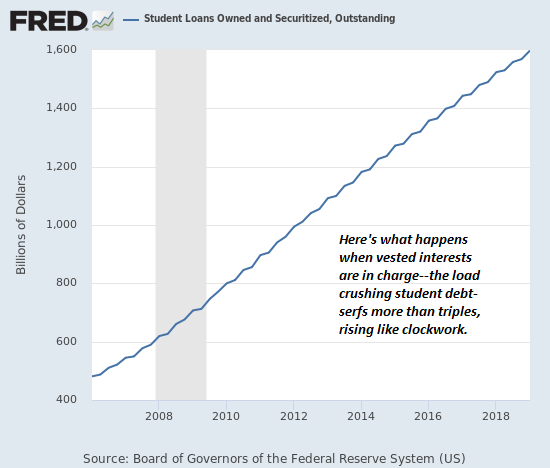
Nobody asked me about the crushing burden of student loan debt, though I mentioned the $1.6 trillion debt early in my talk. Vested interests are remarkably disinterested in costs borne by others, and remarkably interested in policy tweaks that give the PR appearance of addressing unaffordable costs of the cartel that pays their salary.
For example: free college for all, Medicare for All, etc.: how do you gain the political approval of vested interests? Guarantee the federal government (i.e. taxpayers) will pay all the bloated costs of a rapacious, ineffective system ruled by vested interests and predatory elites.
Transformation is painful. There's no easy, painless way to obsolete entire sectors.
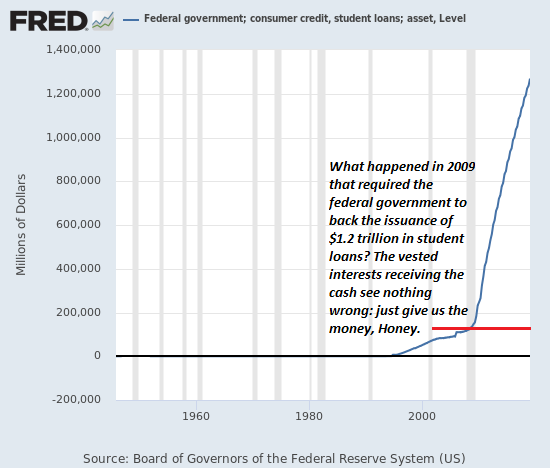
Consider this chart of student loans with fresh eyes. The tripling of student loan debt in a few short years is like clockwork: this is the price of suppressing innovation to protect vested interests.
What happened around 2009 that caused federally backed student loan debt to skyrocket? Entrenched insiders have various explanations, but they're really just excuses. The bottom line is that private-sector lenders started to get nervous about students replaying their gargantuan debts, so they lobbied the federal government to become the guarantor of their predatory lending.
Everyone gorging at the trough of higher education could care less where the money comes from: just keep it flowing in all its hundreds of billions of dollars. After all, we have to offer "competitive salaries" to the assistant deans skimming $200,000 for monitoring virtue-signaling on campus.
What no vested interest will dare admit is higher education is failing entire generations of students while burdening them with debt. The technology exists to reduce the cost of higher education by 90% and improve the actual acquisition of knowledge, by changing the incentive structure and model of learning.
It boils down to two very simple principles: accredit the student, not the institution and teach every student how to rigorously learn on their own. These common-sense concepts would dismantle the artificial scarcity of credentials imposed by the higher education cartel, and prepare students for the real-world economy they will enter--an economy that places a premium on lifetime learning, flexibility, multiple skillsets and adaptability.
In summary: if vested interests are in charge, failure is guaranteed. Entrenched elites will cling to failing models and unaffordable cost structures to insure that the trough they feed from stays full to the brim, regardless of its failures and costs.
The only possible output of this arrangement is collapse.


Pathfinding our Destiny: Preventing the Final Fall of Our Democratic Republic ($6.95 ebook, $12 print, $13.08 audiobook): Read the first section for free in PDF format.


My new mystery The Adventures of the Consulting Philosopher: The Disappearance of Drake is a ridiculously affordable $1.29 (Kindle) or $8.95 (print); read the first chapters for free (PDF)
My book Money and Work Unchained is now $6.95 for the Kindle ebook and $15 for the print edition. Read the first section for free in PDF format.


If you found value in this content, please join me in seeking solutions by becoming a $1/month patron of my work via patreon.com. New benefit for subscribers/patrons: a monthly Q&A where I respond to your questions/topics.

NOTE: Contributions/subscriptions are acknowledged in the order received. Your name and email remain confidential and will not be given to any other individual, company or agency.
 
Thank you, Charles R. ($200), for your beyond outrageously generous contribution to this site-- I am greatly honored by your steadfast support and readership.
 

Read more...

Monday, July 01, 2019

America's Concealed Crisis: Fifty Years of Economic Decline, 1969 to 2019

If we consider the long term, it's clear America's economy and society have been declining for the average household for 50 years.
What if the "prosperity" of the past 50 years is mostly a statistical mirage for the bottom 80% of households? What if whatever real gains (adjusted for real-world loss of purchasing power) accrued only to the top of the wealth-power pyramid, those closest to financial and political power? What if the U.S. economy and society shifted from "everybody wins" to "winner takes all" or at best, :winner take most"?
These are not "what if", they're reality. The working class, which as I have recently noted, now comprises the entire working populace other than the upper-middle class Misplaced Pride: Most of the "Middle Class" Is Actually Working Class (June 14, 2019), has lost ground over the past 50 years, from 1969 to the present.
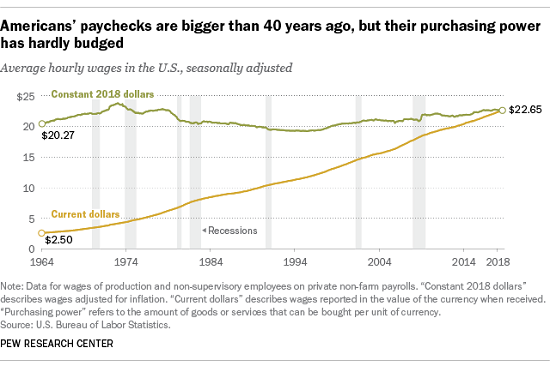
The keys to understanding the concealed crisis of decline are purchasing power relative to wages/earnings--how many goods and services can wages buy? For the average American household, wages have risen modestly while the purchasing power of those wages has plummeted.
Furthermore, the quality of goods and services has in many cases declined sharply, so that even if prices have dropped, what you get for your money has fallen even further, effectively reducing the purchasing power of your wages.
Case in point: appliances were once designed and built to last a generation or longer. Refrigerators, washers and dryers lasted for decades. Now the average appliance fails within a few years, and the electronic board--costing roughly a third of the entire appliance price--fails and must be replaced. With labor, the cost of the repair is so high, consumers often send the almost-new appliance to the landfill and buy a new (and soon to fail) appliance.
Net-net, low quality reduces purchasing power even if price has declined.
Then there's the big-ticket items: rent, housing, college, healthcare.Anecdotally, I've been told a young engineer in Silicon Valley could earn $20,000 a year and rent a modest apartment for $200. Now the young engineer makes $100,000 but rent for the modest flat is $2,500 per month: wages rose five-fold but rent rose 12-fold.
This is a staggering loss of purchasing power.
As for college, tens of millions of students completed their university training with zero debt--student loan debt as we understand it today simply didn't exist because it was unnecessary.
The scarcity value of that college diploma has fallen precipitously over the decades, rendering most degrees that aren't part of artificial scarcity schemes essentially valueless.
As for healthcare: we now have $100,000 operations that work miracles on one side and people being bankrupted by costs on the other, and tens of thousands dying of opioid drugs promoted by the status quo as "safe" and non-addictive. Where metabolic disorders (lifestyle diseases such as diabesity) were once a relative rarity, now up to a third of the entire population is at risk of chronic lifestyle diseases that are difficult and costly to manage--but oh so profitable to those delivering the meds and care.
Bottom line: how much housing, higher education and well-being does the average wage buy now compared to decades past? Not much. The statistics are bleak: wages are basically unchanged from the high water mark 50 years ago, which coincidentally was also the high water mark of U.S. energy production until very recently. Adjusted for purchasing power and quality, the average paycheck buys far less than it did 50 years ago.
Wages' share of the national income has plummeted since the last secular expansion of wages in the Internet boom of the late 1990s.
The average households' ownership of productive capital, and thus of financial security, has declined. There's fewer assets within reach and those that are in reach have been reduced to a casino of booms and busts that wipes out all but the most agile gamblers.
If we consider the long term (la longue duree), it's clear America's economy and society have been declining for the average household for 50 years.Nobody wants to admit this because it's politically inconvenient, to say the least. What do we make of a society in which only the top 5% have prospered in terms of their earnings buying more goods and services?
Meanwhile, everyone else has compensated for the sharp decline in purchasing power by going ever deeper into debt while the nation has decayed into a landfill economy.


Pathfinding our Destiny: Preventing the Final Fall of Our Democratic Republic ($6.95 ebook, $12 print, $13.08 audiobook): Read the first section for free in PDF format.


My new mystery The Adventures of the Consulting Philosopher: The Disappearance of Drake is a ridiculously affordable $1.29 (Kindle) or $8.95 (print); read the first chapters for free (PDF)
My book Money and Work Unchained is now $6.95 for the Kindle ebook and $15 for the print edition. Read the first section for free in PDF format.


If you found value in this content, please join me in seeking solutions by becoming a $1/month patron of my work via patreon.com. New benefit for subscribers/patrons: a monthly Q&A where I respond to your questions/topics.

NOTE: Contributions/subscriptions are acknowledged in the order received. Your name and email remain confidential and will not be given to any other individual, company or agency.
 
Thank you, Charles R. ($200), for your beyond outrageously generous contribution to this site-- I am greatly honored by your steadfast support and readership.
 

Read more...

Terms of Service

All content on this blog is provided by Trewe LLC for informational purposes only. The owner of this blog makes no representations as to the accuracy or completeness of any information on this site or found by following any link on this site. The owner will not be liable for any errors or omissions in this information nor for the availability of this information. The owner will not be liable for any losses, injuries, or damages from the display or use of this information. These terms and conditions of use are subject to change at anytime and without notice.

RE: European Union AI Act, and Our Use of Generative AI Tools and Agents Policy

All text on this site is composed by Charles Hugh Smith or by a credited guest-author. No Generative AI Tools are used in the composition / writing of any text or graphic content created by Charles Hugh Smith. This site deploys no AI agents or generative AI tools. This site is not responsible for the disclosures, use or non-use of AI agents or generative AI tools in advertisements displayed by Investing Channel or other ad placement services.

Audio files generated by text-to-audio transcription tools are identified as such.

Our Privacy Policy:

Correspondents' email is strictly confidential. This site does not collect digital data from visitors or distribute cookies. Advertisements served by third-party advertising networks such as Investing Channel may use cookies or collect information from visitors for the purpose of Interest-Based Advertising; if you wish to opt out of Interest-Based Advertising, please go to Opt out of interest-based advertising (The Network Advertising Initiative) If you have other privacy concerns relating to advertisements, please contact advertisers directly.

PRIVACY NOTICE FOR EEA INDIVIDUALS

This section covers disclosures on the General Data Protection Regulation (GDPR) for users residing within EEA only. GDPR replaces the existing Directive 95/46/ec, and aims at harmonizing data protection laws in the EU that are fit for purpose in the digital age. The primary objective of the GDPR is to give citizens back control of their personal data. Please follow the link below to access InvestingChannel's General Data Protection Notice.
https://stg.media.investingchannel.com/gdpr-notice/

Notice of Compliance with The California Consumer Protection Act

This site does not collect digital data from visitors or distribute cookies. Advertisements served by a third-party advertising network (Investing Channel) may use cookies or collect information from visitors for the purpose of Interest-Based Advertising. If you do not want any personal information that may be collected by third-party advertising to be sold, please follow the instructions on this page: Do Not Sell My Personal Information.

Regarding Cookies:

This site does not collect digital data from visitors or distribute cookies. Advertisements served by third-party advertising networks such as Investing Channel may use cookies or collect information from visitors for the purpose of Interest-Based Advertising; if you wish to opt out of Interest-Based Advertising, please go to Opt out of interest-based advertising (The Network Advertising Initiative) If you have other privacy concerns relating to advertisements, please contact advertisers directly.

Our Commission Policy:

Though I earn a small commission on Amazon.com books and gift certificates and gold (BullionVault) purchased via links on my site, I receive no fees or compensation for any other non-advertising links or content posted on my site.

Copyright Notice:

All original images (Drawings and Photographs), text (essays, books and works of fiction), audio and video recordings, musical compositions, graphic design, graphic design elements and HTML coding on this site are the copyrighted work of Charles Hugh Smith unless otherwise credited or noted. They are published as information for the private use of site visitors, and any reproduction or redistribution of this content or coding in any media in any format or distribution channel (text, audio, video/film, web) without the written permission of the copyright holder is strictly prohibited. All rights in all media reserved globally.

  © Blogger templates Newspaper III by Ourblogtemplates.com 2008

Back to TOP