Friday, November 01, 2024

The Extremely Profitable Inner Workings of Digital Addiction

Turn the crank of social media / search (SM/S) and you get highly profitable Digital Addiction and social destabilization leading to disorder and breakdown.

The extremely profitable inner workings of digital addiction are complex, but the business model is simple: collect user data and sell it to advertisers. The more users you addict, oops I mean attract, and the more time they spend on your platform, the more money you make.

The raison d'etre of social media / search (SM/S) is to collect user data to sell to the highest bidder. To maximize profits, the SM/S platforms stimulate users to post more content and spend more time "engaging" (i.e. creating user data) on their platform.

There are three mechanisms to accomplish this goal:

1. Financial incentives. By offering users a tiny share of the third of the trillion dollars in revenue (of just the top three platforms), users are incentivized to post more content, and optimize that content o attract more views / engagement by other users.

The share earned by the few who attract an audience of millions is substantial, but the modest revenues shared with users posting content follows a power law distribution: a handful make millions, a few make $100,000 or more annually, a small circle make a middle class living ($60,000 annually), and the vast "long tail" earn a pittance at best.

Your song received hundreds of thousands of downloads? Thank you for the content and engagement. Here is your share of the revenues generated: $17. Your content attracted thousands of views, here's your share of advert revenue: $73.

The share is a pittance, but it's enough to drive a Darwinian frenzy that optimizes extremism and clickbait. This extremism can be measured, and as a result of the frenzied competition for attention, extremism is off the charts, with predictably destabilizing social consequences.

2. Self-worth incentives. Given the structure of everyday life, the vast majority of us have little influence or power in the status quo. (For many of us, our power lies not in the status quo but in opting out of the status quo.) Given the zeitgeist of our market-driven global economy, we observe others gaining visibility and income within the digital realm of social media. Since anyone with a phone or laptop / tablet can get online, this digital road to fame and fortune is open to all. This is in marked contrast with the real world, which is characterized by few pathways to fame and fortune, or even being noticed.

I'm worthy of attention is a powerful manifestation of selfhood: if I attract attention / engagement, I'm somebody. Without attention / engagement, I'm nobody.

This self-worth incentive is amplified by glorifying the few winners in the free-for-all competition for attention. No wonder it's called the Attention Economy: attention = user data = trillions in revenue.


3. Optimizing addiction. The mechanisms of addiction are fairly well understood, and these mechanisms function with profitable precision in endless scrolls of feeds and posts and algorithms that amplify clickbait and extremism, for these arouse base emotions that then increase "engagement," i.e. collecting more user data.

The net result is Digital Addiction and social destabilization. Turn the crank of social media / search (SM/S) and you get highly profitable Digital Addiction and social destabilization leading to disorder and breakdown.

Digital Addiction has many destructive consequences. Here is one with profound effects stretching across the entire landscape and far into the future: The Anxious Generation: How the Great Rewiring of Childhood Is Causing an Epidemic of Mental Illness (2024, Jonathon Haidt).


My recent books:

Disclosure: As an Amazon Associate I earn from qualifying purchases originated via links to Amazon products on this site.

The Mythology of Progress, Anti-Progress and a Mythology for the 21st Century print $18, (Kindle $8.95, Hardcover $24 (215 pages, 2024) Read the Introduction and first chapter for free (PDF)

Self-Reliance in the 21st Century print $18, (Kindle $8.95, audiobook $13.08 (96 pages, 2022) Read the first chapter for free (PDF)

The Asian Heroine Who Seduced Me (Novel) print $10.95, Kindle $6.95 Read an excerpt for free (PDF)

When You Can't Go On: Burnout, Reckoning and Renewal $18 print, $8.95 Kindle ebook; audiobook Read the first section for free (PDF)

Global Crisis, National Renewal: A (Revolutionary) Grand Strategy for the United States (Kindle $9.95, print $24, audiobook) Read Chapter One for free (PDF).

A Hacker's Teleology: Sharing the Wealth of Our Shrinking Planet (Kindle $8.95, print $20, audiobook $17.46) Read the first section for free (PDF).

Will You Be Richer or Poorer?: Profit, Power, and AI in a Traumatized World
(Kindle $5, print $10, audiobook) Read the first section for free (PDF).

The Adventures of the Consulting Philosopher: The Disappearance of Drake (Novel) $4.95 Kindle, $10.95 print); read the first chapters for free (PDF)

Money and Work Unchained $6.95 Kindle, $15 print)
Read the first section for free


Become a $3/month patron of my work via patreon.com.

Subscribe to my Substack for free


NOTE: Contributions/subscriptions are acknowledged in the order received. Your name and email remain confidential and will not be given to any other individual, company or agency.

Thank you, Jim ($7/month), for your superbly generous subscription to this site -- I am greatly honored by your steadfast support and readership.


Thank you, Richrd B. ($3/month), for your most generous patronage to this site -- I am greatly honored by your support and readership.


Thank you, Dean J. ($3/month), for your marvelously generous patronage to this site -- I am greatly honored by your support and readership.


Thank you, Lewis B. ($32.40), for your splendidly generous patronage to this site -- I am greatly honored by your support and readership.

Read more...

Wednesday, October 30, 2024

Is Social Media Actually "Media," Or Is It Something Else?

By placing search/social media in the bucket of newspapers, radio and TV networks, perhaps we've obscured their true nature as "Digital Marketing Mechanisms."

Language is a funny thing. If we don't have a word for something, in some way it doesn't exist. When we find a word in another language that describes this something, we borrow the word, for example schadenfreude from German and tsunami from Japanese.

If we use an existing word to describe something novel, we may mis-categorize it, in effect obscuring its true nature. For example, calling a whale a "fish" makes a certain kind of sense (an animal that lives in the sea), but it doesn't capture the fact that the whale is a mammal, not a fish.

Which brings us to social media, and the possibility that it isn't actually "media" at all, and we've obscured its true nature by mis-categorizing it as "media." This distinction isn't merely academic; it has significant real-world consequences.

Let's begin with the "media" that existed when the the US Constitution was drafted and ratified. "Media" wasn't a word in usage at the time, and what we understand today as "media" was understood as "the printed word" in newspapers, flyers, posters, periodicals and books. This is the origin of the Constitution's focus on "free speech" and the "free press": Congress shall make no law abridging the freedom of speech, or of the press.

The two concepts are intimately bound. Free speech includes public gatherings and oratory as well as all printed words, but the printed word attracts most of the legal wrangling around the meaning and limits of "free speech," a topic I explored in A Contrarian Clarification of "Free Speech".

The point of my post was that the constitutional definition focused on the government's restriction of free speech, not the private suppression or censorship of "free speech." As I explained, a private enterprise such as a newspaper is not obligated to provide a platform for everyone who wishes to exercise their "right to free speech." The newspaper can print whatever "letters to the editor" or "commentary" its owners / managers choose.

Now we have many other forms of media: radio, films, television and now the Internet, with its vast array of "printed" word, audio and video content.

In what we might call traditional media, the owners / managers publish / post content generated by their staff or other professional content creators: journalists, talk-show hosts, filmmakers, etc.

Social media is something different: all its content is created by its users. Yes, social media platforms have news feeds from traditional media, but this is a sideline to their core model, which is in effect a global message board that is open to any registered user. Unlike a Web1.0 message board / forum, whose audience was limited to the membership of the board / forum, social media platforms offer each user who posts content a potentially global audience.

The potential to build an audience of hundreds, thousands or even millions is addictively attractive, and so social media platforms (and their cousin, search) have billions of users.

This is novel. Is it "media" or is it something else? As I noted in my previous post, "free speech" is muddied when it comes to search and social media, as the government is limited by the Constitution in its capacity to restrict what's posted on social media, but there are few (if any) Constitutional restrictions on what private enterprises can restrict on their media outlets / platforms / search results.

Next, let's consider the revenues and data collection of traditional media and social media. Traditional media was limited to display ads in print, and the equivalent broadcast ads on radio and TV. These forms of media did not have the capacity/tools to collect reams of data on every user, and then use this data to sell adverts that target specific audiences--for example, surfers who have traveled to Southeast Asia to surf.

The resort on the beach in Indonesia will have far better results from adverts targeting surfers who have already demonstrated a willingness and ability to travel to Southeast Asia to surf compared to a broadcast advert that may theoretically reach a million people, of whom only a tiny percentage will be a target audience for the resort. The resort's marketing will pay a hefty premium for this data-rich targeted advert capability.

Search is also novel. Is it "media" or something else? Search engines purport to crawl the entire Web and present the most relevant answers / results to one's query. But this too is a data-collection revenue-creation mechanism, for the auctioning of search results--pay the search company money, and your product / service will be placed at the top of the search results--is lucrative.

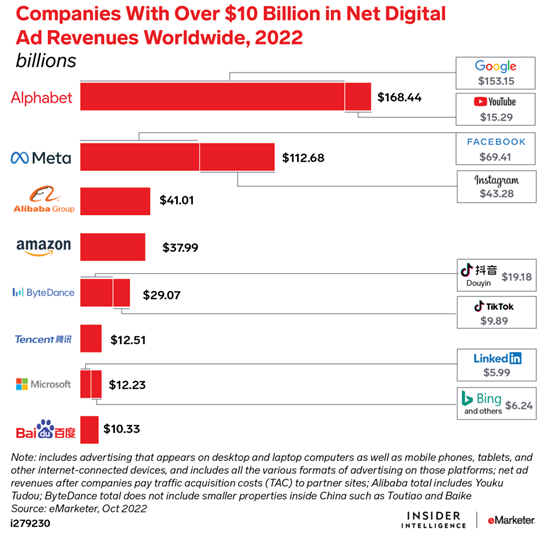
This ability to target the audience based on detailed data collected on their web activity increases the value of the resulting advertising greatly. Consider the scale of digital adverts: the top three US corporations (Alphabet/Google, Meta/Facebook and Amazon) collect $320 billion in digital advertising revenues:


Compare this to traditional-media newspaper revenues: circulation revenue is about $11 billion and newspaper adverts, print and digital, total around $5 billion, for a total of $16 billion, roughly 5% of search/social media advert revenue.

Search/social media is free to users, but this "free access" is in effect a trade for the user data that generates a third of a trillion dollars in revenue. This "trade" also seems novel, both in form and in scale.

Would it be more accurate to describe search/social media platforms as Marketing Mechanisms that solicit user-created search/content to generate revenues rather than as "media" platforms?

The distinction is critical, for "free speech" is not a blanket carte blanche for marketing. If we remove search/social media from the category of "media" and create a new category Digital Marketing Mechanisms (DMM), then this new category necessarily requires a new regulatory structure and very different legal interpretations and protections of "free speech."

As we all know, it's very tempting for governments to "request" (or require) private-sector search/social media platforms restrict what's visible to the public to "approved" information. If a private-sector company restricts what it publishes at the "request" of the state, where are the Constitutional limits on state censorship? It seems they've been skirted by this "cooperation" of public / private power.

By placing search/social media in the bucket of newspapers, radio and TV networks, perhaps we've obscured their true nature as Digital Marketing Mechanisms, novel, complex devices more like a digital Antikythera Mechanism than an inert printed page protected as "free press."


My recent books:

Disclosure: As an Amazon Associate I earn from qualifying purchases originated via links to Amazon products on this site.

The Mythology of Progress, Anti-Progress and a Mythology for the 21st Century print $18, (Kindle $8.95, Hardcover $24 (215 pages, 2024) Read the Introduction and first chapter for free (PDF)

Self-Reliance in the 21st Century print $18, (Kindle $8.95, audiobook $13.08 (96 pages, 2022) Read the first chapter for free (PDF)

The Asian Heroine Who Seduced Me (Novel) print $10.95, Kindle $6.95 Read an excerpt for free (PDF)

When You Can't Go On: Burnout, Reckoning and Renewal $18 print, $8.95 Kindle ebook; audiobook Read the first section for free (PDF)

Global Crisis, National Renewal: A (Revolutionary) Grand Strategy for the United States (Kindle $9.95, print $24, audiobook) Read Chapter One for free (PDF).

A Hacker's Teleology: Sharing the Wealth of Our Shrinking Planet (Kindle $8.95, print $20, audiobook $17.46) Read the first section for free (PDF).

Will You Be Richer or Poorer?: Profit, Power, and AI in a Traumatized World
(Kindle $5, print $10, audiobook) Read the first section for free (PDF).

The Adventures of the Consulting Philosopher: The Disappearance of Drake (Novel) $4.95 Kindle, $10.95 print); read the first chapters for free (PDF)

Money and Work Unchained $6.95 Kindle, $15 print)
Read the first section for free


Become a $3/month patron of my work via patreon.com.

Subscribe to my Substack for free


NOTE: Contributions/subscriptions are acknowledged in the order received. Your name and email remain confidential and will not be given to any other individual, company or agency.

Thank you, Bob O. ($200), for your beyond-outrageously generous subscription to this site -- I am greatly honored by your steadfast support and readership.


Thank you, Joe ($3/month), for your most generous patronage to this site -- I am greatly honored by your support and readership.


Thank you, Alex C. ($7/month), for your marvelously generous subscription to this site -- I am greatly honored by your support and readership.


Thank you, Deborah R. ($32.40), for your splendidly generous patronage to this site -- I am greatly honored by your support and readership.

Read more...

Tuesday, October 29, 2024

Welcome to the Circular Firing Squad

If you find my scribblings upsetting, there's an easy solution: stop reading it. We'll both benefit.

I'm never more than one inch away from converting my site from essays to photos of kittens and puppies as the only means to gain respite from being hammered for my many failings as a human being. But alas, were I to do so, some readers would detect an insufferable air of elitist superiority in my selection of kitten photos, others would trash me for my worthless posts, and should I post a photo of a sad puppy, I'd promptly be denounced as a bitter old man.

Welcome to the circular firing squad. As a culture, we seem to have reached a permanently high plateau of extreme touchiness, a sensitivity to slight coupled with an urgent need to lash out not just at opinions but at those who present them, a touchiness which manifests as an irrepressible flood tide of righteous indignation: how dare you!

I've been bitterly denounced as an elitist for spending two days preparing a homemade Thanksgiving dinner for a few dozen guests, as only elites could possibly afford a home-cooked Thanksgiving dinner. How dare you prepare a home-cooked meal!

In what ward of the insane asylum is a guy who's spent his entire life on the tattered margins of the economy and society, a guy with absolutely no status, inheritance, family connections, elite credentials or position in the power structure--all the traits that characterize elite membership--be denounced for preparing a home-cooked meal to be shared with others? A guy who scraped by in genteel poverty on the crumbling edge of free-lancing. a guy who's only corporate gig was picking pineapple one summer for Dole Pineapple at 16, a guy who never worked for any government agency or anything remotely connected to the Power Elite, a guy with 50 years experience behind a worm-drive Skilsaw?

Back when I started my blog, I never expected to have an audience. Dummy that I am, I used my real name and called my blog Of Two Minds, expressing my willingness to change my mind and my general view that there was capacious open ground to explore between any two polar-opposite positions.

I should have hidden behind something like Insufferable Elitist, Worthless Writer or Bitter Old Man, or cut to the chase and called it How Dare You!

My critics overlook one of my deepest flaws: I'm overly civil. I was taught that saying horrid things about people you didn't know, and people you did know, was, well, horrid. Yes, I know: how dare you because only elites with an air of superiority are civil.

As for my air of superiority, I can't help it: I'm half Irish, with the rest being Scots and Norse / Norman. My sense of superiority is genetically hard-wired, along with my obstreperous, cantankerous, cocky nature. How dare you be half-Irish! Yes, well, please accept my apologies on behalf of my DNA.

All of which leads to an unsolvable mystery: how did this Insufferable Elitist, Worthless Writer and Bitter Old Man get 150 million page views on his own sites and a couple hundred million more page views on sites with large audiences such as Lew Rockwell, Daily Reckoning, Seeking Alpha and Zero Hedge (all terribly elitist sites, slithering with insufferable elites)? If you figure out how this Insufferable Elitist, Worthless Writer and Bitter Old Man got a third of a billion page views, please let me know. I agree, it makes no sense.

Clearly, somebody else far more deserving should have gotten the third of a billion page views. Or, horror of horrors, for unfathomable reasons, people want to read stuff composed by an Insufferable Elitist, Worthless Writer and Bitter Old Man. Believe me, I'm as mystified as you are. But go ahead and say it: How Dare You!

If you find my scribblings upsetting, there's an easy solution: stop reading it. We'll both benefit. I implore you to ignore my scribblings, for both our sakes: it will relieve my sense of guilt at upsetting anyone, and you'll be spared the tribulations of becoming upset.

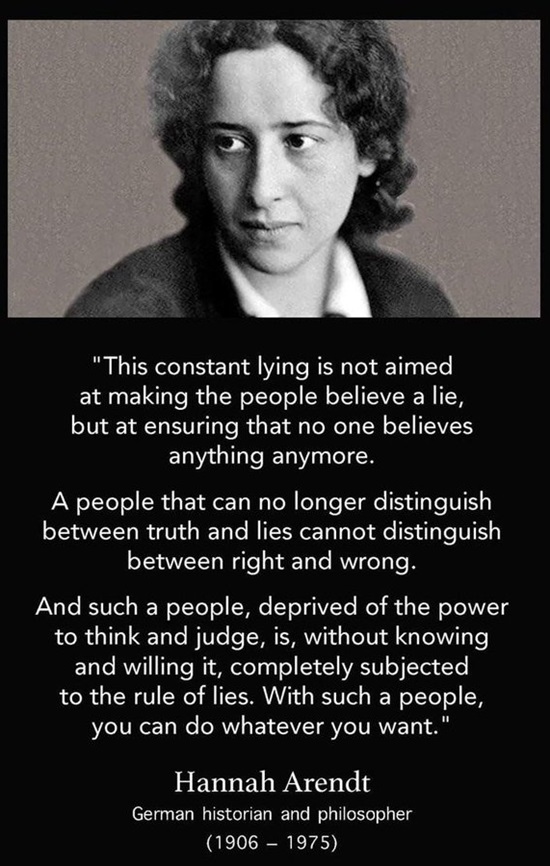
I looked around for some photos of kittens and puppies, but rather than risk a copyright violation, I'm going with this from Hannah Arendt:


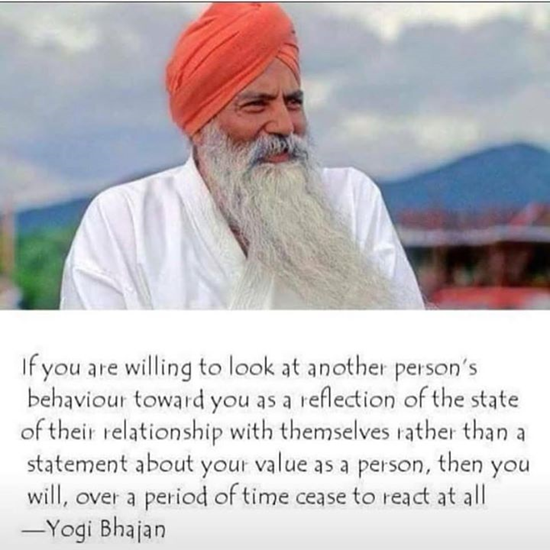
And because I'm an Insufferable Elitist enveloped by a vortex of Superiority, I'm adding this bit. Yes, I know: How Dare You!


Welcome to the circular firing squad. Civility is being shredded, but never mind, because civility is elitist.


My recent books:

Disclosure: As an Amazon Associate I earn from qualifying purchases originated via links to Amazon products on this site.

The Mythology of Progress, Anti-Progress and a Mythology for the 21st Century print $18, (Kindle $8.95, Hardcover $24 (215 pages, 2024) Read the Introduction and first chapter for free (PDF)

Self-Reliance in the 21st Century print $18, (Kindle $8.95, audiobook $13.08 (96 pages, 2022) Read the first chapter for free (PDF)

The Asian Heroine Who Seduced Me (Novel) print $10.95, Kindle $6.95 Read an excerpt for free (PDF)

When You Can't Go On: Burnout, Reckoning and Renewal $18 print, $8.95 Kindle ebook; audiobook Read the first section for free (PDF)

Global Crisis, National Renewal: A (Revolutionary) Grand Strategy for the United States (Kindle $9.95, print $24, audiobook) Read Chapter One for free (PDF).

A Hacker's Teleology: Sharing the Wealth of Our Shrinking Planet (Kindle $8.95, print $20, audiobook $17.46) Read the first section for free (PDF).

Will You Be Richer or Poorer?: Profit, Power, and AI in a Traumatized World
(Kindle $5, print $10, audiobook) Read the first section for free (PDF).

The Adventures of the Consulting Philosopher: The Disappearance of Drake (Novel) $4.95 Kindle, $10.95 print); read the first chapters for free (PDF)

Money and Work Unchained $6.95 Kindle, $15 print)
Read the first section for free


Become a $3/month patron of my work via patreon.com.

Subscribe to my Substack for free


NOTE: Contributions/subscriptions are acknowledged in the order received. Your name and email remain confidential and will not be given to any other individual, company or agency.

Thank you, Doug M. ($70), for your superbly generous subscription to this site -- I am greatly honored by your support and readership.


Thank you, Jay B. ($70), for your magnificently generous subscription to this site -- I am greatly honored by your support and readership.


Thank you, Glenn W. ($70), for your marvelously generous subscription to this site -- I am greatly honored by your support and readership.


Thank you, Alain M. ($50), for your splendidly generous subscription to this site -- I am greatly honored by your support and readership.

Read more...

Friday, October 25, 2024

A Contrarian Clarification of "Free Speech"

A social media company has the right to decline publishing my opinion, but the government's ability to restrict what the social media company publishes is restricted by the First Amendment.

We all know what "free speech" means: it's our right to say whatever we want, whenever we want, wherever we want, as long as we're not libeling someone. Well, actually, no, that's not what "free speech" means. Here's the First Amendment to the Constitution of the United States:

Congress shall make no law respecting an establishment of religion, or prohibiting the free exercise thereof; or abridging the freedom of speech, or of the press; or the right of the people peaceably to assemble, and to petition the Government for a redress of grievances.

For an overview of the immense body of jurisprudence regarding the limits of "free speech," here's a good place to start: First Amendment Fundamental Freedoms Analysis and Interpretation of the U.S. Constitution.

In essence, the first amendment prohibits the federal government from "abridging the freedom of speech, or of the press," in other words, censorship. The Founders were seeking to limit the powers of the state to restrict pushback from the citizenry against state policies or decisions.

But this doesn't mean "everything is protected as 'free speech.'" For example, a drunk in a bar who shouts, "You're worthless, you suck!" at other patrons is not protected by the First Amendment.

"In Chaplinsky v. New Hampshire, the Supreme Court unanimously sustained a conviction under a state law proscribing any 'offensive, derisive or annoying word addressed to any person in a public place'... 'the use in a public place of words likely to cause a breach of the peace,' words 'by their very utterance, inflict injury or tend to incite an immediate breach of the peace. Accordingly, such utterances are no essential part of any exposition of ideas, and are of such slight social value as a step to truth that any benefit that may be derived from them is clearly outweighed by the social interest in order and morality.'"

Yet by some strange bewitchment, the "right" to shout "You're worthless, you suck!" online is now considered "protected" as "free speech." As the Court clearly stated, "free speech" is intended to protect an exposition of ideas as a step to truth, not content-free abuse.

The First Amendment does not obligate privately owned media to provide a forum for everyone to shout "You're worthless, you suck!" If the drunk wanders from the bar to the Heritage Foundation and demands they publish his "opinion," the Foundation is under no obligation to comply.

The newspaper is not obligated to print the drunk's "letter to the editor," nor is the radio station or TV network obligated to provide a forum for his "opinion."

On occasion a reader expresses discontent that I don't have a "comments forum" on my website, on the presumption that everyone paying to host a website is somehow obligated to also pay the expenses so everyone else can use their privately funded site as a public forum for their opinions.

What the First Amendment says is that government cannot restrict anyone from hosting a website, though what they post publicly is subject to Chaplinsky v. New Hampshire. Other cases reflect the Court's view that the issue with "free speech" is government actions that restrict free speech, not the right of privately owned enterprises to choose what they publish / post publicly.

My response to those expecting that a privately funded "forum" for their "opinion" is a "right": pay for your own server / website and then you can post whatever opinions you wish to. That's the limit of free speech: you're free to carry a sign in public places (with certain restrictions), publish your own newspaper, start your own website or media platform, or give speeches from soapboxes, but nothing obligates a media corporation to publish your "opinion" or provide an unrestricted forum for everyone's opinions.

In other words, a social media company has the right to decline publishing my opinion, but the government's ability to restrict what the social media company publishes is restricted by the First Amendment.

What obscures this distinction is the Big Tech platform's profit-driven fear of alienating the users they're trying to addict by clarifying what their "community standards" actually mean. It would be refreshing if social media / search platforms stated what they consider acceptable and unacceptable in clear, simple terms.

For example, "the owners and management of this site hold values generally described as (progressive, conservative, libertarian, etc.) and we have the right to decline to publish opinion and content that conflicts with our values." At least the political reality would be in plain sight rather than being cloaked by phony claims of neutrality.

It would be refreshing if a Big Tech corporation stated, "We retain the right to judge whether a comment or post offers an exposition of ideas as a step to truth or is content-free opinion of slight social value" instead of pandering to the claim that they're pursuing "free speech" rather than "free enterprise," an enterprise enriched by shouting "You're worthless, you suck!" as often as possible, to spur "engagement."

What the First Amendment clearly restricts is government censorship by proxy, that is, government "requesting" social media corporations limit what is posted based on standards selected not by the owners but by the government. I often complain about being shadow-banned, but what I'm complaining about is not the right of these platforms to refuse to publish my content; that is their right, just as it's my right to refuse to provide a public forum for everyone else to post their opinion.

What I object to is the mealy-mouthed, cowardly way the media giants hide their guidelines, out of fear of reducing their precious profits. But the First Amendment doesn't require media corporations to state their guidelines. Newspapers have the right to decline to publish opinions submitted by readers that the editors disagree with or don't want to promote, and there's no obligation for them to explain every refusal.

If we disagree with the media company's decision, then our "right to free speech" boils down to peaceful public protests or starting our own newspaper / website / platform / radio station / channel.

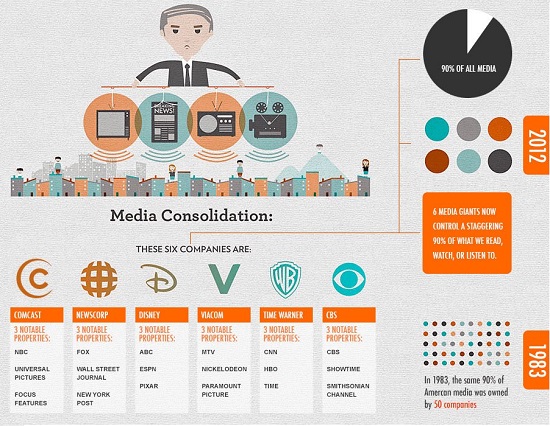
The concentration of media is another issue: there are negative social consequences of monopolies and cartels dominating media platforms. But that's a topic for a future essay.


My recent books:

Disclosure: As an Amazon Associate I earn from qualifying purchases originated via links to Amazon products on this site.

The Mythology of Progress, Anti-Progress and a Mythology for the 21st Century print $18, (Kindle $8.95, Hardcover $24 (215 pages, 2024) Read the Introduction and first chapter for free (PDF)

Self-Reliance in the 21st Century print $18, (Kindle $8.95, audiobook $13.08 (96 pages, 2022) Read the first chapter for free (PDF)

The Asian Heroine Who Seduced Me (Novel) print $10.95, Kindle $6.95 Read an excerpt for free (PDF)

When You Can't Go On: Burnout, Reckoning and Renewal $18 print, $8.95 Kindle ebook; audiobook Read the first section for free (PDF)

Global Crisis, National Renewal: A (Revolutionary) Grand Strategy for the United States (Kindle $9.95, print $24, audiobook) Read Chapter One for free (PDF).

A Hacker's Teleology: Sharing the Wealth of Our Shrinking Planet (Kindle $8.95, print $20, audiobook $17.46) Read the first section for free (PDF).

Will You Be Richer or Poorer?: Profit, Power, and AI in a Traumatized World
(Kindle $5, print $10, audiobook) Read the first section for free (PDF).

The Adventures of the Consulting Philosopher: The Disappearance of Drake (Novel) $4.95 Kindle, $10.95 print); read the first chapters for free (PDF)

Money and Work Unchained $6.95 Kindle, $15 print)
Read the first section for free


Become a $3/month patron of my work via patreon.com.

Subscribe to my Substack for free


NOTE: Contributions/subscriptions are acknowledged in the order received. Your name and email remain confidential and will not be given to any other individual, company or agency.

Thank you, Gregory C. ($70), for your superbly generous subscription to this site -- I am greatly honored by your support and readership.


Thank you, Norah D. ($70), for your magnificently generous subscription to this site -- I am greatly honored by your support and readership.


Thank you, DaVinati ($70), for your marvelously generous subscription to this site -- I am greatly honored by your support and readership.


Thank you, Thomas H. ($7/month), for your splendidly generous subscription to this site -- I am greatly honored by your support and readership.

Read more...

Wednesday, October 23, 2024

All The World's a Stage: Everything Is Fake

No wonder we're restless, teetering on the edge, frustrated by our addictions to fakery and excess, starved for what cannot be marketed or made profitable, so it no longer exists except in the shadows.

Everything is staged, and therefore fake. Given the near-zero cost of posting content in the digital world, everyone discovered that staging wasn't limited to high-end political events, parades and Hollywood sets; since all the world's a stage, everything could be staged, from every selfie on social media to every video on YouTube to every public display.

With staging comes spectacle, with spectacle comes self-serving artifice, and with artifice comes excess. The captivating idea of staging is by mimicking authenticity, we manifest an implicitly self-serving purpose: we stage the film to mimic "real life" to entertain the audience, and by this means reap a fortune.

By staging a political event, we rouse blood lust to serve our ascension to power. By staging a selfie in a swank bar sipping a costly cocktail, while home is a shared room in a squalid, overpriced flat, we serve our desire for a digitally distributed simulacrum of a status we cannot possibly achieve in our real lives.

Now that everything is staged, the competition to get noticed in a sea frothing with endless scrolls of "content" demands excess. Everything is now so sensationalized that we are desensitized to it all. As a result, everything distills down to self-parody, rendering parody impossible, for everything is already a parody of itself.

Mimicking authenticity to make the sale is now so embedded, so ubiquitous, that irony is also lost: we are living in a Philip K. Dick story come to life in which young women fabricating fake lives of glamor and luxury to boost their visibility are now competing with digitized imaginary young women that are idealized versions of the sexually compelling female.

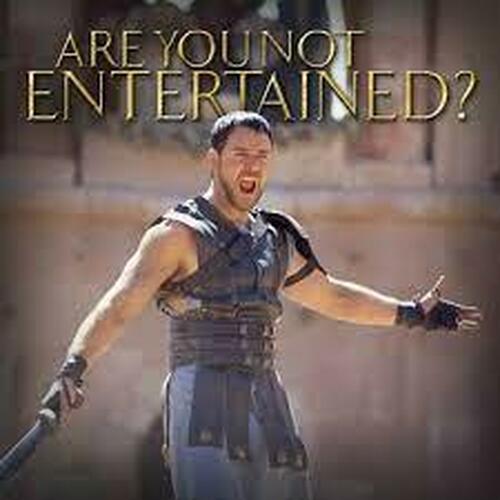
Now that engagement is the coin of the Attention Economy realm, traditional media and social media have merged: everybody's competing for engagement because that's everyone's source of income. Never mind that the Big Tech platforms skim the bulk of the engagement revenues and a handful of influencers reap the majority of what's left; the mob is furiously dedicated to the task of picking up the pennies scattered in the sand-covered floor of the Coliseum.

In my view, engagement is the polite term for addiction, the core value proposition in Addiction Capitalism. As every dealer knows, there's no more reliable source of revenue than a junkie with a monkey on his back, and encouraging addiction to screens is astoundingly profitable.

The fevered competition for eyeballs / visibility has generated a self-reinforcing feedback of faking authenticity better than other spectacles. The goal isn't to present "real life," what would be the point of such absurdly uncompelling, boring anti-spectacle?

The goal is to stage the mise en scene so cleverly that it really looks real: the rural kitchen in all its handmade glory, the "real food" lovingly prepared with simple tools, or the high-wire emotions of the indignant, filled to the brim with passionate intensity, planning their role when the rough beast, its hour come round at last, slouches towards Bethlehem to be born.

But authenticity cannot be profitably milked for long; we caught on long ago. The transformation into sensationalized, self-parodying staging makes a mockery of authenticity, and as everyone crowds onto the world stage seeking visibility and the money the right staging brings, authenticity dissipates into dark energy, present but invisible, undetectable, a fleeting shadow lost in the churning wake of spectacle.

French philosopher Guy Debord's 1967 book, The Society of the Spectacle, sheds light on this transformation. (This is a PDF of the entire text.) "The vague feeling that there has been a rapid invasion which has forced people to lead their lives in an entirely different way is now widespread; but this is experienced rather like some inexplicable change in the climate, or in some other natural equilibrium, a change faced with which ignorance knows only that it has nothing to say."

This reminds me of a comment French writer Michel Houellebecq made in an interview: "I have the impression of being caught up in a network of complicated, minute, stupid rules, and I have the impression of being herded towards a uniform kind of happiness, toward a kind of happiness that doesn't really make me happy."

The ceaseless staging and spectacles have deranged us. The mood of the mob is fast becoming ugly; even the victors of the staged games are being booed. The attention span of the audience has dwindled to the point that few even wait for the outcome of the contest to scream for somebody's blood. The crowd is no longer satiated by gore or drama, and even the comedic interludes no longer mask the sense that the mob is one spark away from taking their rage and frustration out on each other--the vicarious thrills are no longer enough.

This is the fruit of relying on fakery, of believing that no one can tell the difference between authenticity and staged simulacra. The audience craves something real, and what's served up as "real" is just another self-serving mise en scene. No wonder we're restless, teetering on the edge, frustrated by our addictions to fakery and excess, starved for what cannot be marketed or made profitable, so it no longer exists except in the shadows.


My recent books:

Disclosure: As an Amazon Associate I earn from qualifying purchases originated via links to Amazon products on this site.

The Mythology of Progress, Anti-Progress and a Mythology for the 21st Century print $18, (Kindle $8.95, Hardcover $24 (215 pages, 2024) Read the Introduction and first chapter for free (PDF)

Self-Reliance in the 21st Century print $18, (Kindle $8.95, audiobook $13.08 (96 pages, 2022) Read the first chapter for free (PDF)

The Asian Heroine Who Seduced Me (Novel) print $10.95, Kindle $6.95 Read an excerpt for free (PDF)

When You Can't Go On: Burnout, Reckoning and Renewal $18 print, $8.95 Kindle ebook; audiobook Read the first section for free (PDF)

Global Crisis, National Renewal: A (Revolutionary) Grand Strategy for the United States (Kindle $9.95, print $24, audiobook) Read Chapter One for free (PDF).

A Hacker's Teleology: Sharing the Wealth of Our Shrinking Planet (Kindle $8.95, print $20, audiobook $17.46) Read the first section for free (PDF).

Will You Be Richer or Poorer?: Profit, Power, and AI in a Traumatized World
(Kindle $5, print $10, audiobook) Read the first section for free (PDF).

The Adventures of the Consulting Philosopher: The Disappearance of Drake (Novel) $4.95 Kindle, $10.95 print); read the first chapters for free (PDF)

Money and Work Unchained $6.95 Kindle, $15 print)
Read the first section for free


Become a $3/month patron of my work via patreon.com.

Subscribe to my Substack for free


NOTE: Contributions/subscriptions are acknowledged in the order received. Your name and email remain confidential and will not be given to any other individual, company or agency.

Thank you, Gregory C. ($70), for your superbly generous subscription to this site -- I am greatly honored by your support and readership.


Thank you, Norah D. ($70), for your magnificently generous subscription to this site -- I am greatly honored by your support and readership.


Thank you, DaVinati ($70), for your marvelously generous subscription to this site -- I am greatly honored by your support and readership.


Thank you, Thomas H. ($7/month), for your splendidly generous subscription to this site -- I am greatly honored by your support and readership.

Read more...

Terms of Service

All content on this blog is provided by Trewe LLC for informational purposes only. The owner of this blog makes no representations as to the accuracy or completeness of any information on this site or found by following any link on this site. The owner will not be liable for any errors or omissions in this information nor for the availability of this information. The owner will not be liable for any losses, injuries, or damages from the display or use of this information. These terms and conditions of use are subject to change at anytime and without notice.

RE: European Union AI Act, and Our Use of Generative AI Tools and Agents Policy

All text on this site is composed by Charles Hugh Smith or by a credited guest-author. No Generative AI Tools are used in the composition / writing of any text or graphic content created by Charles Hugh Smith. This site deploys no AI agents or generative AI tools. This site is not responsible for the disclosures, use or non-use of AI agents or generative AI tools in advertisements displayed by Investing Channel or other ad placement services.

Audio files generated by text-to-audio transcription tools are identified as such.

Our Privacy Policy:

Correspondents' email is strictly confidential. This site does not collect digital data from visitors or distribute cookies. Advertisements served by third-party advertising networks such as Investing Channel may use cookies or collect information from visitors for the purpose of Interest-Based Advertising; if you wish to opt out of Interest-Based Advertising, please go to Opt out of interest-based advertising (The Network Advertising Initiative) If you have other privacy concerns relating to advertisements, please contact advertisers directly.

PRIVACY NOTICE FOR EEA INDIVIDUALS

This section covers disclosures on the General Data Protection Regulation (GDPR) for users residing within EEA only. GDPR replaces the existing Directive 95/46/ec, and aims at harmonizing data protection laws in the EU that are fit for purpose in the digital age. The primary objective of the GDPR is to give citizens back control of their personal data. Please follow the link below to access InvestingChannel's General Data Protection Notice.
https://stg.media.investingchannel.com/gdpr-notice/

Notice of Compliance with The California Consumer Protection Act

This site does not collect digital data from visitors or distribute cookies. Advertisements served by a third-party advertising network (Investing Channel) may use cookies or collect information from visitors for the purpose of Interest-Based Advertising. If you do not want any personal information that may be collected by third-party advertising to be sold, please follow the instructions on this page: Do Not Sell My Personal Information.

Regarding Cookies:

This site does not collect digital data from visitors or distribute cookies. Advertisements served by third-party advertising networks such as Investing Channel may use cookies or collect information from visitors for the purpose of Interest-Based Advertising; if you wish to opt out of Interest-Based Advertising, please go to Opt out of interest-based advertising (The Network Advertising Initiative) If you have other privacy concerns relating to advertisements, please contact advertisers directly.

Our Commission Policy:

Though I earn a small commission on Amazon.com books and gift certificates and gold (BullionVault) purchased via links on my site, I receive no fees or compensation for any other non-advertising links or content posted on my site.

Copyright Notice:

All original images (Drawings and Photographs), text (essays, books and works of fiction), audio and video recordings, musical compositions, graphic design, graphic design elements and HTML coding on this site are the copyrighted work of Charles Hugh Smith unless otherwise credited or noted. They are published as information for the private use of site visitors, and any reproduction or redistribution of this content or coding in any media in any format or distribution channel (text, audio, video/film, web) without the written permission of the copyright holder is strictly prohibited. All rights in all media reserved globally.

  © Blogger templates Newspaper III by Ourblogtemplates.com 2008

Back to TOP