




Friday, February 18, 2011

Beyond the False Dawn: Global Crisis 2020-2022

Four long-wave cycles will likely intersect around 2020-2022.


Longtime correspondent Ken R. asked me to elaborate on my recent reference to the "real crisis being pushed forward to 2020" ( A 5-Year Scenario: 2011-2016 February 15, 2011). The long answer would fill entire volumes, so I'll attempt a shorthand version.


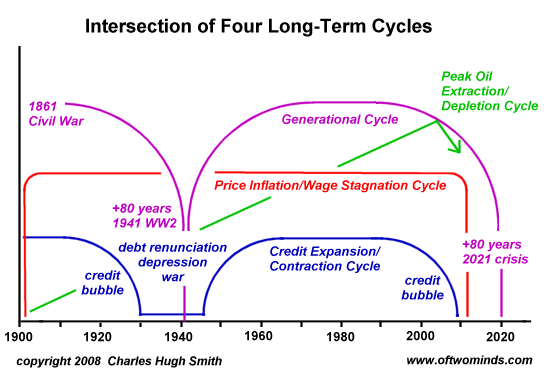
Let's start with the chart I prepared for the cover of my 2008 book Weblogs & New Media: Marketing in Crisis. (You can read the first chapter on the Marketing in Crisis webpage.)


It seems clear to me that four Grand Cycles will intersect around 2020-2022:


1. Peak oil, or the depletion cycle/end-game of the global economy's complete dependence on inexpensive, readily available petroleum/fossil fuels.


2. The cycle of credit expansion and contraction (approximately 60-70 years), which is now beginning the transition from unsustainable credit expansion (bubble) to renunciation of debt (credit collapse) and global depression.


3. The generational cycle (4 generations or approximately 80 years) of American history which leads to nation-changing social, political and economic upheaval. (The American Revolution: 1781 +80 years = Civil War, 1861 +80 years = 1941, World War II + 80 years = 2021)


4. The 100+ year cycle of price inflation and stagnation of wages' purchasing-power which began around 1901 is now reaching the final stage of widespread turmoil, shortages, famine, war, conflict and crisis.


While industrial society, the Central State and global neoliberal capitalism could probably suppress or adjust to any one of these cyclical climaxes, it seems unlikely the Status Quo will be successful in suppressing/adjusting to all four at once.


There is nothing magical about 2020 or about each crisis.


The book The Fourth Turning describes the 4-generation. 80-year cycle of political and social crisis in the U.S., and it makes sense even if you don't believe in cycles: after 80 years have passed, few humans are left who can recall the previous crisis. That loss of experiential capital, if you will, sets up the next crisis, which isn't a repeat performance of the last one but a variation on the general theme that unfolds in a unique historical setting.


That historical setting is defined by massive ecological overshoot as laid out inOvershoot: The Ecological Basis of Revolutionary Change.


This overshoot--humanity as a species expanding to fill every ecological niche when food and energy supplies are rising--leads to roughly 100-year cycles of rising prices for what I call the FEW essentials (food, energy, water) and resulting political instability--not to mention plagues, war, etc. as the over-abundant humans scramble to secure what's left of dwindling resources. This is ably described in The Great Wave: Price Revolutions and the Rhythm of History.


The credit/debt/speculative bubble that is slowly reaching its endgame has been addressed by The (Mis)behavior of Markets and Financial Armageddon: Protecting Your Future from Four Impending Catastrophes.


The end of cheap, abundant oil is covered in The Long Emergency: Surviving the End of Oil, Climate Change, and Other Converging Catastrophes of the Twenty-First Century,Beyond Oil: The View from Hubbert's Peak and The Long Descent: A User's Guide to the End of the Industrial Age, to name but three of many books on the subject.


I could have added a fifth crisis, that of demographics, as the financial promises made to the planet's ageing populace will be broken by the sheer number of the elderly: The Coming Generational Storm: What You Need to Know about America's Economic Future.


My own attempted synthesis of the coming intersection is of course Survival+: Structuring Prosperity for Yourself and the Nation.


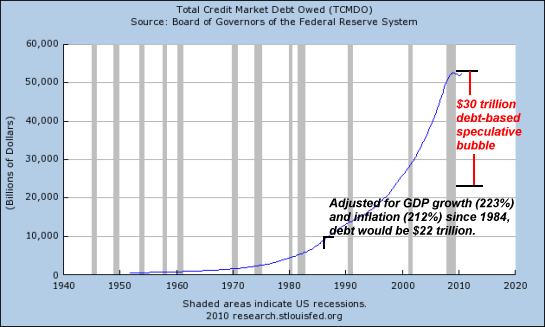
If you have any doubts remaining about the credit/debt bubble, I invite you to study 10 Economic Charts That Will Blow Your Mind (The Economic Collapse).


I've marked up one chart to show how far we've progressed in the speculative debt cycle:


Here's where we are in a nutshell. Borrowing money creates a virtuous cycle when money is cheap and easy to borrow, as the money flows into consumption and investments which feed that consumption.


Eventually, however, organic demand (that is, people actually needing things and services) is met. But as Marx noted, everyone and his brother/sister ramped up production to meet the seemingly limitless demand, so now there is massive excess capacity/overproduction.


Oops! It turns out the market isn't very good at assessing "steady state" levels of debt, consumption, production or speculation. So everyone overborrowed and over-speculated in both productive capacity and unproductive financial gambling.


Two bad things happen in this financial overshoot. One is that all that debt must be serviced, i.e. the interest and some modest attempt to pay down principal must be paid. In the virtuous upcycle, rising profits and asset prices make borrowing more to pay the seemingly trivial interest easy--no burden at all.


But once the overcapacity, over-leveraged, over-indebted cycle breaks, then assets and profits both plummet, leaving the borrowers unable to leverage more debt to pay the interest on their current debt.


As income streams and assets both decline, the interest suddenly gains the force of gravity: what was once lighter than air is leaden and increasingly burdensome.


The Grand Partnership of the Central State and the Financial Plutocracy (parasitic global cartel Capitalism writ large) have suppressed this natural implosion of speculative debt by printing and distributing trillions of dollars in "free" money.The only way to make servicing a trillion dollars bearable is to lower the interest rate to zero. At zero, even you and I can borrow a trillion dollars, and once again we can easily borrow enough to service our mountain of existing debt.


As a special bonus to the Plutocracy, the "free money" enables them to ramp up their favorite pastime, carefree financial speculations based on fraud, collusion and misrepresentation of risk. As any profits will be theirs to keep (private) while any losses (and all the risk) willbe backstopped by their partner, the Central State and its tax-donkeys, the taxpayers, it's a return to fun days at the races for the Financial Elites.


But a funny fork in the road appears after a massive dose of free money: the free money flows into speculative bets on actual tangible resources, creating massive inflation and newly reflated asset bubbles.


As a result, the system is now facing the same old problem--asset bubbles held aloft by "free money" and rampant financial fraud--and a new problem: inflation in resources that sustain the real economy.


The Central State/Financial Elites are thus faced with an impossible choice: if they let the speculative free money flow, then their populations starve as prices of tangible goods such as food and energy skyrocket. Recall that the masses aren't provided with a trillion dollars at zero interest; that privilege is reserved for the Financial Elites who fund the Central State politicos.


The capitalist answer to this vast financial overshoot is simple: interest rates will rise once the unlimited free money stops flowing. Once interest rates rise, then the debt--which has now doubled or tripled in the frenzied flow of free money-- quickly becomes burdensome in the extreme.


In other words, the status quo is now addicted to unlimited flows of free money. If the flow continues, then inflation will destabilize it; if it's cut off, then rising interest payments will destabilize it.


That's why it's easy to predict a financial collapse in the next few years. But there are still enough resources around to restabilize things after the impending financial liquidation; societies and economies have a way of finding a new equilibrium, a process described in The Onset of Catabolic Collapse (The Archdruid Report)

It’s not quite as straightforward as it sounds, because each burst of catabolism on the way down does lower maintenance costs significantly, and can also free up resources for other uses. The usual result is the stairstep sequence of decline that’s traced by the history of so many declining civilizations—half a century of crisis and disintegration, say, followed by several decades of relative stability and partial recovery, and then a return to crisis; rinse and repeat, and you’ve got the process that turned the Forum of imperial Rome into an early medieval sheep pasture.


But a financial re-set won't address any of the other looming crises. As I have often proposed, energy will remain too cheap for alternatives to make financial sense until it doesn't, and then it will be too late.


Such thoughts do leak out of the status quo every now and again, but they are generally viewed as some sort of parlor game: ooh, how deliciously awful it will all be! THE GLOBAL ECONOMY WON'T RECOVER, NOW OR EVER.


Here is an excellent summary of energy realities: A physicist models the city:

West illustrates the problem by translating human life into watts. “A human being at rest runs on 90 watts,” he says. “That’s how much power you need just to lie down. And if you’re a hunter-gatherer and you live in the Amazon, you’ll need about 250 watts. That’s how much energy it takes to run about and find food. So how much energy does our lifestyle [in America] require? Well, when you add up all our calories and then you add up the energy needed to run the computer and the air-conditioner, you get an incredibly large number, somewhere around 11,000 watts. Now you can ask yourself: What kind of animal requires 11,000 watts to live? And what you find is that we have created a lifestyle where we need more watts than a blue whale. We require more energy than the biggest animal that has ever existed. That is why our lifestyle is unsustainable. We can’t have seven billion blue whales on this planet. It’s not even clear that we can afford to have 300 million blue whales.”


I highly recommend this excellent analysis of energy consumption and production which was forwarded to me by knowledgeable correspondent Nathan P.


The author analyzes his own annual energy use and leads us to the conclusion that our 10,000 watts a day lifestyles must be trimmed to around 2,000 watts a day to be sustainable with current technologies.


He then goes on to extrapolate how many windmills, solar arrays and nuclear power plants we as a species will have to install over the next 20 years to replace current consumption of fossil fuels.


As I recall, it will require one new nuclear power plant a week for the next 20 years, plus thousands of new solar and wind arrays.


A significant amount of this planetary project is possible, but not likely, for the reason noted above: energy will remain too cheap for alternatives to make financial sense until it doesn't, and then it will be too late.


I am not a doom and gloomer, however, because history offers us abundant examples of civilizations which prospered on 2,000 watts a day or less, long before civilization became dependent on fossil fuels.


There will be a massive transformation of the status quo, however, and the outcome is in our collective hands.


If you would like to post a comment, please go to DailyJava.net.


Order Survival+: Structuring Prosperity for Yourself and the Nation or Survival+ The Primer from your local bookseller or in ebook and Kindle formats.

Of Two Minds is also available via Kindle: Of Two Minds blog-Kindle

Thank you, Piotr W. ($20), for your much-appreciated generous contribution to this site-- I am honored by your support and readership. Thank you, JDHines.com ($10), for your extremely generous contribution to this site-- I am honored by your support and readership.

Read more...

Thursday, February 17, 2011

Complexity: Bureaucratic (Death Spiral) and Self-Organizing (Sustainable)

Bureaucratic complexity leads to a death-spiral collapse; self-orhanizing complexity retains the assets of complexity and the adaptability of organic networks.


Three classic books address how increasing complexity leads to systemic collapse:


The Collapse of Complex Societies


The Upside of Down: Catastrophe, Creativity, and the Renewal of Civilization


Collapse: How Societies Choose to Fail or Succeed


The basic idea is that increasing complexity is advantageous up to a point, and then the costs of maintaining that complexity exceed the carrying capacity of the now bloated and resource-hungry system. Ad hoc solutions attempted by the Elites include war (conquer more resources to fill the gap), replacement of Elites by other Elites (Meet the new boss, same as the old boss) or exaggerated religious rituals (magical thinking).


A Physicist Models the City:

The graph reflects the bleak reality of corporate growth, in which efficiencies of scale are almost always outweighed by the burdens of bureaucracy.


The danger, West says, is that the inevitable decline in profit per employee makes large companies increasingly vulnerable to market volatility. Since the company now has to support an expensive staff — overhead costs increase with size — even a minor disturbance can lead to significant losses. As West puts it, "Companies are killed by their need to keep on getting bigger."


I recently addressed the systemic tendency of bureaucracies and fiefdoms to expand via the ratchet effect and then implode in a stick-slip event as the underlying instability is masked until the system gives way. Dislocations Ahead: The Ratchet Effect, Stick-Slip and QE3 (February 14, 2011)


In Survival+, I describe the systemic drive within complex bureaucracies to maintain the status quo at all costs: full spectrum defense of the status quo and asymmetric stakes in the game.


In the first, the bureaucracy organizes all its resources to defend itself against encroachment by other fiefdoms (internecine conflict between protected fiefdoms) and outsiders; it does so with desperate vigor because the employees and managers have a keenly asymmetric stake in the game of allocating resources: if their fiefdom loses resources, their livelihoods and perks vanish.


Thus, outsiders rarely muster the political power needed to over-ride these highly motivated forces of bureaucratic over-reach. For examples, we need look no further than the sickcare system, in which an outrageously costly week stay in a hospital has jumped from $10,000 to $120,000, or the Pentagon, where every new weapons system costs twice as much as the weapons it replaces (the F-35 fighter aircraft cost $110 million each, and perhaps as much as $150 million, replacing the Super Hornet F-18 E/F that cost $57 million each), and cities, which responded to the boom of the 80s and 90s by embarking on hiring sprees and limitless "sweeteners" to public labor unions and employees.


San Francisco offers one example. Though the city's population expanded by a modest 7% and inflation added 17% to costs, the city's budget jumped 70% and its payroll rose 30%. Having extended its complex bureaucracy into the stratosphere, the city is responding by raising fees on all sorts of trivial citizen activities.

Cities Slap Fees on Everything: Flailing Desperation and Financial Hara-Kiri (June 24, 2010)

The San Francisco budget grew by 70 percent between 1996 and 2003—three times faster than inflation, from $2.9 billion in 1996 to $4.9 billion in 2003. The 2010 budget is $6.5 billion, a 33% increase in seven years that is almost double the 17% percent rise in total inflation of that time span.


The city has more than 32,000 employees. From 1996 to 2003, its workforce grew by 30% while population grew by only 7%. That is one city employee for every 25 residents. Police and fire protection costs per resident are double other major cities such as San Diego.


More than 30% of city employees make in excess of $100,000 in 2009 (not including benefits). According to the report, pay scales are roughly 20%-30% higher than comparable regional compensation.


The unprecedented rise in the stock market saved the city $100 million in pension payments in the late 1990s, a stellar performance which was then baked into future revenue expectations. The stock market has essentially treaded water from 2000 to 2010, and now the promises made in an era of lavish stock market returns in the city pension funds must be paid out of the dwindling general fund.


A recent report, Pensions: Beyond Our Ability to Pay revealed that the city will have to increase its contributions to its employees’ pensions by over 50 percent by 2011. Due to the demographics of an aging Baby Boom-heavy workforce, half of the city’s workforce will be eligible for retirement in the next five years.


Just as large, complex bureaucratic corporations have vanished without a trace once their overhead costs exceed their carrying capacity, so too will cities inevitably go bust as the immensity of their insolvency becomes inescapable.


The same can be said of the entire Federal government, which has added $1 trillion to its overhead in recent years even as revenues fell. Now the budget exceeds $3.8 trillion while revenues are at best $2.3 trillion, creating a structural deficit of $1.6 trillion-- the expected deficit in 2012.


Cuts of a modest $100 billion are met with howls of pain, and the Federal fiefdoms are increasingly devoting their resources to self-protection rather than pursuing their mission.


Even if cuts of $100 billion are made, expenses in the Central State complex will rise by $200 billion annually without any special effort being made: that's the nature of bureaucratic complexity.


There is another type of complexity, one based on the organic model of self-organization and self-regulation. An interesting example of a large-scale self-organizing enterprise is Bombay's (India) unique system of lunchbox deliveries: Dabbawalas, 5,000 delivery people working seamlessly to delivery tens of thousands of lunches to office workers for a very low cost per lunch.


The system has no bureaucracy; it operates a network that is moving from word-of-mouth communication to SMS (texting). Regardless, the underlying network is self-organizing and self-regulating: no bureaucracy is needed to instruct the delivery people, organize their routes or enforce countless regulations on their conduct.


As a result, the cost remains very low.


Furthermore, if the system encounters problems, it draws upon the network for solutions, rather than a high-cost, complex central authority bureaucracy.


Bombay Dabbawalas go high-tech (from 2006)

Indeed the Dabbawala's method of lunch delivery is unique. Their origin dates back to the 1890s, a period when Bombay saw an influx of people from various communities and regions of India migrating to the city to seek livelihood. According to the Association, there were no canteens or fast-food centers then, and those who could not take a packed lunch from home since they had to leave early invariably had to go hungry.


For over 115 years these lunch deliverymen who were subsequently started to be called Dabbawalas have been collecting lunch packed in three or two-tier metal boxes (called dabbas) from subscribers' homes and delivering them to their workplaces.


Today the 5,000 Dabbawalas make about 200,000 lunch deliveries in the city and have become famous for their clockwork precision and efficiency. Reportedly their mistake rate is just 1 in 16 million deliveries, which caused the Forbes Global magazine to award its Six Sigma certification in 2001. According to Forbes the Dabbawalas work with 99.999999 percent accuracy.


But besides the accuracy rating, the Dabbawala supply-chain system has also attracted interests from global educational institutions and think tanks for its complexity.


In fact, some even say that the Dabbawalas work like the Internet. Just like the Internet, where voice or data files are sliced into tiny packets with their own coded addresses that are then ferried in bursts, independent of other packets and possibly taking different routes, across the world, the Dabbawalas too work with packets in a similar manner.


They collect lunch boxes from homes in the morning and take them to the nearest railway station. From there each of the boxes that is coded according to the station of origin, the Dabbawala team at the collection and delivery point, and the destination, are sorted out and taken to the next intermediary stations, where they are sorted out again for area-wise distribution and delivery. So a single lunch pack could change hands three to four times in the course of its daily journey, "yet they get delivered without a mistake since they are so well coded," says Manish Tripathy, the chief information officer who looks after the Association's technology functions.


Small wonder then, that the world in general too finds the Dabbawalas fascinating. For instance the Berkeley University in California teaches the logistic system of Dabbawalas as a case study in one of their business management programs and many Indian business schools and industry associations have the Dabbawala logistics system in their case-study agenda.


In 1998 two Dutch filmmakers, Jascha De Wilde and Chris Relleke, made a documentary called "Dabbawalas, Mumbai's unique lunch service" and in 2001, the Christian Science Monitor, the Boston-based newspaper, covered the Dabbawalas in an article called "Fastest Food: It's Big Mac vs. Bombay's Dabbawallahs."


Unfortunately, I have been unable to locate a copy of this documentary.


Thus complexity can remain an asset, as long as it is self-organizing, self-correcting and self-regulating. A bureaucracy's systemic response to any challenge or threat is always the same: devote precious resources to self-preservation above all else. Thus the responses needed to save the system never receive the resources they need to be successful, and the bureaucracy's complexity and drive for self-preservation dooms it to collapse.


Complex self-organizing networks like the Dabbawalas, on the other hand, operate more like an ecosystem, evolving rapidly to systemic change without a Central State or management imposing "solutions."


As former Sun Microsystems honcho Scott McNealy said circa 2000: the network is the computer. For the Dabbawalas, their network is the innovator, the management and the adaptive ecology in which they operate and live.


The Dabbawalas are adapting social media and modern communication technologies to serve and extend their network. Those technologies are highly leveragable in such a self-organizing network.


Thank you, CNF, for the information on the Dabbawalas.


If you would like to post a comment, please go to DailyJava.net.


Order Survival+: Structuring Prosperity for Yourself and the Nation or Survival+ The Primer from your local bookseller or in ebook and Kindle formats.

Of Two Minds is also available via Kindle: Of Two Minds blog-Kindle


Thank you, David K. ($50), for your marvelously generous contribution to this site-- I am greatly honored by your support and readership. Thank you, Steven P. ($15), for your most-welcome generous contribution to this site-- I am greatly honored by your support and readership.

Read more...

Wednesday, February 16, 2011

You Want Inflation? Here's How To Get It

Rising prices driven by speculation is not the same as organic inflation, and diverting national income to the banks will not create organic inflation.


The Federal Reserve's stated goal is to create modest inflation. Unfortunately they don't grasp the difference between speculative inflation and organic inflation. The Fed's official goals are to stabilize prices and maintain employment, and its de facto policy to achieve these lofty, high-minded goals is to divert huge sums of the national income to the insolvent banking sector.


The Fed also seeks to bail out the insolvent debt machine by generating some nice solid inflation, to boost the impaired assets held by banks. In other words, the Fed is specifically seeking to create asset inflation, which will eventually enable the banks to appear marginally solvent as their real estate and other assets rise in value.


Let's turn to the origins of the Fed inflation policy, as stated by Chairman Ben Bernanke in his various papers and speeches: deflation VS inflation: an Austrian Analysis:

In a paper from which he earned the sobriquet "Helicopter Ben," Chairman Bernanke provided a thought experiment to demonstrate that any deflation could be defeated: most economists would agree that a large enough helicopter drop [of newly created money] must raise the price level...at some point the public would attempt to convert its increased real wealth into goods and services, spending that would increase aggregate demand and prices.


In a speech a few years later, Bernanke detailed the policy mechanism by which the circulation of dollars might be increased at will: If the Treasury issued debt to purchase private assets and the Fed then purchased an equal amount of Treasury debt with newly created money, the whole operation would be the economic equivalent of direct open-market operations in private assets. "We conclude that, under a paper-money system, a determined government can always generate higher spending and hence positive inflation."


Here's the problem with Bernanke's "solution:" the assets he's goosed ever higher (stocks and bonds) are only held indirectly via pension funds for the bottom 80% of the populace. Only the top 10% of the citizenry own enough stocks and bonds directly to experience the "increased real wealth."


As a result, there's no follow-through of higher spending. Bernanke's policies have failed to generate higher spending for a number of fundamental reasons.


The distinction between housing assets and equity assets is absolutely critical, but it's completely lost on the Fed. We can see Bernanke's game plan in action in the most recent Fed Flow of Funds.


Housing equity has plummeted roughly $6 trillion from the bubble peak to Q3 2010 (and it has slipped further since): $22.6 trillion to $16.5 trillion.


Stocks and bonds, meanwhile, have gained $6 trillion--a nice symmetry. In Q1 2009, corporate equities ($5 T), mutual funds ($3.1 T) and pension fund reserves ($10.4 T) added up to $18.5 trillion. By Q3 2010, these had risen smartly to $24.4 trillion (corporate equities $7.8 T, mutual funds $4.4 T and pension fund reserves $12.2 T)


Housing is the primary household asset for roughly 2/3 of U.S. households, while stocks and bonds are the primary asset for only the top 5%. So what Bernanke has effectively overseen is a massive transfer of private wealth.


He's also accomplished a stupendous transfer of national income to the financial Elites in the banking sector by lowering interest rates to zero (ZIRP). Back in the low inflation 1960s, banks and savings and loans were required to pay 5.25% on all savings. Cash, in other words, generated substantial income for ordinary savers.


The idea with ZIRP is to loan the banks essentially free money, which they can lend out at between 5% and 12% (or higher), generating "free" profits. The Fed's plan is to sluice these gigantic profits to banks so they can recapitalize their insolvent balance sheets without any direct handouts. But ZIRP is nothing but an indirect transfer of wealth from the private sector (now completely deprived of any interest income) to the banks.


The Fed's policies allow for only two ways to access this newly created "increase in real wealth" for the top 10%: sell the assets or borrow money from the banks. If people cash out their stock gains, then that would automatically push stocks lower, bollixing the game plan. The Fed's intention is to "nudge" the populace into borrowing more money from the banks at nominally high rates of interest (anythijng above 0% is pure profit for the banks).


Unfortunately for the Fed, those with rising assets are no longer hankering for higher debt levels, and the bottom 80% are no longer qualified to borrow. So what we have is aspeculative asset inflation which is spilling over into commodities as hot money borrowed for next to nothing seeks higher returns anywhere on the planet.


Contrast this with organic inflation, in which people with lots of free cash are chasing limited goods and services.


Inflation itself is a transfer of wealth. As noted in the paper linked above:

In short, the true crux of deflation is that it does not hide the redistribution going hand in hand with changes in the quantity of money. It entails visible misery for many people, to the benefit of equally visible winners. This starkly contrasts with inflation, which creates anonymous winners at the expense of anonymous losers.


Inflation is a secret rip-off and thus the perfect vehicle for the exploitation of a population through its (false) elites, whereas deflation means open redistribution through bankruptcy according to the law.


The reason that public sentiment has always been biased against monetary deflation can be found in the manner in which wealth transfer occurs under inflationary and deflationary environments. During an inflationary credit expansion, wealth is transferred from the public in general to the earliest recipients of the newly created credit money. In practice the earliest recipients are interest groups with the strongest political connections to the State and, in particular, the State institutions that control monetary policy (i.e., the Federal Reserve in the United States).


Importantly, the wealth transfer that takes place during an inflation is hidden and largely unrecognized by the majority of the population. The population is unaware that the supply of money is increasing and the attendant rise in prices, ostensibly beneficial to business, initially produces [a] general state of euphoria, a false sense of well-being, in which everybody seems to prosper.


Those who without inflation would have made high profits make still higher ones. Those who would have made normal profits make unusually high ones. And not only businesses which were near failure but even some which ought to fail are kept above water by the unexpected boom. There is a general excess of demand over supply--all is saleable and everybody can continue what he had been doing.


And here precisely lies the answer to why the State prefers a policy of controlled inflation. Only in an inflationary environment can State largesse be conferred to the politically well-connected without raising public ire. The widespread and visible transfers of property through bankruptcy that must take place during a deflation are often politically destabilizing and thus highly unappealing to any regime. A sense of injustice grows within the population as banks are saved from the folly of their misguided investments with taxpayer-funded bailouts, while debtors with no political clout have property seized in bankruptcy.


Here is where we are in a nutshell. The general populace has seen its income decline as the Fed's ZIRP policy has channeled their interest income directly into the banks, and as their wages stagnate.


Yet thanks to the speculative inflation engineered by the Fed, prices are rising. In an organic inflation, wages and interest income would both be rising along with prices. So the direct result of the Fed's policies is higher costs and the transfer of national income to the banks.


The average household has seen its income and its asset base (housing) stagnate or decline. Meanwhile, the equities market, which directly "increases real wealth" in only the top 10%, has risen over 80% from the Q1 2009 low.


If the bottom 80% are seeing income and assets stagnate or decline, how can you possibly get organic inflation? Answer: you can't. And speculative inflation only benefits the top financial players, not the general populace.


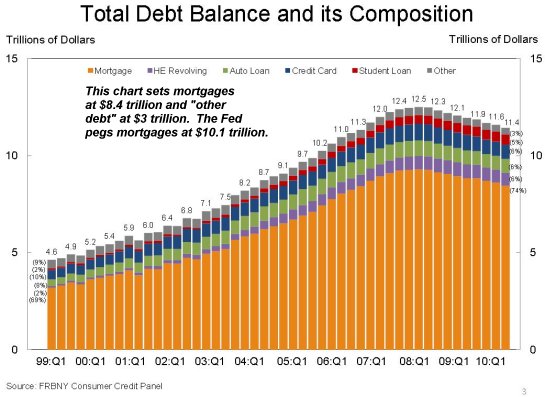
If we combine this chart and the Fed Flow of Funds data, we find that mortgages total $10.1 trillion and other consumer debt is about $3 trillion.


You want to create organic inflation, driven by consumers with plenty of cash chasing goods and services? Here's how:


1. Reinstate the policy of paying 5.25% on all savings, effectively transferring wealth back from banks to citizens. If the banks can't manage to do so and remain solvent, then close them down and liquidiate their assets and liabilities. Others will rise to take their places.


2. Print $5 trillion in cash, not credit, and liquidate all consumer debt and a couple trillion in mortgage debt for those who are not hopelessly underwater.


3. Aggressively cram down underwater mortgages onto the banks, forcing them to liquidate all their bad debt. Yes, this will reveal them as insolvent, but the goal here is not to save the financial Elites' impaired assets, it's to reset the housing market by clearing off all the impaired debt in the system.


By resetting the consumer balance sheet and paying interest, then you would be putting cash into households which could be spent in the real economy.


Is this a wise or prudent policy? I don't know. The goal here was not to assess that question, it was simply to follow up on the goal of creating inflation. If you want organic inflation, you have to divert the national income from the banks to the citizenry, and you have to reset the housing market.


The Fed's policies cannot create organic inflation, because all the Fed is doing is transferring wealth to the nation's Elites. Their spending on luxuries and fine dining are not broadbased enough to generate organic inflation in the entire economy.


Borrowing money does not drive organic inflation: higher incomes and free cash drive organic inflation. If you want inflation, then you have to increase the incomes and assets of 60% of the households, not just the top sliver who own most of the financial assets.


If you would like to post a comment, please go to DailyJava.net.


Order Survival+: Structuring Prosperity for Yourself and the Nation or Survival+ The Primer from your local bookseller or in ebook and Kindle formats.

Of Two Minds is also available via Kindle: Of Two Minds blog-Kindle


Thank you, David M. ($10), for your much-appreciated generous contribution to this site-- I am honored by your support and readership. Thank you, Jon D. ($100), for your stupendously generous contribution to this site-- I am greatly honored by your support and readership.


Read more...

Tuesday, February 15, 2011

A 5-Year Scenario: 2011-2016

In this scenario, the wheels fall off the debt-fueled global "recovery" and assets bottom in 2014.


Here is one possible scenario for the next five years. Why do I consider this somewhat more likely than other possible scenarios? Here some undercurrents which may be generally under-appreciated:


1. There is a difference between speculative and organic demand. The two are of course related, as industrial consumers of resources must hedge against rising prices using the same instruments as speculators--futures contracts, etc.


2. Follow the credit, not just the money. It's not just the U.S. economy which is dependent on cheap, abundant credit--the same can be said of China and the European Union to some degree.


Just because Chinese buyers put 50% down on their fourth flat doesn't mean they don't need credit for the other 50%. Chinese developers are heavily dependent on credit issued or backed by the Central Governments banks and proxies.


Credit is not cash, and creating credit is not the same as printing cash. Shoveling $1 trillion in zero-interest credit into the banking system does not necessarily mean that $1 trillion flows into the real economy--that can only happen if someone or some entity borrows the credit.


This is why some claim that hyperinflation has never occurred in a credit-based system; it can only arise in a monetary system in which cash itself is printed (i.e. Zimbabwe et al.)


I am not making any such broad claim, but to identify the two as identical seems to me to be a profound confusion.


This distinction plays out in a number of ways. If the Fed had actually printed $1 trillion in cash and dropped it from helicopters, then those collecting the cash on the ground might have spent it, creating more organic demand for goods and services.


If the Fed creates credit and loans it to banks at zero-interest rate, the credit only flows into the real economy if somebody borrows it.


Without borrowers, the "money" just sits in reserves, where it does not spark inflationary organic demand for resources, goods or services.


If someone borrows the "money" to refinance existing debt, the only money that flows into the real economy is the difference between their original debt servicing costs and their new debt servicing costs, presuming the new costs are lower than the original. (Not always the case if said borrower had an interest-only "teaser rate" mortgage that he/she is now rolling into a mortgage with principal payments and a market rate interest payment.)


Or a large speculator (trading desk, hedge fund, etc.) could borrow the credit-money to speculate in commodities, driving prices up on the widespread expectation of higher costs in the future. In this case, the credit-money does influence the real world economy by driving commodity prices above levels set by organic demand.


But speculative "hot money" is not organic demand; it flees or is lost if trends suddenly reverse.


Since commodities such as oil are priced on the margins, this matters. A sudden decline in oil from $86/barrel to $76/barrel would trigger an exodus from speculative long positions, reinforcing that decline in a positive feedback loop.


3. Hoarding is a special flavor of organic demand. Like speculative demand, it vanishes once the fear of ever-higher prices evaporates.


4. The global GDP is around $60 trillion; the Federal Reserve has "printed" $2 trillion in the past three years. Placed in the proper context, the Fed's printing and asset purchases are large enough to influence the U.S. stock and bond markets, but they simply aren't significant enough or focused enough to enslave the entire global markets in stocks, bonds, precious metals and commodities.


Other players are busy printing and issuing zero-interest credit, too, of course, but we should be wary of sweeping generalizations about the deterministic nature of these central bank campaigns.


As further context, consider that the Fed's vast interventions have distributed some $2 trillion into the financial sector; meanwhile, U.S. homeowners saw their net equity decline by some $6 trillion.


OK, on to the scenario which will get me in all sorts of trouble:


Here is the sequence of events I consider rather likely:


Q3/Q4 2011-2012: extend and pretend fails. The wheels fall off the global "recovery," the emerging market equity bubbles, oil, China's equities and its property bubble, and most if not all commodities. Gold and silver swoon as per late 2008 as raising cash become paramount. Oil retraces to the $40/barrel level, and then drops further as exporters ramp up their exports to generate desperately needed cash.


Interest rates rise sharply, risk assets tank, borrowing dries up, housing prices "slip" to new lows (the stick-slip phenomenon), and the hated/loathed U.S. dollar confounds almost everyone by breaking out of technical resistance levels.


Civil disorder spreads along with recession and lower energy prices, which devastate oil exporters' primary source of government revenues.


With better grain harvests stemming from improved weather, declining meat consumption in 2012 due to recession and the implosion of the market for corn ethanol, grain prices plummet, wiping out all the speculators who reckoned 2010 had set the trend for the decade.


All of this starts slowly in Q3 2011 but gathers momentum in 2012.


Unfortunately for central banks, all their printing and credit creation is analogous to insulin resistance: without borrowers and solvent banks and consumers, their frantic efforts to "stimulate" their economies with additional liquidity come to naught.


The Central State's other gambit, monumental fiscal "stimulus," runs into the brick wall of rapidly rising interest payments and a political revulsion triggered by the realization that only the financial and political Elites actually benefitted from the trillions squandered in the 2008-2011 orgy of Central State "stimulus" and backstops.


With asset prices collapsing in a phase shift, the equity needed to float new loans vanishes; with risks rising, the market for junk bonds and other risk-laden debt also disappears.


All those who clung on through the "recovery," hoping to made whole, are wiped out. Their bankruptcies trigger a new wave of selling and writedowns.


2013-2014: Re-set and reckoning. Widespread political and financial turmoil leads to a few central choices:


1. Repudiation of the Neoliberal Central State/Financial Oligarchy strategy of 2008-2011 which focused on preserving the insolvent (but politically dominant) banking and Wall Street financial sectors and transferring their private losses to public entities/taxpayers.


2. Replacement of incompetent, venal, exploitative dictatorships with some new flavor or autocracy, oligarchy, theocracy or dictatorship, most of which will prove to be equally incompetent, venal and exploitative--but shorter-lived.


3. Experimentation with new models of governance, "growth" and credit/debt. Some modest recognition of the profound failures in the "extend and pretend" status quo generates a sense that these catastrophically destructive policies have been recognized as such and corrected.


These years will see the near-term bottom in housing, equities, and other assets. Those few who preserved cash during the meltdown are in a position to snap up assets on the cheap. Those who depended on credit/debit find borrowing is now difficult and dear. Those who "bottom-fished" real estate in 2011 are wiped out, along with those who bet that commodities were heading straight to the moon.


2015-2016: false dawn. Things get better; prices stabilize, assets and commodities start rising in price and a sense of hope replaces widespread gloom and distemper.


The real crisis has been pushed forward to 2020-2022. Nonetheless, 2015-2016 will offer those with cash tremendous profit opportunities.


If you would like to post a comment, please go to DailyJava.net.


Order Survival+: Structuring Prosperity for Yourself and the Nation or Survival+ The Primer from your local bookseller or in ebook and Kindle formats.

Of Two Minds is also available via Kindle: Of Two Minds blog-Kindle


Thank you, Steve M. ($5/mo), for your exceedingly generous sybscription to this site-- I am greatly honored by your support and readership. Thank you, Brian K. ($100), for yet another outrageously generous contribution to this site-- I am greatly honored by your ongoing support and readership.
Read more...

Monday, February 14, 2011

Dislocations Ahead: The Ratchet Effect, Stick-Slip and QE3

The Fed has galloped into a box canyon with no escape; no matter what it does, QE3 will "disappoint" the markets.


I think we can safely predict that "Quantitative Easing 3" (the next round of fiat money creation) will "disappoint," triggering stock and bond market mayhem. Last week I noted that the U.S. economy is now addicted via the ratchet effect to unprecedented levels of Federal borrowing and Federal Reserve fiat/credit creation and manipulation.


In other words, the status quo is now completely dependent on the Federal government borrowing 40% of its expenditures ($1.5 trillion a year) and on the Federal Reserve printing fiat money and buying $1 trillion in Treasury bonds every year.


Now that Central State spending and intervention have ratcheted up to those levels, any reduction will destabilize the staus quo of zero-interest rates (ZIRP), unhindered entitlement and military/Security State spending, etc.


Thus we have politicos proposing $35 billion in "cuts" to a Federal budget ( $3.8 trillion for fiscal 2011) which has leaped up by hundreds of billions of dollars in a mere decade.


Two other concepts which I have been discussing in my "weekly musings" (also covered in the Survival+ critique) may apply here as well:


1. Stick-slip phenomena, which I have previously suggested may shed conceptual light on the housing market's phase shifts.


An earthquake is an example of this phenomenon: the pressure on two adjacent plates of the Earth's crust rises without apparent consequence until the plates suddenly "slip," triggering a devastating earthquake.


2. Punctuated equilibrium, a concept from evolutionary biology based on the observation that the stasis (stability, equilibrium) which dominates the history of most fossil species is disrupted (punctuated) by short periods of rapid evolution.


Systemic change--rapid changes in climate and ecology--pressure organisms which had adapted to other circumstances to either experiment (via mutations) and evolve to suit the new environment or go extinct.


The stock and bond markets now depend on massive injections of free money (via the Fed's POMO) into equities and the purchase of newly minted Treasury bonds.This is the ratchet effect on a large scale: any attempt to ratchet down the Fed's interventions will cause uncertainty and doubt about the consequences, for no one seriously believes that private demand is just aching to jump in and replace the Fed's trillion-dollar buying sprees in stocks, bonds and mortgages.


Beneath the surface of illusory stability, pressures are mounting. A stock market which is now entirely reliant on monthly injections of $100 billion of "free money" from the Fed's "quantitative easing 2" program is a market that is exquisitely vulnerable to any reduction in that stimulus.


The same can be said of the bond market, which globally is groaning under the demands of sovereign states borrowing trillions of dollars annually in new bonds from now until Doomsday (roughly 2021, last time we looked, though many see 2012 as the end-game).


If the Fed stops buying Treasuries, then rates--already rising on the long end--will move decisively higher, bollixing the Central State's entire game plan of rescuing the insolvent banks and goosing a "recovery" with low interest rates and unlimited liquidity.


The Fed and Treasury are now boxed in by the ratchet effect. Any reduction in the Fed's unprecedented intervention, no matter how modest, will trigger an earthquake of uncertainty: the apparently "sticky" stability will slip in a dislocation.


The problem with expectations is also a reflection of the ratchet effect: they only go up.


Rather than adapt and evolve, the Central State and its proxy the Federal Reserve simply moved into a higher state of vulnerability. The global financial crisis which finally broke through all the Central State defenses in 2008 punctuated the illusory stasis/stability of the financial status quo. The opportunity to evolve was tossed aside in favor of extend and pretend, denial, and the transfer of risk and liabilities from the now-insolvent parasitic financial Elites to the taxpayers (profits were private, losses are now public).


In effect, the Fed moved into an even more precarious ecosystem, in which the "free markets" of stocks and bonds are now totally dependent on massive Fed manipulation to maintain their current stability. Yet the levels of Fed intervention are so enormous that they are inherently unstable. the illusory stability of the present has been purchased by increasing the systemic levels of instability.


Add these factors up and predicting the Fed's next round of "Quantitative Easing" (QE3) will "disappoint" expectations is easy. The reason is straightforward: the only way the Fed can avoid disappointing lofty expectations is to ratchet up its fiat creation/market manipulations another tooth. Even keeping QE3 the same size as QE2 will "disappoint" those who fear it isn't enough to "stimulate self-sustaining growth" (i.e., an economy which doesn't depend on borrowing 11% of GDP every year and the monetiziation of 2/3 of all new Federal debt via Fed purchases).


Political resistance to the Fed's headlong gallop into the box canyon of monetization and stock market manipulation is rising. The Fed's policies have enriched the top 10%--those who directly own enough stocks to experience a "wealth effect"--and enabled Wall Street to gorge on "free money profits" unleashed by the Fed's diversion of national income to the banks via zero interest rates. But politicos are increasingly aware that the Fed's lifeboats have only saved these Elites, while the passengers in steerage--the bottom 80%--are watching the Titanic sink lower in the water from the tilting deck.


The Fed is boxed in: by expectations of continued massive intervention and by political pressure to cease or curtail these very same interventions.


Ironically, if the Fed flouts political pressure and ramps up its manipulations via a monumental QE3 program, that may well disrupt the markets as much as a policy of diminished intervention, for the markets would soon grasp that the Fed would be guaranteeing a political firestorm of resistance if the Fed's manipulations didn't spark a hiring/jobs boom by the 2012 election season.


And we all know the Fed's QE3 will not spark a hiring boom, for the Fed's policies are designed to serve one goal: preserve and enrich the financial sector's Elites. Now that they're safely in the lifeboats, the failure of the Fed's policies to "trickle down" to the steerage passengers is increasingly evident.


Recapitalizing the "too big to fail" banks has not yet been accomplished, despite the Fed's gargantuan channeling of national income into Wall Street and the TBTF banks. So the Fed is triply boxed in: its unprecedented efforts to recapitalize the TBTF banks and restore Wall Street's swollen profits are only partially complete, yet it is already encountering stiff political resistance.


Even worse, the interventions have had to be ratcheted up to maintain their effect, akin to an addiction or insulin resistance. The vulnerabilities have not been erased, they've only been masked. The pressures on the financial faults beneath our feet are increasing, and the tremors will soon give way to sudden dislocations of expectations, risk and price.


If you would like to post a comment, please go to DailyJava.net.


Order Survival+: Structuring Prosperity for Yourself and the Nation or Survival+ The Primer from your local bookseller or in ebook and Kindle formats.


Of Two Minds is also available via Kindle: Of Two Minds blog-Kindle


Thank you, Kevin L. ($50), for your phenomenally generous contributions to this site, financial and intellectual-- I am greatly honored by your support and readership. Thank you, Todd T. ($20), for your exceedingly generous contribution to this site-- I am greatly honored by your support and readership.


Read more...

Terms of Service

All content on this blog is provided by Trewe LLC for informational purposes only. The owner of this blog makes no representations as to the accuracy or completeness of any information on this site or found by following any link on this site. The owner will not be liable for any errors or omissions in this information nor for the availability of this information. The owner will not be liable for any losses, injuries, or damages from the display or use of this information. These terms and conditions of use are subject to change at anytime and without notice.

RE: European Union AI Act, and Our Use of Generative AI Tools and Agents Policy

All text on this site is composed by Charles Hugh Smith or by a credited guest-author. No Generative AI Tools are used in the composition / writing of any text or graphic content created by Charles Hugh Smith. This site deploys no AI agents or generative AI tools. This site is not responsible for the disclosures, use or non-use of AI agents or generative AI tools in advertisements displayed by Investing Channel or other ad placement services.

Audio files generated by text-to-audio transcription tools are identified as such.

Our Privacy Policy:

Correspondents' email is strictly confidential. This site does not collect digital data from visitors or distribute cookies. Advertisements served by third-party advertising networks such as Investing Channel may use cookies or collect information from visitors for the purpose of Interest-Based Advertising; if you wish to opt out of Interest-Based Advertising, please go to Opt out of interest-based advertising (The Network Advertising Initiative) If you have other privacy concerns relating to advertisements, please contact advertisers directly.

PRIVACY NOTICE FOR EEA INDIVIDUALS

This section covers disclosures on the General Data Protection Regulation (GDPR) for users residing within EEA only. GDPR replaces the existing Directive 95/46/ec, and aims at harmonizing data protection laws in the EU that are fit for purpose in the digital age. The primary objective of the GDPR is to give citizens back control of their personal data. Please follow the link below to access InvestingChannel's General Data Protection Notice.
https://stg.media.investingchannel.com/gdpr-notice/

Notice of Compliance with The California Consumer Protection Act

This site does not collect digital data from visitors or distribute cookies. Advertisements served by a third-party advertising network (Investing Channel) may use cookies or collect information from visitors for the purpose of Interest-Based Advertising. If you do not want any personal information that may be collected by third-party advertising to be sold, please follow the instructions on this page: Do Not Sell My Personal Information.

Regarding Cookies:

This site does not collect digital data from visitors or distribute cookies. Advertisements served by third-party advertising networks such as Investing Channel may use cookies or collect information from visitors for the purpose of Interest-Based Advertising; if you wish to opt out of Interest-Based Advertising, please go to Opt out of interest-based advertising (The Network Advertising Initiative) If you have other privacy concerns relating to advertisements, please contact advertisers directly.

Our Commission Policy:

Though I earn a small commission on Amazon.com books and gift certificates and gold (BullionVault) purchased via links on my site, I receive no fees or compensation for any other non-advertising links or content posted on my site.

Copyright Notice:

All original images (Drawings and Photographs), text (essays, books and works of fiction), audio and video recordings, musical compositions, graphic design, graphic design elements and HTML coding on this site are the copyrighted work of Charles Hugh Smith unless otherwise credited or noted. They are published as information for the private use of site visitors, and any reproduction or redistribution of this content or coding in any media in any format or distribution channel (text, audio, video/film, web) without the written permission of the copyright holder is strictly prohibited. All rights in all media reserved globally.

  © Blogger templates Newspaper III by Ourblogtemplates.com 2008

Back to TOP