Monday, February 20, 2012

Presidents Day: Why Can't We Nominate Our Own President? We Can, We Are

Why can't the American public nominate their own candidate for president? It turns out we can, and are doing so for the first time in American history.


If the last 12 years have revealed anything, they have shown beyond reasonable doubt that both Status Quo political parties in the U.S. are hopelessly, ruinously corrupt and thus beyond any reform or redemption. We all know why: it now takes millions of dollars to run costly mainstream media election campaigns, and the only source for contributions of that scale is the financial/corporate Elite.

It doesn't matter how you arrange the taxonomy of the financial aristocracy that rules the nation or how you subdivide it--old money, new money, family money, corporate money, etc.-- the bottom line is these campaign contributions are viewed by the aristocratic donors as investments that yield gargantuan returns in tax breaks, subsidies, bailouts, sweetheart contracts, "get out of jail free" cards for the shadow banking system, and so on.
In Social Fractals and the Corruption of America (February 8, 2012) I wrote:
Clearly, the tax code is both legal and completely skewed to the very wealthy and politically powerful. $100,000 is still a fairly significant contribution in politics, and if that contribution ends up yielding a tax break that gains the donor $1 million in lower taxes, then that donation earned a 10-fold "return on investment."
Longtime correspondent Kevin K. described the reality from personal knowledge:
I had an old boss (I won't mention his name, but he is worth over $100 million) that actually tracked the ROI (Return on Investment) of every dollar he gave politicians.By the mid 90's there was no better "investment" out there with a better return than "giving perfectly legal campaign contributions". Because of this, his "contributions" kept getting bigger and bigger (they are huge now, with much of the "perfectly legal campaign contributions" hidden by giving to PACs (political action committees) and funding things the politician wants funded rather than writing checks to a re-election fund that has a paper trail.
This neofeudal, systemic corruption raises a simple question: why can't the American people nominate a candidate for president themselves, directly, rather than being left a false choice of whatever lackeys the corrupt, neofeudal parties have nominated? Answer: we can, and even better, we are.

Correspondent Cris V. alerted me to the existence of AmericansElect.org, the first national online primary. "Americans Elect lets you choose a leader that puts country before party. Americans Elect is a secure, online nominating process that combines our oldest values with our newest technologies."

In essence, voters register online and can draft a candidate of their choice, or review the candidates drafted by other citizens. There will be an online primary process where candidates will be pared down by a series of online votes by delegates (you, me, and anyone else who registered to participate). The final candidate will be entered on ballots nationwide as the candidate of Americans Elect.

Here is the Wikipedia entry: Americans Elect:
As of January 2012, Americans Elect has gained ballot status in 15 states: Alaska,[23] Arizona,[23] Arkansas,[24] California,[25][26] Colorado,[27] Florida,[28] Kansas,[23] Maine,[29] Michigan,[28] Mississippi,[30] Nevada,[23] Ohio,[31] Rhode Island,[32] Utah,[33] and Vermont.[34] As of February 2012, certification is pending in Hawaii,[35] New Mexico,[30] and Wyoming.[36] As of December 2011, signatures for fifteen other states were being collected.[26]Americans Elect is in the process of securing a line on the ballot in all 50 states for a ticket to be named directly by the people through the first-ever online nominating convention. Any registered voter can sign up to participate as a Delegate at [AmericansElect.org].[37] The organization is attempting the process of being accredited in every US state, allowing it to place candidates on presidential ballots nationwide.[5] 
In order to obtain ballot access nationwide, some states' guidelines require Americans Elect to register as a political party,[8] even though federal courts have ruled[3] they are not a traditional political party.
It's not too difficult to see Americans Elect as the means by which Americans who want to opt out of the corrupt party system could nominate Ron Paul or another independent.
As Cris V. observed:
Ron Paul will be marginalized by the GOP establishment regardless of how many true Republicans he has coming to the GOP Convention. The GOP/Internationalist Establishment will see that Ron Paul gets buried and forgotten at the GOP convention even as he gets a real larger and larger following.So he will be jumping off the GOP (ham-strung and out of gas) horse and running thru the finish line with 80% Independents, 95% of Constitutionalists and Libertarians, the 55% of Republicans, and 45% of the Democrats. All he has to do is get on the ballot.
Clearly, the Status Quo parties fear and loathe anyone who isn't dependent on their power with every fiber of their rotting, corrupt, neofeudal being. It is also clear that there can be no real reform of anything as long as the two corrupt parties remain in control of the political Elite, which is funded and controlled by the financial Elite. In this sense they are partners in the larger project of looting the republic, transferring private losses to the taxpayers and snuffing out any challenges to their neofeudal power.

In their view, debt-serfs must only be allowed the false choice of voting for Tweedledum or Tweedledee, both of whom are bought and paid for.

If you are a member of the Upper Caste benefitting from serving the Aristocracy, then you will be serving your best interests by voting for one of corrupt parties candidates, Tweedledum or Tweedledee. Nothing will change in any meaningful way because the entire power structure is devoted to one cause and one cause only: suppressing or destroying any and all challenges to their power and perquisites.


Can an independent president change a corrupt aristocracy single-handedly? Of course not. But a single voice of independent reason and truth would provide a beacon of hope in a nation blanketed by ceaseless self-serving propaganda, looting, fraud, devaluation of our currency, debauchery of credit and the corruption of our system of governance.

I see no way to "reform" this base corruption except to ban all contributions from campaigns and fund elections from taxpayer funds. Is that a perfect solution? Of course not; but it is a solution. Eliminate all contributions of any kind and ban those leaving office from working for the government, or any lobbyist or government contractor for five years, and you will have a system which is less easily corruptable than the present neofeudal one.


Here are a few choice quotes from presidents of the past: Oh, how far we have fallen when Soaring Rhetoric (TM) has become the chief qualification to assume the Imperial Presidency.


Lincoln likened the case to that of the boy who, when asked how many legs his calf would have if he called its tail a leg, replied, "Five," to which the prompt response was made that calling the tail a leg would not make it a leg. (source, Reminiscences of Abraham Lincoln)


"Government is not reason; it is not eloquent; it is force. Like fire, it is a dangerous servant and a fearful master." (George Washington)


Few men have virtue to withstand the highest bidder." (George Washington)


"I never did give anybody hell. I just told the truth and they thought it was hell." (Harry S. Truman)


"If you could kick the person in the pants responsible for most of your trouble, you wouldn’t sit for a month." (Theodore Roosevelt)


"Remember you are just an extra in everyone else’s play." (Franklin D. Roosevelt)


Interviews with CHS and Zeus Y. are now available:
My recent interview with Max Keiser (I appear via Skype about halfway)

Zeus Y. interview with Dennis Fetcho (MP3 file)
website link to Zeus Y. interview

Thank you, James B. ($100), for your outrageously generous contribution to this site -- I am greatly honored by your support and readership.Thank you, Richard B. ($10/mo), for your massively generous subscription to this site -- I am greatly honored by your longstanding support and readership.


Read more...

Saturday, February 18, 2012

When Debt is More Important Than People, The System Is Evil

The Empire of Debt has only one end-point: a death spiral. It is evil and must be dismantled.


Ethics has no place in the Empire of Debt. The financialized Status Quo is careful to limit the language used to describe the situation in Greece to the subtexts of "obligations" and "avoiding chaos."

The reality being masked is that debt is now more important than people. The suffering of the people of Greece is presented as a footnote to the financial play being staged; when the suffering is noted, it is presented with a peculiar set of unspoken subtexts:

1. Looky-loo detachment of the "gosh, look at that wrecked car, are there any bodies?" sort. People slow down to look at car crashes, and they revel in videos of riots with the same detached fascination with mayhem that doesn't involve them. Tsk tsk, how awful, etc.

2. They're reaping what they sowed, "they made their bed, now they have to sleep in it," i.e. the suffering of Greek non-Elites is the richly deserved consequences of their government overborrowing.

This begs further investigation. In the normal course of affairs in corrupt kleptocracies, various Elites siphon off most of the swag and the commoners get just enough shreds to buy their complicity. In other words, it may well be that the entire populace of Greece benefitted handsomely from the massive State borrowing, but it also may well be that the private-sector Greeks received little of the swag. In this case, they don't "deserve" to be forced into debt-serfdom by their Euroland overlords.

The ethics of debt, at least in the officially sanctioned media, boils down to: nobody made them borrow all those euros, and so their suffering is just desserts.

What's lost in this subtext is the responsibility of the lender. Yes, nobody forced Greece to borrow 200 billion euros (or whatever the true total may be), but then nobody forced the lenders to extend the credit in the first place.

Consider an individual who is a visibly poor credit risk. He would like to borrow money to blow on consumption and then stiff the lender, but since he cannot create credit, he has to live within his means.

Now a lender comes along who can create credit out of thin air (via fractional reserve banking) and offers this poor credit risk $100,000 in collateral-free debt at low rates of interest. Who is responsible for the creation and extension of credit? The borrower or the lender? Answer: the lender.

In other words, if the lender is foolish enough to extend huge quantities of credit to a poor credit risk, then it's the lender who should suffer the losses when the borrower defaults.

This is the basis of bankruptcy laws--or used to be the basis. When an over-extended borrower defaults, the debt is cleared, the lender takes the loss/writedown, and the borrower loses whatever collateral was pledged. He is left with the basics to carry on: his auto, clothing, his job, and so on. His credit rating is impaired, and it is now his responsibility to earn back a credible credit rating.

The debt is discharged and the borrower must live within his means without relying on credit. But he is also free of the burdens of servicing the debt.

If the lender is forced into insolvency due to the losses, then so be it: lenders that cannot differentiate between good and bad credit risks should go under and disappear: that's what happens in a competitive, transparent capitalist economy. Fools who create credit and extend it to poor credit risks must be eliminated from the system as quickly as possible lest they destroy more capital in the future.

The potential for loss and actually bearing the consequences from irresponsible extensions of credit was unacceptable to the banking cartel, so they rewrote the laws. Now student loans in America cannot be discharged in bankruptcy court; they are permanent and must be carried and serviced until death. This is the acme of debt-serfdom.

The global banking cartel has declared Greece's debts to be permanent and its people debt-serfs. More precisely, some privately held debt will be written down, but certainly not all of it, and the debt owed to the European Central Bank cannot be written down a single euro: Greece must pay the interest on the full debt, whatever the costs to its people.

We might ask why the fully-financialized Status Quo of financial and political Elites so carefully insures no shadow of ethics passes over the Greek debt crisis: If they did, it would become obvious that when debt becomes more important than people, the system is evil and should be dismantled.

Yes, evil, as in evil empire: the Empire of Debt that now dominates the global economy is intrinsically evil and cannot be salvaged; the only way to rid the planet of its parasitic, pervasive evil is to dismantle it, all of it, everywhere.

Europe is a good place to start. The only way to dismantle the evil Empire of Debt is to stop obeying its commands: Greece should not pay a single euro on any of its debts, starting with debt owed to the Evil Empire of Debt's favorite tool, the Troika of the EU(European Union), the ECB and the IMF.

We are constantly told default and exit from the debtors' prison of the euro would lead to chaos. Unfortunately for the Evil Empire of Debt and its Eurozone army of lackeys, toadies and apparatchiks, this claim is demonstrably false. Thanks to Pater Tenebrarum of the always excellent Acting Man financial blog, we have access to a 53-page report from Variant Perception that completely dismantles the fear-mongering claims of Apocalypse for the Greeks should their government default on its debts.

A PRIMER ON THE EURO BREAKUP (Variant Perception)
The only way forward is default and exit from the debtors' prison of the euro.

Once the debt has been renounced, Greece will have to live within its means, i.e. the goods and services produced by their economy. I think a critically important point has been lost in all the fear-mongering: the value of the goods and services produced by an economy remain the same whether they are valued in euros, gold, dollars, bat guano or any other open-market measure of value.

What will impoverish Greece is paying interest on the mountain of debt. If we value total Greek output of goods and services at 100 quatloos, and this economic activity generates a surplus of 10 quatloos, the Greek people can decide to consume that 10 quatloos, invest it or some mix of the two.

If they have to pay 10 quatloos in interest, then there is no capital left to invest in productive assets. As the existing productive assets degrade, wear out and become obsolete, then the goods and services produced will decline, along with the surplus generated. This sets up a positive feedback loop, i.e. a death spiral: as production of value declines, so too does the surplus available to invest in productive assets.

This is why the only way forward is default and exit from the debtors' prison of the euro. The only way forward is to value people more than debt, and to dismantle the evil Empire of Debt. 


Thank you, David B. ($50), for your sumptuously generous contribution to this site -- I am greatly honored by your support and readership.Thank you, Millie N. ($5/mo), for your wondrously generous contribution to this site -- I am greatly honored by your support and readership.


Read more...

Friday, February 17, 2012

Do We Really Know Greece's Default Will Be Orderly?

The market seems to be pricing in an orderly Greek default or a successful "firewall" around the potential instability. Are the unknowns really all known?


The equities market is acting like we know Greece's default will be orderly and no threat to financial stability. It is also acting like we know the U.S. economy can grow smartly while Europe contracts in recession. Lastly, the high level of confidence exuded by market participants suggests we know central bank liquidity is endlessly supportive of equities.

What do we really know about the coming default of Greece? Whether we openly call it default or play semantic games with "voluntary haircuts," we know bondholders will absorb tremendous losses that are equivalent to default. We also suspect some bondholders will refuse to play nice and accept their voluntary haircuts. Beyond that, how much do we know about how this unprecedented situation will play out?

It may be a good time to unearth a famous statement about known knowns and unknown unknowns:
Reports that say that something hasn't happened are always interesting to me, because as we know, there are known knowns; there are things we know we know. We also know there are known unknowns; that is to say we know there are some things we do not know. But there are also unknown unknowns -- the ones we don't know we don't know. (Donald Rumsfeld)
What we know is that the European Union is a model without easy historical precedent. Any predictions made about Greek default or the many financial and political machinations designed to "firewall" Greek default from the rest of the EU are speculations, as there are no good historical precedents to guide our guesswork. To say we "know the European Central Bank has this under control" is to claim knowledge of the unknowable.

We also know the derivatives market for credit default swaps (CDS) is not transparent, so no one can claim to know the risk levels in this market or the possible spillover effects should an "event" trigger instability.

Here is how frequent contributor Harun I. views the CDS market and Greece's impending default:
My contention regarding Greece has been that they cannot be allowed to default because of a tremendously leverage system. This contention remains unchanged.Below, the excerpt from KWN, indicates the problems confronting the system. Ten years ago Greece defaulting would not have been noticed but today, in a world where the CDS market has gone from $60 billion to over $600 trillion in a decade, and needs another $100 trillion in new debt over the next decade, Greece is a line drawn in the sand, apparently even if they burn it to the ground. 
Note the discussion of hypothecation. He is saying that customer accounts have been used two to three times to serve as collateral. And should their money disappear as it will when things fly apart, it will have been perfectly legal because all of this paper was rated AAA when it was purchased. (This is why you will not see any widespread compliance audits even in the wake of MF Global). At leverage of 500 to 1 all equity is wiped out after a 0.2 percent decline or default.
Here is the link Harun referenced: This is Financial Armaggedon, Lehman X 1,000
One thing that isn’t talked about much, although I did receive a note today from UBS regarding it, is derivates related to bond insurance...There are basically three times the amount of bonds out there, existing in contracts, to insure those bonds. Now you have to remember that a lot of these contracts were signed when all of these bonds were considered AAA rated. People didn’t believe they would default. 
So their is huge exposure in these dangerous contracts. There was one contract I saw that was going to pay 500 to 1 for the loss. These things are incredibly toxic contracts confronting the system right now. We don’t know who the counterparties are, and in many cases it’s hypothecated two or three times and it’s something that’s worldwide. 
We are looking at financial Armageddon. This is just awful, Lehman times 1,000. This is why they are going to all of these crazy extremes and calisthenics to make it seem like Greece is not defaulting so the bond insurance doesn’t kick in.
I have no idea if this is true or not, but the point is neither does anyone else. The possibility that one bondholder refusing to accept the "haircut" demanded by the Eurocrat lackeys of the banking cartel might trigger a contractually valid demand for a CDS to be paid does not seem priced into the equities market.

Under a slightly more lurid headline is another story making the same point: Forget Greece, Traders Are Worried About Something That Could Send Us Back To The Middle Ages.
As of now, most of the public discussion has centered on potential contagion among the banks as most of the Greek sovereign debit is held by the European banking community. 
Traders, however, fear that the real risk is in the area of credit default swaps (CDS). They are insurance policies, individually written, that basically say - if Greece defaults, we’ll pay you what they should have. 
Credit default swaps have grown exponentially over the last decade. Since they are individually written, there is no clear visible record of how many CDS contracts are outstanding. Also unknown is who is involved. The two parties obviously know who the counter-party is but there is no public record that would allow a regulator or a third party to find out who was involved. 
No one knows how much CDS exposure there is on Greek debt but is assumed to be a lot. Banks and others looked at the very high and attractive yields on Greek bonds and began salivating. But, what about that risk - better buy some insurance.
If the CDS written against Greek debt are not allowed to execute, then that calls into question all CDS insurance written against Euro-based debt. After all, if the banking cartel and its Eurocrat lackeys can essentially negate CDS written against Greek debt, why wouldn't they do the same with CDS written against Portuguese, Irish, Spanish or Italian debt? And if they pull that off, why would anyone trust any CDS written against debt anywhere in the global system?

I have no idea what will happen in the next few months, but I think it is fair to say that what may be unleashed is a known unknown. To be supremely confident that a Greek default will be orderly is to claim knowledge of that which cannot be known.

That smacks of hubris.

As for the American economy expanding smartly while the rest of the global economy contracts--is there any precedent for this premise? Since there is no precendent for the financial crisis enveloping Europe (and it can be argued, China), then whether the U.S. can grow while the rest of the world slumps into recession is a known unknown.

What we do know about global central banks flooding the world with liquidity is that this inflates asset bubbles that always pop with devastating consequences.Since this is known, what is the basis for the confidence that global liquidity will drive equities ever higher without negative consequences? Is this a "liquidity driven rally" or a "blow-off top"? Perhaps the difference between the two is purely semantic.

Once again the risk of liquidity-inflated asset bubbles--oops, I mean "rallies"--is a known unknown.

But what about the unknown unknowns? Markets don't seem to be pricing in any of the known unknowns, i.e. the risk of disorderly default, much less the unknown unknowns.

Maybe the U.S. will expand without regard to Europe or China or Japan, and maybe the Eurocrats will successfully "firewall" the Greek collapse. (Never mind the cost to the non-Elite Greek people--what matters is getting all those politically powerful bondholders and hedge funds paid.)

It seems to me that there is ample evidence that the situation very likely holds unknown unknowns--but few seem to have priced that into the equities markets. It often seems like a financial soap opera is playing out on some distant stage, but the money being made and lost is real--if the players cash out of the game before the lights go out. 

Thank you, Bryan S. ($100), for your outrageously generous contribution to this site -- I am greatly honored by your support and readership.Thank you, Mark A. ($50), for your lavishly generous contribution to this site -- I am greatly honored by your support and readership.


Read more...

Thursday, February 16, 2012

The Grand Game of Perception Management

The economy will expand if you believe it is expanding--because you'll be "animal spirited" into buying a lot of stuff on credit that you can't afford.


It all boils down to perception--that's the insight at the heart of the Grand Game of Perception Management. Economists speak of magical "animal spirits" that fuel economic expansion, but this is simply a colorful term for perception management: when people perceive others reaping outsized gains in profits or pleasure from taking risky bets and freely spending borrowed money, then they will feel an overpowering urge to follow the herd and leverage their capital (if any) and disposable income (if any) into risky bets and zealous over-consumption, i.e. "animal spirits."

Conversely, when said risky bets blow up and participants have lost their ever-lovingderrieres by following the herd, then "animal spirits" quickly dissipate as the herd thunders off a cliff to its financial demise.

The task of the financial/political/media Status Quo is to convince Americans to overlook the abundant evidence of economic deterioration and focus on heavily juiced "evidence" of robust "growth."

The game plan is this: if the Status Quo can convince you that the economy has righted itself and from here on in everything will get better and better, every day and in every way, then we will abandon financial rationality and start buying homes we can't afford on credit, cars we can't afford on credit and boatloads of stuff from China that we don't need on credit (of course looking cool is a "need," i.e. having an iPad to carry around).

In other words, believing it is so will make it so. That is the essence of the campaign to stimulate "animal spirits" confidence: though the economy is actually tanking, if they can only convince us the Dow is moving to 15,000 and then on to 20,000, jobs are being created left and right and things are looking up everywhere, then the resulting piranha-like shopping-feeding-frenzy will create the expansion that is currently chimerical.

This "feel-good" promotion of "growth" is also designed to persuade the millions of holdouts earning nothing on their IRA funds to drop all that cash back into the stock market, which is "breaking out to new highs." (Isn't that what they said in January 2000?)

And just in case this propaganda campaign fails to do the trick, the Federal Reserve has destroyed the return on savings and cash, all in the hope that the decimated, income-starved herd will turn from rationally avoiding risk to irrationally embracing it out of sheer desperation.

"Perception management" can be usefully shortened to a one-syllable word: "con." The confidence-man's most basic tool is to create the surface sheen of success with minimal investment of time and capital. Thus the con-man buys a couple of designer suits, rents a cubbyhole office with a prestigious address, leases a 500-series Mercedes vehicle, counterfeits some diplomas or other signifiers of Elite status and achievement, and then goes to work conning his credulous marks.

This exactly describes the strategy being pursued by Ben Bernanke, Tim Geithner, the financial media, and America's scabrous political class. Consider one of the Status Quo's most valuable cons, the unemployment rate as calculated by the Bureau of Labor Statistics (BLS).

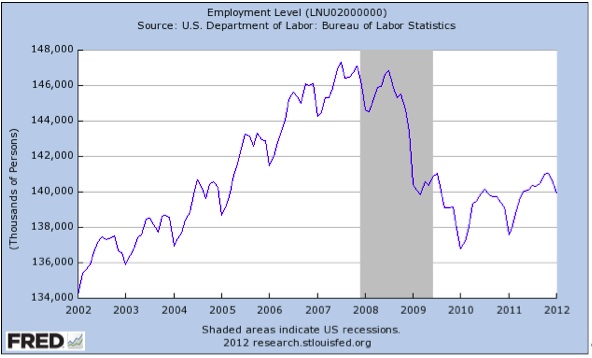
If we look at this chart from the St. Louis Federal Reserve, we see that employment--the actual number of people with jobs, as opposed to those who are without jobs--we see that the number of people with jobs has declined recently and is now at the same level of 3rd quarter 2009, a few months after it was officially declared that the recession had ended.

The official unemployment rate was 10% in October 2009, when about 140 million people were found to have some sort of job, and now that the same number of people have been found to have some sort of job (140 million), the unemployment rate is now only 8.3%, even though the nation has added roughly 6 million residents to the workforce.

Huh? How can 140 million jobs generate an unemployment rate of 10% in 2009 and 8.3% in 2012 while the workforce and population have grown by 6 million? If anything, the unemployment rate should be higher, since the number of people with jobs has held steady while the number of people without jobs has expanded.


Mish Shedlock has done many an autopsy on the unemployment rate, including this one from Feb. 3: Nonfarm Payroll +243,000; Unemployment Rate 8.3%; Those Not in Labor Force Rose an Amazing 1,177,000.

The labor force and the unemployed have magically declined by millions since the recession was declared over in mid-2009.

The Status Quo con-men are careful not to mention that $6 trillion in Federal borrowing has been squandered since 2009 just to return employment to 2004 levels. And that sum rises by $1.3-1.5 trillion every year as unprecedented quantities of money are borrowed to prop up the Status Quo.

A few years ago, deficits of $300 billion were considered unsustainable; now deficits of $1.3 trillion are accepted with little more than routine political jockeying. The con-men also never mention that this "official" deficit leaves out all supplemental appropriations which run into the hundreds of billions of dollars a year for expenditures such as war and bailing out Fannie Mae and Freddie Mac--and now, FHA will be added to the taxpayer bailouts: Housing Agency's Reserves at Risk FHA losses require taxpayer bailout.

Then there's the con-men's masterwork of perception management, the U.S. stock market. As noted earlier this week, much of the stock rally since March 2009 has been attributed to rising corporate profits. Yet a significant share of those profits were smoke-and-mirror illusions created by the Federal Reserve actively depreciating the nation's currency. Now that the dollar is strengthening, that charade is wearing thin.

Another chunk of those fabulous profits resulted from household incomes declining--that is, people earning less from their labor and savings as corporations kept any net increases for management and shareholders. Since 2007, the year before the most recent recession, real median household income has declined 6.4%. The median household income in 2010 was $49,445, down from $49,777 in 2009 and $52,673 in 2007. In other words, all this "growth" in GDP and profits since mid-2009 has not resulted in any visible improvement in household income, healthcare coverage, or any other metric that has a basis in real life. (Please review ths Census Bureau link above for more.)

So believe the smooth talk about Dow 15,000, strong job growth and rising GDP at your own peril. Ignore declining income, empty storefronts, lower energy consumption and all the other real-world evidence of a contracting, enfeebled, precarious economy if it boosts your all-important "consumer confidence," but make sure you don't confuse the con with confidence: the Mercedes is leased, the office a front, the resume a fraud, and the smooth sales pitch a clever fabrication. 


Read more...

Wednesday, February 15, 2012

The Grand Failure of the Econometric Model

If the conventional econometric model based on metrics like forward price-earnings ratios and a declining unemployment rate is so accurate, then why did it fail so completely, totally and utterly in predicting the 2008 meltdown?


A certain flavor of econometric model dominates conventional portfolio management and financial analysis. This model can be paraphrased thusly: seasonally adjusted economic data such as the unemployment rate and financially derived data such as forward earnings and price-earnings ratios are reliable guides to future economic growth and future stock prices.
Here is an excellent example of econometric analysis, which (surprise!) concludes that the Dow Jones Industrial Average is headed for 15,000 as skepticism over economic growth and rising profits diminishes. Time to Reconsider the Upside for Stocks?

As always, there are abundant charts presented to support the econometric call for steady growth in economic activity, corporate profits and stock indices.

The same approach--that standard metrics of growth are not only accurate but they're all that's needed to accurately assess risk and gain--is on display here in the house organ of bullish bias, Barrons: Enter the Bull (Dow 15K or 17K).

If this model is so accurate and reliable, why did it fail so completely in 2008 when a visibly imploding debt-bubble brought down the entire global economy and crashed stock valuations? Of the tens of thousands of fund managers and financial analysts who made their living off various iterations of this econometric model, how many correctly called the implosion in the economy and stock prices? How many articles in Barrons, BusinessWeek, The Economist or the Wall Street Journal correctly predicted the rollover of stocks and how low they would fall?

Of the tens of thousands of managers and analysts, perhaps a few dozen got it right (and that is a guess--it may have been more like a handful). In any event, the number who got it right using any econometric model was statistical noise, i.e. random flecks of accuracy.

The entire econometric model of relying on P-E ratios, forward earnings, the unemployment rate, etc. to predict future economic trends and future stock valuations was proven catastrophically inadequate.

The problem is these models are detached from the actual drivers of growth and stock valuations. If you want to predict market action, the better model is to "follow the money" as Gordon Long does in Why Does The Market Keep Rising? (via U. Doran). This analysis is refreshingly cognizant of the fact that forward earnings, new unemployment claims and all the rest of the econometric spectrum are not predictive tools, they are merely perception management, i.e. justifications for current price action.

Even worse, econometric models are all polishing the rear view mirror as a means of looking ahead, i.e. they are all based on the belief that recent action is a predictably accurate guide to what will happen next.

This is another reason why the econometric models of forward earnings, unemployment rates and all the rest failed so utterly and completely: these metrics are incapable of predicting the next "credit event," "loss of risk appetite" or secular downturn.

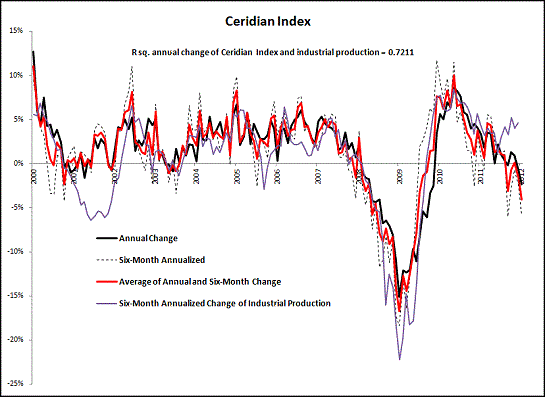
While the econometric models are all predicting renewed growth, rising corporate profits and an uptrend in job creation, consider this chart of the Ceridian Index.Does this chart reflect an expanding economy, or does it share all the traits of a contracting economy? (Chart courtesy of longtime correspondent B.C.)


Indeed, an objective analysis (i.e. one not driven by the desperate need to paint a positive picture via propaganda and perception management) would find it obvious that the "real economy" rolled over in May of 2010, and that the market's recent ascent is nothing but Federal Reserve/central bank manipulation/intervention (see Gordon Long's analysis above for a full account of this dynamic).


And what about the vaunted employment resurgence? Where is it in this chart of actual employment, as opposed to unemployment rates, new claims, and other non-factors trumpeted by the cargo-cult witch doctors of econometrics as "proof of growth"?


Clearly, the number of people with actual jobs is declining, not rising. All manner of lipstick can be applied to the employment pig--weekly claims are dropping!, etc.--but the only number that actually matters is the number of people with jobs, and more narrowly, those with full-time jobs.

In other words, laying off 10 million full-time workers and hiring back 10.1 million part-time workers with no benefits is a completely deceptive measure of employment income, as total compensation (wages and benefits) fell more or less in half and so did the income available for consumption and investment. Such a precipitous decline in income and resultant economic activity would be completely masked by a studiously coarse measure of employment.

As for forward earnings--I have often described the dominant causal factor in the rise of U.S. corporate profits-- the decline of the U.S. dollar. In a nutshell, here's the story of rising profits: 40% of all U.S.-based corporate revenues are generated overseas, and a majority of profit increases result from these rising sales overseas.

When these profits earned in euros, renminbi, yen, etc. are restated in U.S. dollars, then the profits magically rise. For example, 1 euro earned by a U.S.-based corporation in 2002 yielded about $1 when converted to dollars in the company's financial reports. In 2008, that 1 euro ballooned into $1.60 of profits due to the currency exchange rate of 1 euro=$1.60.

Fully 35% of that profit was a result of dollar depreciation, not an actual increase in profit margins or goods and services produced. The Fed's campaign to destroy the nation's currency generated fabulous (and phantom) "growth" in corporate profits at the expense of every holder of the currency.

Now that the U.S. dollar is in a secular uptrend, the Fed's shadow strategy to boost phantom corporate profits and thus the stock market is in trouble. Now all those phantom gains are threatening to vanish as the dollar strengthens.

As I have noted many times, the vast majority of standard-issue financial pundits (SIFPs) are absolutely convinced that the Fed's $1 trillion expansion of its balance sheet will drive the dollar ever lower in the years ahead. I disagree, on a simple "follow the money" analysis: given that there is around $60 trillion in financial assets sloshing around an increasingly risky world seeking some sort of safe haven, the pressing goal of not losing what I have makes parking assets in U.S. dollar-denominated assets a risk-averse strategy.

Recall that it's difficult to temporarily "park" a rather modest $1 trillion in, say, renminbi, bat guano or gold, because the entire global market for these assets is small or restricted (the RMB is not yet a floating currency that can be bought in virtually unlimited sums). For example, the gold market is around $8 trillion, of which 19% is held by central banks and 52% is in jewelry. It's difficult to locate $1 trillion of gold to buy. In contrast, it is comparatively straightforward to "park" $1 trillion in U.S.-denominated assets such as Treasury bonds, corporate bonds, stock funds, etc., and these assets have the additional benefit of being liquid, i.e. you can unload your position in relatively short order without destroying the global market for the asset. (Try that with bat guano or copper.)

This need to park collateral-impaired financial assets in something that won't crater tomorrow or the next day is a powerful reason for some of that $60 trillion sloshing around to find a temporary home in dollar-denominated assets. Compared to the pool of digital money seeking safe haven, the Fed's $1 trillion expansion is simply not big enough to move global markets when the "risk-off" trade explodes.

Meanwhile, the cargo-culters gathered around the econometrics campfire are staring at the glowing embers, entranced by forward P-Es of 14.6 and a 11K drop in new unemployment claims (now 366,000, soon to be adjusted upward by 12K when nobody's looking) or whatever runes painted on rocks they're looking at this week. 

Thank you, Brian L. ($75), for your marvelously generous contribution to this site -- I am greatly honored by your continuing support and readership.Thank you, Timothy S. ($75), for your superbly generous contribution to this site -- I am greatly honored by your steadfast support and readership.


Read more...

Terms of Service

All content on this blog is provided by Trewe LLC for informational purposes only. The owner of this blog makes no representations as to the accuracy or completeness of any information on this site or found by following any link on this site. The owner will not be liable for any errors or omissions in this information nor for the availability of this information. The owner will not be liable for any losses, injuries, or damages from the display or use of this information. These terms and conditions of use are subject to change at anytime and without notice.


Our Privacy Policy:


Correspondents' email is strictly confidential. This site does not collect digital data from visitors or distribute cookies. Advertisements served by a third-party advertising network (Investing Channel) may use cookies or collect information from visitors for the purpose of Interest-Based Advertising; if you wish to opt out of Interest-Based Advertising, please go to Opt out of interest-based advertising (The Network Advertising Initiative). If you have other privacy concerns relating to advertisements, please contact advertisers directly. Websites and blog links on the site's blog roll are posted at my discretion.


PRIVACY NOTICE FOR EEA INDIVIDUALS


This section covers disclosures on the General Data Protection Regulation (GDPR) for users residing within EEA only. GDPR replaces the existing Directive 95/46/ec, and aims at harmonizing data protection laws in the EU that are fit for purpose in the digital age. The primary objective of the GDPR is to give citizens back control of their personal data. Please follow the link below to access InvestingChannel’s General Data Protection Notice. https://stg.media.investingchannel.com/gdpr-notice/


Notice of Compliance with The California Consumer Protection Act
This site does not collect digital data from visitors or distribute cookies. Advertisements served by a third-party advertising network (Investing Channel) may use cookies or collect information from visitors for the purpose of Interest-Based Advertising. If you do not want any personal information that may be collected by third-party advertising to be sold, please follow the instructions on this page: Limit the Use of My Sensitive Personal Information.


Regarding Cookies:


This site does not collect digital data from visitors or distribute cookies. Advertisements served by third-party advertising networks such as Investing Channel may use cookies or collect information from visitors for the purpose of Interest-Based Advertising; if you wish to opt out of Interest-Based Advertising, please go to Opt out of interest-based advertising (The Network Advertising Initiative) If you have other privacy concerns relating to advertisements, please contact advertisers directly.


Our Commission Policy:

As an Amazon Associate I earn from qualifying purchases. I also earn a commission on purchases of precious metals via BullionVault. I receive no fees or compensation for any other non-advertising links or content posted on my site.

  © Blogger templates Newspaper III by Ourblogtemplates.com 2008

Back to TOP