Monday, October 21, 2013

What Does My Klout Score of 59 Signify?

We are in the infancy of measuring online influence.

My Klout score is 59, but I am not sure what this signifies. I understand that Klout measures the social media activity generated by one's posts on Facebook, Twitter, Instagram, LinkedIn, etc. The more people who retweet, like, comment on, etc. your posts, photos, etc., the higher your Klout score.

All measures of influence based on social media metrics seem to share several ontological (intrinsic) weaknesses. What do we mean when we claim to influence others? Is prompting someone to "like" a photo we post online equivalent to influencing another person's assumptions or thought processes?

Is counting the number of retweets or likes measuring popularity or appeal? If so, is this truly equivalent to influence, or is it something else? And if it is not actually influence, then what precisely is it?

This is the problem with claiming large numbers of likes, retweets, comments, etc. accurately reflect influence: a large audience and high level of participation are certainly elements of influence, but they do not guarantee influence, nor do they establish a morphology of influence.

The current level of web metrics are primitive, as they are unable to differentiate in a meaningful way between the activity generated by photos posted on Instagram, links on LinkedIn, retweets on Twitter, and various media posted on Facebook and other social media.

I have not made a comprehensive study of Klout (one measuring system of social media), but a cursory survey reveals that it's possible to obtain very high scores (70s and 80s) mostly as a result of photos posted on Instagram.

Without delving too deeply into the differences between influence in art, popular culture, opinion and values (see Jean-Paul Sartre's What is Literature? for one such exploration), it is self-evident that a photo's potential influence is different from the potential influence of an essay, and that measures of relative popularity/appeal such as likes and LinkedIn links are yet another form of expression that is quite different from photos or essays.

Not all social media activity is equal in terms of the commitment, time and and energy required to generate the activity. Liking an item requires very little time or commitment, while posting elaborate visual/text content requires major commitments of time and energy.

Is it even possible to equate lengthy comments that reflect a potential influence on values and critical analytic skills with a handful of likes, retweets, etc.?

The relative ease of gaming any system that claims to measure popularity and influence is another intrinsic difficulty with web metrics. Anecdotally, it seems one can buy thousands of followers for a few dollars, and various ways of boosting book rankings and other measures are equally commonplace.

As for user-generated content such as TripAdvisor and Yelp, how can we evaluate the relative value of the content if we know essentially nothing about the expertise and experience of the person generating the content?

Google's Page Rank (PR) system approaches the problem of measuring influence from the perspective that what cannot be easily gamed is heavily weighted: those sites with influence (as measured by incoming links from other sites) that link to one's site carry much more weight than external links from sites with few incoming links from other sites.

(Page Rank is a simple 1 to 10 system: sites with few incoming links and small audiences are 1 or 2 while global sites such as Yahoo are a 9 or 10.)

In other words, those sites with numerous incoming links from sites with incoming links from other influential sites will have a higher Page Ranking than sites with few incoming links or external links from other low-influence sites.

In this approach, not all links are equal: those who have earned links from influential sites carry more weight, and will boost the score of sites they link to more than links from lesser sites.

A new website with a PR of 1 would raise its score by attracting links from sites with higher Page Rankings. Persuading enough high-rank sites to link to your site to make a difference in your Page Rank is not easily gamed.

There is no perfect measure of influence, but clearly, any measure should differentiate between types of influence and the hard-to-game influence of those interacting with sites and social media.

I think it is fair to say that we are in the infancy of measuring online influence. Would my Klout score declining or increasing by 10 or 20 points mean that oftwominds.com had lost or gained whatever influence it exerts? Or could the site's modest influence actually increase in terms of contextualizing key public topics even as its Klout score declines? This seems entirely possible, and that is the intrinsic difficulty with equating popularity with influence.

Posts and email responses will be sporadic in October due to family commitments. Thank you for your understanding. 


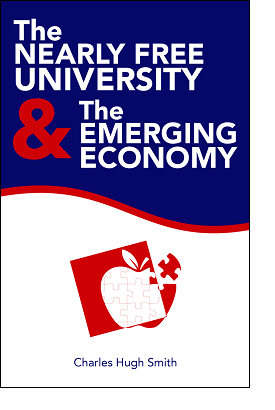
The Nearly Free University and The Emerging Economy:
The Revolution in Higher Education


Reconnecting higher education, livelihoods and the economy
With the soaring cost of higher education, has the value a college degree been turned upside down? College tuition and fees are up 1000% since 1980. Half of all recent college graduates are jobless or underemployed, revealing a deep disconnect between higher education and the job market.

It is no surprise everyone is asking: Where is the return on investment? Is the assumption that higher education returns greater prosperity no longer true? And if this is the case, how does this impact you, your children and grandchildren?
go to Kindle edition
We must thoroughly understand the twin revolutions now fundamentally changing our world: The true cost of higher education and an economy that seems to re-shape itself minute to minute.


The Nearly Free University and the Emerging Economy clearly describes the underlying dynamics at work - and, more importantly, lays out a new low-cost model for higher education: how digital technology is enabling a revolution in higher education that dramatically lowers costs while expanding the opportunities for students of all ages.

The Nearly Free University and the Emerging Economy provides clarity and optimism in a period of the greatest change our educational systems and society have seen, and offers everyone the tools needed to prosper in the Emerging Economy.

Read the Foreword, first section and the Table of Contents.

print edition (list $20, now $18)

Kindle edition: list $9.95 


Things are falling apart--that is obvious. But why are they falling apart? The reasons are complex and global. Our economy and society have structural problems that cannot be solved by adding debt to debt. We are becoming poorer, not just from financial over-reach, but from fundamental forces that are not easy to identify. We will cover the five core reasons why things are falling apart:
go to print edition1. Debt and financialization
2. Crony capitalism
3. Diminishing returns
4. Centralization
5. Technological, financial and demographic changes in our economy

Complex systems weakened by diminishing returns collapse under their own weight and are replaced by systems that are simpler, faster and affordable. If we cling to the old ways, our system will disintegrate. If we want sustainable prosperity rather than collapse, we must embrace a new model that is Decentralized, Adaptive, Transparent and Accountable (DATA).

We are not powerless. Once we accept responsibility, we become powerful.

Kindle: $9.95       print: $24


Thank you, readers, for your much-appreciated generous contributions to this site-- I am greatly honored by your support and readership.

Read more...

Sunday, October 20, 2013

What Do We Expect to Happen?

What we can expect to happen generally happens, as the causal chain cannot be disrupted by wishful thinking.

If I go to Las Vegas and gamble with abandon, what do I expect to happen? If I wander alone through a tough part of town waving my iPhone around, what do I expect to happen? If I insist on hiking up a muddy rain forest trail in street clothes in the pouring rain, what do I expect to happen?

We all know what is likely to happen: In Las Vegas, we will lose our stake; in the tough part of town, our iPhone will be stolen, and on the tropical trail, we will get soaking wet.

These consequences are easily predictable. What we can expect to happen generally happens, as the causal chain cannot be disrupted by wishful thinking.

Yet when we re-elect the same politicos who have failed miserably for years, we somehow expect they will magically succeed in providing leadership the next time around. When we eat visibly unhealthy packaged junk food that is engineered to trigger our reward centers with massive doses of fat, salt and sugar, we somehow expect there will be no consequences of eating this "food."

We sit in front of digital devices all day and eliminate physical fitness from our schools, yet we expect there will be no consequences from this inactivity.

We create trillions of dollars from thin air and borrow trillions of additional dollars into existence, yet we expect there will be no consequences from this unprecedented monetary and credit expansion.

We borrow a third of all government expenditures, yet we expect there will be no consequences from this monumental dependence on public debt to maintain the Status Quo.

We buy the cheapest quality goods, yet complain about the poor quality.

We pursue a plan of borrowing our way to prosperity, yet we are flummoxed that prosperity is elusive.

We push everyone with any assets into risky asset bubbles with zero-interest rates, yet we are surprised when asset bubbles pop.

What do you expect to happen? The causal chain cannot be disrupted by wishful thinking. Bubbles will pop, and increasingly leveraged, fragile systems will crash. Hoping causal consequences will magically vanish is a strategy doomed to catastrophe.

Posts and email responses will be sporadic in October due to family commitments. Thank you for your understanding.


The Nearly Free University and The Emerging Economy:
The Revolution in Higher Education

Reconnecting higher education, livelihoods and the economy
With the soaring cost of higher education, has the value a college degree been turned upside down? College tuition and fees are up 1000% since 1980. Half of all recent college graduates are jobless or underemployed, revealing a deep disconnect between higher education and the job market.

It is no surprise everyone is asking: Where is the return on investment? Is the assumption that higher education returns greater prosperity no longer true? And if this is the case, how does this impact you, your children and grandchildren?

go to Kindle edition
We must thoroughly understand the twin revolutions now fundamentally changing our world: The true cost of higher education and an economy that seems to re-shape itself minute to minute.

The Nearly Free University and the Emerging Economy clearly describes the underlying dynamics at work - and, more importantly, lays out a new low-cost model for higher education: how digital technology is enabling a revolution in higher education that dramatically lowers costs while expanding the opportunities for students of all ages.

The Nearly Free University and the Emerging Economy provides clarity and optimism in a period of the greatest change our educational systems and society have seen, and offers everyone the tools needed to prosper in the Emerging Economy.

Kindle edition: list $9.95 


Things are falling apart--that is obvious. But why are they falling apart? The reasons are complex and global. Our economy and society have structural problems that cannot be solved by adding debt to debt. We are becoming poorer, not just from financial over-reach, but from fundamental forces that are not easy to identify. We will cover the five core reasons why things are falling apart:

go to print edition1. Debt and financialization
2. Crony capitalism
3. Diminishing returns
4. Centralization
5. Technological, financial and demographic changes in our economy

Complex systems weakened by diminishing returns collapse under their own weight and are replaced by systems that are simpler, faster and affordable. If we cling to the old ways, our system will disintegrate. If we want sustainable prosperity rather than collapse, we must embrace a new model that is Decentralized, Adaptive, Transparent and Accountable (DATA).

We are not powerless. Once we accept responsibility, we become powerful.

Kindle: $9.95       print: $24


Thank you, readers, for your much-appreciated generous contributions to this site-- I am greatly honored by your support and readership.

Read more...

Saturday, October 19, 2013

The Poverty of our Political Theater of the Absurd

The public sphere has been effectively stripped of everything but corny, irritatingly hammy political theater.

All we have left in the U.S. is a deeply impoverishing Political Theater of the Absurd. Policy, theory and governance have all been reduced to competing stage performances in the Theater of the Absurd. The actors are transparently given to farcical overacting in exaggerated dramas drained of meaning; they proceed through the cliched motions as if the audience hadn't seen the same charades overplayed dozens of times before.

"Government shutdown" and "debt ceiling" may have engaged audiences starved for entertainment in a bygone age, but now they exemplify a theater that is so impoverished it can only re-stage tired formulaic dramas with a savage appetite for incompetence and buffoonery.

The poverty of this substitution of theater for actual ideas is best displayed by ObamaCare. The entire complex edifice of ObamaCare is not an expression of policy--it is simply the perfection of state complicity with a private cartel that increases its share of the national income regardless of which set of bad actors are on stage.

As for the alternative "policy," it is nothing but a reversion to the pre-ObamaCare cartel-state arrangement that artlessly combines gross injustice, insensitivity to cost and insane incentives for fraud, skimming, defensive medicine and the pursuit of national chronic ill health as the most profitable state of existence.

That these two variations on state-cartel predation pass for "policy" is a clear indication of the absolute impoverishment of American political/social/economic ideas. We are adrift in a political order that glorifies and rewards overacted farce and punishes policy grounded in actual ideas rather than the theatrical trends of the day.

The public sphere has been effectively stripped of everything but corny, irritatingly hammy political theater. The players, bereft of talent and inspiration, chosen for their blind obedience to those benefiting from the eradication of ideas and the replaying of tiresome charades, are blind to the poverty of their performance and political theatrics.

Will the audience ever tire of this cheesy Theater of the Absurd? It seems the appetite of the American public for this sort of play-acting entertainment is essentially bottomless. As a result, so too is our poverty.

Posts and email responses will be sporadic in October due to family commitments. Thank you for your understanding. 


The Nearly Free University and The Emerging Economy:
The Revolution in Higher Education

Reconnecting higher education, livelihoods and the economy

With the soaring cost of higher education, has the value a college degree been turned upside down? College tuition and fees are up 1000% since 1980. Half of all recent college graduates are jobless or underemployed, revealing a deep disconnect between higher education and the job market.

It is no surprise everyone is asking: Where is the return on investment? Is the assumption that higher education returns greater prosperity no longer true? And if this is the case, how does this impact you, your children and grandchildren?

go to Kindle edition
We must thoroughly understand the twin revolutions now fundamentally changing our world: The true cost of higher education and an economy that seems to re-shape itself minute to minute.

The Nearly Free University and the Emerging Economy clearly describes the underlying dynamics at work - and, more importantly, lays out a new low-cost model for higher education: how digital technology is enabling a revolution in higher education that dramatically lowers costs while expanding the opportunities for students of all ages.

The Nearly Free University and the Emerging Economy provides clarity and optimism in a period of the greatest change our educational systems and society have seen, and offers everyone the tools needed to prosper in the Emerging Economy.

Kindle edition: list $9.95 


Things are falling apart--that is obvious. But why are they falling apart? The reasons are complex and global. Our economy and society have structural problems that cannot be solved by adding debt to debt. We are becoming poorer, not just from financial over-reach, but from fundamental forces that are not easy to identify. We will cover the five core reasons why things are falling apart:

go to print edition1. Debt and financialization
2. Crony capitalism
3. Diminishing returns
4. Centralization
5. Technological, financial and demographic changes in our economy

Complex systems weakened by diminishing returns collapse under their own weight and are replaced by systems that are simpler, faster and affordable. If we cling to the old ways, our system will disintegrate. If we want sustainable prosperity rather than collapse, we must embrace a new model that is Decentralized, Adaptive, Transparent and Accountable (DATA).

We are not powerless. Once we accept responsibility, we become powerful.

Kindle: $9.95       print: $24


Thank you, readers, for your much-appreciated generous contributions to this site-- I am greatly honored by your support and readership.

Read more...

Thursday, October 17, 2013

False Positives & the Limits of Predictive Analysis

Analytic systems share system limits with financial markets.

Correspondent Lew G. recently sent me a thought-provoking commentary on the limits of "total information awareness" in terms of any information system's intrinsic rate of generating false positives.

In essence, the rate of false positives limits the effectiveness of any predictive system. The process of attempting to eliminate false positives is inherently one of diminishing return: even with no expense spared, the effort to eliminate false positives runs into boundaries of signal noise and generation of false positives.

To the degree that financial markets are ultimately predictive systems, this suggests a systemic cause of "unexpected" market crashes: signal noise and the intrinsic generation of false positives lead to a false sense of confidence in the system's stability and its ability to predict continued stability.

Here are Lew's comments:

Resources to deal with reality are inherently limited by that reality. 
Information, to the contrary, is inherently infinite, because of the fractal nature of reality. 
A property of that information reality is that 'meaning' is relative to other items of info, and that any single item can change the interpretation of a big set of facts. E.g., "Muslim, bought pipes, bought gun powder, visits jihadi sites, attends the Mosque weekly, tithes ..." can be completely changed in meaning by a fact such as 'belongs to the Libertarian Party', even 'is a plumber, 'is a target shooting enthusiast'". 
This will continue to be true no matter how much info the NSA gathers: it will be a small subset of the information needed to answer the question 'possible terrorist?'. 
Thus NSA's tradeoff of privacy vs security is inconsistent with reality: no matter how much info they gather, no matter how sophisticated their filters, they can never detect terrorists without a false positive rate so high that there will be insufficient resources to follow up on them.
In other words, if the system's lower boundary is one false positive per million, no additional amount of information gathering or predictive analysis will lower that rate of false positive generation to zero.

Why does this matter? It matters because it reveals that large-scale analytic systems are limited by their very nature. It isn't a matter of a lack of political will or funding; there are limits to the practical effectiveness of information gathering and predictive analysis.

Though Lew applied this to the NSA's "total information awareness" program, couldn't it also be applied to other large-scale information gathering and analysis projects such as analyzing financial markets?

This was the conclusion drawn by the father of fractals, Benoit Mandelbrot, in his bookThe (Mis)Behavior of Markets. As Mandelbrot observed: "When the weather changes, nobody believes the laws of physics have changed. Similarly, I don't believe that when the stock market goes into terrible gyrations its rules have changed."

All this should arouse a sense of humility about our ability to predict events, risks and crashes of one kind or another. In other words, risk cannot be entirely eliminated. Beyond a certain point, we're sacrificing treasure, civil liberties and energy for not just zero gain but negative return, as the treasure squandered on the quixotic quest for zero risk carries a steep opportunity cost: what else could we have accomplished with that treasure, effort and energy?

This entry was drawn from the Musings Reports, which are sent weekly to subscribers and major contributors.

Posts and email responses will be sporadic in October due to family commitments. Thank you for your understanding. 


The Nearly Free University and The Emerging Economy:
The Revolution in Higher Education

Reconnecting higher education, livelihoods and the economy

With the soaring cost of higher education, has the value a college degree been turned upside down? College tuition and fees are up 1000% since 1980. Half of all recent college graduates are jobless or underemployed, revealing a deep disconnect between higher education and the job market.

It is no surprise everyone is asking: Where is the return on investment? Is the assumption that higher education returns greater prosperity no longer true? And if this is the case, how does this impact you, your children and grandchildren?

go to Kindle edition
We must thoroughly understand the twin revolutions now fundamentally changing our world: The true cost of higher education and an economy that seems to re-shape itself minute to minute.

The Nearly Free University and the Emerging Economy clearly describes the underlying dynamics at work - and, more importantly, lays out a new low-cost model for higher education: how digital technology is enabling a revolution in higher education that dramatically lowers costs while expanding the opportunities for students of all ages.

The Nearly Free University and the Emerging Economy provides clarity and optimism in a period of the greatest change our educational systems and society have seen, and offers everyone the tools needed to prosper in the Emerging Economy.

Kindle edition: list $9.95 


Things are falling apart--that is obvious. But why are they falling apart? The reasons are complex and global. Our economy and society have structural problems that cannot be solved by adding debt to debt. We are becoming poorer, not just from financial over-reach, but from fundamental forces that are not easy to identify. We will cover the five core reasons why things are falling apart:

go to print edition1. Debt and financialization
2. Crony capitalism
3. Diminishing returns
4. Centralization
5. Technological, financial and demographic changes in our economy

Complex systems weakened by diminishing returns collapse under their own weight and are replaced by systems that are simpler, faster and affordable. If we cling to the old ways, our system will disintegrate. If we want sustainable prosperity rather than collapse, we must embrace a new model that is Decentralized, Adaptive, Transparent and Accountable (DATA).

We are not powerless. Once we accept responsibility, we become powerful.

Kindle: $9.95       print: $24


Thank you, readers, for your much-appreciated generous contributions to this site-- I am greatly honored by your support and readership.

Read more...

The Difficult Escape from Student Loan Debt-Serfdom

Longtime correspondent E.S. submits an insider's perspective of student loan debt-serfdom.

In my analysis, the self-reinforcing dynamics of neocolonial and neofeudal financialization are the key forces of debt-serfdom. The most blatant example of neofeudal debt-serfdom is the vast student loan industry which has burdened college students with over $1 trillion in debt that cannot be discharged by conventional legal means--for example, bankruptcy.


Recently, enforcing this debt-serfdom exploitation has been offloaded onto the Federal government, which now holds roughly 2/3 of the total debt ($674 billion).This is of course the core of the neocolonial financialization model--the state enforces what is essentially a for-profit exploitation of debt-serfdom.

A number of correspondents have observed that there are a few ways to reduce the burdens of student loan debt-serfdom, but these are not that easy to pursue. One is to pay the minimum long enough to qualify for some dispensations, and another is to act as one's own attorney and wind your way through multiple layers of legal maneuvering through bankruptcy. The few who have succeeded at this received enormous publicity, but this does not set a precedent that is useful to others.

Longtime correspondent E.S. submitted an insider's perspective of the more realistic alternative: paying off the loan.

I wanted to weigh in on this student loan issue. I used to work in the student loan industry. When I was in it, Clinton was still president. We always figured that the Feds took over the industry to wrest the profits away from the evil (Republican, for-profit) lenders who were making fortunes on the loans. 
In those days, there were still student loan guarantor agencies which had two basic functions: 1. to pay the lenders when the loans failed and 2. to shut down schools that failed to comply with the Federal regs. 
Then de-regulation came along and we have what we have now--the Dept of Education issuing loans. In the 1970's they tried this and failed. Loans defaulted left and right and the Feds never could track them down. The students blew off their loans and that was the end of it. 
Later, in the 1980's, the regular banks got back in the business and started making massive profits. The guarantor agencies guaranteed the loans, the banks had nothing to lose. (The guarantor agencies were government sponsored agencies anyway.) Everyone was fat, dumb and happy. 
One thing the guarantors did well was shut down bad schools. You don't see that today. After de-regulation, the guaranty agencies went away for the most part. They aren't around now to shut down bad schools. That's why you see so many kids getting worthless, expensive degrees. It's shameless. But, the private and public 4-year schools are really no better. They're still peddling the same liberal arts, none-marketable degrees in 14th century French poetry, as lovely as it is. 
I was an older student and graduated from college in 2000. I've spent the last 13 years trying to pay off my onerous loan from a private, liberal arts college in Oregon. It's been hell. 
Luckily, because I've worked in the industry, I knew precisely what I was in for if I defaulted. I used to make collections call on delinquent and defaulted borrowers. 
Last summer I made up my mind to do WHATEVER it took to get out of this slavery. And it is SLAVERY. I've worked, scrimped, saved, and nearly starved myself at times to pay this loan. It is now 50% lower than it was last year. But, my sum was modest compared to kids now. 
Let me tell you this--no one who is in their twenties is ever going to have the wherewithal to pay off $100-200k in student loan debt. On the minimum payments, none of them will live long enough to ever see it finished. 
And fewer still have the courage or the stubbornness to make the sacrifices necessary to put their debt behind them. Or, perhaps, with the job situation as it is, they just don't have a shot at it at all. I don't know. 
Next year my loan will be gone, by hook or by crook, and probably just in time for the first round of student loan "jubilees." C'est la guerre. 
I will never take out another student loan as long as I live.
Thank you, E.S., for an insider's perspective on student loan debt-serfdom. The only sure way to avoid debt-serfdom is to not borrow money in the first place.

Posts and email responses will be sporadic in October due to family commitments. Thank you for your understanding.


The Nearly Free University and The Emerging Economy:
The Revolution in Higher Education

Reconnecting higher education, livelihoods and the economy

With the soaring cost of higher education, has the value a college degree been turned upside down? College tuition and fees are up 1000% since 1980. Half of all recent college graduates are jobless or underemployed, revealing a deep disconnect between higher education and the job market.

It is no surprise everyone is asking: Where is the return on investment? Is the assumption that higher education returns greater prosperity no longer true? And if this is the case, how does this impact you, your children and grandchildren?

go to Kindle edition
We must thoroughly understand the twin revolutions now fundamentally changing our world: The true cost of higher education and an economy that seems to re-shape itself minute to minute.

The Nearly Free University and the Emerging Economy clearly describes the underlying dynamics at work - and, more importantly, lays out a new low-cost model for higher education: how digital technology is enabling a revolution in higher education that dramatically lowers costs while expanding the opportunities for students of all ages.

The Nearly Free University and the Emerging Economy provides clarity and optimism in a period of the greatest change our educational systems and society have seen, and offers everyone the tools needed to prosper in the Emerging Economy.

Kindle edition: list $9.95 


Things are falling apart--that is obvious. But why are they falling apart? The reasons are complex and global. Our economy and society have structural problems that cannot be solved by adding debt to debt. We are becoming poorer, not just from financial over-reach, but from fundamental forces that are not easy to identify. We will cover the five core reasons why things are falling apart:

go to print edition1. Debt and financialization
2. Crony capitalism
3. Diminishing returns
4. Centralization
5. Technological, financial and demographic changes in our economy

Complex systems weakened by diminishing returns collapse under their own weight and are replaced by systems that are simpler, faster and affordable. If we cling to the old ways, our system will disintegrate. If we want sustainable prosperity rather than collapse, we must embrace a new model that is Decentralized, Adaptive, Transparent and Accountable (DATA).

We are not powerless. Once we accept responsibility, we become powerful.

Kindle: $9.95       print: $24

Read more...

Terms of Service

All content on this blog is provided by Trewe LLC for informational purposes only. The owner of this blog makes no representations as to the accuracy or completeness of any information on this site or found by following any link on this site. The owner will not be liable for any errors or omissions in this information nor for the availability of this information. The owner will not be liable for any losses, injuries, or damages from the display or use of this information. These terms and conditions of use are subject to change at anytime and without notice.

RE: European Union AI Act, and Our Use of Generative AI Tools and Agents Policy

All text on this site is composed by Charles Hugh Smith or by a credited guest-author. No Generative AI Tools are used in the composition / writing of any text or graphic content created by Charles Hugh Smith. This site deploys no AI agents or generative AI tools. This site is not responsible for the disclosures, use or non-use of AI agents or generative AI tools in advertisements displayed by Investing Channel or other ad placement services.

Audio files generated by text-to-audio transcription tools are identified as such.

Our Privacy Policy:

Correspondents' email is strictly confidential. This site does not collect digital data from visitors or distribute cookies. Advertisements served by third-party advertising networks such as Investing Channel may use cookies or collect information from visitors for the purpose of Interest-Based Advertising; if you wish to opt out of Interest-Based Advertising, please go to Opt out of interest-based advertising (The Network Advertising Initiative) If you have other privacy concerns relating to advertisements, please contact advertisers directly.

PRIVACY NOTICE FOR EEA INDIVIDUALS

This section covers disclosures on the General Data Protection Regulation (GDPR) for users residing within EEA only. GDPR replaces the existing Directive 95/46/ec, and aims at harmonizing data protection laws in the EU that are fit for purpose in the digital age. The primary objective of the GDPR is to give citizens back control of their personal data. Please follow the link below to access InvestingChannel's General Data Protection Notice.
https://stg.media.investingchannel.com/gdpr-notice/

Notice of Compliance with The California Consumer Protection Act

This site does not collect digital data from visitors or distribute cookies. Advertisements served by a third-party advertising network (Investing Channel) may use cookies or collect information from visitors for the purpose of Interest-Based Advertising. If you do not want any personal information that may be collected by third-party advertising to be sold, please follow the instructions on this page: Do Not Sell My Personal Information.

Regarding Cookies:

This site does not collect digital data from visitors or distribute cookies. Advertisements served by third-party advertising networks such as Investing Channel may use cookies or collect information from visitors for the purpose of Interest-Based Advertising; if you wish to opt out of Interest-Based Advertising, please go to Opt out of interest-based advertising (The Network Advertising Initiative) If you have other privacy concerns relating to advertisements, please contact advertisers directly.

Our Commission Policy:

Though I earn a small commission on Amazon.com books and gift certificates and gold (BullionVault) purchased via links on my site, I receive no fees or compensation for any other non-advertising links or content posted on my site.

Copyright Notice:

All original images (Drawings and Photographs), text (essays, books and works of fiction), audio and video recordings, musical compositions, graphic design, graphic design elements and HTML coding on this site are the copyrighted work of Charles Hugh Smith unless otherwise credited or noted. They are published as information for the private use of site visitors, and any reproduction or redistribution of this content or coding in any media in any format or distribution channel (text, audio, video/film, web) without the written permission of the copyright holder is strictly prohibited. All rights in all media reserved globally.

  © Blogger templates Newspaper III by Ourblogtemplates.com 2008

Back to TOP