

Friday, May 23, 2014

A Productive Economy Is a Trading Circle

The destructive consequences of a parasitic Tyranny of the Wealthy and Majority have yet to play out, but they will, and sooner than most believe possible.

One of the core concepts of my work is that our state-cartel dominated economy is fundamentally a vast parasitic skimming machine that redistributes the nation's earned wealth to two constituencies that support the skimming operation: those at the top of the financial pyramid (i.e. super-wealthy cronies who fund the political careers of the political elite) who constitute a Tyranny of the Wealthy, and state dependents who constitute a Tyranny of the Majority, i.e. they will support the political elites that guarantee their share of the swag, regardless of the consequences to the nation or the economy.

In other words, these two self-serving groups see the productive economy as the host that the state feeds off to fund their swag: at the top of the pyramid, the swag is unlimited nearly-free credit issued by the Federal Reserve and various tax breaks; at the bottom of the pyramid, the swag is unlimited free services in the form of social programs such as Section 8 housing, easily gamed disability for life, food stamps, free medical care via Medicaid, etc.

The destructive consequences of a parasitic Tyranny of the Wealthy and Majority have yet to play out, but they will, and sooner than most believe possible. Those being sucked dry will never have the wealth or votes to reform the current system, so their only choice is to opt out and choose to live as independently of the state-cartel Status Quo as possible.

This parallel economy is the community economy, the resilient, decentralized, entrepreneurial sectors of the economy that not just survive without state subsidies but thrive outside centralized dependency on the state.

What is the foundation of a productive economy? Correspondent Jeff W. provides an intuitively insightful answer: trading circles.

Here is Jeff's explanation of trading circles:


The trading circle is a concept I came up with in order to try to think clearly about economic issues.

Key definitions/observations include:

A trading circle is any group of people who trade with each other on a regular basis.

I use the term "trading circle" instead of "local economy" because it helps me picture the actual traders involved.

Unless you are Robinson Crusoe, you participate in a trading circle.

Money, of course, is a medium of exchange. People trade their goods and services in the trading circle using money as a convenience.

People have to work AND trade in order to survive. Government counts time away from paid work as leisure time, but you have to go to the grocery store and trade your cash for food if you want to survive.

Activities needed for basic survival are not leisure. Trading for basic necessities is part of the work humans have to do (unless they are Robinson Crusoe).

Trading circles can be growing or shrinking, becoming richer or poorer.

To picture a simple trading circle, picture a few people on a remote island: one fishes, another makes clothing, another builds huts. They trade with each other. Specialization of labor benefits everyone.

People are entering and leaving the trading circle all the time. The trading circle is co-operative, but it is also harsh and unforgiving. Participants want their rivals kicked out. Adam Smith wrote, “The rivalship of competitors, who are all endeavoring to jostle one another out of employment, obliges every man to execute his work with a certain degree of exactness.”

Traders participate in the trading circle as equals, though some may do hundreds of times the business as others. Every participant is allowed to trade. Exceptions to this rule are a king, who does not get his money by trading but through taxation or money printing, and a moneylender, who trades valuable money for promises written on paper. Both the king and the moneylender claim legal rights over their subjects/debtors that ordinary traders do not claim.

People do not get rich outside a good trading circle. Put Warren Buffett in Bangladesh and he will struggle just like everyone else. Your fortune depends on belonging to a good trading circle.

The trading circle is self-correcting in terms of dealing with gluts and shortages. Participants move from one line of work to another according to the advantages they see.

The trading circle tends toward efficiency, improved quality, and reduced prices. It is a progressive institution in that sense. Its free operation tends to make everyone richer.

A trading circle must guard against thieves. Today, America's trading circle, however, is basically owned and operated by thieves.

America used to be known for having good quality products at low prices. That was back when our trading circle was functioning properly.

Sick people, the very old, and the young do not directly participate in the trading circle. Society must make provisions for them (such as having strong families to take care of them). If the young are not cared for properly, society does not survive.

Robots tend to kick people out of the trading circle.

People who are dependent on the state are only partly in the trading circle. They are consumers but not producers. The same goes for government workers. They are thus not full members of the community like the full participants in the trading circle.

All businesses want to skew the rules of the trading circle in their favor. It is thus necessary to have someone in charge of the trading circle who is above it all and whose commitment is to its fair operation. (Editor's note: this is the definition of good governance.)

A good community tries to find niches for the young people in the trading circle. The trading circle may be an unforgiving competitive environment, but the community in which the trading circle resides need not be such an environment.

The trading circle works best when everyone focuses on his own self interest. Altruistic and charitable work should take place outside the trading circle.

A corrupt government kicks everyone out of the trading circle who is not an insider or who does not pay bribes. This leads to higher prices and reduced quality, which is the usual condition of most trading circles historically.

When I think about an economic issue, I always ask, "How does this affect the trading circle?"

A person's niche in the trading circle as a producer and seller is primary; his role as consumer is secondary. If you have a good niche as a producer, you automatically have the means to be a consumer. This is another way of expressing Say's Law, which is that supply creates its own demand. If you lose your niche as a producer, your ability to be a consumer is impaired because you have lost your income.

A person often obtains his niche by degrees. In the old days, there used to be unpaid apprentices, paid apprentices, journeymen, and masters. The master craftsman was a guy who had earned a solid niche, and he usually employed journeymen and apprentices.

A person's niche is dependent on profitability. Many people are hanging on to their niche by a thread, being very close to being driven out by financial losses. Government-imposed burdens on the trading circle have the effect of pushing people out of their niches and into failure and poverty. (Government tries to solve this problem through cartelization.)

Success of the trading circle hinges on business profitability. That is where all the factors come together to determine if a person can stay in his niche or whether a new niche can be created.

A niche in the trading circle must be continually earned. Even if you inherit a business, you still will have to work to ensure its survival. Earning a niche in the trading circle is like physical exercise: no one can do it for you. Government can give you a half-participation in the trading circle, where you are a consumer but you don't produce anything.

Since taxes and inflation harm full participants, there is no free lunch in adding government-supported consumers. Government cannot give you a niche as a producer--or they can only do it through the corrupt act of giving you an unfair advantage. 


Thank you, Jeff, for explaining the concept of trading circles. One way to understand why our economy and society have become unsustainable is to grasp the difference between an economy based on productivity and a level playing field and one based on debt-funded consumption and a corrupt playing field tilted to benefit the few and buy off the many.


That's the economy we have now, and it's the fundamental reason why a systemic financial crisis that disrupts the state-cartel Status Quo between 2020-25 is so predictable.


Want to give an enduringly practical graduation gift? Then give my new book Get a Job, Build a Real Career and Defy a Bewildering Economy, a mere $9.95 for the Kindle ebook edition and $17.76 for the print edition.


Get a Job, Build a Real Career and Defy a Bewildering Economy(Kindle, $9.95)(print, $20)
go to Kindle edition
Are you like me? Ever since my first summer job decades ago, I've been chasing financial security. Not win-the-lottery, Bill Gates riches (although it would be nice!), but simply a feeling of financial control. I want my financial worries to if not disappear at least be manageable and comprehensible.And like most of you, the way I've moved toward my goal has always hinged not just on having a job but a career.
You don't have to be a financial blogger to know that "having a job" and "having a career" do not mean the same thing today as they did when I first started swinging a hammer for a paycheck.
Even the basic concept "getting a job" has changed so radically that jobs--getting and keeping them, and the perceived lack of them--is the number one financial topic among friends, family and for that matter, complete strangers.
So I sat down and wrote this book: Get a Job, Build a Real Career and Defy a Bewildering Economy.
It details everything I've verified about employment and the economy, and lays out an action plan to get you employed.
I am proud of this book. It is the culmination of both my practical work experiences and my financial analysis, and it is a useful, practical, and clarifying read.
Test drive the first section and see for yourself.     Kindle, $9.95     print, $20
"I want to thank you for creating your book Get a Job, Build a Real Career and Defy a Bewildering Economy. It is rare to find a person with a mind like yours, who can take a holistic systems view of things without being captured by specific perspectives or agendas. Your contribution to humanity is much appreciated."
Laura Y. 


Thank you, Paul C. ($100), for your outrageously generous contribution to this site -- I am greatly honored by your longstanding support and readership.Thank you, Michael S. ($20), for your much-appreciated generous contribution to this site -- I am greatly honored by your support and readership.

Read more...

Wednesday, May 21, 2014

A Tale of Two Charts (and Two Economies)

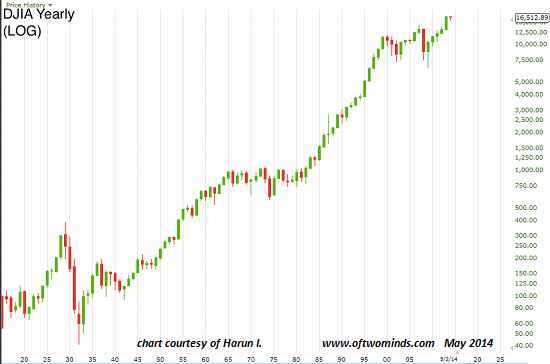
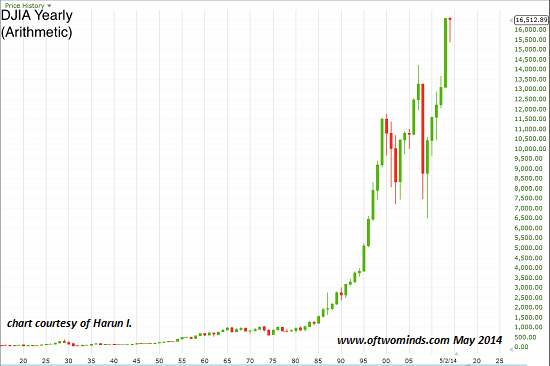
These two charts depict the same index (DJIA) over the same time frame, but they reflect two stories and two economies.

Long-time correspondent Harun I. recently submitted two charts of the stock market that suggest two different stories--and these two stories suggest two different economies.

The first story is the one the Federal Reserve wants us to believe: the economy is expanding smartly without inflation or deflation--in effect, a Goldilocks economy that is enabling expanding profits and margins, which have pushed stocks ever higher.

In summary, this is the happy story.

The other story is the Fed's nightmare scenario: the stock market's expansion is exhausted and poised to decline. This story is one of an economy that never expanded in meaningful fashion, and a stock market rigged to rise by unprecedented intervention (i.e.manipulation) by the Fed.

This is the not-so-happy story.

These two charts depict the same index (Dow Jones Industrial Average (DJIA) over the same time frame, but they reflect two stories and two economies. These divergent stories are possible because the data supports two parallel universes: one in which the booming market is held up as evidence the overall economy is expanding to everyone's benefit, and the other a manipulated market that has expanded not as a reflection of growth but of a staggering loss of purchasing power of the U.S. dollar and a central bank transfer of wealth from the many to the few who own the majority of financial assets.

Here is Harun's commentary:


Below are two charts of the DJIA. The periodicity is yearly, i.e. each bar is one year. One is arithmetic and one is log. They present two dramatically different perspectives.

The log chart puts gains into a relative context and I use them extensively. However, the one drawback I find is that they are a poor indicator of psychology when using the bars to gauge sentiment.

The log chart indicates nothing unusual but the arithmetic chart indicates that we should be asking ourselves whether last year’s bar suggests a high probability of exhaustion. The log chart allows the Fed and others to claim, “see, no ‘flation”, i.e., no inflation or deflation of any sort.

Yet when we look at the relative strength charts and see that when measured against gold and equities, commodities are, in many instances, at all time lows.

The cheers go up--if you are of the small percentage of people who own these assets (gold and equities). But if you are one of the 99.90%, everything has gone up except your paycheck; 1 out of every 6 are on food stamps. In the case of the majority, inflation is everywhere. If you're in the one-third of the working age population that is unemployed, there is no hope in sight.

The arithmetic chart, on the other hand, shouts, "Warning, something is really wrong here!" It says that either the wealthiest people (those who own equities) are really excited about the economy's growth opportunities, or they are fearful and taking advantage of the transfer of wealth being orchestrated by the government via the Fed.

One can choose which narrative best fits. To paraphrase former president Clinton, it just depends what on your definition of is, is.


Thank you, Harun, for explaining the two narratives the charts tell. I suspect the divergent stories will be compressed into one narrative in the next few years: either the overall economy matches the optimistic forecast of the stock market, or the market declines to the recessionary stagnation of the Main Street economy.


Get a Job, Build a Real Career and Defy a Bewildering Economy(Kindle, $9.95)(print, $20)
go to Kindle edition
Are you like me? Ever since my first summer job decades ago, I've been chasing financial security. Not win-the-lottery, Bill Gates riches (although it would be nice!), but simply a feeling of financial control. I want my financial worries to if not disappear at least be manageable and comprehensible.

And like most of you, the way I've moved toward my goal has always hinged not just on having a job but a career.

You don't have to be a financial blogger to know that "having a job" and "having a career" do not mean the same thing today as they did when I first started swinging a hammer for a paycheck.

Even the basic concept "getting a job" has changed so radically that jobs--getting and keeping them, and the perceived lack of them--is the number one financial topic among friends, family and for that matter, complete strangers.

So I sat down and wrote this book: Get a Job, Build a Real Career and Defy a Bewildering Economy.

It details everything I've verified about employment and the economy, and lays out an action plan to get you employed.

I am proud of this book. It is the culmination of both my practical work experiences and my financial analysis, and it is a useful, practical, and clarifying read.

Test drive the first section and see for yourself.     Kindle, $9.95     print, $20
"I want to thank you for creating your book Get a Job, Build a Real Career and Defy a Bewildering Economy. It is rare to find a person with a mind like yours, who can take a holistic systems view of things without being captured by specific perspectives or agendas. Your contribution to humanity is much appreciated."
Laura Y. 


Thank you, John D. ($50), for your fabulously generous contribution to this site -- I am greatly honored by your support and readership.Thank you, Daniel E. ($4), for your most generous contribution to this site -- I am greatly honored by your steadfast support and readership.

Read more...

I'm a Fiat Slave, And So Are You

Fiat money is at base a form of indirect wealth transfer from those forced to hold the money to those issuing the money.

I describe the pernicious servitude created by debt as debt serfdom, as serfdom implies a neofeudal arrangement that requires serfs' acceptance of this financial yoke of servitude. In other words, debt is freely accepted as the line of least resistance in a system that incentivizes debt and places high barriers to debt-free independence from a Status Quo operated to benefit the owners and issuers of debt, not the debtors.

Correspondent Jeff W. has identified an even more insidious form of monetary servitude that he calls fiat slavery, as the servitude is enforced by fiat (unbacked government-issued) money.

In other words, being forced to use state-issued fiat currency is a form of servitude, as fiat money is at base a form of indirect wealth transfer from those forced to hold the money to those issuing the money.

Beyond this state-enforced wealth transfer from citizens to the state, there is a secondary wealth transfer going on in any fiat-money system: the neofeudal financial nobility who are closest to the money spigot get to buy whatever real-world assets and income streams offer the best return before the money trickles down to the debt-serfs paying interest and taxes.

For example, the financial nobility can borrow billions of dollars at near-zero interest from the Federal Reserve, and use this nearly-free fiat money to buy student loans that pay 7+% annually. They can also snap up houses for cash that the nobility then rents to debt-serfs who have been outbid by those with the extraordinary advantage of unlimited access to the Fed's nearly-free fiat money.

Here is Jeff's commentary:


In a world where every country prints fiat money, the entire human race today, except for its money masters, is subjected to fiat slavery.


Almost everyone understands what it means to be a tax slave. It means that people must work several months of the year for the benefit of the taxing authorities. Taxes in the U.S. today are several times higher than they were 100 years ago, and at present-day tax levels, today’s Americans are rightly called tax slaves.

What it means to be a debt slave is also easy to understand. It means that one must spend a large fraction of one’s time to earn money to pay creditors. Millions of Americans today are mired deeply in debt, but today’s America is also a country where if you personally stay out of debt, the government will go into debt for you.

Each American taxpayer is on the hook for his or her share of over $17 trillion in debt that government admits to; the real debt total is much higher.

 Government leaders are eagerly plunging us ever deeper into debt each year.

Most Americans also have personal experience of being a wage slave. It means that a person has no way to make a living except by selling his labor into a glutted market. Thomas Jefferson hoped that most Americans could own their own farms and thereby profit from capital improvements that they made through their own efforts. Such Americans could be their own bosses and escape wage slavery. But today we live in an age of huge factory farms, and it is more difficult than ever to establish or run any small business. Thus wage slavery is the norm for Americans today.

But few people understand what it means to be a fiat slave. Being a fiat slave means that one lives in a country where the machinery of money printing is used to maximize wealth extraction from its citizens.

How do they maximize the wealth they can extract through money printing? 

First of all, it is done by increasing of the volume of transactions that take place in a given fiat currency. Each newly-printed unit of fiat is a drop in the bucket in terms of the inflation it creates, and more fiat can be printed without causing serious inflation if a country has a bigger bucket.

For example, Canada’s GDP is about 11% the size of America’s. At first glance this might be taken to mean that Americans can print nine times more dollars than Canadians. But we must also remember that U.S. dollars circulate throughout the world, and Eurodollars and petrodollars also add to the total of U.S. dollar transactions.

Because of extraterritorial dollar circulation, the U.S. might actually be able to print 20 times more than Canada without causing serious (in terms of causing political problems for the money printers) inflation. From this we see why money printers may want to fight wars to protect America’s dollar circulation areas in the Middle East or in Afghanistan, where much of the opium trade is transacted in dollars.

But a country’s fiat transaction volume is only part of the equation. A more important part of the equation is the inflation level. Imagine two countries: Country A with an annual fiat transaction volume of 100 trillion units per year and Country B with a volume of 50 trillion. Everything else being equal, Country B can only print half as much fiat each year to give to its government and its banking elite.

But suppose further that the inflation rate in Country A is 5% absent any money printing, and the inflation rate in Country B is negative 2% due to global wage arbitrage, regulatory suppression of small businesses, and high unemployment. Suppose further that a real inflation rate of 5% is the money printers’ upper limit because it is the maximum asset erosion that wealthy bondholders will tolerate. Now we see that potential money printing in Country A is reduced to zero, while potential money printing in Country B is 3.5 trillion units (50 trillion times seven percent).

American money printers thus have trillions of dollars in incentive to support deflationary policies, which may include global wage arbitrage (sending work to the country where labor is cheapest), suppression of job creation by small businesses, suppression of private-sector labor unions, support for open borders immigration, commodity price suppression through market interventions, support for genetically modified seeds so as to push agricultural prices down, support for owners taking a larger share of corporate revenues so as to reduce labor’s share, and support for high levels of consumer debt so as to dampen inflationary pressure in a nation of demoralized debt slaves. All of these oppressive policies enrich the money printers at the citizens' expense.

Tax slavery, debt slavery, wage slavery, and fiat slavery are four methods that elites employ to extract wealth from the people. To this list we should also add their encouragement of Ponzi gambling. Ponzi asset bubbles are constantly being created and citizens are encouraged to go into debt to “cash in” on bubble profits (or get wiped out in bubble crashes). Those five methods are the major wealth extraction methods they use.

Those who support the cause of human freedom must resist tax slavery by insisting on a government that keeps its spending down to the bare basics. Free people must also support a culture that discourages people from getting into debt and encourages them to get out of debt and stay out. They must demand that government debt be rolled back to zero.

Policies that favor capital accumulation in families and a supportive legal environment for small businesses are the antidotes to wage slavery, and free people must also demand that there be zero wealth extraction from the citizens through money printing. That can best be done by requiring 100% gold backing for currency and eliminating fractional reserve banking. 

Eliminating the inflation that comes from money printing will also go a long way toward eliminating asset bubbles and Ponzi gambling on asset bubbles.
Older Americans have watched as a once-free people have been reduced to slave-like conditions. Not only has wealth been ruthlessly extracted from the people, but today’s surveillance state is more intrusive than ever, and the police are increasingly insolent and imperious.

What are we going to do? A necessary first step is to take the blinders off and to see clearly how elites are victimizing you. A second step is to figure out what practical steps you can take as an American to secure the blessings of liberty for yourself and your posterity. Freedom is not free, as the saying goes, and the price of freedom is not only eternal vigilance, but also intelligent action. We should begin this work today. 


Thank you, Jeff, for describing our fiat bondage. Awareness of the sources of wealth transfer and monetary servitude is the first step forward.

Of related interest: Bernanke the Sophist: The Deception Behind QE


Get a Job, Build a Real Career and Defy a Bewildering Economy(Kindle, $9.95)(print, $20)
go to Kindle edition
Are you like me? Ever since my first summer job decades ago, I've been chasing financial security. Not win-the-lottery, Bill Gates riches (although it would be nice!), but simply a feeling of financial control. I want my financial worries to if not disappear at least be manageable and comprehensible.

And like most of you, the way I've moved toward my goal has always hinged not just on having a job but a career.

You don't have to be a financial blogger to know that "having a job" and "having a career" do not mean the same thing today as they did when I first started swinging a hammer for a paycheck.

Even the basic concept "getting a job" has changed so radically that jobs--getting and keeping them, and the perceived lack of them--is the number one financial topic among friends, family and for that matter, complete strangers.

So I sat down and wrote this book: Get a Job, Build a Real Career and Defy a Bewildering Economy.

It details everything I've verified about employment and the economy, and lays out an action plan to get you employed.

I am proud of this book. It is the culmination of both my practical work experiences and my financial analysis, and it is a useful, practical, and clarifying read.

Test drive the first section and see for yourself.     Kindle, $9.95     print, $20
"I want to thank you for creating your book Get a Job, Build a Real Career and Defy a Bewildering Economy. It is rare to find a person with a mind like yours, who can take a holistic systems view of things without being captured by specific perspectives or agendas. Your contribution to humanity is much appreciated."
Laura Y. 


Thank you, Jan K. ($120), for your outrageously generous contribution to this site -- I am greatly honored by your steadfast support and readership.Thank you, Larry H. ($50), for your splendidly generous contribution to this site -- I am greatly honored by your support and readership.

Read more...

Tuesday, May 20, 2014

The Decline of Small Business = Decline of Basic Skills

An economy where most people work for the state or a global corporation is an economy that has lost its knowledge of the key entrepreneurial building blocks.


The decline of small business has numerous long-term consequences. One is the decline of the middle class, as entrepreneurial enterprise is a key pathway to generational wealth-building and prosperity.

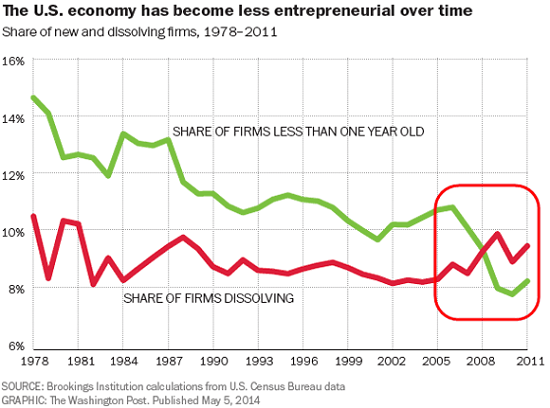
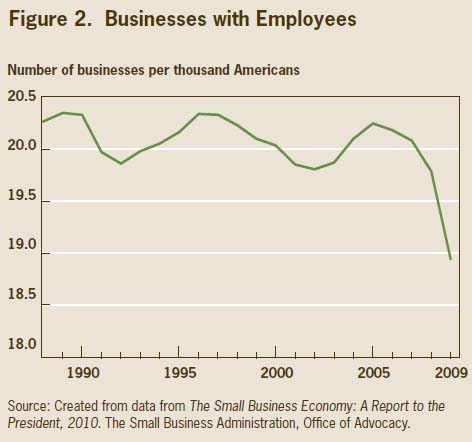
Another is the loss of employment opportunities. As U.S. businesses are being destroyed faster than they’re being created, there are fewer sources of employment.


Since many people get their first job at small businesses, the decline of small business has an outsized effect on entry-level employment opportunities.


Correspondent Kevin K. identified a third long-term consequence: the erosion of opportunities to learn basic skills with economic value. As low-skill work is increasingly replaced by software and robotics, work with a future requires not just higher-level skills but a spectrum of building-block skills and values--what I call the eight essential skills of professionalism in my book Get a Job, Build a Real Career and Defy a Bewildering Economy.

Many of these skills are fundamental life-skills that are not taught in classrooms; they are learned on the job. If the kind of jobs that enable the learning of these basic building blocks of economic value go away, so do the opportunities to gain these skills.

Here is Kevin's commentary: 


In The Decline of Small Business and the Middle Class, you wrote:


It is not coincidental that the middle class and small business are both in decline. Entrepreneurial enterprise and small business have long been stepping stones to middle class incomes and generational wealth, i.e. wealth that is passed down to future generations rather than consumed.

For me the big take-away is that as fewer people in America work for small business owners who often share with employees what they did to create "middle class incomes and generational wealth", we will have fewer people who know how to do this (or even imagine it is possible).

My first "real" (as defined by a job paid for by a non-family member) was pulling weeds for a neighbor (at $0.60/hour a.k.a. "a penny a minute"). I later made $1/hour when I started mowing his lawn then $2/hour until I had to stop at 14 when I started working all day every Saturday at the grocery store making $3/hour.

Unlike today where most gardening jobs have a guy that does not speak English working for a guy that speaks a little English, I was working for a contractor that owned his own business and a home and was into cars (my Dad knew nothing about cars).

He came over and gave us some pointers on turning a corner of our basement into a new room for me (and let us his hammer drill to make holes for the Red Heads to hold the wood to the floor). When I turned 16 he accompanied me a couple times to look at used cars (and saved me from buying a car with major rust/rot).

Working in the little grocery store (owned by two butchers born in Italy), I not only learned about the retail grocery and meat business but how to patch a leaking flat roof with Henry wet patch and how to maintain HVAC systems and commercial refrigeration systems. Today in a WalMart grocery store you typically have a kid working for minimum wage doing what his "manager" (that was probably making minimum wage a year ago) doing what the latest corporate memo told them to do.

When I spent a winter in Lake Tahoe getting vacation homes ready for renters, I not only learned a lot about the rental market and the real estate market, I also learned how to do low-cost home maintenance from owners that have been doing it for years and got to work side by side with them. Kids today working for a giant corporation don't have that opportunity and as a result don't learn nearly as much. 


Thank you, Kevin, for describing the process of learning entrepreneurial life-skills.In a neofeudal economy dominated by the government-corporate partnership, the erosion of small business goes hand in hand with an erosion of building-block skills, opportunities to learn these essential life-skills, and the cultural knowledge of how to start and operate an independent enterprise.


An economy where most people work for the state or a global corporation is an economy that has lost its knowledge of the key entrepreneurial building blocks and its opportunities for independence from the neocolonial Company Store: Is Small Business a Threat to the Status Quo?


Get a Job, Build a Real Career and Defy a Bewildering Economy(Kindle, $9.95)(print, $20)
go to Kindle edition
Are you like me? Ever since my first summer job decades ago, I've been chasing financial security. Not win-the-lottery, Bill Gates riches (although it would be nice!), but simply a feeling of financial control. I want my financial worries to if not disappear at least be manageable and comprehensible.

And like most of you, the way I've moved toward my goal has always hinged not just on having a job but a career.

You don't have to be a financial blogger to know that "having a job" and "having a career" do not mean the same thing today as they did when I first started swinging a hammer for a paycheck.

Even the basic concept "getting a job" has changed so radically that jobs--getting and keeping them, and the perceived lack of them--is the number one financial topic among friends, family and for that matter, complete strangers.

So I sat down and wrote this book: Get a Job, Build a Real Career and Defy a Bewildering Economy.

It details everything I've verified about employment and the economy, and lays out an action plan to get you employed.

I am proud of this book. It is the culmination of both my practical work experiences and my financial analysis, and it is a useful, practical, and clarifying read.

Test drive the first section and see for yourself.     Kindle, $9.95     print, $20
"I want to thank you for creating your book Get a Job, Build a Real Career and Defy a Bewildering Economy. It is rare to find a person with a mind like yours, who can take a holistic systems view of things without being captured by specific perspectives or agendas. Your contribution to humanity is much appreciated."
Laura Y. 


Thank you, Thomas H. ($100), for your outrageously generous contribution to this site -- I am greatly honored by your steadfast support and readership.Thank you, Brendan W. ($10), for your much-appreciated generous contribution to this site -- I am greatly honored by your support and readership.

Read more...

Sunday, May 18, 2014

Is Small Business a Threat to the Status Quo?

Truth is the first victim of the Company Store's dominance.


My view of the Status Quo as a neocolonial, neofeudal arrangement is succinctly captured by correspondent D.C.'s description of state-corporate capitalism: the Company Store. In the plantation model (i.e. any economic setting dominated by a primary corporate employer and/or the state), almost everyone works for the company, and is beholden to the company for their livelihood and security.

In exchange for this neofeudal (often described as paternal) security, employees must shop at the company store, which maintains a near-monopoly (i.e. competition is limited because the company owns the land and/or colludes with local government) as a means of extracting monopoly prices.

The company store extends credit to employees (in the modern version, student loans take the place of employee credit), and since prices are kept artificially high and wages are kept stagnant, the employees never manage to pay off their debts at the company store.

This describes the core dynamic in our state-corporate system. The state-corporate Status Quo suppresses competition (few other stores are allowed in town), usually by indirect means: high land leases, high fees for doing business in town, mountains of absurd regulations no small businesses can afford to meet, etc.

In state-corporate capitalism, small business thus poses a threat to the monopolistic partnership of the government and dominant corporations. Small businesses that try to meet all the regulations and pay all the fees and taxes are either marginalized or driven out of business by the high overhead.

But those that live in the nooks and crannies between the major players pose a threat to the guaranteed profits of the state-corporate Status Quo. As a result, despite the propaganda about how the state supports small business, the real agenda is to marginalize small business in every way possible so the small-business sector can never gain enough political weight to challenge the corporate interests and their partners, the state fiefdoms.

Here is D.C.'s gloves-off, truth-to-power commentary: 


The decline of small businesses serves the same purpose as continuous, compound monetary inflation: Both keep everyone on "company property" buying at the "company store."


Inflation means that people can't save in a medium that is not ready-to-be-seized (by the IRS, any Federal court, any creditor like a hospital, i.e. by any minion of the central state Corporation). If people could save honest money "under the mattress" without continuous erosion, then some of their wealth might remain fully private.

We can't have fully private wealth. The Company must always be able to take what the Company deems its fair share, or take whatever payments the Company Store levies (since people are largely compelled to purchase their medical services, for instance, from the CS and prices are not marked on the shelf...only assessed in arrears).

The same is true of employment. If people are able to earn a living apart from the Company, they become less subject to the Company's innumerable rules (including, especially, the requirement to buy everything at...you guessed it...the Company Store).

Small businesses are messy little vermin much more difficult to regulate (and corral, and milk) than what otherwise amount to subsidiaries of the Company Store. All significant corporations in the USA today are clearly such subsidiaries. What else do their legal departments do but finagle "deals" and navigate "hyper-compliance" with the larger Company? The corporations for which I have worked behave like subordinates in a branch of the military: "Sir, YES Sir!" A larger phylum of invertebrates will never be discovered.

Small businessmen, however, comply only under overt duress and are apt to seek end-arounds at every opportunity due to self-interest and lack of bureaucratic organizational incentives. Seeking alternate paths to exercise greater liberty and keep a larger share of their product puts them on the side of nascent informal networks to which you refer.

Your conception of private or informal networks side-stepping the Company is both (in my opinion) the future and an existential adversary of the central state Corporation. This means to me that we will see an increasingly hot war emerge as the early adopters pursue their fledgling networks while the minions of the Corporate State ever-more-openly chase and harass them.
My belief is that people only abandon a failing paradigm when the cost of duplicating the "service" privately is lower than the combined cost of the old paradigm plus the cost of its failures. For example, people will abandon the tax-paid, centrally-planned education paradigm only as they perceive the cost of duplicating it privately (home schooling, unschooling, foregone income, etc.) is lower than the "cost" of uneducated, mis-educated, unsafe kids.

Early adopters must be willing to pay twice (private duplication plus tax extortion) so their formula for the decision is Private+Tax < tax-produced output.

(By the way, I consider current "private" schools to largely be the same as tax-paid. Until a market fully emerges, finding a true alternative to the tax-paid model is challenging.)

This means that early adopters of non-Corporate State paradigms must evaluate the "costs" of the old paradigm higher than their neighbors. The lingering consent of the neighbors to the old paradigm will place heavy burdens on the early adopters of new paradigms.

A significant problem with forging new paradigms is that the earliest of adopters are overt criminal organizations. Non-criminals will intentionally be conflated with criminal networks as the Corporate State's minions war on alternatives that threaten its parasitic and dysfunctional monopoly. 


Thank you, D.C., for telling it like it is. Truth is the first victim of the Company Store's dominance. 


Get a Job, Build a Real Career and Defy a Bewildering Economy(Kindle, $9.95)(print, $20)
go to Kindle edition
Are you like me? Ever since my first summer job decades ago, I've been chasing financial security. Not win-the-lottery, Bill Gates riches (although it would be nice!), but simply a feeling of financial control. I want my financial worries to if not disappear at least be manageable and comprehensible.


And like most of you, the way I've moved toward my goal has always hinged not just on having a job but a career.

You don't have to be a financial blogger to know that "having a job" and "having a career" do not mean the same thing today as they did when I first started swinging a hammer for a paycheck.

Even the basic concept "getting a job" has changed so radically that jobs--getting and keeping them, and the perceived lack of them--is the number one financial topic among friends, family and for that matter, complete strangers.

So I sat down and wrote this book: Get a Job, Build a Real Career and Defy a Bewildering Economy.

It details everything I've verified about employment and the economy, and lays out an action plan to get you employed.
I am proud of this book. It is the culmination of both my practical work experiences and my financial analysis, and it is a useful, practical, and clarifying read.

Test drive the first section and see for yourself.     Kindle, $9.95     print, $20

"I want to thank you for creating your book Get a Job, Build a Real Career and Defy a Bewildering Economy. It is rare to find a person with a mind like yours, who can take a holistic systems view of things without being captured by specific perspectives or agendas. Your contribution to humanity is much appreciated."
Laura Y. 


Thank you, Max M. ($6), for your most generous contribution to this site -- I am greatly honored by your steadfast support and readership.Thank you, Peter D. ($50), for your magnificently generous contribution to this site -- I am greatly honored by your support and readership.

Read more...

Terms of Service

All content on this blog is provided by Trewe LLC for informational purposes only. The owner of this blog makes no representations as to the accuracy or completeness of any information on this site or found by following any link on this site. The owner will not be liable for any errors or omissions in this information nor for the availability of this information. The owner will not be liable for any losses, injuries, or damages from the display or use of this information. These terms and conditions of use are subject to change at anytime and without notice.


Our Privacy Policy:


Correspondents' email is strictly confidential. This site does not collect digital data from visitors or distribute cookies. Advertisements served by a third-party advertising network (Investing Channel) may use cookies or collect information from visitors for the purpose of Interest-Based Advertising; if you wish to opt out of Interest-Based Advertising, please go to Opt out of interest-based advertising (The Network Advertising Initiative). If you have other privacy concerns relating to advertisements, please contact advertisers directly. Websites and blog links on the site's blog roll are posted at my discretion.


PRIVACY NOTICE FOR EEA INDIVIDUALS


This section covers disclosures on the General Data Protection Regulation (GDPR) for users residing within EEA only. GDPR replaces the existing Directive 95/46/ec, and aims at harmonizing data protection laws in the EU that are fit for purpose in the digital age. The primary objective of the GDPR is to give citizens back control of their personal data. Please follow the link below to access InvestingChannel’s General Data Protection Notice. https://stg.media.investingchannel.com/gdpr-notice/


Notice of Compliance with The California Consumer Protection Act
This site does not collect digital data from visitors or distribute cookies. Advertisements served by a third-party advertising network (Investing Channel) may use cookies or collect information from visitors for the purpose of Interest-Based Advertising. If you do not want any personal information that may be collected by third-party advertising to be sold, please follow the instructions on this page: Limit the Use of My Sensitive Personal Information.


Regarding Cookies:


This site does not collect digital data from visitors or distribute cookies. Advertisements served by third-party advertising networks such as Investing Channel may use cookies or collect information from visitors for the purpose of Interest-Based Advertising; if you wish to opt out of Interest-Based Advertising, please go to Opt out of interest-based advertising (The Network Advertising Initiative) If you have other privacy concerns relating to advertisements, please contact advertisers directly.


Our Commission Policy:

As an Amazon Associate I earn from qualifying purchases. I also earn a commission on purchases of precious metals via BullionVault. I receive no fees or compensation for any other non-advertising links or content posted on my site.

  © Blogger templates Newspaper III by Ourblogtemplates.com 2008

Back to TOP