



Thursday, July 24, 2014

The Rot Within, Part III: Our Political Order Is Defined by Favoritism and Extortion

What's the difference between the U.S. Congress and corrupt petty officials taking bribes at a Third-World border crossing? Only one of scale.

Corruption ceases to be corruption when it becomes the Status Quo; what was once recognized as corruption is seen as just another cost of doing business. Our political order is structurally corrupt: the key dynamic in every level of governance is favoritism and extortion.

Favors must be bought: those foolish enough not to spend freely on lobbyists and campaign contributions find their competitors have gained the upper hand by buying favors such as tax breaks, federal subsidies, no-bid contracts, cost-plus contracts, backroom deals, regulations that exclude competition and so on.

Politicos must extort campaign contributions from the maximum number of supplicants seeking favors to maintain their perquisites and power.

Here's how the system works.

There was much mainstream media hand-wringing and outrage in response to corporations moving their place of business offshore to lower their taxes. This outrage is completely misplaced--and indeed, seems designed to misdirect attention away from the systemic corruption that is the beating heart of the American political order.

Let me explain how favoritism becomes the Status Quo. There are two key dynamics at work.
1. Onerous, uncompetitive taxes and/or regulations. The U.S. corporate tax rate is 35%, the highest in the world, and various observers estimate the average state corporate tax tacks on another 4.1% for a total corporate tax rate of 39.1%.

This is roughly three or four times the nominal and effective corporate tax rates in competing nations.
The heavier and more asymmetrical the burden, the greater the incentive to find a way to lighten the load. This is why nations with asymmetrical tax rates and collection practices are inevitably hotbeds of black market activity, as those few chumps who actually pay the official tax rate go out of business or struggle to make ends meet while their black market competitors are living high on the hog.

The injustice of such a system fuels the need and desire to buy favors to escape the burden that virtually nobody actually pays.

2. Once a significant percentage of participants have eased their burden by buying political favors, everyone else is forced to wonder why they should continue paying the high taxes when others are avoiding them.

This system is not accidental. The asymmetry feeds the need to buy political favors, and is thus a form of systemic extortion. If you refuse to pay the bribe at a Third-World border crossing, the Powers That Be will make sure your life becomes increasingly miserable; while those who ponied up the bribe breeze through the paperwork, you wait and wait and wait, and are told to fill out more paperwork.

In precisely the same fashion, those who refuse to bribe legislators and key political players find their tax rates are crushing and life is miserable indeed. This is known as pay to play, and it defines the U.S. political order.

Those who don't pay the extortion to congresspeople and lobbyists are punished by a system designed to force every participant to pony up the bribe or suffer the consequences.

In other words, U.S. corporate taxes are extortionist and unfairly applied by design, to guarantee every corporation has to buy favors from politicos intent on stripmining billions of dollars in pay to play "contributions."

I know many people feel corporations should pay high taxes because they did so in the 1950s, but this historical precedent is blind to the realities of a global economy. Given global sales and workforces, why should a company headquartered in the U.S. pay punishing U.S. tax rates on its global operations?

Is it good policy to burden our corporations with absurdly complex tax codes and rates so far above global norms that every U.S.-based company is forced to seek tax avoidance schemes just to remain competitive and meet shareholder demands to be as profitable as others in the same global space?

It's easy for pundits protected by academic tenure to criticize corporate management, but put yourself in the shoes of a pension fund that owns stock in a company that actually paid the full 35% while competitors used strategies bought by political favors to eliminate that burden: your dividends and capital gains would be significantly lower as a result of the corporation's refusal to use pay to play tax avoidance strategies.

The reality is the pension fund manager and the corporate managers would both be fired for underperformance if they were stupid enough to pay the full corporate tax rate or insist on the company doing so.

We have a double standard: as individuals, we seek every possible avenue to escape high Federal taxes, and the wealthier you are, the more avenues are open due to favors bought from an always willing to wheel-and-deal Congress.

Yet we publicly demand corporations pay absurdly asymmetric tax rates to qualify as "good corporate citizens."

Corporations don't exist to be good citizens. As noted above, anyone clueless enough to pay the 35% federal tax rate on all net earnings will have failed the shareholders, who naturally demand the same payout in dividends and capital gains as those earned by competitors who paid to play and avoided most or all U.S. taxes.

Systems of good governance make exceptions and favors difficult to gain and the process transparent.

Corrupt governance makes exceptions and favoritism the unspoken rule and the process of buying them hidden from public view. That defines the U.S. political order perfectly.
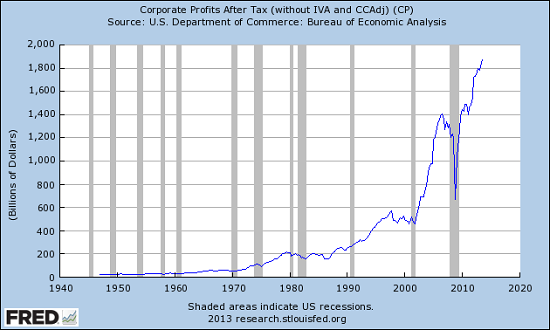
Soaring corporate profits make juicy targets for taxes:


Soaring profits are the engine of a rising stock market:
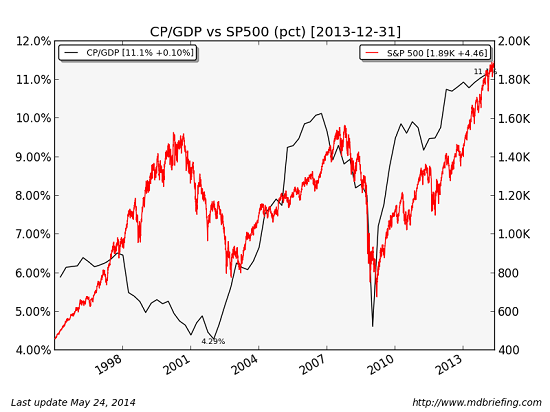

Wages have stagnated while profits have soared:
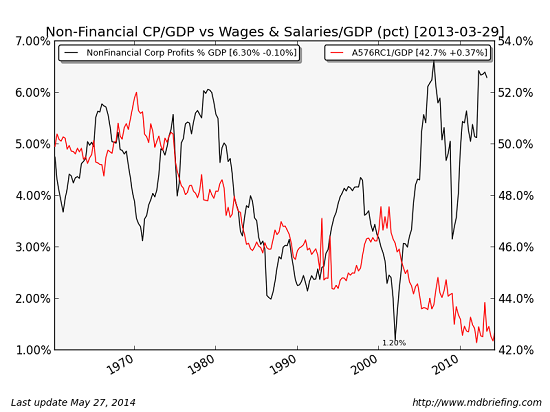

It's easy to see why people want to tax corporations heavily, but in thinking this they are playing right into the extortionist/pay to play political order.

A fairer, good-governance system would lower corporate tax rates to the equivalent of an excise tax and exclude favors and exemptions. A corporate tax rate of 5% that was applied to all corporate sales and earnings in the U.S. regardless of where the company was nominally based would raise more money than the current corrupt system in which many corporations pay almost nothing and chumps who failed to pay the required bribes pay a globally asymmetric rate as punishment for their failure to 'contribute" to the campaigns of incumbents.

A low, evenly applied corporate tax rate would destroy the pay to play system of extortion/bribery, and as a result it will never be adopted. The U.S. political order is systemically corrupt and is incapable of self-reform. The rot has seeped into every nook and cranny of the political order, to the point that it's now accepted as "the way we do business here."

What's the difference between the U.S. Congress and corrupt petty officials taking bribes at a Third-World border crossing? Only one of scale. The corrupt petty officials can only look with envy on the Congressional extortion machine.


Get a Job, Build a Real Career and Defy a Bewildering Economy(Kindle, $9.95)(print, $20)
go to Kindle editionAre you like me? Ever since my first summer job decades ago, I've been chasing financial security. Not win-the-lottery, Bill Gates riches (although it would be nice!), but simply a feeling of financial control. I want my financial worries to if not disappear at least be manageable and comprehensible.

And like most of you, the way I've moved toward my goal has always hinged not just on having a job but a career.
You don't have to be a financial blogger to know that "having a job" and "having a career" do not mean the same thing today as they did when I first started swinging a hammer for a paycheck.
Even the basic concept "getting a job" has changed so radically that jobs--getting and keeping them, and the perceived lack of them--is the number one financial topic among friends, family and for that matter, complete strangers.
So I sat down and wrote this book: Get a Job, Build a Real Career and Defy a Bewildering Economy.
It details everything I've verified about employment and the economy, and lays out an action plan to get you employed.
I am proud of this book. It is the culmination of both my practical work experiences and my financial analysis, and it is a useful, practical, and clarifying read.
Test drive the first section and see for yourself.     Kindle, $9.95     print, $20
"I want to thank you for creating your book Get a Job, Build a Real Career and Defy a Bewildering Economy. It is rare to find a person with a mind like yours, who can take a holistic systems view of things without being captured by specific perspectives or agendas. Your contribution to humanity is much appreciated."
Laura Y.

Gordon Long and I discuss The New Nature of Work: Jobs, Occupations & Careers (25 minutes, YouTube) 


NOTE: Contributions/subscriptions are acknowledged in the order received. Your name and email remain confidential and will not be given to any other individual, company or agency.

Thank you, Kathy S. ($10/month), for your outrageously generous subscription to this site -- I am greatly honored by your steadfast support and readership.Thank you, Advanced Download ($25), for your extremely generous contribution to this site -- I am greatly honored by your steadfast support and readership.

Read more...

Tuesday, July 22, 2014

The Rot Within, Part II: Inflation Is Not "Growth"

Just as the Federal Reserve cannot directly force you to stick the needle of monetary heroin (debt) into your arm, it also can't force employers to pay employees more.

The official policy of the Central Bank (Federal Reserve)/government is: inflation is necessary for "growth," i.e. economic expansion. The unstated reason for this official support of inflation is that it's easier for borrowers to service their debts as their income inflates.

To take an extreme example: let's say a homeowner has a mortgage of $100,000, an annual wage of $40,000 and annual mortgage payments of $10,000. At 100% annual inflation in both prices and wages, the home mortgage remains fixed at $100,000, the payment remains fixed at $10,000 but his earnings double to $80,000.

Where the mortgage payment initially took 25% of his earnings, now it only takes 12.5%. Yippee Skippy, the homeowner has an "extra" 12.5% of his earnings to support more consumption and debt: thanks to inflation, the homeowner can now buy a car on credit and use the "extra" 12.5% of earnings to pay the auto loan.

Central banks around the world seek inflation for another reason: the Keynesian Cargo Cult that dominates all central banks and governments believes with quasi-religious certainty that people respond to inflation by buying more stuff now rather than later: since prices will rise in the future, it makes sense to buy stuff now at "lower prices compared to next year's prices."

This is called bringing demand forward, as the demand to buy stuff is shifted from the future to the present.

In an economy dependent on debt-based consumption, inflation is absolutely essential to reduce the real costs of servicing old debts so households can afford to buy more stuff on credit. This is the basis of the Fed's insistence that inflation is equivalent to "growth"--inflation enables households to continue adding more debt to buy more stuff, as long as earnings inflate along with prices.

There are three problems with the Fed's "inflation is growth" scenario:

1. Earned income (wages and salaries) don't inflate along with prices
2. Rising inflation and low interest rates crimp lender profits and increase risks
3. Bringing demand forward exhausts households' ability to fund additional consumption with debt.

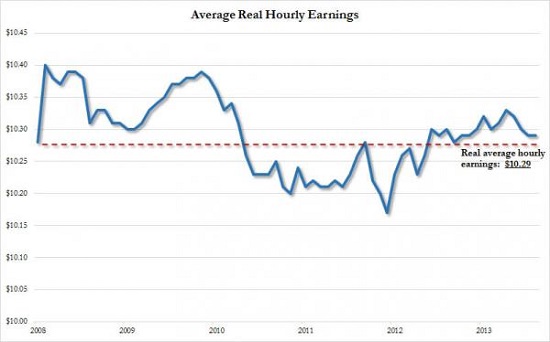
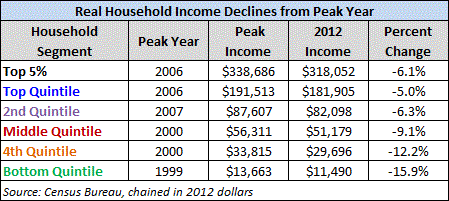
To date, all the Fed's efforts to generate inflation have bypassed earned income: wages and salaries have declined when adjusted for inflation. Hourly wages: stagnant since 2008.


source: Rising Wages Where? Real Wages Post First Annual Decline Since 2012

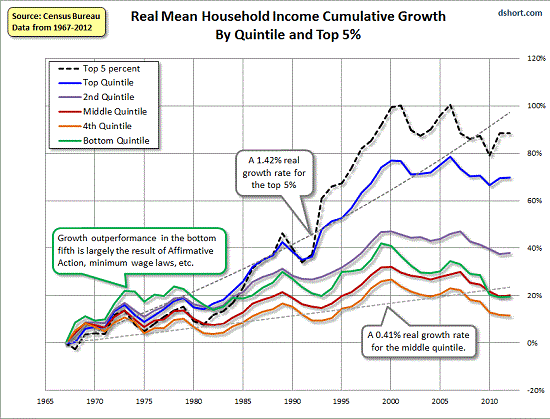
Real household income has declined across the entire income spectrum:


Here's the same data in chart form, courtesy of Doug Short:


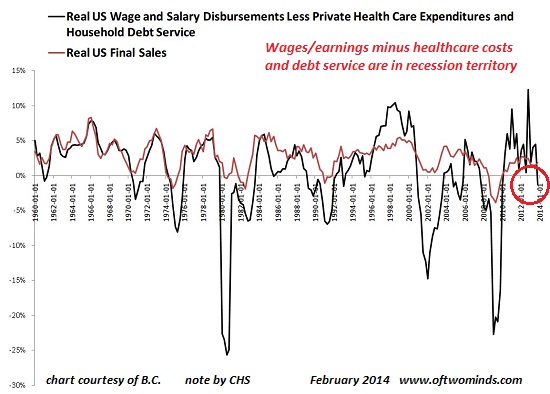
Deduct healthcare expenses and debt service, and what's left of wages for the rest of life's expenses is tanking: Courtesy of longtime correspondent B.C.:


Debating the real rate of inflation has become a financial parlor game because the real rate of inflation depends on the household's demographics, locale, expenses and income. Anyone paying the unsubsidized costs of healthcare or college tuition is experiencing crushing inflation (i.e. loss of purchasing power), while the low-income or retiree household receiving federal subsidies (i.e. no exposure to the real costs of higher education and healthcare) experiences low inflation.

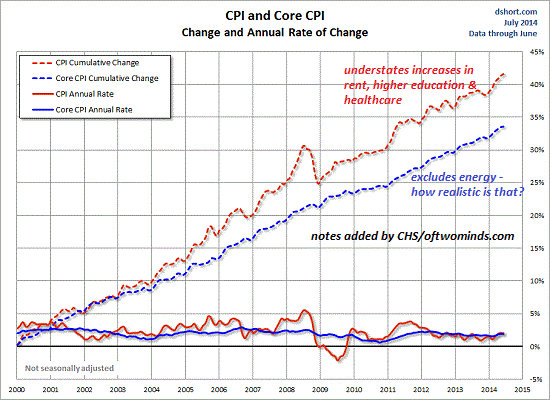
But even the official measures of inflation reflect the destruction of purchasing power wrought by supposedly low inflation when wages are stagnant while costs keep rising:


source: What Inflation Means to You: Inside the Consumer Price Index (Doug Short)
Inflation: A Six-Month X-Ray View (Doug Short)

Fed policies have inflated asset prices but left earned income in the ditch. Please read How Effective Have The Fed's QE Programs Been? (STA Wealth Management) for a fuller understanding of the perverse consequences of the Fed's "inflation is growth" policies.

Though nobody in official circles dares discuss it, the reality is inflation coupled with low interest rates reduces lenders' profit margins and increases systemic risk. In an economy in which wages are stagnating or declining in real terms while major expenses are galloping ever higher, the only way lenders can expand borrowing is to lend to marginal borrowers--households who would not qualify for loans under prudent risk management.

For evidence of this, we need only look at the explosive rise in subprime auto loans and higher-education student loans: In a Subprime Bubble for Used Cars, Borrowers Pay Sky-High Rates (New York Times)

Lastly, there are limits on how much future demand can be brought forward when wages are declining. The Keynesian Cargo Cult has absolute faith in the notion that consumers faced with inflation will buy more today rather than pay more next year.

But the facts do not support the Keynesian Cargo Cult's misplaced faith. In Japan, where the central bank and government have struggled for years to generate price inflation as the means to "re-start growth," wages have fallen by 9% in real terms since 1997. (source: Voodoo Abenomics: Japan's Failed Comeback Plan Foreign Affairs)

When prices rise faster than incomes, people can't afford to buy as much. Soconsumption necessarily declines as prices go up and purchasing power goes down.There is nothing mysterious about this, but the Keynesian Cargo Cult is unmoved by mere fact and common sense.

Just as the Federal Reserve cannot directly force you to stick the needle of monetary heroin (debt) into your arm, it also can't force employers to pay employees more. Prices don't just rise for consumers; they rise for producers and employers as well. Every tick up in healthcare costs and producer costs increases the need for businesses to slash the one large expense they still control: payroll.

We all see the desperate gimmicks corporations are deploying to lower costs while keeping prices the same: reducing package sizes, putting less product in each package, selling "individual servings" at higher cost per ounce, lowering quality of the product, using more fillers, and so on.

The ultimate hubris of the Keynesian Cargo Cult (which includes the global economy's central banks) is the naive notion that they can manipulate an entire system with a few levers such that the desired outcome--and only the desired outcome--is the output.

The idea that you can change one input in an interconnected system of systems and only affect the one output you want is not just naive and simplistic: it requires a level of blindness and incompetence that is off the charts.


Get a Job, Build a Real Career and Defy a Bewildering Economy(Kindle, $9.95)(print, $20)
go to Kindle editionAre you like me? Ever since my first summer job decades ago, I've been chasing financial security. Not win-the-lottery, Bill Gates riches (although it would be nice!), but simply a feeling of financial control. I want my financial worries to if not disappear at least be manageable and comprehensible.


And like most of you, the way I've moved toward my goal has always hinged not just on having a job but a career.

You don't have to be a financial blogger to know that "having a job" and "having a career" do not mean the same thing today as they did when I first started swinging a hammer for a paycheck.

Even the basic concept "getting a job" has changed so radically that jobs--getting and keeping them, and the perceived lack of them--is the number one financial topic among friends, family and for that matter, complete strangers.


So I sat down and wrote this book: Get a Job, Build a Real Career and Defy a Bewildering Economy.


It details everything I've verified about employment and the economy, and lays out an action plan to get you employed.

I am proud of this book. It is the culmination of both my practical work experiences and my financial analysis, and it is a useful, practical, and clarifying read.

Test drive the first section and see for yourself.     Kindle, $9.95     print, $20


"I want to thank you for creating your book Get a Job, Build a Real Career and Defy a Bewildering Economy. It is rare to find a person with a mind like yours, who can take a holistic systems view of things without being captured by specific perspectives or agendas. Your contribution to humanity is much appreciated."
Laura Y.

Gordon Long and I discuss The New Nature of Work: Jobs, Occupations & Careers (25 minutes, YouTube) 


NOTE: Contributions/subscriptions are acknowledged in the order received. Your name and email remain confidential and will not be given to any other individual, company or agency.

Thank you, Robert P. ($100), for your outrageously generous contribution to this site -- I am greatly honored by your steadfast support and readership.Thank you, Karl L. ($50), for yet another magnificently generous contribution to this site -- I am greatly honored by your steadfast support and readership.

Read more...

Monday, July 21, 2014

The Rot Within, Part I: Our Ponzi Economy

Depending on blowing the next bubble to temporarily prop up the economy is the height of foolhardy shortsightedness.

All the conventional policy fixes proposed by Demopublican politicos, technocrats and the vast army of academic/think-tank apparatchiks are the equivalent of slapping a coat of paint on a fragile facade riddled with dryrot. All these fake-fixes share a few key characteristics:

1. They focus on effects and symptoms rather than address the underlying causes, i.e. the dryrot at the heart of our government, society and economy.

2. They maintain and protect the Status Quo Powers That Be--no vested interests, protected fiefdoms or Financial Elites ever lose power as a result of these policy tweaks.

3. They are politically expedient, meaning they assuage the demands of vested interests rather than tackle the rot undermining the nation.

4. They ignore the perverse incentives built into current systems and the incentives of complicity, i.e. to cheer another coat of paint on the dryrot rather than face the costs of real reform.

The financial underpinnings of the economy and society are rotting from within:finance, higher education, defense, healthcare, law, governance, you name it.

This week I want to highlight a few key causes of this pervasive and eventually fatal systemic rot.

Let's start with Our Ponzi Economy. There are three primary examples of our Ponzi Economy: pay-as-you-go social programs (Social Security, Medicare, Medicaid, etc.); housing and the stock market. All are examples of financial Ponzi schemes.

All Ponzi schemes rely on an ever-expanding pool of greater fools who buy into the scheme and pay the interest/gains due the previous pool of greater fools. Ponzi schemes fail because the pool of greater fools is finite, but the scheme demands an ever-expanding pool of participants to function.

All Ponzi schemes eventually fail, though each is declared financially soundbecause this time it's different. The number of greater fools required to keep the scheme going eventually exceeds the working population of the nation.

Here's why Pay-As-You-Go Social Programs are all Ponzi schemes:

1 retiree consumes the taxes paid by 5 workers.
Those 5 workers when they retire consume the taxes paid by 25 workers.
Those 25 workers when they retire consume the taxes paid by 125 workers.
Those 125 workers when they retire consume the taxes paid by 625 workers.
Those 625 workers when they retire consume the taxes paid by 3,125 workers.

You see where this goes: very quickly, the number of workers required to keep the Ponzi scheme afloat exceeds the entire workforce.

The only way to keep the Ponzi scheme going is to keep raising payroll taxes on the remaining workers, which is precisely what welfare states (i.e. every developed economy on the planet) has done.

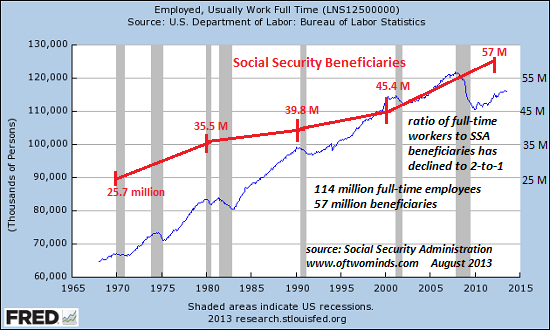
But raising taxes merely extends the Ponzi scheme one cycle. Eventually, taxes are so high that the remaining workers are impoverished. Right now, the U.S. has reached a ratio of 2 full-time workers for every retiree. As the number of retirees rises by thousands every day and the number of full-time jobs stagnates, the ratio will slide toward 1-to-1:

The Problem with Pay-As-You-Go Social Programs: They're Ponzi Schemes (November 5, 2013)


Estimates are even worse in other developed nations. In Europe, the ratio of retirees over 65 to those between 20 and 64 will soon reach 50%--and that's of the population, not of people with full-time jobs paying taxes to fund social welfare programs. (source: Foreign Affairs, July/August 2014, page 130)

As the percentage of the working-age populace with full-time jobs declines, the worker-retiree ratio will become increasingly unsustainable. The taxes paid by each worker are nowhere enough to fund the generous pension and healthcare benefits promised to every retiree.

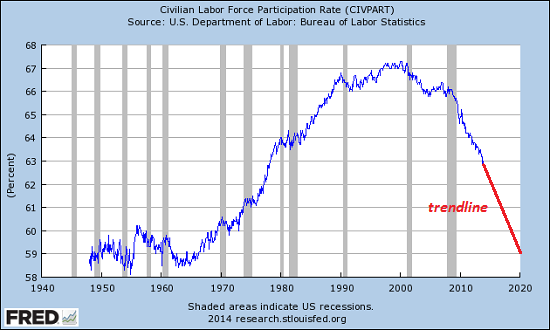
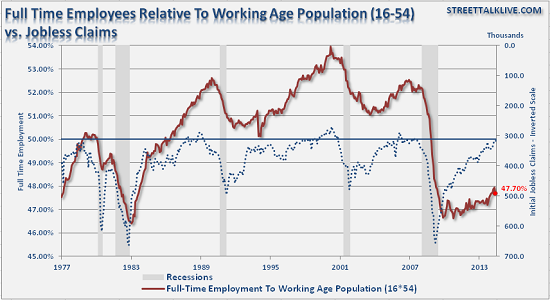
In the U.S., the number of people of working age who are jobless is 92 million; the number of full-time jobs is 118 million. This chart of labor participation includes almost 30 million part-time employees who don't earn enough to pay substantial taxes and millions of self-employed people making poverty-level net incomes.


Courtesy of STA Wealth Management, here is a chart that shows full-time workers are less than half the labor force:


Housing is also a classic Ponzi scheme: prices can only go up if there is an ever-expanding pool of greater fools willing and able to pay even more for a house than the previous pool of greater fools.

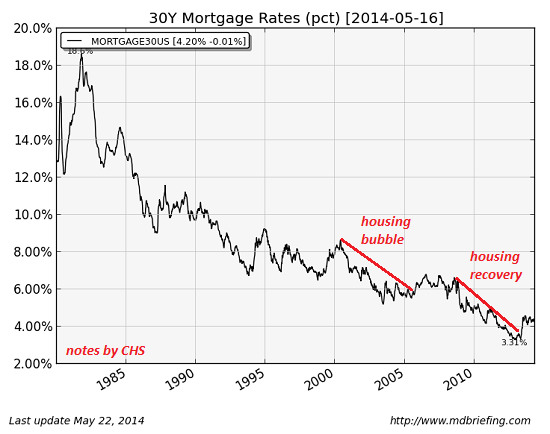
As I have explained many times, the only way the Status Quo has been able to expand the pool of greater fools is to lower interest rates to near-zero, drop down payments to 3% and loosen previously-prudent lending standards.

The Housing "Recovery" in Four Charts (May 27, 2014)

These tricks extend the Ponzi for a cycle by artifically expanding the pool of greater fools, but that pool is not infinite. (Foreign buyers are currently enlarging the pool, but their participation is dependent on the Ponzi schemes in their home economies not blowing up.)


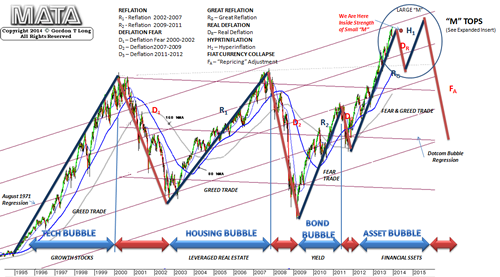
The stock market has been made the official metric of the nation's economic health; too bad it's a Ponzi scheme. Financial bubbles are what economist Robert Shiller calls "naturally occurring Ponzis" because the psychology of ever-rising prices and profits fuels an inflow of greater fools that sustains the bubble until all available greater fools have sunk their cash and credit into the bubble.

Here is what a market that is increasingly dominated by Ponzi bubbles looks like: this is the S&P 500 (SPX):


(source: Gordon T. Long, Macro Analytics)

Depending on blowing the next bubble to temporarily prop up the economy is the height of foolhardy shortsightedness. Yet that's our Status Quo, increasingly dependent on inflating bubbles to evince "economic strength" when the Ponzi paint will soon peel off the rotten wood of the real economy.


Get a Job, Build a Real Career and Defy a Bewildering Economy(Kindle, $9.95)(print, $20)
go to Kindle editionAre you like me? Ever since my first summer job decades ago, I've been chasing financial security. Not win-the-lottery, Bill Gates riches (although it would be nice!), but simply a feeling of financial control. I want my financial worries to if not disappear at least be manageable and comprehensible.


And like most of you, the way I've moved toward my goal has always hinged not just on having a job but a career.

You don't have to be a financial blogger to know that "having a job" and "having a career" do not mean the same thing today as they did when I first started swinging a hammer for a paycheck.

Even the basic concept "getting a job" has changed so radically that jobs--getting and keeping them, and the perceived lack of them--is the number one financial topic among friends, family and for that matter, complete strangers.

So I sat down and wrote this book: Get a Job, Build a Real Career and Defy a Bewildering Economy.

It details everything I've verified about employment and the economy, and lays out an action plan to get you employed.

I am proud of this book. It is the culmination of both my practical work experiences and my financial analysis, and it is a useful, practical, and clarifying read.

Test drive the first section and see for yourself.     Kindle, $9.95     print, $20

"I want to thank you for creating your book Get a Job, Build a Real Career and Defy a Bewildering Economy. It is rare to find a person with a mind like yours, who can take a holistic systems view of things without being captured by specific perspectives or agendas. Your contribution to humanity is much appreciated."
Laura Y.

Gordon Long and I discuss The New Nature of Work: Jobs, Occupations & Careers (25 minutes, YouTube) 


NOTE: Contributions/subscriptions are acknowledged in the order received. Your name and email remain confidential and will not be given to any other individual, company or agency.


Thank you, Eric T. ($200), for your outrageously generous contribution to this site -- I am greatly honored by your steadfast support and readership.Thank you, Susan V. ($25), for your exceedingly generous contribution to this site -- I am greatly honored by your support and readership.

Read more...

Sunday, July 20, 2014

The Insiders' Case for a Stock Market Mini-Crash

The trade only works if everyone is lulled into staying on the long side until it's too late.

Let's try a thought experiment: suppose we're players in the stock market, Wall Street insiders with real leverage and connections to the Fed. You know, the kind of player who can reverse a decline in the S&P 500 with an order (executed through a proxy) for thousands of call options on the SPX.

Retail participants tend to forget we make money on both the long and short side.The small-fry who provide liquidity always assume a sharp decline in equities is a terrible thing because "everybody is losing their gains," and this general belief is pushed by the mainstream financial media: unfailingly chirpy news anchors' expressions and voices darken when reporting the rare drop in stocks: horrible, horrible, horrible, a drop means we all lose, I'm sad reporting this.

The players are laughing at this play-acting and the gullibility of the audience: insiders make huge gains when they engineer a sharp decline. It's not that difficult to manipulate the market when volume and volatility are low, especially in an age where quant-bot trading machines are programmed to follow trends.

It's also easy to hype stocks publicly while selling (distributing) your shares at the top to unwary punters who believe the PR (the Fed has your back, thanks to the Fed's quantitative easing (QE), the market will never go down, etc.).


But pushing the melt-up higher gets more difficult when the market gets heavy.Markets get heavy when participation thins (i.e. fewer stocks are leading the advance), speculative sectors are rolling over as the crowd of greater fools shrinks and volume on up days keeps declining.

When the markets get heavy, the easy-profits trade is get short and engineer a sharp decline. Nudging a heavy market into a free-fall has a number of advantages to players, other than the gratifying profits from being short equities and long volatility.


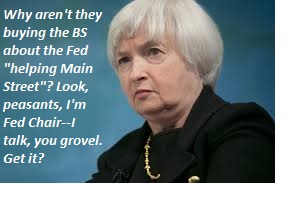
1. The Fed needs a decline to "prove" it isn't pushing markets higher, further enriching the already obscenely rich. A thoroughly corrupted Congress is finally awakening to the public rage over the Federal Reserve's blatant enrichment of the few at the expense of the many, and as a result, the Fed has a serious PR problem: Janet Yellen may be a lot of things, but a believable actress isn't one of them. Her performance claiming the Fed acts only on behalf of widows, orphans, Mom, apple pie and the merchants lining Main Street was laughably inauthentic.


A sharp decline would demonstrate that the Fed isn't controlling the market to enrich the insiders--even though a sharp decline would only benefit the insiders who engineered the drop. Heh. No need to be churlish about it. Where's your sense of humor?

2. A mini-crash would panic the herd into selling, enabling insiders to scoop up shares on sale. This is of course the classic insider play: unload enough shares to blow off all the sell stops (i.e. orders to sell if price drops to specified level), which extends the decline and reinforces the panic-selling.

3. Never give a sucker an even break. After two years without a meaningful correction and complacency at multi-year highs, how much profit is there left in pushing an increasingly heavy market up another few percentage points? The big money is in engineering a decline that catches the crowd by surprise and doesn't allow the traders a chance to board the short-bus before it roars out of the station.

Many traders are confident the market will broadcast a technical signal that will give them a chance to get on the short bus with the insiders. How likely is this? If we're engineering a decline, why would we spoil the trade by letting a bunch of peasants get on board? With every quant-bot programmed to recognize all the usual technical signals and systems, why telegraph the trade?

As legendary stock trader/manipulator Jesse Livermore observed, the market will take the fewest possible number of participants along for the ride, and expecting the market to issue a "go short now for easy profits" signal would violate this rule: if everybody shifts from the long side to the short side, the trade is no longer profitable.

The trade only works if everyone is lulled into staying on the long side until it's too late.Traders seem to be waiting for another standard-issue decline in September/October that would set up yet another standard-issue Santa Claus rally. Will it really be this easy to book profits in the second half? When everybody expects the same thing to unfold, it's just another form of complacency.

Complacency--and the confidence that you can beat a confidence game by following what everybody else is following--is dangerous.


Get a Job, Build a Real Career and Defy a Bewildering Economy(Kindle, $9.95)(print, $20)
go to Kindle edition
Are you like me? Ever since my first summer job decades ago, I've been chasing financial security. Not win-the-lottery, Bill Gates riches (although it would be nice!), but simply a feeling of financial control. I want my financial worries to if not disappear at least be manageable and comprehensible.


And like most of you, the way I've moved toward my goal has always hinged not just on having a job but a career.
You don't have to be a financial blogger to know that "having a job" and "having a career" do not mean the same thing today as they did when I first started swinging a hammer for a paycheck.

Even the basic concept "getting a job" has changed so radically that jobs--getting and keeping them, and the perceived lack of them--is the number one financial topic among friends, family and for that matter, complete strangers.

So I sat down and wrote this book: Get a Job, Build a Real Career and Defy a Bewildering Economy.

It details everything I've verified about employment and the economy, and lays out an action plan to get you employed.
I am proud of this book. It is the culmination of both my practical work experiences and my financial analysis, and it is a useful, practical, and clarifying read.

Test drive the first section and see for yourself.     Kindle, $9.95     print, $20

"I want to thank you for creating your book Get a Job, Build a Real Career and Defy a Bewildering Economy. It is rare to find a person with a mind like yours, who can take a holistic systems view of things without being captured by specific perspectives or agendas. Your contribution to humanity is much appreciated."
Laura Y.


Gordon Long and I discuss The New Nature of Work: Jobs, Occupations & Careers (25 minutes, YouTube) 


NOTE: Contributions/subscriptions are acknowledged in the order received. Your name and email remain confidential and will not be given to any other individual, company or agency.

Thank you, Robert P. ($150), for your outrageously generous contribution to this site -- I am greatly honored by your steadfast support and readership.Thank you, Arshad A. ($25), for your exceedingly generous contribution to this site -- I am greatly honored by your support and readership.

Read more...

Saturday, July 19, 2014

Degrowth Solutions: Half-Farmer, Half-X

The Status Quo is terrified of a world devoid of debt-serf "middle class" consumers.

When people say they want solutions, they're actually seeking only a specific kind of solution, one that leaves everything they have now intact but guarantees them more of something: more security, more healthcare, more education, more money, etc.,but at no cost or inconvenience to themselves.

Anything that fits these parameters isn't a solution; it's magic. Magical thinking and magical fixes are endlessly appealing precisely because they don't require us to change anything or work at anything outside our comfort zone.

In the real world, solutions change core values and processes. If they don't, they're not real solutions. Fake fixes come in various types: cosmetic band-aids, alleviation of the symptoms while the disease continues unchecked, public-relations relabeling of the problem so it appears to go away via semantic trickery, and so on.

Real solutions tend to have two parts: changes in values and operational changes in habits and processes. For example, "protecting air quality" can only occur if the internalized values of the populace change so they value air quality enough to demand it, and if there are operational systems for making air quality happen in the real world: monitoring air quality, tracing sources of pollution, changing the processes that generate pollution, and so on.

This two-sided structure of solutions--values and operations--is scale invariant, meaning it works the same for individuals, households, neighborhoods, towns, cities, organizations, enterprises, nations and empires. Any solution that doesn't change both values and operations in fundamental ways is just another magic trick, a simulacrum solution.

It requires this context of values and operations to understand how half-farmer, half-X is a potential solution for an over-debted, dysfunctional Degrowth economy.Unsurprisingly, the concept originates in Japan, one of the nations farthest down theRoad of No Return of debt, political dysfunction and Degrowth.

I've covered various aspects of Degrowth in depth:

Degrowth, Anti-Consumerism and Peak Consumption (May 9, 2013)

The American Model of "Growth": Overbuilding and Poaching November 19, 2013

When Conventional Success Is No Longer Possible, Degrowth and the Black Market Beckon (February 7, 2014)

And the Next Big Thing Is ... Degrowth? (April 7, 2014)

What is "half-farmer, half-X?" A growing number of young Japanese people, according to Junko Edahiro, whose TEDx Tokyo talk on the "De" Generation (8 min) was submitted by longtime correspondent Zeus Y. in an email exchange resulting from my Musings Report 5, What's Behind the Erosion of Community?


And what is X? X is whatever else the person wants to do with their lives. This stands in stark contrast to the Corporate Japan script that has been the "program" for life in Japan since 1946: work crazily inhuman hours in complete devotion to the corporation or institution, sacrificing one's own life in the process.

We have plenty of friends in Japan and so we know this is still the operant model: the male breadwinner works six days a week, leaving early in the morning and returning late at night. In some cases, the 7th day is devoted to classes and study needed to advance the man's career within the institution.

It's up to each individual to solve for X. When I say, "solve for X," it isn't an algebraic problem, it's an expression of human freedom and choice: what interests you? What do you want to learn, pursue, master, share, create, enjoy?

Being half-farmer, half-X requires a very low-cost lifestyle--no middle-class luxuries here, except the one luxury the middle-class employees of Corporate Japan can never have: time.

Zeus made a number of excellent points in our email exchange, and I excerpt three here:

"The new price of entry is production, as I said in my book Transforming Economy: From Corrupted Capitalism to Connected CommunitiesIf you are a parasite of any stripe, you are dispensable.

Now the only thing that has to happen is for people who have grown dependent on a corrupt and unsustainable (and time-wasting) government, corporate, pop culture, bureaucratic world, to wake up and awaken their genius, contribution, and connection. That is happening as we speak on a largely invisible level.

Here's the deal between the two worlds right now: the Status Quo is dying but trying to take everything with it and the other is trying hold the old world up enough to avoid complete collapse, buy time, and construct the airplane of the new world, all while flying."

The conventional media and indeed, the entire Status Quo, is terrified of a world devoid of debt-serf "middle class" consumers who willingly support debt-based consumption via workaholic devotion to their job in the state/corporation, aspirational consumption, debt-serfdom and high earnings/taxes.


I discuss another solution/model in International Workers' Day (May 1) and the New Class: Mobile Creatives (May 1, 2014).

Compared to that indentured life, being half-farmer, half-X is quite appealing to those who value their time and life, for the one luxury reserved for the super-wealthy--time--is within reach of everyone who jettisons the "middle class" aspirations and lifestyle that mask the harsh reality of debt-serfdom.

This essay is drawn from Musings Report 6 (2014). The weekly Musings Reports are sent exclusively to subscribers ($5/month, or $50/annually). Further information can be found in the right sidebar.


Get a Job, Build a Real Career and Defy a Bewildering Economy(Kindle, $9.95)(print, $20)
go to Kindle editionAre you like me? Ever since my first summer job decades ago, I've been chasing financial security. Not win-the-lottery, Bill Gates riches (although it would be nice!), but simply a feeling of financial control. I want my financial worries to if not disappear at least be manageable and comprehensible.


And like most of you, the way I've moved toward my goal has always hinged not just on having a job but a career.

You don't have to be a financial blogger to know that "having a job" and "having a career" do not mean the same thing today as they did when I first started swinging a hammer for a paycheck.

Even the basic concept "getting a job" has changed so radically that jobs--getting and keeping them, and the perceived lack of them--is the number one financial topic among friends, family and for that matter, complete strangers.

So I sat down and wrote this book: Get a Job, Build a Real Career and Defy a Bewildering Economy.

It details everything I've verified about employment and the economy, and lays out an action plan to get you employed.

I am proud of this book. It is the culmination of both my practical work experiences and my financial analysis, and it is a useful, practical, and clarifying read.

Test drive the first section and see for yourself.     Kindle, $9.95     print, $20

"I want to thank you for creating your book Get a Job, Build a Real Career and Defy a Bewildering Economy. It is rare to find a person with a mind like yours, who can take a holistic systems view of things without being captured by specific perspectives or agendas. Your contribution to humanity is much appreciated."
Laura Y.

Gordon Long and I discuss The New Nature of Work: Jobs, Occupations & Careers (25 minutes, YouTube) 


NOTE: Contributions/subscriptions are acknowledged in the order received. Your name and email remain confidential and will not be given to any other individual, company or agency.


Thank you, Rick B. ($100), for your outrageously generous contribution to this site -- I am greatly honored by your steadfast support and readership.Thank you, G. Wayne A. ($20), for your splendidly generous contribution to this site -- I am greatly honored by your steadfast support and readership.

Read more...

Terms of Service

All content on this blog is provided by Trewe LLC for informational purposes only. The owner of this blog makes no representations as to the accuracy or completeness of any information on this site or found by following any link on this site. The owner will not be liable for any errors or omissions in this information nor for the availability of this information. The owner will not be liable for any losses, injuries, or damages from the display or use of this information. These terms and conditions of use are subject to change at anytime and without notice.


Our Privacy Policy:


Correspondents' email is strictly confidential. This site does not collect digital data from visitors or distribute cookies. Advertisements served by a third-party advertising network (Investing Channel) may use cookies or collect information from visitors for the purpose of Interest-Based Advertising; if you wish to opt out of Interest-Based Advertising, please go to Opt out of interest-based advertising (The Network Advertising Initiative). If you have other privacy concerns relating to advertisements, please contact advertisers directly. Websites and blog links on the site's blog roll are posted at my discretion.


PRIVACY NOTICE FOR EEA INDIVIDUALS


This section covers disclosures on the General Data Protection Regulation (GDPR) for users residing within EEA only. GDPR replaces the existing Directive 95/46/ec, and aims at harmonizing data protection laws in the EU that are fit for purpose in the digital age. The primary objective of the GDPR is to give citizens back control of their personal data. Please follow the link below to access InvestingChannel’s General Data Protection Notice. https://stg.media.investingchannel.com/gdpr-notice/


Notice of Compliance with The California Consumer Protection Act
This site does not collect digital data from visitors or distribute cookies. Advertisements served by a third-party advertising network (Investing Channel) may use cookies or collect information from visitors for the purpose of Interest-Based Advertising. If you do not want any personal information that may be collected by third-party advertising to be sold, please follow the instructions on this page: Limit the Use of My Sensitive Personal Information.


Regarding Cookies:


This site does not collect digital data from visitors or distribute cookies. Advertisements served by third-party advertising networks such as Investing Channel may use cookies or collect information from visitors for the purpose of Interest-Based Advertising; if you wish to opt out of Interest-Based Advertising, please go to Opt out of interest-based advertising (The Network Advertising Initiative) If you have other privacy concerns relating to advertisements, please contact advertisers directly.


Our Commission Policy:

As an Amazon Associate I earn from qualifying purchases. I also earn a commission on purchases of precious metals via BullionVault. I receive no fees or compensation for any other non-advertising links or content posted on my site.

  © Blogger templates Newspaper III by Ourblogtemplates.com 2008

Back to TOP