




Wednesday, December 20, 2017

Santa's Stock Market Rally: Tears of Joy, Or Just Tears?

Everyone who believes risk has disappeared has fallen for the con.
Judging by this year's version of Santa Claus's reliable year-end stock market rally, risk has vanished, not just in stocks but in bonds, junk bonds, housing, commercial real estate, collectible art--just about the entire spectrum of tradable assets (with precious metals and agricultural commodities among the few receiving coals rather than rallies).
One of the maxims of this site is: risk cannot be made to disappear, it can only be cloaked, hedged or offloaded onto others. In other words, when the magician makes the white rabbit disappear, the physical rabbit does not in fact vanish; it is merely transported out of sight of the enthralled audience.
And so it is with risk in markets.
Risk is now viewed as something that can be reliably sold as a more or less guaranteed source of easy profits. In the present-day perception that risk has been eradicated from the markets, it makes little sense to hedge against risk; hedging is a waste of capital when there's no risk in sight.
This suggests risk is either being cloaked and/or offloaded onto punters who aren't aware that risk is piling up in their portfolios. If risk is being masked, every participant is exposed to risk that is being hidden behind policies (the Fed has our back," etc.), statistics (everything's coming up roses everywhere) and the diminishing premium for hedges.
If risk is being offloaded onto unsuspecting participants, then we must look to the poker table for guidance: if you can't identify the marks, you're the mark.
In other words, if we can't identify the chumps who have unknowingly accepted all the accumulated risk, then we're the chumps.
The successful con artist knows the marks want to believe the impossible, and so in essence they are begging to be conned. We all want to believe risk has vanished, because all the anxiety, uncertainty and the high cost of hedging all go away once risk has disappeared.
Everyone who believes risk has disappeared has fallen for the con. The tears of joy being shed as Santa Claus delivers his usual year-end rally may well become tears of shock, mourning and grief once the illusion that risk has been swept away is itself swept away.
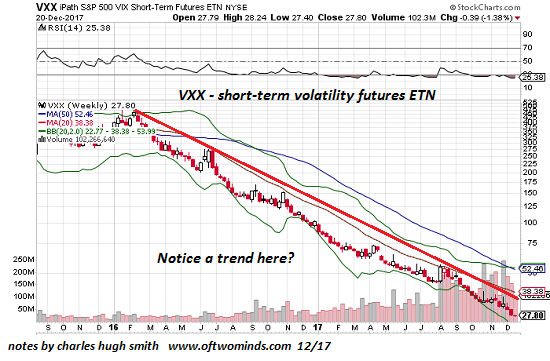
To illustrate how risk is currently perceived, here is a chart of the VXX short-term volatility futures index: notice a trend here? How about a relentless two-year decline?
In the meantime, party hearty and borrow to the hilt (via margin) to buy more of all those risk-free assets in an apparently risk-free market:
A Look at NYSE Margin Debt and the Market (Advisor Perspectives)


I'm offering my new book Money and Work Unchained at a 10% discount ($8.95 for the Kindle ebook and $18 for the print edition) through December, after which the price goes up to retail ($9.95 and $20).
Read the first section for free in PDF format.


If you found value in this content, please join me in seeking solutions by becoming a $1/month patron of my work via patreon.com.

NOTE: Contributions/subscriptions are acknowledged in the order received. Your name and email remain confidential and will not be given to any other individual, company or agency.

Thank you, Michael P. ($50), for your superbly generous contribution to this site-- I am greatly honored by your support and readership.

Read more...

Tuesday, December 19, 2017

Un-Merry Christmas: The Perverse Incentives to Over-Consume and Over-Spend

Isn't it obvious that if we set out to design the most perverse, toxic and doomed system possible, we'd end up with the Keynesian Cargo Cult's insane permanent growth/Landfill Economy?
Few topics are off-limits nowadays: the personal and private are now splashed everywhere for all to see.
One topic is still taboo: the holiday's perverse incentives to over-consume and over-spend,lest our economy implode. This topic is taboo because it strikes at the very heart of our socio-economic system, which is fundamentally based on permanent growth, the faster the better, as if unlimited expansion on a finite planet is not just possible, but desirable.
In the current Mode of Production, the solution to every social and economic ill is to "grow our way out of it."
The solution to unemployment: jump-start growth by expanding consumption, spending and borrowing.
The solution to stagnant wages: jump-start growth.
The solution to declining profits: jump-start growth.
The solution to government deficit spending: jump-start growth.
And so on.
So what happens when most people have not just the basics of life, but a surplus of stuff? Where is the growth going to come from if people already have everything?
The answer is three-fold:
1. Replace a perfectly good product with a new product and dump the old one in the landfill.
2. Buy duplicates and put the surplus products in the closet or storage facility.
3. Buy gimmicks (Pet Rocks, etc.) that are tossed in the dump shortly after the holiday gift-giving season ends.
But does this Landfill Economy make sense? The cheap oil is about gone, and so does it make any rational sense to burn the last of the cheap fossil fuels on assembling stuff nobody needs in China, shipping it thousands of miles to retailers or Amazon warehouses, adding it to the immense piles of stuff most households already own, and then shipping the old but still functional products to the landfill, just to keep the economy humming?
This is of course insane. Decisions aren't being made as if scarcity matters; the goals and incentives are set to encourage perverse and destructive overconsumption and overspending: not only are we squandering resources in the sacrifice to the false gods of "growth," we're indebting households to do so, stripping income that could have been saved and invested in productive uses.
In the lunatic asylum of the current economic model, media anchors sport grins of delirious joy when reporting increases in holiday spending, as if a bump higher from $680 billion to $700 billion is a gargantuan win for the flailing economy.
Wasting resources, capital and income on stuff nobody really needs is a monumental disaster on multiple fronts. Rather than establish incentives to conserve and invest wisely, our system glorifies waste and the destruction of income and capital, as if burning time, capital, resources and wealth on stuff nobody needs is strengthening the economy.
Isn't it obvious that this system is a one-way path to collapse? Isn't it obvious that burning resources and capital to haul stuff to the landfill at an ever-increasing rate is madness, folly, recklessness and stupidity combined?
Isn't it obvious that if we set out to design the most perverse, toxic and doomed system possible, we'd end up with the Keynesian Cargo Cult's insane permanent growth/Landfill Economy?
It doesn't have to be this way. I've sketched out a sustainable, human-scale Mode of Production/way of living in my two books, Money and Work Unchained and A Radically Beneficial World.
A new arrangement is inevitable. Our choice boils down to changing our understanding and Mode of Production now, before the whole perverse structure falls apart, or waiting for scarcities and self-serving systems to collapse the current arrangement, leaving the ill-prepared and shell-shocked populace to sift through the wreckage.
Common sense suggests the first option is the wiser choice, but common sense is scarce in a world trapped in a bizarre Keynesian madness.


I'm offering my new book Money and Work Unchained at a 10% discount ($8.95 for the Kindle ebook and $18 for the print edition) through December, after which the price goes up to retail ($9.95 and $20).
Read the first section for free in PDF format.


If you found value in this content, please join me in seeking solutions by becoming a $1/month patron of my work via patreon.com.

NOTE: Contributions/subscriptions are acknowledged in the order received. Your name and email remain confidential and will not be given to any other individual, company or agency.

Thank you, Metal Roof Estimating ($25), for your superbly generous contribution to this site-- I am greatly honored by your support and readership.

Read more...

Monday, December 18, 2017

Jedi Mind Trick: The Disturbing, Destabilizing Abnormal Is Now Normal

Disturbing, destabilizing abnormalities are now accepted as normal life in America.
Forgive me for wondering if the populace of America hasn't fallen for a Jedi mind trick:
Disturbing, destabilizing abnormalities are now accepted as normal life in America:
1. Sprawling tent camps of homeless sprout like flowers of poverty in U.S. cities, leaving mountains of trash that speak volumes about systemic failure, destitution and overwhelmed city services.
2. The Federal Reserve's vaunted "Wealth Effect" that was supposed to be a tide that raised all boats at least a bit has concentrated wealth and power in the top 5%, 1%, and 1/10th of 1%, leaving the bottom 95% with diminished prospects and a thinning stake in The American Project.
3. The stock market's year-long levitation while the real-world economy decays is a perverse counter-correlation that reflects the widening divide between those enriched by the asset bubbles and those left further behind.
4. In the midst of a supposedly resurgent U.S. "recovery" in its 9th year of wonderfulness, the opioid epidemic has killed tens of thousands and crippled hundreds of thousands of lives and families, yet the federal government, supposedly the most powerful force on the planet, is frozen in a decades-long law-enforcement/Drug Gulag obsession, blind to the Big Pharma Cartel that has created and fueled the epidemic as a means of reaping billions in profits.
5. The nation's Corporate/Billionaire-owned Media obsess endlessly over the chimera of Russian collusion, as if that was the Big Story That Matters, while the nation's rigged economy is coming apart at the seams.
6. While the Sports Media Empires fret over the decline of fan engagement in the NFL, nobody dares mention that Pro Sports is now unaffordable to the vast majority of households.
7. Healthcare costs continue spiraling higher, even as Americans are visibly less healthy.
8. The endless media circus of celebrity scandal, the Russian collusion propaganda parade and the over-saturation of sports obscure the Permanent War Policies of America's Central State.
9. While The Deep State has entered the common lexicon, all the media chatter does little to illuminate the internecine battles within the Deep State that are playing out as shadows cast in the Russian Collusion Kabuki theater.
10. The reality that all these social, political and financial abnormalities are inherently destabilizing is never covered in the Corporate Media, but this orchestrated refusal to face the disturbing facts of systemic decay leaves the status quo increasingly fragile and prone to unexpected disruption.
If the "America" displayed in the Corporate Media seems like "the Real America," then this is not the America you're looking for.


I'm offering my new book Money and Work Unchained at a 10% discount ($8.95 for the Kindle ebook and $18 for the print edition) through December, after which the price goes up to retail ($9.95 and $20).
Read the first section for free in PDF format.


If you found value in this content, please join me in seeking solutions by becoming a $1/month patron of my work via patreon.com.

NOTE: Contributions/subscriptions are acknowledged in the order received. Your name and email remain confidential and will not be given to any other individual, company or agency.

Thank you, Paul C. ($100), for your outrageously generous contribution to this site-- I am greatly honored by your steadfast support and readership.

Read more...

Sunday, December 17, 2017

Regulating Cryptocurrencies--and Why It Matters

Nations that attempt to limit cryptocurrencies' ability to solve these problems will find that protecting high costs and systemic friction will grind their economies into dust.
There's a great deal of confusion right now about the regulation of cryptocurrencies such as bitcoin. Many observers seem to confuse "regulation" and "banning bitcoin," as if regulation amounts to outlawing bitcoin.
Further confusing things is the regulation of cryptocurrency exchanges, where cryptocurrencies are bought and sold.
In China, for example, cryptocurrencies are not outlawed, but exchanges were shut down until regulators could get a handle on how to deal with the potential for excesses such as fraud, misrepresentation, etc.
A Wild West free-for-all is conducive to scammers, and so some thoughtful regulation that protects users is to be welcomed.
Governments tax income and capital gains. This is how they fund their activities. Clearly, gains reaped from cryptocurrencies are no different from gains reaped from other speculations and investments, so they should be recorded and taxed in the same manner.
Some enthusiasts of cryptocurrencies seem to think that regulations requiring the reporting and taxation of gains made buying and selling cryptocurrencies is tantamount to destroying cryptocurrencies.
I think this view has it backwards: fully legalizing and regulating cryptocurrencies as financial instruments legitimizes them in a much wider circle of potential users, and common-sense regulations are to be encouraged and welcomed, not viewed as threats to cryptocurrencies.
I want to stress that beneath all the speculative frenzy we see in the cryptocurrencies, what will retain value and remain scarce and in demand is whatever solves problems.
Cryptocurrencies have the potential to solve two problems:
1. reducing the cost and friction of financial intermediaries.
2. holding value as the $250 trillion in phantom wealth created in the asset bubbles of the past 12 years vanishes.
These are real problems: financial intermediaries introduce a great amount of friction and cost globally, and even a modest reduction in cost and friction (time, effort, compliance, recording transactions, etc.) would add up very quickly.
The global value of real estate, stocks, bonds and debt-assets such as mortgages and auto loans is around $500 trillion. By my rough estimate, about half of this was created in the past 12 years as central banks inflated enormous bubbles.
A house that was worth $200,000 in 2005 is now worth $500,000, but it provides no additional value as shelter; it is the exact same house with the exact same utility value. So the additional $300,000 of current market value is entirely phantom wealth.
The same can be said of all the other assets whose value has skyrocketed: the underlying assets/collateral haven't changed enough to justify the current valuations.
Once the bubbles in stocks, bonds, housing, commercial real estate and debt-assets start popping, the owners of all that phantom wealth will be desperate to sell what is dropping in value and convert that wealth into assets that are either holding their value or appreciating.
Virtually all of this newly created financial "wealth" is ephemeral. Bitcoin et al. are routinely criticized as being "worthless" due to their digital/ephemeral nature.
But critics rarely if ever examine the equally ephemeral nature of $250 trillion in financial "wealth."
Bitcoin in particular has two features which may be viewed as having value as all these coordinated bubbles pop:
1. The organization and distribution of bitcoin is mathematical. It is not something that can be changed at the whim of a handful of self-serving people in a room (i.e. central bankers).
2. It is limited in quantity.
Some critics claim this can be changed, but that's not the way it works. A group of bitcoin miners can propose a new version of bitcoin that will issue a trillion coins, but if nobody supports their new version, it dies.
In other words, the marketplace of users decides what has value and what doesn't.
Regulations that enable cryptocurrencies to solve the two problems listed above should be welcomed, as these problems are structural and impact everyone in some fashion.
Nations that attempt to limit cryptocurrencies' ability to solve these problems will find that protecting high costs and systemic friction will grind their economies into dust.


I'm offering my new book Money and Work Unchained at a 10% discount ($8.95 for the Kindle ebook and $18 for the print edition) through December, after which the price goes up to retail ($9.95 and $20).
Read the first section for free in PDF format.


If you found value in this content, please join me in seeking solutions by becoming a $1/month patron of my work via patreon.com.

NOTE: Contributions/subscriptions are acknowledged in the order received. Your name and email remain confidential and will not be given to any other individual, company or agency.

Thank you, Susan M. ($10/month), for your outrageously generous pledge to this site-- I am greatly honored by your most steadfast support and readership.

Read more...

Friday, December 15, 2017

Have We Reached Peak NFL?

How will the owners and managers of the multi-billion-dollar NFL empire handle the league's decline phase?
OK, I get it: pro football is so popular because it's one of the last refuges of modern life that hasn't been ruined by politics. Oops, scratch that. But we shouldn't pin the decline of pro football's popularity (as measured by viewership) solely on player protests, as the decline predates the recent politicization.
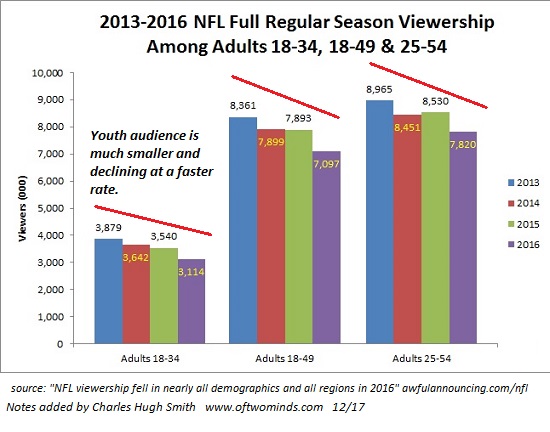
As this chart shows, viewership has been sliding for years across the entire demographic spectrum:
Even more troubling for the multi-billion-dollar NFL empire, the youth demographic is evaporating like mist in a scorching summer day in Death Valley. The problem for the NFL is two-fold: the number of young people who are dedicated NFL viewers is modest, and even worse, it's declining at a fast clip.
I am sure there are plenty of 25-year old fans, but anecdotally, I don't know a single Millennial who has any interest in sitting through a 2-hour pro football game at home, or ponying up the big bucks and huge chunk of time required to attend a game.
Again, anecdotally, young people seem more likely to watch a short clip of the game's highlights on Youtube than devote 2+ hours to sitting through endless annoying TV adverts for a few moments of action.
Or they're investing their sports-related time and money in college or local sports; if they're parents, their time may be devoted to their kids' sports activities.
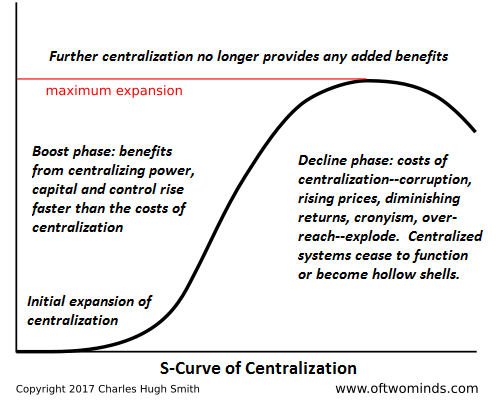
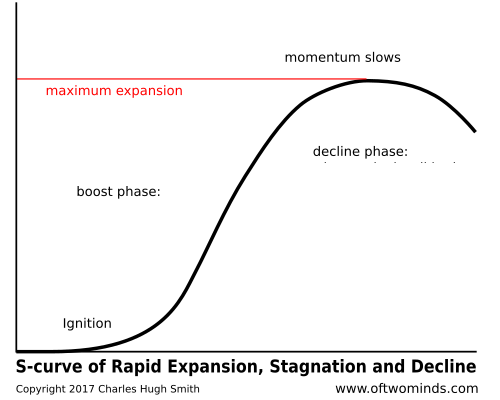
In other words, pro football is an interest of the older generations that isn't shared by the younger generations. We can chart this progression with an S-curve, which in the case of the NFL, is marked by the "boost phase" of viewership in the 1970s and 1980s as Monday Night Football expanded the TV audience and the league added franchises.
The league reached a maximum audience some years ago, and has now entered the decline phase.
But the NFL's troubles run even deeper than demographics: its fan base is being pressured financially while the cost of attending a game keeps rising.Anecdotally, attending a game costs a small fortune now. Yes, there may be a few cheap seats in the nose-bleed sections, but the costs of getting to the game, parking and refreshments far exceed what attendance cost the previous generation, even adjusting for inflation.
Maybe somebody feels $10 for a beer in a tiny plastic cup suitable for a urine sample and $20 (or more) for a couple of hot dogs or snacks is a fair price, but outside the circle of dedicated fans, it's a ripoff.
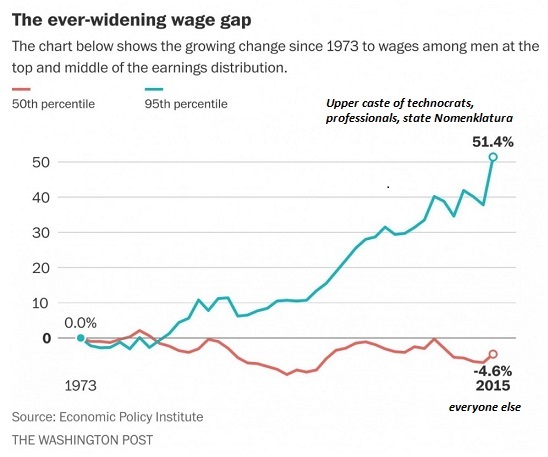
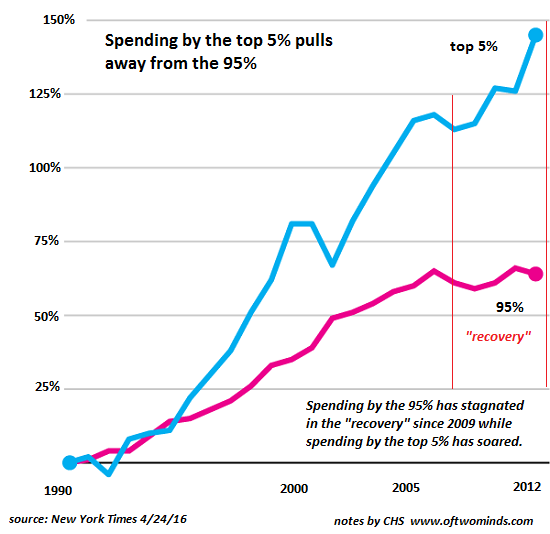
Just in case the NFL didn't notice, 95% of the populace is experiencing stagnating wages and rising costs of essentials, leaving less and less to blow on luxuries such as NFL games.
Only the top 5% have the dough to blow on luxuries, and not to put too fine a point on it, but outside of the luxury corporate boxes, the top 5% is not the prime NFL audience for several reasons, including that they're too busy working and taking care of responsibilities to devote precious spare time to watching pro football.
Spending is correlated to income, naturally enough: most of the "recovery" is the result of soaring discretionary spending by the top 5%, not the modest spending that is affordable to the bottom 95%. That means that the advertisers spending big bucks to advertise on NFL TV games are reaching an audience with diminishing cash or credit to spend.
Lastly, the NFL has reached the point of over-saturation. Monday Night Football was an innovation in 1970, but who has time or interest for Thursday morning football, Friday afternoon football, etc.? Then there's the health-related issues (brain damage suffered by players) and the politicization.
To summarize:
1. The NFL has saturated the potential audience to the point of exhaustion.
2. The potential audience is shrinking as student-loan-burdened Millennials have collectively little interest in spending the money or time required to be a rabid fan of pro football.
3. The cost of attending an NFL game is increasingly out of reach of the bottom 95% of households.
4. TV viewership is declining across the entire demographic spectrum.
5. The wages/income of the vast majority of the TV audience has stagnated, and 95% of the populace has less disposable income than a generation ago.
6. The top 5% with the majority of the disposable income are not big pro sports fans, mostly due to the many demands on their time and the diversity of other pursuits available to them.
How will the owners and managers of the multi-billion-dollar NFL empire handle the league's decline phase? Managing the decline phase is less fun than reveling in the expansion phase.


I'm offering my new book Money and Work Unchained at a 10% discount ($8.95 for the Kindle ebook and $18 for the print edition) through December, after which the price goes up to retail ($9.95 and $20).
Read the first section for free in PDF format.


If you found value in this content, please join me in seeking solutions by becoming a $1/month patron of my work via patreon.com.

NOTE: Contributions/subscriptions are acknowledged in the order received. Your name and email remain confidential and will not be given to any other individual, company or agency.

Thank you, Matthew R. ($5/month), for your monstrously generous pledge to this site-- I am greatly honored by your support and readership.

Read more...

Terms of Service

All content on this blog is provided by Trewe LLC for informational purposes only. The owner of this blog makes no representations as to the accuracy or completeness of any information on this site or found by following any link on this site. The owner will not be liable for any errors or omissions in this information nor for the availability of this information. The owner will not be liable for any losses, injuries, or damages from the display or use of this information. These terms and conditions of use are subject to change at anytime and without notice.

RE: European Union AI Act, and Our Use of Generative AI Tools and Agents Policy

All text on this site is composed by Charles Hugh Smith or by a credited guest-author. No Generative AI Tools are used in the composition / writing of any text or graphic content created by Charles Hugh Smith. This site deploys no AI agents or generative AI tools. This site is not responsible for the disclosures, use or non-use of AI agents or generative AI tools in advertisements displayed by Investing Channel or other ad placement services.

Audio files generated by text-to-audio transcription tools are identified as such.

Our Privacy Policy:

Correspondents' email is strictly confidential. This site does not collect digital data from visitors or distribute cookies. Advertisements served by third-party advertising networks such as Investing Channel may use cookies or collect information from visitors for the purpose of Interest-Based Advertising; if you wish to opt out of Interest-Based Advertising, please go to Opt out of interest-based advertising (The Network Advertising Initiative) If you have other privacy concerns relating to advertisements, please contact advertisers directly.

PRIVACY NOTICE FOR EEA INDIVIDUALS

This section covers disclosures on the General Data Protection Regulation (GDPR) for users residing within EEA only. GDPR replaces the existing Directive 95/46/ec, and aims at harmonizing data protection laws in the EU that are fit for purpose in the digital age. The primary objective of the GDPR is to give citizens back control of their personal data. Please follow the link below to access InvestingChannel's General Data Protection Notice.
https://stg.media.investingchannel.com/gdpr-notice/

Notice of Compliance with The California Consumer Protection Act

This site does not collect digital data from visitors or distribute cookies. Advertisements served by a third-party advertising network (Investing Channel) may use cookies or collect information from visitors for the purpose of Interest-Based Advertising. If you do not want any personal information that may be collected by third-party advertising to be sold, please follow the instructions on this page: Do Not Sell My Personal Information.

Regarding Cookies:

This site does not collect digital data from visitors or distribute cookies. Advertisements served by third-party advertising networks such as Investing Channel may use cookies or collect information from visitors for the purpose of Interest-Based Advertising; if you wish to opt out of Interest-Based Advertising, please go to Opt out of interest-based advertising (The Network Advertising Initiative) If you have other privacy concerns relating to advertisements, please contact advertisers directly.

Our Commission Policy:

Though I earn a small commission on Amazon.com books and gift certificates and gold (BullionVault) purchased via links on my site, I receive no fees or compensation for any other non-advertising links or content posted on my site.

Copyright Notice:

All original images (Drawings and Photographs), text (essays, books and works of fiction), audio and video recordings, musical compositions, graphic design, graphic design elements and HTML coding on this site are the copyrighted work of Charles Hugh Smith unless otherwise credited or noted. They are published as information for the private use of site visitors, and any reproduction or redistribution of this content or coding in any media in any format or distribution channel (text, audio, video/film, web) without the written permission of the copyright holder is strictly prohibited. All rights in all media reserved globally.

  © Blogger templates Newspaper III by Ourblogtemplates.com 2008

Back to TOP