Wednesday, October 09, 2024

When Did Our Institutions Lose Our Trust?

This has now reached the point that corporations and institutions are in effect "mining what remains of our trust" to boost profits / private gains.

Social cohesion is another ill-defined concept which is core to social and economic stability, despite the difficulty of measuring it. As with social trust, we sense its presence and its decay rather than measure ups and downs with any precision. Social trust is a core component of social cohesion, and we sense the decay of both, even if there is no easy metric to chart.

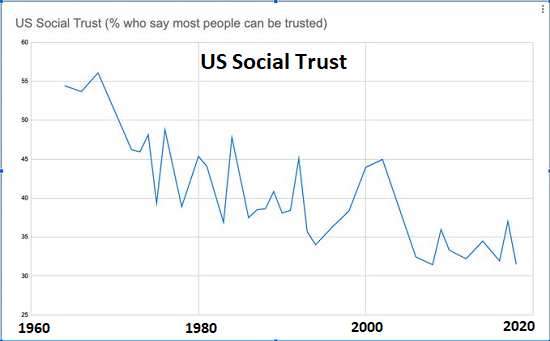
When did our trust in our core institutions start unraveling? Perhaps the more insightful question is: when did our institutions lose our trust? For trust is not just given, it is for institutions--government, healthcare, higher education, industry, media, etc.--to gain or lose by their actions and the disconnect between their claims and the reality.

In the broad sweep of recent history, the trust earned by institutions in the 1940s and 1050s began unraveling in the 1960s and accelerated in the 1970s. For many Americans, the inconsistencies of the official version of the assassination of President John F. Kennedy in 1963 were deeply troubling. Similar inconsistencies arose in the 1968 assassinations of Martin Luther King, Jr. and Robert Kennedy.

If the public wasn't being given the full story, why not? Was it really "national security," or were institutional malfeasance and cover-ups what was actually going on?

The war in Vietnam was another source of institutions losing trust. Between the claims of victory just ahead, the 5 o'clock follies and body counts, the "splendid little war" transmogrified into a big, dirty war that could no longer be contained within the neat narratives established in the "good war" of World War II.

The majority of Americans still wanted to believe in the rightness of their government and the causes of American policy, but many others had suffered complete disillusionment and loss of trust in the official accounts.

Watergate fueled the disillusionment as cover-ups increasingly appeared to be the primary modus operandi of all institutions. This disillusionment increased as the Church Committee revealed the politicization of the nation's law enforcement agency, the FBI, and the illegal domestic activities of the FBI and the nation's premiere intelligence / covert action agency, the CIA, both of which sought to suppress critics of the war in Vietnam with illegal means.

While the conservative movement openly derided government competence in the 1980s, the big, bad government continued expanding regardless of whether "conservatives" or "liberals" were nominally in charge. The federal government's footprint was reduced in President Clinton's campaign to "reinvent government," and the federal budget briefly enjoyed surpluses in the Internet boom years, but since then the expansion of government and institutional /corporate power has continued unabated.

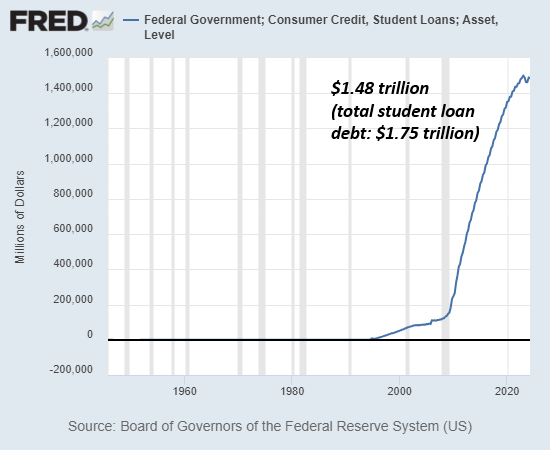
The decay of public-private industries such as healthcare and higher education gathered speed in the 1980s, as costs and profits soared. Consider this chart of student loans. It is astonishing that somehow, despite a rapidly expanding population of college students, higher education managed to remain affordable and did not need students to borrow $2 trillion prior to the early 2000s.


Healthcare also rocketed far beyond affordability, and as with higher education, what expanded wasn't the number of doctors or professors; it was the cadre of highly paid administrators that expanded.

The public slowly caught on that insiders were busy covering up their self-service. The institution had become a profit center rather than an entity performing a vital public service. The pandemic experience accelerated this awareness.


This has now reached the point that corporations and institutions are in effect mining what remains of our trust to boost profits / private gains. Correspondent M.S. offered an example of this: "We bought a GE microwave because of the company's reputation, and it failed within two months. The appliance technician said that he noticed many similar failures with GE."

We observe this mining the last of our trust for private gain everywhere. We are frogs in a simmering pot of water that is approaching the boiling point, and as we await the complete unraveling of the social order, we sigh You can't stop Progress. Indeed.

Sixty years of institutions and business interests mining our trust has eroded social cohesion to the point that non-linear instability now looms as the banquet of consequences. Forfeiting our trust for private profits and power has a price that has yet to be paid.

New podcast: How Asset Deflation Could Play Out (35:37 min)


My recent books:

Disclosure: As an Amazon Associate I earn from qualifying purchases originated via links to Amazon products on this site.

Self-Reliance in the 21st Century print $18, (Kindle $8.95, audiobook $13.08 (96 pages, 2022) Read the first chapter for free (PDF)

The Asian Heroine Who Seduced Me (Novel) print $10.95, Kindle $6.95 Read an excerpt for free (PDF)

When You Can't Go On: Burnout, Reckoning and Renewal $18 print, $8.95 Kindle ebook; audiobook Read the first section for free (PDF)

Global Crisis, National Renewal: A (Revolutionary) Grand Strategy for the United States (Kindle $9.95, print $24, audiobook) Read Chapter One for free (PDF).

A Hacker's Teleology: Sharing the Wealth of Our Shrinking Planet (Kindle $8.95, print $20, audiobook $17.46) Read the first section for free (PDF).

Will You Be Richer or Poorer?: Profit, Power, and AI in a Traumatized World
(Kindle $5, print $10, audiobook) Read the first section for free (PDF).

The Adventures of the Consulting Philosopher: The Disappearance of Drake (Novel) $4.95 Kindle, $10.95 print); read the first chapters for free (PDF)

Money and Work Unchained $6.95 Kindle, $15 print)
Read the first section for free


Become a $3/month patron of my work via patreon.com.

Subscribe to my Substack for free


NOTE: Contributions/subscriptions are acknowledged in the order received. Your name and email remain confidential and will not be given to any other individual, company or agency.

Thank you, Sebastian S. ($70), for your superbly generous subscription to this site -- I am greatly honored by your steadfast support and readership.


Thank you, Phil ($7/month), for your magnificently generous subscription to this site -- I am greatly honored by your support and readership.


Thank you, Dan G. ($70), for your marvelously generous subscription to this site -- I am greatly honored by your support and readership.


Thank you, Zamora1501 ($70), for your splendidly generous subscription to this site -- I am greatly honored by your support and readership.

Read more...

Tuesday, October 08, 2024

Social Trust: It's Not Warm and Fuzzy, It's the Money, Honey

That most of us live in a low-value, low-trust economy of shoddy goods and services hidden beneath high-tech frictionless, faceless transactions is not recognized.

Social trust manifests in all sorts of ways, and it's often amorphous and difficult to measure. We sense its presence or absence, but exactly what is it? Is it our trust in strangers, or our trust in institutions, or a warm and fuzzy feeling that our society isn't falling apart?

In several critical ways, social trust isn't warm and fuzzy, it's all about the money, honey. In high-trust societies, transactions are frictionless and low-cost. In low-trust societies, transactions must go through multiple levels of verification, trusted third-parties, etc., each of which is costly.

Correspondent Bruce H. illuminates the differences between high-trust and low-trust transactions:

"There must be a high degree of social trust in order to make business transactions. If you think the other person is likely to take the goods and not pay, you are not likely to engage as freely, and the "shadow work" of ensuring that a transaction is honored drains the economy.

In cultures where cunning and deception are seen as laudable, business transactions are slow, proceeding only carefully, in a time-consuming way because both parties have to ensure the other's compliance at every phase of the arrangement. This is costly.

In cultures where personal honor take primacy, a quick handshake is sufficient and work can begin immediately, confident that payment or the exchange will proceed to both parties benefit.

That, in essence, is what my father told me about his experience of doing business around the world.

There are places where you just discuss what is needed and agree on a price shake hands and write it down, there are places where you make sure the paperwork is in order and signed before you work, there are places where you make sure they have the money they claim they have and do all the paperwork and get some up front, and there are places where you make sure the money is in the hands of some secure third party (which, of course costs money) before you sign any agreements.

This also absolutely correlates between the relative wealth of these places. The places with the least trust are the poorest, those with the highest levels of trust are the wealthiest, all other factors being equal."


It's the money, honey: low-trust = poor, high-trust = wealthy as cumbersome, time-consuming costly transactions suck the life out of an economy.

There are other financial aspects of high-trust / low-trust societies. In high-trust economies, transactions are the core of the economy. The vast majority of transactions occur online or with complete strangers. In low-trust economies, trusted relationships are the core of the economy, and so business is conducted in much smaller circles which are connected by trusted go-betweens, often related by family or other close social ties.

This relationship-based economy was the model used in the ancient world, and it works well when trade and communications took months or even years. It works well on high-value transactions, for example, ships carrying luxury goods long distances. It works less well in a globalized, commoditized economy where the volume of transactions and business is enormous and covers a range of goods and services.

We can understand the U.S. economy as bifurcated into high-trust / low-trust segments which are difficult to tease apart unless we analyze the society and economy through the lens of class, an unpopular analysis in our supposedly classless culture.

High-value goods and services still tend to function on the level of relationships, while the shoddy, low-value goods and services are strictly transactional. The wealthy have connections, the rest of us get automated customer-service apps.

The wealthiest few reap fortunes from the low-value automated transactional economy that they don't have to endure.

Consider the "value" of an elite university education. The cost is higher than a standard-issue university, but not that much higher. Compare the student who spends $100,000 obtaining a diploma from a second-tier "good" university, and one that spends (or gets scholarships) $150,000 to graduate from an elite university. The difference is in reputation, of course, and entree to elite institutions, but also in the relative ease of making connections.

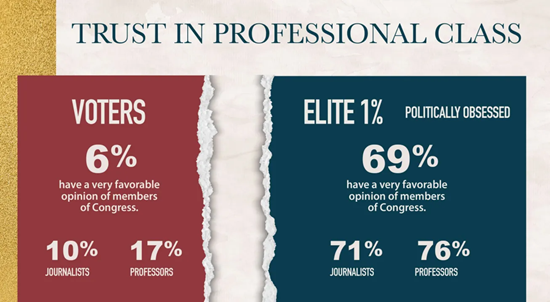
On rare occasions, outlier institutions such as Black Mountain College (1933-1957) offer unique opportunities for commoners to make valuable connections with luminaries, but as a general rule the "high value" goodies are reserved for the elite, which is why the top 1% has great trust in the same institutions that the bottom 99% have lost trust in.


source

That most of us live in a low-value, low-trust economy of shoddy goods and services hidden beneath high-tech frictionless, faceless transactions is not recognized, much less understood as a manifestation of wealth-income inequality. Yes, we trust institutions: we trust them to rip us off, ignore our queries, mess up simple transactions, sell us rubbish that falls apart or is "no longer supported," stripmine us with hidden fees and burden us with endless shadow work to keep all their kludgy apps and digital services functioning.

This raises a question: what happens in a society of intertwined high-trust and low-trust when polycrisis starts applying great pressure on social coherence and institutions?


Those living in a high-trust circle of relationships and connections will do just fine, the rest of us in steerage will be on our own. It's a good idea to start forging our own network of trusted, high-value connections because "when you're thirsty, it's too late to dig a well."

New podcast: How Asset Deflation Could Play Out (35:37 min)


My recent books:

Disclosure: As an Amazon Associate I earn from qualifying purchases originated via links to Amazon products on this site.

Self-Reliance in the 21st Century print $18, (Kindle $8.95, audiobook $13.08 (96 pages, 2022) Read the first chapter for free (PDF)

The Asian Heroine Who Seduced Me (Novel) print $10.95, Kindle $6.95 Read an excerpt for free (PDF)

When You Can't Go On: Burnout, Reckoning and Renewal $18 print, $8.95 Kindle ebook; audiobook Read the first section for free (PDF)

Global Crisis, National Renewal: A (Revolutionary) Grand Strategy for the United States (Kindle $9.95, print $24, audiobook) Read Chapter One for free (PDF).

A Hacker's Teleology: Sharing the Wealth of Our Shrinking Planet (Kindle $8.95, print $20, audiobook $17.46) Read the first section for free (PDF).

Will You Be Richer or Poorer?: Profit, Power, and AI in a Traumatized World
(Kindle $5, print $10, audiobook) Read the first section for free (PDF).

The Adventures of the Consulting Philosopher: The Disappearance of Drake (Novel) $4.95 Kindle, $10.95 print); read the first chapters for free (PDF)

Money and Work Unchained $6.95 Kindle, $15 print)
Read the first section for free


Become a $3/month patron of my work via patreon.com.

Subscribe to my Substack for free


NOTE: Contributions/subscriptions are acknowledged in the order received. Your name and email remain confidential and will not be given to any other individual, company or agency.

Thank you, Sebastian S. ($70), for your superbly generous subscription to this site -- I am greatly honored by your steadfast support and readership.


Thank you, Phil ($7/month), for your magnificently generous subscription to this site -- I am greatly honored by your support and readership.


Thank you, Dan G. ($70), for your marvelously generous subscription to this site -- I am greatly honored by your support and readership.


Thank you, Zamora1501 ($70), for your splendidly generous subscription to this site -- I am greatly honored by your support and readership.

Read more...

Friday, October 04, 2024

Adapt or Die, Or...?

Those few who grasp the crisis in its entirety have been marginalized, and those who are left are drifting downstream, unable to move the mass of self-interested inertia even if they wanted to.

In eras of stability when little changes, the capacity to adapt takes a back seat. As noted in Why Political "Solutions" Don't Fix Crises, They Make Them Worse, absent any pressure from tumultuous change, nature is hard-wired to keep the genetic instructions unchanged, as there is little selective benefit in modifying what's working well and potential risks in messing with it.

In other words, nature is conservative in eras of stability and low volatility. Since its genetic instructions are working pretty well, the shark genome is relatively stable over millions of years, with a few tweaks here and there to adapt to changes in its environment.

But adaptative churn takes the driver's seat when the ecosystem changes rapidly and the existing instructions are failing. This is the adapt or die moment, when species must experiment by churning out modifications (semi-random mutations in the instructions) and test them in trial-and-error: the ones that add selective advantages live, the ones that don't die.

If this period of intense adaptive experimentation is ultimately successful, the species' rate of change spikes and then drifts down to the baseline of low activity. This is known as punctuated equilibrium: the instructions drift along when nothing much is changing, suddenly spike when selective pressures shoot up, threatening extinction, and then diminish as the new adaptations relieve the selective pressure.

All this is automatic and beyond the individual's and the species' conscious control. We can't order our genome to speed up mutations and get cracking on the adaptive modifications.

Human civilization operates on the same principles of adapt or die: when circumstance change, selective pressures mount and the society must adapt or perish.

What's different is humans can stifle or encourage adaptive churn. As social beings hard-wired to organize ourselves in hierarchies, those at the top of the power pyramid will naturally deploy all their power to conserve the status quo, as any modifications might threaten their outsized share of all the good things such as wealth and status.

The view from the top of the pyramid is rather grand. Those at the top see the vastness of the imperial reach, the army's strength, the peasantry toiling away and the obsequious Mandarin bureaucrats bowing and scraping, and the idea that all this immense structure could decay and blow away is incomprehensible.

There is little sense in the top circle that the extinction of the entire social order is a threat. The threat is more personal: is my private fiefdom at risk of being diminished? Are rivals gaining influence? Are the reforms being proposed positive for my fortunes or could they pose a threat?

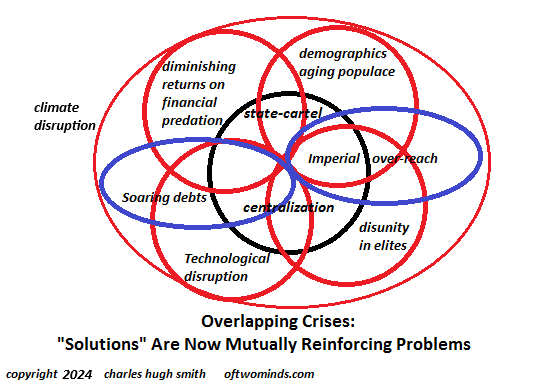
This narrow view of the overlapping crises (a.k.a. polycrisis) favors short-term expediency over more radical long-term modifications, as the Powers That Be have a grip on expedient "stave off the immediate crisis" measures such as imposing curfews, lowering interest rates and increasing the pay of soldiers, but these measures are slapdash rather than part of a recognition that radical changes in the structure of the society must be organized now, not later, for later will be too late.

In other words, there is no urgency for the kind of reforms needed to avoid extinction, there is only urgency for expedient "kick the can down the road" measures because these measures 1) are within easy reach and 2) they don't threaten the pyramid of power the "deciders" dominate.

Put another way, faced with skyrocketing risks of a heart attack, the leadership concludes that cutting out the HoHos but keeping the DingDongs and Twinkies will be enough to maintain the status quo. That the crises demand a complete overhaul of diet and fitness, now, not later, is both 1) too painful to contemplate, and 2) beyond the reach or the leadership's atrophied adaptive skillset: the leadership only has experience with managing stability, not tumultuous crises.

There is an irony in this atrophy of competence: the longer the good times roll, the less experience anyone has of polycrisis. In the competitive churn at the top of the pyramid, the skills that are most valuable in periods of stability are those of bureaucratic in-fighting and maintaining the status quo. Since there is no selective pressure demanding radical changes to survive, the skills needed to manage such a radical transition are nor longer present.

Those with the necessary character and skills to manage radical transformations have all been sent to Siberia for threatening the status quo with all their crazy proposals. Those in power have been selected to believe the organization they rule is perfectly capable of adjusting as needed, without actually changing anything.

This is the exact opposite of what's needed to survive the challenges ahead. And so expedient can-kicking continues (cough, the Fed), grand pronouncements yield nothing but hot air, and everyone reckons cutting out the HoHos and reducing the DingDongs will be enough to ride out the rough patch.

This is of course hubristic delusion. But since events are accelerating and interacting in ways far beyond the grasp of the under-competent leaders, the focus is not on managing a desperately needed radical transformation but on managing the narrative so it looks as if the crises are under control, and the status quo is functioning as intended: we have top people on it, top people. Indeed.


Adapt or die or... decay. Complex systems that have survived for a long time seek to restore equilibrium. These are the expediency feedback loops, where interest rates and taxes are trimmed, money is thrown around, narratives that question the competence of the status quo are suppressed, insiders who reveal the self-serving predation of the leadership are hustled off to Siberia, and all is well, as the decay can be covered up for quite some time.

So quality decays first, then quantity decays, too. Each crisis reveals another layer of under-competence and dry-rotted foundations, and each one is dutifully papered over.

Those few who grasp the crisis in its entirety have been marginalized, and those who are left are drifting downstream, unable to move the mass of self-interested inertia even if they wanted to--and they don't really want to because why should we risk upsetting such a splendid arrangement that's capable of handling anything that arises with ease?

Decay is a perfectly adequate strategy if there's sufficient resources to keep everything glued together as it slowly unravels. Magical thinking (AI!) helps smooth the decline, and soon everyone habituates to decay.

Polycrisis has a way of disrupting decay. If conditions remain stable, decay can be managed. But if volatility soars and multiple crises arise and reinforce each other, decay accelerates into collapse.

The ability to discern an existential challenge before it's too late is rare and unrewarded. "When you're thirsty, it's too late to dig a well."

New podcast: How Asset Deflation Could Play Out (35:37 min)


My recent books:

Disclosure: As an Amazon Associate I earn from qualifying purchases originated via links to Amazon products on this site.

Self-Reliance in the 21st Century print $18, (Kindle $8.95, audiobook $13.08 (96 pages, 2022) Read the first chapter for free (PDF)

The Asian Heroine Who Seduced Me (Novel) print $10.95, Kindle $6.95 Read an excerpt for free (PDF)

When You Can't Go On: Burnout, Reckoning and Renewal $18 print, $8.95 Kindle ebook; audiobook Read the first section for free (PDF)

Global Crisis, National Renewal: A (Revolutionary) Grand Strategy for the United States (Kindle $9.95, print $24, audiobook) Read Chapter One for free (PDF).

A Hacker's Teleology: Sharing the Wealth of Our Shrinking Planet (Kindle $8.95, print $20, audiobook $17.46) Read the first section for free (PDF).

Will You Be Richer or Poorer?: Profit, Power, and AI in a Traumatized World
(Kindle $5, print $10, audiobook) Read the first section for free (PDF).

The Adventures of the Consulting Philosopher: The Disappearance of Drake (Novel) $4.95 Kindle, $10.95 print); read the first chapters for free (PDF)

Money and Work Unchained $6.95 Kindle, $15 print)
Read the first section for free


Become a $3/month patron of my work via patreon.com.

Subscribe to my Substack for free


NOTE: Contributions/subscriptions are acknowledged in the order received. Your name and email remain confidential and will not be given to any other individual, company or agency.

Thank you, De Engineer ($7/month), for your superbly generous subscription to this site -- I am greatly honored by your support and readership.


Thank you, Ebeth ($7/month), for your magnificently generous subscription to this site -- I am greatly honored by your support and readership.


Thank you, James ($7/month), for your marvelously generous subscription to this site -- I am greatly honored by your support and readership.


Thank you, Richard B. ($3/month), for your splendidly generous subscription to this site -- I am greatly honored by your support and readership.

Read more...

Wednesday, October 02, 2024

Why Political "Solutions" Don't Fix Crises, They Make Them Worse

The system has reached the limits of its adaptability. Everything else is entertainment.

A great many people have immense faith in political solutions to looming crises: if only we elect new leaders, if only we replace current policies with new policies, everything would be fixed and the crises will all dissipate.

There are powerful reasons for this faith and equally powerful reasons why political solutions fail in crisis. Our faith in politics is nurtured by recency bias in eras of relatively low-level volatility: when the system is humming along, decade after decade, the incremental adaptations of politics are enough to resolve whatever spots of bother arise.

There are three key points here. One is that politics is by its nature incremental, and there are profound reasons for this aversion to radical reforms. All organisms are well-served by the innate conservatism of natural selection: if it isn't broken, don't fix it. If the current set of instructions--genetic, epigenetic, social, cultural, economic, political--is working, then it makes sense to conserve what works and be cautious about adapting new instructions.

Natural selection tinkers with experiments when selective pressure is applied to a species, and this is an incremental process: if random mutations in an individual offer some meaningful advantage in changing conditions, over time that improvement spreads through the species.

Experiments that fail to offer advantages are eliminated by, well, death. Not exactly warm and fuzzy, but when push comes to shove, Nature doesn't fool around.

This is why humans experience financial losses so sharply and forget the euphoria of winning. In the big picture, gains are nice and we enjoy the dopamine hit, but losses can be catastrophic, and so we're wired to be risk averse as a key survival trait.

In the political realm, this plays out as favoring incremental policy adjustments over radical--and therefore difficult to risk-assess--course changes. Enthusiasm to really tackle the crisis head-on is tempered by fears that some unforeseen consequence could emerge from the untested policy that triggers losses or instability that cannot be reversed.

The second key point is everyone in a position of power or influence is committed to preserving the status quo that has rewarded them so well. Outsiders with no power or influence may be chomping at the bit to overthrow the stale, sclerotic, do-nothing status quo, but insiders are self-selected defenders of the status quo, as it has served their interests so well: they rose to wealth and power within this system, and no matter how great the crisis, all their energies are devoted to preserving the system that has served them so splendidly.

Self-service is neatly cloaked by a belief that since the system has served me so well, it serves everyone equally well, and so defenders of modest, incremental adjustments in policy naturally believe the system is the best possible and worthy of protecting, despite its flaws.

A third source of incrementalism is the lack of consensus and the self-serving divisions in the Power Elite. There are ideological differences which lead to disagreements over policy--welfare queens in Cadillacs, etc.--and there is the auction of favors where to get the vote / approval of a powerful politician, some utterly nonsensical, needlessly costly bauble must be tossed to them--for example, an outdated rocket engine must be manufactured in their district even though the cost is higher and the harm to the project is irreversible.

This is the infamous "making sausage" of political wheeling and dealing. Incremental change is all that's possible when few of the participants are feeling any real pain that demands radical adaptations and the majority aren't feeling they're getting anything for supporting radical change. Rather, they're risking their career on a longshot which might end up harming their constituency and position in the party / power structure.

This is why we see tepid, baby-step, and ultimately ineffective policy adjustments as empires crumble into crisis. Insiders are loathe to relinquish power or admit that the status quo is incapable of dealing with the crises threatening to overwhelm the empire, and so they agree to doing more of what's failed as this is 1) the safe bet and 2) what all the squabbling power players can agree on.

In crisis, the safe bet is the losing bet, but insiders are blind to this reality, for in their blinkered, self-serving recency bias view, the system could not possibly be at risk, so their only concern is preserving their slice of the pie and making as few risky changes as possible.

Since radical reforms inevitably reduce somebody's slice of the pie, they're politically impossible. Never mind the risk of collapse, a reduction in my slice of the pie is completely unacceptable. As a result, collapse is the politically acceptable default.

The faith that "it will all work itself out if we leave it alone" is persuasive after decades of stability. That this faith is catastrophically misplaced will only become apparent after it's too late.

I often refer to these excerpts, as they so succinctly capture the key dynamics is this delusional drift into disaster. The first is from Michael Grant, author of The Fall of the Roman Empire, who describes the clueless mindset of the ruling elite faced with novel crises that are beyond the reach of the usual bag of "safe" (and self-serving) policies:

"There was no room at all, in these ways of thinking, for the novel, apocalyptic situation which had now arisen, a situation which needed solutions as radical as itself. His whole attitude is a complacent acceptance of things as they are, without a single new idea.

This acceptance was accompanied by greatly excessive optimism about the present and future. Even when the end was only sixty years away, and the Empire was already crumbling fast, Rutilius continued to address the spirit of Rome with the same supreme assurance.

This blind adherence to the ideas of the past ranks high among the principal causes of the downfall of Rome. If you were sufficiently lulled by these traditional fictions, there was no call to take any practical first-aid measures at all."


The second excerpt is from Ray Huang's 1587, A Year of No Significance: The Ming Dynasty in Decline, which describes how the status quo, wedded to past success, guided by self-interest and risk aversion, impervious to any real change in its power structure, is beyond the reach of any leader or reform because it has reached the limits of its adaptability and thus of its ability to deal with crises:

"The year 1587 may seem to be insignificant; nevertheless, it is evident by that time the limit for the Ming dynasty had already been reached. It no longer mattered whether the ruler was conscientious or irresponsible, whether his chief counselor was enterprising or conformist, whether the generals were resourceful or incompetent, whether the civil officials were honest or corrupt, or whether the leading thinkers were radicals or conservatives--in the end they all failed to reach fulfillment."

In the late stage of crises unmet with anything but magical incantations (cough, The Fed) and reliance on past glories, the public's assessment of crises forks off from the complacent hubris of the ruling elite, as evidenced by this survey, which found that the top 1%--unsurprisingly, given their lofty opinion of their god-like abilities--has supreme confidence in their matchless leadership and wisdom, while the general public has lost faith in the entire ruling elite.


source

Those reckoning that new leadership and new policies will avert the crises just ahead will be disappointed. The ship's wheel is lashed tight by all the factors listed above: risk aversion, supreme confidence in either doing nothing or incremental adjustments, blindness to the novelty of the crises, reliance on past solutions, i.e. doing more of what's failed, the dead hand of mummified ideologies, the shackles of self-interest, and last but not least, a hubristic confidence in the status quo and their own abilities to emerge victorious no matter what the crisis, even as the status quo has reached the limits of its adaptability.

All of which is to say: we're on our own. One might as well rely on the magic of waving dead chickens while doing the humba-humba around the midnight campfire than rely on the magic of the Federal Reserve or some witches' brew of policies that first and foremost satisfy the power players' desires and delusions.

The system has reached the limits of its adaptability. Everything else is entertainment. Rome was eternal, and so were the Ming Empire and the Soviet Union. Everything is forever until radical adaptations become too difficult and painful to bear.

New podcast: How Asset Deflation Could Play Out (35:37 min)


My recent books:

Disclosure: As an Amazon Associate I earn from qualifying purchases originated via links to Amazon products on this site.

Self-Reliance in the 21st Century print $18, (Kindle $8.95, audiobook $13.08 (96 pages, 2022) Read the first chapter for free (PDF)

The Asian Heroine Who Seduced Me (Novel) print $10.95, Kindle $6.95 Read an excerpt for free (PDF)

When You Can't Go On: Burnout, Reckoning and Renewal $18 print, $8.95 Kindle ebook; audiobook Read the first section for free (PDF)

Global Crisis, National Renewal: A (Revolutionary) Grand Strategy for the United States (Kindle $9.95, print $24, audiobook) Read Chapter One for free (PDF).

A Hacker's Teleology: Sharing the Wealth of Our Shrinking Planet (Kindle $8.95, print $20, audiobook $17.46) Read the first section for free (PDF).

Will You Be Richer or Poorer?: Profit, Power, and AI in a Traumatized World
(Kindle $5, print $10, audiobook) Read the first section for free (PDF).

The Adventures of the Consulting Philosopher: The Disappearance of Drake (Novel) $4.95 Kindle, $10.95 print); read the first chapters for free (PDF)

Money and Work Unchained $6.95 Kindle, $15 print)
Read the first section for free


Become a $3/month patron of my work via patreon.com.

Subscribe to my Substack for free


NOTE: Contributions/subscriptions are acknowledged in the order received. Your name and email remain confidential and will not be given to any other individual, company or agency.

Thank you, David L. ($70), for your superbly generous subscription to this site -- I am greatly honored by your support and readership.


Thank you, James R. ($70), for your magnificently generous subscription to this site -- I am greatly honored by your support and readership.


Thank you, Victura Enterprises ($70), for your marvelously generous subscription to this site -- I am greatly honored by your support and readership.


Thank you, Sailor B. ($70), for your splendidly generous subscription to this site -- I am greatly honored by your support and readership.

Read more...

Monday, September 30, 2024

Ahead Lies Ruin: The Decay of Social Trust

Loss of social trust has consequences.

There are three solvents of social trust: 1) the self-aggrandizement of insiders; 2) decay of competence, and 3) precarity, generated by soaring inequality / cost of living and the decay of social mobility, all of which erode confidence in the social contract, i.e. our confidence that the system isn't rigged to benefit the few at the expense of the many.

These are of course related, but let's tease them apart. Once insiders focus on maximizing their personal gain as the purpose and goal of their employment, the value of the institution's service to the public / customers decays behind a flimsy screen of self-serving PR promoting the successes of the hollowed-out institution.

Even if insiders are devoted to serving the public, if their ability to perform the necessary work is impaired due to under-competence, the public's trust decays. Rather than look for incompetence, which presumably could be fixed by replacing the incompetent with the competent, the real problem is under-competence, a subject I addressed in The Catastrophic Consequences of Under-Competence (subscribers/patrons only).

The basic idea here is the organization has lost the core competencies needed to handle anything other than day-to-day processes. In other words, those inside the organization think they have what it takes, until challenges arise that they do not fully recognize or understand due to institutionalized under-competence. Here is an excerpt from my essay:

We all understand human error: someone was tired and misread the situation, or they were impatient. We also understand incompetence: the individual simply didn't have the knowledge and experience needed to make the right decisions and take corrective action.

Author Charles Perrow studied organizational weaknesses that generate flawed responses to what he calls "normal accidents," responses that made the situation far worse. In other words, the system itself increases the risks of normal accidents becoming catastrophic accidents.


In other words, as organizations become more complex, the staff no longer has the competence required to manage challenges and crises that were previously considered part of the job.

When self-interested insiders no longer care about the organization's under-competence, this is toxic to social trust. On a society-wide scale, this decay erodes the social contract, the unstated but implicit understanding that the system is functional and fair, i.e. a level playing field, and we "get what we pay for," i.e. we will receive fair value for our work and money.

Soaring inequality, the rising cost of living and the decay of social mobility are all indicators of an increasingly unlevel playing field and a decline in the value of our work and money, even as we're constantly assured that we have the best of everything.

This reliance on artifice and propaganda is also toxic to social trust. When we sense that we're just marks / chumps being ripped off by corporations and institutions, and the gains are going to the few at our expense, we lose trust in the system.

No wonder social trust has been declining for decades. This is inversely correlated to rising inequality: as inequality increases, social trust declines.


The widening gap between the the few and the many is reflected by this chart: those who find the system works very well for me have great trust in the institutions that employ and enrich them, while the rest of us, i.e. the marks and chumps being stripmined, have very little trust in our elites or the institutions that empower them.


Consider Higher Education, the vast "industry" of universities and colleges tasked with imparting higher levels skills and knowledge. That the emergence of student loans--from near-zero two generations ago to $1.75 trillion in "free money" to higher education--enabled a vast expansion of shiny new buildings and well-paid administrators is beyond question.

This chart shows federally backed student loan debt--$1.48 trillion--out of a total (federal and private-sector debt) of $1.75 trillion. Note that Higher Education managed to expand for decades without any federally backed student debt. In 20 years, federally backed student debt rose from $87 billion to $1.48 trillion. How did the "industry" survive all those postwar decades as it expanded at an unprecedented rate?


Two generations ago, critics inside and outside the "industry" were already questioning the value of the education being offered to students, for example Ivan Illich's Disabling Professions and Deschooling Society , and Donald Schon's The Reflective Practitioner: How Professionals Think In Action, in which Schon, a professor at M.I.T., explored how little was understood about how students learn real-world skills in management and other professions.

That student enrollment in the Higher Education industry has plummeted from 18 million to 15 million in the past few years reflects not just demographics but an erosion of trust in the value of what's being taught. The real test of the value of what's been sold as a valuable education lies ahead, when extraordinary challenges will reveal that what's been taught largely qualifies as under-competence.

The same can be said of what's being sold by Corporate America, as the quality, durability and value of goods and services has declined to the point of parody: in effect, Corporate America's "party line" is: our products and services are garbage, but if you upgrade to Premium, you'll suffer less.

That this doesn't inspire trust in the status quo is obvious to the many, but the few continue living in their protected bubble, confident that since I'm doing so well, everyone is doing well.

Loss of social trust has consequences which are difficult to predict. The first-order effect is precarity, the general sense that life is increasingly precarious on multiple levels. The second-order effects start with the unraveling of the social order and proceed from there.

New podcast: How Asset Deflation Could Play Out (35:37 min)


My recent books:

Disclosure: As an Amazon Associate I earn from qualifying purchases originated via links to Amazon products on this site.

Self-Reliance in the 21st Century print $18, (Kindle $8.95, audiobook $13.08 (96 pages, 2022) Read the first chapter for free (PDF)

The Asian Heroine Who Seduced Me (Novel) print $10.95, Kindle $6.95 Read an excerpt for free (PDF)

When You Can't Go On: Burnout, Reckoning and Renewal $18 print, $8.95 Kindle ebook; audiobook Read the first section for free (PDF)

Global Crisis, National Renewal: A (Revolutionary) Grand Strategy for the United States (Kindle $9.95, print $24, audiobook) Read Chapter One for free (PDF).

A Hacker's Teleology: Sharing the Wealth of Our Shrinking Planet (Kindle $8.95, print $20, audiobook $17.46) Read the first section for free (PDF).

Will You Be Richer or Poorer?: Profit, Power, and AI in a Traumatized World
(Kindle $5, print $10, audiobook) Read the first section for free (PDF).

The Adventures of the Consulting Philosopher: The Disappearance of Drake (Novel) $4.95 Kindle, $10.95 print); read the first chapters for free (PDF)

Money and Work Unchained $6.95 Kindle, $15 print)
Read the first section for free


Become a $3/month patron of my work via patreon.com.

Subscribe to my Substack for free


NOTE: Contributions/subscriptions are acknowledged in the order received. Your name and email remain confidential and will not be given to any other individual, company or agency.

Thank you, Sue K.W. ($184.40), for your beyond-outrageously generous subscription to this site -- I am greatly honored by your support and readership.


Thank you, John F. ($108), for your outrageously generous subscription to this site -- I am greatly honored by your support and readership.


Thank you, Sue R. ($70), for your marvelously generous subscription to this site -- I am greatly honored by your support and readership.


Thank you, Pickles ($7/month), for your splendidly generous subscription to this site -- I am greatly honored by your support and readership.

Read more...

Terms of Service

All content on this blog is provided by Trewe LLC for informational purposes only. The owner of this blog makes no representations as to the accuracy or completeness of any information on this site or found by following any link on this site. The owner will not be liable for any errors or omissions in this information nor for the availability of this information. The owner will not be liable for any losses, injuries, or damages from the display or use of this information. These terms and conditions of use are subject to change at anytime and without notice.

RE: European Union AI Act, and Our Use of Generative AI Tools and Agents Policy

All text on this site is composed by Charles Hugh Smith or by a credited guest-author. No Generative AI Tools are used in the composition / writing of any text or graphic content created by Charles Hugh Smith. This site deploys no AI agents or generative AI tools. This site is not responsible for the disclosures, use or non-use of AI agents or generative AI tools in advertisements displayed by Investing Channel or other ad placement services.

Audio files generated by text-to-audio transcription tools are identified as such.

Our Privacy Policy:

Correspondents' email is strictly confidential. This site does not collect digital data from visitors or distribute cookies. Advertisements served by third-party advertising networks such as Investing Channel may use cookies or collect information from visitors for the purpose of Interest-Based Advertising; if you wish to opt out of Interest-Based Advertising, please go to Opt out of interest-based advertising (The Network Advertising Initiative) If you have other privacy concerns relating to advertisements, please contact advertisers directly.

PRIVACY NOTICE FOR EEA INDIVIDUALS

This section covers disclosures on the General Data Protection Regulation (GDPR) for users residing within EEA only. GDPR replaces the existing Directive 95/46/ec, and aims at harmonizing data protection laws in the EU that are fit for purpose in the digital age. The primary objective of the GDPR is to give citizens back control of their personal data. Please follow the link below to access InvestingChannel's General Data Protection Notice.
https://stg.media.investingchannel.com/gdpr-notice/

Notice of Compliance with The California Consumer Protection Act

This site does not collect digital data from visitors or distribute cookies. Advertisements served by a third-party advertising network (Investing Channel) may use cookies or collect information from visitors for the purpose of Interest-Based Advertising. If you do not want any personal information that may be collected by third-party advertising to be sold, please follow the instructions on this page: Do Not Sell My Personal Information.

Regarding Cookies:

This site does not collect digital data from visitors or distribute cookies. Advertisements served by third-party advertising networks such as Investing Channel may use cookies or collect information from visitors for the purpose of Interest-Based Advertising; if you wish to opt out of Interest-Based Advertising, please go to Opt out of interest-based advertising (The Network Advertising Initiative) If you have other privacy concerns relating to advertisements, please contact advertisers directly.

Our Commission Policy:

Though I earn a small commission on Amazon.com books and gift certificates and gold (BullionVault) purchased via links on my site, I receive no fees or compensation for any other non-advertising links or content posted on my site.

Copyright Notice:

All original images (Drawings and Photographs), text (essays, books and works of fiction), audio and video recordings, musical compositions, graphic design, graphic design elements and HTML coding on this site are the copyrighted work of Charles Hugh Smith unless otherwise credited or noted. They are published as information for the private use of site visitors, and any reproduction or redistribution of this content or coding in any media in any format or distribution channel (text, audio, video/film, web) without the written permission of the copyright holder is strictly prohibited. All rights in all media reserved globally.

  © Blogger templates Newspaper III by Ourblogtemplates.com 2008

Back to TOP