




Showing posts sorted by relevance for query health care. Sort by date Show all posts

Friday, October 31, 2008

Healthcare Rising: "Safety Net" or Stealth Tax?

Way back in September 2006 BusinessWeek ran a feature story What's Really Propping Up The Economy: Since 2001, the health-care industry has added 1.7 million jobs. The rest of the private sector? None.

For years, everyone from politicians on both sides of the aisle to corporate execs to your Aunt Tilly have justifiably bemoaned American health care -- the out-of-control costs, the vast inefficiencies, the lack of access, and the often inexplicable blunders.

But the very real problems with the health-care system mask a simple fact: Without it the nation's labor market would be in a deep coma. Since 2001, 1.7 million new jobs have been added in the health-care sector, which includes related industries such as pharmaceuticals and health insurance. Meanwhile, the number of private-sector jobs outside of health care is no higher than it was five years ago.

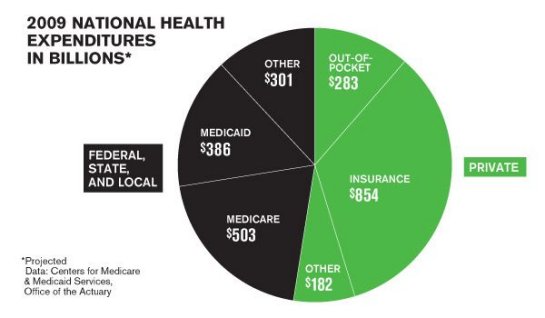
Almost invisibly, health care has become the main American job program for the 21st century, replacing, at least for the moment, all the other industries that are vanishing from the landscape. With more than $2 trillion in spending -- half public, half private -- health care is propping up local job markets.

Health care is highly labor intensive, so most of that $2 trillion ends up in the pockets of workers. And at least so far, there's little leakage abroad in terms of patient care. "Health care is all home-produced," says Princeton University economist and health-care expert Uwe Reinhardt.

John Maynard Keynes would nod approvingly if he were alive. Seventy years ago, the elegant British economist proposed that in tough times the government could and should spend large sums of money to create jobs and stimulate growth. His theories are out of fashion, but substitute "health care" for "government," and that's exactly what is happening today.

Make no mistake, though: The U.S. could eventually pay a big economic price for all these jobs. Ballooning government spending on health care is a major reason why Washington is running an enormous budget deficit, since federal outlays for health care totaled more than $600 billion in 2005, or roughly one quarter of the whole federal budget. Rising prices for medical care are making it harder for the average American to afford health insurance, leaving 47 million uninsured.

Moreover, as the high cost of health care lowers the competitiveness of U.S. corporations, it may accelerate the outflow of jobs in a self-reinforcing cycle. In fact, one explanation for the huge U.S. trade deficit is that the country is borrowing from overseas to fund creation of health-care jobs.
There's another enormous long-term problem: If current trends continue, 30% to 40% of all new jobs created over the next 25 years will be in health care. That sort of lopsided job creation is not the blueprint for a well-functioning economy."

In other words, from the point of view of government-supported employment, healthcare looks like a "safety net," but from the point of view of productive allocation of scarce resources, it looks like a stealth tax on our entire economy.

Healthcare costs are rising at double the official rate of inflation and already make up 16% of the $14 trillion U.S. GDP: from the National Coalition on Health Care website's Health Insurance Costs:

"By several measures, health care spending continues to rise at the fastest rate in our history.
In 2007, total national health expenditures were expected to rise 6.9 percent — two times the rate of inflation.1 Total spending was $2.3 TRILLION in 2007, or $7600 per person. Total health care spending represented 16 percent of the gross domestic product (GDP).

U.S. health care spending is expected to increase at similar levels for the next decade reaching $4.2 TRILLION in 2016, or 20 percent of GDP.

In 2007, employer health insurance premiums increased by 6.1 percent - two times the rate of inflation. The annual premium for an employer health plan covering a family of four averaged nearly $12,100. The annual premium for single coverage averaged over $4,400.

Experts agree that our health care system is riddled with inefficiencies, excessive administrative expenses, inflated prices, poor management, and inappropriate care, waste and fraud. These problems significantly increase the cost of medical care and health insurance for employers and workers and affect the security of families."

This is not intended as a slam on everyone working in healthcare. Many nurses and doctors read this site and I know their work is difficult, and often made more difficult by the above-mentioned inefficiencies and excessive administration.

Yet isn't there some similarity between the healthcare complex and the Pentagon, that other famous sinkhole for trillions of dollars wasted in inefficiency, politically mandated pork, and excessive administration? How can we be spending $2.3 trillion a year (and rising) and be getting so little "health" for all that money?

If we're ill, then we all want the finest care; that's understood. But the problem seems to be that much of the "care" isn't making us better; in the case of costly pharmaceuticals, it seems many drugs are giving us new health problems or simply ending our lives. People go into hospitals to get well and instead catch life-threatening bacteria and viruses.

It seems that healthcare has morphed into "the third rail" of American politics: you touch it, you "die." Every effort at reform is stymied by powerful interest groups, and of course there's a positive feedback loop at work: the more people who are employed in the complex, the more powerful their lobbying efforts, and thus there is more resistance to reforms.

Everyone knows the system is hopelessly riddled with corruption, inefficiency and needless procedures, but nobody wants to lose their own piece of the action. This is understandable.
But we as a society have to ask: is this the best place to be spending $2.3 trillion, soon to be $3 trillion, a year? What about energy and food security? How "well" will be be if we run short of food and energy?

It would be nice if we could declare a "peace dividend" so beloved by liberals and slash $100 billion or even $200 billion from Pentagon spending and "solve" the healthcare funding issue "painlessly" (painless unless you're in the military or related industries). But the scale of healthcare spending now dwarfs the Pentagon to such a degree that $200 billion isn't even 10% of what we spend on healthcare; with healthcare costs rising 6% a year, a $200 billion "gift" carved off the Pentagon would only cover about 18 months of the healthcare complex's increased spending.

As I have noted here many times, no program which grows at 6% can be sustained by an economy which grows over the long-term at 2% or 3%. We all know the Baby Boom is starting to retire, putting even more pressure on healthcare spending--but that spending has been growing by leaps and bounds even without the Baby Boom retiring.
Clearly, something has to give.

One alternative is to let healthcare costs spiral out of control until the Federal government becomes insolvent i.e. can no longer pay its expenses with newly printed Treasury bonds (debt/borrowed money) at which point Medicare and everything else freezes up and goes bust. I would say the likelihood of this increases every year, and a 2015-2021 window for such Federal insolvency is already baked in if the various interest groups are able to sustain their deathgrip on serious reforms.

This national bankruptcy won't be pleasant, but it does have the advantage of wiping the slate clean and enabling a fresh start.

Another alternative is to introduce the same global competitive forces which reduced costs in electronics and other industries. This is unpopular with those whose jobs will be at risk, and popular with consumers. This is already happening on the fringes, as people (some even sent by health providers) fly to India or Thailand to have surgeries performed for 20% of the cost of the operation in the U.S.

If energy costs spiral up, then 5,000 mile flights might become prohibitive, at which point alternatives based in Mexico or Central America become attractive from a cost basis. I have covered the emergence of cash-only dental clinics in Mexico designed to serve American customers, so the precedent is already firmly in place.

As Americans, we believe it is our birthright to avoid hard choices; we deserve to "have it all": super-costly medical care, new infrastructure, a new energy complex, the best military forces, etc. without any trade-off required. Our various trading partners have enabled this fantasy by funding our trillions in new debt/ Federal deficit spending. Should that gravy-train ever grind to a halt, and we are unable to borrow another couple trillion a year to fund "everything we want and need and care about," then we will collectively have to start making the difficult trade-offs.
Perhaps we will then finally get serious about demanding some basic efficiencies in these vast, sprawling industries.

It's hard not to look at the Pentagon (which is basically viewed as a jobs/pork program by Congress) and the healthcare complex and speculate that waste and inefficiency is the result of being protected from foreign competition. The same could be said of the entire education complex in the U.S., another "protected" domestic industry with costs that rise 6% or more a year even as the underlying economy grows at about a third of that rate.

If we look at these growth rates in cost structure, we discern unsustainable trends. It is tempting to hope that tinkering with the edges can "fix" the problems--easier student loans, higher co-pays, etc.

But none of these tinkering schemes address the core issue, which is the structural costs cannot be controlled without systemic transformation of the entire models of healthcare, Armed Forces and education. Competition provides the leverage which "consensual political reform" cannot, because no one will allow their sacred cows to be slaughtered for the common good.
There is one final structural dilemma embedded in the healthcare complex. By some measures (for instance, chronic diseases), our collective health has declined even as our spending has skyrocketed, and this forces us to ask why this is so.

Certainly one answer is the combination of lax marketing regulations, profit motive and Madison Avenue persuasion which together have created a toxic brew of questionable drugs being hyped and fear-mongered to a credulous frightened public and an overworked cadre of health providers.

Another is the very ambiguity of so many procedures, tests and drugs. If we spend $1 trillion on new power lines and solar-power arrays, regardless of what choices were made (perhaps not the best systems, perhaps politically influenced decision-making, etc.), at the conclusion we have new, measurable infrastructure in place which we can deploy to generate electrical power.

If we spend $1 trillion on more tests, procedures and drugs, the actual measurable improvement in health is at best ambiguous and at worst near-zero. Via Medicare we pay for drugs which my parents faithfully consume which may or may not even work. For instance, statins appear to be essentially useless; blood-pressure reduction drugs don't seem to lower heart attack rates, and so on.

Toss in needless hospital visits (hey, Medicare is paying, you better follow our orders and consent to being hospitalized at $30K a day) and the resulting infections/ deaths, botched operations, needless procedures, redundant/needless tests and we have to conclude that it is entirely likely we got very little improved health for that $1 trillion investment--much of which is borrowed, and hence once interest is added in, it's actually $1.5 trillion.

This is not to say some lives won't be saved or extended by the $1 trillion, it is only to point out the inherent ambiguity in measuring the results. If the patients didn't consume the 7 drugs a day, didn't go in the hospital, didn't get the 3 extra tests, didn't consent to the operation--would they actually be healthier? There is no way to know.

One obvious idea is to set up a triage which funds those medical procedures and drugs which we know work for specific conditions like infections, injuries, removal of tumors, etc. Beyond that, patients are instructed to first do whatever lifestyle changes may improve their condition; beyond that, whatever cheap generic drugs might help are paid for, and beyond that, it's on the patient's dime.

While we can borrow $1 trillion a year to put off any trade-offs, it's nice to "debate" whether this would "work." But when we can no longer pay for our "must-haves" with borrowed trillions, then we'll have to make the hard choices anyway.

It seems wise to start thinking about the fairest, most efficient forms of financial and healthcare triage now, before insolvency forces our hand.

Thank you, Michael M. ($5) for your much-appreciated donation to this site. I am greatly honored by your support and readership.

Read more...

Tuesday, May 08, 2007

Gordian Knot: Healthcare

A good friend of ours recently received the news we all dread: brain tumor. A large tumor has been growing at the base of her skull for years, and now that it has reached the size of a golf ball, it finally began causing mysterious symptoms: a bothersome knee and headaches.

Her experience highlights much of what is good and bad in our convoluted healthcare system. Here's the bad: her symptoms were initially blown off as stress or age-related. The orthopedic doctor who had treated her knee for a running injury realized her distress could not be caused by that long-healed injury, and sent her in for an MRI.

Brain tumors are not that common, and so it's not the first thought most physicians would have regarding headaches and a knee which doesn't seem to get better. But mis-diagnosis is a real problem, and we have to ask: is overwork an issue? Are doctors being "asked" to see more patients than they can adequately care for? Are HMOs and insurance companies paying for "second and third opinions," or resisting such checks on wrong diagnoses?

The good: her team of surgeons was experienced, and the 13-hour surgery was successful in removing about half of the tumor; the remaining parts were too intertwined with critical nerves to risk removing surgically. The next phase of treatment will be targeted radiation. In sum: if you need complex, risky surgery and high-tech treatment, you can get it here in the U.S. with no more than a couple week's delay.

The bad: the hospital (unnamed because I have only the first-hand reports of her husband, who I know is a reliable informant, but one opinion is not enough to form a judgment). According to our friend (the husband), the hospital is overwhelmed; there are not just beggars outside, but inside the facility. An infection the week after the surgery nearly killed his wife, and it was only a visiting friend who happens to be a medical student finishing her residency who observed the signs of dangerous infection.

We all know the debating points: nursing staffing have been cut back to save money, other staff doesn't care/is overwhelmed/is poorly trained--I only know that this is not a unique report within my circle of contacts. The horror list at major hospitals--not some small-town clinic, but major urban facilities where the upper-middle class go to be treated--goes on and on: wrong dosages, wrong meds, you name it.

It's all academic until it's you or your spouse in bed, very ill, and you're counting on a visibly harried/uncaring staff to keep them alive (and hopefully heal them).

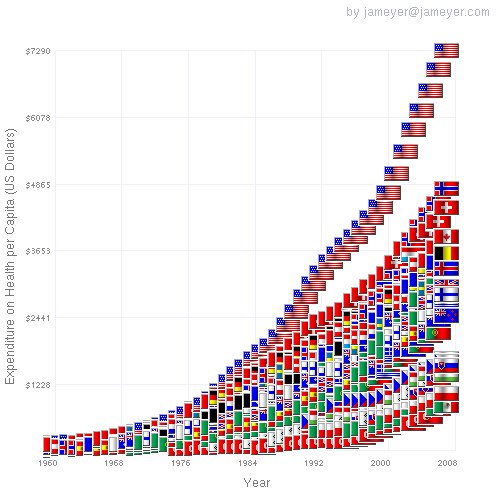
Let's grant that medicine is a difficult field; even the best internists are left wondering what ails people with vague symptoms; there are so many possible causes and so few good data points to work with. But look at this chart, which shows that we as a nation spend a much greater amount of money per capita on healthcare than other developed nations. We have to ask: are we getting as much as we're paying for?

There's one more bad: the co-pay. My friend hasn't totalled up their share of the costs, because they're still rapidly spinning upward. If it wasn't for his wife's parents' savings, it would be tough to pay for the hotel and meals for the family to stay in the city to be nearby the patient--never mind the ultimate co-payment ($20,000? $30,000? $50,000?). S

elling their house to pay the bills seems like a likelihood. And this of course is for a middle-class family with a job in a Fortune 500 corporation and healthcare benefits. There doesn't seem to be an end to the negative trends: skyrocketing costs and declining health and coverage. Scan just a few of the hundreds of articles outlining the issues: Annual U.S. Health Care Spending Expected To Double By 2016 To Nearly $4 trillion, CMS Report Finds

The authors of the report wrote, "We are moving incrementally away from traditional sources of insurance, such as employer-based coverage, to a system comprising more federal and state government-provided health care." According to John Poisal, lead author of the report, "We will continue to face tough questions about how we finance our health care bill" as that shift occurs (Wall Street Journal, 2/21). The report did not make health care policy recommendations but warned of the possibility "that we will have to make important sacrifices to pay for health care" and of a need for "constant assessment of the value we associate with our health care investment".

HHS Secretary Mike Leavitt said, "America's per capita health spending is the highest in the world. There is simply no place on the economic leader board for a nation that spends a fifth of its domestic product on health care".

Robert Bixby, executive director of the Concord Coalition, said that the cost of health care "is really the key issue for the fiscal future of the nation," adding, "If health care costs continue to drift up -- unless you dramatically raise taxes -- you will have health care pushing out everything else government does. Nobody can say exactly when you reach a point that it's unsustainable, but you can look at something and say it's unlikely."

Ron Pollack, executive director of Families USA said, "As health care spending increases faster than earnings, it means more and more people will find health care unaffordable and join the ranks of the uninsured and underinsured".

National Medical Spending Attributable To Overweight And Obesity: How Much, And Who’s Paying?
Roland Sturm used regression analysis to show that obese adults incur annual medical expenditures that are 36 percent higher than those of normal weight incur. This analysis, however, was limited to people under age sixty-five. People age sixty-five and older now account for roughly one-fourth of the obese population, and, because of the chronic nature of obesity-attributable diseases, medical spending for treating elderly obese people is likely to be much higher than spending for nonelderly obese people.

Annual estimate of retiree health care costs up nearly 8 percent:
Rising health care costs are eating up more of retirees' savings, with a 65-year-old couple retiring this year needing about $215,000 to cover medical costs after they stop working, Fidelity Investments said Tuesday.

Health consequences of inactivity:
Physical inactivity and diet combined are the second leading cause of preventable death and disease in the United States and a huge economic burden on the state.
Nearly 60 percent of Minnesota adults are overweight and nearly 17 percent are obese.
The proportion of overweight or obese children in the United States has doubled in the last 20 years, to 13 percent.
Mortality, morbidity, and cancer rates are higher among sedentary populations.
Research has shown that many cases of heart disease, hypertension, type 2 diabetes, colon cancer, stroke, osteoporosis, depression and anxiety, breast cancer, and falls among the elderly are attributable to inactive lifestyles.

So what's the solution? Let's start with what any solution must include:
1. Portability. Benefits can't be dependent on employers; workers need to know their benefits travel with them to new jobs. Otherwise, labor markets are skewed away from opportunity to retaining benefits.
2. An emphasis on cost-cutting via patient lifestyle and diet changes, not cutting care. The primary cause of many illnesses is well-known: an unhealthy junk-food diet, and lack of exercise. The answer is simple: we must take responsibility for our own health. No one can predict who might be struck down by a brain tumor, but let's face reality on diseases like type 2 diabetes, which simply didn't exist 40 years ago, and coronary diseases caused by sloppy diets and sedentary lifestyles.
3. A competitive environment of providers, for without this there is no pricing pressure and no incentives to provide first-rate care. Ultimately, when hospitals in India and Thailand are siphoning off enough patients for lucrative surgeries ($100,000 in the U.S., $9,000 overseas with the same or better quality of staffing and facilities) then perhaps some changes which were once "unthinkable" will become very thinkable.

I have long touted Kaiser Permanente as a non-profit HMO model which is scaled for national care and which has a 50+ year history. If there were even a half-dozen such providers competing with each other, that would constitute a pretty competitive environment for care and cost-cutting. If we eliminated the welter of insurance types and paperwork (which consumes an estimated 30% of our total "healthcare" spending), then we'd free up money for actual care rather than paperwork.

There will be hundreds of thousands of jobs lost if the healthcare industry were streamlined; hence the tremendous resistance to any streamlining. But the streamlining will come anyway, for once the last middle-class person sells their depreciating home to pay their medical bills, and General Motors goes belly-up and reneges on its promise of lifetime medical care to its pensioners, and once the Federal Deficit soars beyond what the world is willing to subsidize, the gravy train will end regardless of who's fiddling as the city burns around us.

Check out this week's Readers Journal commentaries for correspondent Fred Roper's comments on national healthcare and James C.'s observations on consumerism run amok.

New essays include Protagoras' take on recent elections in the U.K. and Harun I.'s thoughtful disquisition on global imbalances.

Read more...

Thursday, June 19, 2008

U.S. Lifestyle + "Healthcare" = Bankruptcy


How and why is the U.S. going bankrupt? Let me count the ways. There's the debt/housing bubble popping, the inexorable rise in energy and food costs, the trillion-dollar war in Iraq, the Pentagon and Homeland Security budgets, the pork spending, ethanol subsidies, and so on.
But the two 800-pound budget-busting gorillas in the room nobody wants to face are our unhealthy lifestyle and our unsustainable, dysfunctional "healthcare" system.

I know budget deficits and all that are boring so I'll just cut to the chase: Any expense which rises by 10% per year in an economy which grows 2% on average will quickly bankrupt the nation. Study: Employer health care costs expected to increase nearly 10 percent this year and next.
That is the very definition of unsustainable growth in expenses. Healthcare already consumes 16% of the U.S. GDP and will soon consume 20%: (National Coalition on Health Care)
By several measures, health care spending continues to rise at the fastest rate in our history. (emphasis added, CHS)

In 2007, total national health expenditures were expected to rise 6.9 percent — two times the rate of inflation. Total spending was $2.3 TRILLION in 2007, or $7600 per person. Total health care spending represented 16 percent of the gross domestic product (GDP).

U.S. health care spending is expected to increase at similar levels for the next decade reaching $4.2 TRILLION in 2016, or 20 percent of GDP.

In 2007, employer health insurance premiums increased by 6.1 percent - two times the rate of inflation. The annual premium for an employer health plan covering a family of four averaged nearly $12,100. The annual premium for single coverage averaged over $4,400.

Experts agree that our health care system is riddled with inefficiencies, excessive administrative expenses, inflated prices, poor management, and inappropriate care, waste and fraud. These problems significantly increase the cost of medical care and health insurance for employers and workers and affect the security of families.

Health insurance expenses are the fastest growing cost component for employers. Unless something changes dramatically, health insurance costs will overtake profits by 2008.

Premiums for employer-sponsored health insurance in the United States have been rising four times faster on average than workers’ earnings since 2000.

Can you say "train wreck"? How about "speeding off a cliff"? Nobody seems to be noticing, but the budget-buster which is pushing cities, counties, municipalities and government agencies to the edge of insolvency is skyrocketing healthcare costs. AC Transit to get an earful on fare hike ideas:

The (regional bus service) deficit comes mainly from a sevenfold increase in employee health care costs this decade."

Recall that labor costs make up about 75%-80% of all government and service-sector firms' expenses. How can any organization or enterprise survive a major expense which rises 7-fold in only eight years? Short answer: they can't.

So who's happy with the current system? The doctors? No way: Eyes Bloodshot, Doctors Vent Their Discontent (New York Times)

As a physician, I could empathize. I too often feel overwhelmed with paperwork. But my friend’s discontent seemed to run much deeper than that. Unfortunately, he is not alone. I have been hearing physician colleagues voice a level of dissatisfaction with medical practice that is alarming."

Meanwhile, back at the ranch, the elusive "cure" for so many of our ailments appears to be no farther away than our plates and the sidewalk outside:
Can Lifestyle Changes Bring Out the Best in Genes? New research shows diet and exercise may change how genes act.

A new pilot study shows that eating right, exercising and reducing stress may help keep chronic diseases at bay by switching on beneficial genes, including tumor-fighters, and silencing those that trigger malignancies and other ills."

Look, I'm not trying to beat up on everyone who doesn't exercise and who eats too much and/or eats poorly. It is a struggle not to cave in to the constant brainwashing via 24/7 advertising and marketing from fast-food and packaged food companies which profit immensely from the illness-creating American diet. And it's a struggle to get out there and get some exercise, especially if you live some place far from parks, without sidewalks, without safe bike lanes, etc.

I'm religious about exercise but I gained a few pounds this year when I visited Hawaii and let myself eat like a much younger person. (Yikes!)

Despite the temptations to do nothing, there is no other choice: we have to take responsibility for our own health. The longer we do nothing, the sooner the nation will go bankrupt, starting with cities, agencies and local government, followed by companies which either blow off their employee health insurance or go under.

Longtime correspondent UKC recently submitted an item posted on Karl Denninger's excellent Market Ticker forum--excerpts from Mr. Fisher's (of the Dallas Fed) recent speech regarding unfunded federal programs (Medicare and Social Security).

"Even the perception that the Fed is pursuing a cheap-money strategy to accommodate fiscal burdens, should it take root, is a paramount risk to the long-term welfare of the U.S. economy. The Federal Reserve will never let this happen. It is not an option. Ever. Period. No combination of tax hikes and spending cuts, though, will change the total burden borne by current and future generations.
For the existing unfunded liabilities to be covered in the end, someone must pay $99.2 trillion more or receive $99.2 trillion less than they have been currently promised. This is a cold, hard fact. (emphasis added, CHS) The decision we must make is whether to shoulder a substantial portion of that burden today or compel future generations to bear its full weight.
We know from centuries of evidence in countless economies, from ancient Rome to today’s Zimbabwe, that running the printing press to pay off today’s bills leads to much worse problems later on. The inflation that results from the flood of money into the economy turns out to be far worse than the fiscal pain those countries hoped to avoid.
How much would we have to pay if we split the tab? Again, the math is painful. With a total population of 304 million, from infants to the elderly, the per-person payment to the federal treasury would come to $330,000. This comes to $1.3 million per family of four—over 25 times the average household’s income. "

The causal tie-in of our unhealthy lifestyle with that stunning unfunded liability was drawn by another poster to the forum:

"There is one thing that the cold-raw figures fails to capture making the situation actually far far more dire than he even states:
The OBESITY epidemic.
You hear about it all the time on the television and in the newspapers, yet to the casual and otherwise not directly affected, it sounds like a benign and inert phrase. Something for 'tomorrow'.
It is not!
I personally was a paramedic for nearly a decade some years ago, and that causes me to keep in close current touch with the shifts that are going in the EMS world and the hospital and health care environment in general.
I can tell you without a doubt, the obesity epidemic is a multi-warhead nuke with our society targeted for sheer financial destruction. NOTHING LESS. (emphasis added, CHS)
You have to add the compound multitude of health related issues stemming from so many obese people on top of the MILES HIGH tsunami of aging patients that are just now beginning impact the system to the point of utter breakdown.
And we're just getting started.
The Los Angeles County Commission on Aging estimates that by the year 2012, only three and a half years away, the number of citizens reaching 'healthcare system dependency' will add 6000 PER WEEK, JUST IN L.A. COUNTY, and the number will go parabolic north from that point forward into the future.
Each and every week, week in and week out continuously adding to the overall number of aging and compromised, medically dependent patients for at least 15 or more years before the pace of increase even starts to ease.
These are not simply patients aging gracefully in their rocking chair who just need a gentle assist to fetch their newspaper. Nothing will be farther from the truth.
These will be patients, whom after spending a lifetime eating gross amounts of unhealthy food in equally unhealthy quantities that will ultimately possess a literal alphabet soup of chronic, degenerative and VERY expensive conditions to treat. They will not only be consumers of medical resources but also need social and supplimental income support due to their conditions. Often times these conditions are accompanied by an early end to income earning capabilities and the resultant loss of productive tax contribution.
They will literally deluge the already crumbling health care system with infinite numbers of cases of cardiovascular disease and diabetes each of which creates it's own encyclopedia of resulting conditions.
Twenty years ago, specially constructed and equipped 'bariatric' ambulances were a rarity usually found only at teaching universities. They are now routinely dispatched every day all over the country to transport patients that are TOO HEAVY to be accommodated in a 1/2 ton capacity van. In most cases, a fire-engine crew must also be dispatched for manpower, as it often takes 6 or more responders to manage the patient.
What once took only 2 responders, now requires 6, more times than you can imagine.
You can quickly see that we're not simply talking raw, uniformed numbers affecting the ultimate condition of Medicare. We are in-fact talking a leveraging of sheer numbers of costly patients by magnitudes that would make the most aggressive hedge-fund manager blush in embarrassment.
We as a society have NOTHING close to the resources to address this problem, not even in the ballpark, not even on the planet or its nearby celestial universe.
Given the current state of our society it is very hard for me to imagine, given anything less than tectonic upheaval in the way we manage our health care system, anything other than a very very STEEP decline in either or BOTH of each of these two:
Our overall standard of living
Our expectation of medical care and life expectancy.
Both of which in my opinion, are certain to decline beyond our wildest imagination."

OK, here's where I would normally present a possible solution, but there isn't any in the form most hope or expect. The "solution" is to start acting like there won't be a Government Agency which will pay your medical bills. Because it is very clear that Medicare and most people's employer-paid coverage is unsustainable and will disappear or be cut so severely that it is the equivalent of disappearing. Maybe the government will be able to provide "palliative care," i.e. painkillers, and that's it.

Tweaking the system here and there by changing the parameters of who gets paid how much and which pills are allowed and which are not, etc., is truly re-arranging the deck chairs of the Titanic as the bow settles lower and lower into the cold, cold water.

Some smart people anticipate the Federal Government will nationalize healthcare as things deteriorate, but my question to them is: nice, but with what money? We're already facing a $100 trillion hole. Who is going to lend us $100 trillion? Even the Gulf Oil states don't have that much money, and why would they gamble on our ability to pay them interest, much less return their capital?

"Printing money to pay the bills," as Mr. Fisher of the Fed so eloquently pointed out, won't work, never has, never will. Hyper-inflation destroys the nation the money-press was supposed to "save," and Weimar Germany remains fresh in enough old minds not to be completely forgotten.

Although it might be lost on many present-day Chinese citizens, the wise "old ones" of that ancient culture held that food and medicine were one in the same; "disease comes in through the mouth." Many of you know cancer survivors who jettisoned the American lifestyle as part of their healing. Of course not all cancers are curable, and not all are lifestyle-related, but if food and exercise can modify gene expression, then the power of lifestyle should not be underestimated, either.

Whatever happens, we can safely predict the "healthcare"/illness-inducing-lifestyle system as it now stands will fall, and there won't be enough money, capital or resources to construct something this unsustainable and this ineffective again.

Three new Readers Journal essays (read all five):

The Principles of Trading Also Apply to Life (Harun I., June 19, 2008)

The State of Real Estate (don't buy that house just yet) (Jonathan Surridge, June 19, 2008) (PDF format)

We Will All be Better Off with Falling House Prices (Paul Tolnai, June 18, 2008)

New commentaries on diet/lifestyle and Something Amiss added:

Readers Journal commentaries week of June 20, 2008 Electric vehicles, long-wave cycles pointing to World War III, bikeways to L.A., Chinese goods and competition, something amiss and more.

Triage in the Upcoming War for (Energy) Independence (Paul Tolnai, June 9, 2008)

Compressed Natural Gas (CNG): A Peak-Oil "Bridge Fuel" (Matt Gaspar, June 15, 2008)

Read more...

Tuesday, June 12, 2007

What Can We Learn from France About National Healthcare?

I asked correspondent/author John Kinsella, a resident of France for many years, for an "on the ground" account of that nation's healthcare system.
I think you'll find his comments most interesting, as they relate to our own debate on how to provide affordable healthcare to all.

Frequent contributor Michael Goodfellow, whose own practical and insightful essay on the subject can be found in the Readers Journal sidebar to your right, sumbitted two story links on the same subject.

The reason I asked Mr. Kinsella for a report is that we hear a great deal about the national health care systems in Britain and Canada, but very little about France's, which is an entirely different model than either the U.K. or Canada.

Here is Mr. Kinsella's commentary:

"If you were to question the average French man or woman’s opinion on their country’s health system you would no doubt be met by a deluge of criticism. Besides the fact that criticism of the country’s institutions is a national pastime, this is a rather curious attitude, since by international standards the system is judged one of the world’s best according to the World Health Organisation after that of Sweden, Finland, Norway and Japan, with the United States in the 14th position.

Any even superficial examination of a health system is extremely complex, thus it is difficult for observers to provide a rational analysis of so vast a structure, which in the case of France absorbs 10.6% of the country’s GDP, and which is influenced by multifaceted political and economic forces that come into play together with the demands of the general population.

It is evident that today, more than ever in history, health is the first priority of a nation for its population after peace, food and shelter. This is due to universal education and higher expectations, including that of life expectancy.

Healthcare is the right of every man, woman and child, and the right to health protection features in Article 11 of the preamble to the French 1946 Constitution. In addition legislation introduced in 1999 ensures the coverage of 99.9% of the country’s population.

Thus every individual, even the most modest citizen has access to instant medical care, whatever the degree of need and for as long as necessary, whether he is insured or not. It is considered a fundamental right and no person can be refused access to care.

The consequence is that any attempt to reform the generous system is instantly seen as some kind of insidious plot to reduce healthcare, often resulting in strikes and demonstrations.

In 2006 France stood at the top of the Euro Health Consumer Index, followed by the Netherlands and Germany. So the question that remains is why do French people criticise their system? The answer is that the demand for healthcare is endless; today for the slightest cold or sprain the average citizen runs to his doctor, who will refer him to a specialist, who will often propose costly treatment, when in fact old fashioned recipes would probably do the job in many cases.

Cost has become a nightmare. In 2000 France ranked number one in the world for health care, and in 2005 the country’s national health expenditure stood at €181 billion or 10.6% of gross domestic product, thus ranking France fourth in the Organisation for Economic Cooperation and Development countries, behind the United States (15.3%), Switzerland (11.6%) and Germany (10.9%).

The ongoing question is the cost and sustainability of the system, as France’s health system is institutionally complex, which leads to tensions between the state, health insurance funds and providers. The challenge of the new president, Nicolas Sarkozy is how to improve the relations and clarify the responsibilities of the key actors in the system, he has also promised to reform the system, which is a monumental task.

The principal political problem is therefore reform and cost control without reducing the quality of care, which is a daunting task for any politician.

According to the French authorities the health system is based on a national social insurance system, which is complemented by elements of tax based financing and complementary voluntary health insurance. The system is regulated by the state and statutory health insurance funds. The state sets the ceiling for health insurance spending, approves an annual plan for health and social security.

The statutory health insurance system is composed of a general scheme that covers about 84% of the population, followed by the agricultural scheme covering farmers and their families equal to about 7 % of the population. Then there is the scheme for those self-employed that covers another 5% of the population, and in 2004, a specific insurance fund was established to cover dependent elderly persons. Finally there is the universal health insurance coverage scheme established on the basis of residence in France introduced in 1999.

The French health system is noted for its high level of freedom for doctors and choice for patients, pluralism in the provision of health services, easy access to health care for most people is general, as is the absence of waiting lists for treatment that have become a serious obstacle to healthcare in Great Britain for example.

The French system is pluralistic since private and public structures coexist side by side. Patients choose their practitioners and freely access the different types of hospitals.

However, one of the sensitive questions constantly raised by different parties is the abuse of this very generous system, and abuse there is in all forms, both from the providers and those cared for. Nothing prevents a French person from seeing several doctors and specialists in the same day, his costs are covered at almost one hundred percent by the health insurance system (perhaps with an almost negligible surcharge), since the health insurance system established in 1945 offers all French citizens equal access to healthcare, regardless of income.

In 2005, the health insurance system covered 77.1% of health expenditure, whilst supplementary insurance bodies covered 12% of the remaining share, households 8.7%, and central and local government 1.3%.

The conclusion is that any such system cannot offer endless healthcare without some kind of limitation, reform is needed without refusing aid to those in need, but what kind of reform?"

Thank you, John, for an excellent precis of an extremely complex subject.

Michael Goodfellow sent in this story critiquing Michael Moore's latest film, Sicko, which relates to the French as well as the British model:

Sicko or Wacko?

"Moore calls the French system 'free,' convieniently ignoring the 13.55 percent payroll tax, a 5.25 percent income tax, and additional taxes on tobacco, alcohol, and pharmaceutical company revenues that fund the system. (Despite the high taxes, the system is running an €11.6 billion annual deficit.) The French system is not even free in terms of what patients pay. Its patients pay high copayments and other out-of-pocket expenses, and physicians are able to bill patients for charges over and above what the government reimburses. As a result, 92 percent of French citizens have private health insurance to complement the government system. Yet there remain shortages of modern health care technology and a lack of access to the most advanced care."

Michael also submitted this report on long waits for care in the U.K.:

Waiting list crisis as NHS cuts costs:

"The 18-week target, set in 2004, is widely considered to be among the most ambitious of the Government’s aims for the NHS. A baseline estimate published in December suggested that 35 per cent of patients across the country were treated within this time.

At that time up to a quarter of patients needing operations such as hip or knee replacements were estimated to wait between one and two years for surgery, with a small number waiting longer than this. The figures showed that most specialities treat between 30 and 50 per cent of inpatients within 18 weeks. In trauma and orthopaedics the figure is only 20 per cent. The Government has set an interim target of 85 per cent of admitted patients and 90 per cent of nonadmitted to be treated within 18 weeks by March next year."

Michael's comments:

"18 weeks is an astonishingly long time to be sitting around waiting for surgery! And this was for "inpatients"! So these people are already in a hospital, and waiting 4 months for treatment? Worse in a "trauma and orthopaedics" wards? Am I correct in thinking of accident victims warehoused for months before they can get corrective surgery?"

One would hope not, but it's in our interests as a nation to find out as much as we can about the real-world practicalities of alternative systems before making ideology-based decisions pro or con.

Read more...

Sunday, August 19, 2012

A Sustainable National Healthcare System: Prevention Only

The current sickcare system will bankrupt the nation. One model of a sustainable national system would focus solely on providing preventative care.


Longtime readers know that I have presented various options to our costly (and therefore doomed) sickcare system. I have suggested a "cash only" system (The "Impossible" Healthcare Solution: Go Back to Cash July 29, 2009), and observed that the Veterans Administration (VA)offers a model for a national opt-in healthcare system that would offer an alternative to the hopelessly corrupt "fee for service" sickcare (Healthcare: A Large-Scale Solution January 4, 2011).

Stripped of purposefully obscuring complexity, sickcare is a system of State-sanctioned cartel skimming that redistributes the wealth of many to the hands of a few. There are many potentially sustainable alternatives, but regardless of the options offered, it is self-evident that open competition between transparent systems is necessary to provide cost discipline and encourage innovation.

In other words, one size cannot fit all, and the broader the spectrum of transparent opt-in choices, the greater the cost discipline and incentives for innovation.

Healthcare is one of those peculiarly ideological topics where people tend to conceptualize all choices as either/or: either a system is "socialized" or it is "free market" (code name for cartel skimming controlled by the State). The idea that a system of multiple options, complementary and competitive, might be the most sustainable, is difficult for many to conceptualize, much less accept.

Advocates of the Central State taking a dominant role in healthcare bear the responsibility of explaining what will limit the capture of the State's spending and power by wealthy vested interests, a process of corruption that would quickly turn any "new" system into the same crony-capitalist, unaffordable system we now have.

Apologists for the present system of State-sanctioned cartel skimming claim that Medicare, Medicaid and ObamaCare are all sustainable with what amounts to modest policy tweaks. There is scant evidence for this claim; indeed, the one thing we know is that the promises issued to the 306 million residents of the U.S. are claims on future national income and surplus that cannot possibly be met, and magical projections of unending "growth" and unlimited borrowing power for generations to come are fantasies.

Since sickcare is unsustainable, it will eventually be replaced by something that is sustainable. Our only choice is to either let the current system collapse and then start pondering sustainable alternatives, or begin an honest discussion of sustainable alternatives before sickcare implodes in insolvency.

In this spirit of openly discussing a variety of sustainable options, we present this essay by correspondent Lonn Gary Schwartz, O.D. Dr. Schwartz makes a compelling case for the view that the only truly affordable, sustainable national system is one that provides preventative healthcare only.
Here is Dr. Schwartz's essay:
The decades-long health care crisis we continue to experience in the United States is multi-faceted and highly complex, touching every U.S. citizen and every American institution. Despite the complexities, getting to the root of the problem simply requires us to confront the following realities. 
First and foremost, we can not, nor will we ever be able to arrest the aging process, eliminate illness, nor avoid death. Despite what the myriad of “Eternal Fountain of Youth,” industries puts forward, these very events define what it is to be part of the organic life-cycle on this planet.
Therefore, it would seem that we, as a society, need to let go of the illusion that we can circumvent the natural order of things. 
Secondly, each individual needs to take primary responsibility for his/her own health [care]. No more dependence on having others bail us out of poor life choices [insufficient exercise, poor diet, unstable mental/emotional/spiritual states]. No more squandering the nation’s wealth on highly destructive lifestyles and their outrageously expensive antidotes. 
Additionally, and believe it or not, the amount of social wealth that can be allocated to health care is finite. We can no longer tolerate insurance companies acting as health commissars, corporations that are a hideous synthesis of investment banker, tax collector, medical policy and decision maker, and grand financializer, indeed, the worst of all worlds. 
If we well-understand that ignoring basic vehicular maintenance leads to pre-mature wear, mechanical breakdown, and expensive repair costs, why do so many of us fail to acknowledge that a similar outcome is inevitable when it comes to our bodies?
Although volumes can be produced attempting to figure out why people do what they do [regarding their health habits], social policy need not be concerned with the reasons, but only insure that individuals take personal responsibility for their actions, and not necessarily because it will result in a better [health] outcomes or a more productive citizenry, but instead, because there are simply no other fiscally sustainable alternatives. 
The current health care system is geared to heal, repair and/or replace. Attempting to repair and re-fabricate body parts on every American within the context of the current explosion in technologic potentiality is absurd. 
Imagine the possibilities when considering the varieties medical technologies already in place; transplantation, bio-mechanics [robotics], genetic engineering, and pharmacologic, to name a few. Soon enough, you will be able to spend nearly unlimited amounts of money keeping just one person alive! 
The solution? There is only one solution and that is prevention only. And although this may seem harsh upon first consideration, it certainly seems to be closer to what Nature intended for all of Her life-forms. Regardless, it is what it is.
Whatever resources can be allocated to health care [within the context of a fiscally responsible government], should be earmarked to prevention, that is, actual health care. 
If by chance [or misfortune], you happen to contract a disease/develop a condition/be subject to an accident, then you are in the same position as people are today when there are no known treatments available. What would probably be available are low-cost conventional, alternative, and natural remedies, provided by individuals or small businesses, and payable in cash. 
In order to prevent a similar sick-care system from being resurrected, health care must be de-institutionalized. No more insurance companies, no more Big Pharma, no more corporate super hospital systems designed to turn natural events into mega-profits for the few and fiscal bankruptcy for the rest. After all, all of these institutions presently exist only through government decree. 
The results of a de-centralized system will be fiscal sanity, individual responsibility, and hopefully, a much healthier population. This is not to deny that a move toward sanity in one respect will not cause much pain and adjustment in others, but the development of just social policy must have [at its core] compassion, personal responsibility, and sustainability driving the process. 
Just as the welfare state could not save everybody from the natural forces of human social interaction, or give unqualified people mortgages in order to allow them to live “a better life,” we cannot promise to save everybody from the inevitabilities of our own natural life-cycle. 
Getting beyond this era of counterfeit debt-money, and the resulting fiscal insanity it has guaranteed, will require the acceptance of principles that were once very much a part of who we were as Americans. 
We must accept that just as real wealth is created by producing, saving, and investment guided by the principles of transparent risk/reward assessment, our good health must also be earned through sensible eating habits, adequate exercise, and some method of maintaining mental/emotional/spiritual balance. 
Better times lie ahead for those willing to take responsibility for their own wealth and their own health. After all, it is the American way.
Thank you, Dr. Schwartz. The demographic and fiscal cliff are real. Hoping that we can borrow our way to prosperity by dumping trillions of dollars into fraud, malinvestment and needless, counterproductive paperwork, tests, medications, lawsuits and procedures (i.e. sickcare) is the path to insolvency and a future that fails everyone.

In related news, Otis Brawley, M.D. recently laid bare the ill health of our healthcare system in his book How We Do Harm: A Doctor Breaks Ranks About Being Sick in America(Kindle) (print)
"I blame patients, I blame doctors, I blame hospitals, I blame drug companies, I blame insurance companies. Our health care system is messed up because the system is designed to fail, and everybody is responsible for health care failing as it is now." Dr. Otis Brawley


Resistance, Revolution, Liberation: A Model for Positive Change (print $25)
(Kindle eBook $9.95)

We are like passengers on the Titanic ten minutes after its fatal encounter with the iceberg: though our financial system seems unsinkable, its reliance on debt and financialization has already doomed it.We cannot know when the Central State and financial system will destabilize, we only know they will destabilize. We cannot know which of the State’s fast-rising debts and obligations will be renounced; we only know they will be renounced in one fashion or another.
The process of the unsustainable collapsing and a new, more sustainable model emerging is called revolution.
Rather than being powerless, we hold the fundamental building blocks of power. We need neither permission nor political change to liberate ourselves. A powerless individual becomes powerful when he renounces the lies and complicity that enable the doomed Status Quo’s dominance.

Thank you, Lynn M. (handmade potholders), for your very useful and beautifully made contribution to this site's kitchen-- I am greatly honored by your ongoing support and readership.


Read more...

Wednesday, August 29, 2012

The Rot Runs Deep 3: The Capture of the Professional Class

A rotten-to-the-core system continues grinding on because it has effectively co-opted (captured) the professional/managerial class with promises of phantom wealth and security.


The Status Quo depends on the professional/managerial class to maintain order and keep the machine running. Since this class has more options in life than less educated lower-income workers, their belief in the fairness and stability of the Status Quo is essential: should their belief in the Status Quo weaken, so would their commitment to positions that require long work days and abundant stress.

I addressed this dependence on the professional/managerial class over four years ago inWhen Belief in the System Fades (March 12, 2008):
The corollary to this structural need for highly motivated, dedicated people to work the gears is that if their belief in the machine fades, then the machine grinds to a halt. 
This belief is far more vulnerable than the Powers That Be seem to understand.
In a way, a belief in the value, transparency, trust and reciprocity of the System is like a religious belief. The converts, the true believers, are the ones who work like crazy for the company or agency. And when the veil of illusion is tugged from their eyes, then the Believer does a reversal, and becomes a devout non-believer in the System. He or she drops out, moves to a lower position, or "retires" to some lower level of employment. 
When the most dedicated servants of the system awaken to the realization that they are not benefitting from their service as they'd once believed, that their near-religious faith in the System has been bruised by the grim knowledge that the few are benefitting from the lives and sacrifices of the many, then t 
hey simply quit, or move down the chain to an undemanding position.
At that point--a point I anticipate will come to pass in the next 5-10 years--then the Elites' machine grinds to a crawl. People don't have to throw their bodies on the gears of the machine--they just have to stop believing, stop taking that promotion, and stop wanting to trade their entire lives for a thin slice of more more more.
The belief that the Status Quo is fair, just, stable and sustainable is wearing thin,and so the response of the Neofeudal Status Quo has been to "capture" the essential managerial/professional class and effectively chain them to their grindstones.
This phenomenon of "capture" is discussed in the following essay by correspondent Lonn Gary Schwartz, O.D.:
Many are familiar with the concept, regulatory capture, a term generally referring to an industry gaining control over, or capturing, those agencies mandated to regulate their business activities/conduct. A common example is Wall Street and the Too Big To Fail banks that, over the past several years, have been accused of capturing their appointed federal regulators. 
I would like to suggest that a similar process applies to the entire American professional class, those highly educated, advanced degreed group of intellectuals designated –legislated - to administrate The System. Except in this case, it is outside - corporate/government - influence that has altered the dynamic of the “self-regulated” professions. 
Although this professional capture mostly involves the professions’ elite, once these “thought leaders” capitulate to the needs of the predominant external interests, the bulk of their flock quickly fall into line, understanding that these are not times when fighting The System leads to highly satisfactory outcomes. 
Instead of carrying out their professional responsibility of self-regulating their field of expertise - i.e. protecting the interests of their patients/clients/customers - these doctors, lawyers, accountants, educators, etc., have been - in many cases - manipulated, both from without and from within, at times acting completely antithetically to their legislated responsibilities. 
Let’s take health care as an example, although this would apply to all professions.
It should come as no great surprise that with the decades-long corporate/government takeover of the American health care system, individual health care providers lost a great deal of professional autonomy. 
As this forfeiture revealed itself in decreasing control over patient-care as well as declining real incomes, it becomes easier to understand how professional and economic pressures began to subject health professionals to a variety of external influences. 
Accordingly, outside control in health care emerged in several forms. Perhaps the most influential was - and still is - the insurance company provider agreement, a contract that spells out exactly what is expected of the practitioner in terms of clinical care and, in the same breath, stipulates compensation levels. 
In other words, not only has the insurance company - in many cases - determined for the practitioner what is best for their patients, but they have also decided how much they are going to be reimbursed for providing these services. They have, de facto, taken over the health practitioner’s business model, a nearly complete loss of both professional and fiscal autonomy. 
Whether this can actually work for individual providers - or their patients - seems lost on the insurance companies, as they have judged what works best for their corporate bottom-line, and since they control much of the market, what they say, goes. The result is that both the patient and doctor lose, the insurance company wins. 
The greatest degree of external control, though, is exacted by government, whose laws, regulations, taxes, fees, and all the rest, have not only created a bureaucratic nightmare but has sanctioned - through regulation - the private insurance companies and their anti-free market practices [see Obamacare]. 
Therefore, the current corporate-government coalition in health care has created the worst of all worlds: distorted markets, incredible inefficiencies, skyrocketing costs, tremendous mal-investment, a health [sick] care system designed in the primary interests of ROI [return on investment] in the corporate sector, and a loss of professional control, i.e. professional capture. 
The sad reality is - and as a direct result of the above policies - that it has become incredibly difficult to practice ethically and profitably on any level commensurate with the cost of a professional education/investment in a quality practice environment. Indeed, in an increasing number of health [sub] specialties, the insurance companies and government have financialzed and regulated health practitioners right out of existence! 
In other words, booming corporate profits and an ever expanding government presence in health care have come at the expense of the patient - increasing insurance premiums/taxes - AND the doctor - loss of professional control/decreasing reimbursements - not to mention declining health care quality levels. 
Although the government-sanctioned corporate take over of American life has certainly given us a nearly unlimited selection of mass produced consumer products, at what price has this material frenzy come? 
The cost has been the obliteration of our national moral compass, elevating ROI above personal ethics to the point where not only have the professions been sacrificed to the alter of maximum corporate profit, but our very sense of who we are as Americans is being seriously questioned. 
When it becomes nearly impossible to do business because of the plethora of laws, regulations, fees, taxes, financialization, and all the rest, highly trained, well-intentioned professionals succumb to the financial pressures and subject themselves to the degradation/humiliation of acquiescing to a system run by hooligans adherent only to the legally mandated corporate bottom-line. 
Wealth creation based on widely accepted moral standards is what made the United States the great country it is, but if you can not practice your profession/carry out your business in a way that expresses your true professional nature, treats your patients/clients/customers with high levels of respect, while at the same time, deriving a socially acceptable return on your investment in a professional education/practice capital investment, then what’s the point? 
It is time for the leaders of the professions to stand up and say, “ENOUGH IS ENOUGH!!” It is within the power of the professions to bring serious change to this country by acting in the direct interests of the American people. 
Whether it is in health care, the legal system, corporate/government accounting, education, or any other professions, massive change is necessary to restore a balance to our national purpose. 
It simply takes COURAGE and LEADERSHIP, and a willingness to look at the simple truth that it is time to make the interests of all Americans, PRIMARY. 
It is time for those in positions of power and influence to put away the toys and pick up the tools that will enable us to rebuild the foundation of this great country so that future generations of Americans can enjoy what we have almost completely squandered. The American people need help, and they need help NOW.
The process of capture involves many of the dynamics I have long discussed in the blog and in my books. Wealth is power, and if you want a slice of the wealth then you toe the line and keep quiet. There's a word for for this "voluntary capture": co-option.

At every juncture where a decision to opt out (quit) or continue serving the Status Quo arises, the believer is co-opted by their desire to "stay in the game" for the promised slice of wealth and security. The risk-return calculus is heavily skewed to complicity, because the options for wealth and security outside the machine are meager and loaded with risk.

It is my contention that the wealth and security promised by the machine in exchange for subservience are phantom, and the risk of the promises not being kept is much higher than generally assumed. ironically, those who opt out and accept the risk and lower compensation are actually more secure and much wealthier (in terms of well-being and autonomy) than those who submit to voluntary capture.


Resistance, Revolution, Liberation: A Model for Positive Change (print $25)
(Kindle eBook $9.95)

We are like passengers on the Titanic ten minutes after its fatal encounter with the iceberg: though our financial system seems unsinkable, its reliance on debt and financialization has already doomed it.We cannot know when the Central State and financial system will destabilize, we only know they will destabilize. We cannot know which of the State’s fast-rising debts and obligations will be renounced; we only know they will be renounced in one fashion or another.
The process of the unsustainable collapsing and a new, more sustainable model emerging is called revolution.
Rather than being powerless, we hold the fundamental building blocks of power. We need neither permission nor political change to liberate ourselves. A powerless individual becomes powerful when he renounces the lies and complicity that enable the doomed Status Quo’s dominance.

Thank you, Karl L.($10/month), for your outrageously generous subscription to this site-- I am greatly honored by your ongoing support and readership.

Read more...

Monday, March 21, 2011

Sickcare Will Bankrupt the Nation--And Soon

The costs of the U.S. "healthcare" system, a.k.a. sickcare, are rising at a rate that is three to five times faster than the growth of the GDP--when it's growing at all. That guarantees sickcare will bankrupt the nation within a few years.


Forget the Pentagon and welfare: what will soon bankrupt the nation is our out-of-control malignant sickcare system, a.k.a. "healthcare." The runaway costs of "healthcare" are undermining the nation's economy on multiple levels.


The people actually providing the care know the system is broken. It's not "fixable" via minor policy tweaks or limiting payments to one slice of providers; the problem is systemic.


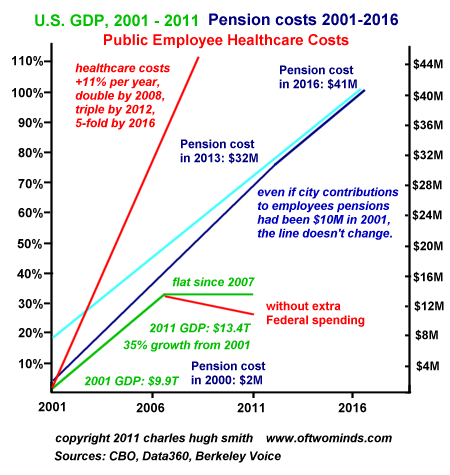
The country is in a tizzy over public employee bargaining rights and compensation costs, but few ask this question: What is the biggest cause of public employees compensation soaring to unsustainability? Answer: The costs of providing healthcare, which are rising 6% every year across a flatlined economy, and up to 11% per year for public employees.


Here is a chart drawn from Public Pension and Healthcare Costs and Financial Common Sense (February 28, 2011) which depicts how fast-rising pensions and healthcare costs are completely disconnected from the underlying economy.


Public employee healthcare costs in some California cities have been rising an average of 11% per year in the decade since 2000.


Here is what happens to $1 in healthcare costs which increase 11% per year:

1 (2001)
1.11
1.23
1.37
1.52
1.69
1.87
2.08 (2008)
2.3
2.56
2.84
3.15 (2012)
3.5
3.88
4.31
4.78 (2016)


By 2012, these costs have more than tripled and by 2016 they will have jumped five-fold. Once again: does anyone seriously believe these trends are sustainable in an economy which isn't even growing at all once we subtract Central State borrowing and spending?


For context on Central State borrowing (Federal deficits): Here are the deficits of the past three years, and the estimated shortfalls for fiscal years 2011 and 2012:


2008: $458 billion
2009: $1.4 trillion
2010: $1.3 trillion
2011: $1.5 trillion (est.)
2012: $1.6 trillion (est.)

(CBO estimate for 2011)


total: $6.258 trillion in five years.


While healthcare costs are rising around the developed world due to the demographics of aging and more treatment options, the U.S. sickcare system costs twice as much as our competitors' systems.


Medical Care Prices Are Rising Faster Than Overall Inflation (BusinessWeek)


The U.S. spent an estimated $2.4 trillion on health care in 2008, about 16.5% of gross domestic product and a 6% increase from a year earlier. Medical care prices are rising faster than overall inflation, and the burden on consumers continues to grow.


The source of the problem is the "fee for service" foundation of the system. There are no real limits on spending, despite various "reforms" which attempt to limit the runaway costs. Correspondent Quentin VT submitted this article from The New York Times on CEOs of publicly funded hospitals drawing millions of dollars a year in compensation: Immune to Cuts: Lofty Salaries at Hospitals.


I have covered these issues in depth for years:


Healthcare "Reform": the State and Plutocracy Stripmine the Middle Class (Again)(November 9, 2009)


The Simulacra of Change, the Propaganda of Hope (January 20, 2010)


Is Fee-for-Service What Ails America's Health Care System? (January 18, 2010)


Can Health Care Reform Possibly Control Costs? (April 10, 2011)


Sickcare is fundamentally a system of interlinked politically powerful cartels.


Insiders who refuse to speak on the record for fear of antagonizing the powers that be, exorbitant price increases, confidential agreements and a tug-of-war between warring tribes. Is this the Mafia we're talking about?


From the point of view of investigative journalism, it could also describe America's health care industry. Setting aside the politically attractive mantra of "improving access to healthcare," from this point of view the industry is a highly profitable and politically powerful group of companies which operate in cartel-like fashion: that is, they use their clout to limit competition and establish highly profitable pricing.


These observers use the word "cartel" not in the sense of a formal organization like OPEC (the Organization of the Petroleum Exporting Countries) or the criminal activities of drug cartels, but in the informal sense of a small group of companies which dominate specific markets and thus wield significant political and pricing power within those markets.


Why should we care? Experts say that it is a sign of the medical industry's enormous political power that the health reform bill overlooked some of the biggest cost drivers in American medicine.


And if costs don't go down, then the affordability and sustainability of the U.S. healthcare system become questionable over the long-term. The U.S. already spends twice as much as other developed countries on healthcare as a percentage of GDP.


When asked to identify the source of America's runaway health care costs -- U.S. spending on health care has more than doubled as a share of GDP in the past 30 years -- healthcare industries and trade groups excel at pointing to the next guy as the source. Doctors, hospitals, insurers, HMOs, pharmaceutical companies, malpractice lawsuits and the courts which award huge settlements, Federal regulatory agencies, Medicare--scapegoats abound, and so do rationalizations.


If no one industry is responsible, then perhaps we need to look at the entire system of self-serving industries which profit from guaranteed payments to private-sector corporations which involve special political dispensations such as exemptions from anti-trust laws, and a tolerance for ways of limiting competition and insuring highly profitable contracts.


If the healthcare reform bill doesn't really address the cost drivers and the incentives built into the current system, then it's difficult to see how costs can decline.


This system is based on regional networks of providers negotiating with insurers to exclude competitors and set exorbitant prices that are passed on as insurance premiums. While insurers complain about rising costs, they are exempt from antitrust laws and thus they have the power to consolidate smaller insurers within a region and then pass on price increases to consumers and businesses alike.


A recent report by Massachusetts Attorney General Martha Coakley uncovered multiple forms of anti-competitive behavior among providers, including huge price disparities that had no visible relation to any free-market factors. The report concluded that this and other forms of collusive behavior were "pervasive."


Once upon a time in U.S. healthcare, it was the norm to post prices for procedures and care; this is no longer the norm.


Some local providers who post their prices openly, such as Keith Smith, an anesthesiologist with the Oklahoma Surgery Center, find that preferred provider organizations (PPOs) and insurance companies aren't interested in contracting with his group, even though their prices are 70% less than those charged by local not-for-profit hospitals. To Smith, that is strong evidence that medical cartels are making deals with insurers to monopolize services in their region.


To cite another example of the distortions which end up costing the nation twice as much for health care (as a percentage of GDP) as competing developed countries such as Australia and Japan: Pittsburgh has almost as many MRI machines as the nation of Canada.


According to local media reports, Western Pennsylvania has about 140 MRI machines, while the 32 million residents of Canada share 151 MRI machines. And the machines are getting a lot of use: the number of CT and MRI scans (scans other than old-fashioned X rays) tripled from 85 to 234 per thousand insured people since 1999.


While proponents are quick to note that scans are cheaper than the alternative diagnostic procedures, one firm's research found that a doctor who owns his own machineis four times as likely to order a scan as a doctor who doesn't.


As if that wasn't enough to highlight the self-serving nature of "fee for service" cartels, MRI scanner manufacturer General Electric waged a two-year lobbying campaign to roll back cuts in Medicare reimbursements for scans. While the effort proved unsuccessful due to the intense political pressure to reduce soaring Medicare costs, some critics claim that providers simply made up the reduced reimbursements by increasing the number of tests administered.


The only solution that actually addresses the systemic problem is to get rid of the entire fee-for-service structure and break up the cartels. Healthcare must be reconnected to diet, nutrition, fitness, lifestyle and community, and to education and emotional well-being.


The odds of any of this happening are essentially zero, and so we can safely predict that sickcare will bankrupt the nation (with a helping hand from the Pentagon) within a few years.


If you would like to post a comment, please go to DailyJava.net.


Order Survival+: Structuring Prosperity for Yourself and the Nation (free bits) (Mobi ebook) (Kindle) or Survival+ The Primer (Kindle) or Weblogs & New Media: Marketing in Crisis (free bits) (Kindle) or from your local bookseller.

Of Two Minds is also available via Kindle: Of Two Minds blog-Kindle


Thank you, Paul L. ($225), for your unimaginably generous contributions to this site (of garden tools and cash)-- I am greatly honored by your support and readership. Thank you, Clinton S. ($25), for your admirably generous contribution to this site -- I am greatly honored by your support and readership.
Read more...

Terms of Service

All content on this blog is provided by Trewe LLC for informational purposes only. The owner of this blog makes no representations as to the accuracy or completeness of any information on this site or found by following any link on this site. The owner will not be liable for any errors or omissions in this information nor for the availability of this information. The owner will not be liable for any losses, injuries, or damages from the display or use of this information. These terms and conditions of use are subject to change at anytime and without notice.

RE: European Union AI Act, and Our Use of Generative AI Tools and Agents Policy

All text on this site is composed by Charles Hugh Smith or by a credited guest-author. No Generative AI Tools are used in the composition / writing of any text or graphic content created by Charles Hugh Smith. This site deploys no AI agents or generative AI tools. This site is not responsible for the disclosures, use or non-use of AI agents or generative AI tools in advertisements displayed by Investing Channel or other ad placement services.

Audio files generated by text-to-audio transcription tools are identified as such.

Our Privacy Policy:

Correspondents' email is strictly confidential. This site does not collect digital data from visitors or distribute cookies. Advertisements served by third-party advertising networks such as Investing Channel may use cookies or collect information from visitors for the purpose of Interest-Based Advertising; if you wish to opt out of Interest-Based Advertising, please go to Opt out of interest-based advertising (The Network Advertising Initiative) If you have other privacy concerns relating to advertisements, please contact advertisers directly.

PRIVACY NOTICE FOR EEA INDIVIDUALS

This section covers disclosures on the General Data Protection Regulation (GDPR) for users residing within EEA only. GDPR replaces the existing Directive 95/46/ec, and aims at harmonizing data protection laws in the EU that are fit for purpose in the digital age. The primary objective of the GDPR is to give citizens back control of their personal data. Please follow the link below to access InvestingChannel's General Data Protection Notice.
https://stg.media.investingchannel.com/gdpr-notice/

Notice of Compliance with The California Consumer Protection Act

This site does not collect digital data from visitors or distribute cookies. Advertisements served by a third-party advertising network (Investing Channel) may use cookies or collect information from visitors for the purpose of Interest-Based Advertising. If you do not want any personal information that may be collected by third-party advertising to be sold, please follow the instructions on this page: Do Not Sell My Personal Information.

Regarding Cookies:

This site does not collect digital data from visitors or distribute cookies. Advertisements served by third-party advertising networks such as Investing Channel may use cookies or collect information from visitors for the purpose of Interest-Based Advertising; if you wish to opt out of Interest-Based Advertising, please go to Opt out of interest-based advertising (The Network Advertising Initiative) If you have other privacy concerns relating to advertisements, please contact advertisers directly.

Our Commission Policy:

Though I earn a small commission on Amazon.com books and gift certificates and gold (BullionVault) purchased via links on my site, I receive no fees or compensation for any other non-advertising links or content posted on my site.

Copyright Notice:

All original images (Drawings and Photographs), text (essays, books and works of fiction), audio and video recordings, musical compositions, graphic design, graphic design elements and HTML coding on this site are the copyrighted work of Charles Hugh Smith unless otherwise credited or noted. They are published as information for the private use of site visitors, and any reproduction or redistribution of this content or coding in any media in any format or distribution channel (text, audio, video/film, web) without the written permission of the copyright holder is strictly prohibited. All rights in all media reserved globally.

  © Blogger templates Newspaper III by Ourblogtemplates.com 2008

Back to TOP