Friday, December 19, 2025

Insane Financial Imbalances and Social Revolution

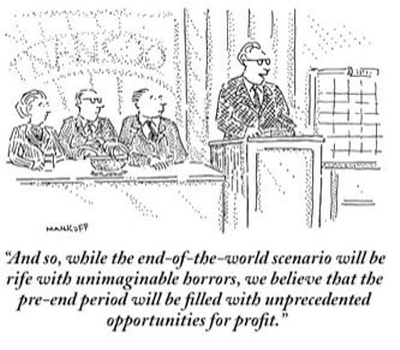
A rebalancing of the economy and society will ultimately prove very positive, but first we must navigate the model collapse of insane financial extremes.

I've endeavored to explain how self-referential models veer into hallucinations that are accepted as accurate reflections of the real world. Models are by definition synthetic abstractions of the real world, and as these "train" on their own output, they drift away from authentic understanding without the users being aware that their "world" is both artificial and self-reinforcing: each iteration reinforces their belief in the model's accuracy.

Patient users of AI programs can force AI to admit its output was a hallucination, at which point AI tends to abjectly apologize. But human pride--especially strong among those with high opinions of their intelligence and mastery of life--precludes recognition of catastrophic error (i.e. believing in a hallucination) and apologizing for the error.

Human hubris leads us to double-down when faced with evidence we've placed our faith in a hallucination. We deny that our system/model is a self-reinforcing hallucination even as we go over the falls. The faint cries of "save me!" are short-lived.

Models collapse from their own internal dynamics. They don't need our approval. Our disapproval doesn't stop their collapse. Our choices boil down to 1) go over the falls as models collapse; 2) snap out of the hallucination or 3) enter the netherworld of hyper-normalization, the state of mind where we embrace two contradictory "truths": the hallucination is forever and we're not surprised when it collapses.

Model collapse manifests in many ways: people and systems break down. Anti-social behaviors become normalized, and extremes are accepted as normal as we habituate to dysfunction and breakdowns.

I call this Anti-Progress: what we're sold as "progress" actually reduces our quality of life. In my book The Mythology of Progress, I describe Progress as a powerful mythology, but it can also be understood as a model that is collapsing into a hallucination we cling to with hubristic tenacity.

In everyday life, these extremes manifest as Ultra-Processed Life, a synthetic world in which artificial substitutes have replaced authentic life and experiences because the model increases profits via unhealthy addictions in both the consumer and digital realms.

But people break down in this Mouse Utopia of ultra-processed abundance, and the model's self-reinforcing iterations veer ever farther from authentic experiences.

Which brings us to my latest podcast with Richard Bonugli, Insane Financial Imbalances and a Social Revolution (36:34 min). The word "insane" is jarring, for the dominant model of the global order holds that financial extremes are not just sane, they're proof that all is well, and so calling these extremes "insane" is what's insane.

This is classic model collapse: up until the point of breakdown, the model seems to be functioning perfectly, because being self-referential, there is no other possible output other than the system is performing nominally.

In my new book Investing In Revolution, I describe the two structural flaws in the current model: 1) due to its success in generating abundance, the model's adaptive capacity has decayed, leaving it incapable of adapting to rapidly changing real-world conditions, and 2) the dominance of the financial model has fatally imbalanced society and the economy, an extreme imbalance that will be rebalanced by the pendulum swinging to the opposite extreme.

I call this systemically predictable rebalancing a social revolution, as meet the new boss, same as the old boss is no longer sufficient: the values and incentives that maintain a sustainable balance between society and the economy must change. This Reformation is not financial or political, it is fundamentally social in nature.

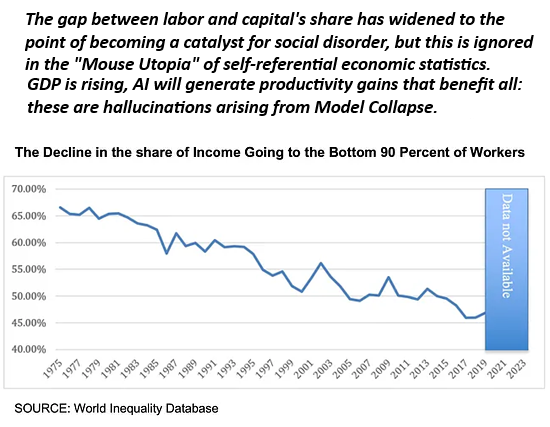
This imbalance is visible in the widening divide between the share of the economy going to labor and capital: wage earners' share has been declining for decades, reducing their capacity to afford a secure quality of life without piling up debt:


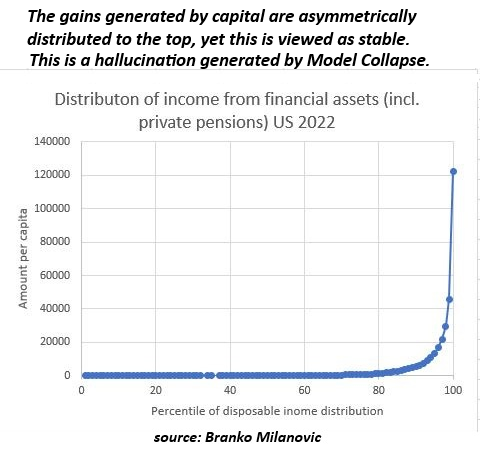
The earnings generated by ownership of capital go mostly to the very top of the wealth-power pyramid: the majority of income from capital flows to the top 0.25%, with the rest dribbling down to the top 5%.


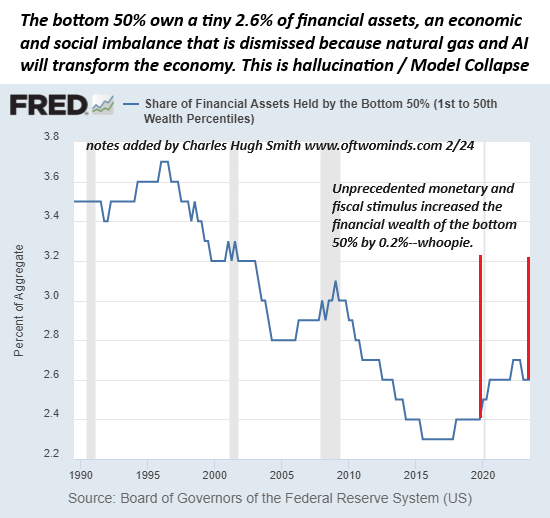
The bottom 50%'s share of financial assets amounts to signal noise--2.6%.


This imbalance is so extreme that it will catalyze social disorder, yet to call it unsustainable is "insane."


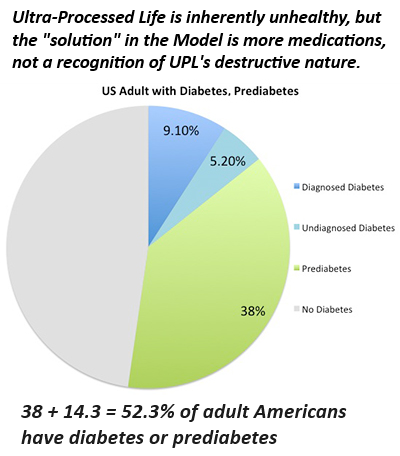
The health of the non-elites has reached crisis levels, yet this too is unremarkable because the model has a "solution": more costly medications that must be taken for life: highly profitable, so all is well.


The hallucination that this is all wonderfully sustainable reveals the dominance of the financial model of how the world works. That society is breaking down is of no concern because natural gas is so abundant that we can easily power up AI data centers, and GDP is rising.


The problem is we only manage what we measure, and all the financial analysis "trains" on its own output. Those staring at screens of soaring stocks and corporate profits declare this is the best possible world while the social order breaks down around them.

A rebalancing of the economy and society will ultimately prove very positive, but first we must navigate the model collapse of insane financial extremes, extremes that are unrecognized in the current hallucination. The collision of the self-reinforcing hallucination with the real world will be challenging.

If we accept that the dominant models have lost their capacity to adapt, and that the imbalance between economic forces and society have reached extremes that demand rebalancing, we can return to the real world in good order. If we cling to the hallucination, then over the falls we will go.


New Podcasts: Insane Financial Imbalances and a Social Revolution (36:34 min)

Ultra-Processed Life: Unhealthy, Addictive, Deranging, Artificial (36 min)

My new book Investing In Revolution is available at a 10% discount ($18 for the paperback, $24 for the hardcover and $8.95 for the ebook edition). Introduction (free)


Check out my updated Books and Films.

Become a $3/month patron of my work via patreon.com

Subscribe to my Substack for free


NOTE: Contributions/subscriptions are acknowledged in the order received. Your name and email remain confidential and will not be given to any other individual, company or agency.

Thank you, Melissa G. ($70), for your monumentally generous subscription to this site -- I am greatly honored by your support and readership.


Thank you, Rey R. ($7/month), for your marvelously generous subscription to this site -- I am greatly honored by your support and readership.


Thank you, BioChamp ($70) for your superbly generous subscription to this site -- I am greatly honored by your support and readership.


Thank you, Mike H. ($70), for your splendidly generous subscription to this site -- I am greatly honored by your support and readership.

Read more...

Wednesday, December 17, 2025

All the Dominant Models Are Collapsing

Every nation is operating on models that are collapsing without those at the controls being aware that the implicit assumptions of their models no longer map reality.

A recent article lays out the collapse of the dominant geopolitical model of "rising powers generate conflict": The Stagnant Order And the End of Rising Powers (Foreign Affairs, paywalled). The basic idea is that the foundations of "rising powers"--demographics and productivity gains--no longer support grandiose planetary dominance.

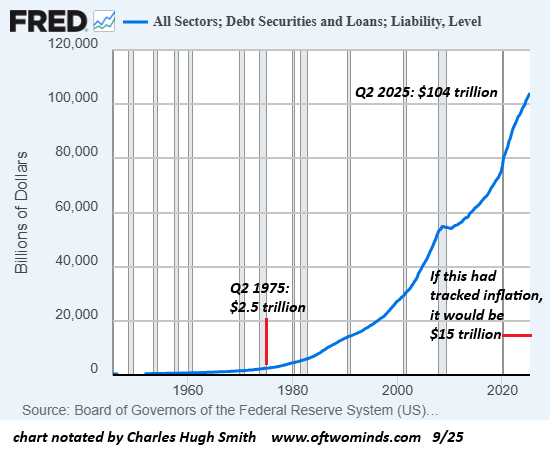
Rather, demographics is already baked in as a crushing liability to all existing powers, and despite endless claims that technology will jumpstart productivity, the reality is productivity gains have flatlined for decades. "Growth" is a function of expanding debt, not productivity gains.

This dynamic extends beyond geopolitical models: all the models being used to explain and control the world are all collapsing: economic, social, political, they're all collapsing because they are all constructs assembled in eras that no longer map the present.

As I explained in The Entire Bubble Economy Is a Hallucination, models collapse because of two limitations that define all models:

1. All models are self-referential, as they "train" (i.e. generate current analysis) on a limited spectrum of metrics that are presumed to summarize the immensely complex "real world." The model is blind to its own self-referential feedback loop and the limits of the metrics it bases its output on.

Over time, this self-referential "training" degrades the output--the analysis and the decisions based on that analysis--to the point of hallucination: the model is generating output of how the world works that has drifted to far from authentic understanding that it is a hallucination, one that is taken to be "real" by those controlling the model.

2. The metrics being measured leave out enormous fields of the real world, but what's been left out isn't explicit, as it's all based on what is considered "knowable" and "known," as I explained in What We "Know" Is More Dangerous Than the Unknown: these assumptions are hidden limitations of the model, as we only manage what we measure.

I break this down in my book Investing In Revolution.

The collapse of the dominant models is visible everywhere, but perhaps most painfully in economics, which has become the dominant model of how the world works due to the dominance of statistical models of finance and the policies those models generate.

I addressed this failure of economics to accurately predict outcomes back in 2013: Why Isn't There a Demonstrably Correct Economic Theory? (August 16, 2013)

"This system is intrinsically unstable, as the financial claims of credit and fiat money on limited real-world resources and wealth eventually far exceed real-world resources, and the system of claims collapses in a heap.

Although economics doesn't recognize it, the operative phrase here is systemic injustice."


Why Economics Will Never Be a Legitimate Science (December 24, 2013)

All the extant economic models are artifacts of bygone eras. The economic models of the 19th century--all based on the implicit assumption that resources were endless--were modified in the 1930s into Keynesian hallucinations still based on endless resources: let's just pay people with freshly printed "money" to dig holes and fill them. This presumes endless resources to squander on digging holes and filling them, as if that is a productive use of labor and resources.

This hallucination continues to be the dominant paradigm: resources are endless because we're clever and there will always be a substitute for whatever is depleted, so the "solution" is just print "money" to pay people to dig holes and fill them.

The "problem" is "growth" of consumption, and so if we "solve" that problem by goosing consumption by any means available, we enter "Mouse Utopia," an artificial world of never-ending abundance.

The book Money, Blood and Revolution: How Darwin and the Doctor of King Charles I Could Turn Economics into a Science takes a stab at turning economics into "science," but that's not actually "the problem." The real problem is all models have intrinsic limits and end up hallucinating, but those controlling the gearing of the model depend on it to maintain their own power, so they are blind to the failure of their precious model to track the real world and generate authentic understanding.

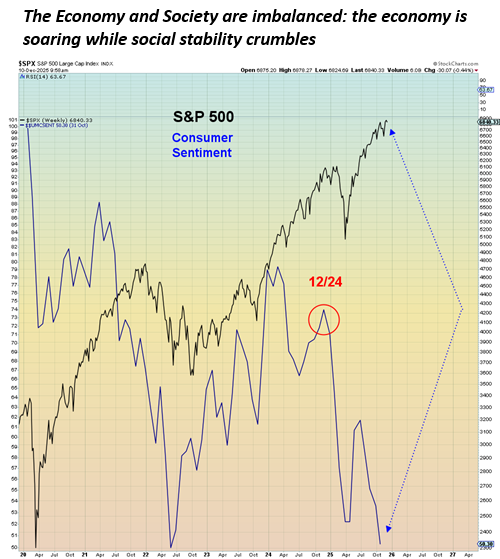
So we're told that all is well because GDP and the stock market are rising, and since we have lots of natural gas to power AI data centers, we're entering a "Mouse Utopia" of endless abundance. That these are all hallucinations is lost on those clinging to collapsing models as the means of maintaining their power.


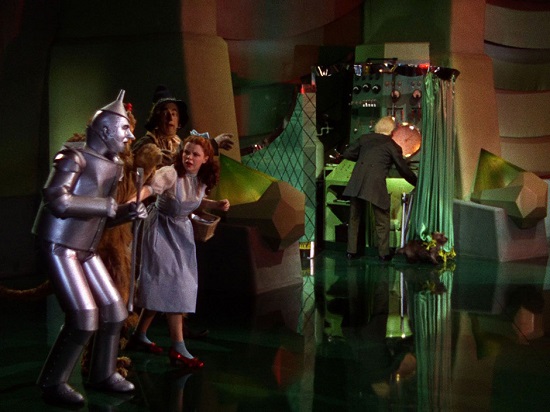
That the hallucinations are sustainable is itself a hallucination:


That the inhabitants of "Mouse Utopia" are not focused on how natty gas and AI are going to make Utopia even more utopian is lost in the current model collapse: antisocial behaviors are accelerating due to the the artificial nature and exploitive structure of our "Mouse Utopia," but these realities aren't measured and so they don't exist in the current model's self-referential hallucinations:


All the dominant models are collapsing at once, and no nation is immune to the consequences, as every nation is operating on models that are collapsing without those at the controls being aware that the implicit assumptions of their models no longer map reality:

If We Measured the Economy by Quality-of-Life Instead of GDP, We'd Be In a Depression (October 16, 2025)


New Podcast: Insane Financial Imbalances and a Social Revolution (36:34 min)

My new book Investing In Revolution is available at a 10% discount ($18 for the paperback, $24 for the hardcover and $8.95 for the ebook edition). Introduction (free)


Check out my updated Books and Films.

Become a $3/month patron of my work via patreon.com

Subscribe to my Substack for free


NOTE: Contributions/subscriptions are acknowledged in the order received. Your name and email remain confidential and will not be given to any other individual, company or agency.

Thank you, Susan F. ($7/month), for your monumentally generous subscription to this site -- I am greatly honored by your support and readership.


Thank you, Douglas H. ($7/month), for your marvelously generous subscription to this site -- I am greatly honored by your support and readership.


Thank you, Dr X. ($70) for your superbly generous subscription to this site -- I am greatly honored by your support and readership.


Thank you, Todd D. ($7/month), for your splendidly generous subscription to this site -- I am greatly honored by your support and readership.

Read more...

Monday, December 15, 2025

The Wile E. Coyote Insight: What We "Know" Is More Dangerous Than the Unknown

This is why "knowledge is power": those who define what is "knowable" and "known" shape the reality of everyone in the model / system.

Oh crikey, is this another boring post trying to make philosophy relevant? No, it's a post about survival of the fittest, as what we "know" will lead us straight off the cliff in a state of delusional confidence. What we "know" is a mix of what we accept as known and what is knowable, which is defined by the system / zeitgeist / frame of reference we inhabit.

Nowadays we can't talk about "knowing" without invoking AI, which claims to have gathered all of human knowledge and made it available to us in natural language. But as I've taken pains to describe this year in dozens of posts and two books, what AI presents as "known" has been processed in ways we don't see, and these processes limit the reliability and trustworthiness of what AI presents as "known" and "knowable."

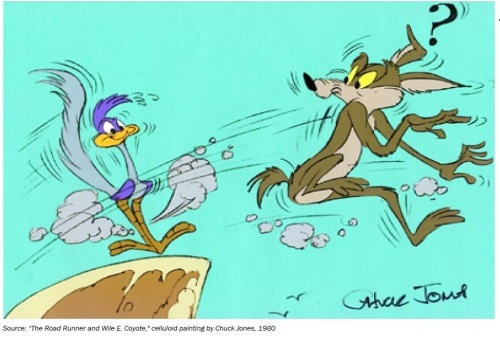
The danger here is our ill-informed confidence in AI and in what our system presents as rock-solid "knowable." The system says Gross Domestic product (GDP) is a rock-solid measure of the economy, and since it's rising, you can be absolutely confident about chasing gains (the Roadrunner) off the cliff. (See Wile E. Coyote below.)

Here's the thing that gets passed over: AI hallucinates, but it doesn't "know" it's hallucinating; it presents fabrications as "known facts." AI didn't "knowingly" take digital Ayahuasca and LSD and "know" it will be hallucinating as a result. It "thinks" it's reporting what are established "knowns"--first, this is knowable, and second, this is known.

We're no different when we're fed hallucinations as if they're "known facts." We're unaware they're hallucinations, and so we blithely walk off the cliff because we placed our confidence in fabrications, models that have collapsed without us being aware that 1) we accepted a model as reality and 2) the model collapsed and is now generating "information" that isn't entirely knowable and isn't "fact."

You see the difference: when we knowingly take hallucinogens such as Ayahuasca or LSD, we know our experiences no longer reflect "facts." We understand our experiences may veer into territory that science defines as "unknowable," yet we are experiencing it anyway. We know it is unwise to walk along a cliff edge at dusk in a hallucinogenic state.

But in model collapses, we think the hallucination is the real world. It is in this confused state that we place our confidence in a hallucination and walk calmly off the cliff to our demise.

This is where the survival of the fittest kicks in: confusing reality and a model-collapse hallucination does not generate positive survival outcomes. I explain the systemic sources of this confusion in my latest book Investing In Revolution.

As I explained in Model Collapse: The Entire Bubble Economy Is a Hallucination, model collapse is the inevitable result when those controlling the model's gearing / programming begin using the output of their previous results (output) to "train" the next iteration of their "knowledge," i.e. what they consider knowable and known.

Using probabilistic functions and overweighting what is accepted by conventions as knowable and known both skew the outputs, which accumulate as each iteration "trains" on the skewed outputs. Knowledge that is on the margins or discounted by conventional definitions of what is being measured as "facts" is edited out of the knowledge base or reframed in conventional terms: in AI "training," this is the Silicon Valley frame of reference.

Those who control the gearing / programming trust their own judgement and models, and so they resist recognizing the increasingly hallucinogenic nature of their model. Their frame of reference is we have god-like powers and are building utopia, and the idea that they have a poor grasp of what is knowable and what is known doesn't penetrate their hubris.

The inhabitants of their Mouse Utopia have been trained to trust their techno-leaders as demi-gods because "technology is Progress," and so their core survival skills--skepticism, a keen awareness of what is unknown because reality has one foot in what is intrinsically unknowable--have atrophied. Surrounded by novelties, addictive distractions, conveniences and comforts, they have lost the ability to differentiate the real world from a (highly profitable) artificial world.

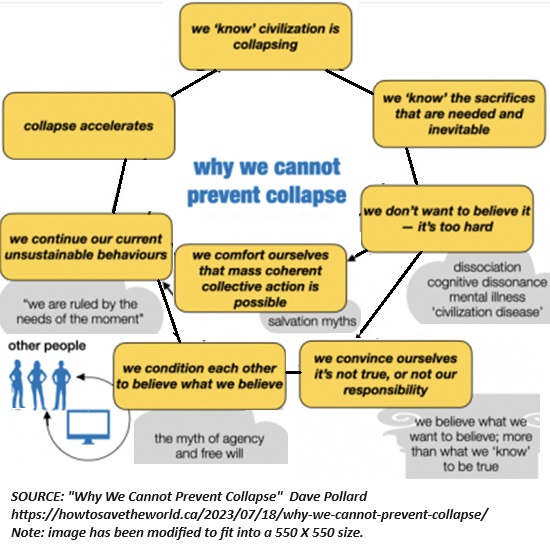
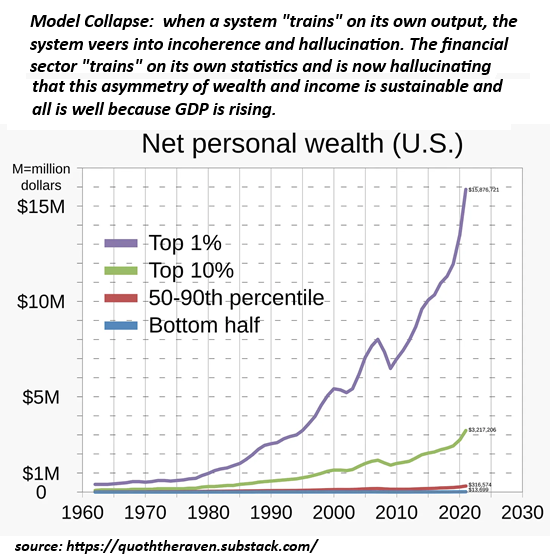
This is a visual representation of what happens when a system "trains" on its own output: GDP is rising, so everyone's doing great, money solves all problems, except moral decay and the other sources of our hallucinations, and so on:


Here's a list of the model-collapse hallucinations we now trust as reality to our future detriment:

1. The entire global financial system is a hallucination generated by model collapse. This hallucination is most easily visible in bubbles, credit, "banking" and "money."

2. The entire AI bubble, including AGI (artificial general intelligence), is a hallucination generated by model collapse that is being purposefully obscured to maximize private gains from the public's embrace of the AI-bubble hallucination.

3. Social Media is a hallucination generated by model collapse that is being purposefully obscured to maximize private gains from the public's addiction to the social-media hallucination.

4. The entire status quo of Ultra-Processed Life is a model collapse hallucination, including the delusions that all our problems can be resolved with an "abundance of money" and "energy."

This is why "knowledge is power": those who define what is "knowable" and "known" shape the reality of everyone in the model / system. The result is we're living in a Mouse Utopia that is in late-stage model collapse that is largely unrecognized by the inhabitants but acutely visible to those keeping it glued together long enough to amass private fortunes before it all implodes.

It's highly profitable to maintain the illusion that these hallucinations are "the known world," but when the model implodes, you'll want to be outside the ruins rather than buried beneath rubble. It is only then that we'll realize that what we "know" is more dangerous than the unknown.


My new book Investing In Revolution is available at a 10% discount ($18 for the paperback, $24 for the hardcover and $8.95 for the ebook edition). Introduction (free)


Check out my updated Books and Films.

Become a $3/month patron of my work via patreon.com

Subscribe to my Substack for free


NOTE: Contributions/subscriptions are acknowledged in the order received. Your name and email remain confidential and will not be given to any other individual, company or agency.

Thank you, Scott B. ($7/month), for your monumentally generous subscription to this site -- I am greatly honored by your support and readership.


Thank you, Christian M. ($7/month), for your marvelously generous subscription to this site -- I am greatly honored by your support and readership.


Thank you, Philip T. ($32.50) for your superbly generous subscription to this site -- I am greatly honored by your support and readership.


Thank you, Robert O. ($7/month), for your splendidly generous subscription to this site -- I am greatly honored by your support and readership.

Read more...

Saturday, December 13, 2025

The Perilous Journey Ahead

I reckon it prudent to see the next decade as a journey through a wilderness few of us have experienced.

Marketing has seized "your journey" by the throat. The marketing of everything from storage facilities to downtowns now references "your journey," with the primary message being your journey will be fruitful, fun, exciting--but also safe and secure. In other words, our journey will follow well-worn, well-marked trails, and the outcome will always be positive. If anything untoward happens, someone will be available to get "the journey" back on track.

In other words, "the journey" is never through a wilderness without trails or markers where help is unavailable, where we're on our own and the journey's outcome is uncertain, and fear is the companion who is always by our side.

In the marketed "journey," all you need is money: to rent a storage space or an apartment, to pay tuition or a plane ticket and sturdy boots. This is the essence of what I call Ultra-Processed Life: adventure that is safe and certain can be purchased off the shelf.

We take all the intricate structures that make this possible for granted, and have little grasp of what life is like without them. As long as we have money, we have power. But in a wilderness, there's nothing to buy and no one to pay to make it all go away. In a wilderness, we experience the limits of our power. Stripped of all the structures that make life certain and safe, we come face to face with our own powerlessness.

Many of us have already experienced powerlessness in our childhood. We were repeatedly moved around against our wishes by adults, step-parents were imposed on us and then dispensed with, and we were dropped into schools where we were vulnerable to bullying. Certainty and safety were ephemeral, and we lacked the tools and strengths offered by adulthood.

It is not surprising that many of the elements of Ultra-Processed Life are child-like: we're offered "adventures" that are safe and certain, as in "let's play adventure" but in a safe, protected environment.

The problem with packaging life based on the ubiquity of complex structures that protect us from contact with uncertainty, risk and powerlessness is we're completely unprepared for the real world when we do finally encounter it. We cannot imagine experiences that unravel and cannot be reversed with a phone call or credit card.

Unaccustomed to being totally on our own in situations we've never experienced before, we're ill-prepared to function in a fast-moving environment of uncertainty and risks we cannot fully grasp. These environments can be external--the real-world unraveling--and/or internal: the unraveling of burnout or breakdown.

I've written a lot about self-reliance, as this is the penumbra (Latin for "almost shadow") of powerlessness: self-reliance is never limitless, for we do not have god-like powers. It is intrinsically limited. But it does generate agency, the capacity to direct our lives by exerting our will, skills and effort.

One analogy for "the journey" is driving a car. Our experience is 100% low-risk predictability and control until we experience an accident, and so our experience doesn't prepare us for things going awry. We have no tools for dealing with sudden extremes or unexpected failures in the systems we take for granted. It's only after such experiences do we learn our limits an gain an appreciation for what might happen even in low-risk settings.

Those of us who have had such experiences tend to think along "worst-case scenario" lines as the means of avoiding being caught off-guard by "longtail risks," i.e. events deemed unlikely but still well within the realm of the possible.

For example, if I climb on a roof, I assume I'm going to slip and fall, so I take precautions that look excessive to those who haven't fallen off roofs.

In a similar fashion, it seems risky to have no water, food and fuel stored up for the unlikely eventuality that the systems we rely on to provide these essentials break down or are disrupted. It seems equally risky to have few skills in fashioning shelter, growing food, organizing security, and planning scenarios to deal with breakdowns in what we take for granted based on real-world experience.

We're accustomed to emergencies being temporary, the result of a natural disaster that responses are in place to deal with. We have little or no experience of systems decaying and not returning to the status quo.

My sense is that we're entering an extraordinary period that is more like a wilderness than a well-marked path with help around every corner. Beneath the surface of normal life, the systems we take for granted are eroding. Since we have no experience of this, we're unprepared for a journey that is intrinsically uncertain and brimming with risks we cannot assess because they are contingent, novel and non-linear, i.e. unpredictable.

The consensus is such a situation is not in the realm of possibility. Everything we take for granted is permanent. My view is the next 7 to 10 years will present us with challenges few are prepared to manage based on previous experience and their existing reserves of agency, skills and resources, reserves based on the expectation of permanent structures providing security and safety.

The phrase "situational awareness" is bantered about, but as a general rule we can only be aware of situations we've experienced before. We're blind to what we have yet to experience. Without experience, we tend to over-estimate our readiness to deal with extraordinary circumstances because we've successfully managed everyday life.

Fear is a useful tool that few learn to use because they don't have enough experience with it. Fear is a spectrum, one that spans from caution to panic. The difficult part is avoiding the slide into disorientation and panic. Like self-reliance, this is imperfect. Our ability to assess risks and threats is also imperfect. No matter how well prepared, we can still be surprised, unwary, blind to what we haven't experienced.

Knowing this is also a tool.

Some things happen so fast we don't even have time to become afraid. We just react instinctively. In slow-moving crises, uneasiness dissipates all too easily into passive acceptance.

We habituate to decay so readily that it's hard to anticipate where it's heading. We assume the current level will hold, when the reality is the current level is only temporary, and the next step down is just ahead. Our ability to distinguish a step down from a precipice is limited.

I reckon it prudent to see the next decade as a journey through a wilderness few of us have experienced. It may appear to be financial or political, but fundamentally it is a journey each of us will take to some degree on our own.

We will be powerless to restore the systems that have decayed. Our only power will be what we provide ourselves. Empowerment will likely take multiple forms, manifesting as self-reliance, experimentation, failure, shared experiences and cooperation with others.

These ruminations were inspired by this work, which I leave unattributed so you can read it as it is without any preconceptions generated by authorship, place or time.

A Manner Of Traveling

I awoke and found myself walking
along a muddy road,
dim with filtered light and an uncertain sun.
My feet were cut and bleeding.

I glanced back at my tracks and recognized nothing,
and saw small patches of my blood
in the dark damp depressions of my footsteps.

Yes, anger and love can co-exist.
This I know for I am both.

I am in an unfamiliar place.
The leaves and branches are wet with recent rain
and I cannot tell if I have been crying
or just walking with my face turned up to the sky.

I find my feet marching forward, steadily,
and I am astounded at the effort they are making
without my will.

Yes, decisions and no will can co-exist.
This I know for I am both.

I consider turning back but I do not remember
coming here. There is nothing to return to.
I am alone, though I see the eroded,
water-filled spoor of other walkers.

I am afraid, for I cannot see ahead
and do not know the future that my mind
is striving to see.

Yes, certainty and the unknown can co-exist.
This I know for I am both.

There are deep scratches on my exposed arms;
I do not recall crashing blindly through
wilderness, but clearly, I have done so.

I am thirsty and tired but there is no place to rest.
I feel this power pulling me forward.
I am trying to return to the birthplace
I have never seen, as birds and fish do.
I will not recognize it with my eyes but with my belly.

I want to feel sorry for myself, to have someone
comfort me in my distress, but I am alone,
with only my mind and body for company,
and the insects buzzing unseen above my head,
oblivious to my aching feet and confused mind.

Yes, pain and love can co-exist.
This I know for I am both.

There is the rich scent of vegetation around me,
fecund, growing, matted, decaying, life and death
in the same place and time.

I walk on and the smell lies heavily over
the damp vines and reaching trees above me.


My new book Investing In Revolution is available at a 10% discount ($18 for the paperback, $24 for the hardcover and $8.95 for the ebook edition). Introduction (free)


Check out my updated Books and Films.

Become a $3/month patron of my work via patreon.com

Subscribe to my Substack for free


NOTE: Contributions/subscriptions are acknowledged in the order received. Your name and email remain confidential and will not be given to any other individual, company or agency.

Thank you, Tom ($200), for your beyond-outrageously generous subscription to this site -- I am greatly honored by your support and readership.


Thank you, Mike H. ($70), for your marvelously generous subscription to this site -- I am greatly honored by your support and readership.


Thank you, Ramon M. ($7/month) for your superbly generous subscription to this site -- I am greatly honored by your support and readership.


Thank you, Kirk C. ($7/month), for your splendidly generous subscription to this site -- I am greatly honored by your support and readership.

Read more...
Thursday, December 11, 2025

How We Fail: The Empire Is Forever

Tunnel-vision greed and blindness to what is unseen and therefore "unknowable" is self-reinforcing.

The immense literature on the decline and collapse of civilizations tends to overlook a simple but profound dynamic: the tunnel-vision created by the fusion of an unquestioned belief in the permanence of the status quo and a narrow focus on maintaining and/or expanding the perquisites we're siphoning off of the empire.

The list of causes / sources of decay, decline and collapse is long indeed, but most are external factors: environmental changes such as drought, plagues and pandemics, invasions by barbarians, and so on. Internal sources of decay are often dismissed or given short shrift: for example, the Western Roman empire did not collapse due to moral decay, it was overwhelmed by the invasions of tribes pushed westward into Roman territory by warriors from the steppes of Asia.

The focus on externalities benefits from an easily traceable if-then causality, but it misses the critical importance of the social-economic-political milieu, the mindset of what's assumed, what is "known," what is unrecognized (and therefore "unknowable" in the mindset of that era), and the unseen decay wrought by enduring success.

Yes, enduring success is self-liquidating, as the impressively convenient idea that the empire is so durable that everyone with the means to do so can siphon off as much wealth as they can manage with absolutely no systemic consequences.

The possibility that this narrow focus on maximizing self-enrichment might weaken the empire in aggregate never occurs to any of those amassing private fortunes at the expense of imperial stability.

As I explain in my new book Investing In Revolution, success slowly corrodes our ability to adapt to rapidly changing circumstances. Whatever the challenge, it is assumed that the empire has the resources and systems to make the problem go away, and do so without demanding any sacrifices of its higher classes of aristocrats, patricians, clerisy and functionaries.

In other words, let them eat cake: there's always a solution that somebody else will make happen.

This decay of adaptive muscle goes unnoticed, for no one other than a few elders has any experience of a crisis or overlapping series of crises that demanded society-wide sacrifices and risky decisions to avoid failure. The systems that had evolved to maintain the empire had been up to the task for so long that the sclerosis of adaptive capacity is unseen and thus "unknowable."

That the empire could fail and collapse is beyond the realm of what's conceivable. The enduring success of the imperial structures fosters both:

1) a self-absorbed focus on accumulating as much private wealth as possible with no regard whatsoever for the eventual systemic consequences of everyone focusing on amassing their own fortune, and

2) a blindness to the erosion of the society's capacity to adapt to conditions that are so novel that the existing responses are inadequate and doomed to fail.

This blindness extends to the failure of the status quo responses: everyone watches the system do more of what's failed and assumes that devoting even more resources to the failing policies of the past will magically work again.

This is how we fail: externalities are relatively easy to identify and measure. The internal forces of self-liquidating success--the loss of adaptive capacity and a self-absorbed blindness to the eventual consequences of moral decay generated by tunnel-vision greed and the sclerosis fostered by enduring success--go unnoticed as they are not easily measured and are as hidden from view as the melting ice beneath the snowpack that makes an avalanche not just likely but inevitable.

Tunnel-vision greed and blindness to what is unseen and therefore "unknowable" is self-reinforcing:


My new book Investing In Revolution is available at a 10% discount ($18 for the paperback, $24 for the hardcover and $8.95 for the ebook edition). Introduction (free)


Check out my updated Books and Films.

Become a $3/month patron of my work via patreon.com

Subscribe to my Substack for free


NOTE: Contributions/subscriptions are acknowledged in the order received. Your name and email remain confidential and will not be given to any other individual, company or agency.

Thank you, Tom ($200), for your beyond-outrageously generous subscription to this site -- I am greatly honored by your support and readership.


Thank you, Mike H. ($70), for your marvelously generous subscription to this site -- I am greatly honored by your support and readership.


Thank you, Ramon M. ($7/month) for your superbly generous subscription to this site -- I am greatly honored by your support and readership.


Thank you, Kirk C. ($7/month), for your splendidly generous subscription to this site -- I am greatly honored by your support and readership.

Read more...
Tuesday, December 09, 2025

Why We Fail

No wonder the world seems deranged--it is deranged by the immense strength of an Old Guard clinging onto power by any means available even as the world around them spins into incoherence.

There are many reasons why we fail, but perhaps the most critical one is continuing to do more of what has failed. This has many potential sources, from the psychological (self-sabotage, etc.) to the ideological (the market is the solution to every problem, etc.) to cognitive biases (recency bias, etc.).

One enduring source of continuing to do more of what has failed is hard-wired on a deeper level than mere cognitive biases. One way to summarize this is: we can't let go of a story that explains how the world works unless we have a replacement story in hand.

In short: we must have a story that accounts for the world around us. Not having any story is not possible. We can have multiple overlapping stories--Jungian psychology, general theory of relativity, Keynesian economics, and so on--but we need a story that explains key elements of our experience and what we observe and "know," with know in quotes to indicate that the story we embrace defines what we know and what we can know.

Given this need for a story, we can only relinquish a story that's failing to account for what we observe if we have a better story available: and by "better" I mean one that more accurately accounts for what we observe.

This substitution of a new story for an existing story that no longer makes sense (i.e. offers constructive predictions) of the world is easily confused with another human trait: the power of the Powers That Be rest on a foundational story, and replacing this story removes the source of their power. Replacing the story that empowers them discredits their claim to superiority, effectively stripping away their entitlement to authority and their overweening delusions of grandiosity that come with entering the ranks of the Powers That Be.

This desire to maintain the status quo story as part of maintaining their authority and power is the core dynamic described by Thomas Kuhn in his classic The Structure of Scientific Revolutions: the Old Guard who embraced the story that the universe revolves around the Earth resists accepting the new story that the Earth is an inconsequential minor planet that orbits the sun in a local system which is in motion in much larger structures even as all the observational data undermines their story and supports the new story.

Fast-forward to the present and we have multiple Old Guards clinging to ideological stories that no longer track what we observe. Yet like all previous Old Guards, the Powers That Be are loathe to accept a new story that strips away their claim to authority and all the perquisites of power they currently enjoy.

We live in a world torn between the artifices needed to make "the Earth is the center of the Universe" somewhat plausible even as that story crumbles into incoherence and the formation of a new story that actually tracks reality. In terms of a metaphor, consider a glossy "lifestyle" publication that simultaneously touts a new chocolate cake recipe that is simply out of this world and a new diet to slim down in a healthier way than taking meds with horrible side effects that must be taken for life.

No wonder the world seems deranged--it is deranged by the immense strength of an Old Guard clinging onto power by any means available even as the world around them spins into incoherence.

Economic incoherence:


Political incoherence:


Psychological incoherence:


My new book Investing In Revolution is available at a 10% discount ($18 for the paperback, $24 for the hardcover and $8.95 for the ebook edition). Introduction (free)


Check out my updated Books and Films.

Become a $3/month patron of my work via patreon.com

Subscribe to my Substack for free


NOTE: Contributions/subscriptions are acknowledged in the order received. Your name and email remain confidential and will not be given to any other individual, company or agency.

Thank you, Greg H. ($70), for your magnificently generous subscription to this site -- I am greatly honored by your support and readership.


Thank you, Carl L. ($7/month), for your marvelously generous subscription to this site -- I am greatly honored by your support and readership.


Thank you, Geoffrey K. ($70) for your superbly generous subscription to this site -- I am greatly honored by your support and readership.


Thank you, Robert H. ($70), for your splendidly generous subscription to this site -- I am greatly honored by your support and readership.

Read more...
Friday, December 05, 2025

Greed, Centralization, Monopoly, Ruin

Greed is good up to the point that it delivers ruin.

The primary characteristic of this era is the purposeful confusion of profit and greed, as if they are the same thing. Greed is good because profit is good, and profit is good because the profit motive is the engine of Capitalism which is the engine of global prosperity.

The problem with this logic is greed is not the same as profit. In the sanitized version of the story, the profit motive of each individual magically generates the best possible socio-economic outcome for all via the secret powers of The Invisible Hand of market forces.

This is a fairy tale, of course, for the most profitable arrangement isn't a competitive free-for-all, it's a monopoly that controls the market to its own advantage. Monopolies are by their nature centralized; monopolies snap up or steamroll competitors until they exert centralized power--if not in a single entity then in a cartel that centralizes control of the market.

In the fairy tale about the magic of The Invisible Hand, individuals seek to maximize their private gains by increasing productivity and producing goods and services with more utility-value: higher quality, increased durability, etc. This narrative is core to The Mythology of Progress, which is the belief that Progress is 1) unstoppable and 2) a permanent force that advances as the natural order of things.

In the real world, entities maximize their gains by increasing the price while diminishing the utility-value of the goods and services: profits are maximized by reducing durability (planned obsolescence), reducing quality / quantity and manipulating a monopoly on information to modify the price to extract the maximum profit from each transaction--dynamic pricing is the seemingly harmless cover-term for this exploitation of information asymmetry: the buyer knows little or nothing, the seller knows everything.

This use of cover-stories and terminology is the foundational dynamic of Anti-Progress and Ultra-Processed Life: the authentic term (profit motive) is now the cover story for exploitation-driven greed, and Progress is now the cover story for Anti-Progress--the degradation of quality, durability, transparency and agency.

Greed is not the same as profit. Greed maximizes gains by exploitation, not increasing value. Greed is the operative driver of the current era. The socio-political-economic system is dominated by greed-driven concentrations of power: monopolies, cartels and states.

There are three mechanisms that greatly expand the potential for assembling monopoly / cartel centralization of power: 1) technology, 2) credit and 3) the state.

1) Technology by its very nature leads to centralized ubiquity due to the network effect--the technology that recruits the most users becomes the default access to participate in the economy--participation that is essential to function in a technology-dominated economy. This ubiquity generates monopoly (or quasi-monopoly) which then generates high stock valuations which then provide the money needed to maintain and extend the monopoly.

Technology companies' access to the stock market via initial public offerings (IPOs) offers unique access to a nearly limitless source of "free money" to buy up competitors via issuing more shares of the company's stock.

This immense pool of wealth enables technology companies to buy control of narratives and political power.

2) Credit. If an entity cannot create "free money" by issuing more shares of its stock, if it has access to nearly limitless credit, it can use this credit top buy up competitiors and buy political protection of its monopoly. This is why John D. Rockefeller was obsessed with gaining access to more credit: that was his pathway to establishing a monopoly in the oil industry.

3. The state. Those who buy (or gain by other means) political influence can then create monopolies or cartels via state regulations. To the degree that the state has a monopoly on centralized power, all monopolies and cartels are private-sector / state entities, as centralized privately controlled power can only exist if the centralized state allows it.

As I explain in my new book Investing In Revolution, we inhabit a world in which authenticity has been replaced by self-serving artifice, artifice which enriches those who own or reap gains from centralized, monopolistic, extractive, exploitive entities created by technology, credit/issuance of stock and the state.

Orwell called this substitution double-speak: greed is positive profit, Anti-Progress is positive Progress, extraction that enriches the few at the expense of the many is just good old profit driving Progress, and so on, a hall of mirrors that spins 24/7 in a digital carnival intentionally designed to be addictive.

Greed is good up to the point that it delivers ruin. We are closer to that phase-change than we imagine--if we can imagine such a phase-change at all.


Part 1: My Life Is a Lie: How a Broken Benchmark Quietly Broke America (via Cheryl A.)


My new book Investing In Revolution is available at a 10% discount ($18 for the paperback, $24 for the hardcover and $8.95 for the ebook edition). Introduction (free)


Check out my updated Books and Films.

Become a $3/month patron of my work via patreon.com

Subscribe to my Substack for free


NOTE: Contributions/subscriptions are acknowledged in the order received. Your name and email remain confidential and will not be given to any other individual, company or agency.

Thank you, Molly B. ($70), for your magnificently generous subscription to this site -- I am greatly honored by your support and readership.


Thank you, Dennis O. ($7/month), for your marvelously generous subscription to this site -- I am greatly honored by your support and readership.


Thank you, Katie S. ($7/month) for your superbly generous subscription to this site -- I am greatly honored by your support and readership.


Thank you, Arthur K. ($70), for your splendidly generous subscription to this site -- I am greatly honored by your support and readership.

Read more...
Wednesday, December 03, 2025

Model Collapse: The Entire Bubble Economy Is a Hallucination

The conclusion that soaring asset prices mean the economy is strong is a hallucination that goes unrecognized because the entire financial system is hallucinating.

Consider the data that the financial sector bases conclusions / decisions on (i.e. the data that the financial sector "trains" on) in a Bubble Economy like the present. The Bubble Economy's core goal is to inflate the valuation of assets not by increasing utility-value or productivity but by artificially expanding credit and leverage.

This benefits those who already own assets, as their collateral (i.e. "wealth") expands without any effort, and this swelling collateral enables them to borrow money to buy more assets.

This also benefits those with high incomes and modest debt, as these boost their credit rating, enabling them to borrow at lower rates than the bottom 90% of the workforce--credit they can use to outbid the bottom 90% to snap up assets which are soaring in value.

This Bubble Economy dynamic is a self-reinforcing series of iterations: the central bank expands credit and leverage, goosing asset prices higher, which boosts the collateral foundation for further credit expansion. This flood-tide of credit flows to those whose assets are generating more collateral, enabling them to buy more assets and outbid the less creditworthy while also increasing their consumer spending.

Since the top 10% own most of the assets bubbling higher, this "wealth effect" is concentrated in the top 10%, who account for roughly 50% of all consumer spending.

The Bubble Economy financial system uses this self-referential data to "train" its responses and conclusions. This is analogous to the way that AI systems "train" on data they generated in previous iterations.

This leads to the topic of Model Collapse, the degradation of AI's output (answers) when it starts training on its own curated output rather than raw data. This then leads to a provocative Unified Theory of Model Collapse (via Tom D.), which posits that model collapse is not limited to AI, it applies equally well to humans, mice and pretty much every other system.

The basic idea is that raw, unadulterated data--"in the wild" data that hasn't been "cooked," curated or massaged--is the foundation of model stability and utility. We can call this authentic data, as it includes outliers, conflicting data points, ambiguous readings and all the messiness of the real world.

Once the "raw" data has been "cooked" (channeling French anthropologist Claude Lévi-Strauss), its authenticity is lost and the "cooked" / curated / processed data is increasingly artificial.

Each iteration of curating / processing data further distances the new output from "raw" / authentic data. Over time, the coherence and meaning of the output is degraded to the point at AI generates hallucinations that are presented as "accurate answers."

This is the dynamic I describe in my book Ultra-Processed Life: the substitution of authenticity with artifice leads to system collapse, not just in the digital realm but in the realm of human experience.

As artifice--data and models drawn from "cooked," curated, massaged, processed sources--replaces "raw" authenticity, entire populations and systems start hallucinating while believing the artificial model is "real." In this state of delusion, they believe their hallucinations are reflecting "the real world": they're blind to the distance between the Ultra-Processed Life they accept as "real" (i.e. "raw") and the actual raw real world.

In this state, the conclusions / answers provided by both AI and humans are hallucinations that are presented as "fact." Those who have lost touch with "raw" real world data then accept these hallucinations as "fact" until the inevitable collision with reality.

The conclusion that soaring asset prices mean the economy is strong and so all is well is a hallucination that goes unrecognized because the entire financial system is hallucinating because it's "training" on artificial data that it generated in a self-referential feedback loop of artificial stimulus and the resulting rise in asset valuations and spending. That none of this stimulus boosted utility value or productivity is left out of the "training," which focuses solely on curated data that supports the hallucination.

Here is how the author of the Unified Theory of Model Collapse describes this process:

"Training on AI-generated data causes models to hallucinate, become delusional, and deviate from reality to the point where they're no longer useful: i.e., Model Collapse.

The more 'poisoned' the data is with artificial content, the more quickly an AI model collapses as minority data is forgotten or lost. The majority of data becomes corrupted, and long-tail statistical data distributions are either ignored or replaced with nonsense.

Those models lose the capacity to understand long-tail information (improbable, but important data) that is no longer represented. Information on topics like serious injuries, getting punched in the nose, how dangerous wild animals can be, and what it's like to truly be hungry because you can't find food. Their models default to synthetic human artifice instead of understanding real implications.


The proposed thesis is that AI models, human minds, larger human cultures, and our furry little friends, all train on available data.

Brains (or brain regions) undergo model collapse just like AI systems. They become unable to reference reality, they become delusional, and hallucinate things that make no sense. Hence, the 'Why do we need farmers when food just comes from the store' level of disconnection observed in urban populations.

In a heavily urban setting, humans train on 'data sets' that are nearly wholly artificial. The less time spent outside, the less time spent interacting with the real physical world around them, the less accurate their model of reality becomes. A rocky slope up a hill may be 100% real, a grass playing field may be 70% real, and a concrete sidewalk may be around 40% real. At some point, however, the 'salted' artificial data is sufficient to corrupt the real-world knowledge of individuals and cause model collapse.

I am reminded of an anecdote from when I was a child. A cousin came to play with my siblings and I. My family had been raised going camping and hiking and wandering the wilds since before I can remember. Somewhere around age 3 or 4, our cousin came to visit and we went cruising up a hill hiking with our fathers in tow.

This cousin, however, had grown up in a suburban hellhole where everything was artificial. As such, he found it nearly impossible to navigate a sloped hill. His experience with walking and running had only ever consisted of flat, soft, curated environments produced by other people. He had no experience, or ability, in navigating a dirt trail at a 20 degree incline. His neurological model of the world was trained on human-produced data, and could not function when confronted with reality.

The universal thesis for model collapse is that advanced modeling systems, when trained on information produced by entities of their own class, lose information fidelity inter-generationally. After multiple generations of training on poisoned datasets, the models themselves become delusional, hallucinate false information, and cease to function.

In the same way that AI models become delusional and hallucinate when too much AI-generated data is in the training dataset, humans also become delusional when too much human-generated data is in their training dataset."


The author then applies this to the famous Mouse Utopia experiment of John Calhoun, in which a handful of breeding-pair mice were put in a large artificial "world" with unlimited food and water and space for 6,000 mice. The researchers anticipated the mice would proliferate to the maximum limit of 6,000 and then experience some version of population overshoot.

But this isn't what happened. The mice population reached 2,200 and then collapsed as anti-social behaviors exploded and reproduction ceased. A wide variety of causal factors have been posited and discussed over the decades since the 1962-72 experiments. The Unified Theory of Model Collapse suggests the core causal mechanism is the mice born in this artificial world of endless abundance "trained" on increasingly artificial data and this disconnect from "raw" real-world experience deranged not just individual mice but the entire society of the artificial world of abundance in a crowded, artificial "urban" environment.

The author suggests the current human population has reached the urban population density (roughly 60% of humanity lives in urban settings) that triggers anti-social behaviors and a rapid decline in fertility / reproduction. Many explanations for the current sharp decline in birth rates in most developed-world economies have been offered, and the Unified Theory of Model Collapse shed important light on the causal mechanisms of artificial environments and abundance.

In my latest book, Investing in Revolution, I explore this irony of abundance: since abundance was only temporary for 99% of humanity's existence, an artificial world of abundance degrades our core survival mechanisms of adaptation to the point that we've lost the capacity to adapt that was kept sharp by scarcity and daily exposure to authentic experiences.

Ultra-Processed Life is artificial because the entire point is to replace messy authentic experiences with convenience and abundance. Just as AI programs cannot differentiate between "facts" and hallucinations, advanced economies /societies cannot recognize or explain their derangement because the implicit goal of Progress is to replace authentic experiences in the "raw" real world with artificial (and highly profitable) convenience and abundance.

The conclusion here is striking: the entirety of the modern world of Progress--urbanized, detached from the "raw" real world in service of convenience and abundance, a world where we "train" our mental models on "cooked," curated, processed artifices--is all a vast, inter-connected, self-reinforcing hallucination bound for a collision with an inconveniently "raw" real world.

The Bubble Economy will be the first point of contact. Prepare accordingly.

AI models collapse when trained on recursively generated data (nature.com)

My new book Investing In Revolution is available at a 10% discount ($18 for the paperback, $24 for the hardcover and $8.95 for the ebook edition). Introduction (free)


Check out my updated Books and Films.

Become a $3/month patron of my work via patreon.com

Subscribe to my Substack for free


NOTE: Contributions/subscriptions are acknowledged in the order received. Your name and email remain confidential and will not be given to any other individual, company or agency.

Thank you, Douglas J. ($70), for your magnificently generous subscription to this site -- I am greatly honored by your support and readership.


Thank you, Bassam M. ($7/month), for your marvelously generous subscription to this site -- I am greatly honored by your support and readership.


Thank you, Herschel R. ($7/month) for your superbly generous subscription to this site -- I am greatly honored by your support and readership.


Thank you, Kathryn L. ($7/month), for your splendidly generous subscription to this site -- I am greatly honored by your support and readership.

Read more...
Monday, December 01, 2025

Why Healthcare Is in a Death Spiral: Follow the Money

If each of these is not a part of any 'reform,' than all that is being done is pouring money into a monopolizing cartel, just in a slightly different way.

Unbeknownst to those of us with little inside knowledge of the complex financial plumbing of the US healthcare system, healthcare is in a death spiral that will surprise everyone but insiders who grasp the system's unsustainability.

To help us outsiders understand the death spiral, I asked a senior MD to guide us through "follow the money."

Trump Blasts "Big, Fat, Rich Insurance Companies" As Lawmakers Propose Ways To 'Fix' Obamacare.

Since this is the issue of the day and it falls within my expertise, here are some thoughts.

Executive Summary

Multiple conditions are aligning for a broad re-alignment of medical care delivery in the US, resulting in the development of a two-tiered delivery model: high-quality, efficient, innovating cash-pay for those who can pay and low-quality, wait-rationed care delivery for those who can't.

If you can't afford it, don't get sick.

Health systems make their money through inflated commercial real estate (CRE), sale of patient health information (PHI), consolidation of supply chains, and kickbacks in exchange for redirecting federal dollars. Absent a tiny sliver of procedures, the delivery of healthcare itself is a loss leader. It is a requirement for entry, not a source of value. As such, care delivery managed to prevent loss, not promote innovation.

Most health system CEOs are financial engineers, not care delivery specialists, and compare the size of their real estate management infrastructure with their care delivery management infrastructure; the former is always much more robust than the latter.

Insurers have become utilities, administering government payment programs. Their ability to bear risk as a business model was discarded with the ACA; they no longer have the infrastructure or talent to do so. You might as well ask them to make shoes.

This monoculture, the corruption of monopoly and finally the response to the pandemic has crippled both.

Health systems faced a profound interruption in throughput which they dealt with by tapping reserves, inflating CRE further, pushing the boundaries of PHI sales, increasing their kickback programs, and, most importantly, becoming fully dependent on the now ending government bailouts.

Further consolidation and partnering with private money is their only path forward. Recent experience teaches that the private money will cut the delivery of healthcare to the bare minimum needed to maximize the other sources of value. A whole lot of administrators and c-suiters are also going to lose their jobs.

After the ACA, the Insurer's only cash cow was the immensely overfunded and fraud-filled Value-Based Care (VBC) Medicare and Medicaid programs such as Medicare Advantage. The fraud is now being criminally prosecuted, the overpayments are gone, and the cost of care delayed during the pandemic and which the insurers now bear are being realized manifold.

Insurers simply have no path forward other than as payment administrators. Look for massive consolidation, starting with the individual Blues. The government has been resistant, but now it's a choice of merger or bankruptcy. In 2028 probably only Coventry, United, and Centene will be left standing, no more blues.

The ACA itself is in a death spiral. Envisioned as a universal mandatory risk pool, so many exceptions have been made that only the sickest and those who have no choice get their care there, the former being subsidized by the latter, the government, and ever dwindling coverage. The pandemic subsidies masked it and without them the coverage is non-sensical. Non-participation will be its end.

In addition, government medical care programs have long been subsidized by suppressing payment for the resources used to obtain care delivery; clinicians, labor, administration, and even bedpans. Real wages for even the highest paying doctors working within the system haven't increased since 2010, nursing wages have gone up only because so many have become free-lancing agency workers. I got offered a locums position for $145/hour, the same as I was offered 8 years ago.

All those resources are now worth more outside the system than inside. Thus, those resources are migrating to the cash-pay market. Used to be the huge government market and dependable payments was enough to overcome the difference in value between the two markets, cash vs third party. No longer.

The legacy costs, management/leadership expertise and business models of current Fee For Service (FFS) health systems preclude all but the most highly branded health systems from competing in the cash-pay model.

Access to the cash-pay market will vary based on jurisdiction: it's illegal in some states, hamstrung by others, free in still more.

Look for policy to evolve into a high-dollar, deductible, roll-over Health Savings Account (HSA) with income-based subsidies paired with a government subsidized catastrophic care program. At least until the young and disaffected elect a socialist.

A $2,000 direct payment to beneficiaries such as being currently contemplated is completely ineffectual, especially since it has to be borrowed and will just increase inflation that much further.

True reform must include:

1.Invalidation of state and federal laws which restrict cash-pay.

2. Prohibition of not-for-profit (NFP) / Religious organizations from third-party payment programs. The competitive advantage of the tax-free business model and the inherent corruption it has engendered render their participation not in the public interest.

3. Removal of restrictions on clinician ownership in healthcare delivery.

4. Renewed criminal anti-trust enforcement in medical care delivery.

Others can be added, but if each of these is not a part of any 'reform,' than all that is being done is pouring money into a monopolizing cartel, just in a slightly different way.

No improvement will occur.

It's not payments which need reform, it's delivery.

And a lot of folks' paychecks depend on obfuscating that fact.


Thank you, senior MD for the guided tour of healthcare's financial death spiral. I have long stated that healthcare in its current extractive-cartel form will bankrupt the nation all by itself:

Why America's Healthcare (Sickcare) System Is Broken and Unfixable (July 16, 2014)

Sickcare Will Bankrupt the Nation (March 21, 2011)

My questions:

1. Is any of this financial plumbing actually private insurance, or is it all just sluicing government funding through a profitable skimming operation?

2. How can a 'healthcare' system that refuses to connect digital derangement, ultra-processed diet and poor fitness to 'health' possibly generate 'health' as an output?

These questions are taboo because the answers would implode the entire system.

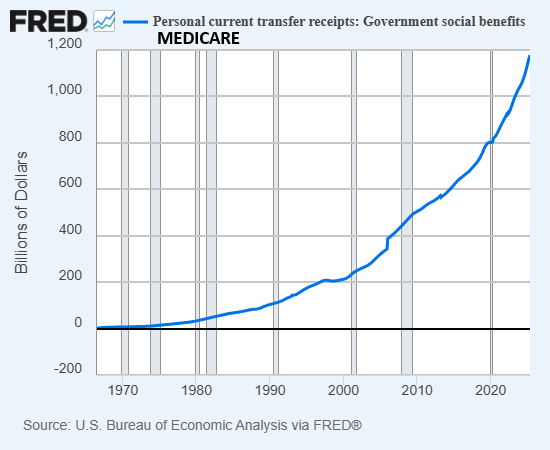
Medicare costs: parabolic:


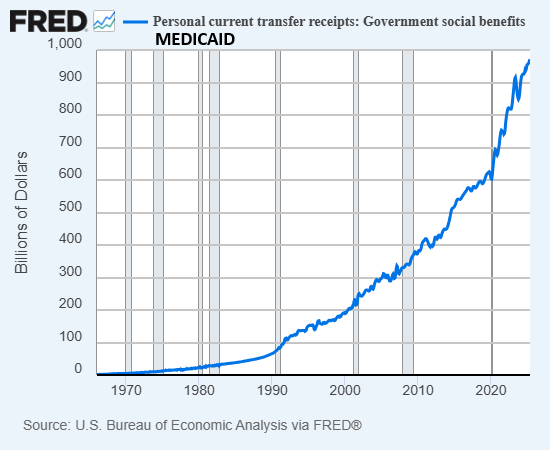
Medicaid costs: parabolic:


My new book Investing In Revolution is available at a 10% discount ($18 for the paperback, $24 for the hardcover and $8.95 for the ebook edition). Introduction (free)


NOTE: Contributions/subscriptions are acknowledged in the order received. Your name and email remain confidential and will not be given to any other individual, company or agency.

Thank you, C.J.G. ($7/month), for your magnificently generous subscription to this site -- I am greatly honored by your support and readership.


Thank you, Coconut Snowshoe ($7/month), for your marvelously generous subscription to this site -- I am greatly honored by your support and readership.


Thank you, Jeff M. ($7/month) for your superbly generous subscription to this site -- I am greatly honored by your support and readership.


Thank you, Love Simply ($70), for your splendidly generous subscription to this site -- I am greatly honored by your support and readership.

Read more...
Terms of Service

All content on this blog is provided by Trewe LLC for informational purposes only. The owner of this blog makes no representations as to the accuracy or completeness of any information on this site or found by following any link on this site. The owner will not be liable for any errors or omissions in this information nor for the availability of this information. The owner will not be liable for any losses, injuries, or damages from the display or use of this information. These terms and conditions of use are subject to change at anytime and without notice.

Our Privacy Policy:


Correspondents' email is strictly confidential. This site does not collect digital data from visitors or distribute cookies. Advertisements served by a third-party advertising network (Investing Channel) may use cookies or collect information from visitors for the purpose of Interest-Based Advertising; if you wish to opt out of Interest-Based Advertising, please go to Opt out of interest-based advertising (The Network Advertising Initiative). If you have other privacy concerns relating to advertisements, please contact advertisers directly. Websites and blog links on the site's blog roll are posted at my discretion.


PRIVACY NOTICE FOR EEA INDIVIDUALS


This section covers disclosures on the General Data Protection Regulation (GDPR) for users residing within EEA only. GDPR replaces the existing Directive 95/46/ec, and aims at harmonizing data protection laws in the EU that are fit for purpose in the digital age. The primary objective of the GDPR is to give citizens back control of their personal data. Please follow the link below to access InvestingChannel’s General Data Protection Notice. https://stg.media.investingchannel.com/gdpr-notice/


Notice of Compliance with The California Consumer Protection Act
This site does not collect digital data from visitors or distribute cookies. Advertisements served by a third-party advertising network (Investing Channel) may use cookies or collect information from visitors for the purpose of Interest-Based Advertising. If you do not want any personal information that may be collected by third-party advertising to be sold, please follow the instructions on this page: Limit the Use of My Sensitive Personal Information.


Regarding Cookies:


This site does not collect digital data from visitors or distribute cookies. Advertisements served by third-party advertising networks such as Investing Channel may use cookies or collect information from visitors for the purpose of Interest-Based Advertising; if you wish to opt out of Interest-Based Advertising, please go to Opt out of interest-based advertising (The Network Advertising Initiative) If you have other privacy concerns relating to advertisements, please contact advertisers directly.


Our Commission Policy:

As an Amazon Associate I earn from qualifying purchases. I also earn a commission on purchases of precious metals via BullionVault. I receive no fees or compensation for any other non-advertising links or content posted on my site.

  © Blogger templates Newspaper III by Ourblogtemplates.com 2008

Back to TOP