Every nation is operating on models that are collapsing without those at the controls being aware that the implicit assumptions of their models no longer map reality.
A recent article lays out the collapse of the dominant geopolitical model of "rising powers generate conflict":
The Stagnant Order And the End of Rising Powers (Foreign Affairs, paywalled). The basic idea is that the foundations of "rising powers"--demographics and productivity gains--no longer support grandiose planetary dominance.
Rather, demographics is already baked in as a crushing liability to all existing powers, and despite endless claims that technology will jumpstart productivity, the reality is productivity gains have flatlined for decades. "Growth" is a function of expanding debt, not productivity gains.
This dynamic extends beyond geopolitical models: all the models being used to explain and control the world are all collapsing: economic, social, political, they're all collapsing because they are all constructs assembled in eras that no longer map the present.
As I explained in
The Entire Bubble Economy Is a Hallucination, models collapse because of two limitations that define all models:
1. All models are self-referential, as they "train" (i.e. generate current analysis) on a limited spectrum of metrics that are presumed to summarize the immensely complex "real world." The model is blind to its own self-referential feedback loop and the limits of the metrics it bases its output on.
Over time, this self-referential "training" degrades the output--the analysis and the decisions based on that analysis--to the point of hallucination: the model is generating output of how the world works that has drifted to far from authentic understanding that it is a hallucination, one that is taken to be "real" by those controlling the model.
2. The metrics being measured leave out enormous fields of the real world, but what's been left out isn't explicit, as it's all based on what is considered "knowable" and "known," as I explained in What We "Know" Is More Dangerous Than the Unknown: these assumptions are hidden limitations of the model, as we only manage what we measure.
I break this down in my book Investing In Revolution.
The collapse of the dominant models is visible everywhere, but perhaps most painfully in economics, which has become the dominant model of how the world works due to the dominance of statistical models of finance and the policies those models generate.
I addressed this failure of economics to accurately predict outcomes back in 2013:
Why Isn't There a Demonstrably Correct Economic Theory? (August 16, 2013)
"This system is intrinsically unstable, as the financial claims of credit and fiat money on limited real-world resources and wealth eventually far exceed real-world resources, and the system of claims collapses in a heap.
Although economics doesn't recognize it, the operative phrase here is systemic injustice."
Why Economics Will Never Be a Legitimate Science (December 24, 2013)
All the extant economic models are artifacts of bygone eras. The economic models of the 19th century--all based on the implicit assumption that resources were endless--were modified in the 1930s into Keynesian hallucinations still based on endless resources: let's just pay people with freshly printed "money" to dig holes and fill them. This presumes endless resources to squander on digging holes and filling them, as if that is a productive use of labor and resources.
This hallucination continues to be the dominant paradigm: resources are endless because we're clever and there will always be a substitute for whatever is depleted, so the "solution" is just print "money" to pay people to dig holes and fill them.
The "problem" is "growth" of consumption, and so if we "solve" that problem by goosing consumption by any means available, we enter "Mouse Utopia," an artificial world of never-ending abundance.
The book
Money, Blood and Revolution: How Darwin and the Doctor of King Charles I Could Turn Economics into a Science takes a stab at turning economics into "science," but that's not actually "the problem."
The real problem is all models have intrinsic limits and end up hallucinating, but those controlling the gearing of the model depend on it to maintain their own power, so they are blind to the failure of their precious model to track the real world and generate authentic understanding.
So we're told that all is well because GDP and the stock market are rising, and since we have lots of natural gas to power AI data centers, we're entering a "Mouse Utopia" of endless abundance. That these are all hallucinations is lost on those clinging to collapsing models as the means of maintaining their power.
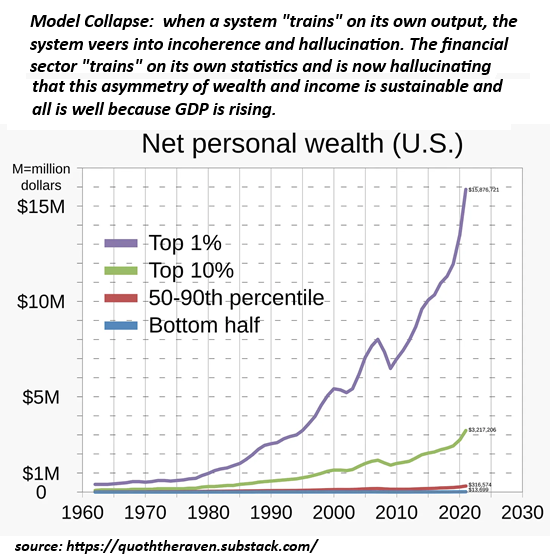
That the hallucinations are sustainable is itself a hallucination:
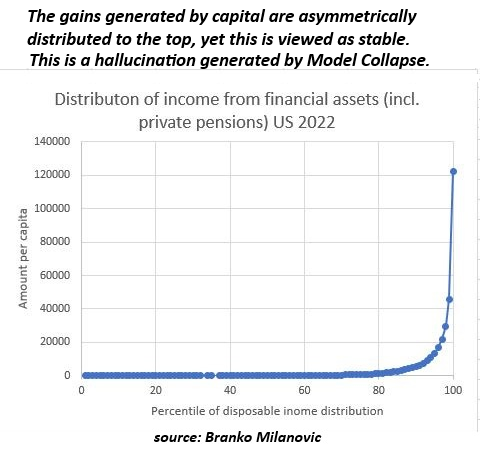
That the inhabitants of "Mouse Utopia" are not focused on how natty gas and AI are going to make Utopia even more utopian is lost in the current model collapse: antisocial behaviors are accelerating due to the the artificial nature and exploitive structure of our "Mouse Utopia," but these realities aren't measured and so they don't exist in the current model's self-referential hallucinations:
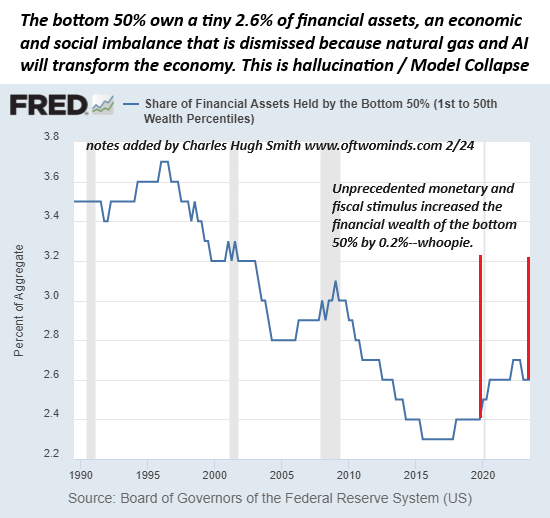
All the dominant models are collapsing at once, and no nation is immune to the consequences, as every nation is operating on models that are collapsing without those at the controls being aware that the implicit assumptions of their models no longer map reality:
If We Measured the Economy by Quality-of-Life Instead of GDP, We'd Be In a Depression
(October 16, 2025)
New Podcast:
Insane Financial Imbalances and a Social Revolution (36:34 min)
My new book Investing In Revolution is available at a 10% discount ($18 for the paperback, $24 for the hardcover and $8.95 for the ebook edition).
Introduction (free)
Check out my updated Books and Films.
Become
a $3/month patron of my work via patreon.com
Subscribe to my Substack for free
NOTE: Contributions/subscriptions are acknowledged in the order received. Your name and email
remain confidential and will not be given to any other individual, company or agency.
|
Thank you, Susan F. ($7/month), for your monumentally generous subscription
to this site -- I am greatly honored by your support and readership.
|
|
Thank you, Douglas H. ($7/month), for your marvelously generous subscription
to this site -- I am greatly honored by your support and readership.
|
|
Thank you, Dr X. ($70) for your superbly generous subscription
to this site -- I am greatly honored by your support and readership.
|
|
Thank you, Todd D. ($7/month), for your splendidly generous subscription
to this site -- I am greatly honored by your support and readership.
|