Monday, February 23, 2026

Money Is Funny That Way: The Case for USD Supremacy

The point here is not to make a prediction; the point is to keep an open mind about the social-construct / utility-value of currency.

The consensus holds that the US dollar is doomed, irrevocably sliding to zero. The US will continue issuing new dollars to maintain the pretense of stability until this money-printing triggers hyper-inflation, which will wipe out the USD's remaining shreds of value.

This consensus is largely based on the history of the Weimar Republic and other examples of money-printing (the only expedient solution) leading to the destruction of the currency. This could be the path the USD takes.

But money is funny that way. It is a social construct and so the range of possibilities is wider than we might imagine. As a thought experiment, let's construct a case for USD supremacy rather than collapse.

Let's start with two imaginary forms of money: the first is an internationally recognized currency backed by a pool of industrial commodities: metals such as silver and copper, fuels such as oil, etc. This currency's value isn't scarcity per se; its value is based on the utility-value of the commodities that back it.

Since it is aligned with a physical pool of resources, new currency can only be issued if the pool expands. It can't be borrowed into existence by central or private banks.

The second currency has an expiration date, and must be spent before it becomes worthless. This form of currency is often called a scrip. These two currencies reflect money's dual nature as a store of value and a means of exchange.

We will naturally save the first currency in our rainy-day or retirement fund, as its value is based on real-world stores of utility-value that aren't going away. We will spend the scrip-money as soon as possible, converting it into goods and services.

Switching gears, consider all the kinds of money one collects as one travels around the world. We end up with small bills and coins from various countries we visited. Every bill and coin is "money" in one place but of no value elsewhere until it is converted into the local currency.

This is also true of precious metals: trading a piece of silver for a bowl of noodles requires the seller of the noodles who accepts the silver to convert it into local currency or some other store of value, a process with inherent transaction / arbitrage costs.

And should the noodle seller have to pay taxes and fees, the government won't accept the piece of silver; the payment to the state must be made in the state's own currency.

This is an important feature of money that's generally misunderstood. Fiat currency isn't "backed by nothing;" its value is one's permission to participate in the economy of the state that issues the currency.

If this permission to participate seems of low value, consider a work / residency permit: without a work / residency permit, one can only participate in an economy on the margins. Full participation in an economy has far less friction / risk and lower costs than marginal participation.

Switching gears again, let's ask: what currency would you take that's likely to be accepted everywhere, from backwater souks to a developed-world metropolis.

The currency most likely to be accepted is a crisp $100 USD bill in protective plastic. This is not the result of the USD having any greater inherent value than any other form of paper money; it's a manifestation of the network effect: whatever is already ubiquitous / widely used has greater utility-value than alternatives with low rates of recognition, exchange and participation.

No one form of money offers all of these features without friction, tradeoffs and costs. This suggests the search for one ideal form of money is intrinsically futile. It also suggests that whatever forms of money offer 1) participation in the largest economic sphere, 2) the largest network effect / ubiquity / recognition and 3) a store of value with easy price-discovery will have greater utility and less friction than any other single alternative.

All of these factor into demand for the currency. There is 1) built-in demand for stores of value, 2) built-in demand to circulate scrip-money that is losing its value to time decay, and 3) built-in demand for currencies that offer participation in the widest possible sphere of opportunity and ubiquity / network effect.

Money issued by states has another funny attribute: the supply can be limited or expanded. Should the supply expand at a rate lower than the expansion of demand, as with any other commodity, the price / purchasing power of the commodity will rise.

The demand for currency is harder to measure than the supply, as the demand is the sum total of millions of participants seeking savings, low-friction transactions, network effects, arbitrage gains, etc., while supply can be measured (imperfectly) with far greater ease.

The case for USD supremacy rests on its imperfect but still advantageous combination of sources of utility-value, each of which is unique: the ease of price discovery, the low-friction transactional ease of use, the network effect ubiquity and participation in the widest possible sphere of opportunity.

Each of these attributes isn't just a reflection of a central bank's policy du jour; it's a reflection of the entirety of the issuing state's governance, institutions, economy, social trust, network effects and cultural values.

If demand expands faster than supply, the value of the money measured in various ways (purchasing power, trustworthiness, predictability, etc.) rises accordingly. "Money" in all its forms is a commodity, and follows the same supply/demand pricing as any other commodity.

The case for USD supremacy boils down to this: if risks start rising globally, demand may expand faster than supply, and continue increasing as rising demand and the network effect combine to push the value even higher in a self-reinforcing feedback.


Money is funny that way. We think we understand everything about it, and so even as we predict a currency should keel over, it wins the marathon.

The point here is not to make a prediction; the point is to keep an open mind about the social-construct / utility-value of currency.

Of related interest:

Could a Rip-Your-Face-Off Rally in the Dollar Trigger a Global Financial Crisis? (October 21, 2025)

Money and Work Unchained (book)


My new book Investing In Revolution is available at a 10% discount ($18 for the paperback, $24 for the hardcover and $8.95 for the ebook edition). Introduction (free)


Check out my updated Books and Films.

Become a $3/month patron of my work via patreon.com

Subscribe to my Substack for free


NOTE: Contributions/subscriptions are acknowledged in the order received. Your name and email remain confidential and will not be given to any other individual, company or agency.

Thank you, David S, ($200), for your beyond-outrageously generous subscription to this site -- I am greatly honored by your steadfast support and readership.


Thank you, Irving W. ($7/month), for your magnificently generous subscription to this site -- I am greatly honored by your support and readership.


Thank you, Andrew D. ($100) for your outrageously generous subscription to this site -- I am greatly honored by your steadfast support and readership.


Thank you, Meg ($7/month) for your splendidly generous subscription to this site -- I am greatly honored by your support and readership.

Read more...

Friday, February 20, 2026

What Defines a "Good Economy"? Social Mobility and Not Losing Ground

What defines a "Good Economy"? Real advances in ownership of capital and the real-world resources an hour of labor can buy are within reach of the majority.

What defines a "good economy"? To answer this, we start with a second question: a "good economy" for whom? Economists turn to financial statistics to answer both queries, and this brings us face to face with the core difficulty with statistics: "money" is an overlay on the real world, and doesn't necessarily map the real world.

Economists measure "the economy" as a whole with GDP (gross domestic product), inflation, trade deficits or surpluses, money supply, the total credit/debt outstanding, productivity, and so on, but who's getting the real-world consequences--who's gaining ground and who's losing ground--is harder to determine.

Wealth as measured in money can be rising but this doesn't guarantee we're getting a higher quality of life. Much of real-world life can't be distilled down to dollars and cents, and so we ignore what's difficult to measure in favor of what's easy to measure: financial data.

I have long held that the only truly accurate measure of gaining or losing ground is how many real-world resources can be bought with one hour of labor. In other words, how many hours do we need to work to pay for shelter, healthcare insurance, childcare, college, food, utilities, transportation, etc.?

If we have to work more hours to buy the same resources that previously required fewer hours of work to buy, we're losing ground, regardless of statistics such as GDP, productivity, inflation, etc. If one hour of labor buys more real-world resources, products and services, we're gaining ground.

Put another way, the only meaningful measure of whether an economy is good or bad is social mobility, which has two components:

1. Whether we're gaining ground as defined above--what each hour of our labor can buy in real-world resources, and

2. Whether we're accumulating productive capital--assets that generate income and increase productivity--or not.

This is where the abstract world of economists touting higher GDP, net worth and income fails in a systemically consequential fashion: GDP can be rising, one's house can be gaining in value so our "wealth" is rising and our income can be rising, but if our labor buys less of the real world and we're just keeping our head above water paying for essentials, then all those "positive statistics" mean nothing.

Social mobility describes the relative ease or difficulty of advancing not just one's income but one's ownership of productive capital. If only a handful of the bottom 80% can manage to claw their way into the top 20% as measured by ownership of productive assets, social mobility is broken.

If the core qualities of middle-class life are out of reach or demand extraordinary sacrifices and luck, social mobility is broken. These include a secure career / employment, healthcare, a home, and sufficient surpluses to accumulate productive assets, as opposed to gambling.

Economists have mastered Ultra-Processed Life, which is the substitution of artifice for authenticity. So we're supposed to accept that the auto that cost $24,000 a few years ago that now costs $40,000 is "equivalent" because it has more digital systems and air bags overlooks the reality that we have no choice but to buy what is being produced today: if we need a car, we now pay $40,000, and if this takes far more hours of work to buy, we've lost ground, regardless of "hedonics."

Italian economist Vilfredo Pareto found that the top 20% of households own about 80% of the land / productive wealth, and this ratio doesn't vary much. What varies is the dynamism of the flow of people into and out of the top 20%, i.e. social mobility both up and down.

When ownership of assets that produce income becomes concentrated above this 80/20 distribution, the social order / economy become unstable as social mobility decays and those in the top tier lock in their advantages.

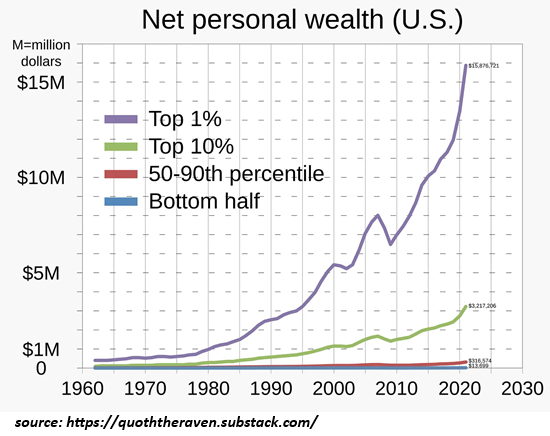
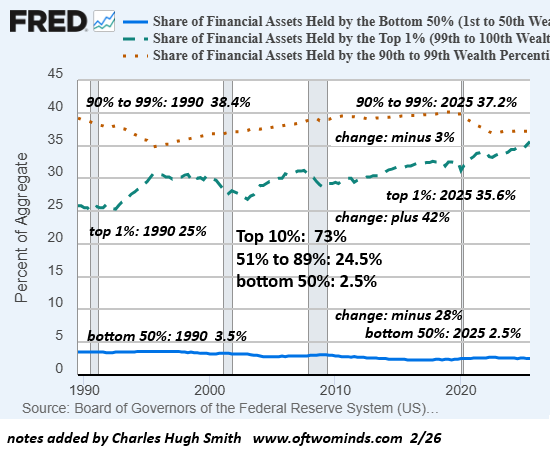
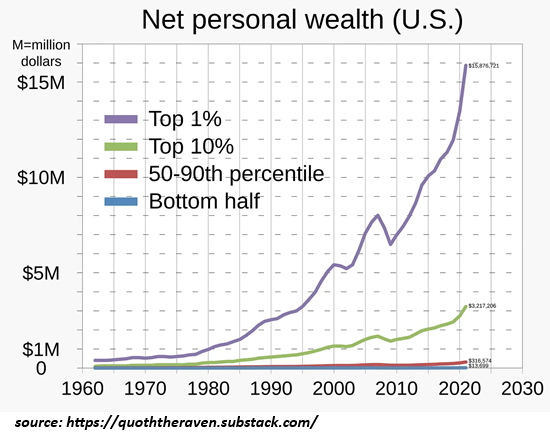
In the US, the top 10% now own roughly 3/4ths of all financial wealth. The "middle class" (those between the bottom 50% and the top 10%) own about 1/4th, and the bottom 50% own a signal-noise sliver: 2.5%. This distribution is more concentrated than 80/20.


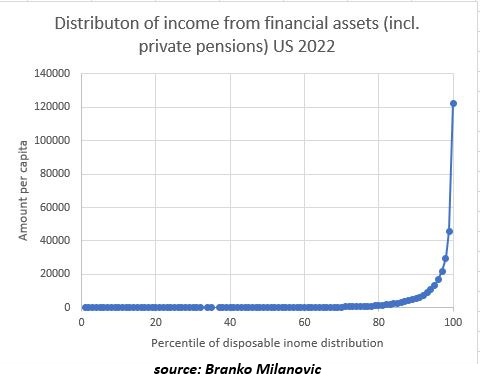
Here's another depiction of the same reality: a grossly imbalanced economy that favors the few.


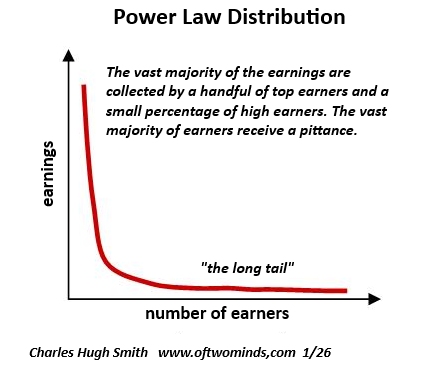
The income generated by capital is concentrated in the few at the top, a power-law distribution:


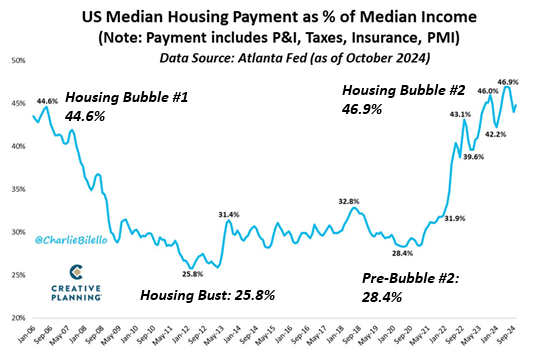
The cost of buying/owning a home is higher than previous eras, requiring far more hours of work to pay the mortgage, property taxes, home insurance, maintenance and other costs.


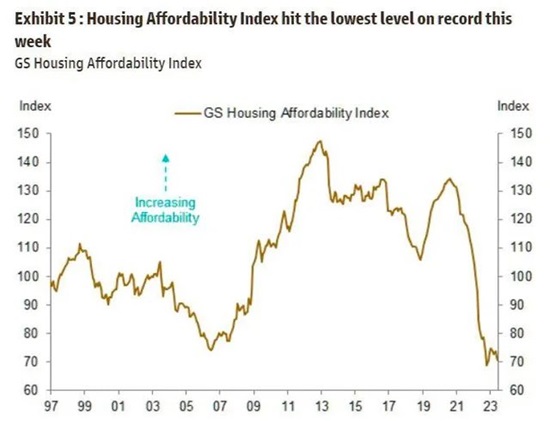
Housing affordability is at historic lows, meaning home ownership is out of reach of those who once could have bought a home without extraordinary sacrifices or family wealth.


A college education did not require student loans a few decades ago. Now it requires debt-serfdom or wealthy parents: the number of hours needed to "buy" a university education has skyrocketed.


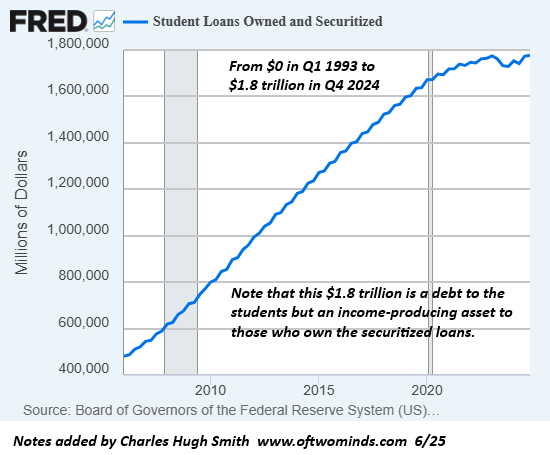
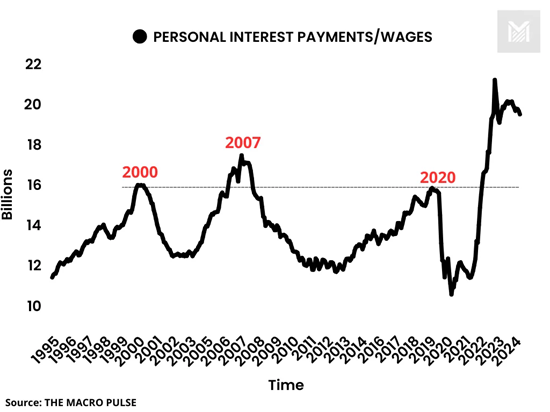
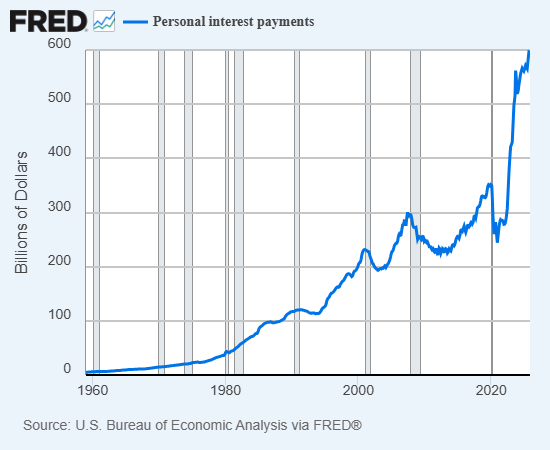
As debt becomes the norm to afford a middle-class quality of life, an increasing share of wages is devoted to debt service/interest. Recall that every student loan and mortgage is a debt to the borrower but an income-producing asset to the owner of the loan.


The income spent paying interest is income that cannot be set aside to accumulate productive capital.


An economy where people are increasingly relying on gambling as their last-ditch means to secure a future that is less precarious than the present is not a "good economy" except for the top 10%. And to the degree their wealth is also a gamble placed in a central-bank casino, the precarity of all this wealth is masked by the artificial "goodness" of statistics that reflect artifices rather than the real world.

What defines a "Good Economy"? Real advances in ownership of capital and the real-world resources an hour of labor can buy are within reach of the majority. In an era of rising precarity and receding social mobility, many will settle for Not Losing Ground.


My new book Investing In Revolution is available at a 10% discount ($18 for the paperback, $24 for the hardcover and $8.95 for the ebook edition). Introduction (free)


Check out my updated Books and Films.

Become a $3/month patron of my work via patreon.com

Subscribe to my Substack for free


NOTE: Contributions/subscriptions are acknowledged in the order received. Your name and email remain confidential and will not be given to any other individual, company or agency.

Thank you, Good Journal Capital ($75), for your massively generous subscription to this site -- I am greatly honored by your support and readership.


Thank you, SDC ($7/month), for your magnificently generous subscription to this site -- I am greatly honored by your support and readership.


Thank you, Bruce L.M. ($60) for your superbly generous subscription to this site -- I am greatly honored by your support and readership.


Thank you, Tap ($7/month) for your splendidly generous subscription to this site -- I am greatly honored by your support and readership.

Read more...

Tuesday, February 17, 2026

Small Business in the TINA Economy: Competing for the Scraps

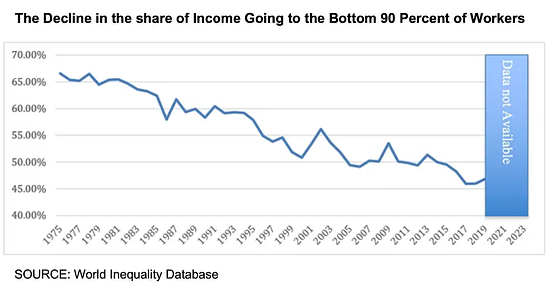
While the top 10% who manage the TINA Economy are fixated on their ballooning stock market wealth, the bottom 90% are melting away. Some day that might actually have consequences.

Let's start with a thought experiment focusing on soaring household expenses. Consider healthcare insurance, which has risen not just in the monthly premiums paid by employers and employees, but in higher fees out of pocket and co-pays. The value of the healthcare insurance has declined as households opt for high-deductible plans and insurers deny claims to reduce their expenses.

Let's say that a household paying their own insurance seeks to lower their costs by finding a local provider rather than one of the giant corporate insurers which effectively form a cartel. They soon discover that there aren't any local providers of healthcare insurance. There may be direct primary care alliances that offer some services, but virtually all healthcare insurance in the US is controlled by a handful of corporations, a cartel with superficial competition.

This is also the case for home and auto insurance, utilities, education expenses and interest on debt all of which are rising rapidly for many households. In every case, the competition between the handful of giant corporations that dominate each sector is superficial, as this is the point of cartels and quasi-monopolies: eliminate competition to keep revenues and profits high.

A slew of essential services such as Internet and mobile phone subscriptions are also controlled by a handful of providers. Introductory offers that expire in a few months provide a fig-leaf of competition, but the actual cost differences are negligible: maybe enough to buy one sandwich a month, not enough to restore a stretched household budget.

Other services such as auto repair and veterinary services are soaring in cost as the same cartels squeezing households are squeezing small businesses. In some cases, private equity has been buying up local services, assembling hidden cartels behind a screen of illusory local ownership.

Then there's the software subscriptions employees are expected to maintain, costly credentials they must pay for to keep their jobs, and a host of similar expenses which are controlled by other quasi-monopolies and cartels.

Note that these are all big-ticket expenses: healthcare, home and auto insurance, auto repairs / maintenance, utilities, etc. cost thousands of dollars annually. If the cost of a new TV declines $100, that "falling inflation" is a drop in the bucket of the big-ticket expenses that are consuming thousands of extra dollars a year.

As household budgets are squeezed by soaring costs for which there is no alternative--the TINA Economy--the sum left for discretionary spending is reduced. Non-competitive cartels and quasi-monopolies controls virtually all the big-ticket TINA expenses that are soaring by leaps and bounds, leaving the rapidly shrinking pool of discretionary household budgets to the local, small-business sector which is the only sector that is still marginally competitive.

So while corporations and cartels such as higher education and credentialing feast on TINA--there is no alternative in a monopoly-cartel controlled economy--small businesses must compete for the scraps left (discretionary spending) after the cartels have consumed the majority of household budgets, fattening the profits / revenues that fuel their political and market power.

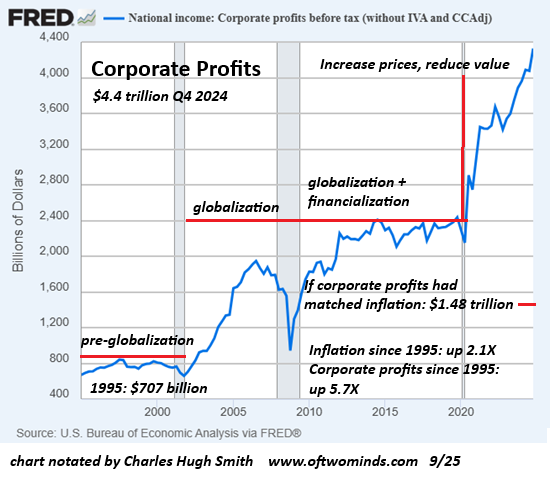
This is why corporate profits are soaring while small businesses are in decline: since there's only superficial competition for big-ticket expenses, households have no alternative to paying higher costs. What money is left is all that can be spent supporting local enterprises, which face the double-whammy of higher operating costs imposed by the same cartels squeezing households and the diminishing pool of discretionary income left to households.

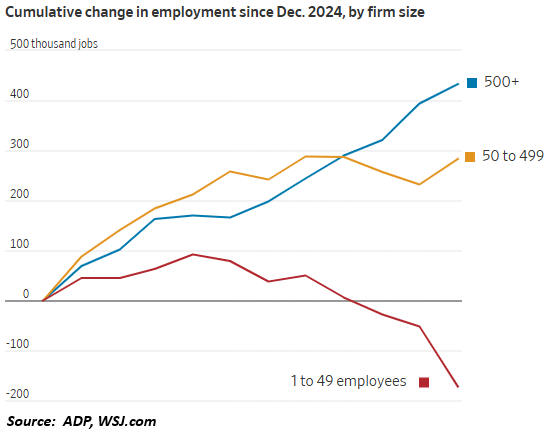
The Economic Divide Between Big and Small Companies Is Growing: Economic fortunes of low- and high-income Americans are diverging--same pattern happening with companies. (WSJ.com)

--The growing divide between the fortunes of small and large businesses mirrors the divide that has emerged over the past year between low-income Americans and their high-income counterparts.

--Large, publicly traded companies in the S&P 500 saw net income increase by 12.9% in the third quarter, contrasting with faltering small-business profits.

--Small businesses are facing economic headwinds, including high inflation and cautious consumers, leading to job cuts; 120,000 jobs were shed in November.


Small business, whose ownership and interests are diffuse, have been reduced to tax donkeys struggling to pay soaring rent, wages, utilities and overhead costs without the market muscle of monopolies / cartels to force consumers to pay higher prices for degraded goods and services.

While large corporations are adding employees, small businesses are shedding employees to survive.


Corporate profits reflect this structural asymmetry: the large corporations that have eliminated competition are expanding their revenues and profits, leaving less for the only sector that still faces competition, small businesses:


We're constantly assured an economy where the gains follow an extraordinarily asymmetric power-law distribution is a wondrous engine of sustainable growth that benefits everyone, but the facts don't support this fairy-tale PR promoted by the winners to placate those losing ground.


This distribution of the gains to the few and the costs to the many is not inevitable, it was the direct result of policy choices made by our political class in response to the money and lobbying funded by the few to increase their share of the economy's gains by any means available.

The avalanche analogy is apt: the snowpack looks stable because the melting is hidden from view. But when a critical point that cannot be predicted is reached, the mountainside gives way. While the top 10% who manage the TINA Economy are fixated on their ballooning stock market wealth, the bottom 90% of households and small enterprises are melting away. Some day that might actually have consequences.


This is where the TINA economy is heading: there is no alternative to system breakdown.

The Middle Class Vanishing Act Nobody Saw Coming Until It Was Too Late (medium.com)


My new book Investing In Revolution is available at a 10% discount ($18 for the paperback, $24 for the hardcover and $8.95 for the ebook edition). Introduction (free)


Check out my updated Books and Films.

Become a $3/month patron of my work via patreon.com

Subscribe to my Substack for free


NOTE: Contributions/subscriptions are acknowledged in the order received. Your name and email remain confidential and will not be given to any other individual, company or agency.

Thank you, Natli V. ($75), for your massively generous subscription to this site -- I am greatly honored by your support and readership.


Thank you, Willis S. ($7/month), for your magnificently generous subscription to this site -- I am greatly honored by your support and readership.


Thank you, lloyd L. ($70) for your superbly generous subscription to this site -- I am greatly honored by your support and readership.


Thank you, Howard R. ($7/month) for your splendidly generous subscription to this site -- I am greatly honored by your support and readership.

Read more...

Thursday, February 12, 2026

What Few Understand About Money

This leaves out the purpose of money, which is facilitating social organization.

I've thought a lot about "money" and wrote two books that explore what few understand about money: that it's fundamentally a social construct with a social purpose and structure. The books are Money and Work Unchained and A Radically Beneficial World.

The conventional understanding of money is that it's a financial unit with economic functions--store of value, means of exchange and unit of accounting-- defined by its intrinsic nature as a material that's valuable or convenient.

So gold is "real money" because it's physically permanent, convenient in size and scarce, and fiat currency--paper money and its digital versions--are intrinsically worthless as paper is fragile and digital currency is conjured out of thin air.

This leaves out the purpose of money, which is facilitating social organization. Money's social function and structure is the water we swim in, unseen because we take it for granted.

Many have embraced the view that all our problems would be solved if we returned to the gold standard or adopted Bitcoin. The simplicity of this is appealing, but when examined under the lens of social purpose and function, the simple solutions turn out to have limits: being a store of value isn't enough, as the wealthy hoard stores of value and remove them from circulation. Hoarded stores of value don't enable social mobility, they limit it.

When the social waters we swim in become turbulent, money reveals its fluid, adaptive nature. In a severe famine, for example, the most valuable store of value and most sought-after means of exchange are non-perishable food items and train tickets that take the holder far away from the famine. Gold will have potential value on the periphery, but the most valuable "money" are flimsy train tickets and things we can consume to stave off starvation.

Let's shed light on the social nature of money with a thought experiment.

Let's say there is a geographically defined region with scattered gold deposits. that can be panned in streams or collected with simple hand tools. Gold is the store of value and means of exchange, but its exchange value fluctuates depending on the scarcity of what people want to buy: eggs, shelter, tools, etc.

Two townships arise in this region. The first is conventional: mining gold is a "winner takes all" activity: as long as a miner has a legitimate claim, whatever gold is found is theirs to keep. So when a lucky miner stumbles on a big rock that turns out to be almost solid gold, he quietly uses this windfall to buy up the town's mining claims, land and businesses as a silent partner. Once he controls the town, he raises prices to milk the residents, exploiting his gold hoard in an extractive fiefdom.

The fact that gold is money worked well for the wealthy owner hoarding the gold but not for everyone else. Social mobility--a key social purpose of money--is limited in this neofeudal economy.

The other township establishes by vote of the residents a much different social construct for the gold. Rather than "winner takes all," every miner agrees to put 20% of whatever gold they collect into a common fund that has two purposes: to provide a small stake for those miners who have worked diligently but come up empty due to bad luck or illness, and a town "rainy day fund" for periods where the work stops due to severe weather or other events.

Those tasked with collecting and protecting the town's gold fund are duly elected and scrutinized to insure their conduct is above-board and they're doing their job correctly.

This system works well until an extended period of declining yields of gold begins pressuring the service population--the laundries, restaurants, etc. that the town needs to survive. Those managing the gold fund explain the situation and obtain permission from the miners to extend the modest hard-luck stipend to service workers should they otherwise be forced to abandon the town, leaving the residents without key services.

Even when yields stabilize, it's now obvious that the easy gold has been recovered, and yields will continue declining. The town residents face abandoning the town or starting some other industries to compensate for the decline in gold mining.

The leadership comes up with an idea: why not issue paper currency for use in the town, based on the gold still held in reserve, and save whatever new gold is added to the town's fund for trading for essentials from elsewhere? The paper currency will be "backed by gold": as the town's gold won't be spent, this paper money will have something valuable behind it. The paper money is a representation of value rather than a valuable object in itself.

After some skepticism, the miners agree because the other option--abandoning the town--is even less appealing. After all, the decline in gold yields isn't limited to the township; it's happening everywhere. Pulling up stakes and trying to find an as-yet unexploited area is a gamble with poor odds.

After some hesitation, the paper money is distributed to residents as their stipend and used to pay for services and materials. Those accepting the paper find they can buy goods from other merchants with the paper money, and so trust in the new money is established.

Miners who abandoned their claims are paid to dig deeper mines with the paper money, and a small lumber harvesting operation is also funded by the paper money. Merchants still need gold to buy products from afar, but the paper money encourages residents to start producing more food locally. Though gold production is way down, the paper money has funded the labor needed to continue producing enough gold for outside trade.

The town actually expands as new residents take advantage of the opportunities--social mobility is broadening--and while the leaders maintain the town's stash of gold, the paper money that's needed to grease commerce and pay wages now far exceeds the value of the gold in the town vault.

In effect, the town is issuing a fiat currency, a paper money with no intrinsic value, based on the trust that there is gold backing it up.

But this paper money isn't actually valueless. It's backed by the social structure and purpose of the town's economy--the residents' trust in the institutions, their fellow residents, and in the valuable work being enabled by the paper currency.

As long as the worker issued $1 in paper money can buy $1 of goods with that piece of paper, and the merchant who accepts the $1 can buy labor, goods and services with it, the system functions smoothly.

The key to the system's trust is the leadership's discipline in only gradually expanding the issuance of the paper currency in line with the expansion of the workforce and town's economy. For if the currency doesn't expand enough, the town's economy is starved of both means of exchange and "small money" store of value.

If the leaders issue too much paper money, this excess eventually reduces the value of the paper money and residents will lose trust in the system. The ideal they must seek is scarcity of paper money, but not so severe that it begins limiting hiring and commerce. They must resist the natural demands for more money entering circulation, as the entire structure is trustworthy precisely because there is resistance to issuing any more than the absolute minimum needed to keep the wheels of commerce turning.

But consider what happened: a gold standard--gold was the only money--was dooming the township as the supply of new gold was no longer enough to turn the wheels of commerce. The social purpose of money--maintaining a viable economy, social mobility and a vibrant social order--demanded the introduction of fiat currency, which could be prudently expanded as needed.

The town thrived by doing what many consider is the opposite of financial wisdom: they abandoned a gold standard in favor of fiat currency as the only means of not just surviving, but of thriving by enabling an expansion of work and initiative.

(if this seems farfetched, study the history of paper money in dynastic China.)

This is why I have suggested a labor-backed currency: rather than return to a system in which the wealthy hoard the majority of gold or Bitcoin, or give the power to issue currency to central banks and private banks who enrich those already at the top of the wealth-power pyramid, money is only issued when useful work has been performed. This money is created at the bottom of the pyramid to pay those doing useful work, which is the ultimate foundation of a productive social order and economy.

Money is a social construct with an implicit structure and purpose which we swim in but don't even see. Money is fluid and must adapt to fulfill social purposes. If it fails to do so, it's not just money that fails, the entire society fails.


My new book Investing In Revolution is available at a 10% discount ($18 for the paperback, $24 for the hardcover and $8.95 for the ebook edition). Introduction (free)


Check out my updated Books and Films.

Become a $3/month patron of my work via patreon.com

Subscribe to my Substack for free


NOTE: Contributions/subscriptions are acknowledged in the order received. Your name and email remain confidential and will not be given to any other individual, company or agency.

Thank you, Mark E. ($70), for your massively generous subscription to this site -- I am greatly honored by your support and readership.


Thank you, Tomas ($7/month), for your magnificently generous subscription to this site -- I am greatly honored by your support and readership.


Thank you, A Water Bearer ($7/month) for your superbly generous subscription to this site -- I am greatly honored by your support and readership.


Thank you, Ryan P. ($7/month) for your splendidly generous subscription to this site -- I am greatly honored by your support and readership.

Read more...
Wednesday, February 11, 2026

Self-Employment Series #2: Ownership Is Not Freedom

Ownership collapses abstraction.

This guest essay by correspondent 0bserver is #2 in a series on self-employment / owning your work. The first entry was Owning Your Work in a World That Rents Your Life.


Charles Hugh Smith's book Get a Job, Build a Real Career and Defy a Bewildering Economy did not resonate with me because it promised escape.

It did the opposite. It stripped away illusions.

Self-employment is often marketed as freedom: no boss, flexible hours, autonomy.

In reality, it is ownership. And ownership is heavier than people expect.

When you own your income, you also own:

Risk
Uncertainty
The learning curve
The boredom
The consequences of poor decisions
The cost of hesitation

There is no HR department to absorb mistakes.

No manager to hide behind.

No structure unless you order it yourself.

That reality alone filters out most people--not because they are lazy, but because their goals are oriented toward comfort rather than responsibility.


The Shift No One Prepares You For

The hardest part of building a self-owned income stream is not technical.

It is psychological.

You have to abandon assumptions that are quietly reinforced for years:

That effort should be quickly rewarded
That credentials confer value
That security comes from institutions
That direction will be provided

None of that survives ownership.

Revenue does not care how hard you worked.

Customers do not care how clever you are.

The market does not care what you intended.

It responds only to value delivered, consistently, under constraint.

That requires a different orientation toward time.

Days give way to weeks.

Weeks expand into months.

Eventually, years become the unit of measurement.

Most people do not fail because they lack ability.

They fail because they measure progress using the wrong clock.


Loneliness, Boredom, and Friction

Self-employment is lonelier than advertised.

There is no shared ladder, no approved narrative, no external validation.

You don't get credit for persistence.

You don't get applause for showing up.

Much of the work is unglamorous:

Repeating tasks that don't scale yet
Fixing small operational failures
Saying no to distractions that feel productive
Doing things manually because leverage comes later

There are long stretches where nothing appears to happen--except quiet improvement.

Those stretches are where most people quit.

Not because the work is too hard, but because it is dull.


Feedback, Authority, and Reality

Ownership collapses abstraction.

It forces human capital into direct contact with reality.

Feedback arrives through product quality, timing, and process.

It is immediate and unforgiving.

One of the harder lessons is that ownership cannot be delegated.

Responsibility without final authority does not create empowerment--it creates resentment.

Businesses are not voluntary societies.

Someone has to decide.

Someone has to absorb the consequences.

Cleverness works early.

It fails under scale.

Structure survives pressure.

That realization changes how you operate--and how you lead.


Why So Much Work Is Being Exposed

This is why the current economic adjustment feels so destabilizing.

Large portions of modern work drifted away from value creation and toward coordination, signaling, and lifestyle optimization. When conditions were loose, that drift was tolerated. When conditions tighten, it is not.

Ownership environments do not allow that separation.

If something does not produce value, it disappears quickly.

That is not cruelty.

It is feedback.

And feedback, while uncomfortable, is clarifying.


What Ownership Actually Provides

This is not a warning against self-employment.

It is an argument for honesty.

If you accept the tradeoffs, ownership offers something rare:

Alignment between effort and outcome
Skills that compound rather than expire
Optionality grounded in capability, not permission
Social capital built through accountability

These rewards come late.

And they only arrive once the work stops being an identity project and becomes a discipline.

You do not become self-employed.

You build something that earns the right to exist.


Conclusion

Ownership forced me to recalibrate what I measure and why.

Progress stopped looking like recognition.

Success stopped meaning comfort.

Work stopped being expressive and became accountable.

Nothing about it felt free at first.

Most of it felt heavier.

But over time, the weight clarified what mattered.

And clarity--not freedom--is what ownership ultimately provides.

This is a guest essay by longtime correspondent 0bserver.


My new book Investing In Revolution is available at a 10% discount ($18 for the paperback, $24 for the hardcover and $8.95 for the ebook edition). Introduction (free)


Check out my updated Books and Films.

Become a $3/month patron of my work via patreon.com

Subscribe to my Substack for free


NOTE: Contributions/subscriptions are acknowledged in the order received. Your name and email remain confidential and will not be given to any other individual, company or agency.

Thank you, Mark E. ($70), for your massively generous subscription to this site -- I am greatly honored by your support and readership.


Thank you, Tomas ($7/month), for your magnificently generous subscription to this site -- I am greatly honored by your support and readership.


Thank you, A Water Bearer ($7/month) for your superbly generous subscription to this site -- I am greatly honored by your support and readership.


Thank you, Ryan P. ($7/month) for your splendidly generous subscription to this site -- I am greatly honored by your support and readership.

Read more...
Tuesday, February 10, 2026

A Market Crash and Recession Are Bullish, Not Bearish

This isn't "Capitalism," it's Model Collapse ushering in the inevitable conflagration.

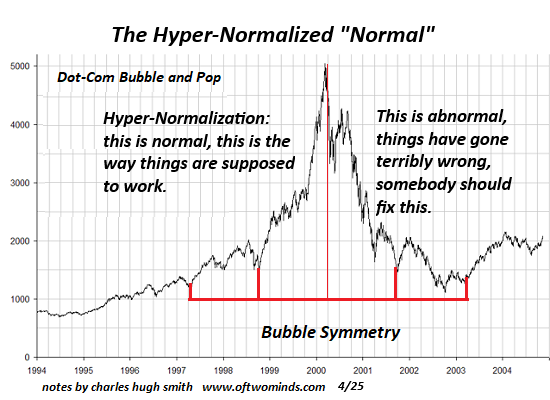
One of the most peculiar hyper-normalized hallucinations about "Capitalism" is that markets and the economy "should always go up" and if they don't, something is terribly wrong and somebody better do something to fix it.

Remarkably, this hyper-normalized hallucination is the exact opposite of real-world "Capitalism," which relies on the periodic clearing of excesses of debt, leverage and speculation as its essential mechanism of self-correction and adaptation. If these are stripped out, "Capitalism" fails as a system.

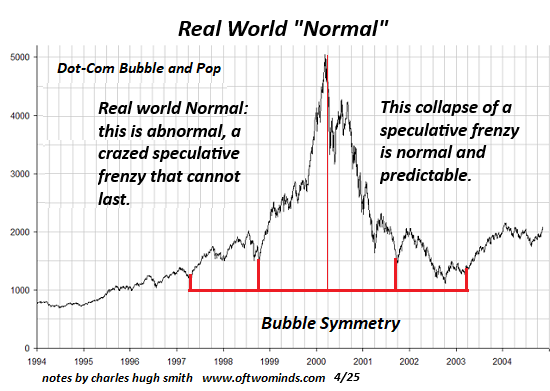
The two charts of the NASDAQ stock index below illustrate the astounding divide between a real-world understanding of "Capitalism" and the hyper-normalized hallucination of always goes up "Capitalism."

Various justifications are trotted out to support the "markets and GDP should always go up" narrative:

1. There's always a Bull Market somewhere. In other words, the market and "growth" are always going up somewhere, and so rotating out of flat sectors into growing sectors enables markets to always go up.

2. The economy can no longer survive a market crash or recession, and so we can't allow either to happen. Spoiler alert: If the market and economy cannot survive self-correction, then "Capitalism" as a system has already failed.

3. The Federal Reserve has mastered the art of manipulating--oops, I mean managing--the market and economy via adjusting the dials of liquidity, stimulus, money supply, cost of credit, etc. As a happy result of their god-like financial powers, markets and GDP will never go down again, barring an alien invasion or asteroid strike.

These justifications overlook the need for systems to self-correct self-reinforcing excesses that reflect the inevitable self-reinforcing human emotions: greed / confidence and doubt / fear: soaring markets generate demand for more credit and leverage to boost higher risk gambles which in the euphoria of the bubble are perceived as guaranteed to win rather than guaranteed to fail.

Given that the core functions of capitalism require feedback that correct / clear excesses, these justifications are incoherent. Dynamic systems such as capitalism don't remain in a steady state; they are constantly in motion, and humanity's herd instinct and built-in attraction to windfalls will inevitably generate the madness of crowds which then generate excesses of borrowing, leverage, risk and speculation, all of which must be reset via market crashes and recessions.

If corrective market crashes and recessions are not allowed (via ever higher stimulus, moral-hazard backstops of the biggest gamblers, etc.), then the system becomes increasingly brittle and dependent on hallucinations such as "markets can always go up, and so they should always go up."

Actually, excesses must be wiped out to enable markets and economies to reset organically rather than kept aloft by centrally organized manipulation. The forest fire analogy explains this: routine, periodic fires burn off the deadwood that piles up in a forest, clearing space for new growth. If these healthy fires are suppressed, the deadwood (debt, leverage, speculation, moral hazard) reach dangerous extremes: when a fire finally ignites, the conflagration consumes the entire forest.

This is how markets clear excesses of speculation and risk: they crash 80% and reset over a period of years. Though the crash is naturally viewed as disastrously bearish by those absorbing the losses, it's ultimately bullish for the economy and market, as suppressing the self-correction generates system collapse.


This is how the incoherent, system-failure hallucination views this bullish process: quick, do more of what crippled the system to maintain the illusion that "Capitalism" is "markets always go up."


This isn't "Capitalism," it's Model Collapse ushering in the inevitable conflagration.


My new book Investing In Revolution is available at a 10% discount ($18 for the paperback, $24 for the hardcover and $8.95 for the ebook edition). Introduction (free)


Check out my updated Books and Films.

Become a $3/month patron of my work via patreon.com

Subscribe to my Substack for free


NOTE: Contributions/subscriptions are acknowledged in the order received. Your name and email remain confidential and will not be given to any other individual, company or agency.

Thank you, Richard C. ($70), for your massively generous subscription to this site -- I am greatly honored by your support and readership.


Thank you, Bill ($7/month), for your magnificently generous subscription to this site -- I am greatly honored by your support and readership.


Thank you, Buppa68 ($7/month) for your superbly generous subscription to this site -- I am greatly honored by your support and readership.


Thank you, Catatonic ($7/month) for your splendidly generous subscription to this site -- I am greatly honored by your support and readership.

Read more...
Sunday, February 08, 2026

The Banality of Evil and Those Who Said No

In the Realm of the Banality of Evil, saying yes is always easy. The hard part is saying no, for reasons that have nothing to do with getting ahead.

The Epstein files have unleashed a flood tide of bleatings of innocence and accusations of guilt by association. This is just what we'd expect in the Realm of the Banality of Evil, a phrase made famous by Hannah Arendt, who described the "terrifyingly normal" participants in systems that normalize evil of the sort that "could not be traced to any particularity of wickedness, pathology or ideological conviction in the doer, whose only personal distinction was a perhaps extraordinary shallowness."

Amidst this flood tide of proclaimed innocence, consider the forgotten few who declined invitations to enter Epstein's circle of influence. While the files record those who accepted an invitation, those who said no appear to be less well documented.

Was it really that difficult to make a few inquiries about the host before saying yes? Or was the attraction of obtaining favors, funding and flattery just too powerful to resist? Or was it the promise of rubbing shoulders with the rich and powerful that was impossible to resist? Or was it the discreet promise of self-indulgence without limit?

Yet some did make inquiries and declined. Some said no. These few are forgotten, for their refusal is an indictment of the entire status quo. In the rush to declare everyone's innocence, perhaps we should first consider those who refused the invitations for self-evidently sound reasons.

In the context of the Banality of Evil, those few who said no are the only real innocents. Everyone who said yes was manifesting ordinary obedience to the perverse rulebook of America's elite class and aspirants seeking to join this elite: when it comes to self-enrichment and ambition, the only question is: can you get away with it.

In other words, there isn't a low standard of morality and ethics: there is no standard at all, a complete absence of anything but by any means available. America's elites in all the fields Epstein harvested were part of a system that made their unquestioning, automatic acceptance of the invitation inevitable.

The ideal medium for the expansion of evil is the shallow passivity of taking every opportunity to climb the ladder of power and increase one's private wealth without hesitation. Rising into the ranks of the elites in America boils down to doing everything you can get away with to get ahead without any thought for the consequences borne by others or for the sacrifice of your integrity, because integrity has no value in today's America. Even saying the word integrity makes you a chump.

In the Realm of the Banality of Evil, saying yes is always easy. The hard part is saying no, for reasons that have nothing to do with getting ahead. As Hannah Arendt wrote: "The sad truth is that most evil is done by people who never make up their minds to be good or evil."

One of the points I'm trying to make here is that the surveys of the Epstein files are prone to Survivorship bias: "the logical error of concentrating on entities that passed a selection process while overlooking those that did not." In other words, the data points of who accepted Epstein's invitations to parties (both the conventional parties of bigshots and those on his island) are becoming known, while the data points of who declined the invitations (those who said no)--and why they chose to decline/say no--are not known.

Yet those are the most interesting data points, as the few who refused to enter Epstein's circle of influence tell us more about the moral rot of our culture and the realm of the Banality of Evil than all those who joined the herd saying yes. And it was a large herd, extending into the upper reaches of virtually every sector's elite.

Self-absorbed ambition and self-gratification have no use for pondering good and evil, and that's the banality of evil that's consumed America's culture, society and economy.


Can you see those dark clouds gathering up ahead?
They're gonna wash this planet clean like the Bible said.
Now you can hold on steady, try to be ready
But everybody's gonna get wet.
Don't think it won't happen just because it hasn't happened yet.


My new book Investing In Revolution is available at a 10% discount ($18 for the paperback, $24 for the hardcover and $8.95 for the ebook edition). Introduction (free)


Check out my updated Books and Films.

Become a $3/month patron of my work via patreon.com

Subscribe to my Substack for free


NOTE: Contributions/subscriptions are acknowledged in the order received. Your name and email remain confidential and will not be given to any other individual, company or agency.

Thank you, Hores Cocu ($70), for your massively generous subscription to this site -- I am greatly honored by your support and readership.


Thank you, Sterlings Lair ($7/month), for your magnificently generous subscription to this site -- I am greatly honored by your support and readership.


Thank you, Pnw Transplant ($7/month) for your superbly generous subscription to this site -- I am greatly honored by your support and readership.


Thank you, Grzy Sky Blue ($7/month) for your splendidly generous subscription to this site -- I am greatly honored by your support and readership.

Read more...
Thursday, February 05, 2026

Re-Set: Reversing the Debt-Debasement Death-Spiral

The end-game of debt-debasement is already visible. The only thing that's still up in the air is our response.

The unspoken foundation of the US dollar debasement narrative is TINA: There Is No Alternative to debasing the USD to zero because reversing course by reversing the expansion of debt and the money supply (i.e. monetary inflation) are impossible in a debt-dependent economy.

Without a steady expansion of debt and a steady debasement of the dollar so debtors have an easier time paying existing debts, the economy would crash, and so doing more of what leads to collapse is the status quo "solution."

The second assumption of the US dollar debasement narrative is that those who own crypto, precious metals and other tangible assets will not just survive the eventual crisis but emerge wealthy, as the value of their assets is not dependent on fiat currencies.

This suggests the following thought experiment: since those holding the levers of power "know" the end-game of debasement is the collapse of the currency and the economy, and they "know" the economic devastation that this collapse will deliver not just to the majority but to the wealthy whose wealth ultimately depends on a functioning economy, wouldn't they consider pursuing a still-painful but less apocalyptic option that steers clear of the death-spiral?

Let's also consider that history hasn't been kind to governments that let their currency collapse. Those in power who "know" this would be wise to seek a way to escape the debasement death-spiral simply out of self-preservation, as their power would not survive the (entirely avoidable) destruction of the currency and economy.

Put another way: is there a way to escape the debasement death-spiral that actually re-sets the economy for legitimate advances in the quality of life after a painful excising of the fatal dependence on ever-soaring debt and debasement to prop up the illusion of "prosperity"?

There is a way to reverse the death-spiral, and the key for those in power is to distribute the unavoidable pain evenly enough that no one class reaches the point where they have nothing to lose in seeking to dismantle the entire status quo.

For the past 50 years, the status quo has slowly bled the bottom 80% while channeling all the gains to the top 10%. There were sufficient crumbs left by those feasting on capital gains to give the bottom 80% a reason to comply rather than revolt, but the pain of reversing debasement could make revolt more appealing than compliance.

Note that this redistribution was the result of policy decisions that benefited those reaping the gains of financialization and globalization. It was a choice, not fate.

Those in power must even out the distribution of pain so those who reaped the gains (the top 10%) bear the brunt of the financial damage while funneling enough of life's essentials to the bottom 80% to avoid revolt.

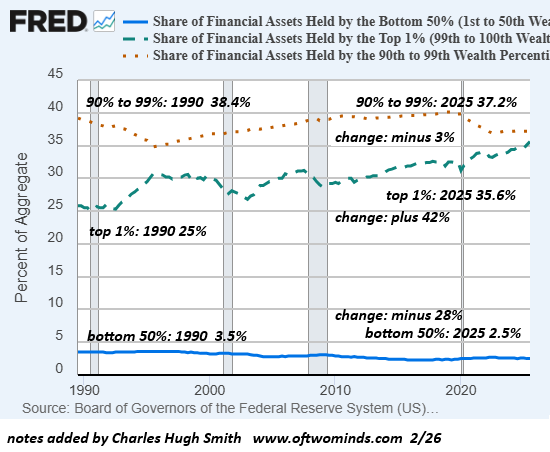
Recall that the top 10% own the vast majority of financial assets, with the bottom 50% owning a wafer-thin 2.5% of financial assets, a 28% decline from their 3.5% share in 1990. The share owned by the top 1%, meanwhile, rose by 42% to 35.6%.


The only way to reverse the debasement death spiral is to end the economy's dependence on ever-rising debt to fund consumption and an ever-expanding money supply to inflate the asset bubbles that fuel both soaring wealth inequality and the outsized spending of the top 10%--spending that generates a lopsided illusion of "growth."

The most effective way to defend the dollar and suppress debt expansion is to influence supply and demand by jacking up Treasury yields / interest rates. Global capital will flow into US Treasury bonds to reap the higher rates while demand for new loans declines as rates rise. The federal government's borrowing costs will jump, squeezing spending while debt-based consumption falls off a cliff.

This is the recession that's necessary to clear the dependence on debt, inflation and speculative excesses, the recession that's been put off for 45 years by excessive money / debt expansion.

At the same time, the Federal Reserve lets the resulting bankruptcies and defaults reduce private-sector debt by refusing to bail out Wall Street and the "too big to fail" banks. Overleveraged banks will fail as the necessary step to re-establish some semblance of market discipline rather than backstop the biggest gamblers (i.e. Moral Hazard).

As when the Savings and Loan debacle wiped out (often fraudulent) lenders, the appropriate public agencies will liquidate assets and spread the losses borne by the public over enough time to manage the pain.

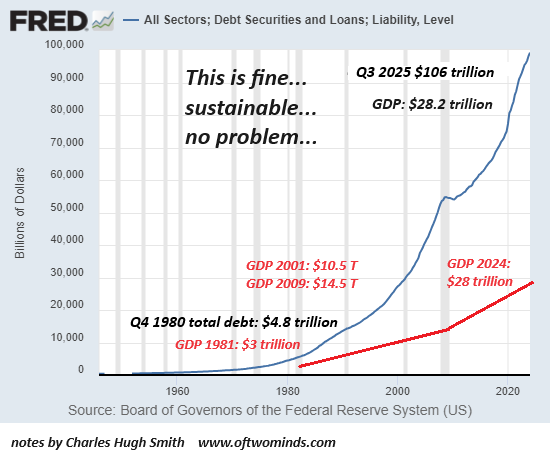
Note that federal debt (i.e. the national debt) of $38 trillion is about a third of total debt, with 2/3 being private-sector.

Recall that private-sector lenders create most of the new currency: when a bank issues a new mortgage, that origination creates new currency. When the mortgage is paid off, that currency goes to Money Heaven--the money supply declines accordingly. Paying down debt or writedowns of debt both reduce the quantity of dollars.


Concurrently, the Federal Reserve tightens liquidity / ceases creating USD out of thin air, reducing the money supply, which induces a scarcity of dollars globally as investors seeking to lock in the higher yields of Treasuries (see above) are in effect bidding for dollars, as Treasury bonds / bills / notes are denominated in US dollars.

The dollar rises due to this shift in supply and demand, and while this punishes exporters, it increases the purchasing power of the dollar for workers and employers alike. Again, any reversal / re-set will generate extreme pain, and the only management strategy with any hope of success is to distribute the pain widely enough, and fairly enough, so that no one class absorbs all the pain.

The long-avoided rebalancing of federal obligations and revenues is finally undertaken, reversing the past 50 years of policies that benefited owners of capital (the top 10%) at the expense of wage earners (the bottom 90%).

Here's an example of such a policy change: apply the 15.3% social-welfare tax paid by self-employed workers to all unearned income: capital gains, stock option compensation, etc. As with self-employed workers, income tax is on top of this 15.3% social-welfare tax.

On the expense side, ending the perverse incentives built into SickCare and the no-limits funding of all the sacred cows (Big Ag, Big Processed Food, Big Pharma, Big Defense, Big Banks, SickCare, Higher Education, etc.) would spread the pain to those elites and sectors that have enjoyed unimpaired federal largesse for decades.

As recession cuts consumption and employment, mass defaults will wipe out trillions in debt. You can't get blood from a stone, and the owners of all this debt--auto loans, student loans, credit cards, mortgages, etc.--will eat the writedowns. All the currency created by the debt issuance disappears, and the quantity of dollars in circulation plummets, reversing the debt-debasement-inflation death-spiral.

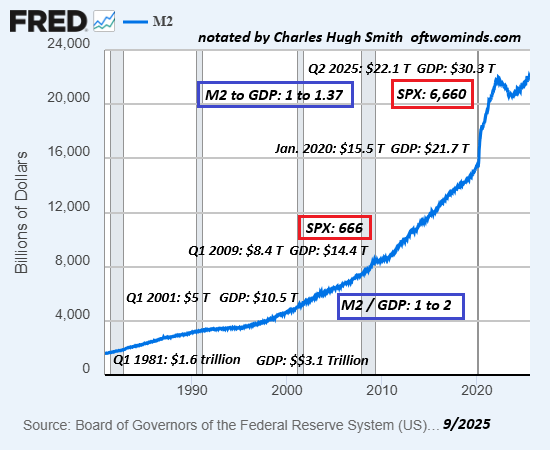
This is a chart of M2 Money Supply, which shows the expansion of the money supply in relation to the GDP generated by the money. (Note that M2 and GDP are imperfect / misleading measures, but everyone uses them anyway.)


Yes, I get it, every one of these steps is "impossible" because some entrenched concentration of wealth / power would suffer. The point here is the suffering that will be inflicted on the elites and sacred cows by the collapse of the currency will be far greater than the pain they will suffer in a re-set that actually changes the nation's course from a debt-debasement death-spiral to an economy with market discipline and a dynamic balance of social and financial interests.

As I explain in my new book Investing In Revolution, the extreme imbalances generated by the current death-spiral policies will get rebalanced one way or the other, and those influencing policy have a stark choice: leave the status quo as-is and guarantee a non-linear (i.e. uncontrolled, chaotic) collapse, or reverse course now while some control of the re-set is still available.

The end-game of debt-debasement is already visible. The only thing that's still up in the air is our response. Don't think it won't happen just because it hasn't happened yet.

My new book Investing In Revolution is available at a 10% discount ($18 for the paperback, $24 for the hardcover and $8.95 for the ebook edition). Introduction (free)


Check out my updated Books and Films.

Become a $3/month patron of my work via patreon.com

Subscribe to my Substack for free


NOTE: Contributions/subscriptions are acknowledged in the order received. Your name and email remain confidential and will not be given to any other individual, company or agency.

Thank you, Hores Cocu ($70), for your massively generous subscription to this site -- I am greatly honored by your support and readership.


Thank you, Sterlings Lair ($7/month), for your magnificently generous subscription to this site -- I am greatly honored by your support and readership.


Thank you, Pnw Transplant ($7/month) for your superbly generous subscription to this site -- I am greatly honored by your support and readership.


Thank you, Grzy Sky Blue. ($7/month) for your splendidly generous subscription to this site -- I am greatly honored by your support and readership.

Read more...
Tuesday, February 03, 2026

Owning Your Work in a World That Rents Your Life

This is the quiet truth of institutional work: improvement doesn't buy freedom. It buys responsibility without ownership.

This guest essay by longtime correspondent 0bserver describes the core dynamics of work in America and the global economy: if we don't own our work, we only "rent" our income and the life it funds. I discuss the process of owning your work in my book Get A Job, Build a Real Career and Defy a Bewildering Economy. The system doesn't make it easy to own your work, and this isn't accidental.

Modern work promises freedom but delivers dependence. The language is flattering--flexibility, opportunity, growth--but the structure is rigid. You don't own the work. You rent access to it. Your time, attention, and energy are leased month to month, contingent on priorities you do not control.

In theory, performance compounds.

In practice, it resets.

Every quarter resets the scoreboard.

Every month resets the scoreboard.

Often, every week.

I learned this twice, in the same industry, in two very different environments.

The first time, I stood in the open.

The second time, I sat in a chair.


The Kiosk

The kiosk sat in the middle of the mall. No walls. No back room. Shirt and tie. Ironed. Serious enough to signal legitimacy, close enough to retail to remain disposable.

Friday morning sales meetings were held off the floor in a business office. Everyone was half-awake, suits pressed, coffee, doing little. The whiteboard showed the same columns it always did: new contracts, renewals, data attachment, accessories.

At one of those meetings, a manager told us--earnestly--that it was harder to get hired there than to get into Harvard.

He offered it as an explanation. Why the pressure was justified. Why the metrics mattered. Why we should feel fortunate.

New and Renew were what paid you. Contracts and commitments. Real money.

The rest--data attachment and accessories--were something else entirely. Loyalty tests. Metrics that paid the company, not the worker.

We were asked to brainstorm ways to raise them anyway.

Someone suggested bundling more accessories.

Someone else suggested reframing the pitch.

No one suggested aligning compensation with the ask.

That was the first time I noticed that performance wasn't cumulative. Competence didn't reduce pressure; it increased expectations. Solving last month's problem simply earned you a harder one next month, at the same pay and with less tolerance.

The scoreboard didn't measure value created.

It measured compliance with whatever mattered now.

You could be excellent and still be wrong.

Strong production but weak accessory numbers? Coaching.

Solid revenue but low data attachment? Attitude problem.

The rules shifted constantly. Quotas changed. Staffing changes altered the math overnight. Decisions made far upstream--pricing, promotions, online upgrades--were absorbed downstream by people standing on the floor.

After work, we joked about it at the bar. About executives not sitting in rooms trying to figure out how to pay us more, but how to make sure they didn't have to.

The kiosk exhausted the body.

But it was honest about the transaction.


The Cubicle

The cubicle presented itself differently. Quieter. Legitimate.

Inbound sales. New customers only.

Hourly base plus commission, paid on completed installs. Long-term contracts paid best. Internet was the product. Phone lines were inexpensive add-ons. Television rarely sold and mostly complicated the transaction.

There were no scripts, but there were constraints.

You couldn't change pricing.

You couldn't change contract terms.

You couldn't change installation rules or service windows.

Your role was to move orders through the system, absorb frustration created elsewhere, and keep the machine operating smoothly enough that customers didn't notice its edges.

If you understood the system, you could do well. Same-day closes. Next-day installs. Competitive pricing used deliberately to avoid marginal accounts that churned and consumed time.

The work rewarded efficiency, not judgment.

Once an install was scheduled, your involvement ended. If it failed, the anger returned to you. If it succeeded, it disappeared. Nothing accumulated. Nothing followed you forward.

On paper, it was a good job.

The promise was stability.

Not fulfillment. Not advancement. Stability.

But the structure was already thinning. Strategic uncertainty. Leadership turnover. Hiring followed by 'realignment.' Compensation plans adjusted downward. Training sessions explaining why this was reasonable.

People began paying attention to different variables. Mortgage payments. Closing dates. Whether a spouse's income could carry the household if this stopped.

The job wasn't asking for loyalty.

It was asking for patience.

I took the position hoping for runway--time to fund entrepreneurial efforts, time to build something that could exist independently before the structure inevitably changed.

The cubicle didn't exhaust the body.

It exhausted something quieter.


The Reset Made Visible

The layoff arrived without drama.

A visiting executive tried to soften it with a metaphor.

"We bought a nice house," he said, "but it's already filled with people."

There was no malice in it. Just accuracy.

That was the moment the language finally aligned with the structure. We weren't being removed for failure. We were excess capacity. The house no longer required us.

Nothing I had done there could belong to me.

And nothing I could have done would have altered the outcome.


Orientation Toward Ownership

This is the quiet truth of institutional work: improvement doesn't buy freedom. It buys responsibility without ownership.

The better you perform, the more efficiently your output is absorbed--and the easier you are to remove when conditions shift.

Ownership reverses that relationship.

You become smaller, but sturdier.

You trade the illusion of scale for the reality of control.

When you own the work, effort compounds. Skills persist across transitions. Mistakes cost you--but they teach you. Success stays with you. The feedback loop tightens.

Ownership doesn't mean safety.

It means alignment.

Large systems promise stability and deliver fragility.

Small ownership looks fragile and delivers durability.

In a world that rents your time, ownership isn't rebellion or ideology.

It's orientation.

Work that leads somewhere.

Skills that survive disruption.

A life that doesn't reset every quarter.

That's not a philosophy.

It's the difference between running in place and moving forward.

This is a guest essay by longtime correspondent 0bserver.


My new book Investing In Revolution is available at a 10% discount ($18 for the paperback, $24 for the hardcover and $8.95 for the ebook edition). Introduction (free)


Check out my updated Books and Films.

Become a $3/month patron of my work via patreon.com

Subscribe to my Substack for free


NOTE: Contributions/subscriptions are acknowledged in the order received. Your name and email remain confidential and will not be given to any other individual, company or agency.

Thank you, David D. ($70), for your massively generous subscription to this site -- I am greatly honored by your support and readership.


Thank you, Gabe ($7/month), for your magnificently generous subscription to this site -- I am greatly honored by your support and readership.


Thank you, Michael ($70) for your superbly generous subscription to this site -- I am greatly honored by your support and readership.


Thank you, Dave D. ($7/month) for your splendidly generous subscription to this site -- I am greatly honored by your support and readership.

Read more...
Monday, February 02, 2026

Power and Impunity

Those acting with impunity are confident that their powers or god-like because they appear so in the human realm. But there are limits to everything in the human realm.

One of the first things we learned about the Internet is that anything sent via email could readily become public and anything created on a computer might be stolen/hacked and distributed.

Recent events suggest that many high-profile players had few concerns about the security of their private communications. Thirty years into the Internet, ignorance can be dismissed as a factor, and so that leaves impunity: there would be no consequences even if their private correspondence became public.

There is power, and then there is impunity. Power has limits; those acting with impunity are confident that their power has elevated them beyond the reach of any authority or adverse consequence, and so they're free to act with complete impunity.

Which brings us to Smith's Neofeudalism Principle #1: If the citizenry cannot replace a kleptocratic authoritarian government and/or limit the power of the financial Aristocracy at the ballot box, the nation is a democracy in name only.

A kleptocracy doesn't just take money; it takes whatever it wants, and with that impunity, it dismantles the foundations of its own power: the legitimacy of the state and the pretense that anything resembling justice is possible is a kleptocracy. With democracy and justice neutered, the hollowness of the entire status quo is revealed.

The impunity of the present era exceeds that of absolute monarchs, who despite their claim to unfettered power still faced the limiting counterweights of a powerful nobility, a merchant class that paid the taxes, a clerisy with both spiritual and material influence and the potential for a revolt of the peasantry that with elite support could transmogrify into a full-blown civil war.

Those acting with impunity now have far more tools of control than the absolute monarchs of old ever had. They can obfuscate their above the law impunity with legal maneuvers, false claims the evidence is fabricated, twisting the narrative in their favor, and by letting those in their grip know that the cost of attempting to limit their lawlessness will be so costly that complicity in the destruction of democracy and justice is the only route available.

The irony here is that their impunity to consequence has its own consequence: the dismantling of the system that protects and empowers them. A state and status quo that has squandered their legitimacy to protect the powerful from consequence loses The Mandate of Heaven: the citizenry, Heaven and Earth all turn against this corrupt regime.

Revelations of impunity are not yet consequential because all the technocratic elite desires is their seat in the casino is left undisturbed so they can continue amassing wealth to their own accounts. Nothing else matters.

Unbeknownst to the speculators, their position atop the wealth-power pyramid is also at risk, for the kleptocracy's destruction of democracy and justice is also dismantling the foundations of the casino they depend on to increase their wealth.

Those acting with impunity are confident that their powers or god-like because they appear so in the human realm. But there are limits to everything in the human realm. Since the way of the Tao is reversal, extremes of impunity--the ultimate manifestation of fate-tempting hubris--will reverse to extremes of consequence.

Jackson Brown's 1974 song The Road and the Sky come to mind:

Can you see those dark clouds gathering up ahead?
They're gonna wash this planet clean like the Bible said
Now you can hold on steady, try to be ready
But everybody's gonna get wet
Don't think it won't happen just because it hasn't happened yet.


My new book Investing In Revolution is available at a 10% discount ($18 for the paperback, $24 for the hardcover and $8.95 for the ebook edition). Introduction (free)


Check out my updated Books and Films.

Become a $3/month patron of my work via patreon.com

Subscribe to my Substack for free


NOTE: Contributions/subscriptions are acknowledged in the order received. Your name and email remain confidential and will not be given to any other individual, company or agency.

Thank you, Duane S. ($35), for your massively generous subscription to this site -- I am greatly honored by your support and readership.


Thank you, James C. ($7/month), for your magnificently generous subscription to this site -- I am greatly honored by your support and readership.


Thank you, Hand on the Tiller ($7/month) for your superbly generous subscription to this site -- I am greatly honored by your support and readership.


Thank you, Mark B. ($7/month) for your splendidly generous subscription to this site -- I am greatly honored by your support and readership.

Read more...
Terms of Service

All content on this blog is provided by Trewe LLC for informational purposes only. The owner of this blog makes no representations as to the accuracy or completeness of any information on this site or found by following any link on this site. The owner will not be liable for any errors or omissions in this information nor for the availability of this information. The owner will not be liable for any losses, injuries, or damages from the display or use of this information. These terms and conditions of use are subject to change at anytime and without notice.

Our Privacy Policy:


Correspondents' email is strictly confidential. This site does not collect digital data from visitors or distribute cookies. Advertisements served by a third-party advertising network (Investing Channel) may use cookies or collect information from visitors for the purpose of Interest-Based Advertising; if you wish to opt out of Interest-Based Advertising, please go to Opt out of interest-based advertising (The Network Advertising Initiative). If you have other privacy concerns relating to advertisements, please contact advertisers directly. Websites and blog links on the site's blog roll are posted at my discretion.


PRIVACY NOTICE FOR EEA INDIVIDUALS


This section covers disclosures on the General Data Protection Regulation (GDPR) for users residing within EEA only. GDPR replaces the existing Directive 95/46/ec, and aims at harmonizing data protection laws in the EU that are fit for purpose in the digital age. The primary objective of the GDPR is to give citizens back control of their personal data. Please follow the link below to access InvestingChannel’s General Data Protection Notice. https://stg.media.investingchannel.com/gdpr-notice/


Notice of Compliance with The California Consumer Protection Act
This site does not collect digital data from visitors or distribute cookies. Advertisements served by a third-party advertising network (Investing Channel) may use cookies or collect information from visitors for the purpose of Interest-Based Advertising. If you do not want any personal information that may be collected by third-party advertising to be sold, please follow the instructions on this page: Limit the Use of My Sensitive Personal Information.


Regarding Cookies:


This site does not collect digital data from visitors or distribute cookies. Advertisements served by third-party advertising networks such as Investing Channel may use cookies or collect information from visitors for the purpose of Interest-Based Advertising; if you wish to opt out of Interest-Based Advertising, please go to Opt out of interest-based advertising (The Network Advertising Initiative) If you have other privacy concerns relating to advertisements, please contact advertisers directly.


Our Commission Policy:

As an Amazon Associate I earn from qualifying purchases. I also earn a commission on purchases of precious metals via BullionVault. I receive no fees or compensation for any other non-advertising links or content posted on my site.

  © Blogger templates Newspaper III by Ourblogtemplates.com 2008

Back to TOP