While the top 10% who manage the TINA Economy are fixated on their ballooning stock market wealth, the bottom 90% are melting away. Some day that might actually have consequences.
Let's start with a thought experiment focusing on soaring household expenses. Consider healthcare insurance, which has risen not just in the monthly premiums paid by employers and employees, but in higher fees out of pocket and co-pays. The value of the healthcare insurance has declined as households opt for high-deductible plans and insurers deny claims to reduce their expenses.
Let's say that a household paying their own insurance seeks to lower their costs by finding a local provider rather than one of the giant corporate insurers which effectively form a cartel. They soon discover that there aren't any local providers of healthcare insurance. There may be direct primary care alliances that offer some services, but virtually all healthcare insurance in the US is controlled by a handful of corporations, a cartel with superficial competition.
This is also the case for home and auto insurance, utilities, education expenses and interest on debt all of which are rising rapidly for many households. In every case, the competition between the handful of giant corporations that dominate each sector is superficial, as this is the point of cartels and quasi-monopolies: eliminate competition to keep revenues and profits high.
A slew of essential services such as Internet and mobile phone subscriptions are also controlled by a handful of providers. Introductory offers that expire in a few months provide a fig-leaf of competition, but the actual cost differences are negligible: maybe enough to buy one sandwich a month, not enough to restore a stretched household budget.
Other services such as auto repair and veterinary services are soaring in cost as the same cartels squeezing households are squeezing small businesses. In some cases, private equity has been buying up local services, assembling hidden cartels behind a screen of illusory local ownership.
Then there's the software subscriptions employees are expected to maintain, costly credentials they must pay for to keep their jobs, and a host of similar expenses which are controlled by other quasi-monopolies and cartels.
Note that these are all big-ticket expenses: healthcare, home and auto insurance, auto repairs / maintenance, utilities, etc. cost thousands of dollars annually. If the cost of a new TV declines $100, that "falling inflation" is a drop in the bucket of the big-ticket expenses that are consuming thousands of extra dollars a year.
As household budgets are squeezed by soaring costs for which there is no alternative--the TINA Economy--the sum left for discretionary spending is reduced. Non-competitive cartels and quasi-monopolies controls virtually all the big-ticket TINA expenses that are soaring by leaps and bounds, leaving the rapidly shrinking pool of discretionary household budgets to the local, small-business sector which is the only sector that is still marginally competitive.
So while corporations and cartels such as higher education and credentialing feast on TINA--there is no alternative in a monopoly-cartel controlled economy--small businesses must compete for the scraps left (discretionary spending) after the cartels have consumed the majority of household budgets, fattening the profits / revenues that fuel their political and market power.
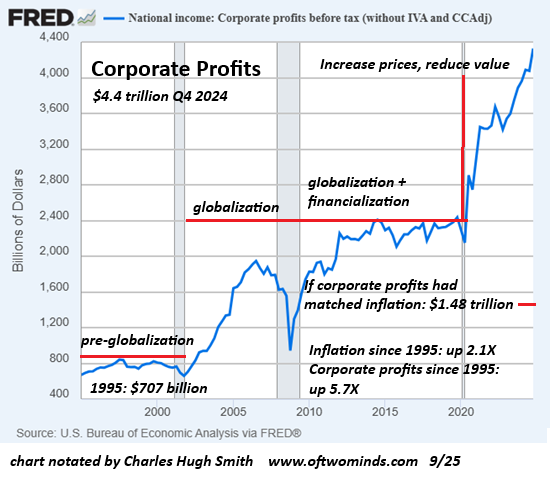
This is why corporate profits are soaring while small businesses are in decline: since there's only superficial competition for big-ticket expenses, households have no alternative to paying higher costs. What money is left is all that can be spent supporting local enterprises, which face the double-whammy of higher operating costs imposed by the same cartels squeezing households and the diminishing pool of discretionary income left to households.
The Economic Divide Between Big and Small Companies Is Growing: Economic fortunes of low- and high-income Americans are diverging--same pattern happening with companies. (WSJ.com)
--The growing divide between the fortunes of small and large businesses mirrors the divide that has emerged over the past year between low-income Americans and their high-income counterparts.
--Large, publicly traded companies in the S&P 500 saw net income increase by 12.9% in the third quarter, contrasting with faltering small-business profits.
--Small businesses are facing economic headwinds, including high inflation and cautious consumers, leading to job cuts; 120,000 jobs were shed in November.
Small business, whose ownership and interests are diffuse, have been reduced to tax donkeys struggling to pay soaring rent, wages, utilities and overhead costs without the market muscle of monopolies / cartels to force consumers to pay higher prices for degraded goods and services.
While large corporations are adding employees, small businesses are shedding employees to survive.
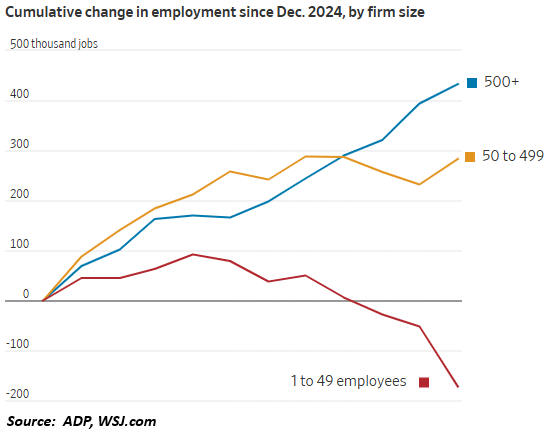
Corporate profits reflect this structural asymmetry: the large corporations that have eliminated competition are expanding their revenues and profits, leaving less for the only sector that still faces competition, small businesses:
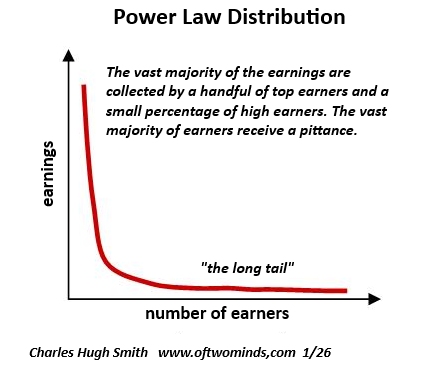
We're constantly assured an economy where the gains follow an extraordinarily asymmetric power-law distribution is a wondrous engine of sustainable growth that benefits everyone, but the facts don't support this fairy-tale PR promoted by the winners to placate those losing ground.
This distribution of the gains to the few and the costs to the many is not inevitable, it was the direct result of policy choices made by our political class in response to the money and lobbying funded by the few to increase their share of the economy's gains by any means available.
The avalanche analogy is apt: the snowpack looks stable because the melting is hidden from view. But when a critical point that cannot be predicted is reached, the mountainside gives way. While the top 10% who manage the TINA Economy are fixated on their ballooning stock market wealth, the bottom 90% of households and small enterprises are melting away. Some day that might actually have consequences.
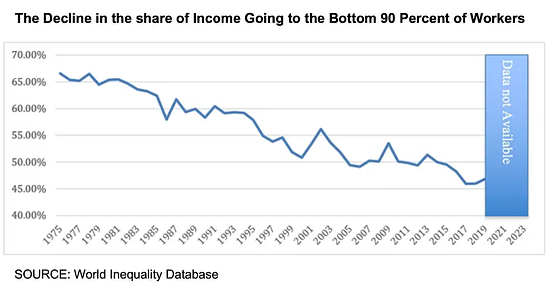
This is where the TINA economy is heading: there is no alternative to system breakdown.
The Middle Class Vanishing Act Nobody Saw Coming Until It Was Too Late (medium.com)
My new book Investing In Revolution is available at a 10% discount ($18 for the paperback, $24 for the hardcover and $8.95 for the ebook edition).
Introduction (free)
Check out my updated Books and Films.
Become
a $3/month patron of my work via patreon.com
Subscribe to my Substack for free
NOTE: Contributions/subscriptions are acknowledged in the order received. Your name and email
remain confidential and will not be given to any other individual, company or agency.
|
Thank you, Natli V. ($75), for your massively generous subscription
to this site -- I am greatly honored by your support and readership.
|
|
Thank you, Willis S. ($7/month), for your magnificently generous subscription
to this site -- I am greatly honored by your support and readership.
|
|
Thank you, lloyd L. ($70) for your superbly generous subscription
to this site -- I am greatly honored by your support and readership.
|
|
Thank you, Howard R. ($7/month) for your splendidly generous subscription
to this site -- I am greatly honored by your support and readership.
|