











AI and the Delusions of Increasing Productivity
Most of AI isn't productive, it's just another form of consumption.
Like GDP (Gross Domestic Product), economic Productivity is an unquenchable spring of delusions, delusions being pushed to new heights of delirium by promises of endless leaps of productivity as AI is deployed in every nook and cranny of the global economy.
Let's start with what Productivity measures. Like GDP, Productivity distills everything in the world down to money: the cost of all inputs (labor, capital, resources) and the monetary value of the output (goods and services). If the output goes up while the input costs remain the same or decline, Productivity is going up: we're producing more with the same basket of inputs (work, capital, etc.).
On the surface, this appears commonsensical, but as with GDP, AI and many other sources of confusion and delusion, what matters is what's not being measured or even recognized. Exhibit #1 in the cavalcade of delusion is Corporate America's sleight of hand way of boosting Productivity by offloading work onto consumers and households.
It's not that Corporate America actually generated more goods and services with the same inputs: what they did was transfer work they should have done to consumers and households. Consumers and households are now burdened with unending shadow work dealing with Corporate America's rubbish products and services, doing unpaid work to fix or maintain products and services that break down or don't work reliably and are "black boxes," i.e. unrepairable without "customer service," which has degraded to the point of parody.
We all perform this unpaid shadow work every day: pump our own gasoline, scan our own groceries, and waste hours dealing with kludgy services and maddeningly dysfunctional AI "customer service" chatbots and 3-item menu choices that don't have an option for the problem we have-- a problem that should be the company's responsibility, but it's been dumped on us.
If we measured the billions of dollars in unpaid shadow work forced on consumers and households by state agencies and Corporate America, Productivity would be falling off a cliff. But that doesn't support the self-serving claims that the casino-economy is doing great because corporate profits are rising.
What's left out of the glowing claims is the corporate profits come not from producing quality goods and services but from dumping all the consequences of shoddy products and services on consumers and households.
Exhibit #2 is the collapse of product durability and the quality of services. Durability isn't measured in the the calculations of Productivity, so the fact that appliances that routinely lasted 30-40 years now fail in 3-4 years is not even recognized, much less measured.
The same is true of the decline in the quality and utility of services, and the soaring costs of repair. Recall that "output" is a dollar amount. So when we take our out-of-the-paltry-one-year-warranty vehicle in for a $3,400 repair that used to cost $1,400, since the parts and labor didn't change in any material way, the higher price boosts both GDP and Productivity: woohoo, 4 hours of labor and a handful of parts now generated "more output" and "higher GDP."
You see the insanity here: the reason why we're paying higher prices is the quality of the products and services has cratered, but this is measured as "wonderful" because GDP goes up and Productivity is higher, too, since the input costs went up less than the value of the output.
Monopolies and cartels thus boost the wondrously wonderful trifecta: corporate profits, GDP and Productivity all go up as quality goes down and costs and risks are transferred to hapless consumers and households, who have no other choice in a fake "marketplace" of state and corporate monopolies.
Exhibit #3 is the self-serving hype about AI automating limitless gains in Productivity, which is shorthand for limitless gains in corporate profits. This too is delusional for a number of reasons:
1. Most of AI isn't productive, it's just another form of consumption. Conversing with a chatbot, having AI compose another worthless term paper or conjure another worthless song or graphic image--these are all consumption, not productive applications of capital. They're superfluous forms of consumption that are the direct result of AI's true costs being subsidized. If everyone had to pay the actual costs of running these stupendously costly operations, these superfluous forms of consumption would plummet accordingly.
2. There is precious little evidence that AI is actually improving real productivity. As with all casino-economy hype, outliers are touted as examples of AI's transformational magic: AI found a math proof, AI conjured a new virus, etc. That these are A) atypical and B) examples of how AI can be used for malicious purposes just as easily as it can for good is ignored.
How will Productivity be affected when a rogue player uses AI to conjure a super-virus? Nobody dares ask this because it might tarnish the casino-economy hype that AI will make us all wealthy beyond measure.
The problem with AI will boost productivity everywhere claim is a consequential share of all "work" is needless bureaucratic churn created not by actual need but by the apparently permanent abundance of huge surpluses that can be squandered on make-work, churn and profiteering.
So AI will automate worthless churn, marketing and make-work. Is this actually boosting the quality, durability and real value of the economy's output, or is it all just an illusion of "value" created by endless surpluses of cash to squander?

The problem is the surpluses are declining and being replaced by borrowed money. Debt is another input that is glossed over in calculations of GDP and Productivity.
Last but not least, there is evidence that AI's initial illusion of increasing productivity and lowering costs transmogrifies into lower productivity and higher costs as maintenance of complex systems kicks in. The kludgy nature of AI's "almost good enough" magic only becomes visible as all the "not quite good enough" starts piling up and breaking down complex systems.
Economics is akin to an ancient cult glorifying a temple of fabricated gods. The priesthood (naturally) claims extraordinary powers that can only be wielded by those with temple-granted credentials. That the cult is nothing more than a collection of beliefs claiming to be "science" is cloaked by measures that leave out everything of true value and consequence to serve the illusion that these beliefs are "how the world works."
GDP and Productivity are the functional equivalents of waving dead chickens while dancing the humba-humba around the campfire at midnight, delusional claims of "how the world works" that set up a world-shattering encounter when the real world doesn't obey the claims.
Economics measures what's easy to measure, not what matters, and eventually that will matter more than the temple's believers can possibly imagine.
When economists start measuring durability, the quality of services, unpaid shadow-work performed by consumers and households that should be done by the companies providing the services, the perverse profiteering of monopolies, state and private, and the true costs over time of fixing AI's "almost good enough" magic, then their cultish claims to being "science" might have a shred of credibility.
Until then, prepare for impact:
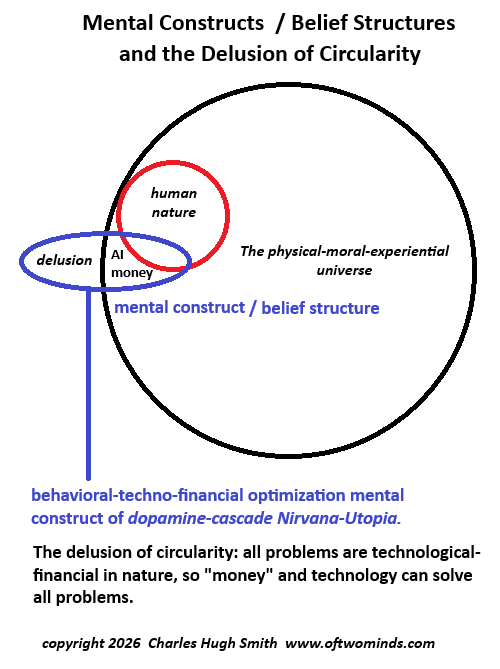
The eventual consequence of AI's "almost good enough" magic:

My book Investing In Revolution is available at a 10% discount ($18 for the paperback, $24 for the hardcover and $8.95 for the ebook edition).
Introduction (free)
Subscribe to my Substack for free
NOTE: Contributions/subscriptions are acknowledged in the order received. Your name and email remain confidential and will not be given to any other individual, company or agency.
|
Thank you, Lou ($7/month), for your superbly generous subscription to this site -- I am greatly honored by your support and readership. |
Thank you, Don ($7/month), for your marvelously generous subscription to this site -- I am greatly honored by your support and readership. |
|
|
Thank you, Tom C. ($7/month), for your massively generous subscription to this site -- I am greatly honored by your support and readership. |
Thank you, XX ($7/month), for your splendidly generous subscription to this site -- I am greatly honored by your support and readership. |