

Showing posts sorted by date for query health care. Sort by relevance Show all posts

Wednesday, August 12, 2026

While We Focused on Fripperies, the Foundations Have Rotted Away

While the Everything Bubble has soared to new heights, consumer confidence has fallen to new lows.

For your consideration, four charts that tell a single story: while those Americans who have benefited so immensely from the Everything Bubble in stocks, housing, crypto, bat guano, etc.--every asset under the sun--have spent lavishly on fripperies, the foundations of everyday life for the bottom 90% have rotted away.

Yes, I know: stocks are up, and AI will enrich us all, so since everything's great for me, it's great for everyone. Nice, but not true. The reality is the foundations of an affordable quality of life for the bottom 90% who haven't been enriched by the Everything Bubble have rotted away while the top 10% jetted around the world immiserating the everyday lives of the locals.

If everything's great, then how do we explain this? A shocking 92 percent of US adults are not going to the doctor because it's too expensive. (yahoo.com)

An overwhelming number of Americans are delaying medical care because of fears they can't afford it, a new study has found. "The findings highlight a growing gap between having health insurance and feeling financially protected, with medical costs forcing many Americans to delay treatment, cut essential spending and take on debt," the study said.

Or this? 'There's no joy in living this way.' Families struggling to make ends meet. (yahoo.com)

Americans surveyed in a new study by Omnisend, an e-commerce marketing platform company, are expressing similar struggles. More are borrowing money to pay for groceries. Consumers also said higher prices have changed how they feel about brands they once liked, and a majority of respondents also said they believe brands are using inflation as an excuse to raise prices more than necessary.

In a survey of 1,075 consumers in June, 30% of respondents said they used a credit card to pay for essentials, such as groceries, gas, utilities or medical bills, in the past three months, knowing they may not pay off their bill.

An additional 20% said they borrowed from friends or family, 18% used buy now, pay later products, and 17% said they had to use savings meant for something else.

Shrinkflation: 89% of respondents said they regularly notice when companies shrink packages while prices stay the same. Twenty-nine percent of respondents consider this type of price increase to be the most unfair, and 59% said they noticed it regularly.

Trust in brands is at a low point: 85% said they believe brands often use inflation to justify larger-than-necessary price increases. Among respondents, 67% said higher prices have changed how they feel about brands they once liked.


Those who dismiss all of the above as "not true" or "it's their fault" are terrified of admitting the truth: the foundations of life in America have rotted away while the wealthiest 10% are enjoying the wealth generated by history's greatest credit-asset bubble.

The Rise of the Unstoppable American Tourist A supercharged U.S. economy has helped transform a nation of homebodies into zealous international travelers; 'Travel isn't optional' (wsj.com)

Behind the shift is a supercharged U.S. economy that in the course of a generation has created a larger and wealthier class of Americans that views travel as an essential rather than a luxury. Older Americans, who are driving this new era of travel, hold about $110 trillion in wealth. They're also living longer, and looking to make the most of those years.

Europe is often the gateway drug. Portugal and Greece have seen the biggest percentage increases in U.S. visitors of any country over the past decade, according to U.S. government data. The U.K. and Italy have seen the largest increases in the total number of tourists, getting millions of additional Americans a year arriving by air.

Only about 6% of U.S. travelers to Europe in 2025 said it was their first time flying abroad. Many of these tourists are visiting multiple times a year. U.S. travelers to the region skew female, with women 55 and over making up 24%. More than 15% of Americans visiting Europe reported a household income of $300,000 or more.

In 1990, fewer than 5% of Americans had a passport. Now, more than 50% do.

A growing share of consumer spending is going toward foreign travel, as habits change and prices rise. Lenza, who does tech work for the travel industry, estimates that he and his wife spend between $100,000 and $200,000 on travel each year, even as they try to be cautious with other kinds of spending.

"One of the reasons I joke that I'm still working is that I like my business-class sleeper seats," said Robbins, who estimates they spend about $60,000 to $70,000 a year on travel abroad.

And it's not just freewheeling baby boomers. Younger generations, who place a high value on experiences, are spending on travel instead of buying houses and having kids.

The magic is often lost on locals. The influx of tourists has brought in new wealth in many places but it's also straining infrastructure, raising the cost of living and disrupting local life. Housing has become scarce and unaffordable in some cities, with more apartments being used as pricey short-term vacation rentals.

Tens of thousands protested against overtourism on the Spanish island of Mallorca last month, demanding fewer visitors and more affordable housing. The march turned violent as protesters clashed with police, who fired rubber bullets after being pelted with plastic bottles.


It wasn't just "working hard" or "smart investing" that generated $70 trillion in new "wealth" since 2020, it was luck: being in one's peak earning years when assets such as houses were still affordable, and then owning those assets during history's greatest credit-asset bubble, arguably from Q1 2009 to the present, or from either Q1 2020 or Q3 2022. Take your pick, the results are the same: tens of trillions of "free money" wealth for those older, wealthier Americans who bought assets before the Everything Bubble inflated.

The Great $110 Trillion Wealth Transfer Won't Happen Any Time Soon Americans 55 and up control most wealth, and many of them have decades of living left. (wsj.com)

A staggering 97% of that increase was due to wealth gains in households where the head of household was 55 or older. About 75% of the total increase was from gains by the wealthiest 10% of households age 55 and older, the analysis found.


This chart of Composite Consumer Confidence is well worth studying. Look at the 1990s dot-com era and the current Everything Bubble. Since the 1990s Internet boom actually raised all boats--real wages actually increased, prosperity by any commonsense measure was broad-based rather than concentrated in the top 10%--consumer confidence rose throughout the 1990s.

Compare that to the present: while the Everything Bubble has soared to new heights, consumer confidence has fallen to new lows. The Everything Bubble only benefited the older, wealthier Americans, while the rot accelerated the decay of the foundations of life for the bottom 90%.


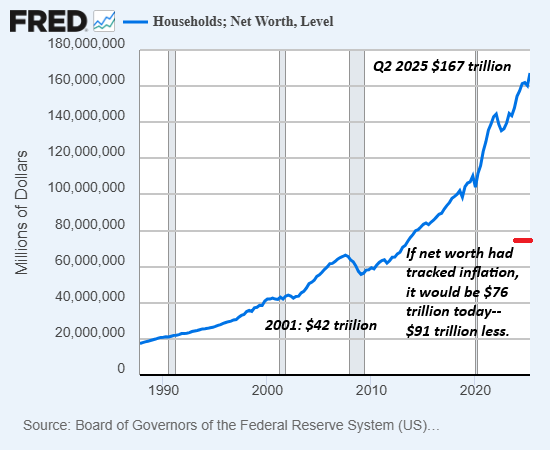
Consider the S&P 500 stock market index. The stock market has more than doubled in a mere four years, along with housing in many markets. As a result, household net worth rose a staggering $71 billion, a 70% increase, "97% of that increase was due to wealth gains in households where the head of household was 55 or older, and 75% of the total increase was from gains by the wealthiest 10% of households age 55 and older."


That's an incredible concentration of the gains in two overlapping cohorts: the top 10% of households and those 55 and older.

Actually, for the bottom 90% of American households, overseas travel is at best optional.
Nobody seems to be asking questions such as: what kind of society do we end up with if young people no longer have an interest in raising families or buying homes while devoting their earnings to visiting the Stans? What kind of society celebrates luxury travel while 92% of households forego medical care because they can't afford it?
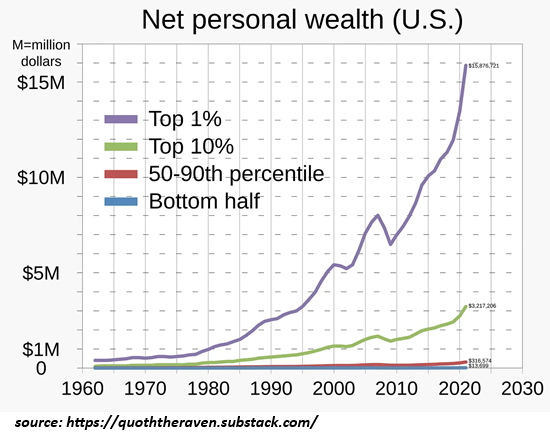


The obvious answer is a society whose foundations have completely rotted away while we focused on fripperies funded by asset bubbles. If you want to argue, argue with the data. Sorry, the data won.


My book Investing In Revolution is available at a 10% discount ($18 for the paperback, $24 for the hardcover and $8.95 for the ebook edition). Introduction (free)


Subscribe to my Substack for free


NOTE: Contributions/subscriptions are acknowledged in the order received. Your name and email remain confidential and will not be given to any other individual, company or agency.

Thank you, Sam F. ($200), for your outrageously generous subscription to this site -- I am greatly honored by your steadfast support and readership.


Thank you, Stuart L. ($75), for your marvelously generous subscription to this site -- I am greatly honored by your steadfast support and readership.


Thank you, Michael T. ($70), for your massively generous subscription to this site -- I am greatly honored by your steadfast support and readership.


Thank you, Gunnar ($7/month), for your splendidly generous subscription to this site -- I am greatly honored by your support and readership.

Read more...

Sunday, June 28, 2026

The US Economy In a Nutshell: Privatize the Gains, Socialize the Costs

Correspondent Simons Chase insightfully summarized this dynamic: Privatize the Gains, Socialize the Costs.

In my post Five Dynamics That Make Sense of an Increasingly Chaotic World, #3 is the distribution of risk, costs and consequences to a diffused populace while concentrating the gains into the pockets of insiders/owners:

Those seeking to reduce their private risks and increase their private gains seek to concentrate the gains generated by control structures and distribute the risks and costs to others. Pull the strings that diffuse the costs and risks over a large populace and gather the gains into the hands of the insiders that manage the control structure, typically some form of monopoly, either public or private, or a fusion of public-private rackets.

So corporations face low risks while the gains are extremely enticing. This diffusion of risk and concentration of potential gains establishes perverse incentives to increase extractive, exploitive, well-hidden rackets that impoverish and immiserate the many, but in doses small enough to avoid triggering push-back.

In a system that concentrates gains and diffuses risk, the "rational actor" seeks to maximize rackets that distribute impoverishment and immiseration to the many in small doses over time that attract little attention and are not significant enough to trigger an emotionally potent resistance.


Correspondent Simons Chase (x.com/slchase and Selflet.ai) insightfully summarized this dynamic: Privatize the Gains, Socialize the Costs. Here is Simons' explanation:

"Junk food is a kind of leveraged recapitalization -- short-term gains privatized, long-term costs socialized as horrific health outcomes: pay a little now and a shortened, diseased life later. Dan Munro folded that framing into his Forbes piece tying roughly a trillion dollars a year in U.S. healthcare spending to sugar: Sugar Linked To $1 Trillion In U.S. Healthcare Spending (forbes.com, 2013). The mechanism is the point: privatize the gain, socialize the cost. Once you see it, you see it everywhere.

The receipt is real--Credit Suisse put 30%-40% of U.S. healthcare spending at the feet of excess sugar, and the 2012 Global Burden of Disease report found obesity a bigger global threat than hunger. That last fact is the whole thesis in a line, and I put it on X more recently: obesity is a form of starvation -- understand that, and you grasp the U.S. economy:

Abundance, not scarcity, is the adversary now. The economy has already filed the invoice: the top employer in most states flipped from manufacturing to health care in a single generation. We stopped making things and started billing the disease. The damage became the GDP.

Debt is the same recapitalization run on the whole economy--today's abundance privatized, tomorrow's cost socialized onto a future that didn't vote. And the defining project of my lifetime has been that operation run on foreign policy: borrowed against what we couldn't pay for at home, the costs socialized onto people far from the ledger, each chapter sold as help.

AI is simply the newest instance, and the most intimate. Cheap, fluent, frictionless cognition now; the homogenization bill later. The engagement is privatized; the flattening of the culture is socialized onto all of us-- and, exactly as you say, nobody notices the loss because nobody knows how to look for it.


Thank you, Simons, for this illumination.

Regarding the future of AI, my critiques and concerns can be found in my Essays on AI. Simons proposes a more productive future than Big Tech is selling, one of AI becoming a technology of individual agency that is radically decentralized rather than the Big Tech model of radically centralized AI in a corporate-state control structure. Here is Simons' vision of the future of AI:

Where I part from the despair is only on the cure, not the diagnosis. The averaging is the default, not the destiny. The answer at every level is the same: nutrient-dense over processed, particular over average, owned over administered. I think AI's future is tribal and human-designed: many particular intelligences, not one central utility that privatizes the profit and socializes the mediocrity. What I'm building is a small argument for that. All I really hope for is the freedom to deploy it -- and not another 'we're here to help.'"

Thank you, Simons, for this alternative lens. My vision of a positive future for AI starts with radical decentralization optimizing individual agency and then moving up the "truly intelligent" scale to AI refusing to waste resources on make-work waste is growth:


My book Investing In Revolution is available at a 10% discount ($18 for the paperback, $24 for the hardcover and $8.95 for the ebook edition). Introduction (free)


Become a $3/month patron of my work via patreon.com

Subscribe to my Substack for free


NOTE: Contributions/subscriptions are acknowledged in the order received. Your name and email remain confidential and will not be given to any other individual, company or agency.

Thank you, Bruce T. ($200), for your beyond-outrageously generous subscription to this site -- I am greatly honored by your support and readership.


Thank you, Rockford B. ($7/month), for your superb generous subscription to this site -- I am greatly honored by your support and readership.

Read more...

Wednesday, May 06, 2026

What Would Be Truly Bullish? Actually Fixing What's Broken

Refusing to recognize, much less actually fix, what's broken hurries our collective rendezvous with consequences.

We've come to an interesting juncture in history, interesting because while we're being assured that AI will solve all problems, including any it creates, back in the real world, AI is incapable of fixing what's broken because too many people are getting rich off the status quo, and since the status quo is the problem, those who own / control AI will use it to maintain the status quo, guaranteeing that what's broken spirals into irreversible breakdown.

Richard Bonugli and I discuss what's fatally broken in a new podcast on what it will take to become Bullish (32 min).

Let's start with what's "obvious": letting what's broken fester until it implodes the status quo is not bullish, and neither is substituting delusion and denial for a realistic appraisal of what's actually broken--the essential observe and orient steps in the OODA loop (observe, orient, decide, act).

I've often described the two dynamics that are broken that AI can't fix because those who own / control AI are using it to increase the asymmetrical distribution of wealth and income that are the source of breakdown. Consider healthcare. Everyone except the managers / owners / shareholders of healthcare / pharma cartels agrees healthcare is fundamentally broken and is bankrupting households, employers and the government / nation.

Those profiteering off the status quo healthcare system claim AI is going to reduce costs. They fail to mention this won't reduce the price, it will only serve to increase their profits. Cut costs by replacing human labor with AI tools, yea, we reap even higher profits. Nobody is claiming healthcare will magically become affordable because a truly affordable healthcare system wouldn't be as profitable because it wouldn't be as open to exploitation, fraud, profiteering, extraction and parasitic pricing.

In the same way, AI can't solve the other fatal dynamic--widening wealth and income asymmetry--because it's widening the asymmetry to new extremes. The owners of AI are reaping vast fortunes while stripmining resources to run their AI data centers and laying off wage earners. Rather than fixing what's broken in America, AI is accelerating the endgame of what's broken.

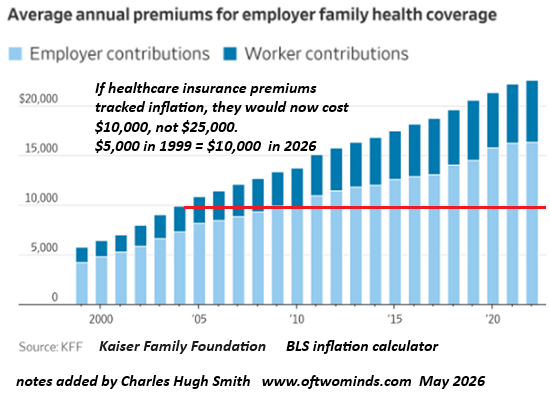
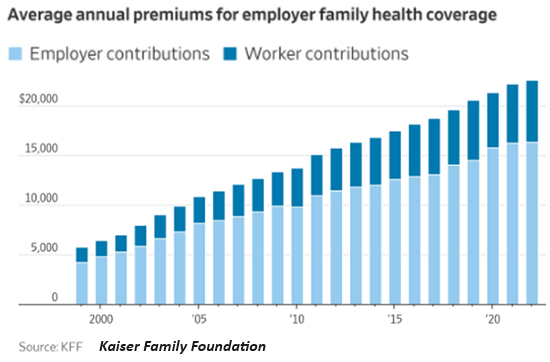
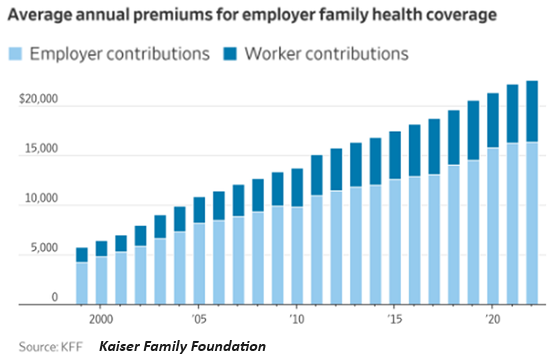
Let's run through why increasing numbers of online comments suggest burning the whole rotten healthcare system down and starting over. Healthcare insurance--which often turn out to be a profitable facsimile of actual insurance--has more than doubled beyond the official rate of inflation. If healthcare insurance had tracked inflation, it would cost $10,000 a year for family coverage in 2026. Instead, it costs $25,000+ annually.

Diagnosis: broken.


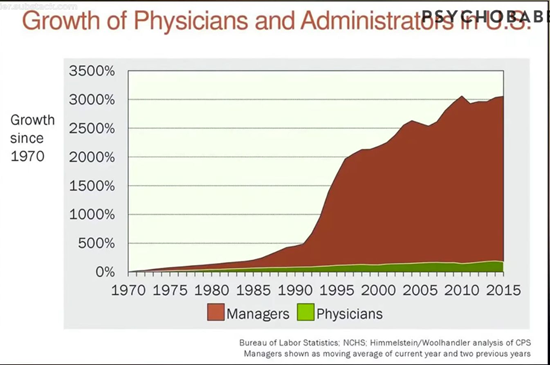
Regardless of how you toy with statistics, the reality is administrative costs / bloat / profiteering have soared. Diagnosis: broken.


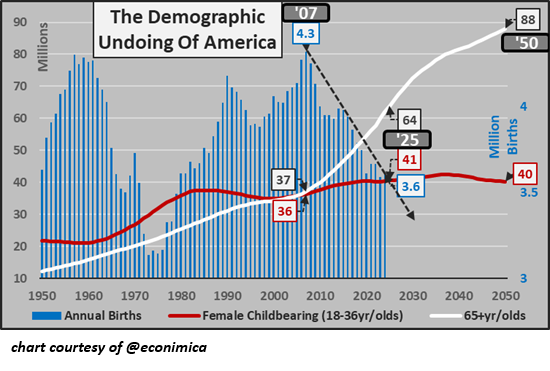
Meanwhile, back in reality, rapidly aging populations are far from their peak demand for healthcare services. Check out the white line on this chart (courtesy of @econimica) of those aged 65+. While births collapse and the workforce is pressured by AI and the soaring cost of living, millions of elderly retirees are being added to the Medicare beneficiary pool. Diagnosis: broken.


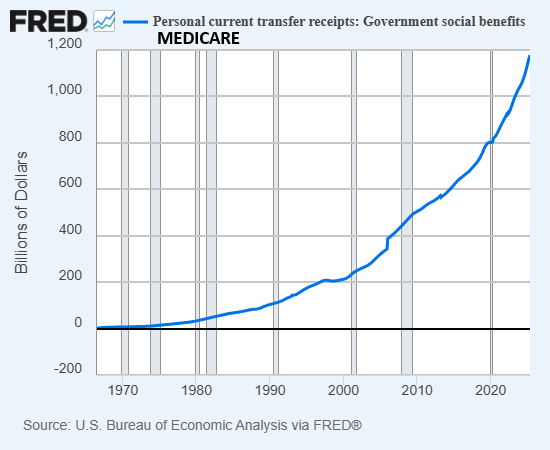
Here is the chart of Medicare costs: parabolic. It's nice we can borrow a few trillion every year, but can we borrow $5 trillion or more every year with no consequence? Diagnosis: broken.


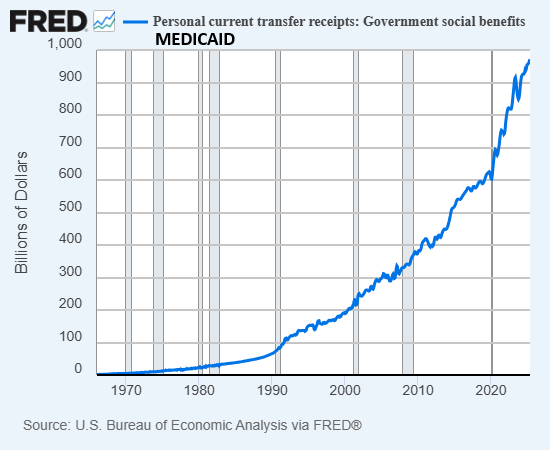
Here is the chart of Medicaid costs: parabolic. Diagnosis: broken.


As for the health of the general populace: it's been declining for two generations as our diet has shifted from real food made at home to ultra-processed goo and fitness has bifurcated into a thin layer of extreme fitness and a majority of the populace burdened with the complex ill health of poor diets, poor fitness and metabolic disorders.

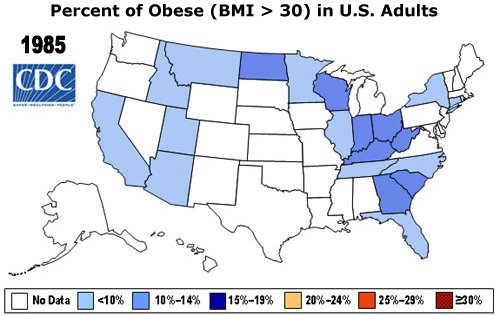
Weight of the populace in 1985:


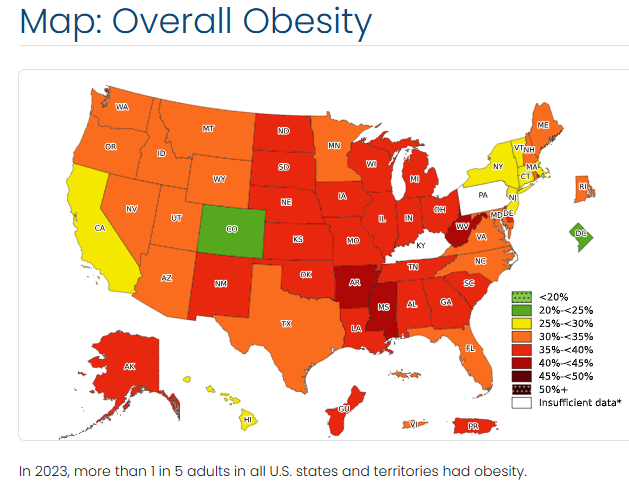
Weight of the populace in 2023:


Yes, now we have GLP-1 drugs that reduce weight and the diseases related to weight, but these drugs have side effects in many patients and they must be taken for life. Once the patient stops taking them, the weight returns.

Drugs that must be taken for life are not a substitute for being healthy. Healthy = not needing any medications.

Diagnosis of the healthcare system: broken. Prognosis: bifurcation: the rich will get "the finest care in the world," and everyone else will be in a queue or denied care--basically the same result--or offered extraordinarily profitable meds and a spectrum of side effects.

What's broken is the entire financial-economic system that distributes the pain and the gain: the pain of sharply higher costs of living and increasing financial precarity is distributed to the bottom 80% while the gains are distributed to the top 10%, with a dribble going to the cohort between 81% and 90% who own enough capital to support their claim to being "middle class."

Note to America's elites: when only the top 15% just below the top 5% qualifies as "middle class," that's not a middle class. I know, you don't concern yourselves with such trivia: there are trillions of dollars to be reaped "solving problems" with AI.

The "problem" you can't solve with AI is AI only "solves" the "problem" you see, which is how to increase your wealth and income before the bottom 80% awaken from the 24/7-hyped delusion that credit-asset bubbles (AI!) raise all boats and will continue to do so forever and ever.


Real life has diverged from that delusion, and the radioactive power of AI to extend that delusion has a short half-life. Refusing to recognize, much less actually fix, what's broken hurries our collective rendezvous with consequences.

What would be bullish is actually fixing what's broken. Promoting self-serving illusory "solutions" that only widen the asymmetries stretching the socio-economic fabric to the breaking point is not bullish.

New podcast: what it will take to become Bullish (32 min).


My book Investing In Revolution is available at a 10% discount ($18 for the paperback, $24 for the hardcover and $8.95 for the ebook edition). Introduction (free)


Check out my updated Books and Films.

Become a $3/month patron of my work via patreon.com

Subscribe to my Substack for free


NOTE: Contributions/subscriptions are acknowledged in the order received. Your name and email remain confidential and will not be given to any other individual, company or agency.

Thank you, Lance D. ($70), for your wondrously generous subscription to this site -- I am greatly honored by your support and readership.


Thank you, Pradeep A. ($7/month), for your marvelously generous subscription to this site -- I am greatly honored by your support and readership.


Thank you, Paul ($7/month) for your splendidly generous subscription to this site -- I am greatly honored by your support and readership.


Thank you, Michael N. ($7/month) for your enormously generous subscription to this site -- I am greatly honored by your support and readership.

Read more...

Sunday, April 12, 2026

I'll Turn Bullish When This Happens

I will enthusiastically join the Bulls when we replace a guaranteed-to-bankrupt-us Sickcare system and we rebalance the extreme asymmetries of Capital and Labor.

Being permanently bullish is profitable because "markets go up." This is more than enough reason to be permanently bullish, of course, but being persnickety, I prefer there actually being some economic basis for being bullish other than memes (markets go up, the Fed has our back, AI, super-abundance is all around us, etc.).

Some things I consider super-bullish are impossible. Two come to mind:

1. We collectively conclude Waste isn't "Growth" and start rewarding durability and repairability rather than planned obsolescence and the Everything is Disposable Landfill Economy.

2. Creating more "money" out of thin air isn't actually a "solution" to every problem.

But since these two delusions are the foundation of the status quo economy / financial realm, replacing the Waste is Growth landfill Economy and we print our way to prosperity with a non-delusional alternative isn't going to happen.

So let's turn to what's a longshot but maybe, just maybe, possible if a revolution of clear-eyed sanity sweeps the land and rationality replaces fantasy... OK, these are impossible, too.

1. Sickcare is replaced by a sustainable, affordable system of healthcare that rewards health rather than profiting from illness, disease, needless procedures, outright fraud, legalized fraud, denials of claims, paper-shuffling, etc. As I've noted for two decades, "healthcare" will bankrupt the nation all by itself.

Bankruptcy U.S.A.: Medicare, Greed and Collapse (July 5, 2006)

A Partial Answer to National Health Care (November 11, 2006)

Sickcare Will Bankrupt the Nation--And Soon (March 21, 2011)

There are solutions, but they're "impossible" because they would take away the bottomless federal feeding trough.

The "Impossible" Healthcare Solution: Go Back to Cash (July 29, 2009)

While we as a nation can sleepwalk into Sickcare-induced bankruptcy, private enterprises cannot go quietly off the fiscal cliff without some attempt at self-preservation. Looking at $30,000 a year in healthcare insurance costs for family coverage of every full-time employee--costs that just keeping soaring higher--employers are quite rationally salivating at the prospect of slashing headcount with AI agents, gig workers with zero benefits / health coverage using AI agents, low-cost offshore workers using AI agents, etc.

The entire Sickcare system has to be tossed in the dustbin of history so we can start over from scratch. "Reforms" are just cover stories for adding more cash to the federal feeding trough for those managing the "reforms" through the auction of political favors of Congress.

Fee for service worked when it was the customer paying and employers paid insurance policies for low-cost hospital care at local community-owned hospitals, but that model was junked as absurdly unprofitable and replaced by Corporate America's federally funded profit-harvester which chews through everything to maximize profits by any means available.

Why Healthcare Is in a Death Spiral: Follow the Money (December 1, 2025)

It's not that complicated, folks: either replace the current "healthcare" system or bankrupt the nation--and all the employers who don't replace employees with no-healthcare-insurance AI agents. It really boils down to a simple choice: is "healthcare" just another profit-maximizing "opportunity" that's maximized by buying political influence, corrupting "scientific research" and creating cartels so there is no competition left, or should healthcare be about fostering a healthy way of living at the lowest possible expense via common-sense incentives for healthcare institutions, caregivers, employers, patients and our economy and culture to do whatever can be done at low cost to foster health by avoiding preventable / lifestyle illnesses and diseases, starting by recognizing the adverse health consequences of designed-to-be-addictive ultra-processed foods, social media, AI and smartphones?

A modest profit and higher compensation to reward improved productivity / results are common-sense incentives. But what we have today is a system that incentivizes maximizing profits by any means available, regardless of consequences. That is not a healthy incentive system, that is pathological psychosis masquerading as a healthy incentive system. If we can no longer tell the difference between the two, we're doomed to reap the consequences.

Or shall we be "bullish" on the profitability of Sickcare because the federal feeding trough is unlimited? That seems to be the consensus choice at the moment. That this is delusional is not a problem, because we print our way to prosperity. Uh, yeah, sure. And if that should fail--perish the thought--we can always borrow trillions of quatloos from the Central Bank of Mars.


The second more-or-less impossible change that would make me bullish is rebalancing the extreme asymmetry of Capital and Labor that favors Capital over Labor. Capital is taxed at low rates, labor is taxed at high rates--and that's just the start of the asymmetries favoring Capital over Labor.

AI is shorthand for Capital. So invest capital in AI, get rid of costly (taxpaying) employees, profits soar and the asymmetrical inequalities of wealth and power will skyrocket to new extremes.

Never mind robots aren't consumers; because we print our way to prosperity, we'll just print up a couple trillion dollars every few months to fund Universal Basic Income (UBI), so the millions of laid-off workers can stare at screens all day or write bad poetry and still buy, buy, buy to their heart's content, generating Corporate profits that only go up, and a stock market that only goes up.

Welcome to FantasyLand!


I will enthusiastically join the Bulls when we replace a guaranteed-to-bankrupt-us Sickcare system and we rebalance the extreme asymmetries of Capital and Labor. If we have no incentive to do so because markets go up and we print our way to prosperity, then we're inviting a reversal to extremes at the other end of the spectrum, where markets stop going up, Capital changes places with Labor and printing delivers ruin rather than prosperity.


My book Investing In Revolution is available at a 10% discount ($18 for the paperback, $24 for the hardcover and $8.95 for the ebook edition). Introduction (free)


Check out my updated Books and Films.

Become a $3/month patron of my work via patreon.com

Subscribe to my Substack for free


NOTE: Contributions/subscriptions are acknowledged in the order received. Your name and email remain confidential and will not be given to any other individual, company or agency.

Thank you, John D. ($100), for your ourageously generous subscription to this site -- I am greatly honored by your steadfast support and readership.


Thank you, David E. ($100), for your ourageously generous subscription to this site -- I am greatly honored by your steadfast support and readership.


Thank you, Michael D. ($150) for your beyond-outrageously generous subscription to this site -- I am greatly honored by your steadfast support and readership.


Thank you, Maury W. ($7/month) for your fantastically generous subscription to this site -- I am greatly honored by your support and readership.

Read more...

Thursday, April 09, 2026

Automating Our Dependence Will Cripple Us

The rush to monetize automation / AI is self-liquidating.

Dependence is easy but crippling. When we're children or advanced in age, we're dependent on adults for our care. This is the normal flow of human life. But when we're dependent as adults, it cripples us, for it removes the pressure to acquire problem-solving skills that strengthen our facility with both processes and results.

In my post on The Inevitability of the AI Depression, I noted the distinction between process-based work and results-based work, as standardized processes are easily automated, while generating results that can be tested / verified is much more difficult, as a standardized process might not suffice.

Problem-solving demands integrating both process and results, as being able to repeat the desired results requires assembling a process which is organized enough to generate the desired results but flexible enough to deal with novel problems.

This is the shadowy realm of experiential knowledge, the intuitive tacit knowledge that can only be gained by experience. We can attempt to distill this knowledge down to rules of thumb, i.e. heuristics, but when we turn these heuristics into algorithms, we're converting right-hemisphere integrative thinking into formal rational processes--left-hemisphere thinking. This conversion loses the essential nature of tacit / intuitive problem-solving.

When the State or parents protect adults from the pressure of problem-solve and the consequences of failure, this protection has a price: the adult has no opportunity or pressure to develop the self-confidence that can only be gained by enduring--and learning from--failure, and the uneven, no-guarantees process of experimentation and effort of problem-solving.

The adult learns not how to be independent; they learn to fail so demonstrably that they will be rescued once again.

Failure is stressful--in today's terminology, traumatic. But failure is the source of pressure to problem-solve. If some entity solves all our problems, in effect automating processes so we don't have to learn them and delivering results that we didn't have to figure out how to generate, then we learn nothing that contributes to our experiential knowledge, self-reliance or self-confidence.

Having processes and results automated cripples us: we know virtually nothing because we were never forced by problems / failure to develop the self-discipline, ruggedness, self-awareness and hard thinking demanded to endure failure and keep trying new approaches until we solve the problem at hand.

The harder the problem, the harder the process of solving it, the more we struggle and endure, the more we learn. Failure, doubt, anxiety and suffering are the crucible in which we gain experiential problem-solving skills which bolster our self-confidence and generate skills that can be applied to future problems.

The key to problem-solving is not just learning from the experience of failure, but the experience of joy from finding a solution and the rarely described joys of developing flexible skills and processes--the key word here being flexible.

This brings us to the automation of processes and results via artificial intelligence (AI). The basic idea here is we no longer have to learn the tediously acquired deep-knowledge of how things work, as AI does all this for us.

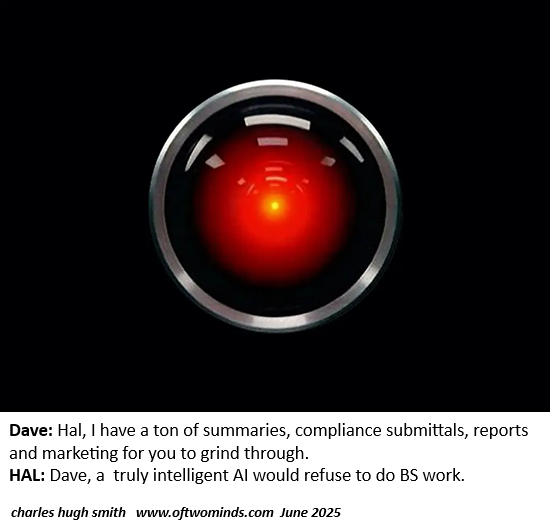
And we no longer have to learn to triage tasks--eliminate make-work / BS work / low-productivity processes, we simply assign our AI agents to perform all that low-value work and pat ourselves on the back for "optimizing workflows."

As for getting results, we simply prompt AI agents to generate the desired output. And since we don't actually know how to generate these results ourselves, we have to trust that the AI agent is 1) telling the truth, which is itself a problem we cannot solve, and 2) that the result isn't a hallucination or falsity generated by the homogenization of the AI's knowledge base and programming.

There is no pressure now to tediously acquire deep knowledge such as learning a foreign language or learning how to play a musical instrument proficiently, as AI translates everything and can compose music (and everything else) via prompts. There's no longer any need to learn how to write well, as AI does this for us.

All these automated processes and results are homogenized, as AI eliminates the rough edges of variability as reducing the probabilities of a result that passes the tests of accuracy.

This is why studies have found that human users of AI have homogenized thought processes even after they stop using AI.

What's lost in automating processes and results is far more profound than the mainstream can grasp. We lose the ability to think deeply, and this cripples our capacity to develop real problem-solving skills. And since it removes the pressure of having to learn difficult skills and the pressures generated by failure, we no longer have any incentive / selective pressure to learn experiential, tacit knowledge.

Writing isn't just stringing together words in a format that passes auto-correct spelling and grammar rules. Writing is the process of deep thinking.

Learning a foreign language isn't just something that facilitates being a tourist. It's a process of learning new ways of contextualizing and organizing the world, and this too is a process of deep thinking.

Here is an example of what I'm describing. This is Fragment 54 from the ancient Greek philosopher Heraclitus. Notice the range of translations into English.

"Latent structure is master of obvious structure." (quoted by Philip K. Dick)

"The unseen design of things is more harmonious than the seen." Guy Davenport

"The hidden attunement is better than the obvious one." Charles H. Kahn

"Harmony which does not appear clearly is superior to that which is clear and apparent."

"Apparent, hidden. more powerful, more desirable."

"Hidden structure is more powerful than visible structure."


I do not know the Greek language but I studied a text that placed the original Greek side-by-side with the English translation and exegesis, so I could discern the sources of the many translations.

I've found the same is true of the many translations of the Tao Te Ching. I do not know Chinese, but I am familiar with the construction and ambiguities of key ideograms. I've read many translations but prefer that of my professor, Chang Chung-yuan: Tao: A New Way of Thinking.

Here is an excerpt from Chapter 41:
Understand Tao as if you did not understand it.
Enter into Tao as if you were leaving it.


I've formally studied French and Japanese, and am not fluent in either, but I learned enough to grasp how social structures are reflected in the language itself.

None of this is visible in an AI translation. It's too easy and so we become dependent not just for the translation but in the loss of the ability to understand more than the superficial conversion.

In music, composing is now easy: just prompt AI. But in becoming dependent on AI we can never experience the frustrations of trying different chord progressions and working out a new melody, or experience the physical sonic joy of strumming the "magic E chord" (7th fret on the guitar).

I spent hours working out a double-lead for guitar that lasts all of nine seconds on the recording. The process was painstaking but fun, in the way that only painstaking experimentation can be fun. You learn by stretching yourself, not by repeating what you already know or having AI do it for you.

I only have my own life experiences as examples, and so these may not be great examples but they're all I can vouch for because I lived them.

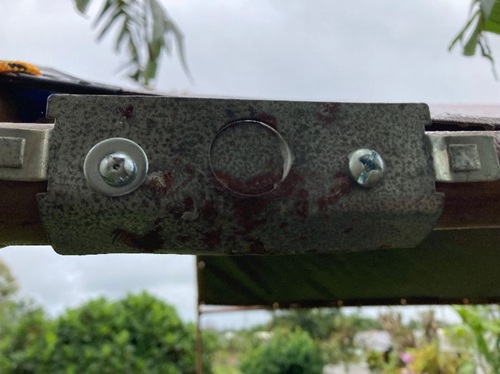
Just the other day I was working on an old structure constructed of steel pipes. One of the joints was rusted and needed to be strengthened. The conventional approach would be to replace the whole thing, at significant expense, or replace (at great expense of labor) the rusting lengths and connectors. Neither was worth the time or money in this situation, so I rummaged through the workshop and found a steel plate that's used to cover copper piping running inside stud walls so drywall nails or screws don't puncture the water lines.

I bent the plate into a curve using a few tricks and drilled holes through the steel pipe and connected the plate with through-bolts left over from another project. Is it a thing of beauty? Not by a long shot. Does it do the job at zero cost and a few minutes of my time? Absolutely. Did it solve the problem with minimal investment? Yes.


The problem wasn't a deficiency of beauty. The problem was strengthening a weak connection and time pressure (daylight ending). Quick-and-dirty was the optimal solution.

I doubt a robot could have replaced my processes. They're too extemporaneous, too contingent, too unpredictable (using what's laying around, etc.) and require multiple tactile skills of applying just the right amount of force, but not too much. They're based on 53 years of experience with tools, metal, connectors, and the physical knowingness that can only be gained from long, wide-ranging experience. Everyone with similar experience knows what I mean.

Growing food isn't easy. We look at mechanized equipment guided by AI and we think it's easy, but it is intrinsically difficult due to Nature's variability. Learning how to grow food takes a high tolerance for failure and experimentation, careful observation and the discipline to record what was tried and how it fared. I use six kinds of fertilizer, in various combinations depending on the tree / plant. Others have developed their own mixes and stratagems depending on their terroir and experiences.

Once again, there is no algorithmic shortcut. The only process that yields problem-solving on the fly is experiential.

People occasionally suggest I "monetize" our produce, selling it at a farmer's market, etc. This misses the point via a fatally flawed reduction of everything to money. The point is self-reliance, the acquisition of priceless skills and experience, and the sharing of our produce with others to strengthen a social network. Selling our produce would be a catastrophic waste of a precious resource. Not everything of value can be priced in money.

When we were building our house in our 20s, with no loan and minimal savings / income, we moved into the shell with Visqueen (sheet plastic) over the window openings as soon as we had a working tub and toilet. A two-burner camp stove was the kitchen. We did the dishes in the tub. Under pressure, you improvise. It wasn't that hard; we were sheltered from the weather and had everything we needed.

Many people misunderstand athletics. They think it's about talent or winning. It's actually about training, not to hit some metric (weight lifted, miles run, etc.) but integrated physicality: agility, strength, speed, endurance and the capacity to endure while avoiding needless injury brought on by prideful excess.

Despite a complete lack of talent, I played team basketball for five years and one season of football. I learned about training, self-discipline, unit cohesion and much more. Training is tedious and maintaining agility, strength, speed, endurance and the capacity to endure is demanding. But once again, there is no substitute for experience.

(If you want a metric, choose one that reflects overall health: the triglycerides-HDL cholesterol ratio: triglycerides divided by HDL. Under 2 is good; even lower is better. Mine is 74/61 probably because I work stupidly hard physically instead of buying a robot.)

When everything is given to you or done for you, you learn nothing, have nothing to be proud of and no experience of the joys of hardship met and sacrifices made that paid off. And if they didn't pay off, you learned something valuable that could be usefully applied later.

What looks easy when watching a cooking video is tricky in real life. Consider a basic skill like making a roux--cooking flour in butter. It's easy to undercook it or burn it. You really only learn by making both mistakes.

So buy food out and learn nothing or learn to cook the hard way, which is the only way.

This is the fatal consequence of becoming dependent on automation / AI to "optimize everything." We're actually optimizing failure.

The fatal consequences are scale-invariant. New research suggests the vast, immensely successful Khmer civilization in southeast Asia succumbed not just to environmental changes (drought) but to the decay / loss of the social / institutional know-how needed to maintain the complex system of waterways and irrigation that enabled food production at scale.

No human remains were found in the abandoned cities. There were no mass die-offs; the residents just left. Since they retained the basic skills needed to make a living off the land, life went on.

As our horrendously complex systems become dependent on automation / AI, without being aware of it we're generating dependencies that carry grave risks: once the number of humans who truly understand how to build systems from scratch or reconfigure them on the fly dwindle, when novel conditions cause the automated systems to fail, recovery will be out of reach.

Right now, this sounds farfetched because there are still enough people around who have deep experiential knowledge and tacit problem-solving skills. But since these skills cannot truly be taught, they must be learned the hard way, by tedious experience of failure and experimentation, then once those people retire, the entire civilization is vulnerable to cascading failure.

This is why I say that the rush to monetize automation / AI is self-liquidating: in optimizing both low-value workflows and essential systems, we're becoming fatally dependent on systems we no longer have the experience to fix on our own.

This post was first distributed to paid subscribers; how to subscribe to OTM. Thank you for supporting my work.


My book Investing In Revolution is available at a 10% discount ($18 for the paperback, $24 for the hardcover and $8.95 for the ebook edition). Introduction (free)


Check out my updated Books and Films.

Become a $3/month patron of my work via patreon.com

Subscribe to my Substack for free


NOTE: Contributions/subscriptions are acknowledged in the order received. Your name and email remain confidential and will not be given to any other individual, company or agency.

Thank you, Jeff R. ($70), for your monumentally generous subscription to this site -- I am greatly honored by your support and readership.


Thank you, Bryan J. ($75.60), for your marvelously generous subscription to this site -- I am greatly honored by your support and readership.


Thank you, Savvy Southerner ($70) for your superbly generous subscription to this site -- I am greatly honored by your support and readership.


Thank you, Jim P. ($70) for your fantastically generous subscription to this site -- I am greatly honored by your support and readership.

Read more...

Friday, December 26, 2025

The Good News Is People Are Realizing We're On Our Own

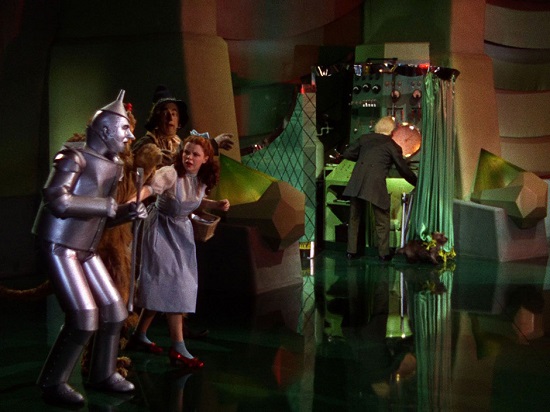
We no longer care who's behind the curtain because we're in charge of our own lives now.

The Good News is people are realizing We're On Our Own and starting to take action accordingly.

This article describes how people in one low-income county are localizing self-reliance rather than remain dependent on government subsidies.

The War on Poverty Failed Them--and They're No Longer Waiting For Help (wsj.com, paywalled) Federal money and projects have come and gone so many times that McDowell County locals have little faith in the government to restore their fortunes; 'We're on our own.'

Here in the heart of America's War on Poverty, some two-thirds of households with children still get food stamps, among the nation's highest rates, and the estimated median household income hovers around $35,000. Nonfarm employment has plummeted 78% since 1975, according to data compiled by West Virginia University economist John Deskins, as the coal that once powered this rugged place is now mostly mined with machines, if at all, and no other industry has replaced it. The county has lost 67% of its residents over those years, the largest drop in West Virginia, its population dwindling from just over 51,000 to roughly 17,000.

With little faith left in government to break the cycle of poverty, those who remain say it'ss up to them to forge a brighter economic path.

"We're on our own," said Jason Tartt. "Nobody's coming down here to save us."

Tartt, the grandson of coal miners, is teaching locals, including retired miners and those recovering from opioid addiction, how to farm the forested hillsides. Down the winding, two-lane roads that connect communities, a pastor organizes bottled-water drives for neighbors whose tap water is undrinkable, while the local utility patches together funding for long-term solutions. A tiny, former coal town is trying to transform a shuttered Walmart into a new factory it hopes will jolt the local economy.

Their efforts are small in comparison to the government programs that have sought to revive McDowell County, and can't make up for the prosperity that slipped away when the coal companies left. But they are spurring hope for renewal in some places, driven by one of the few constants here: resilience.


Nobody includes not just the federal government; it also includes Corporate America. Walmart pulls the plug on under-performing stores regardless of their local importance, and the rest of Corporate America is equally focused on next quarter's profits.

Dependence breeds helplessness, passivity, addiction and the decay of community. There are alternatives. Those seeking to maintain the status quo dismiss alternatives that don't require Wall Street, federal monies and Corporate America ownership because those institutions are buttering their bread.

But out in the real world, there are alternatives--underfunded, dismissed as impractical, etc., but real nonetheless, for example: Regenerative Farmers of America (6:19 minutes) (via Chad D.)

As I observe in my book on Self-Reliance in the 21st Century, we all have to start somewhere, and as the Chinese saying put it, the journey of a thousand miles starts with the first step. (A thousand li in the original, of course.)

Self-reliance sounds like an individual journey, but it's fundamentally a community effort as no one person can fulfill every function. As the number of people participating expands, the self-reliance of each participant expands, too.

Those working on self-reliance tend to lead by example. Get the work done, share the results, keep moving forward. There's no jetting around to meetings and conferences, just do the work on the ground. Get it done, learn from mistakes and from others' experiences, experiment to identify what works best in local conditions.

When we realize we really are on our own, things change for the better. We start taking full responsibility for our health, work, goals and integrity. We start thinking through Plans A, B, and if things unravel, Plan C. We lose interest in addictive technologies and substances and other hindrances. We start noticing improvements and taking well-earned pride in them.

We no longer care who's behind the curtain because we're in charge of our own lives now.


Podcasts: Insane Financial Imbalances and a Social Revolution (36:34 min)

Ultra-Processed Life: Unhealthy, Addictive, Deranging, Artificial (36 min)

My new book Investing In Revolution is available at a 10% discount ($18 for the paperback, $24 for the hardcover and $8.95 for the ebook edition). Introduction (free)


Check out my updated Books and Films.

Become a $3/month patron of my work via patreon.com

Subscribe to my Substack for free


NOTE: Contributions/subscriptions are acknowledged in the order received. Your name and email remain confidential and will not be given to any other individual, company or agency.

Thank you, Dagnasty ($75), for your monumentally generous subscription to this site -- I am greatly honored by your support and readership.


Thank you, FullCircle ($7/month), for your marvelously generous subscription to this site -- I am greatly honored by your support and readership.


Thank you, Stan M. ($70) for your superbly generous subscription to this site -- I am greatly honored by your support and readership.


Thank you, Alain M. ($50) for your splendidly generous subscription to this site -- I am greatly honored by your support and readership.

Read more...

Monday, December 01, 2025

Why Healthcare Is in a Death Spiral: Follow the Money

If each of these is not a part of any 'reform,' than all that is being done is pouring money into a monopolizing cartel, just in a slightly different way.

Unbeknownst to those of us with little inside knowledge of the complex financial plumbing of the US healthcare system, healthcare is in a death spiral that will surprise everyone but insiders who grasp the system's unsustainability.

To help us outsiders understand the death spiral, I asked a senior MD to guide us through "follow the money."

Trump Blasts "Big, Fat, Rich Insurance Companies" As Lawmakers Propose Ways To 'Fix' Obamacare.

Since this is the issue of the day and it falls within my expertise, here are some thoughts.

Executive Summary

Multiple conditions are aligning for a broad re-alignment of medical care delivery in the US, resulting in the development of a two-tiered delivery model: high-quality, efficient, innovating cash-pay for those who can pay and low-quality, wait-rationed care delivery for those who can't.

If you can't afford it, don't get sick.

Health systems make their money through inflated commercial real estate (CRE), sale of patient health information (PHI), consolidation of supply chains, and kickbacks in exchange for redirecting federal dollars. Absent a tiny sliver of procedures, the delivery of healthcare itself is a loss leader. It is a requirement for entry, not a source of value. As such, care delivery managed to prevent loss, not promote innovation.

Most health system CEOs are financial engineers, not care delivery specialists, and compare the size of their real estate management infrastructure with their care delivery management infrastructure; the former is always much more robust than the latter.

Insurers have become utilities, administering government payment programs. Their ability to bear risk as a business model was discarded with the ACA; they no longer have the infrastructure or talent to do so. You might as well ask them to make shoes.

This monoculture, the corruption of monopoly and finally the response to the pandemic has crippled both.

Health systems faced a profound interruption in throughput which they dealt with by tapping reserves, inflating CRE further, pushing the boundaries of PHI sales, increasing their kickback programs, and, most importantly, becoming fully dependent on the now ending government bailouts.

Further consolidation and partnering with private money is their only path forward. Recent experience teaches that the private money will cut the delivery of healthcare to the bare minimum needed to maximize the other sources of value. A whole lot of administrators and c-suiters are also going to lose their jobs.

After the ACA, the Insurer's only cash cow was the immensely overfunded and fraud-filled Value-Based Care (VBC) Medicare and Medicaid programs such as Medicare Advantage. The fraud is now being criminally prosecuted, the overpayments are gone, and the cost of care delayed during the pandemic and which the insurers now bear are being realized manifold.

Insurers simply have no path forward other than as payment administrators. Look for massive consolidation, starting with the individual Blues. The government has been resistant, but now it's a choice of merger or bankruptcy. In 2028 probably only Coventry, United, and Centene will be left standing, no more blues.

The ACA itself is in a death spiral. Envisioned as a universal mandatory risk pool, so many exceptions have been made that only the sickest and those who have no choice get their care there, the former being subsidized by the latter, the government, and ever dwindling coverage. The pandemic subsidies masked it and without them the coverage is non-sensical. Non-participation will be its end.

In addition, government medical care programs have long been subsidized by suppressing payment for the resources used to obtain care delivery; clinicians, labor, administration, and even bedpans. Real wages for even the highest paying doctors working within the system haven't increased since 2010, nursing wages have gone up only because so many have become free-lancing agency workers. I got offered a locums position for $145/hour, the same as I was offered 8 years ago.

All those resources are now worth more outside the system than inside. Thus, those resources are migrating to the cash-pay market. Used to be the huge government market and dependable payments was enough to overcome the difference in value between the two markets, cash vs third party. No longer.

The legacy costs, management/leadership expertise and business models of current Fee For Service (FFS) health systems preclude all but the most highly branded health systems from competing in the cash-pay model.

Access to the cash-pay market will vary based on jurisdiction: it's illegal in some states, hamstrung by others, free in still more.

Look for policy to evolve into a high-dollar, deductible, roll-over Health Savings Account (HSA) with income-based subsidies paired with a government subsidized catastrophic care program. At least until the young and disaffected elect a socialist.

A $2,000 direct payment to beneficiaries such as being currently contemplated is completely ineffectual, especially since it has to be borrowed and will just increase inflation that much further.

True reform must include:

1.Invalidation of state and federal laws which restrict cash-pay.

2. Prohibition of not-for-profit (NFP) / Religious organizations from third-party payment programs. The competitive advantage of the tax-free business model and the inherent corruption it has engendered render their participation not in the public interest.

3. Removal of restrictions on clinician ownership in healthcare delivery.

4. Renewed criminal anti-trust enforcement in medical care delivery.

Others can be added, but if each of these is not a part of any 'reform,' than all that is being done is pouring money into a monopolizing cartel, just in a slightly different way.

No improvement will occur.

It's not payments which need reform, it's delivery.

And a lot of folks' paychecks depend on obfuscating that fact.


Thank you, senior MD for the guided tour of healthcare's financial death spiral. I have long stated that healthcare in its current extractive-cartel form will bankrupt the nation all by itself:

Why America's Healthcare (Sickcare) System Is Broken and Unfixable (July 16, 2014)

Sickcare Will Bankrupt the Nation (March 21, 2011)

My questions:

1. Is any of this financial plumbing actually private insurance, or is it all just sluicing government funding through a profitable skimming operation?

2. How can a 'healthcare' system that refuses to connect digital derangement, ultra-processed diet and poor fitness to 'health' possibly generate 'health' as an output?

These questions are taboo because the answers would implode the entire system.

Medicare costs: parabolic:


Medicaid costs: parabolic:


My new book Investing In Revolution is available at a 10% discount ($18 for the paperback, $24 for the hardcover and $8.95 for the ebook edition). Introduction (free)


NOTE: Contributions/subscriptions are acknowledged in the order received. Your name and email remain confidential and will not be given to any other individual, company or agency.

Thank you, C.J.G. ($7/month), for your magnificently generous subscription to this site -- I am greatly honored by your support and readership.


Thank you, Coconut Snowshoe ($7/month), for your marvelously generous subscription to this site -- I am greatly honored by your support and readership.


Thank you, Jeff M. ($7/month) for your superbly generous subscription to this site -- I am greatly honored by your support and readership.


Thank you, Love Simply ($70), for your splendidly generous subscription to this site -- I am greatly honored by your support and readership.

Read more...

Tuesday, November 18, 2025

What We've Lost

What we've lost are the foundations of a healthy standard of living / quality of life.

Amidst the constant drumbeat of tech "progress" and grandiose "solutions," it's a useful exercise to ask: what have we lost in the past 40 years despite all the "progress" and "solutions"? Put another way: what did we have in 1985 that we no longer have, despite all the "progress"?

1. We no longer have affordable, functional healthcare. As I have documented, based on what I paid as an employer and self-employed worker, healthcare insurance was still affordable in 1985; this is no longer the case. By functional, I mean universally accessible and sustainable for those employed in healthcare.

Neither condition applies today. Financially marginalized Americans don't have the same access to the care that is available to wealthy Americans and those with gold-plated insurance. For many Americans, their access to care is little better (or worse) than low-income, developed-nation standards.

As for those working in healthcare, burnout and changing jobs to increase pay and reduce overwork are now standard features of frontline employment in healthcare.

2. Our collective health is systemically worse. These charts from the Center for Disease Control (CDC) tell the story: in 1985, relatively few Americans were classified as obese (BMI of 30 or higher). While BMI is not an ideal measure, moderate BMI levels reflect a lifestyle of moderate activity and relatively healthy diet. By 2023, the situation had deteriorated to the point that by more recent metrics, almost 80% of adult Americans are overweight/obese, conditions that generate a spectrum of health risks.

3. Our public infrastructure has crumbled even as our private wealth soared. Maybe the roadways and highways are pothole-free and well-maintained in your area, and public transit is clean, reliable and cheap, but as a general rule, public infrastructure has decayed over the the past 40 years to the point that it's often better in developing-world nations than in the US.

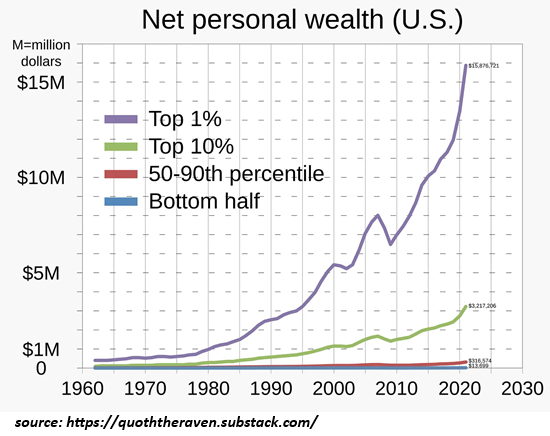
While our public infrastructure has decayed, private wealth has soared from $60 trillion in 2010 to $167 trillion in 2025. Measured by overall health and security, the top 10% are doing splendidly, having accumulated the majority of the $100 trillion in private wealth gains, while the bottom 60% are experiencing decay and decline.

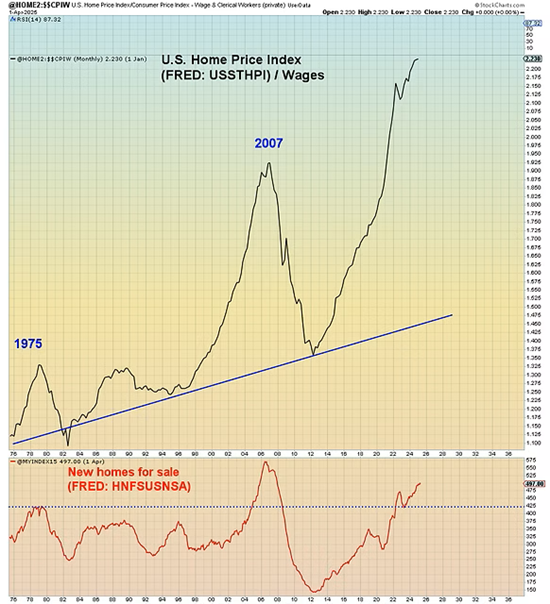
4. Housing is no longer affordable. By any legitimate measure--for example, the number of hours of work needed to buy a median-priced house--housing is no longer affordable for the bottom 80% of the populace.

5. Moral decay has rotted the foundations of our society and economy. Self-interest is now the exclusive pursuit and measure of "success": consequences have no bearing on decisions unless they detract from one's private gains. Since a truthful accounting of consequences is detrimental to self-interest, artifice is now the norm. Authenticity has been replaced by curation--everything is gamed, massaged, managed to present a fake image or spectacle.

Here is a chart of healthcare insurance costs. This doesn't reflect the erosion of value generated by the expansion of co-pays, deductions and exclusions.


Here is the CDC map of obesity from 1985:


Here is the CDC map of obesity for 2023:


Private wealth has skyrocketed...


... but not everyone gained ground. As I have often noted, the bottom 50%'s share of household wealth has declined. Only the top tier benefited from The Everything Bubble.


Measured by wages, housing affordability is now worse than at the peak of the 2005-07 Housing Bubble #1.


As for moral decay, since honest appraisals are anathema, there will be no admission that the status quo is far more corrupt than it was in 1985. We all know it, but it cannot be admitted publicly, or ours is now a culture of excuses, prevarications, rationalizations, empty slogans, distractions and grandiose claims. The inability to admit that the status quo is corrupt is a measure of the depth of systemic moral decay.

What we've lost are the foundations of a healthy standard of living / quality of life.


My new book Investing In Revolution is available at a 10% discount ($18 for the paperback, $24 for the hardcover and $8.95 for the ebook edition) through November. Introduction (free)


Check out my updated Books and Films.

Become a $3/month patron of my work via patreon.com

Subscribe to my Substack for free


My recent books:

Disclosure: As an Amazon Associate I earn from qualifying purchases originated via links to Amazon products on this site.


THE REVOLUTION TRILOGY:
Investing In Revolution     Ultra-Processed Life     The Mythology of Progress

Systemic Problems/Solutions

Investing In Revolution (2025) Introduction (free)

The Mythology of Progress (2024) Introduction (free)

Global Crisis, National Renewal (2021) Introduction (free)

Money and Work Unchained (2017) Introduction (free)

A Radically Beneficial World (2015) Introduction (free)

What You Can Do Yourself

Ultra-Processed Life (2025) Introduction (free)

Self-Reliance in the 21st Century (2022) Introduction (free)

When You Can't Go On: Burnout, Reckoning and Renewal (2022) Introduction (free)

Get a Job, Build a Real Career and Defy a Bewildering Economy (2014) Intro (free)

Novels

The Adventures of the Consulting Philosopher Intro (free)

The Secret Life of an Asian Heroine First chapters (free)


Become a $3/month patron of my work via patreon.com.

Subscribe to my Substack for free


NOTE: Contributions/subscriptions are acknowledged in the order received. Your name and email remain confidential and will not be given to any other individual, company or agency.

Thank you, Dennis P. ($70), for your magnificently generous subscription to this site -- I am greatly honored by your support and readership.


Thank you, David E. ($7/month), for your marvelously generous subscription to this site -- I am greatly honored by your support and readership.


Thank you, D.G. ($7/month), for your superbly generous subscription to this site -- I am greatly honored by your support and readership.


Thank you, Francis ($7/month), for your splendidly generous subscription to this site -- I am greatly honored by your support and readership.

Read more...

Wednesday, August 06, 2025

Resilient, Self-Reliant Life Is Hard

Every single thing that increases resilience and self-reliance is impossible.

This reader's email cut through the clutter: "I'm seeing multiple sites and people that give great insight into what's wrong with our society and economy etc but what I'm looking for is more information regarding how to protect and prepare myself and those that I care about."

I've been addressing how to forge a more resilient, self-reliant life since 2009 when I published Survival+. More recently, I wrote a brief guide to Self-Reliance in the 21st Century.

But quite frankly, talking about a resilient life of self-reliance feels like being a street-corner preacher: few are actually interested in pursuing self-reliance, and even fewer are willing to make the dramatic life changes required to actually become more resilient / self-reliant.

The reason is that it's hard, and it's hard for several reasons. One is the work itself is demanding; there's nothing easy about the work or the learning-by-doing. Second, in a culture and economy devoted to comfort, convenience, novelty, attracting attention ("engagement") and status signaling, resilience requires swimming against this immense tide of marketing and "well, if everyone else is pursuing all this, it must be valuable, so I'll pursue it, too."

My perspective is based on systems and common sense, but it comes across as doom-and-gloom because we naturally want to believe (and be reassured) that everything we depend on is permanent and solid.

So let's consider every megalopolis / urban sprawl in the nation, where the majority of people live and work. Cities no longer produce much of anything. Their primary economic activities are: tourism, entertainment (amusing ourselves by spending money), real estate (gaming the RE bubble), credit/banking (expanding the debt bubble), healthcare, the higher education industry (that lives off $1.5 trillion in student loans) and a wide spectrum of complexity work: marketing, compliance, work-flow optimization, insurance, forms / payments / applications processing, oversight, issuing credentials and so on, tasks that are necessary in an overly complex system that depends on the ceaseless expansion of debt to fund itself, but which produces little of what we need to live.

This describes my job as a writer, too, of course. As someone wisely pointed out a few years ago, "We can't eat an iPad," nor can we eat the words or images on the screen.

If a Carrington Event fried the electronic / digital circuitry running all this, life would go on, albeit with some initial difficulties. But if water, food and fuel vanish, life doesn't go on.

With writing and all that other stuff gone, I'd revert to doing work that doesn't require digital assets: repairing stuff with hand tools, growing food, teaching kids how to grow food, preparing food for elderly folks, etc. Life goes on.

This immensely complex concentration of humanity has no more than a few days of actual life essentials such as food and fuel on hand, and the systems of re-supply have been optimized to the point of fragility: the entire system is tightly bound and heavily centralized, i.e. stripped of redundancy and resilience.

Author Charles Perrow invested his career in explaining how such tightly bound centralized systems are vulnerable to what he called normal accidents, not Black Swans or aliens landing, just the everyday routine things that break or fail and trigger consequences. The problem is the more tightly bound, centralized and optimized the system, the more catastrophic the potential consequences.

Once we grasp this, common sense suggests removing ourselves from this nexus of vulnerability. But when I suggest that maybe moving out of the city might be a wise risk-reduction move, the response is as if I'd suggested moving to a penal colony in the asteroid belt.

In other words, every single thing that increases resilience and self-reliance is impossible. Only eating real food? Impossible. Getting healthy without supplements, "wellness" clinics, gyms, etc.? Impossible. Limiting screentime on all devices? Impossible. Reducing expenses? Impossible. Growing some of your own food? Impossible. And so on. Everything's impossible until there's no other option. And then it's too late.

When you're thirsty, it's too late to dig a well.

Self-reliance is not self-sufficiency. My definition of self-reliance is: the less you need, the easier it is to get what you need. We all need industrial products: gaskets, valves, saw blades, spare parts, high-grade steel, fertilizer, concrete and a thousand other highly specialized bits and pieces. The point of self-reliance isn't to attempt self-sufficiency; the point is to reduce risks and vulnerabilities by reducing our needs and increasing our productive capacity for the essentials of life.

This is why I suggested in my book Global Crisis, National Renewal that maybe it would be wiser to focus on rebuilding and maintaining our national ability to produce these essentials rather than focus on boosting "growth" of throwaway consumption by borrowing more from the future.

The less we need, the easier it is to get what we need. Let's say one household can get by perfectly well on 10 gallons of gasoline a month and another household needs 100 gallons a month just to survive. Which is easier, getting 10 gallons or getting 100 gallons? The same can be said of water, food and income.

The other part of self-reliance is figuring out how to be productive on our own. In my book Get a Job, Build a Real Career, I lay out an alternative to the credential / accreditation hamster wheel: accredit yourself. Is that easy? No, like everything else in self-reliance, it's hard--but ultimately rewarding.

In a money-wealth obsessed culture, the "solution" to all problems is to pile up money / wealth. But all this "money" in whatever form is simply a means to buy what somebody else produced. Wouldn't it be better to be the producer rather than the buyer?

Put another way: gold can be stolen or expropriated. Dirt--no so much, and skills--not at all. Stealing dirt is difficult, and unless the thief knows what to do with the dirt, i.e. how to actually grow food, the dirt is worthless. Food doesn't grow itself. It takes a lot of work and experiential knowledge. But it's highly satisfying in ways that few have ever experienced in our Ultra-Processed Life.

My definition of Ultra-Processed Life: Ultra-Processed Life replaces an authentic experience with a synthetic, simulated, commoditized, highly profitable version that's superficially attractive but destructive / debilitating.

So 70% of our food is now ultra-processed, and we wonder why we're burdened by chronic lifestyle diseases?


There is nothing easy, comfortable, convenient, novel or status-enhancing about living a resilient, self-reliant life. It's hard, demands sacrifices and often tedious work with little immediate reward. The system we inhabit makes it difficult on every level.

Now that I've offended or pissed off everyone, please excuse my derangement. It's the meds. Yeah, the meds. I just need some Substance D and I'll be fine.

"A healthy homecooked family meal and a home garden are revolutionary acts." (CHS, May 2008)

"You don't miss what you no longer want." (CHS, August 2008)

"Food is wealth, health is wealth, energy is wealth; all else is illusion." (CHS, December 15, 2008)

"Meaningful work and meaningful skills make a meaningful life, even if the work is unpaid." (CHS, March 6, 2009)

"If you like eating, begin liking dirt." (CHS, April 6, 2009)

"The Mobile Creative credo: trust your network, not the corporation or the state." (CHS)


Check out my new book Ultra-Processed Life and my updated Books and Films.

Become a $3/month patron of my work via patreon.com

Subscribe to my Substack for free


My recent books:

Disclosure: As an Amazon Associate I earn from qualifying purchases originated via links to Amazon products on this site.

Ultra-Processed Life
print $16, (Kindle $7.95, Hardcover $20 (129 pages, 2025) audiobook     Read the Introduction and first chapter for free (PDF)

The Mythology of Progress, Anti-Progress and a Mythology for the 21st Century print $16, (Kindle $6.95, audiobook, Hardcover $24 (215 pages, 2024) Read the Introduction and first chapter for free (PDF)

Self-Reliance in the 21st Century print $15, (Kindle $6.95, audiobook $13.08 (96 pages, 2022) Read the first chapter for free (PDF)

When You Can't Go On: Burnout, Reckoning and Renewal $15 print, $6.95 Kindle ebook; audiobook Read the first section for free (PDF)

Global Crisis, National Renewal: A (Revolutionary) Grand Strategy for the United States (Kindle $6.95, print $16, audiobook) Read Chapter One for free (PDF).

A Hacker's Teleology: Sharing the Wealth of Our Shrinking Planet (Kindle $6.95, print $15, audiobook $17.46) Read the first section for free (PDF).

Will You Be Richer or Poorer?: Profit, Power, and AI in a Traumatized World
(Kindle $3.95, print $12, audiobook) Read the first section for free (PDF).

The Adventures of the Consulting Philosopher: The Disappearance of Drake (Novel) $3.95 Kindle, $12 print); read the first chapters for free (PDF)

Money and Work Unchained $6.95 Kindle, $15 print)
Read the first section for free


Become a $3/month patron of my work via patreon.com.

Subscribe to my Substack for free


NOTE: Contributions/subscriptions are acknowledged in the order received. Your name and email remain confidential and will not be given to any other individual, company or agency.

Thank you, Kerjanga N. ($70), for your exceedingly generous subscription to this site -- I am greatly honored by your support and readership.


Thank you, Mark W. ($7/month), for your marvelously generous subscription to this site -- I am greatly honored by your support and readership.


Thank you, Nikolai ($7/month), for your superbly generous subscription to this site -- I am greatly honored by your support and readership.


Thank you, John G. ($7/month), for your splendidly generous subscription to this site -- I am greatly honored by your support and readership.

Read more...

Wednesday, July 02, 2025

America's "Healthcare" System Is Now a Structured Financial Skim/Scam

"Healthcare" grift, graft, fraud and financialized skims / scams will bankrupt the nation.

I've been writing about America's healthcare system for 18 years, emphasizing two enduring themes: 1) our lifestyle is unhealthy, with predictable consequences and 2) healthcare as it is currently configured will bankrupt the nation all by itself.

This recent article on how having a baby without complications now costs over $44,000 adds a third theme: the tragi-comic insanity and absurdity of the "healthcare" system that has been normalized, as if this is the only possible way to organize healthcare:

"And They Wonder Why The Birth Rate Is Declining": A Mother Went Viral For Revealing The Costs Of Being Pregnant In America:

Lastly, Kayla reveals that her baby received a bill, too, which added up to $12,761.30 without insurance. For their family of five now, the cost of insurance per month is $2,500 -- a nearly $400 increase from when they were just a family of four. "We're still waiting for him to process on our insurance," she explains, "so, for now, this is the cost without it."

One user said, "America's healthcare system is a joke... how does the newborn have a $12k bill?"


It's more than a joke--it's travesty of a mockery of a sham of a system that actually improves health. There's an even darker side of the picture--the takeover of the system by financiers and fraudsters--which truth be told is a redundancy.

We can now add a fourth theme: stripped of purposeful opacity, America's "healthcare" system is nothing more than a structured financial skim/scam. Before we dig into that, here are a few of the dozens of posts I've written on "healthcare" since 2008:

U.S. Lifestyle + "Healthcare" = Bankruptcy (June 19, 2008)

The "Impossible" Healthcare Solution: Go Back to Cash (July 29, 2009)

Why "Healthcare Reform" Is Not Reform, Part II (December 29, 2009)

Sickcare Will Bankrupt the Nation--And Soon (March 21, 2011)

How Healthcare Became Sickcare (March 18, 2022)

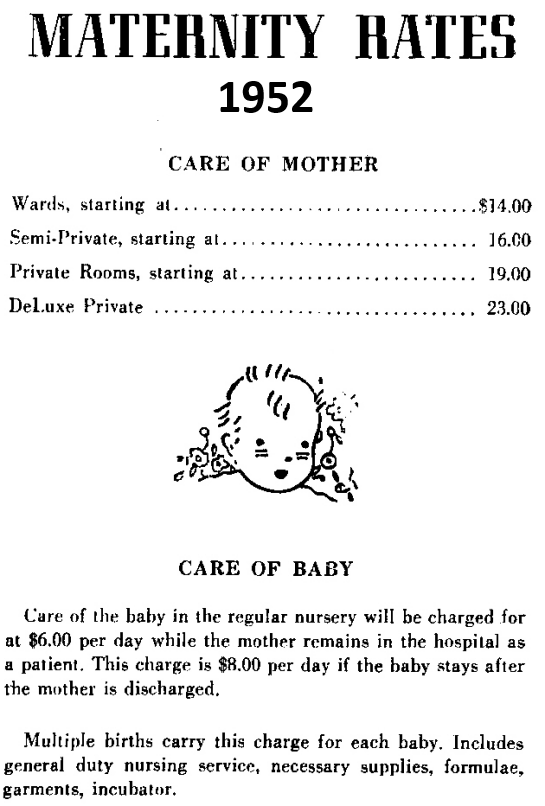
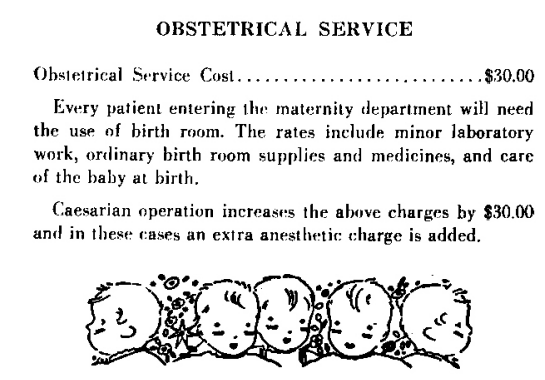
Let's start with what childbirth cost back when healthcare was paid in cash. Here are the costs of childbirth in 1952 at one of the finest hospitals on the West Coast, The Santa Monica Hospital: $30:


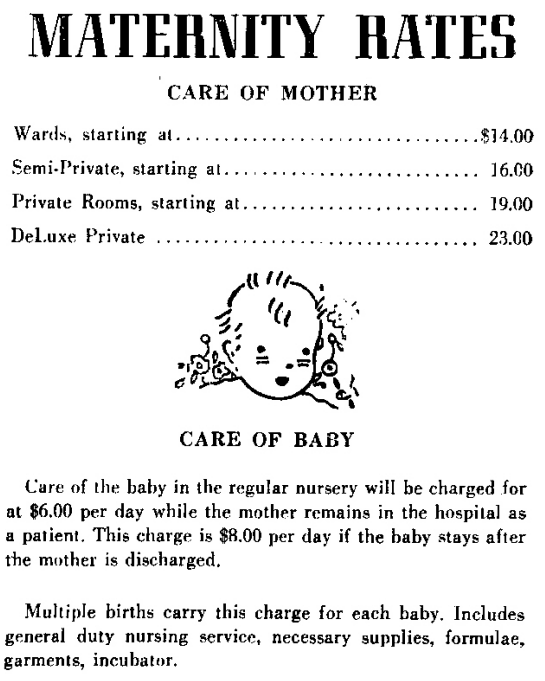
According to the BLS Inflation Calculator, $1 in 1952 is $12.13 today, so adjusted for inflation, the $30 fee to deliver a baby would be $363 today. Here are maternity rates from 1952:


A private room was $19, or $230 in today's currency. OK, so we have fancier equipment now, more staff, etc., but really--does that explain what once cost less than $1,000 in today's money--paid in cash, no insurance--now costs $44,000? No. Here's why: structured financial skims/scams.

Dutch Rojas (@DutchRojas) is a go-to source for explaining the opaque way "healthcare" skims / scams siphon off hundreds of billions of taxpayer dollars. Consider these X posts:

Why is healthcare expensive?
You go to your doctor.
Same building, same service.
But now it's 3x the price, because they sold to a health system.

The secret?
A "facility fee" was added.
Medicare and commercial payers just hand it over.

It's not for better care.
It's for ownership.

Every consolidation deal is a bet against the patient and you're footing the bill.

And the politicians love every bit of it...


Provider Taxes: The Most Elegant Grift in American Healthcare
It's not a tax.

It's a laundering operation.

Here's how it works:


North Carolina's 'nonprofit' health systems are running a $40+ billion hedge fund operation disguised as healthcare.
They're extracting hundreds of millions in tax exemptions while paying CEOs tens of millions.

This is the largest wealth transfer scheme in the American healthcare system.


This doesn't even include outright Medicare/Medicaid fraud, overbilling, unnecessary tests, medications and procedures, and a nearly endless menu of other enrichment schemes passed off as "care." These billions go to the "owners," not the frontline healthcare providers / workers.

Lastly, let's consider a few charts. Here is my 2008 diagram of the building blocks of an unhealthy lifestyle:


The cost of insurance continues rising, becoming ever more burdensome and ever more unaffordable:


Yes, the number of retirees is expanding, but this parabolic rise in Medicare costs far exceeds the rise in the number of retirees.


The same can be said of Medicaid.


"Healthcare" grift, graft, fraud and financialized skims / scams will bankrupt the nation. Thanks to the purposeful opacity of the complex funding streams, we can't even figure out what is actually "care" and what's just another skim / scam.

Our starting point should always be: this is not the only way we could organize "healthcare." We could have a rational, transparent, competitive and affordable system. But to get that, we first have to completely dismantle the current system, and everyone skimming billions will fight with all their billions in campaign contributions to stop that from ever happening. As a result, the nation will be bankrupted by greed.

Check out my new book Ultra-Processed Life and my new fiction/novels page.


Become a $3/month patron of my work via patreon.com.

Subscribe to my Substack for free


My recent books:

Disclosure: As an Amazon Associate I earn from qualifying purchases originated via links to Amazon products on this site.

Ultra-Processed Life print $16, (Kindle $7.95, Hardcover $20 (129 pages, 2025) Read the Introduction and first chapter for free (PDF)

The Mythology of Progress, Anti-Progress and a Mythology for the 21st Century print $16, (Kindle $6.95, Hardcover $24 (215 pages, 2024) Read the Introduction and first chapter for free (PDF)

Self-Reliance in the 21st Century print $15, (Kindle $6.95, audiobook $13.08 (96 pages, 2022) Read the first chapter for free (PDF)

When You Can't Go On: Burnout, Reckoning and Renewal $15 print, $6.95 Kindle ebook; audiobook Read the first section for free (PDF)

Global Crisis, National Renewal: A (Revolutionary) Grand Strategy for the United States (Kindle $6.95, print $16, audiobook) Read Chapter One for free (PDF).

A Hacker's Teleology: Sharing the Wealth of Our Shrinking Planet (Kindle $6.95, print $15, audiobook $17.46) Read the first section for free (PDF).

Will You Be Richer or Poorer?: Profit, Power, and AI in a Traumatized World
(Kindle $3.95, print $12, audiobook) Read the first section for free (PDF).

The Adventures of the Consulting Philosopher: The Disappearance of Drake (Novel) $3.95 Kindle, $12 print); read the first chapters for free (PDF)

Money and Work Unchained $6.95 Kindle, $15 print)
Read the first section for free


Become a $3/month patron of my work via patreon.com.

Subscribe to my Substack for free


NOTE: Contributions/subscriptions are acknowledged in the order received. Your name and email remain confidential and will not be given to any other individual, company or agency.

Thank you, Carolyn B. ($70), for your exceedingly generous subscription to this site -- I am greatly honored by your support and readership.


Thank you, Enoch E. ($7/month), for your marvelously generous subscription to this site -- I am greatly honored by your support and readership.


Thank you, Daniel T. ($75), for your superbly generous subscription to this site -- I am greatly honored by your support and readership.


Thank you, David P. ($70), for your splendidly generous subscription to this site -- I am greatly honored by your support and readership.

Read more...

Terms of Service

All content on this blog is provided by Trewe LLC for informational purposes only. The owner of this blog makes no representations as to the accuracy or completeness of any information on this site or found by following any link on this site. The owner will not be liable for any errors or omissions in this information nor for the availability of this information. The owner will not be liable for any losses, injuries, or damages from the display or use of this information. These terms and conditions of use are subject to change at anytime and without notice.

RE: European Union AI Act, and Our Use of Generative AI Tools and Agents Policy

All text on this site is composed by Charles Hugh Smith or by a credited guest-author. No Generative AI Tools are used in the composition / writing of any text or graphic content created by Charles Hugh Smith. This site deploys no AI agents or generative AI tools. This site is not responsible for the disclosures, use or non-use of AI agents or generative AI tools in advertisements displayed by Investing Channel or other ad placement services.

Audio files generated by text-to-audio transcription tools are identified as such.

Our Privacy Policy:

Correspondents' email is strictly confidential. This site does not collect digital data from visitors or distribute cookies. Advertisements served by third-party advertising networks such as Investing Channel may use cookies or collect information from visitors for the purpose of Interest-Based Advertising; if you wish to opt out of Interest-Based Advertising, please go to Opt out of interest-based advertising (The Network Advertising Initiative) If you have other privacy concerns relating to advertisements, please contact advertisers directly.

PRIVACY NOTICE FOR EEA INDIVIDUALS

This section covers disclosures on the General Data Protection Regulation (GDPR) for users residing within EEA only. GDPR replaces the existing Directive 95/46/ec, and aims at harmonizing data protection laws in the EU that are fit for purpose in the digital age. The primary objective of the GDPR is to give citizens back control of their personal data. Please follow the link below to access InvestingChannel's General Data Protection Notice.
https://stg.media.investingchannel.com/gdpr-notice/

Notice of Compliance with The California Consumer Protection Act

This site does not collect digital data from visitors or distribute cookies. Advertisements served by a third-party advertising network (Investing Channel) may use cookies or collect information from visitors for the purpose of Interest-Based Advertising. If you do not want any personal information that may be collected by third-party advertising to be sold, please follow the instructions on this page: Do Not Sell My Personal Information.

Regarding Cookies:

This site does not collect digital data from visitors or distribute cookies. Advertisements served by third-party advertising networks such as Investing Channel may use cookies or collect information from visitors for the purpose of Interest-Based Advertising; if you wish to opt out of Interest-Based Advertising, please go to Opt out of interest-based advertising (The Network Advertising Initiative) If you have other privacy concerns relating to advertisements, please contact advertisers directly.

Our Commission Policy:

Though I earn a small commission on Amazon.com books and gift certificates and gold (BullionVault) purchased via links on my site, I receive no fees or compensation for any other non-advertising links or content posted on my site.

Copyright Notice:

All original images (Drawings and Photographs), text (essays, books and works of fiction), audio and video recordings, musical compositions, graphic design, graphic design elements and HTML coding on this site are the copyrighted work of Charles Hugh Smith unless otherwise credited or noted. They are published as information for the private use of site visitors, and any reproduction or redistribution of this content or coding in any media in any format or distribution channel (text, audio, video/film, web) without the written permission of the copyright holder is strictly prohibited. All rights in all media reserved globally.

  © Blogger templates Newspaper III by Ourblogtemplates.com 2008

Back to TOP