







Friday, September 06, 2013

The Cost of Convenience

Convenience, it seems, is the killer app we'll die for.


The ultimate killer app in the U.S. economy is convenience. Convenience sells in every market and every sector: on the large scale, autos are the ultimate in private transport convenience. On the small scale, the teabag conveniently replaces messing about with loose tea.

Convenience and comfort have long replaced need as the driver of developed economies. The first electric refrigerators were more convenient than the ice boxes they replaced, and the electric washing machine was a quantum leap in convenience and ease above the washboard and wringer.

Persuading consumers to buy (often with credit) further increments of convenience beyond the first big step up required exaggerating the benefits of ever-smaller increments of convenience: the refrigerator now automatically makes ice cubes, has a cold water spout, and will soon scan the contents and text you when the milk is getting low, etc.

Since the economy depends on convenience as the one surefire motivator of sales, no one dares admit that convenience has reached diminishing returns. We are so habituated to absurd marketing "innovations" offering some tiny additional gain in convenience that we may not notice that the gains in convenience have slipped to near-zero.

Here are a couple of examples. A container of coffee that is 50% decaf and 50% regular coffee, and frozen cooked oatmeal. Is it really that difficult to mix your own decaf and regular coffee? As for oatmeal, it takes the same time and trouble to prepare the frozen oatmeal (which was sucking up energy to stay frozen) as it does to put some oatmeal and water in a bowl and microwave it--and you don't get the diabesity-inducing high-fructose corn syrup if you make your own.

It turns out that convenience is truly the killer app, as it ultimately leads to diabesity, chronic disease and early death. There are many causes for a decline in fitness and diet, including women entering the workforce en masse, increasing consumption of empty-calorie beverages, etc., but the self-evident reason is the ubiquity of fast food and convenience food: snacks, frozen pizzas, burritos, etc. and the convenience (and in many places, the necessity) of autos and the relative inconvenience (in many places) of walking and bicycling as fitness-enhancing ways of getting about.

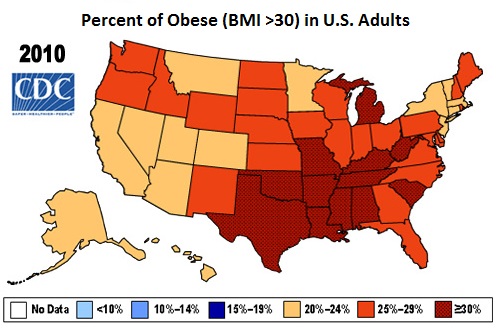
Longtime readers know that I occasionally dumpster-dive trash containers, especially when young people move out, as they almost always empty their freezer and pantry into the trash, even if they're just moving a few hours away by car. To many Americans, food has so little value that it's not even worth packing up to move.

I find very little real food such as fruit, vegetables, meat. etc. in the trash--the vast majority is frozen convenience food that is engineered to light up our brain's reward centers with heavy doses of salt, sweetness and fat: everything that is scarce in Nature.

The consequences of engineered convenience food is not limited to America. Wherever the convenience-food diet goes, diabesity follows: The Sick Man of Asia: China's Health Crisis(Foreign Affairs, by Yanzhong Huang)

The essay traces out the devolution of China's once-universal if basic healthcare system for all into a U.S.-type system of full coverage for Elites and a more brutal one for everyone else: if you don't have the cash to pay for care, you die.

China has the largest population of diabetics and pre-diabetics in the world. China's diabetes rate has skyrocketed to 11% of the adult population, slightly higher than that of the U.S., while its rates of other non-communicable "lifestyle" diseases such as heart disease have also soared to U.S. levels.


Next time you're in a fast food outlet or a supermarket, try to find a convenience food that won't harm you. It will be a challenge:


  • chips: out, too much fat, too much salt
  • fries: out, too much fat, too much salt
  • sausage: out, too much fat, too much salt
  • fast food in general: out, too much fat, too much salt
  • salted nuts: out, too much salt
  • canned goods: out, too much salt
  • most cereals: out, too much sugar and/or salt
  • bottled salad dressings: out, too much salt
  • sports drinks: out, too much salt
  • pre-packaged salads: out, too much salt in the dressing
  • frozen meals: out, too much salt, fat, sugar
  • packaged snacks: out, too much salt
  • packaged noodles: out, too much salt
  • In general: too much salt, sugar, low-quality fat, empty calories, processed carbos


  • Sadly, the vast majority of this convenience food doesn't really taste good, either: it's primary value is the convenience of preparing it. Fast food has the same selling points: loaded with salt, fat and sweetness and very convenient (unless traffic is congested, but that is still less inconvenient than walking/biking).

    Convenience has gone from diminishing returns to negative returns. Staying fit and preparing real meals are intrinsically inconvenient. Convenience, it seems, is the killer app we'll die for.


    Programs/books of note: My recent appearance on Max Keiser:


    Things are falling apart--that is obvious. But why are they falling apart? The reasons are complex and global. Our economy and society have structural problems that cannot be solved by adding debt to debt. We are becoming poorer, not just from financial over-reach, but from fundamental forces that are not easy to identify or understand. We will cover the five core reasons why things are falling apart:
    go to print edition1. Debt and financialization
    2. Crony capitalism and the elimination of accountability
    3. Diminishing returns
    4. Centralization
    5. Technological, financial and demographic changes in our economyComplex systems weakened by diminishing returns collapse under their own weight and are replaced by systems that are simpler, faster and affordable. If we cling to the old ways, our system will disintegrate. If we want sustainable prosperity rather than collapse, we must embrace a new model that is Decentralized, Adaptive, Transparent and Accountable (DATA).
    We are not powerless. Not accepting responsibility and being powerless are two sides of the same coin: once we accept responsibility, we become powerful.

    Kindle edition: $9.95       print edition: $24 on Amazon.com
    To receive a 20% discount on the print edition: $19.20 (retail $24), follow the link, open a Createspace account and enter discount code SJRGPLAB. (This is the only way I can offer a discount.)

    Read more...

    Thursday, September 05, 2013

    Maybe This Is Why We Now Have a Serial-Bubble Economy

    Who benefits from serial bubbles? The financial sector and the central government.


    If there is any one strikingly obvious feature of the U.S. economy in the past 15 years, it's the serial asset bubbles, one after another. Take a look at this chart:


    Why did our economy become dependent on asset bubbles for "growth"? One way to find an answer is to ask: cui bono, to whose benefit? Correspondent Jeff W. has the answer: the financial sector and the central government.

    Here is Jeff's commentary.
    We should always bear in mind how lucrative asset bubbles are for the banks, the government, and super-wealthy insiders. The banks make money by loaning to speculators because their collateral gets a boost. As collateral is boosted, they can make loans to borrowers who are poor credit risks (no job, no income liar loans). Government makes money by taking a cut of speculative profits through taxes. Clued-in insiders get to ride the bubbles up and down, getting advance signals of the turns. 
    When Ben Bernanke says in effect of the housing bubble, “What bubble? We didn’t know there was any bubble. We don’t have any way to know if there is a bubble or not,” I am not impressed. The housing bubble of 1981-2006 gave rise to a huge expansion of the finance, insurance and real estate sectors; enriched government, which expanded greatly during those 25 years; and witnessed the emergence of super-wealthy who measure their wealth in the tens of billions. 
    To me, when Ben Bernanke says, “What bubble?” it is like a kid with chocolate all over his mouth, saying, “What cookies? I didn’t eat any cookies.” 
    Each asset bubble is a bonanza for the banks, government, and wealth insiders, and because those exact groups run this country, and because we have lived through serial bubbles since 1971, I say that if a person says there will be no more asset bubbles, the burden is on him to explain why. Why should the Powers That Be deny themselves a bonanza? 
    Those who managed the 2008 crisis (Bernanke, Paulson, and an assorted cast from Goldman Sachs), saw to it that the government and the Fed emerged unscathed. The Federal government is now much bigger than ever. They also saw to it that the TBTF banks emerged unscathed. They are now larger and more dominant than ever. Other super-wealthy such as Warren Buffett and George Soros also profited from the crisis.
    Ben Bernanke is hailed as a genius for his masterful handling of the 2008 financial crisis. He may protest that he never saw the crisis coming, and that might even be true (though I doubt it), but he was well prepared to use the crisis to enrich the TBTF banks, the government, and super-wealthy insiders. 
    So in summary, because every asset bubble is a bonanza for the Powers That Be, I do not believe they blindly stumble into them. The work together as a team to engineer asset bubbles.
    Thank you, Jeff. I would add that the serial-bubble economy has a pernicious appeal to debt-serfs and those with minimal financial capital, because each bubble holds out the promise that any debt-serf who manages to catch the ride up and exit at the top can vastly increase his/her wealth, just like the top 1/10th of 1%.

    But timing the bubble is not necessarily easy (except in hindsight), and the state of mind required to sell when everyone else is buying must overcome powerful forces in human psychology: the herd instinct, greed, confirmation bias, etc.

    Those enabling and extending the bubbles know very few participants will overcome greed and the herd instinct and sell near the top; rather, they will become bagholders of phantom assets that quickly lose value, leaving only the debt to service.

    To escape the crushing burden of debt (except for student loans, which are fiendishly difficult to escape), the bagholders must sell out, losing whatever wealth they might have had. Those who sold early have cash to buy the assets on the cheap. If the assets no longer have value, that's OK, too--the money has already been made originating and offloading the debt that was borrowed to buy the assets.

    As the saying goes, rinse and repeat. No wonder the serial-bubble model is so attractive to the Powers That Be. 


    Things are falling apart--that is obvious. But why are they falling apart? The reasons are complex and global. Our economy and society have structural problems that cannot be solved by adding debt to debt. We are becoming poorer, not just from financial over-reach, but from fundamental forces that are not easy to identify or understand. We will cover the five core reasons why things are falling apart:

    go to print edition1. Debt and financialization
    2. Crony capitalism and the elimination of accountability
    3. Diminishing returns
    4. Centralization
    5. Technological, financial and demographic changes in our economy

    Complex systems weakened by diminishing returns collapse under their own weight and are replaced by systems that are simpler, faster and affordable. If we cling to the old ways, our system will disintegrate. If we want sustainable prosperity rather than collapse, we must embrace a new model that is Decentralized, Adaptive, Transparent and Accountable (DATA).

    We are not powerless. Not accepting responsibility and being powerless are two sides of the same coin: once we accept responsibility, we become powerful.

    Kindle edition: $9.95       print edition: $24 on Amazon.com
    To receive a 20% discount on the print edition: $19.20 (retail $24), follow the link, open a Createspace account and enter discount code SJRGPLAB. (This is the only way I can offer a discount.)


    Thank you, Cynthia W. ($10/month), for your extremely generous subscription to this site-- I am greatly honored by your support and readership.

    Read more...

    Wednesday, September 04, 2013

    Have Advances in Consumer Electronics Reached Diminishing Returns?

    Consumer and commercial electronic devices in 2053 are likely to look and perform almost exactly like they do today.


    Correspondent Mark G. recently proposed an interesting analogy between the technological product cycle of commercial aircraft and consumer electronics.Aerospace technology experienced a Golden Age of rapid technological development that leveled off once fundamental technologies had matured. Investment in further advances reached a point of diminishing return: the cost of squeezing out modest gains exceeded the profit potential of the advances.

    Here is Mark's commentary.
    Silicon daddy: Moore's Law about to be repealed, but don't blame physics is a significant article. The principal expert quoted, Robert Colwell, is one of the true Kelly Johnsons of the golden age of semiconductors. I date this Golden Age period from 1975 to 2015. And like Kelly Johnson (Lockheed's P-38 to SR-71 wunderkind), Colwell was active over an entire 40-year Golden Age. He was already at Bell Labs in 1980 and he's still at DARPA today. 
    I think this semiconductor - aerospace analogy is very strong. Look at what happened from 1930 to 1970 in aerospace engineering and manufacturing. We went from fabric covered crates flown by barnstorming Great Waldo Peppers to XB-70 Mach 3 bombers (production cancelled) and Boeing 747s. By 1970 a series of real physical limits were reached in an array of basic aerospace technologies, all nearly simultaneously. Come 1971 the US Congress deleted funding for the US supersonic transport (SST). The British-French Concorde and the Soviet Tu-144 went ahead. Both were commercial failures and developmental dead ends. 
    The result is that 44 years later Boeing is still building 747s (and 737s). Boeing undoubtedly now has numerous retirees whose entire careers were spent in the 737 or 747 programs. This is an outcome very few people would have predicted in 1968 when these two programs were beginning. 
    It's ironic that Alvin Toffler published Future Shock the same year that phenomenon generally stopped in aerospace. Subsequent margin tweaking in commercial aerospace engineering has focused on three functional areas: safety, manufacturing cost and operational cost. On the other hand, continued attempts to increase military aircraft performance helped lead to the runaway program costs we're still witnessing (for example, the $1 trillion F-35 Lightning program). 
    This will be replicated in military electronics once the limit of Moore's Law is reached. Further increases in capability will start costing more, not less. This will lead to reduced total production runs and further cost increases from loss of scale. 
    The above suggests that consumer and commercial electronic devices in 2053 are likely to look and perform almost exactly like they do today.Subsequent improvements will be aimed at reducing costs, not enhancing raw performance.
    It doesn't mean the world will stay in stasis. Look at the changes the ever rising population of 747s and 737s helped usher in between 1970 - 2013.
    Thank you, Mark, for a provocative analysis of exponential trends. As Robert Cowell noted in the above article, "Let's at least face the fact that Moore's Law is an exponential, and there cannot be an exponential that doesn't end," he said. "You can't have it."

    It's not just processor speeds that reflect exponential trends; cost declines in electronics (think digital memory) tend to follow near-exponential rates, too. Once the fundamental technology matures, those price declines flatten out.

    As Mark noted at the end of his commentary, the economic and social changes from mature technologies arise from ubiquity rather than additional capabilities.The revolution in commercial aerospace was not technological improvements in speed (such as the SST), it was the price reduction in the cost to passengers and the ubiquity of commercial aircraft and routes.
    We can expect the same trajectory of change in consumer electronics: it will be ubiquity that creates change, rather than technological leaps in capabilities. 


    Things are falling apart--that is obvious. But why are they falling apart? The reasons are complex and global. Our economy and society have structural problems that cannot be solved by adding debt to debt. We are becoming poorer, not just from financial over-reach, but from fundamental forces that are not easy to identify or understand. We will cover the five core reasons why things are falling apart:

    go to print edition1. Debt and financialization
    2. Crony capitalism and the elimination of accountability
    3. Diminishing returns
    4. Centralization
    5. Technological, financial and demographic changes in our economy

    Complex systems weakened by diminishing returns collapse under their own weight and are replaced by systems that are simpler, faster and affordable. If we cling to the old ways, our system will disintegrate. If we want sustainable prosperity rather than collapse, we must embrace a new model that is Decentralized, Adaptive, Transparent and Accountable (DATA).

    We are not powerless. Not accepting responsibility and being powerless are two sides of the same coin: once we accept responsibility, we become powerful.

    Kindle edition: $9.95       print edition: $24 on Amazon.com
    To receive a 20% discount on the print edition: $19.20 (retail $24), follow the link, open a Createspace account and enter discount code SJRGPLAB. (This is the only way I can offer a discount.)


    Thank you, Lance D. ($10), for your most generous contribution to this site-- I am greatly honored by your support and readership.

    Read more...

    Tuesday, September 03, 2013

    America's Energy Boom and the Rising U.S. Dollar

    The energy boom directly reduces the number of U.S. dollars being supplied to the global economy, and that pushes the value of the dollar higher.


    The petrodollar regime--that oil is bought and sold globally in U.S. dollars--is easy to understand. It boils down to these two principles:

    1. Petroleum is the lifeblood of the global economy.

    2. Any nation that can print its own currency and trade the conjured money for oil has an extraordinary advantage over nations that cannot trade freshly created money for oil.

    This is why many analysts trace much of America's foreign policy back to defending the petrodollar regime. In the normal course of things, anyone printing money in quantity would soon find the conjured currency bought fewer and fewer barrels of oil as the surplus of conjured currency floating around the world greatly exceeded the supply of oil.

    Currency can be conjured out of thin air, but oil is increasingly costly to find, extract and process.

    America's energy boom is creating consequences for the value of the dollar. As I have explained here a number of times, this goes back to Triffin's Paradox, which states that when one nation's fiat currency is used as the world's reserve currency, the needs of the global trading community are different from the needs of domestic policy makers.


    Prior to 1971, the dollar was backed by gold, which acted as a supra-national anchor to the dollar's reserve status. The gold standard inhibited both massive trade deficits and money creation, so it was jettisoned.
    The Triffin paradox is a theory that when a national currency also serves as an international reserve currency, there could be conflicts of interest between short-term domestic and long-term international economic objectives. This dilemma was first identified by Belgian-American economist Robert Triffin in the 1960s, who pointed out that the country whose currency foreign nations wish to hold (the global reserve currency) must be willing to supply the world with an extra supply of its currency to fulfill world demand for this 'reserve' currency (foreign exchange reserves) and thus cause a trade deficit. (emphasis added) 
    The use of a national currency (i.e. the U.S. dollar) as global reserve currency leads to a tension between national monetary policy and global monetary policy. This is reflected in fundamental imbalances in the balance of payments, specifically the current account: some goals require an overall flow of dollars out of the United States, while others require an overall flow of dollars in to the United States. Net currency inflows and outflows cannot both happen at once.
    In other words, the U.S. must "export" U.S. dollars by running a trade deficit to supply the world with dollars to hold as reserves and to use to pay debt denominated in dollars. If the trade deficit shrinks, fewer dollars are available for reserves and to service debt denominated in dollars.

    Basic supply and demand will push the dollar higher relative to other currencies and eventually, other assets.

    One reason why the trade deficit is shrinking is the U.S. is supplying more of its own energy. Every unit of petroleum extracted in the U.S. means a unit does not have to be imported from oil exporting nations.

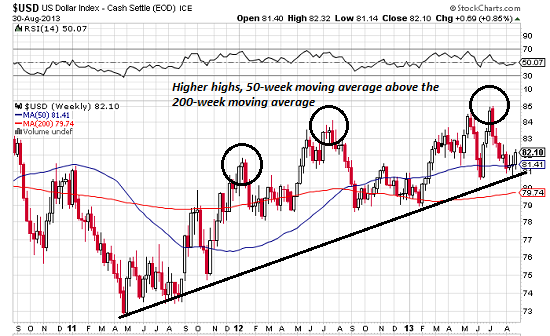
    The energy boom directly reduces the number of dollars being supplied to the global economy. This creates a relative scarcity of dollars, which pushes the value of the dollar higher:


    Is it coincidence that the dollar's uptrend aligns with the rise of U.S. energy production? It's not coincidence, it's causation.

    Oil prices have broken out of a technical wedge:


    As global oil prices push higher, more previously marginal petroleum reserves in the U.S. and Canada become profitable, further boosting production. The more energy produced in the U.S., the smaller the trade deficit and the fewer dollars provided to the global economy.

    As the dollar strengthens, the U.S. will pay less for imported energy and earn more for exported energy. This decline in energy costs will ripple through the real economy, offsetting any decline in exports. A strengthening dollar lowers the cost basis of all goods and services originating in the U.S.

    A strengthening dollar also benefits trading nations, as the increasing value of their dollar reserves enlarges the base for their own credit. This is the irony of China's dumping of its dollar reserves: China only amassed such massive dollar reserves because it was running equally massive trade surpluses with the U.S. As the trade surplus shrinks, so too must China's dollar reserves contract.

    Many observers confuse the dollars created by the Federal Reserve with the dollars available to trading nations for reserves and dollar-denominated debt. If the Fed creates $1 trillion which then lays fallow in the U.S. financial system, those dollars are not exported into the global economy via trade deficits.

    Add all this up and it's clear America's energy boom will push the dollar higher as the trade deficit shrinks and those needing dollars on the global market will have to pay more for to get the dollars they need for reserves and payment of dollar-denominated debts. 


    Things are falling apart--that is obvious. But why are they falling apart? The reasons are complex and global. Our economy and society have structural problems that cannot be solved by adding debt to debt. We are becoming poorer, not just from financial over-reach, but from fundamental forces that are not easy to identify or understand. We will cover the five core reasons why things are falling apart:

    go to print edition1. Debt and financialization
    2. Crony capitalism and the elimination of accountability
    3. Diminishing returns
    4. Centralization
    5. Technological, financial and demographic changes in our economy

    Complex systems weakened by diminishing returns collapse under their own weight and are replaced by systems that are simpler, faster and affordable. If we cling to the old ways, our system will disintegrate. If we want sustainable prosperity rather than collapse, we must embrace a new model that is Decentralized, Adaptive, Transparent and Accountable (DATA).

    We are not powerless. Not accepting responsibility and being powerless are two sides of the same coin: once we accept responsibility, we become powerful.

    Kindle edition: $9.95       print edition: $24 on Amazon.com
    To receive a 20% discount on the print edition: $19.20 (retail $24), follow the link, open a Createspace account and enter discount code SJRGPLAB. (This is the only way I can offer a discount.)


    Thank you, Morris P. ($10), for your much-appreciated generous contribution to this site-- I am greatly honored by your longstanding support and readership.

    Read more...

    Monday, September 02, 2013

    Labor Day 2013: How To Get and Keep a Job in a Fast-Changing Economy

    In the 21st century economy, if you want to stay employed, seek out a field that is ascending rather than declining.


    It's become a Labor Day tradition here at oftwominds.com to publish a jobs/employment-related essay by longtime correspondent Bob Z. This year Bob reviews the state of the U.S. economy and then sketches out what it takes to get and keep a job in an economy with many declining sectors and few rising ones.


    Last year’s Labor Day essay suggested that technology had progressed to the point that it now destroyed more jobs than it created. Simply by reviewing technological advances that have been reported over the past year, many people might justifiably conclude that the process of automation is accelerating. Here are just a few of these new robotic inventions:

    1. Robotic bartenders
    2. Robotic burger-flipping machines (360 burgers per hour)
    3. Robots that pick fruits and vegetables

    These inventions threaten to destroy millions upon millions of low and medium-wage jobs at a time when American workers are generally desperate to find any kind of job that pays middle class wages. One of the “bright spots” for wage earners appeared to be the Tesla factory in Fremont, CA. After all, the facility does employ some 3,000 workers at good wages in a high-tech environment.

    But upon closer examination, one finds that this facility fabricates most of the parts used for its automobile production in-house. Gone are the thousands and thousands of jobs that used to exist at parts suppliers. Since new and improved robotic processes are routinely introduced at the facility, the likely outcome is slow but ongoing attrition of jobs at the facility as robotic technology continues to improve.

    Most people understand that technology is fundamentally changing the nature of work and employment. These changes are also having a profound effect on the state of the US economy. So on Labor Day 2013, let’s start by taking a look at the state of the US economy.

    Most advanced industrial countries such as the United States are experiencing one or more of these three major economic headwinds. First, debt levels are too high. In many countries, the cost of debt service puts a damper on economic growth, as a growing proportion of current income is diverted to paying off past debts. Second, aging populations consume less of virtually everything except medical care. That crimps a country’s growth prospects. Finally, persistently high unemployment eventually forces consumers to reduce their spending, which creates a drag on economic growth.

    In July 2013, President Obama began campaigning for “a better bargain for the middle class.” Notwithstanding the irony of watching a lame duck President hitting the campaign trail, a dispassionate observer might ask this embarrassing question: “Exactly where have you been for the past 4-1/2 years, Mr. President?” Compounding the irony, one of the first stops on Mr. Obama’s campaign tour was a visit to an Amazon fulfillment center in Chattanooga, TN, where as many as two-thirds of the jobs at peak periods are temporary jobs without benefits. Left unsaid at the Amazon campaign stop was the unpleasant prospect that, even as Amazon prospers and hires new employees, an even greater number of jobs are disappearing at traditional brick and mortar stores.

    Many believe that, despite the US stock market’s massive run-up in the first half of 2013, the state of the US economy is precarious at best. Interest rates on longer-term government bonds began a massive run-up at the beginning of May, and there has been little resistance as rates have spiked upward. As of mid-August, both 10-year and 30-year rates have risen by well over a full percentage point.

    In terms of corporate earnings, major retailers such as Walmart, Kohl’s and Macy’s reported 2nd quarter earnings results that were characterized as lackluster to disappointing. In fact, excluding financial companies, 2nd quarter earnings appear to have declined by about 1% on a year-over-year basis, while earnings estimates for the 3rd quarter have been quietly reduced. This combination of lackluster earnings and rising interest rates is putting significant pressure on share prices.

    Is it possible that despite trillions of dollars of stimulus spending and borrowing by government and trillions more in bailouts, loan guarantees and money-printing (AKA “quantitative easing”) by the Federal Reserve, the current mediocre state of the US economy is as good as it is going to get?

    Has the bond market finally decided to shut down Ben Bernanke’s printing press? Won’t rising interest rates put a huge damper on the so-called “housing recovery”? July’s new home sales report showed a sharp falloff in sales and June new home sales numbers were revised downward as well. As of mid-August, mortgage applications had declined for 13 of the 15 preceding weeks. Don’t rising food and energy prices hurt all consumers, especially those on the lower rungs of the economic ladder? The answers to such questions are important, because they play a part in developing an answer to the really important question on most peoples’ minds: What are my prospects for finding a decent-paying job?

    Most people know that Wal-Mart is the largest corporate employer in the world. Far fewer people know that the second-largest corporate employer in the world is Kelly Services, a temp agency. While Wal-Mart and Kelly Services do provide several million jobs, these jobs are generally not the kind of high-paying jobs with full benefits that people need in order to live out the American Dream. In the past, such low-wage jobs were viewed as stepping stones to better jobs. In the “New Economy,” it appears that these low-wages jobs are becoming a way of life for millions of workers who cannot find better-paying jobs.

    How do you go about finding that “great” job? Let’s work backwards as we examine the job search process. Obviously, if you are looking to land a good job, you’ll need to learn how to navigate through a typical human resources (HR) department – this includes preparing a first-rate resume with no typographical errors, presenting your skills on the resume so that they “fit” the job opening you are interested in, and developing an outgoing interview technique. An interview technique is like a sales pitch, and you are trying to sell yourself to a company or enterprise. Far too many applicants fail an interviewer’s first big test – they don’t have a good 1 to 2 minute response to the ominous statement: “Tell me about yourself.”

    You really don’t want to be written off three minutes into your interview.

    But before you even think about trying to navigate through HR, you should first ask yourself whether or not you really want to work in a particular field or for a particular company. Interviewers always seem know whether or not you really have any interest in a particular field, be it accounting, law, medicine, construction or plumbing. And they instinctively sense whether or not you are “compatible” with their company. You need to enjoy the work that you want do, and you have to develop enough “people skills” to get along with your co-workers.

    So you have some ideas about the field of work you are interested in. Do some thorough research. First and foremost, in this new 21st century economy, if you want to stay employed you have to seek out a field that is ascending, rather than declining. Here’s just one example out of hundreds: tax preparers. There are numerous tax preparation services, some with offices in large retail stores and others with offices in strip malls. But tax preparation services have a problem. With the ascendancy of the internet, web-based tax preparation software is ascending, while traditional tax preparation services are declining. The point is that you don’t want to be automated out of your job and you don’t want your field of interest to quickly become obsolete.

    For those who are searching for that dream job, good luck!

    About the author: Bob Z., of Vancouver, Washington, is a Corporate Finance executive who retired in 2007 from an upper management position with a Fortune 500 corporation.


    Thank you, Bob. There are at least three other ways to work your way into a great job:

    (1) Start a company in an ascending field with one employee (yourself).

    (2) Seek out small/micro-companies without human resources departments and figure out how you can make an enormous difference in the success and viability of that small business, and then pitch the owner directly for an opportunity to do so.

    (3) Assemble a patchwork career (what I call hybrid work) of several income streams, perhaps mixing self-employment with multiple sources of paid work.

    I address these topics in my next book, The Nearly Free University and the Emerging Economy.


    Things are falling apart--that is obvious. But why are they falling apart? The reasons are complex and global. Our economy and society have structural problems that cannot be solved by adding debt to debt. We are becoming poorer, not just from financial over-reach, but from fundamental forces that are not easy to identify or understand. We will cover the five core reasons why things are falling apart:

    go to print edition1. Debt and financialization
    2. Crony capitalism and the elimination of accountability
    3. Diminishing returns
    4. Centralization
    5. Technological, financial and demographic changes in our economy

    Complex systems weakened by diminishing returns collapse under their own weight and are replaced by systems that are simpler, faster and affordable. If we cling to the old ways, our system will disintegrate. If we want sustainable prosperity rather than collapse, we must embrace a new model that is Decentralized, Adaptive, Transparent and Accountable (DATA).

    We are not powerless. Not accepting responsibility and being powerless are two sides of the same coin: once we accept responsibility, we become powerful.

    Kindle edition: $9.95       print edition: $24 on Amazon.com
    To receive a 20% discount on the print edition: $19.20 (retail $24), follow the link, open a Createspace account and enter discount code SJRGPLAB. (This is the only way I can offer a discount.)


    Thank you, James M. ($25), for your exceedingly generous contribution to this site-- I am greatly honored by your steadfast support and readership.

    Read more...

    Terms of Service

    All content on this blog is provided by Trewe LLC for informational purposes only. The owner of this blog makes no representations as to the accuracy or completeness of any information on this site or found by following any link on this site. The owner will not be liable for any errors or omissions in this information nor for the availability of this information. The owner will not be liable for any losses, injuries, or damages from the display or use of this information. These terms and conditions of use are subject to change at anytime and without notice.

    RE: European Union AI Act, and Our Use of Generative AI Tools and Agents Policy

    All text on this site is composed by Charles Hugh Smith or by a credited guest-author. No Generative AI Tools are used in the composition / writing of any text or graphics/charts created by Charles Hugh Smith. This site deploys no AI agents . This site is not responsible for the disclosures, use or non-use of AI agents or generative AI tools in advertisements displayed by Investing Channel or other ad placement services.

    Audio files (such as the KDP-generated audiobooks of my novels) generated by text-to-audio transcription tools are identified as such. The MP4 videos accompanying my original songs and the illustrations in my graphic novels are generated by AI tools. The story, scenes, characters and all descriptions and dialog of the graphic novels are composed solely by me..

    Our Privacy Policy:

    Correspondents' email is strictly confidential. This site does not collect digital data from visitors or distribute cookies. Advertisements served by third-party advertising networks such as Investing Channel may use cookies or collect information from visitors for the purpose of Interest-Based Advertising; if you wish to opt out of Interest-Based Advertising, please go to Opt out of interest-based advertising (The Network Advertising Initiative) If you have other privacy concerns relating to advertisements, please contact advertisers directly.

    PRIVACY NOTICE FOR EEA INDIVIDUALS

    This section covers disclosures on the General Data Protection Regulation (GDPR) for users residing within EEA only. GDPR replaces the existing Directive 95/46/ec, and aims at harmonizing data protection laws in the EU that are fit for purpose in the digital age. The primary objective of the GDPR is to give citizens back control of their personal data. Please follow the link below to access InvestingChannel's General Data Protection Notice.
    https://stg.media.investingchannel.com/gdpr-notice/

    Notice of Compliance with The California Consumer Protection Act

    This site does not collect digital data from visitors or distribute cookies. Advertisements served by a third-party advertising network (Investing Channel) may use cookies or collect information from visitors for the purpose of Interest-Based Advertising. If you do not want any personal information that may be collected by third-party advertising to be sold, please follow the instructions on this page: Do Not Sell My Personal Information.

    Regarding Cookies:

    This site does not collect digital data from visitors or distribute cookies. Advertisements served by third-party advertising networks such as Investing Channel may use cookies or collect information from visitors for the purpose of Interest-Based Advertising; if you wish to opt out of Interest-Based Advertising, please go to Opt out of interest-based advertising (The Network Advertising Initiative) If you have other privacy concerns relating to advertisements, please contact advertisers directly.

    Our Commission Policy:

    Though I earn a small commission on Amazon.com books and gift certificates and gold (BullionVault) purchased via links on my site, I receive no fees or compensation for any other non-advertising links or content posted on my site.

    Copyright Notice:

    All original images (Drawings and Photographs), text (essays, books and works of fiction), audio and video recordings, musical compositions, graphic design, graphic design elements and HTML coding on this site are the copyrighted work of Charles Hugh Smith unless otherwise credited or noted. They are published as information for the private use of site visitors, and any reproduction or redistribution of this content or coding in any media in any format or distribution channel (text, audio, video/film, web) without the written permission of the copyright holder is strictly prohibited. All rights in all media reserved globally.

      © Blogger templates Newspaper III by Ourblogtemplates.com 2008

    Back to TOP