
Tuesday, August 12, 2014

We're Relying on Phantom Wealth to Fund Our Retirement

Phantom wealth cannot possibly fund unprecedented retirement and healthcare promises.

The narrative that Social Security, Medicare and pension funds invested in stocks and bonds can fund the retirement of 65 million people is a misleading fantasy. The sad reality is we can't fund the enormous expense of retirement/healthcare for 20% of the populace out of our national earned income, and the savings that have been set aside are either fictitious (the Social Security Trust Fund) or based on phantom wealth created by speculative asset bubbles in stocks, bonds and real estate.

I explain the fraud of the Social Security Trust Fund in detail in The Fraud at the Heart of Social Security (January 17, 2011).

In the bogus "Trust Fund," the cash has been siphoned off and spent on Federal government outlays. The Fund holds no cash. Instead, it has been given IOUs "backed by the full faith and credit of the United States," the non-marketable securities.

Now what happens when the Social Security system redeems $100 billion of those securities? the Treasury goes out and borrows the $100 billion on the global bond market, and taxpayers are on the hook for the debt and the interest on that freshly issued debt.

This isn't that difficult to understand, but let's go through it again:

In a real Trust Fund, taxpayers pay in their cash, and the surplus cash is invested in marketable bonds--not IOUs, but real assets that pile up in the Trust Fund just like savings in a savings account. That cash is then withdrawn later, as needed, via the sale of bonds purchased with the cash. Taxpayers (employees and employers) pay nothing above and beyond their payroll taxes to fund Social Security.

In the fraudulent "Trust Fund," taxpayers' Social Security taxes have been squandered on other Federal expenses, and they have to pay interest on Treasury debt which is borrowed to pay their SSA benefits. In other words, taxpayers pay twice: once via Social Security taxes, a substantial 12.4% of all wages, and then they pay again to borrow cash on the bond market to actually pay the Social Security benefits.

Medicare is equally unsustainable: please read these for the full story:

Rather than face up to the reality that we face an impossible dilemma--either workers will be slowly impoverished by taxes that must go up to fund unrealistic retirement/healthcare promises, or those promises will have to be drastically scaled back--we have chosen to believe the happy illusion that inflating asset bubbles will painlessly conjure up enough phantom wealth to pay all those promises.

How can an unprecedented number of people (65 million Baby Boomers) all retire with unprecedented pension payouts and unprecedented healthcare expenses, and do so without raising taxes? Easy--just inflate asset bubbles that create trillions of dollars in magical wealth.

But as I explained in The Happy Story of Boomers Retiring on Their Generational Wealth Is Wrong (June 25, 2014), the assumption that there will be buyers of stocks, bonds and real estate at bubble-level valuations is not based on demographic realities.

The phantom wealth of asset bubbles is based on anomalously low interest rates and equally anomalous central bank intervention in capital markets. The base assumption is that these anomalous conditions are not anomalous but the New Normal: central banks can intervene without any negative consequences forever, interest rates can be suppressed to near-zero without any negative consequences forever, and sovereign debt (government deficits) can rise indefinitely without any negative consequences forever.

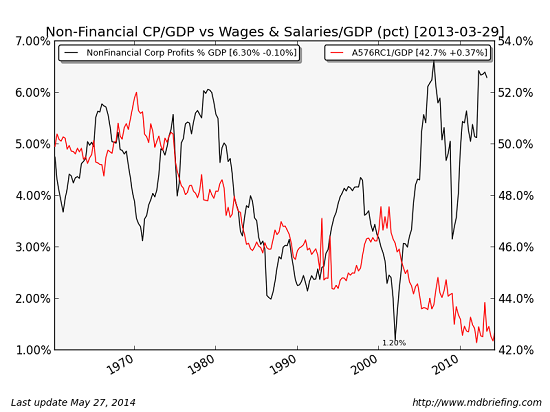
Oh, and corporate profits can also rise indefinitely, too, even as earned income (as a share of gross domestic product--GDP) declines:
To tap this phantom wealth, assets must be sold at bubblicious valuations; this raise the question, Who Will Boomers Sell Their Stocks To? (June 23, 2014)

Consider the fundamental relationship of stocks to the nation's gross domestic product (GDP). Current sky-high stock valuations are not just aberrations in terms of previous stock prices--they're aberrations in terms of stocks' valuations compared to the nation's entire economy.
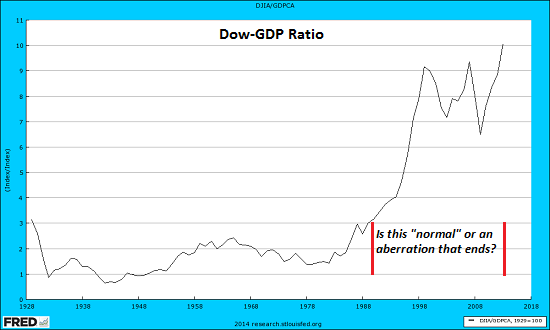

So if bonds decline by 50% as interest rates normalize (i.e. rise), and stocks fall 50% as corporate profits and central bank intervention normalize, and real estate declines 50% in most locales as declining wages meet rising interest rates, then what source of funding will replace the $30 trillion in phantom wealth that evaporated?

Declining wages? A new speculative asset bubble in bat guano?

Perhaps it's time that we face up to the fiscal reality that unprecedented promises can only be paid out of current income and hard assets that can be sold in vast quantities without depressing the price of those assets. As earned income declines as a share of the economy and asset bubbles based on liquidity and financialization pop, we will eventually have to deal with the difficult reality that government debt is not a hard asset that can be sold in vast quantities without depressing the value of that asset.

In sum, phantom wealth cannot possibly fund unprecedented retirement and healthcare promises. Only real wealth can do that, and central bank liquidity and the asset bubbles it inflates are not real wealth.


Get a Job, Build a Real Career and Defy a Bewildering Economy(Kindle, $9.95)(print, $20)
go to Kindle editionAre you like me? Ever since my first summer job decades ago, I've been chasing financial security. Not win-the-lottery, Bill Gates riches (although it would be nice!), but simply a feeling of financial control. I want my financial worries to if not disappear at least be manageable and comprehensible.


And like most of you, the way I've moved toward my goal has always hinged not just on having a job but a career.

You don't have to be a financial blogger to know that "having a job" and "having a career" do not mean the same thing today as they did when I first started swinging a hammer for a paycheck.

Even the basic concept "getting a job" has changed so radically that jobs--getting and keeping them, and the perceived lack of them--is the number one financial topic among friends, family and for that matter, complete strangers.

So I sat down and wrote this book: Get a Job, Build a Real Career and Defy a Bewildering Economy.

It details everything I've verified about employment and the economy, and lays out an action plan to get you employed.

I am proud of this book. It is the culmination of both my practical work experiences and my financial analysis, and it is a useful, practical, and clarifying read.

Test drive the first section and see for yourself.     Kindle, $9.95     print, $20

"I want to thank you for creating your book Get a Job, Build a Real Career and Defy a Bewildering Economy. It is rare to find a person with a mind like yours, who can take a holistic systems view of things without being captured by specific perspectives or agendas. Your contribution to humanity is much appreciated."
Laura Y.

Gordon Long and I discuss The New Nature of Work: Jobs, Occupations & Careers (25 minutes, YouTube) 


NOTE: Contributions/subscriptions are acknowledged in the order received. Your name and email remain confidential and will not be given to any other individual, company or agency.


Thank you, Ron R. ($100), for your outrageously generous contribution to this site -- I am greatly honored by your steadfast support and readership.Thank you, John R. ($5/month), for your supremely generous re-subscription to this site -- I am greatly honored by your steadfast support and readership.

Read more...

Monday, August 11, 2014

It's Not Just Healthcare That's Bankrupt--It's Our Legal System, Too

Yes, there is malpractice, but our current system is insane.


What can you say about a "healthcare" system in which 99% of all physicians will face a malpractice claim in their careers? According to Malpractice Risk According to Physician Specialty (The New England Journal of Medicine), "It was estimated that by the age of 65 years, 75% of physicians in low-risk specialties had faced a malpractice claim, as compared with 99% of physicians in high-risk specialties."

Longtime correspondent Ishabaka (M.D.) provides some context:

"A little legal education is necessary to understand malpractice:For a malpractice suit to be successful, there are five necessary things:

1. A duty to treat - there has to be an established doctor - patient relationship. A typical example would be someone who corners me at a party and asks me what I think is causing their abdominal pain. I give them my card, ask them to make an appointment for a check-up, they never do, and the pain turns out to be fatal cancer - in that case I had no duty to treat.


2. Failure to practice the standard of care - note - this does not mean the BEST care in the world - it means the average, or median standard of care.


3. A physician in the same specialty willing to testify that the doctor practiced below the standard of care - all States require this.


4. Causation - the substandard care has to have caused the patient's problem - again, this requires expert physician testimony.


5. Damages - if the substandard care causes no damage, there is no basis for a suit.


Now, I ask you - how can 99% of obstetrician gynecologists, neurosurgeons, emergency physicians, neonatologists (pediatricians who take care of premature babies in the neonatal intensive care unit), and other high-risk specialists practice worse medicine than average? It's mathematically impossible.
By the way, in the back of law journals are ads for medical expert companies that promise they will get a doctor to testify to anything the lawyer wants.


Yes, there is malpractice, but our current system is insane."


I am not an attorney or a doctor, but it seems self-evident that our legal system enables "fishing expeditions" in search of a settlement by keeping the cost of "fishing" very low, the rewards high and no penalties for abuse of the law, by which I mean issuing unsubstantiated or fraudulent accusations in the hopes of triggering a nuisance settlement, i.e. it's cheaper and less stressful for the accused to pay the accuser a substantial sum to make him go away.

This practice is not unique to medicine. Anecdotally, I have heard from insiders in the insurance industry that there are people who make a good living claiming they were injured in department stores and retail outlets. The claims are bogus, but the grifters know our legal system encourages paying bribes to accusers to avoid the outrageous expense of a court trial.

Give me $10,000 and I'll go away. Do this ten times a year and it's a tidy income.

How can we defend a system where people are rewarded for spewing claims of damages in the hope that a few may stick or the falsely accused will pony up cash to avoid the horrendous expenses of defending oneself against baseless accusations in court?

Ishabaka (M.D.) has practiced medicine in both Canada and the U.S., and he reports that Canada's system for monitoring and dealing with malpractice is more effective at actually limiting incompetence in the system, and it does so without accusing essentially every physician of malpractice in an absurd "line up everyone for target practice" abuse of the legal system.

I do not have the expertise to validate this, and no doubt there are countless complexities to consider, but I find it difficult to believe that "ours is the best possible system," a blanket excuse issued in defense of both sickcare and our equally broken legal system.

I can anticipate that some within the legal profession will say that the low cost of making claims and accusations is worth the corrosive cost and stress of dealing with bogus claims and baseless accusations because it enables the poor and powerless to seek redress.
I find this argument mostly meritless based on two points:

1. How can anyone defend a system as fair, just and cost-effective when 99% of all physicians dealing with serious cases end up being accused of malpractice? It would take about 30 seconds to come up with a lower-cost, more just and effective system than what passes for "justice" in America.

2. The vast majority of poor people don't end up having their day in court because that day in court is as absurdly expensive as sickcare. "Justice" in America goes more or less to the highest bidder, outside of propaganda-type Hollywood films.Legal services are extremely expensive and mostly paid in cash, so only the wealthy can afford legal representation or advice.

We would be remiss not to mention the other factor in malpractice, which is unrealistic expectations of medical science and practitioners. Yes, there are some incompetent doctors who should no longer be allowed to practice medicine. But there are many other factors to consider, for example, those doctors who take on the most hopeless, difficult cases are the ones whose "track record" will appear less than stellar.

Yes, there are legitimate cases of malpractice, and legitimate claims that end up being argued in court. But any system that accuses 99% of its practitioners of gross incompetence is deeply flawed, rife with injustice and bloated by needless waste and stress.

It's not just our healthcare system that is bankrupt--so is our legal system.


Get a Job, Build a Real Career and Defy a Bewildering Economy(Kindle, $9.95)(print, $20)
go to Kindle editionAre you like me? Ever since my first summer job decades ago, I've been chasing financial security. Not win-the-lottery, Bill Gates riches (although it would be nice!), but simply a feeling of financial control. I want my financial worries to if not disappear at least be manageable and comprehensible.


And like most of you, the way I've moved toward my goal has always hinged not just on having a job but a career.

You don't have to be a financial blogger to know that "having a job" and "having a career" do not mean the same thing today as they did when I first started swinging a hammer for a paycheck.

Even the basic concept "getting a job" has changed so radically that jobs--getting and keeping them, and the perceived lack of them--is the number one financial topic among friends, family and for that matter, complete strangers.

So I sat down and wrote this book: Get a Job, Build a Real Career and Defy a Bewildering Economy.

It details everything I've verified about employment and the economy, and lays out an action plan to get you employed.

I am proud of this book. It is the culmination of both my practical work experiences and my financial analysis, and it is a useful, practical, and clarifying read.

Test drive the first section and see for yourself.     Kindle, $9.95     print, $20

"I want to thank you for creating your book Get a Job, Build a Real Career and Defy a Bewildering Economy. It is rare to find a person with a mind like yours, who can take a holistic systems view of things without being captured by specific perspectives or agendas. Your contribution to humanity is much appreciated."
Laura Y.
Gordon Long and I discuss The New Nature of Work: Jobs, Occupations & Careers (25 minutes, YouTube) 


NOTE: Contributions/subscriptions are acknowledged in the order received. Your name and email remain confidential and will not be given to any other individual, company or agency.


Thank you, Robert T. ($5/month), for your supremely generous subscription to this site -- I am greatly honored by your steadfast support and readership.Thank you, Erle H. ($20), for your much-appreciated generous contribution to this site -- I am greatly honored by your steadfast support and readership.

Read more...

Sunday, August 10, 2014

Here's Why Wages Might Rise Despite Millions of Unemployed Being Available for Work

Tragically, the inability of our institutions to impart the skills required by the emerging economy hobble not just the unemployed but employers.


A reader recently offered a compelling reason why total compensation costs (wages plus benefits/payroll taxes) could rise even in a stagnant economy with millions available for work: many of those who have been out of work for a long time (or have yet to hold a formal job) are unqualified by experience and professionalism to perform the work that is available.

This is a complex topic, so let's separate the key issues.

1. Inability to perform the available work successfully on a sustained basis is a problem across the entire spectrum from low-skill to high skill. On the face of it, just about anyone who isn't disabled should be able to do low-skill farm labor such as harvesting fruits and vegetables, etc.

But anecdotal evidence suggests many unemployed Americans are incapable of doing this kind of demanding physical labor on a sustained basis: stories abound of native-born Americans working in the fields for a few hours or days and then giving up.

At the higher-skill end of the spectrum, those who have been out of work for years may find that their skillset has been leapfrogged by technology, and it's cheaper/more efficient for employers to poach workers from competitors than it is to train workers who lack the specific skills needed.


Though it may seem counter-intuitive to non-employers, it's actually cheaper and lower risk to pay a higher salary to poach a competitor's employee because you can be confident the employee can start producing value on Day One, where if you hire a long-unemployed worker, you are taking the risk the person has lost the ability to perform at a high level, and you're taking on the expense and time required to retrain them.

Training takes time and investment, and it's easier to hire employees from competitors than invest the time/money in training new employees.


2. Ageism. Ageism cuts both ways: Baby Boomers are clinging on to their jobs rather than retiring because they need the higher income. In jobs with tenure (such as virtually every government or union job), this trend ties employers into paying the highest wage scale and healthcare costs because it's generally illegal to force someone to retire against their will.

On the other end of the scale, older workers often find employers prefer younger employees--not just because they will accept lower wages (and lower healthcare costs) but because the employers may assume their skills are more up to date.

Anecdotally, sectors dominated by tenure/union contracts will experience higher total compensation costs as their workforce clings to their jobs as they age.

3. Work is more demanding than ever. The pool of people claiming to want work appears large, but the demands made on employees is rising constantly as corporate employers seek higher productivity. A significant number of people are simply unable to perform the work at the sustained level of productivity required nowadays.

An employee who could keep up 20 years ago or even 10 years ago may fall behind in today's work environment.

We might recall the 80/20 Pareto Distribution here: as a rule of thumb, 20% of employees are responsible for 80% of the department's output/sales (this is not exact, but it is nonetheless remarkably accurate).

Employers are willing to bid up compensation for the top 20% who generate the majority of the output/sales, etc.

4. Healthcare costs are still soaring for employers. While a few data points suggest total healthcare spending has leveled off, this is likely the result of ObamaCare pushing the first $5,000 of expenses onto the "insured" with Bronze Plans.

(If "healthcare" requires ponying up $5,000 in deductibles, how is that even "insurance"? In my view, is it a simulacrum of insurance.)

In other words, now that they have to pay the first $5,000 for care in cash, people are not going to the doctor.

Meanwhile, employers are getting stiffed by much higher premiums. Using my own bare-bones coverage as a baseline, my monthly healthcare insurance fee has shot up about 20% in the past two years. Plans with better coverage increased even more.

Unknown to most employees, there is a tax in ObamaCare paid by employers. That raises total compensation costs even though employees don't see it in their paychecks.

5. Slashing head count has reached marginal returns. The majority of corporate employers have already outsourced/automated the low-hanging fruit of their labor force, and what's left in the U.S. remains for a reason: it serves the U.S. market or does work that produces high value (for example, managing overseas divisions, designing products made overseas, etc.)

So we have a diminishing number of jobs that can be outsourced and a diminishing number of qualified people who can do the work.

6. Minimum wages are rising in many locales as higher costs outstrip entry-level earnings. Rather than engage in the debate over whether higher minimum wages are good or bad, let's stipulate that minimum wages are rising a a number of communities, and in aggregate, this pushes compensation costs up.

It's un-PC to say out loud than many of the unemployed are unhireable because they lack the basic "people skills" of professional manners, the desire or ability to learn, the willingness to persevere and prove their worth to employers, etc.

This pressure to be politically correct inhibits an honest discussion of the disconnect between graduates from high school and college and the skills, values and professionalism needed by employers.

I have listed what I consider the eight essential skills of professionalism in my book Get a Job, Build a Real Career and Defy a Bewildering Economy, based on my own experience as a employer and as a managing employee.

Those without these basic skills have a tough time qualifying for any job, even an entry job in retail or fast-food service.

I fault our dysfunctional, disconnected education system for this failure to teach the basic skills of being employable. Fortunately, anyone can learn these skills on their own, but this is a process that demands a lot of potential employees: self-awareness, perseverance, a willingness to seek out mentors and community-based (often unpaid) work to acquire skills and connections, etc.

To sum up: let's say there are 15 million people who say they want work. But maybe only a few million actually have the skills, values and experience in hand to qualify for the jobs that are available.

That mismatch--in addition to the other factors listed above--could push total labor compensation costs higher even in an economy that appears to have a lot of slack in its labor market.

Personally, I don't see how any small-business employer could afford to hire anyone but those in the top 20% of work ethic, accountability, honesty, willingness to learn new skills, communication skills, etc.

Despite an abundance of lip-service paid to entrepreneurial skills, it seems our educational institutions have largely failed to pass on these skills, which are alien to protected bureaucracies such as those of institutionalized education. To ask a bureaucrat who is forced to adhere to a bunch of disconnected-from-the-real-world guidelines to "teach" entrepreneurism is to ask the impossible.

Tragically, this inability of our institutions to impart the skills required by the emerging economy hobble not just the unemployed but employers. As a result, I see labor costs rising in the years ahead despite an apparent surplus of people willing to work.


Get a Job, Build a Real Career and Defy a Bewildering Economy(Kindle, $9.95)(print, $20)
go to Kindle edition
Are you like me? Ever since my first summer job decades ago, I've been chasing financial security. Not win-the-lottery, Bill Gates riches (although it would be nice!), but simply a feeling of financial control. I want my financial worries to if not disappear at least be manageable and comprehensible.


And like most of you, the way I've moved toward my goal has always hinged not just on having a job but a career.

You don't have to be a financial blogger to know that "having a job" and "having a career" do not mean the same thing today as they did when I first started swinging a hammer for a paycheck.

Even the basic concept "getting a job" has changed so radically that jobs--getting and keeping them, and the perceived lack of them--is the number one financial topic among friends, family and for that matter, complete strangers.

So I sat down and wrote this book: Get a Job, Build a Real Career and Defy a Bewildering Economy.

It details everything I've verified about employment and the economy, and lays out an action plan to get you employed.
I am proud of this book. It is the culmination of both my practical work experiences and my financial analysis, and it is a useful, practical, and clarifying read.

Test drive the first section and see for yourself.     Kindle, $9.95     print, $20

"I want to thank you for creating your book Get a Job, Build a Real Career and Defy a Bewildering Economy. It is rare to find a person with a mind like yours, who can take a holistic systems view of things without being captured by specific perspectives or agendas. Your contribution to humanity is much appreciated."
Laura Y.


Gordon Long and I discuss The New Nature of Work: Jobs, Occupations & Careers (25 minutes, YouTube) 


NOTE: Contributions/subscriptions are acknowledged in the order received. Your name and email remain confidential and will not be given to any other individual, company or agency.


Thank you, Sue K. ($5/month), for your superbly generous re-subscription to this site -- I am greatly honored by your steadfast support and readership.Thank you, Christopher T. ($50), for your splendidly generous contribution to this site -- I am greatly honored by your steadfast support and readership.

Read more...

Saturday, August 09, 2014

The Joys of Being Productive

The joys of being productive do not become stale with the passage of time.

The joys of consuming are familiar to us all--a good meal, a cold beverage, a fine article of clothing, a new gadget, a new travel experience, another cosmetic procedure.

We're flooded with messages emphasizing the joys of consumption. Consuming more is what powers the global economy and more specifically, profits.

Governments need profits to tax, and companies making profits to hire workers who then pay taxes. So it has become a perverse patriotic duty to consume more, especially if we have to borrow money to do so, as that debt boosts bank profits.

Lost in the frenzy to persuade us to consume more and take on more debt are the joys of producing. We're all expected to master the processes of consumption--comparision shopping, obtaining credit cards, etc.--yet our culture rarely makes room for the joys of being productive and thrifty, i.e. reusing materials, repairing useful things, creating art from leftover supplies, etc.

Consuming is fun, but so is being productive. Here's a photo from a fun deckbuilding project I participated in this summer--re-using old redwood planking to replace rotted fir decking. Watch where you step--especially with a 17-pound Skil 77 worm drive power saw in hand....


The joys of using tools and one's skills cannot be overstated. Tools become like old friends after many years of experience; these include all sorts of tools, from sewing machines to saws to woks to lathes--the list is endless.

For me, the Skil 77 worm drive offers a combination of familiarity and power that is very comfortable. Other power saws feel twinkie, underpowered or unbalanced, and I have to think about the process of cutting in a way that requires no thought at all with the Skil 77.

The Taoists of ancient China understood that the Tao (in modern terminology, the zoneflows from mastery gained from focus and experience. Once a tool becomes an extension of one's body, one no longer needs to focus on the tool or process.

This characteristic of mastery is captured in this story from Chapter 19 ofThe Complete Works Of Chuang Tzu(Translated by Burton Watson):
Yen Yuan said to Confucius, "I once crossed the gulf at Goblet Deeps and the ferryman handled the boat with supernatural skill. I asked him, `Can a person learn how to handle a boat?' and he replied, `Certainly. A good swimmer will in no time get the knack of it. And, if a man can swim under water, he may never have seen a boat before and still he'll know how to handle it!' I asked him what he meant by that, but he wouldn't tell me. May I venture to ask you what it means?"Confucius said, "A good swimmer will in no time get the knack of it - that means he's forgotten the water. If a man can swim under water, he may never have seen a boat before and still he'll know how to handle it - that's because he sees the water as so much dry land, and regards the capsizing of a boat as he would the overturning of a cart. The ten thousand things may all be capsizing and backsliding at the same time right in front of him and it can't get at him and affect what's inside - so where could he go and not be at ease?
Part of this internalized awareness is respect for the power of tools. That the saw can take off a finger in a split second is never out of my awareness, just as it is natural to position myself to avoid kickback. Cockiness has no place in mastery. Mastery is aboutskills doing the work themselves, not reveling in the possession of skills.
Bruce Lee expressed this state of mind in this way:
A good martial artist does not become tense, but ready. Not thinking, yet not dreaming. Ready for whatever may come. When the opponent expands, I contract; and when he contracts, I expand. And when there is an opportunity, "I" do not hit, "it" hits all by itself.
The joys of consumption are intrinsically limited. We are soon sated by food, new clothing soon loses its charms, and the exotic locale becomes commonplace.
The joys of being productive, in contrast, do not become stale with the passage of time. If anything, skills and tools are welcomed as old friends, their value burnished rather than depleted by experience.


Get a Job, Build a Real Career and Defy a Bewildering Economy(Kindle, $9.95)(print, $20)
go to Kindle editionAre you like me? Ever since my first summer job decades ago, I've been chasing financial security. Not win-the-lottery, Bill Gates riches (although it would be nice!), but simply a feeling of financial control. I want my financial worries to if not disappear at least be manageable and comprehensible.


And like most of you, the way I've moved toward my goal has always hinged not just on having a job but a career.

You don't have to be a financial blogger to know that "having a job" and "having a career" do not mean the same thing today as they did when I first started swinging a hammer for a paycheck.

Even the basic concept "getting a job" has changed so radically that jobs--getting and keeping them, and the perceived lack of them--is the number one financial topic among friends, family and for that matter, complete strangers.

So I sat down and wrote this book: Get a Job, Build a Real Career and Defy a Bewildering Economy.

It details everything I've verified about employment and the economy, and lays out an action plan to get you employed.

I am proud of this book. It is the culmination of both my practical work experiences and my financial analysis, and it is a useful, practical, and clarifying read.

Test drive the first section and see for yourself.     Kindle, $9.95     print, $20

"I want to thank you for creating your book Get a Job, Build a Real Career and Defy a Bewildering Economy. It is rare to find a person with a mind like yours, who can take a holistic systems view of things without being captured by specific perspectives or agendas. Your contribution to humanity is much appreciated."
Laura Y.

Gordon Long and I discuss The New Nature of Work: Jobs, Occupations & Careers (25 minutes, YouTube) 


NOTE: Contributions/subscriptions are acknowledged in the order received. Your name and email remain confidential and will not be given to any other individual, company or agency.


Thank you, Robert S.. ($5/month), for your superbly generous subscription to this site -- I am greatly honored by your support and readership.Thank you, John D. ($20), for your extremely generous contribution to this site -- I am greatly honored by your support and readership.

Read more...

Thursday, August 07, 2014

A Brief Note on the Difference Between Trading and Investing

Investing in oneself and enterprises one actively controls may be the only legitimate deployment of capital that qualifies as an investment in the traditional sense.


Since I've been discussing the stock market in general terms (Bull and Bear, etc.), it seems like a good time to briefly note the difference between trading and investing.

In general, investing is putting capital at risk for the long term, based on a trend or story that the investor believes will have a material impact on whatever financial vehicle he has chosen to invest in.

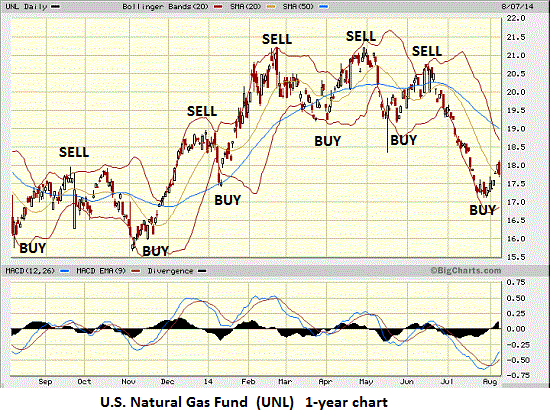
In general, trading is shorter-term and technical-based. A trader might buy and sell the investor's chosen financial vehicle many times, based on technical trends and indicators.

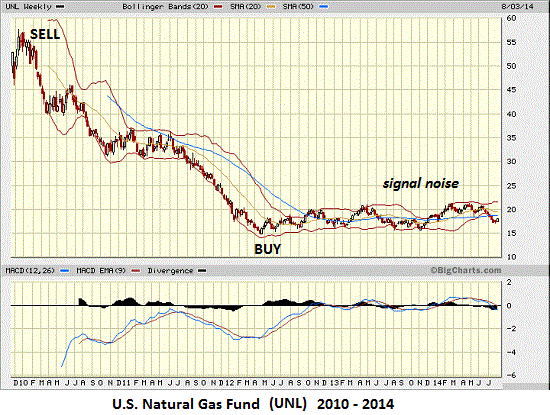
For an example, let's take a look at a natural gas-based commodity fund, UNL. United States 12 Month Natural Gas Fund (UNL):
"The United States 12 Month Natural Gas Fund® LP (UNL) is an exchange-traded security that is designed to track the price movements of natural gas. UNL issues shares that may be purchased and sold on the NYSE Arca.UNL invests primarily in listed natural gas futures contracts and other natural gas related futures contracts, and may invest in forwards and swap contracts. These investments will be collateralized by cash, cash equivalents, and US government obligations with remaining maturities of two years or less."
Here is a long-term chart of UNL with an investor's buys and sells marked:


Here is a one-year chart of UNL with a trader's buys and sells marked:


The long-term investor may use technical tools to choose entry points--for example, MACD and moving-average crosses--but the investment is fundamentally based on a story about the underlying dynamics and trend changes.

For example, the investor in UNL may be betting on this story: either natural gas production in the U.S. will decline as fracked production falls off, or global demand for natural gas will rise even faster than production, pushing prices higher. Whatever the underlying dynamics, demand will outstrip supply and prices will move dramatically higher over time.

To the investor with this long-term story, the last year's price variations are essentially signal noise.

To the trader, the dynamics and trends of the story have no material impact on trading decisions, which are all technical: bullish and bearish crosses, moves above and below Bollinger bands, etc.

The choice of being an investor or trader is not either/or. Some people have both a long-term investment in a financial instrument, and another sum of money in a trading account that they use to actively buy and sell the same instrument.

One can find a story about the economy or stock market compelling but choose not to trade or invest capital based on the story because the stock market may be trading more on sentiment and central bank intervention than on fundamentals. I covered this in Here's What I Recommend in the Stock Market: Zip, Zero, Nada (June 20, 2014).

In other words, it's an open question whether a market that is heavily dependent on perception management and unprecedented intervention by central banks,opaque dark pools/shadow banking and digital trading robots run by major players, and gamed corporate profit/loss statements can support traditional long-term investments without exposing investors to largely invisible systemic risks.

From this perspective, investing in oneself and enterprises one actively controls may be the only legitimate deployment of capital that qualifies as an investment in the traditional sense--that is, capital isn't being risked in rigged gambling halls and Ponzi schemes.

Of related interest:


Get a Job, Build a Real Career and Defy a Bewildering Economy(Kindle, $9.95)(print, $20)
go to Kindle editionAre you like me? Ever since my first summer job decades ago, I've been chasing financial security. Not win-the-lottery, Bill Gates riches (although it would be nice!), but simply a feeling of financial control. I want my financial worries to if not disappear at least be manageable and comprehensible.


And like most of you, the way I've moved toward my goal has always hinged not just on having a job but a career.

You don't have to be a financial blogger to know that "having a job" and "having a career" do not mean the same thing today as they did when I first started swinging a hammer for a paycheck.

Even the basic concept "getting a job" has changed so radically that jobs--getting and keeping them, and the perceived lack of them--is the number one financial topic among friends, family and for that matter, complete strangers.

So I sat down and wrote this book: Get a Job, Build a Real Career and Defy a Bewildering Economy.

It details everything I've verified about employment and the economy, and lays out an action plan to get you employed.

I am proud of this book. It is the culmination of both my practical work experiences and my financial analysis, and it is a useful, practical, and clarifying read.

Test drive the first section and see for yourself.     Kindle, $9.95     print, $20

"I want to thank you for creating your book Get a Job, Build a Real Career and Defy a Bewildering Economy. It is rare to find a person with a mind like yours, who can take a holistic systems view of things without being captured by specific perspectives or agendas. Your contribution to humanity is much appreciated."
Laura Y.

Gordon Long and I discuss The New Nature of Work: Jobs, Occupations & Careers (25 minutes, YouTube) 


NOTE: Contributions/subscriptions are acknowledged in the order received. Your name and email remain confidential and will not be given to any other individual, company or agency.
Thank you, Daniel G. ($50), for yet another splendidly generous contribution to this site -- I am greatly honored by your steadfast support and readership.Thank you, Mark M. ($15), for your extremely generous contribution to this site -- I am greatly honored by your support and readership.

Read more...

Terms of Service

All content on this blog is provided by Trewe LLC for informational purposes only. The owner of this blog makes no representations as to the accuracy or completeness of any information on this site or found by following any link on this site. The owner will not be liable for any errors or omissions in this information nor for the availability of this information. The owner will not be liable for any losses, injuries, or damages from the display or use of this information. These terms and conditions of use are subject to change at anytime and without notice.


Our Privacy Policy:


Correspondents' email is strictly confidential. This site does not collect digital data from visitors or distribute cookies. Advertisements served by a third-party advertising network (Investing Channel) may use cookies or collect information from visitors for the purpose of Interest-Based Advertising; if you wish to opt out of Interest-Based Advertising, please go to Opt out of interest-based advertising (The Network Advertising Initiative). If you have other privacy concerns relating to advertisements, please contact advertisers directly. Websites and blog links on the site's blog roll are posted at my discretion.


PRIVACY NOTICE FOR EEA INDIVIDUALS


This section covers disclosures on the General Data Protection Regulation (GDPR) for users residing within EEA only. GDPR replaces the existing Directive 95/46/ec, and aims at harmonizing data protection laws in the EU that are fit for purpose in the digital age. The primary objective of the GDPR is to give citizens back control of their personal data. Please follow the link below to access InvestingChannel’s General Data Protection Notice. https://stg.media.investingchannel.com/gdpr-notice/


Notice of Compliance with The California Consumer Protection Act
This site does not collect digital data from visitors or distribute cookies. Advertisements served by a third-party advertising network (Investing Channel) may use cookies or collect information from visitors for the purpose of Interest-Based Advertising. If you do not want any personal information that may be collected by third-party advertising to be sold, please follow the instructions on this page: Limit the Use of My Sensitive Personal Information.


Regarding Cookies:


This site does not collect digital data from visitors or distribute cookies. Advertisements served by third-party advertising networks such as Investing Channel may use cookies or collect information from visitors for the purpose of Interest-Based Advertising; if you wish to opt out of Interest-Based Advertising, please go to Opt out of interest-based advertising (The Network Advertising Initiative) If you have other privacy concerns relating to advertisements, please contact advertisers directly.


Our Commission Policy:

As an Amazon Associate I earn from qualifying purchases. I also earn a commission on purchases of precious metals via BullionVault. I receive no fees or compensation for any other non-advertising links or content posted on my site.

  © Blogger templates Newspaper III by Ourblogtemplates.com 2008

Back to TOP