
Tuesday, April 14, 2015

The Changing World of Work 3: "Full-Stack" Skills

More important than being a full-stack employee is owning a full stack of skills.


My longtime friend G.F.B. sent me an article on the emerging value of tech-savvy generalists: The full-stack employee by Chris Messina:

Nearly two years after I left Google, I’m starting to understand what’s going on in the professional sphere. The conventional seams between disciplines are fraying, and the set of skills necessary to succeed are broader and more nebulous than they’ve been before. These days, you’ve gotta be a real polymath to get ahead; you’ve got to be a full-stack employee.

If you have a low tolerance (as I do) for breathless techno-buzzword dropping--worked at Google, UI, CSV file, Kickstarter, social apps, Vine, self-promotion, always-on connectedness, blah blah blah--you will have to shoulder through the techno-hip chatter.

(Is there no inoculation against peppering content with these cliches? If email is dead, please tell that to the 16,000 non-spam emails that pile up on my server every year.)

But the core point of the essay is worth examining: specialization is no longer enough outside of fields such as surgery. An increasing number of jobs now require working knowledge, or at least awareness, of cross-disciplinary advances.

Put another way: owning one skill is no longer enough. Virtually any skill that can be reduced to a procedure defined by a set of rules can be automated or offshored. Any skill with defined inputs and outputs can be commoditized: reduced to software or a set of procedures that can be performed anywhere in the world.

The only value creation model left for labor is to own the entire process of production. Depending on the industry or sector, this might include a variety of machining, 3D fabrication and injection-mold technologies, marketing, design and content creation, software development and sales--the combinations are almost endless depending on what processes are creating value.

As management guru Peter Drucker noted, enterprises don't have profits, they only have expenses. Creating value is what generates profits, and without profits enterprises can't pay employees, and government can't skim taxes from profits and wages.

Drucker foresaw that workers' knowledge (human capital) would become the primary means of production in a knowledge economy, a dynamic he described in his book Post-Capitalist Society.

What are the core skills everyone needs to own? In my book Get a Job, Build a Real Career and Defy a Bewildering Economy, I identify the Eight Essential Skills of Professionalism that are the foundational soft skills that enable the acquisition of specific hard skills within a sector or field.

The idea that a full stack of cross-disciplinary skills are what's valuable in an increasingly commoditized-labor world is the heart of what I have described as the emerging class of Mobile Creatives (as described in America's Nine Classes.)

More important than being a full-stack employee is owning a full stack of skills. Counting on Corporate America or the central state to employ everyone who wants to work is giving Corporate America and the central state way too much power over our individual destinies and the destiny of the nation. Opportunity is presented by life and the market for goods, services and ideas, not Corporate America and the central state.

Those pining for "good-paying middle class jobs" doing repetitive factory work or routine office data shuffling are looking backward to an era that is firmly in the past. Those who expect existing factory model educational structures to magically churn out students with a full stack of cross-disciplinary skills that create value are equally delusional.

Enterprises don't have profits, they only have expenses, and government funds its programs with taxes skimmed from the profits and payroll taxes of those creating value. Creating money out of thin air via Federal Reserve quantitative easing or Zimbabwe-style state printing presses is no substitute for creating value.

Opportunity, liberty and risk are not divisible. We either grasp the nettle of creating value or we devolve to wistful pining for what is irrevocably in the past. 


Get a Job, Build a Real Career and Defy a Bewildering Economy(Kindle, $9.95)(print, $20)
go to Kindle edition
Are you like me? Ever since my first summer job decades ago, I've been chasing financial security. Not win-the-lottery, Bill Gates riches (although it would be nice!), but simply a feeling of financial control. I want my financial worries to if not disappear at least be manageable and comprehensible. 

And like most of you, the way I've moved toward my goal has always hinged not just on having a job but a career.

You don't have to be a financial blogger to know that "having a job" and "having a career" do not mean the same thing today as they did when I first started swinging a hammer for a paycheck.

Even the basic concept "getting a job" has changed so radically that jobs--getting and keeping them, and the perceived lack of them--is the number one financial topic among friends, family and for that matter, complete strangers.

So I sat down and wrote this book: Get a Job, Build a Real Career and Defy a Bewildering Economy.

It details everything I've verified about employment and the economy, and lays out an action plan to get you employed.

I am proud of this book. It is the culmination of both my practical work experiences and my financial analysis, and it is a useful, practical, and clarifying read.

Test drive the first section and see for yourself.     Kindle, $9.95     print, $20

"I want to thank you for creating your book Get a Job, Build a Real Career and Defy a Bewildering Economy. It is rare to find a person with a mind like yours, who can take a holistic systems view of things without being captured by specific perspectives or agendas. Your contribution to humanity is much appreciated."
Laura Y.

Gordon Long and I discuss The New Nature of Work: Jobs, Occupations & Careers(25 minutes, YouTube) 


NOTE: Contributions/subscriptions are acknowledged in the order received. Your name and email remain confidential and will not be given to any other individual, company or agency.


 Thank you, Michael M. ($60), for yet another monumentally generous contribution to this site--(and the Yuja Wang CD)-- I am greatly honored by your support and readership.

Read more...

Monday, April 13, 2015

The Changing World of Work 2: Financialization = Insecurity

Promises of wealth and security are far more contingent than is being advertised.


The Millennial Generation, if we're to believe various polls, aspires to either make boatloads of money on Wall Street, or secure a can't-be-fired job in the government. Given the dominance of finance and an economic backdrop of rising insecurity, these are rational choices.

But all those Millennials hoping to work for Goldman Sachs does raise a question:when did playing financial games become so much more profitable than producing goods and services?

And that raises another question: is the dominance of the FIRE sectors (finance, insurance, real estate) permanent or cyclical?

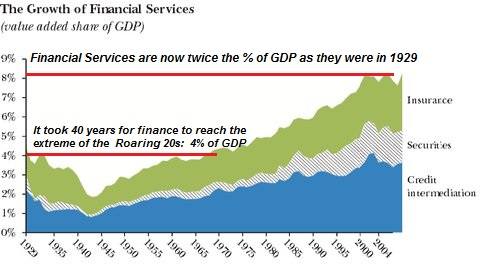
Let's turn to some charts for answers. The first is a look at the finance and insurance sectors' share of the gross domestic product (GDP). The sectors's share reached 4% of GDP in the stock market bubble of 1929 and the echo bubble in the mid-1930s.

It took 40 years for finance and insurance to exceed the highs of the Roaring 20s bubble.


In the 40 years since the early 1970s, finance and insurance have doubled their share of the GDP. Note that since GDP has expanded many times over since 1935, the nominal size of financial services has soared.

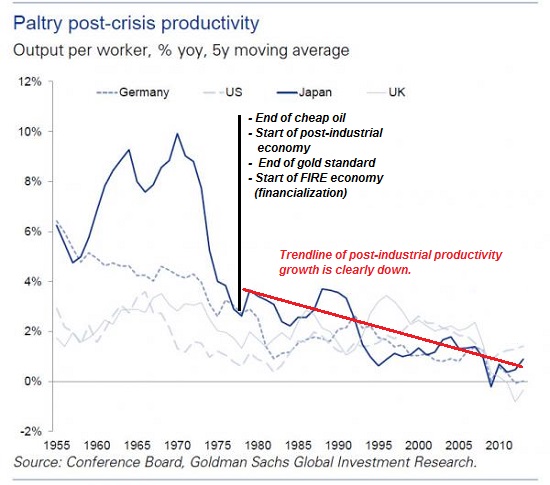
Next, let's look at productivity--the engine of all wealth creation--at least in an economy that incentivizes producing goods and services.

It turns out productivity growth collapsed after the oil shock of the early 1970s. But as I note on the chart, it wasn't just the oil shock: the low-hanging fruit of productivity gains generated by mechanization and new technologies had been picked, and the satiation of basic consumer demands led to a post-industrial economy focused more on the profits to be reaped by extending credit so consumers could buy more than their incomes would otherwise allow.

The early 1970s also saw the end of the gold standard and the advent of fiat currencies.


Financialization really only took off, however, in the early 1980s. Broadly speaking, financialization is the substitution of debt for income and the commoditification of debt into financial instruments that could be sold globally, leveraged and hedged with derivatives.


While definitions of financialization vary, mine is:

Financialization is the mass commodification of debt and debt-based financial instruments collaterized by previously low-risk assets, a pyramiding of risk and speculative gains that is only possible in a massive expansion of low-cost credit and leverage.

Another way to describe the same dynamic is: financialization results when leverage and information asymmetry replace innovation and productive investment as the source of wealth creation.

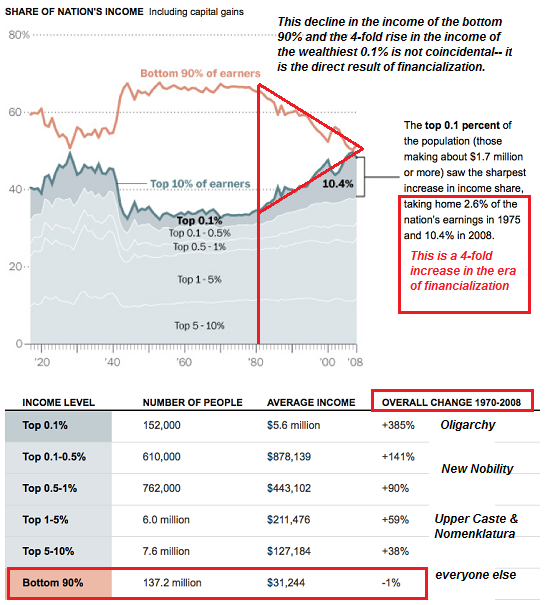
So what happened to the incomes of the wealthiest class and the bottom 90% after financialization kicked into gear? I've drawn the line that marks the pre-financialization era from the Financialization Era--around 1982--on the income chart below.

I've also correlated the income levels with America's Nine Classes: the Oligarchy and New Nobility classes are at the top, followed closely by the Upper Caste of technocrats and government Nomenklatura.

After financialization kicked in, the income of the Oligarchy/Financial Aristocracy quadrupled, as their share of the nation's income soared from 2.6% to 10.4%.

The Upper Caste and state Nomenklatura did OK for themselves, earning between 38% and 58% more when adjusted for inflation from 1975 (just before financialization took hold).

Everyone else--the bottom 90%--lost ground. This is not coincidence or just bad luck--it is the direct consequence of financial games becoming far more lucrative than actual productive work.


This reality is so obvious that even the Mainstream Media has finally felt obligated to accept it: Finance Is to Blame for Rise in Inequality (via Jason Y.)

The government has not been a disinterested bystander in the lucrative boom of finance: the state has benefited enormously on several fronts. As profits soared, so did tax revenues. As real estate bubbled up to new heights, local governments saw their property tax revenues explode higher.

Once the Federal Reserve dropped interest rates to zero (ZIRP) to keep the unproductive financial-gaming machine grinding onward, governments found their borrowing costs plunged, enabling federal, state and local governments to feast on debt by selling bonds.

In effect, the Millennials seeking employment in Wall Street or the government are looking for work in the same sector, because once financialization implodes, both Wall Street and tax revenues will implode, too.

Those benefiting from financialization would have us believe it is permanent, stable and enduring, when in reality it has dug its own grave. Once the collateral holding up the inverted pyramid of debt and derivatives cracks, the entire pyramid will collapse in a heap of counterparty claims and valuations which no longer have any connection to the real world or the market.

The most modest decline in collateral in 2008 triggered the near-implosion of the financialization machine.

Those benefiting from the machine's appetite for leverage believe they understand its inner workings to perfection. Risk has been eliminated, so we're told, by hedges and government guarantees.

Believe that fairy tale at your own risk. Researchers who closely examined just one part of the financialization machine's shadow banking found little to substantiate the widespread assumptions about the causes of the 2008 Global Financial Meltdown: The Role of "Repo" in the Financial Crisis Researchers look at the effect of banks' off-balance-sheet collateralization of commercial paper in the recent financial crisis.

So if in fact nobody truly understands what triggered the near-collapse of 2008, what supports the current confidence that "it can never happen again"?

Those planning to work for Wall Street or the state might want to look at contingency plans for Life Beyond Financialization. When the underlying collateral finally loses its bubble valuation, the inverted pyramid holding up Wall Street and government tax revenues will collapse.

Promises of wealth and security are far more contingent than is being advertised. 


Get a Job, Build a Real Career and Defy a Bewildering Economy(Kindle, $9.95)(print, $20)
go to Kindle edition
Are you like me? Ever since my first summer job decades ago, I've been chasing financial security. Not win-the-lottery, Bill Gates riches (although it would be nice!), but simply a feeling of financial control. I want my financial worries to if not disappear at least be manageable and comprehensible.And like most of you, the way I've moved toward my goal has always hinged not just on having a job but a career.
You don't have to be a financial blogger to know that "having a job" and "having a career" do not mean the same thing today as they did when I first started swinging a hammer for a paycheck.
Even the basic concept "getting a job" has changed so radically that jobs--getting and keeping them, and the perceived lack of them--is the number one financial topic among friends, family and for that matter, complete strangers.
So I sat down and wrote this book: Get a Job, Build a Real Career and Defy a Bewildering Economy.
It details everything I've verified about employment and the economy, and lays out an action plan to get you employed.
I am proud of this book. It is the culmination of both my practical work experiences and my financial analysis, and it is a useful, practical, and clarifying read.
Test drive the first section and see for yourself.     Kindle, $9.95     print, $20
"I want to thank you for creating your book Get a Job, Build a Real Career and Defy a Bewildering Economy. It is rare to find a person with a mind like yours, who can take a holistic systems view of things without being captured by specific perspectives or agendas. Your contribution to humanity is much appreciated."
Laura Y.
Gordon Long and I discuss The New Nature of Work: Jobs, Occupations & Careers(25 minutes, YouTube) 


NOTE: Contributions/subscriptions are acknowledged in the order received. Your name and email remain confidential and will not be given to any other individual, company or agency.


 Thank you, Mark F. ($5/month), for your tremendously generous subscription to this site-- I am greatly honored by your support and readership.

Read more...

Sunday, April 12, 2015

The Changing World of Work I: America's Nine Classes

Eight of the nine classes are hidebound by backward-looking conventions, neofeudal and neocolonial arrangements and a spectrum of perverse incentives and false choices.


My theme this week is the changing world of work. The goal of this week's five-part look at the changing world of work is to look forward, rather than dwell with misty-eyed longing for what is now firmly in the past.

Let's start by establishing a socio-economic context for the discussion: the class and income structure of the U.S.

The conventional class structure is divided along the lines of income, i.e. the wealthy, upper middle class, middle class, lower middle class and the poor.

A few years ago I suggested that a more useful scheme is to view America through the lens not just of income but of political power and state dependency, as a Three-and-a-Half Class Society (October 22, 2012).

But this 3.5-class structure did not capture the changing nature of employment, income and wealth/political power, so last year I subdivided America's socio-economic spectrum into nine classes.

This nine-class structure is not feudal, in the sense of extremely limited social and economic mobility; only the Oligarchy Class is nearly impervious to upward social mobility, and even this class can be cracked open by anyone amassing billions of dollars in productive assets.

It is however neofeudal, a term I use to describe a society and economy dominated by financialization and the apex of wealth and political power that wealth buys. The classes below this apex are either tax donkeys, Upper Caste technocrats serving the apex, or the lower classes that are bought off with social welfare and various modern iterations of bread and circuses.

I described the tax donkeys in Neofeudalism 101: Strip-Mining the Upper Middle Class.

The bread and circuses class is aptly described in this first-hand report: I live better on Welfare then I ever did working.

Let's review the nine classes:

1. The Deep State. Mike Lofgren offered this description of the Deep State in Anatomy of the Deep State:

The Deep State is a hybrid association of elements of government and parts of top-level finance and industry that is effectively able to govern the nation without reference to the consent of the governed as expressed through the formal political process.

I describe the U.S. Deep State as the National Security State which enables a vast Imperial structure that incorporates hard and soft power--military, diplomatic, intelligence, finance, commercial, energy, media, higher education--in a system of global dominance.

The key feature of the Deep State is that it makes decisions behind closed doors that the surface elected government ratifies and implements.

The number of people in the Deep State class is small: senior Federal officials (NSA, Pentagon, State, Treasury, etc.), Executive Branch officials and key private-sector players.

Membership in the Deep State class is not dependent on wealth so much as on relationships and power. One's origins matter less than one's ambition, moxie, smarts and ability to maneuver up through the political thickets of bureaucracies.

2. The Oligarchs. Oligarchy is in the news--for example We're Headed for Oligarchy--and a number of descriptors are somewhat interchangeable: corporatocracy, plutocracy, etc. I have used Financial Aristocracy to invoke the neofeudal structure of our economy.

Whatever word you prefer, this small class is more or less the top .01% who owns a majority of the nation's financial wealth. They essentially own the political machinery of the nation, writing the rules that regulate their industries, taxes, etc.

Anyone who starts another Google of Facebook (and quickly diversifies their wealth into political power) can buy their way into this class.

3. New Nobility. This is the super-wealthy class just below the Oligarchs. They own a significant percentage of all assets but do not directly manage the political process like the Oligarch class. They hire CPAs and attorneys to protect their interests and constitute an influential political-financial class with global connections.

4. Upper Caste. I use this term to describe the technocrat/professional class that manages the Status Quo for the upper classes. They serve in both government and the private sector. These are the people described in the link above, who work hard for their corporate/state masters and who can afford to live in San Francisco, West L.A. and Manhattan, and pay for all the tech-enabled services that have replaced a dedicated private servant with a small army of people delivering prepared food, groceries, Amazon Prime goods, etc.

5. State Nomenklatura. In the Soviet Union, the Nomenklatura were the key administrators in all sectors. In the U.S., the Nomenklatura are well-paid government administrators with security and power. Collectively, they administer their own share of the swag, gaming the system to maximize their pensions, benefits, etc.

Together, the Upper Caste and the Nomenklatura comprise about 9% of the 121 million households in the U.S.: roughly 8.7 million households who earn between $145,000 and $250,000 annually. This class is the bulk of the top 7%, i.e. the top 90% to 97%.Household income in the United States.

The top level of the Upper Caste (2.8 million households) earns more than $250,000 annually. The Nomenklatura and Upper Caste number in total about 11.5 million households.

6. The Middle Class. While others attempt to define the middle class by income alone (many see a household income of around $50,000 as qualifying), I define the middle class not by income alone but by purchasing power, benefits and assets owned. What Does It Take To Be Middle Class? (December 5, 2013).

By this definition, the middle class is the cohort between 70% and 90%--households earning $80,000 or more. Even this is problematic, because in high-cost cities $80,000 is not enough to sustain middle-class conventions (owning a home, reliable vehicles, retirement funds, etc.) while it may be ample in lower-cost regions.

This 20% comprises about 24 million households.

The lower middle class--what I define as having some but not all of the attributes of full middle class membership--is the cohort between 50% and 70%--households earning more than $55,000 annually.

This class also comprises about 20% (24 million) of all households.

If you think this is too restrictive, please read my above analysis of middle class membership. It may change your view of what constitutes middle-class.

7. The Working Poor. Roughly 38 million households have earned income but it is not sufficient to secure the basics of middle class life. Many qualify for social welfare programs such as food stamps and Medicaid.

This class is about 30% of all households.

8. State Dependents. Though often labeled "poor," those with minimal legal employment may be living better than the working poor, due to generous social welfare benefits such as Section 8 (housing), Medicaid (healthcare), child care, food stamps, disability, etc., and black-market sources of cash income. This class is comprised of the bottom 20% of households.

9. Mobile Creatives. This is an emerging class that ranges across many income classifications and thus cannot be described by income alone. Some earn Upper Caste incomes, others are Working Poor. This class is self-employed, free-lance, entrepreneurial, sole proprietors with adaptive skills. They may collaborate with other Creatives rather than have employees, and may have part-time jobs.

There are roughly 5.5 million incorporated self-employed people in the U.S.; these tend to be professionals such as attorneys, engineers and physicians. These self-employed are generally members of the Upper Caste.

The Mobile Creatives (which include small farmers, craftspeople, independent programmers, etc.) number around 10 million, or 8% of the workforce. I use the word mobile here not to suggest mobility between physical places (though that is one factor in this class's flexibility) but mobility between sectors, skills and ways of earning income.

Members of this class might take a short-term paying gig if the pay and circumstance is attractive, and then return to self-employment. They tend to foster multiple income streams and in general operate by the principle trust the network, not the corporation or the state.

Some members of this class joined the cohort involuntarily, as the result of layoffs; others pursue this livelihood for its freedom, flexibility (important to parents of young children or those caring for elderly parents) and potential for self-expression.

This is the "wild card" class that falls outside all conventional class/income hierarchies. It includes those seeking outlier wealth and those who have chosen voluntary poverty as a means to an independent life that they "own" lock, stock and barrel.

Though this class wields little conventional financial or political power, it has a potentially large leadership role in social and technical innovations. This is the 4% Pareto Distribution that can exert outsized influence on the 64%.

The other eight classes are hidebound by conventions, neofeudal and neocolonial arrangements and a variety of perverse incentives, false choices and illusions of choice, including democracy itself.

I will end this examination of the Nine Classes of America with these questions:which class is having more fun? Which has a future as the Status Quo unravels? Your answer may say more about your aspirations and worldview than the class/employment/income hierarchy itself.

Of related interest:


Get a Job, Build a Real Career and Defy a Bewildering Economy(Kindle, $9.95)(print, $20)
go to Kindle edition
Are you like me? Ever since my first summer job decades ago, I've been chasing financial security. Not win-the-lottery, Bill Gates riches (although it would be nice!), but simply a feeling of financial control. I want my financial worries to if not disappear at least be manageable and comprehensible.


And like most of you, the way I've moved toward my goal has always hinged not just on having a job but a career.

You don't have to be a financial blogger to know that "having a job" and "having a career" do not mean the same thing today as they did when I first started swinging a hammer for a paycheck.


Even the basic concept "getting a job" has changed so radically that jobs--getting and keeping them, and the perceived lack of them--is the number one financial topic among friends, family and for that matter, complete strangers.


So I sat down and wrote this book: Get a Job, Build a Real Career and Defy a Bewildering Economy.


It details everything I've verified about employment and the economy, and lays out an action plan to get you employed.


I am proud of this book. It is the culmination of both my practical work experiences and my financial analysis, and it is a useful, practical, and clarifying read.


Test drive the first section and see for yourself.     Kindle, $9.95     print, $20


"I want to thank you for creating your book Get a Job, Build a Real Career and Defy a Bewildering Economy. It is rare to find a person with a mind like yours, who can take a holistic systems view of things without being captured by specific perspectives or agendas. Your contribution to humanity is much appreciated."
Laura Y.


Gordon Long and I discuss The New Nature of Work: Jobs, Occupations & Careers(25 minutes, YouTube) 


NOTE: Contributions/subscriptions are acknowledged in the order received. Your name and email remain confidential and will not be given to any other individual, company or agency.

Thank you, Kevin K. (kitchen knives), for your immensely useful gifts to this site-- I am greatly honored by your steadfast support and readership.

Read more...

Saturday, April 11, 2015

What's Cooking at our House: Banh Xeo

Banh Xeo is a delight of contrasting textures and flavors.


Banh Xeo is a Vietnamese crepe, literally translated as sizzling cake. Celebrity chef Charles Pham (owner of The Slanted Door in San Francisco) described the prep process in his cookbook Vietnamese Home Cooking:

The cooking technique (of this crispy crepe stuffed with bean sprouts, pork and shrimp) will be familiar to anyone who has ever made French-style crepe, but the batter itself is different: it is eggless, made mostly from rice flour and dried mung beans, and is seasoned with turmeric and coconut milk.

Ma femme was inspired to make banh xeo and Pham's sauce. here are the results (the recipe is on page 58 of Pham's cookbook):


We asked our Vietnamese friends about the range of banh xeo fillings, and they reported that the choice is very flexible. The recipe calls for mint leaves; we left the mint out. It's also easy to leave out the meat and substitute pressed flavored tofu.

The traditional way of consuming banh xeo is to cut a piece of the crepe, place it on a fresh lettuce leaf (red or leaf lettuce, not iceberg), drizzle with sauce and eat the resulting morsel with your fingers.


The banh xeo is a delight of contrasting textures and flavors--crispy, chewy, flavorful. 


Get a Job, Build a Real Career and Defy a Bewildering Economy(Kindle, $9.95)(print, $20)
go to Kindle edition
Are you like me? Ever since my first summer job decades ago, I've been chasing financial security. Not win-the-lottery, Bill Gates riches (although it would be nice!), but simply a feeling of financial control. I want my financial worries to if not disappear at least be manageable and comprehensible.

And like most of you, the way I've moved toward my goal has always hinged not just on having a job but a career.

You don't have to be a financial blogger to know that "having a job" and "having a career" do not mean the same thing today as they did when I first started swinging a hammer for a paycheck.

Even the basic concept "getting a job" has changed so radically that jobs--getting and keeping them, and the perceived lack of them--is the number one financial topic among friends, family and for that matter, complete strangers.

So I sat down and wrote this book: Get a Job, Build a Real Career and Defy a Bewildering Economy.

It details everything I've verified about employment and the economy, and lays out an action plan to get you employed.

I am proud of this book. It is the culmination of both my practical work experiences and my financial analysis, and it is a useful, practical, and clarifying read.

Test drive the first section and see for yourself.     Kindle, $9.95     print, $20

"I want to thank you for creating your book Get a Job, Build a Real Career and Defy a Bewildering Economy. It is rare to find a person with a mind like yours, who can take a holistic systems view of things without being captured by specific perspectives or agendas. Your contribution to humanity is much appreciated."
Laura Y.

Gordon Long and I discuss The New Nature of Work: Jobs, Occupations & Careers(25 minutes, YouTube) 


NOTE: Contributions/subscriptions are acknowledged in the order received. Your name and email remain confidential and will not be given to any other individual, company or agency.


 Thank you, Frank S. ($50), for your astoundingly generous contribution (via Dwolla) to this site-- I am greatly honored by your steadfast support and readership.

Read more...

Thursday, April 09, 2015

Today's Money Regimes Are Doomed To Failure

Centrally issued money centralizes wealth and generates systemic inequality.


A Thought Experiment on Money

Let’s imagine a small mountain kingdom with only ten very scarce and thus highly valued seashells in circulation.  These few shells are certainly valuable in terms of scarcity, but there aren’t enough of them to act as a means of exchange.

One solution to this innate problem of scarcity—money has to be scarce enough to retain value but not so scarce that there isn’t enough of it in circulation to grease trade—is for the kingdom to issue 100 slips of paper for each shell, each slip of paper representing 1/100thof the shell’s value. Now there is enough money in circulation to facilitate trade and each slip retains a store of value equal to 1/100th of a shell. The slips are paper money, i.e. currency.

This system works well, but the rulers of the kingdom aspire to consume goods and services in excess of what their share of the shell-backed money can buy in the open market.  The kingdom’s leaders print another 100 slips of paper without acquiring a shell to back the new slips with intrinsic value. Nobody seems to notice, and so the leaders print another 100 slips. Note that the kingdom didn’t produce more goods and services; its leaders simply produced more money.

Eventually this excess of paper slips reduces the value of each slip in circulation. What once cost 10 slips now costs 20 slips. This reduction in the purchasing power of money is called inflation, as the price of goods inflates as the money supply is increased while the production of goods and services remains unchanged.

Let’s assume the kingdom’s leaders avoid the temptation to expand their consumption by printing money rather than first increasing the production of goods and services.

As the kingdom expands its production of goods and services and its population, the original 1,000 slips of paper are no longer enough to facilitate trade: lacking money, people revert to the clumsy alternative of bartering goods and services or issuing letters of credit.  The purchasing power of the existing money might well increase due to the imbalance between the demand for money (high) and the supply (limited); what once cost 10 slips now costs only five slips.

The value of each slip has now detached from the underlying value of the shell. It’s not the scarcity of the shell that is creating the paper’s value—it’s the scarcity of paper money itself which is creating the paper money’s store of value.

The kingdom can respond to this shortage by issuing more slips of paper.  If the kingdom only issues a sum of money that is equal to the increase in goods and services produced, demand will remain high (as trade in the expanded supply of goods and services expands) and the value of the money will remain stable as well.

This detachment of the value of the paper money from the underlying value of the scarce shells worries some in the kingdom, and they propose that the kingdom borrow ten shells from others and pay them interest for the loan of the shells. In effect, money is being loaned into existence: the kingdom borrows ten shells and issues 1,000 new slips of paper that is fully backed by the new shells.  But the kingdom has to pay interest on the loan.

One advisor has an insight: rather than actually borrow the shells, why not just borrow the money into existence by selling the kingdom’s promise of paying interest?  Why bother with the shells when the only transaction that’s needed is payment of interest on the newly created money?

And so the kingdom sells ten promises to pay interest—what we call a bond—and the buyers receive interest, just as if they’d loaned the kingdom a valuable shell.

The new money isn’t backed by shells at all; it’s backed by the interest paid on the bonds.  The kingdom sells off the original ten shells and issues ten more bonds. Now the kingdom’s money is not backed by any intrinsic store of value; it is backed entirely by the kingdom’s promise to pay interest on the bonds.

If the kingdom is prudent and only issues enough money to match an increase in the production and exchange of goods and services, the demand for money will remain in line with the supply, and the money will retain its value.

On the face of it, the kingdom’s money has no intrinsic value at all; but if we follow the example closely, we see that the money is both a store of value and a means of exchange, and its value (when priced in shells, goods or services) fluctuates with supply and demand.

The kingdom’s slips of paper fulfill all the requirements of money.

When the kingdom loaned the money into existence, the money retained its value as long as the kingdom only issued new money to match the demand for money from the expansion of production and exchange.  In other words, the supply of money rose in tandem with the expansion of the real economy’s production of goods and services.

The fact that the kingdom had to pay interest on newly issued money created a cost to issuing new money that eventually limited how much new money could be created.  Creating too much money would not only reduce its purchasing power, but the treasury of the kingdom would be drained by the interest paid on new bonds.

This raises a very interesting point: when the kingdom created new money only to match the expanding production of real-world goods and services, it didn’t matter that the new money was not backed by either shells or bonds; demand for the money alone maintained purchasing power. There was no need to back the newly issued money with scarce shells or interest-bearing bonds.

Economist Paul Samuelson observed that “money is a social contrivance.”  In other words, money exists to serve a social function—to facilitate exchange and the real-world production of goods and services to the benefit of all participants in the economy. If the supply of money is connected to the demand generated by the production and trade of goods and services, it needs no backing nor does it need to be backed by interest-bearing bonds.

Let’s now turn to the way money is issued in the present: by central banks.


Money Issued by the Central Bank Benefits the Few at the Expense of the Many

Let’s imagine that we have a $1 billion line of credit with our central bank at an interest rate of .25%--one-quarter of 1%. We don’t need to post any collateral, and the central bank has given us whispered assurances that should we lose the money in risky gambles, the losses will be made good by the taxpayers. 

This is called moral hazard: the risks have been disconnected from the consequences.

If we make a profit with the borrowed money, it’s ours to keep. If we lose the borrowed money, the taxpayers will foot the bill.

It’s difficult to imagine a better deal: near-zero interest rate, no collateral, and no risk of having to suffer the consequences of losing the borrowed money.

But our advantages are even better than this already astonishing deal: with the magic of fractional reserve banking, we get to create $19 billion of new money with our $1 billion of borrowed central bank money.

Our options to make low-risk profits are nearly limitless.  Anything we earn beyond the annual interest of $2.5 million is ours to keep. We could invest the $1 billion in Treasury bonds yielding 2%. That would yield us an annual gain of $17.5 million for doing absolutely nothing beyond clicking a few keys to buy $1 billion Treasury bonds.

If we are willing to take on higher risk, we could buy stocks that pay dividends of 3% or more annually. If the stocks rose in value, then we’d also earn capital gains.  An annual gain of $30 million or more is easily possible in the relatively low-risk investment.

If we wanted even higher yields, we could seek out bonds in other countries that are paying 6%. If those currencies are strengthening versus the U.S. dollar, then this foreign-exchange gain could boost our total gain to 10% annually—a cool $100 million, out of which we only have to pay the central bank a modest $2.5 million in interest.

Or we could set up a bank that issues auto loans and credit cards with the $1 billion. Thanks to fractional reserve lending, our $1 billion in cash (never mind it was borrowed from the central bank—to the rest of the world, it’s cash) can leverage $19 billion in high-interest consumer loans.  If the average interest paid on our loan portfolio is 10%, we are earning $1.9 billion in gross revenues. If operating the bank costs $900 million, we net a cool $1 billion annually from the $1 billion line of credit: 100% annual return.

This is precisely how the banking system works, and it illustrates how central banks enable private banks to accrue vast profits.  Those closest to the central bank money-spigot are given an opportunity to leverage up astounding profits.

In theory, central banks claim the noble task of providing credit to the private banking sector to facilitate increased production of goods and services, but in reality central banks benefit the few with access to their credit at the expense of the many. The few can generate immense profits without producing any goods and services.

Imagine if we each had a relatively tiny $1 million line of credit at .25% interest from a central bank that we could use to issue loans of $19 million. 

Let’s say we issued $19 million in home loans with an annual interest rate of 4%. The gross revenue (before expenses) of our leveraged $1 million is $760,000 annually.  Since the accounting of the $19 million in loans is highly automated, our expenses are modest.  Let’s assume we net $600,000 per year after annual expenses of $160,000. Recall that the interest due on the $1 million line of credit is a paltry $2,500 annually.

Median income for workers in the U.S. is around $30,000 annually.  Thus a modest $1 million line of credit at .25% interest from the central bank enables us to net 20 years of a typical worker’s earnings every single year.

But central banks don’t offer this largesse to individuals or communities; these profoundly profitable privileges are only available to private banks.


Today's Money Regimes Are Doomed To Failure

I hope you now understand that the current system of issuing money and credit intrinsically benefits the few at the expense of the many. This vast privilege and the equally vast inequality that is the only possible output of the system cannot be reformed away; it is intrinsic to centrally issued money and private banking.

The problem isn’t fiat money—currency that isn’t backed by scarce commodities; it’s centrally issued money that is distributed to the few at the expense of the many. This centrally created money is issued not to facilitate the production of goods and services and the demand that naturally arises from the expansion of the real economy, but to serve the state and its cronies.

Centrally issued money centralizes wealth and generates systemic inequality. This is equally true of all centrally issued currencies.  But the inequity that is intrinsic to this system is politically, socially and financially destabilizing, and so this system is unsustainable.

In Part II: The Future Of Money, we consider what the landscape will look like once the current system of central bank-issued credit-money implodes. Which new form(s) of money are most likely to rise from the ashes?

Click here to read Part 2 of this report (free executive summary, enrollment required for full access)

This essay was originally published on peakprosperity.com, where I am a contributing writer. 


Get a Job, Build a Real Career and Defy a Bewildering Economy(Kindle, $9.95)(print, $20)
go to Kindle edition
Are you like me? Ever since my first summer job decades ago, I've been chasing financial security. Not win-the-lottery, Bill Gates riches (although it would be nice!), but simply a feeling of financial control. I want my financial worries to if not disappear at least be manageable and comprehensible. 


 And like most of you, the way I've moved toward my goal has always hinged not just on having a job but a career.

You don't have to be a financial blogger to know that "having a job" and "having a career" do not mean the same thing today as they did when I first started swinging a hammer for a paycheck.

Even the basic concept "getting a job" has changed so radically that jobs--getting and keeping them, and the perceived lack of them--is the number one financial topic among friends, family and for that matter, complete strangers.

So I sat down and wrote this book: Get a Job, Build a Real Career and Defy a Bewildering Economy.

It details everything I've verified about employment and the economy, and lays out an action plan to get you employed.

I am proud of this book. It is the culmination of both my practical work experiences and my financial analysis, and it is a useful, practical, and clarifying read.

Test drive the first section and see for yourself.     Kindle, $9.95     print, $20

"I want to thank you for creating your book Get a Job, Build a Real Career and Defy a Bewildering Economy. It is rare to find a person with a mind like yours, who can take a holistic systems view of things without being captured by specific perspectives or agendas. Your contribution to humanity is much appreciated."
Laura Y.

Gordon Long and I discuss The New Nature of Work: Jobs, Occupations & Careers(25 minutes, YouTube) 


NOTE: Contributions/subscriptions are acknowledged in the order received. Your name and email remain confidential and will not be given to any other individual, company or agency.

Thank you, Robert P. ($150), for your beyond-outrageously generous contribution to this site-- I am greatly honored by your steadfast support and readership.

Read more...

Terms of Service

All content on this blog is provided by Trewe LLC for informational purposes only. The owner of this blog makes no representations as to the accuracy or completeness of any information on this site or found by following any link on this site. The owner will not be liable for any errors or omissions in this information nor for the availability of this information. The owner will not be liable for any losses, injuries, or damages from the display or use of this information. These terms and conditions of use are subject to change at anytime and without notice.

RE: European Union AI Act, and Our Use of Generative AI Tools and Agents Policy

All text on this site is composed by Charles Hugh Smith or by a credited guest-author. No Generative AI Tools are used in the composition / writing of any text or graphic content created by Charles Hugh Smith. This site deploys no AI agents or generative AI tools. This site is not responsible for the disclosures, use or non-use of AI agents or generative AI tools in advertisements displayed by Investing Channel or other ad placement services.

Audio files generated by text-to-audio transcription tools are identified as such.

Our Privacy Policy:

Correspondents' email is strictly confidential. This site does not collect digital data from visitors or distribute cookies. Advertisements served by third-party advertising networks such as Investing Channel may use cookies or collect information from visitors for the purpose of Interest-Based Advertising; if you wish to opt out of Interest-Based Advertising, please go to Opt out of interest-based advertising (The Network Advertising Initiative) If you have other privacy concerns relating to advertisements, please contact advertisers directly.

PRIVACY NOTICE FOR EEA INDIVIDUALS

This section covers disclosures on the General Data Protection Regulation (GDPR) for users residing within EEA only. GDPR replaces the existing Directive 95/46/ec, and aims at harmonizing data protection laws in the EU that are fit for purpose in the digital age. The primary objective of the GDPR is to give citizens back control of their personal data. Please follow the link below to access InvestingChannel's General Data Protection Notice.
https://stg.media.investingchannel.com/gdpr-notice/

Notice of Compliance with The California Consumer Protection Act

This site does not collect digital data from visitors or distribute cookies. Advertisements served by a third-party advertising network (Investing Channel) may use cookies or collect information from visitors for the purpose of Interest-Based Advertising. If you do not want any personal information that may be collected by third-party advertising to be sold, please follow the instructions on this page: Do Not Sell My Personal Information.

Regarding Cookies:

This site does not collect digital data from visitors or distribute cookies. Advertisements served by third-party advertising networks such as Investing Channel may use cookies or collect information from visitors for the purpose of Interest-Based Advertising; if you wish to opt out of Interest-Based Advertising, please go to Opt out of interest-based advertising (The Network Advertising Initiative) If you have other privacy concerns relating to advertisements, please contact advertisers directly.

Our Commission Policy:

Though I earn a small commission on Amazon.com books and gift certificates and gold (BullionVault) purchased via links on my site, I receive no fees or compensation for any other non-advertising links or content posted on my site.

Copyright Notice:

All original images (Drawings and Photographs), text (essays, books and works of fiction), audio and video recordings, musical compositions, graphic design, graphic design elements and HTML coding on this site are the copyrighted work of Charles Hugh Smith unless otherwise credited or noted. They are published as information for the private use of site visitors, and any reproduction or redistribution of this content or coding in any media in any format or distribution channel (text, audio, video/film, web) without the written permission of the copyright holder is strictly prohibited. All rights in all media reserved globally.

  © Blogger templates Newspaper III by Ourblogtemplates.com 2008

Back to TOP