
Sunday, June 07, 2015

The Cost of China's Industrialization: 700 Million People with Diabesity /Cancer /Lung Disease and 225 Million with Mental Disorders

That the China Story is going to implode is already baked into the public health catastrophe that will unfold with a vengeance in the coming decade.


The financial pundits gushing over "The China Story"--that the Middle Kingdom's industrialization is a permanent boon to the global economy and China's poor--never calculate the human cost of that runaway industrialization and the vast inequalities it has unleashed.

The human cost is staggering: at least half the population is suffering from chronic lifestyle/environmental-related illnesses and 225 million suffer from mental disorders. For context, the population of China is estimated to be 1.39 billion, roughly 4.4 times the U.S. population of 317 million, and about 20% of the total global population.

Here are some estimates of China's public health problems: (source links below)

-- Half the population is estimated to be prediabetic (suffering from metabolic syndrome/diabesity).

-- 12% of the populace now has diabetes, roughly 115 million people.

-- An estimated 70% of China's diabetics are undiagnosed; only 25% are receiving any treatment and of the 25%, the disease is only being controlled in 40% of those getting treatment.

-- Noncommunicable diseases--cardiovascular disease, chronic respiratory diseases and cancer, account for 85% of total deaths in China today -- much higher than the global average of 60%.

-- Mental disorders rose by more than 50 percent between 2003 and 2008. An estimated 17.5% of the population (225 million) suffers from some form of mental problem, one of the highest rates in the world.

-- More than 300 million people in China -- roughly equivalent to the entire U.S. population of 317 million -- smoke tobacco.

-- 200 million workers are directly exposed to occupational hazards.

-- Informal estimates suggest a large percentage of the urban population suffers from lung/pulmonary diseases. Over the last 30 years, deaths ascribed to lung cancer have risen by a factor of five in China.

-- 160 million Chinese adults have hypertension (high blood pressure).

-- In 2006, 80 percent of China’s health budget was spent on just 8.5 million government officials.

-- Tthe rate of health-care coverage is high, but the level of benefits is still very low. 836 million rural residents who were officially covered by the government's plan still had to pay the lion’s share of their medical bills. The government coverage paid a mere 8.6% of rural residents' total healthcare expenditures.

Sources:

Reliable statistics are hard to come by for a number of reasons. Authorities in China avoid quantifying China's public health realities because it detracts from the glowing "China Story" they promote.

The rural population (still 55% of the total populace) often has little access to health care and statistics are sketchy.
Preconditions that lead to disease (for example, prediabetes and early-stage COPD (chronic obstructive pulmonary disease) are not accurately monitored.

The standard Western proponent of the China Story spends a few days in a fancy Shanghai hotel and then repeats glowing (and dodgy) economic statistics, as if that's the whole story. Western pundits don't visit rural village stripped of working-age adults, where grandparents are struggling to raise the children who resent their factory-worker parents' absence.

Proponents don't spend time with those on the bottom of the urban "growth story," the millions living in makeshift hovels who receive no state aid due to their status as "illegal residents" in urban zones.

The mental health issues arising from dislocated families, uprooted workers and grinding poverty in the midst of a society dominated by an Elite that drives super-sports cars and owns lavish homes in the West are ignored by the mainstream Western media.

The rapid ageing of the Chinese populace is exacerbating an already immense public health crisis. It's estimated that by 2040 there will be more people with Alzheimer’s disease in China than in all the developed countries combined.

Ill health and chronic disease are undercutting the economic growth everyone is focusing on. Whatever the metric used--hours of labor lost to illness, years of labor lost to early retirement due to ill-health, etc.--the costs of China's environmental damage, disrupted social order and low investment in public health are weighing heavily on output.

The rise in health-related costs going forward will not be linear but geometric.Linear increases in pollution, diabesity, etc. can yield a ten-fold increase in diseases that require costly treatments.

Every nation, developed and developing alike, has public health challenges. What's different about China (and India) is the scale is just so enormous: 740 million Chinese are regularly exposed to second-hand smoke, for example, and ten of millions of urban dwellers are exposed to air pollution that is said to rival smoking three packs of cigarettes a day in its negative impact on pulmonary health.

It's all well and good to toss around grandiose plans for new Silk Roads, aircraft carriers and islands constructed in disputed seas, but where is the money and labor going to come from when the health problems of hundreds of millions of workers and retirees come due and payable? How many more trillions of yuan can local governments borrow once the credit bubble in China deflates, as all financial bubbles eventually do?

Apologists and cheerleaders will naturally claim these estimates are exaggerated, and that China is aggressively tackling its immense environmental and public-health problems. The Chinese excel at the Soviet model of showcase trials and projects staged for propaganda, and officials regularly present Potemkin-Village pollution clean-ups. But if you try to come back a year later and check on the progress, you will find it isn't possible--and insisting might get you arrested.

What's being exaggerated is China's response to the unfolding environmental and public health catastrophe. The Chinese government's priorities are tightening control of its domestic society and extending hegemony in the South China Sea. Public health receives lip service and a marginal slice of state funding and focus. The money flows to care for the elites, and the peasantry gets next to nothing.

That the China Story is going to implode is already baked into the public health catastrophe that will unfold with a vengeance in the coming decade. 


Get a Job, Build a Real Career and Defy a Bewildering Economy(Kindle, $9.95)(print, $20)
go to Kindle edition
Are you like me? Ever since my first summer job decades ago, I've been chasing financial security. Not win-the-lottery, Bill Gates riches (although it would be nice!), but simply a feeling of financial control. I want my financial worries to if not disappear at least be manageable and comprehensible. 


And like most of you, the way I've moved toward my goal has always hinged not just on having a job but a career.

You don't have to be a financial blogger to know that "having a job" and "having a career" do not mean the same thing today as they did when I first started swinging a hammer for a paycheck.


Even the basic concept "getting a job" has changed so radically that jobs--getting and keeping them, and the perceived lack of them--is the number one financial topic among friends, family and for that matter, complete strangers.


So I sat down and wrote this book: Get a Job, Build a Real Career and Defy a Bewildering Economy.


It details everything I've verified about employment and the economy, and lays out an action plan to get you employed.


I am proud of this book. It is the culmination of both my practical work experiences and my financial analysis, and it is a useful, practical, and clarifying read.


Test drive the first section and see for yourself.     Kindle, $9.95     print, $20

"I want to thank you for creating your book Get a Job, Build a Real Career and Defy a Bewildering Economy. It is rare to find a person with a mind like yours, who can take a holistic systems view of things without being captured by specific perspectives or agendas. Your contribution to humanity is much appreciated."
Laura Y.

Gordon Long and I discuss The New Nature of Work: Jobs, Occupations & Careers(25 minutes, YouTube)
The Old Models of Work Are Broken 


NOTE: Contributions/subscriptions are acknowledged in the order received. Your name and email remain confidential and will not be given to any other individual, company or agency.

Thank you, Ram A. ($100), for your outrageously generous contribution to this site-- I am greatly honored by your support and readership.

Read more...

Thursday, June 04, 2015

Memo to the Fed and its Media Tool Hilsenrath: We're Not Here to Enrich Your Corporate Cronies

Memo to the Fed: you are the enemy of the middle class, capitalism and the nation.


The Federal Reserve is appalled that we're not spending enough to further inflate the value of its corporate and banking cronies. In the Fed's eyes, your reason for being is to channel whatever income you have to the Fed's private-sector cronies--banks and corporations.

If you're being "stingy" and actually conserving some of your income for savings and investment, you are Public Enemy #1 to the Fed. Your financial security is nothing compared to the need of banks and corporations to earn even more obscene profits. According to the Fed, all our problems stem from not funneling enough money to the Fed's private-sector cronies.

Fed media tool Jon Hilsenrath recently gave voice to the Fed's obsessive concern for its cronies' profits, and received a rebuke from the middle class he chastised as "stingy." Hilsenrath Confused Midde-Class "Responded Strongly" To "Offensive" Question Why It Isn't Spending.

Memo to the Fed and its media tool Hilsenrath: we're not here to further enrich your already obscenely rich banker and corporate cronies by buying overpriced goods and services we don't need. Our job is not to spend every cent we earn on interest to banks and mostly-garbage corporate goods and services. Our job is to limit the amount we squander on interest and needless spending. Our job is to build the financial security of our families by saving capital and prudently investing it in assets we control (as opposed to letting Wall Street control our assets parked in equity and bond funds).

Your zero-interest rate policy (ZIRP) has gutted our ability to build capital safely. For that alone, you are an enemy of the middle class. Let's say we wanted to buy a real asset that we control, for example, a rental house, rather than gamble our retirement funds on Wall Street's Scam du Jour (stock buybacks funded by debt, to name the latest and greatest scam).

Thanks to your policies of ZIRP and unlimited liquidity for financiers, we've been outbid by the Wall Street/private-equity crowd--your cronies and pals. They pay almost nothing for their money and they don't need a down payment, while we're paying 4.5% on mortgages and need 30% down payment for a non-owner occupied home. Who wins that bidding process? Those with 100% financing at near-zero rates.

Here's a short list of stuff we don't need to buy:

1. New house: overpriced. Debt-serfdom for a wafer-board/sawdust-and-glue mansion? Pay your banker buddies $250,000 in interest to buy a $300,000 house? Hope the bursting of the real estate bubble doesn't wipe out whatever equity we might have? No thanks.

2. New vehicle: overpriced. We can buy a good used car and a can of "new car smell" for half the price, or abandon car ownership entirely if we live in a city with peer-to-peer transport services. We can bicycle or ride a motorscooter.

3. Anything paid with credit cards.

4. Any processed food.

5. A subscription to the Wall Street Journal and other financial-media cheerleaders for you, your banker buddies and Corporate America.

How Wall Street Devoured Corporate America: Thirty years ago, the financial sector claimed around a tenth of U.S. corporate profits. Today, it's almost 30 percent

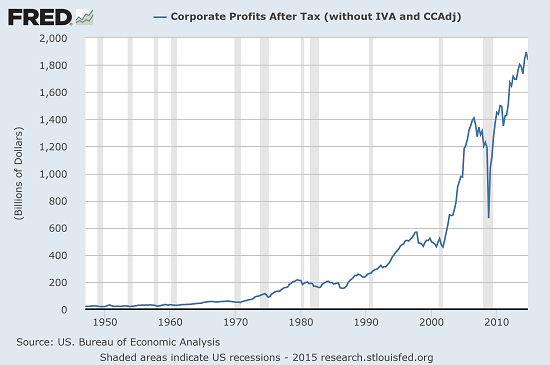
Here's how your cronies have fared since you started your low-interest rate/free money for financiers policies circa 2001: corporate profits have soared:


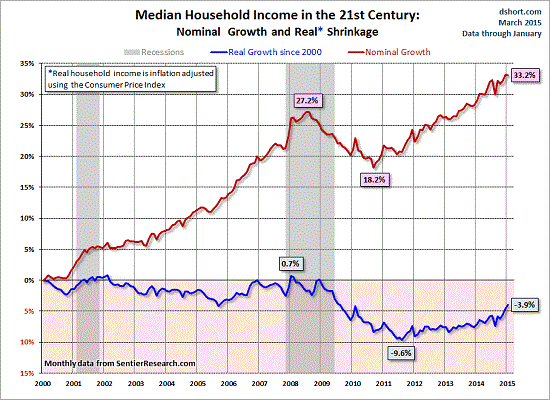
Now look at median household income adjusted for inflation: down 4%--inflation which we know is skewed to under-weight the big ticket items such as healthcare and college education that are skyrocketing in cost:


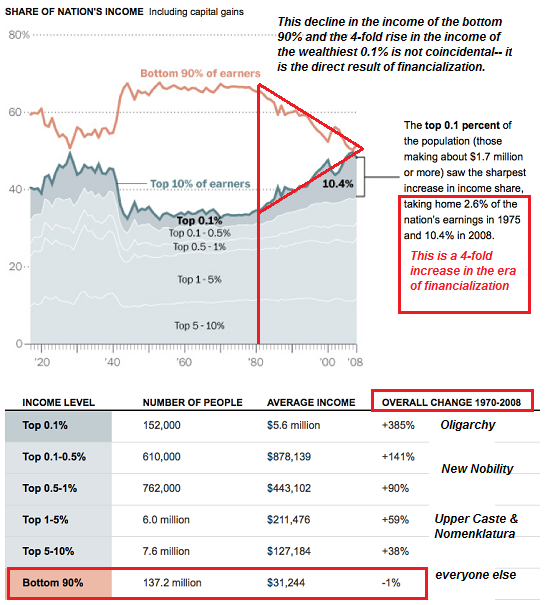
And here's how the middle class has fared since the Federal Reserve made boosting Wall Street and the too big to fail banks its primary goal, circa 1982: the bottom 90% have treaded water for decades, the top 9% did well and the top 1% reaped fabulous gains as a result of your policies.


If you're wondering why we're not spending, look at our incomes (going nowhere), earnings on savings (essentially zero) and the future you've created: ever-widening income disparity, ever-greater financial insecurity, ever-higher risks for those forced to gamble in your rigged casino, and a political/financial system firmly in the hands of your ever-wealthier cronies.

Capital--which includes savings--is the foundation of capitalism. If you attack savings as the scourge limiting corporate profits, you are attacking capitalism and upward mobility. The Fed is not supporting capitalism; rather, the Fed's raison d'etre is crony-capitalism, in which insiders and financiers get essentially free money from the Fed in unlimited quantities that they then use to buy up all the productive assets.

Everyone else--the bottom 99.5%--is relegated to consumer: you are not supposed to accumulate productive capital, you are supposed to spend every penny you earn on interest paid to banks and buying goods and services that further boost corporate profits.

This inversion of capitalism is not just destructive to the nation--it is evil. Funneling trillions of dollars in free money for financiers while chiding Americans for not going deeper into debt is evil.

Memo to the Fed: you are the enemy of capitalism, the middle class and the nation. 


Get a Job, Build a Real Career and Defy a Bewildering Economy(Kindle, $9.95)(print, $20)
go to Kindle editionAre you like me? Ever since my first summer job decades ago, I've been chasing financial security. Not win-the-lottery, Bill Gates riches (although it would be nice!), but simply a feeling of financial control. I want my financial worries to if not disappear at least be manageable and comprehensible. 


And like most of you, the way I've moved toward my goal has always hinged not just on having a job but a career.

You don't have to be a financial blogger to know that "having a job" and "having a career" do not mean the same thing today as they did when I first started swinging a hammer for a paycheck.


Even the basic concept "getting a job" has changed so radically that jobs--getting and keeping them, and the perceived lack of them--is the number one financial topic among friends, family and for that matter, complete strangers.


So I sat down and wrote this book: Get a Job, Build a Real Career and Defy a Bewildering Economy.


It details everything I've verified about employment and the economy, and lays out an action plan to get you employed.


I am proud of this book. It is the culmination of both my practical work experiences and my financial analysis, and it is a useful, practical, and clarifying read.


Test drive the first section and see for yourself.     Kindle, $9.95     print, $20


"I want to thank you for creating your book Get a Job, Build a Real Career and Defy a Bewildering Economy. It is rare to find a person with a mind like yours, who can take a holistic systems view of things without being captured by specific perspectives or agendas. Your contribution to humanity is much appreciated."
Laura Y.

Gordon Long and I discuss The New Nature of Work: Jobs, Occupations & Careers(25 minutes, YouTube)
The Old Models of Work Are Broken 


NOTE: Contributions/subscriptions are acknowledged in the order received. Your name and email remain confidential and will not be given to any other individual, company or agency.

Thank you, William P. ($5/month), for your splendidly generous subscription to this site-- I am greatly honored by your support and readership.

Read more...

Wednesday, June 03, 2015

Cancel the F-35 and Build 21st Century Air Superiority with Drones

Our focus should not be on the glory of the past (piloted aircraft) or protecting institutional turf but on building a true air superiority fleet of drones that the nation can actually afford.


The tragedy of broken systems is they eventually reach a perfection of their pathologies. In the U.S. weapons acquisition system, that ultimate failure is the F-35 Joint Strike Fighter (JSF). It is painful to read this recent summary of how we got stuck with the unaffordable and inferior F-35: How the U.S. and Its Allies Got Stuck with the World’s Worst New Warplane.


Supporters of the F-35 will quibble, of course--who in the Pentagon or Lockheed is going to stand up and declare the aircraft is a failure and we need to start over?

My critique is far more radical than the conventional criticisms of the F-35 program. The problem isn't just the one-design-fits-all-services failure, or the software failures, or the issue of being underpowered and underarmed, or the horrendous cost overruns--any one of which would have doomed the program had the system not been broken.

In my view, it's absolutely insane to risk pilots in combat when there is no longer any need to do so.

When you think about it rationally, it's crazy to invest hundreds of thousands of dollars in training pilots and then risk their lives in combat when they could be safely on the ground (or on board a distant ship) doing the same job.

It is equally insane to burden an aircraft with the constraints of keeping the pilot alive. A drone flown by a ground-based pilot can jink(maneuver) in ways that a piloted aircraft cannot, as pilots black out in high-G maneuvers.

All the systems needed to keep the pilot alive can be jettisoned in a drone. That lowers the weight and the cost considerably.

Pilots are not expendable, and neither are $300 million aircraft. When the cost of a weapons system reaches absurd heights, no nation can afford to build and maintain very many of the weapons. As a result, when combat looms, commanders are limited by the likelihood that the unavoidable losses of combat will quickly deplete the force.

The whole point of drones is they're expendable. If they're designed to be built cheaply, commanders can afford to sacrifice a great many drones to force the opponent into a war of attrition.

The other advantage of drones is they can be tailored to a variety of combat situations. It is easy to envision an air superiority fleet that operates a wide range of drones, from small aircraft designed to have near-zero radar signatures to large drones that are basically platforms to get various kinds of fire and forget air-to-air missiles (stand-off missiles such as the AMRAAM or short-range Sidewinders) within range of enemy aircraft.

Small highly maneuverable drones could act as self-guided sacrificial weapons, essentially designed to get in the way of enemy aircraft and drones and destroy them on impact.

After throwing layers of such deadly but dispensable drones at an enemy force, what was left of the enemy would face a smaller force of air-superiority drones with multiple armaments.

The history of aircraft development offers numerous examples of the right and wrong way to design and build game-changing weapons systems. Aircraft intended to serve the very different needs of the Navy, Marines and Air Force are generally failures, for self-evident reasons: by the time every service's specifications have been thrown in, the aircraft cannot perform well and is hyper-costly.

Aircraft designed by committee and political meddling that stretch over decades are always costly failures.

Successful aircraft are designed by a handful of experienced engineers in a skunkworks protected from design-by-committee Pentagon brass and politicians angling for defense contracts in their district. The engineers are not hampered by an impossible list of "and it also has to do this" specs. They are free to design an aircraft using off-the-shelf components that does a few things extremely well.

The mission goal is clear but the means to reach that goal are not specified.

Sadly, our nation's ability to design and build successful aircraft is completely hobbled by the broken system of design-by-committee and the political dominance of too-big-to-cancel defense contractors and their politico lackeys.

The sunk costs of the F-35 are now so high that it is impossible for the institutional players to let go of it, even though they know the program is 1) unaffordable and 2) a failure.

Anyone who values pilots and understands that weapons systems designed to be everything to everybody are doomed to operational failure and cost overruns would not hesitate to cancel the F-35 albatross in a second.

Our focus should not be on the glory of the past (piloted aircraft) or protecting institutional turf but on building a true air superiority fleet of drones that the nation can actually afford.

What the nation needs in 2016 is a president with the courage and fortitude to cancel failed weapons programs like the F-35 and move beyond outdated paradigms that put more emphasis on protecting federal fiefdoms and spending than they do on affordable military superiority.

We can still indulge the illusion that we have a choice--shall we build a fleet of aircraft that cost over $200 million each and requires $560 billion to maintain and operate over its service life? This choice is false, as we cannot afford $1 trillion programs for outdated weapons. This will become painfully obvious in the decade ahead. 


Get a Job, Build a Real Career and Defy a Bewildering Economy(Kindle, $9.95)(print, $20)
go to Kindle edition
Are you like me? Ever since my first summer job decades ago, I've been chasing financial security. Not win-the-lottery, Bill Gates riches (although it would be nice!), but simply a feeling of financial control. I want my financial worries to if not disappear at least be manageable and comprehensible.

And like most of you, the way I've moved toward my goal has always hinged not just on having a job but a career.

You don't have to be a financial blogger to know that "having a job" and "having a career" do not mean the same thing today as they did when I first started swinging a hammer for a paycheck.

Even the basic concept "getting a job" has changed so radically that jobs--getting and keeping them, and the perceived lack of them--is the number one financial topic among friends, family and for that matter, complete strangers.

So I sat down and wrote this book: Get a Job, Build a Real Career and Defy a Bewildering Economy.

It details everything I've verified about employment and the economy, and lays out an action plan to get you employed.

I am proud of this book. It is the culmination of both my practical work experiences and my financial analysis, and it is a useful, practical, and clarifying read.

Test drive the first section and see for yourself.     Kindle, $9.95     print, $20

"I want to thank you for creating your book Get a Job, Build a Real Career and Defy a Bewildering Economy. It is rare to find a person with a mind like yours, who can take a holistic systems view of things without being captured by specific perspectives or agendas. Your contribution to humanity is much appreciated."
Laura Y.

Gordon Long and I discuss The New Nature of Work: Jobs, Occupations & Careers(25 minutes, YouTube)

The Old Models of Work Are Broken 


NOTE: Contributions/subscriptions are acknowledged in the order received. Your name and email remain confidential and will not be given to any other individual, company or agency.


 Thank you, Maynard W. ($5/month), for your fantastically generous subscription to this site-- I am greatly honored by your steadfast support and readership.

Read more...

Tuesday, June 02, 2015

Being Healthy Is Unprofitable

U.S. healthcare is unsustainable. That it will break in the next decade is predictable.


That good health is insanely unprofitable was highlighted by a staggering statistic in the recent research paper The Concentration of Health Care Spending (via B.C.):

Mean annual spending for the bottom half of (the American population) distribution was just $236 per person, totaling only $36 billion for the entire group of more than 150 million people.

We don't know why the 150 million people did not consume much in the way of "health services"-- they might have been healthy and had no need for healthcare beyond routine tests, or they might have needed care and been unable to afford it, despite the Orwellian-titled Affordable Care Act (ACA).

But let's assume that the 150 million people--roughly half of America's 317 million residents--were healthy and had no need for health services beyond minimal prevention and a few low-cost tests.

The total cost of their care was $36 billion--just over 1% of the nation's $3.2 trillion bill for healthcare and healthcare insurance. Let's assume that 90% of the populace was healthy, and the remaining 10% were very ill and needed 100 times as much care as the healthy.

The total cost of caring for the 285 million healthy people would be roughly $67 billion, or just over 2% of the $3 trillion we currently spend on healthcare. The very ill 32 million would need $23,600 each, or $755 billion.

The total cost for a largely healthy population and 32 million ill people who required 100 times more care than the healthy would be $822 billion, or roughly 25% of the $3.2 trillion we currently spend annually.

Here is an example of the insanity of U.S. healthcare costs. One of our European friends was doing post-doctorate research at a major U.S. university. His son suffered a minor burn in the kitchen, and on the doctor's recommendation, the parents took the toddler to a hospital a few days later to have the dressing--basically a piece of gauze taped over the burn--changed.
Naive to the absurdities and costs of U.S. healthcare, the parents followed these instructions rather than just changing the gauze themselves.

Their punishment for foolishly asking the medical establishment to spend 5 minutes changing a small piece of gauze: a bill for $875. The list of similar charges is equally absurd. Among those known to me first-hand: $120,000 for a few days in a hospital, no operation, not intensive care; $6,000 for 20 minutes sitting in an observation room after a minor outpatient surgery on the patient's big toe--the list is essentially endless.

Readers are quick to note that the charges may not be paid in full--but that is no defense of the system. So that makes it OK that Medicare is charged "only" $80,000 for a few days in a hospital bed, or "only" $5,000 for sitting in a room for 20 minutes?

Estimates of the cost of paper-shuffling and fraud in our healthcare system start at 40%. Outright fraud (billing for phantom services and patients) accounts for an astounding percentage of healthcare expenditures, as do needless/ineffective tests and procedures.
Prevention is cheap, intervention and care of chronic disease is costly.

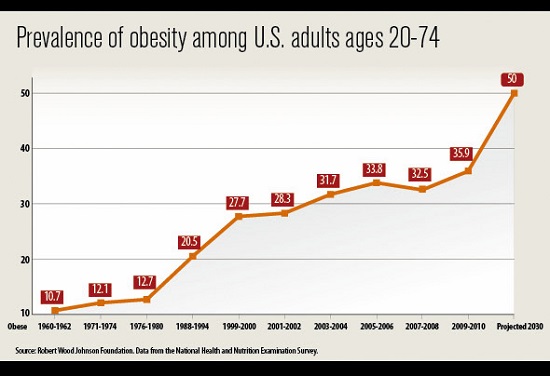
Sadly, we know 90% of the American populace is not healthy. Rather, the 70% who are overweight are facing decades of ill-health and needlessly early deaths.Consider this report cited in America The Obese:

Published in the journal The Lancet Diabetes & Endocrinology, a study comparing young men and women of healthy weights to young obese individuals found that those who were overweight lost about 8.4 years off of their lives if they were men and 6.1 years off of their lives if they were women.

Young obese men suffered 18.8 more years of poor health leading up to their early deaths compared to men of healthy weight, while young obese women suffered 19.1 years of poor health. Even when obesity emerged just in old age, both men and women were found to lose years off of their lives: for men, an average of 3.7 years and for women about 5.3 years.

Americans spend $60 billion annually on weight loss programs and products, yet we become more overweight every year. Note that this $60 billion is almost twice the amount spent on healthcare for 150 million Americans.

The weight gain may be linear in nature, but the adverse consequences of extra weight are geometric. As noted in New obesity guidelines help physicians and patients with weight loss treatments:

As our waistlines expand, so too do the number of medical problems caused by excess body weight. A 2012 report by the Robert Wood Johnson Foundation, “F as in Fat, How Obesity Threatens America’s Future,” found that if obesity rates continue on their current trajectories, the number of new cases of type 2 diabetes, coronary heart disease and stroke, hypertension, and arthritis could increase 10-fold between 2010 and 2020—and double again by 2030.

“As evidence unfolds, everyone is beginning to appreciate that obesity and excess body weight are driving medical conditions and costs. You cannot get medical costs under control as long as we have these rising rates of obesity,” says Donna Ryan, MD, professor emeritus at Pennington Biomedical Research Center at Louisiana State University Health System, and previous past president of The Obesity Society.

That America's ill health has become a national security risk is obvious: America: Too fat to fight.

Excess body weight threatens not just the nation's healthbut its economy and social fabric: F as in Fat: How Obesity Threatens America's Future (Robert Wood Johnson Foundation).


Anyone who thinks the stagnant American economy that already spends twice as much per person on healthcare as our advanced 1st World competitors can support 10-fold increases in lifestyle-caused chronic diseases is living in Fantasyland. The pharmaceutical industry has a plan to "cure" diabesity--their fondest dream is a bunch of pills that cost $84,000 a year, just like the recent treatment for Hepatitis C. Patients Get Extreme to Obtain Hepatitis Drug That's 1% the Cost Outside U.S.

Here's what will happen as the wave of weight/lifestyle diseases swell into a tsunami:

1. Care will become scarce within our "somebody else pays for me" system as the system starts breaking down.

2. Care will become cash only as payments to frontline providers dwindle.

The "cure" for excess body weight is well-known and well-documented. The vast majority of us can only change our lifestyle and thus our weight and health within a support group of others engaged in the same challenge. Supplements don't work, fad diets don't work, gym memberships (lacking a total transformation of lifestyle) don't work--nothing works but continual human support from those dealing with the same issues.

But operating support groups is not profitable, and so our healthcare system gives the only real cure lip-service. Prevention and support groups are cheap and effective, but they're terribly, horribly, unavoidably unprofitable, so they are given lip-service, while the healthcare industries gear up to provide $100,000 procedures and $84,000 per year medications, all paid by "somebody else."

U.S. healthcare is unsustainable. That it will break in the next decade is predictable. We are collectively wandering the beach, picking up seashells, while a mighty tsunami wave is approaching that will wash everyone on the beach away. We can either deal with the lifestyle and cultural causes of our mounting ill health or be swept away when the system crashes. 


Get a Job, Build a Real Career and Defy a Bewildering Economy(Kindle, $9.95)(print, $20)
go to Kindle editionAre you like me? Ever since my first summer job decades ago, I've been chasing financial security. Not win-the-lottery, Bill Gates riches (although it would be nice!), but simply a feeling of financial control. I want my financial worries to if not disappear at least be manageable and comprehensible. 


And like most of you, the way I've moved toward my goal has always hinged not just on having a job but a career.

You don't have to be a financial blogger to know that "having a job" and "having a career" do not mean the same thing today as they did when I first started swinging a hammer for a paycheck.


Even the basic concept "getting a job" has changed so radically that jobs--getting and keeping them, and the perceived lack of them--is the number one financial topic among friends, family and for that matter, complete strangers.


So I sat down and wrote this book: Get a Job, Build a Real Career and Defy a Bewildering Economy.


It details everything I've verified about employment and the economy, and lays out an action plan to get you employed.


I am proud of this book. It is the culmination of both my practical work experiences and my financial analysis, and it is a useful, practical, and clarifying read.


Test drive the first section and see for yourself.     Kindle, $9.95     print, $20


"I want to thank you for creating your book Get a Job, Build a Real Career and Defy a Bewildering Economy. It is rare to find a person with a mind like yours, who can take a holistic systems view of things without being captured by specific perspectives or agendas. Your contribution to humanity is much appreciated."
Laura Y.

Gordon Long and I discuss The New Nature of Work: Jobs, Occupations & Careers(25 minutes, YouTube)
The Old Models of Work Are Broken 


NOTE: Contributions/subscriptions are acknowledged in the order received. Your name and email remain confidential and will not be given to any other individual, company or agency.

Thank you, D.M.T. ($100), for your outrageously generous contribution to this site-- I am greatly honored by your wondrously steadfast support and readership.

Read more...

Monday, June 01, 2015

Liberation Is Unprofitable

12 examples of how liberation is not profitable and therefore it must be marginalized, outlawed, proscribed or ridiculed.


If we had to summarize the sickness of our economy and society, we could start by noting that liberation is unprofitable, and whatever is not profitable to vested interests is marginalized, outlawed, proscribed or ridiculed. Examples of this abound.

Liberation from digital communication servitude is not profitable. Don't have a smart phone on 18 hours a day, every day? Loser! Luddite! Liberation from digital communication servitude is not profitable, therefore it is ridiculed.

Liberation from debt is not profitable. Only the wealthy can afford to buy a vehicle without debt, a home without debt or a university education without debt. For everyone else, liberation from debt is not an option, because debt is highly profitable to our financial Overlords and the politicos they buy/own.


Liberation from political elites is not profitable. Dependence on the state for monthly payments binds the recipients to the political elites that control the money and payments, and to the financial elites who control the political elites.

Liberation from the staged, soap-opera political drama of elections is not profitable. Election advertising generates staggering profits for media companies, and the ceaseless nurturing of fear, resentment and indignation fuels acceptance of centralized power and control.


Liberation from the consumerist mindset is not profitable. Aspirational purchases in the pursuit of appearances are the most profitable of all spending; re-use, repair and informal peer-to-peer sharing are all intrinsically unprofitable.


Liberation from the tyranny of central banks is not profitable. Our entire financial system is built on the simple dynamic that everyone is forced to use money issued by the central bank (Federal Reserve) to its member banks and their financier cronies.

Money that is decentralized and not issued by central banks is not profitable.

Common-sense, minimal regulations are not profitable. Regulations feed government fiefdoms and the revolving-door spoils system between the state and private industry, and erect formidable barriers to new competitors. As a result, over-regulation is immensely profitable.


The ability to think independently is not profitable. The control mechanisms that keep the various classes of serfs in permanent servitude all depend on a dumbed-down populace that has been stripped of the ability to think independently by propaganda, group-think, medications, the education industry and lifelong dependency on the state.


An economy/society without corruption is not profitable. Buying favors, cronyism and cartel control of pricing are the primary sources of corruption. Cartels and the auctioning of favors are highly profitable to politicos and the vested interests who control the tollways of finance, political influence and social mobility.


Degrowth is not profitable. Needing fewer, quality things that last for decades is not profitable. Reparing things for nearly-free is not profitable. Giving stuff away to others for free is not profitable. Making do with what you have is not profitable.


A scarcity of stress and anxiety is not profitable. Stress, anxiety and financial insecurity are all highly profitable, as these drive profitably addictive behaviors such as going deep into debt, shopaholic binge buying, multiple anti-anxiety/anti-depression medications, costly therapy and various forms of self-medication.


Opting out is not profitable. Opting out of debt-serfdom and the burdens of being a tax donkey is not profitable to vested interests or the state. Adopting self-reliance and low-cost/low-impact living and opting out of the status quo culture of consumerism, debt and complicity with a parasitic, exploitive cartel-state Aristocracy/ Plutocracy/ Oligarchy/ Kleptocracy (take your pick--it's still the same rapacious Elite whatever name you choose)--is not profitable.

Tune In, Turn On, Opt Out (May 17, 2013) 


Get a Job, Build a Real Career and Defy a Bewildering Economy(Kindle, $9.95)(print, $20)
go to Kindle edition
Are you like me? Ever since my first summer job decades ago, I've been chasing financial security. Not win-the-lottery, Bill Gates riches (although it would be nice!), but simply a feeling of financial control. I want my financial worries to if not disappear at least be manageable and comprehensible.

And like most of you, the way I've moved toward my goal has always hinged not just on having a job but a career.

You don't have to be a financial blogger to know that "having a job" and "having a career" do not mean the same thing today as they did when I first started swinging a hammer for a paycheck.

Even the basic concept "getting a job" has changed so radically that jobs--getting and keeping them, and the perceived lack of them--is the number one financial topic among friends, family and for that matter, complete strangers.

So I sat down and wrote this book: Get a Job, Build a Real Career and Defy a Bewildering Economy.

It details everything I've verified about employment and the economy, and lays out an action plan to get you employed.

I am proud of this book. It is the culmination of both my practical work experiences and my financial analysis, and it is a useful, practical, and clarifying read.

Test drive the first section and see for yourself.     Kindle, $9.95     print, $20

"I want to thank you for creating your book Get a Job, Build a Real Career and Defy a Bewildering Economy. It is rare to find a person with a mind like yours, who can take a holistic systems view of things without being captured by specific perspectives or agendas. Your contribution to humanity is much appreciated."
Laura Y.

Gordon Long and I discuss The New Nature of Work: Jobs, Occupations & Careers(25 minutes, YouTube)
The Old Models of Work Are Broken 


NOTE: Contributions/subscriptions are acknowledged in the order received. Your name and email remain confidential and will not be given to any other individual, company or agency.

Thank you, William S. ($50), for your splendidly generous contribution to this site-- I am greatly honored by your steadfast support and readership.

Read more...

Terms of Service

All content on this blog is provided by Trewe LLC for informational purposes only. The owner of this blog makes no representations as to the accuracy or completeness of any information on this site or found by following any link on this site. The owner will not be liable for any errors or omissions in this information nor for the availability of this information. The owner will not be liable for any losses, injuries, or damages from the display or use of this information. These terms and conditions of use are subject to change at anytime and without notice.

RE: European Union AI Act, and Our Use of Generative AI Tools and Agents Policy

All text on this site is composed by Charles Hugh Smith or by a credited guest-author. No Generative AI Tools are used in the composition / writing of any text or graphic content created by Charles Hugh Smith. This site deploys no AI agents or generative AI tools. This site is not responsible for the disclosures, use or non-use of AI agents or generative AI tools in advertisements displayed by Investing Channel or other ad placement services.

Audio files generated by text-to-audio transcription tools are identified as such.

Our Privacy Policy:

Correspondents' email is strictly confidential. This site does not collect digital data from visitors or distribute cookies. Advertisements served by third-party advertising networks such as Investing Channel may use cookies or collect information from visitors for the purpose of Interest-Based Advertising; if you wish to opt out of Interest-Based Advertising, please go to Opt out of interest-based advertising (The Network Advertising Initiative) If you have other privacy concerns relating to advertisements, please contact advertisers directly.

PRIVACY NOTICE FOR EEA INDIVIDUALS

This section covers disclosures on the General Data Protection Regulation (GDPR) for users residing within EEA only. GDPR replaces the existing Directive 95/46/ec, and aims at harmonizing data protection laws in the EU that are fit for purpose in the digital age. The primary objective of the GDPR is to give citizens back control of their personal data. Please follow the link below to access InvestingChannel's General Data Protection Notice.
https://stg.media.investingchannel.com/gdpr-notice/

Notice of Compliance with The California Consumer Protection Act

This site does not collect digital data from visitors or distribute cookies. Advertisements served by a third-party advertising network (Investing Channel) may use cookies or collect information from visitors for the purpose of Interest-Based Advertising. If you do not want any personal information that may be collected by third-party advertising to be sold, please follow the instructions on this page: Do Not Sell My Personal Information.

Regarding Cookies:

This site does not collect digital data from visitors or distribute cookies. Advertisements served by third-party advertising networks such as Investing Channel may use cookies or collect information from visitors for the purpose of Interest-Based Advertising; if you wish to opt out of Interest-Based Advertising, please go to Opt out of interest-based advertising (The Network Advertising Initiative) If you have other privacy concerns relating to advertisements, please contact advertisers directly.

Our Commission Policy:

Though I earn a small commission on Amazon.com books and gift certificates and gold (BullionVault) purchased via links on my site, I receive no fees or compensation for any other non-advertising links or content posted on my site.

Copyright Notice:

All original images (Drawings and Photographs), text (essays, books and works of fiction), audio and video recordings, musical compositions, graphic design, graphic design elements and HTML coding on this site are the copyrighted work of Charles Hugh Smith unless otherwise credited or noted. They are published as information for the private use of site visitors, and any reproduction or redistribution of this content or coding in any media in any format or distribution channel (text, audio, video/film, web) without the written permission of the copyright holder is strictly prohibited. All rights in all media reserved globally.

  © Blogger templates Newspaper III by Ourblogtemplates.com 2008

Back to TOP