Monday, July 12, 2021

The $50 Trillion Plundered from Workers by America's Aristocracy Is Trickling Back

As I often note here, when you push the pendulum to an extreme of wealth and income inequality, it will swing to the opposite extreme minus a tiny bit of friction.

The depth of America's indoctrination can be measured by the unquestioned assumption that Capital should earn 15% every year, rain or shine, while workers are fated to lose ground every year, rain or shine. And if wages should ever start ticking upward even slightly, then the Billionaires' Apologists are unleashed to shout that higher wages means higher inflation, which will kill the economic "recovery."

Said another way: if wages stagnate so workers lose ground every year as inflation in essentials rises, that's the way it should be. If wages rise so workers can keep up with inflation, then that will trigger an inflationary death spiral.

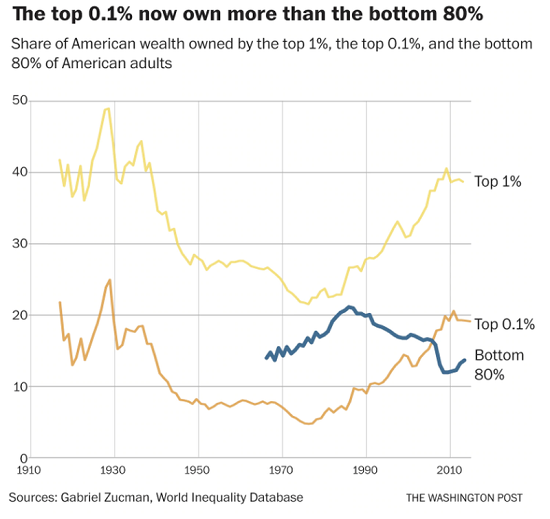
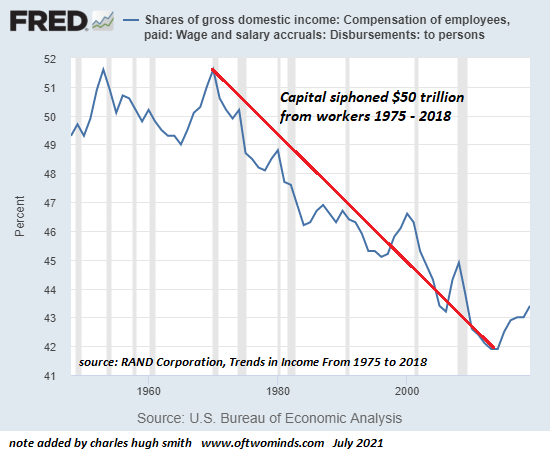
That this indoctrination is so widely accepted reveals the success of America's Aristocracy in reshaping the narrative to make their plundering appear to be "inevitable." But the siphoning of $50 trillion from workers to the Aristocracy, and the Nobility's control of political power was anything but inevitable: it was engineered by policies that enriched billionaires, the top 0.01% Aristocracy, and the top 10% who own 90% of America's productive capital.

This wholesale transfer of wealth and income from workers to Capital was documented by a RAND Corporation report, Trends in Income From 1975 to 2018. Time magazine summarized the findings: The Top 1% of Americans Have Taken $50 Trillion From the Bottom 90% -- And That's Made the U.S. Less Secure.

There are some who blame the current plight of working Americans on structural changes in the underlying economy--on automation, and especially on globalization. According to this popular narrative, the lower wages of the past 40 years were the unfortunate but necessary price of keeping American businesses competitive in an increasingly cutthroat global market. But in fact, the $50 trillion transfer of wealth the RAND report documents has occurred entirely within the American economy, not between it and its trading partners. No, this upward redistribution of income, wealth, and power wasn't inevitable; it was a choice--a direct result of the trickle-down policies we chose to implement since 1975.

The net result of this four-decade siphoning of wealth/income from workers was recently documented by a Foreign Affairs article: Monopoly Versus Democracy:

Ten percent of Americans now control 97 percent of all capital income in the country. Nearly half of the new income generated since the global financial crisis of 2008 has gone to the wealthiest one percent of U.S. citizens. The richest three Americans collectively have more wealth than the poorest 160 million Americans.

In other words, the bottom 90% have very little stake in the status quo: they receive essentially zero income from America's stupendous $121 trillion hoard of private wealth and have essentially zero political influence, as documented in Testing Theories of American Politics: Elites, Interest Groups, and Average Citizens.

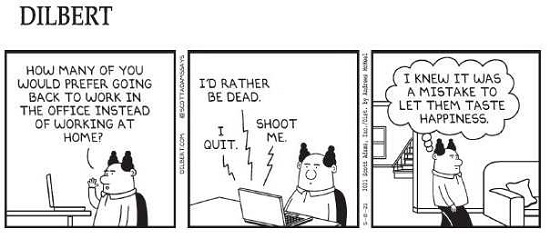
Now the worm has finally turned, and workers are refusing to accept the Neofeudal dominance of the Aristocracy, not by open revolts that the State can violently crush but by indirect means. Fed-up Boomers are retiring, fed-up Gen-Xers are cutting their hours, refusing to go back to the office, starting their own enterprises and Millennials are assembling multiple income streams, building micro-houses, and leveraging shortages of workers for higher wages.

The techno-fantasy that's Corporate America's fondest dream is automation of all labor: get rid of all human workers and just manage the robots with loving care. But the reality is robots have limits, as I explain in my book Will You Be Richer or Poorer?--limits imposed by physics and finance.

And so, weeping inconsolably, Corporate America continues exploiting its workforce with the usual threats: you're powerless because we can automate your job or offshore it to Lower Slobovia.

Contrast this with the real world: a young man of my acquaintance recently took a job at a Corporate America Big Box outlet. His wage was $12/hour, and all the power was of course in the hands of Corporate America: he had no power over his schedule, or anything else.

In the script of the past four decades, Corporate America (while crushing small business and buying the best government money can buy) could keep the serfs slaving away for stagnating wages, all in service of maximizing corporate insiders' stock options, buybacks and soaring profits.

This individual was tipped off to a much better opportunity, and when he gave notice to the Big Box manager, the manager corralled him for two hours, first offering a $3/hour raise (25%) and then badgering him to stay on as a serf on the Big Box plantation. He refused.

This is the pure distillation of Corporate America and the Aristocracy: if they'd offered this hard-working individual the 25% raise after he proved his worth, then maybe he wouldn't have been so motivated to seek better opportunities elsewhere.

At long last, some the $50 trillion plundered from workers is trickling back to the people who actually create the income and wealth. As a thought experiment, consider an economy in which farmers and workers reaped 15% gains annually like clockwork, and Corporate America's insiders, financiers and speculators, and Wall Street's parasites all lost 15% of their wealth and income every year like clockwork.

In other words, imagine the $50 trillion flowing back to those who generated it from those who looted it.

As I often note here, when you push the pendulum to an extreme of wealth and income inequality, it will swing to the opposite extreme minus a tiny bit of friction. The serfs are quietly slipping away, and the Aristocracy, blinded by hubris and greed, believes nothing will ever change because, well, their wealth and power is deserved. What they really deserve will manifest in the next four years as the chairs at the banquet of consequences are shuffled.


If you found value in this content, please join me in seeking solutions by becoming a $1/month patron of my work via patreon.com.

My new book is available! A Hacker's Teleology: Sharing the Wealth of Our Shrinking Planet 20% and 15% discounts (Kindle $7, print $17, audiobook now available $17.46)

Read excerpts of the book for free (PDF).

The Story Behind the Book and the Introduction.


Recent Videos/Podcasts:

AoE Salon #44: We say "Satyagraha", they say "sedition" with author Max Borders (1:03 hrs)

My COVID-19 Pandemic Posts


My recent books:

A Hacker's Teleology: Sharing the Wealth of Our Shrinking Planet (Kindle $8.95, print $20, audiobook $17.46) Read the first section for free (PDF).

Will You Be Richer or Poorer?: Profit, Power, and AI in a Traumatized World
(Kindle $5, print $10, audiobook) Read the first section for free (PDF).

Pathfinding our Destiny: Preventing the Final Fall of Our Democratic Republic ($5 (Kindle), $10 (print), ( audiobook): Read the first section for free (PDF).

The Adventures of the Consulting Philosopher: The Disappearance of Drake $1.29 (Kindle), $8.95 (print); read the first chapters for free (PDF)

Money and Work Unchained $6.95 (Kindle), $15 (print) Read the first section for free (PDF).


Become a $1/month patron of my work via patreon.com.


NOTE: Contributions/subscriptions are acknowledged in the order received. Your name and email remain confidential and will not be given to any other individual, company or agency.

Thank you, Joseph C. ($50), for your magnificently generous contribution to this site -- I am greatly honored by your support and readership.


Thank you, David M. ($50), for your marvelously generous contribution to this site -- I am greatly honored by your support and readership.

Read more...

Thursday, July 08, 2021

Housing Bubble #2: Ready to Pop?

All debt-fueled speculative bubbles pop, even as cheerleaders claim otherwise.

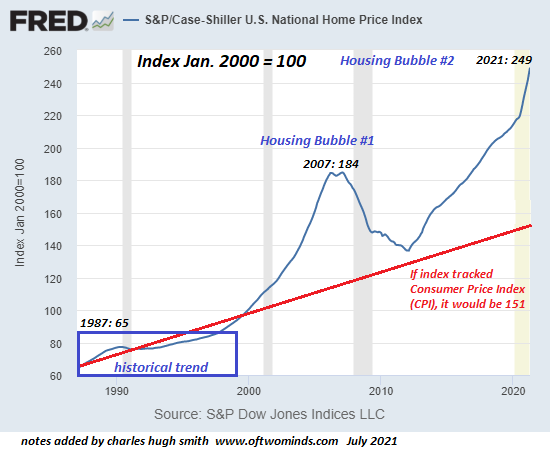
The expansion of Housing Bubble #2 is clearly visible in these two charts of house valuations, courtesy of the St. Louis Federal Reserve database (FRED). The first is the Case-Shiller Index, which as you recall tracks the price of homes on an "apples to apples" basis, i.e. it tracks price movements for the same house over time.

Note that this is an index chart where the index is set at 100 as of January 2000. It is not a chart of median housing prices.

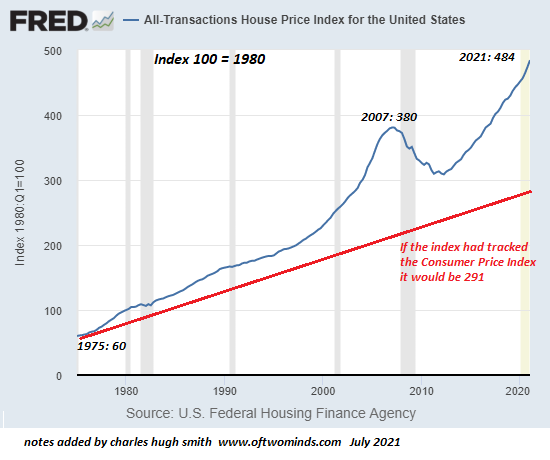
The second chart is also a housing price index chart courtesy of the U.S. Federal Housing Finance Agency. (Shoutout to the USFHFA, never came across your work before.)

The red line marks where house prices would be if they had tracked the Consumer Price Index (CPI), i.e. inflation as measured by the Bureau of Labor Statistics. You'll notice that the last time the Case-Shiller Index touched this baseline was 1998, almost a quarter-century ago. On the FHFA index, it hasn't touched it since the mid-1970s, 45 years ago.

You'll notice that housing would have to drop by 40% to touch the baseline. Yes, this is officially "impossible," because the Fed has our back in every bubble and housing never goes down because the demand is forever rising.


Nice, but when you turn an asset class into a casino of speculators and financiers playing with Fed-spewed "free money," you're not dealing with shelter, you're dealing with gambling chips. You'll notice that the Federal Reserve's massive manipulation--oops, sorry, intervention-- in response to the Asian-Contagion of 1997-1998 began inflating an unprecedented bubble in housing that rose to spectacular heights on the back of Fed policies (lowering interest rates, etc.) and institutionalized fraud on a global scale in the casino's subprime mortgage table.

You may recall that $300 billion of designed-to-default subprime mortgage pools almost took down America's entire financial system and with that teetering, the entire global financial system ($100 trillion at the time).

I've often pointed out the remarkable symmetry of speculative bubbles popping. Housing Bubble #1 took about four years to reach absurd valuations and about four years to plummet towards the baseline--a decline that the Federal Reserve stopped by effectively socializing the mortgage market and manipulating mortgage rates into a steady slide lower.


This manipulation has inflated Housing Bubble #2 as mortgage rates fell beneath the rate of inflation (as measured by any quasi-realistic metric). In other words, lenders are losing money on every mortgage, every month, as their yield is less than zero once adjusted for inflation.

The idea that issuing mortgages that lose money is perfectly sound and sustainable is, well, financial madness. It may be fun to originate mortgages that lose money from Day One and sell them to a Norwegian pension fund or other bagholder, but over time people will catch on that losing money is not a winning strategy in the long term.

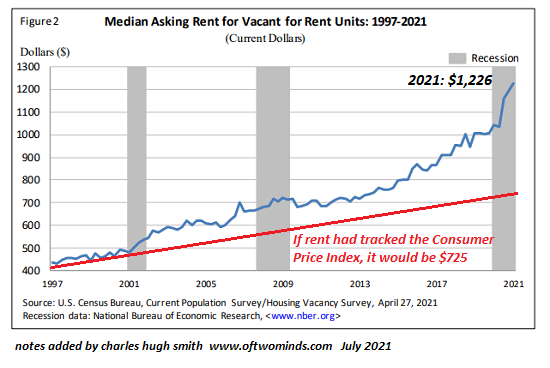
Housing Bubble #2 has naturally blown a bubble in rents, as the third chart shows. If I just paid 100% more for a rental than it was worth a few years ago, of course the rent should double, too, to cover my higher costs.

To touch the baseline, rents would also have to drop 40%. yes, I know, that's "impossible" because the Fed has our back, population is growing, and so on.


Fear of Missing Out (FOMO) is a reliable feature of every debt-funded speculative bubble and Housing Bubble #2 has a palpable FOMO frenzy feel.

But housing has an interesting feature: if the number of people occupying a dwelling increases, the population can grow by millions without needing even one additional house. Interestingly, The number of people in the average U.S. household is going up for the first time in over 160 years (Pew Research).

There are 331 million U.S. residents and about 126 million occupied dwellings, so that's about 2.6 people per housing unit.

A consequential number of the 82.5 million owner-occupied homes in America are currently occupied by one or two people. If the number of people living in those homes rose, the demand for additional housing would slacken considerably.

There are a consequential number of unoccupied homes in the U.S. as detailed on Page 4 of Residential Vacancies and Homeownership, Q1 2021 (Census.gov)

Many of these may be in places few people want to live, others may be abandoned and in need of renovation, but nonetheless it seems there are at least 5 million unoccupied dwellings in the U.S. that are "held off the market" for various reasons (3.8 million units) or only in "occasional use" (2 million dwellings that are not vacation "seasonal" homes or short-term rentals, as those are separate categories).

New York City has 3.5 million housing units and Los Angeles has 1.5 million housing units, so 5 million unoccupied dwellings is a large number. With more work being done remotely, and the price of housing at absurd levels in many urban areas, it's not difficult to imagine an increase in the number of residents per dwelling and a slow migration to housing sitting empty.

I built a micro-house back in 1978, and the trend is accelerating. A great many young people cannot afford a McMansion and will never be able to afford one, and many have no interest in debt-serfdom. Micro-houses in low-cost rural areas are a solution that adds housing units but not in the conventional high-cost manner.

All debt-fueled speculative bubbles pop, even as cheerleaders claim otherwise. There are a great many people with vested interests in Housing Bubble #2 expanding forever, but history suggests a return to the baseline is more likely than a speculative bubble expanding forever. Demand is contingent, mortgage rates are contingent, demographic flows are contingent, the number of occupants per dwelling is contingent, and the rise of cheap alternatives to conventional housing is an under-appreciated trend.

And that's how "impossible" reverses to "inevitable."


If you found value in this content, please join me in seeking solutions by becoming a $1/month patron of my work via patreon.com.

My new book is available! A Hacker's Teleology: Sharing the Wealth of Our Shrinking Planet 20% and 15% discounts (Kindle $7, print $17, audiobook now available $17.46)

Read excerpts of the book for free (PDF).

The Story Behind the Book and the Introduction.


Recent Videos/Podcasts:

It Always Ends The Same Way (34:33) (with Gordon Long)

My COVID-19 Pandemic Posts


My recent books:

A Hacker's Teleology: Sharing the Wealth of Our Shrinking Planet (Kindle $8.95, print $20, audiobook $17.46) Read the first section for free (PDF).

Will You Be Richer or Poorer?: Profit, Power, and AI in a Traumatized World
(Kindle $5, print $10, audiobook) Read the first section for free (PDF).

Pathfinding our Destiny: Preventing the Final Fall of Our Democratic Republic ($5 (Kindle), $10 (print), ( audiobook): Read the first section for free (PDF).

The Adventures of the Consulting Philosopher: The Disappearance of Drake $1.29 (Kindle), $8.95 (print); read the first chapters for free (PDF)

Money and Work Unchained $6.95 (Kindle), $15 (print) Read the first section for free (PDF).


Become a $1/month patron of my work via patreon.com.


NOTE: Contributions/subscriptions are acknowledged in the order received. Your name and email remain confidential and will not be given to any other individual, company or agency.

Thank you, Stuart L. ($50), for your magnificently generous contribution to this site -- I am greatly honored by your steadfast support and readership.


Thank you, Hughski ($108), for your outrageously generous contribution to this site -- I am greatly honored by your support and readership.

Read more...

Monday, July 05, 2021

A Few Things About Reinforced Concrete High-Rise Condos

There is a downside to steel reinforcing bars: they rust.

The second most remarkable thing about the sudden collapse of the Florida condo building was the rush to assure everyone that this was a one-off catastrophe: all the factors fingered as causes were unique to this building, the implication being all other high-rise reinforced concrete condos without the exact same mix of causal factors were not in danger.

Before we accept this conveniently feel-good conclusion, there are a few things we should consider about reinforced concrete high-rise condos.

1. This may seem too obvious to be important, but concrete is a heavy material. Fill a 5-gallon bucket with wet concrete, let it cure (harden) and then pick the bucket up--if you can.

2. Conventional concrete is not water-proof; it absorbs moisture. Construct a concrete wall against an excavated cliff of damp earth saturated with underground moisture and the concrete wall will be damp unless it is sealed essentially perfectly--no easy task.

3. Steel reinforcing bars add specific kinds of strength to concrete, which is rather brittle in its conventional unreinforced state: tilt a slab of unreinforced concrete on a large, sharp rock and hit the elevated half of the slab with a sledge hammer, and the slab will crack on the (fulcrum) rock.

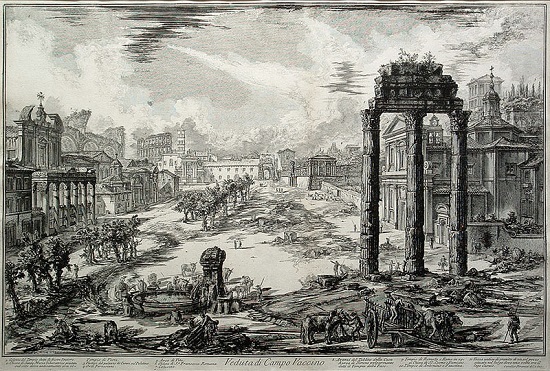
4. Roman aqueducts, bridges and buildings are still standing 2,000 after completion because they do not contain reinforcing steel bars, a.k.a. rebar. Roman concrete developed its remarkable durability and strength from its unqiue mix of aggregates--the rocks and sand-like materials that are mixed with cement to form concrete.

Why are these 2,000 year old structures still standing despite lacking reinforcing steel bars?

5. There is a downside to steel reinforcing bars: they rust. The porousness of conventional concrete and steel's propensity to rust in the presence of moisture become a structural problem in the making, for rust expands. As previously noted, concrete is rather brittle, and so a rusting rebar will crack the concrete from the inside. When the broken concrete piece falls off, this is called spalling.

When concrete spalls off, exposing the rusting rebar, this accelerates the rust by exposing it to additional moisture and oxygen in the air. Seawater and salt-laden air accelerate rust. There are ways to make rebar rust-resistant and concrete water-resistant, but these cost more and are therefore not conventional.

Given enough time, rebar rusts away, weakening the concrete in that part of the structure. This part of the structure becomes a weak point and potential point of failure, for as noted previously, concrete is very heavy. (Add a rooftop pool filled with water, and that adds even more weight. Fill a 5-gallon bucket with water and carry it, if you can.)

6. Given that this type of damage can be hidden inside the structure, it's non-trivial to identify it via visual inspections. If concrete spalling and rusting rebar are visible, it's non-trivial to assess the weakness this creates.

7. Pre-stressed reinforced concrete beams are made in factories, but the rest of the concrete is poured on-site and is subject to sloppy or hasty work. For example, if the rebar is too close to the surface (i.e., not embedded deep enough), then it is more readily reached by moisture and rusts/spalls more rapidly. Voids in concrete are also common, and post-completion patches may not offer much resistance to water.

8. Repairing serious structural damage in a reinforced concrete high-rise is a special skill, and few contractors have the requisite experience (and liability insurance) to do this work. As the insurer, how do you cover the possibility, however unlikely, that the repair uncovers further damage or fails to strengthen the structure sufficiently?

9. Reinforced concrete high-rises built decades ago to the building codes of that time may not be up to snuff should ground settlement exceed modest limits or structural weaknesses develop. Age and water are enemies of all structures, but multi-story buildings are especially at risk.

10. The value of units inside reinforced concrete high-rise condos will adjust to the results of inspections which reveal structural weaknesses, as the cost of repairs must be factored in. Unrepaired structural weaknesses may impair the creditworthiness of the units, limiting owners' ability to borrow the money needed to pay for potentially burdensome repairs.

11. The cost of repairing serious damage could easily exceed the original cost of the entire building, due to the risks and unknowns regarding the seriousness of the damage and the liabilities of every entity involved in the assessment, plans, insurance and execution of the repairs.

12. Owners who cannot afford the repairs or whose initial purchase cost was modest may elect to (or be forced to) abandon their unit, surrendering their equity (which may be severely impaired by the uncertainties generated by the knowledge of structural weaknesses). These abandoned units may well be difficult to sell, given the unknown total cost of repairs, and so they would revert to the control of the condo association, whcih would then be responsible for funding the unit's share of the repair bill.

If enough owners abandon their units, the remaining owners may find the threshold of repair costs per unit far exceeds the market value of the units once the building is repaired. In this scenario, the only option left is to surrender the building to demolition to eliminate the liability of it collapsing and damaging other structures or injuring others.

If that scenario seems farfetched, consider the ease of underestimating the costs of repairing structural damage in high-rise buildings, the liability exposure of all parties and the risks and unknowns intrinsic to the multi-stage process of repair.


If you found value in this content, please join me in seeking solutions by becoming a $1/month patron of my work via patreon.com.

My new book is available! A Hacker's Teleology: Sharing the Wealth of Our Shrinking Planet 20% and 15% discounts (Kindle $7, print $17, audiobook now available $17.46)

Read excerpts of the book for free (PDF).

The Story Behind the Book and the Introduction.


Recent Videos/Podcasts:

It Always Ends The Same Way (34:33) (with Gordon Long)

My COVID-19 Pandemic Posts


My recent books:

A Hacker's Teleology: Sharing the Wealth of Our Shrinking Planet (Kindle $8.95, print $20, audiobook $17.46) Read the first section for free (PDF).

Will You Be Richer or Poorer?: Profit, Power, and AI in a Traumatized World
(Kindle $5, print $10, audiobook) Read the first section for free (PDF).

Pathfinding our Destiny: Preventing the Final Fall of Our Democratic Republic ($5 (Kindle), $10 (print), ( audiobook): Read the first section for free (PDF).

The Adventures of the Consulting Philosopher: The Disappearance of Drake $1.29 (Kindle), $8.95 (print); read the first chapters for free (PDF)

Money and Work Unchained $6.95 (Kindle), $15 (print) Read the first section for free (PDF).


Become a $1/month patron of my work via patreon.com.


NOTE: Contributions/subscriptions are acknowledged in the order received. Your name and email remain confidential and will not be given to any other individual, company or agency.

Thank you, Larry D. ($50), for your magnificently generous contribution to this site -- I am greatly honored by your support and readership.


Thank you, Bill U. ($54), for your marvelously generous contribution to this site -- I am greatly honored by your support and readership.

Read more...

Saturday, July 03, 2021

July 4th: Sorry, America, You Lost Me

Star Wars 24 plus the novelized version, amusement park ride, podcast, action figure and OnlyFans pages, anyone?

I happened to be in a Big Box Emporium, buying two bags of whole wheat flour, when a strange revelation struck me: almost nothing in this giant emporium was made in the USA. Apologists will quickly point out that the two bags of whole wheat flour were "made in the USA," and note the US-made items in the food, liquor and beverage aisles; but wander out of these aisles and tell me how many of the hundreds of items are made in the USA (not assembled of foreign components, but made entirely in the USA). The answer is very few.

I suppose this fact is unremarkable to the majority of Americans, but my reaction was, sorry, America, you lost me: how is this not insane to depend on sweatshops thousands of miles away to make virtually everything on the shelves and warehouses of the U.S.?

It's as if a war was declared on manufacturing in America and we lost--or simply surrendered.

If you want to buy a bulldozer or electric vehicle, you can Buy American, and if you buy an iPhone, the firmware is conjured in Cupertino (the phone is assembled in China of components sourced globally). But below a certain price point and outside the snacks, magazines and beer aisles, U.S.-made good are "special order" if they're available at all.

Is this because the foreign made stuff is so high quality? No, it's virtually all garbage quality. A war was declared on quality, and America lost. Virtually nothing on the shelves of America's Big Box Emporiums and fulfillment warehouses is durable; it's either designed to fail (planned obsolescence) or it's so poorly made that it breaks, fades, rips, tears, delaminates or fails, and is dutifully hauled to the landfill as part of the entire Landfill Economy. (Forget trying to repair it; it's been designed to be impossible to repair, and all the components are junk, too.)

If stuff breaks or fails in short order, it isn't cheap, no matter what the price says. It's expensive because it must be constantly replaced. A war was declared on value, and America lost. Sorry, America, you lost me. How is the transition from quality and value to junk not a complete disaster for the nation?

So what is the business of America? Marketing. Everything boils down to marketing in America. Everything is a channel to collect consumer data that can be monetized (no, you can't monetize your own data; that's not how it works) or a channel to upsell anyone ensnared in the value chain.

You may naively think an iPhone is a device for phone calls and texts. Silly you! It's nothing but a channel to upsell you Apple services. The "settings" on my old SE still have a nag notice because "setting up" your iPhone means signing up for Apple TV, Apple Music, Apple Pay, Apple Skim and Apple Scam.

My Mom-in-law is in her 90s and like many in her age group, she enjoys watching TV. She lives with us and so we handle the cable TV subscription for her. She asked us to get the commercial-free English-language network from Japan, NHK, and of course this is only available in a package of rubbish channels.

Since I have a basketball hoop for my fitness amusement and have long been a roundball fan, I clicked to the NBA channel listed. It was nothing but a series of moronic adverts. I tried again later, nothing but moronic adverts. I gave up on the third try, because it dawned on me that apparently this channel doesn't actually televise any actual basketball, it only promises to do so at some later date; and in the meantime, here is an endless stream of moronic adverts.

Sorry, America, you lost me. Marketing and upselling is not prosperity or success, it's ruination.

The list of channels that are nothing but data mining, marketing and upselling is endless in America. Every subscription service is nothing more than a channel to upsell you on "Premium services."

Social media: nothing but data mining, marketing and upselling.

Internet Search: nothing but data mining, marketing and upselling.

Media, telecommunications, banking, etc.: nothing but data mining, marketing and upselling.
Look at the most profitable and highest valuation corporations in America, and their sole business model and reason to exist is data mining, marketing and upselling.

The Healthcare Borg is also nothing but data mining, marketing and upselling. If you want to get a look indicating profound suspicion of your motives and beliefs, tell your healthcare provider, "I'm over 65 and don't take any meds." Within the Borg, such a statement can only mean 1) you haven't yet signed up for Medicare/Medicaid, and we need to get you in the gravy-train pronto; 2) you're some kind of nutcase who refuses medications, or 3) you're a dangerous subversive who should be reported to Facebook as a potential extremist.

The Healthcare Borg's marketing has reached extremes of absurdity. Practitioners are under extreme pressure from Corporate HQ to bill you for something on a regular basis, and so I received increasingly frantic phone calls and emails demanding I set up a telemarketing, oops, I mean telemedicine confab with my PCP (primary care physician--the Borg loves acronyms as much as the Pentagon).

I halfway expected to be accosted on the street by thugs informing me to make a telemedicine appointment or "we're gonna have to break something." Sorry, America, you lost me. When healthcare stopped being about nurturing health, especially via basic preventative measures, and became a profit center and marketing channel, the well-being of the nation spiraled into the sewer.

While I foolishly waited for a basketball game to appear on the NBA channel--how naive of me!--I clicked through a few movie channels. The offerings were the most recent batch of the super-hero genre. As a huge fan of action films, I had hopes these might reverse my disinterest in the genre. Nope. The movies were not bad, they were simply... uninteresting and derivative.

Sorry, America, you lost me. Everything that's a derivative of something that was creative and fresh decades ago is uninteresting, and virtually everything is a derivative. America is subjected to a remake of a remake of a remake, with a switch of media being the supposed creative magic.

Star Wars 24 plus the novelized version, amusement park ride, podcast, action figure and OnlyFans pages, anyone?

America's cultural obsession with super-heroes made me wonder, in a dangerously subversive fashion, what this means beneath the superficiality of reaping reliable profits. Does it now require super-human powers to survive the onslaught of exploitation, profiteering, overwork and exposure to fanatical marketing, data mining and upselling that is life in the USA?

Or does this cultural obsession reflect our fear that we're so far gone down the road of worshiping billionaires blowing billions on space tourism that only super-heroes can save us?

Sorry, America, you lost me. Many readers will write all this off as the sour rantings of some out-of-it geezer. But ask yourself: what if everything said here is correct, but nobody dares talk about it because that might make it real?


If you found value in this content, please join me in seeking solutions by becoming a $1/month patron of my work via patreon.com.

My new book is available! A Hacker's Teleology: Sharing the Wealth of Our Shrinking Planet 20% and 15% discounts (Kindle $7, print $17, audiobook now available $17.46)

Read excerpts of the book for free (PDF).

The Story Behind the Book and the Introduction.


Recent Videos/Podcasts:

It Always Ends The Same Way (34:33) (with Gordon Long)

My COVID-19 Pandemic Posts


My recent books:

A Hacker's Teleology: Sharing the Wealth of Our Shrinking Planet (Kindle $8.95, print $20, audiobook $17.46) Read the first section for free (PDF).

Will You Be Richer or Poorer?: Profit, Power, and AI in a Traumatized World
(Kindle $5, print $10, audiobook) Read the first section for free (PDF).

Pathfinding our Destiny: Preventing the Final Fall of Our Democratic Republic ($5 (Kindle), $10 (print), ( audiobook): Read the first section for free (PDF).

The Adventures of the Consulting Philosopher: The Disappearance of Drake $1.29 (Kindle), $8.95 (print); read the first chapters for free (PDF)

Money and Work Unchained $6.95 (Kindle), $15 (print) Read the first section for free (PDF).


Become a $1/month patron of my work via patreon.com.


NOTE: Contributions/subscriptions are acknowledged in the order received. Your name and email remain confidential and will not be given to any other individual, company or agency.

Thank you, Stephen T. ($10/month), for your outrageously generous pledge to this site -- I am greatly honored by your support and readership.


Thank you, Ted C.B. ($54), for your marvelously generous contribution to this site -- I am greatly honored by your support and readership.

Read more...

Thursday, July 01, 2021

Virus Z: A Thought Experiment

What's striking about our thought experiment is how little reliable data we have about the transmissibility of our hypothetical Virus Z and the long-term consequences of its mutations.

Let's run a thought experiment on a hypothetical virus we'll call Virus Z, a run-of-the-mill respiratory variety not much different from other viruses which are 1) very small; 2) mutate rapidly and 3) infect human cells and modify the cellular machinery to produce more viral particles.

Like other viruses, Virus Z continually improves the odds of future replication via the natural selection of any mutations which improve its replication capabilities. Since viruses need host cells to replicate, the key advantages selected through mutation are evading hosts' immune responses to invading viruses.

As in all organisms in which advantageous mutations arise and eventually spread throughout the organism's genetic instructions, the natural selection of mutations in viruses is not teleological, meaning there is no set goal to the evolutionary process other than whatever is advantageous in a particular setting.

To use a football analogy, the viral mutations don't have a goal of advancing 10 yards to get a first down and continue down the field to score a touchdown. Any mutation which helps the virus evade getting tackled by the host immune system is conserved, as the viruses which get tackled and gobbled up by the immune system are no longer replicating, while the virus which evades the immune system continues replicating. Whatever mutations that enable it to evade getting tackled are conserved in the genetic coding of all future viruses.

In our thought experiment, Virus Z is a novel respiratory virus, i.e. it spreads via particles of moisture exhaled by human hosts, so most human hosts don't have a natural immunity to it because their body's immune system has never encountered it before. As a result, many people exposed to Virus Z become ill as the virus triggers an immune response (inflammation, fever, congestion) which disrupts various processes (oxygen uptake, digestion, etc.)

Like many other pathogens, Virus Z leads to the death of some infected people with compromised or weakened immune systems. In our thought experiment, Virus Z leads to the hospitalization of a percentage of infected people and the death of around 2% of all people who contract the illness.

This is not an exceptional rate in human history, and like many other pathogens, Virus Z tends to sicken the old and frail who have less robust immune systems.

But nonetheless, 2% is not zero, and so bioscience develops a vaccine to Virus Z which successfully reduces the severity of the illness and this naturally lowers the rate of those dying from the viral illness.

The vaccine is tested for one goal: does it reduce the severity of the illness or not? As a result of this goal and the testing protocol, it's unknown if the virus can remain at low levels in vaccinated individuals and be transmissible to others.

In other words, it's unknown if some vaccinated individuals might be contagious even though they exhibit no symptoms of illness.

Just as flu shots are not 100% effective against all strains of influenza, it turns out the Virus Z vaccine is highly effective in reducing the odds of contracting the virus and the severity of any subsequent illness, but it doesn't reduce the transmissibility to zero or the number of those who become ill despite being vaccinated to zero.

Since it's not practical to constantly test every vaccinated individual, the number of vaccinated individuals who still harbor low levels of virus while being symptom-free (i.e. asymptomatic) is unknown. A vaccinated individual might be virus-free but then be reinfected by exposure to a new variant that survives the immune onslaught but does not generate symptoms.

So in this pool of X number of vaccinated individuals, the virus continues to mutate, with those mutations which help the virus evade the vaccine-enhanced immune system of the host being the mutations which are conserved, as the viruses which get tackled by the immune system no longer replicate while those with the helpful mutation continue replicating.

The viruses which evade the immune system tacklers are also selected for improved transmissibility, meaning those with limited transmissibility don't infect other hosts while those with improved transmissibility (i.e. are more contagious) spread with relative ease to other hosts, both unvaccinated and vaccinated, as the vaccine suppresses transmissibility but doesn't reduce it to zeeo.

Since the goal of the vaccine program was to reduce the number of those becoming severely ill and requiring hospitalization, the system only counts individuals who become ill enough to require hospitalization: those hospitalized are tabulated in two fields, unvaccinated or vaccinated.

As expected, the majority of those hospitalized with severe illness are unvaccinated, as the vaccine effectively reduced the number of people who develop severe cases after contracting the disease.

What the vaccine doesn't do is reduce the number of vaccinated people who contract the disease to zero, nor does it reduce the transmissibility of vaccinated carriers of the virus to zero.

This means some unknown percentage (unknown because it's not practical to routinely test tens of millions of people) of vaccinated individuals become carriers of the virus. Some unknown percentage will contract the illness but not severely enough to require hospitalization, so they won't be counted by the system. A relative few will require hospitalization, and will be counted as "breakthrough cases," i.e. vaccinated individuals who contracted the virus, became ill and required hospitalization.

But because the system doesn't count vaccinated people who become ill and stay at home, the number of officially tallied "breakthrough cases" is an undercount of the total number.

Since relatively few vaccinated individuals who are ill at home will drag themselves to a testing facility to confirm they have Virus Z, the total number of vaccinated individuals who are carriers (i.e. are contagious) and who became ill enough to stay home is also unknown.

Like many other viruses, Virus Z triggers long-term debilitating symptoms in a percentage of those who become ill, and some percentage of these long-term effects occur in individuals whose illness was relatively mild. Since it's it's not practical to routinely test tens of millions of vaccinated individuals, the number who contracted the illness and are experiencing long-term debilitating symptoms is unknown.

What we do know via careful contract tracing is that one vaccinated individual transmitted the virus to 20 other people, both unvaccinated and vaccinated, in one encounter in an enclosed space, and this variant is genetically distinct from the initial Virus Z.

This is worrisome, as the transmissibility of a virus is more dangerous than than the mortality rate of those infected. If a virus with low transmissibility causes the death of 5% of those who contract the illness, and it sickens 1,000 people, then 50 of those stricken will die. A highly transmissible virus with a mortality rate of 2% may appear less dangerous, but if it sickens 100,000 people and 2% die, that's 2,000 people who lost their lives.

Since the virus has been mutating in X number of vaccinated individuals at a rate of mutation typical of viruses (i.e. a high rate), a small but significant number of these millions of mutations help the mutated virus evade the host immune system and whatever advantages were conferred by the vaccine.

Within this pool of mutations which evaded the immune system tacklers, those mutations which also enhance transmissibility spread rapidly to other human hosts, both unvaccinated and vaccinated, depending on the relative effectiveness of the vaccination in each individual, the relative robustness of their immune system and a variety of other complex factors such as partial natural immunity, exposure to previous variants of Virus Z and so on.

Within this pool of mutations that enhance transmissibility, some percentage will enhance transmissibility to younger, healthier individuals who were less susceptible to the initial Virus Z.

What's striking about our thought experiment is how little reliable data we have about the transmissibility of our hypothetical Virus Z and the long-term consequences of its mutations. What's striking is the number of important data fields which are unknown, only haphazardly collected, or in which data is so incomplete that it is misleading.

Science cannot advance if data is unavailable, unreliable or so selectively gathered that it's misleading. What's striking about our thought experiment is how little is reliably known about Virus Z's transmissibility, virulence or long-term effects.


If you found value in this content, please join me in seeking solutions by becoming a $1/month patron of my work via patreon.com.

My new book is available! A Hacker's Teleology: Sharing the Wealth of Our Shrinking Planet 20% and 15% discounts (Kindle $7, print $17, audiobook now available $17.46)

Read excerpts of the book for free (PDF).

The Story Behind the Book and the Introduction.


Recent Videos/Podcasts:

It Always Ends The Same Way (34:33) (with Gordon Long)

My COVID-19 Pandemic Posts


My recent books:

A Hacker's Teleology: Sharing the Wealth of Our Shrinking Planet (Kindle $8.95, print $20, audiobook $17.46) Read the first section for free (PDF).

Will You Be Richer or Poorer?: Profit, Power, and AI in a Traumatized World
(Kindle $5, print $10, audiobook) Read the first section for free (PDF).

Pathfinding our Destiny: Preventing the Final Fall of Our Democratic Republic ($5 (Kindle), $10 (print), ( audiobook): Read the first section for free (PDF).

The Adventures of the Consulting Philosopher: The Disappearance of Drake $1.29 (Kindle), $8.95 (print); read the first chapters for free (PDF)

Money and Work Unchained $6.95 (Kindle), $15 (print) Read the first section for free (PDF).


Become a $1/month patron of my work via patreon.com.


NOTE: Contributions/subscriptions are acknowledged in the order received. Your name and email remain confidential and will not be given to any other individual, company or agency.

Thank you, Charles G. ($50), for your exceedingly generous contribution to this site -- I am greatly honored by your support and readership.


Thank you, Cryptopolis ($5/monh), for your marvelously generous pledge to this site -- I am greatly honored by your support and readership.

Read more...

Terms of Service

All content on this blog is provided by Trewe LLC for informational purposes only. The owner of this blog makes no representations as to the accuracy or completeness of any information on this site or found by following any link on this site. The owner will not be liable for any errors or omissions in this information nor for the availability of this information. The owner will not be liable for any losses, injuries, or damages from the display or use of this information. These terms and conditions of use are subject to change at anytime and without notice.


Our Privacy Policy:


Correspondents' email is strictly confidential. This site does not collect digital data from visitors or distribute cookies. Advertisements served by a third-party advertising network (Investing Channel) may use cookies or collect information from visitors for the purpose of Interest-Based Advertising; if you wish to opt out of Interest-Based Advertising, please go to Opt out of interest-based advertising (The Network Advertising Initiative). If you have other privacy concerns relating to advertisements, please contact advertisers directly. Websites and blog links on the site's blog roll are posted at my discretion.


PRIVACY NOTICE FOR EEA INDIVIDUALS


This section covers disclosures on the General Data Protection Regulation (GDPR) for users residing within EEA only. GDPR replaces the existing Directive 95/46/ec, and aims at harmonizing data protection laws in the EU that are fit for purpose in the digital age. The primary objective of the GDPR is to give citizens back control of their personal data. Please follow the link below to access InvestingChannel’s General Data Protection Notice. https://stg.media.investingchannel.com/gdpr-notice/


Notice of Compliance with The California Consumer Protection Act
This site does not collect digital data from visitors or distribute cookies. Advertisements served by a third-party advertising network (Investing Channel) may use cookies or collect information from visitors for the purpose of Interest-Based Advertising. If you do not want any personal information that may be collected by third-party advertising to be sold, please follow the instructions on this page: Limit the Use of My Sensitive Personal Information.


Regarding Cookies:


This site does not collect digital data from visitors or distribute cookies. Advertisements served by third-party advertising networks such as Investing Channel may use cookies or collect information from visitors for the purpose of Interest-Based Advertising; if you wish to opt out of Interest-Based Advertising, please go to Opt out of interest-based advertising (The Network Advertising Initiative) If you have other privacy concerns relating to advertisements, please contact advertisers directly.


Our Commission Policy:

As an Amazon Associate I earn from qualifying purchases. I also earn a commission on purchases of precious metals via BullionVault. I receive no fees or compensation for any other non-advertising links or content posted on my site.

  © Blogger templates Newspaper III by Ourblogtemplates.com 2008

Back to TOP