The illusion created by the initial success of central planning is that it can continue indefinitely, when the reality is it's unavoidably self-liquidating as the distortions unravel the entire economy.
China offers a real-time case study of the upsides and downsides of central planning, broadly defined as the central state establishing the goals, financing, incentives and regulatory structure for various sectors of the nation's economy.
In the U.S., examples include the transformation of the American economy to wartime production in World War II, and the razing of inner city neighborhoods to build freeways in the 1960s. A swath wasn't just bulldozed in one or two cities; it happened everywhere because the federal government established the funding and incentives.
Turning to China: those of us who were fortunate enough to visit China just before the "China miracle" took off recall the decrepit state of China's housing stock, much of which was unchanged from the 19th century except for electrical wires strung haphazardly through dimly lit common areas.
Starting in the 1990s, China's central government began selling land leases to households, retaining ownership but granting lessor ownership rights to those living in the homes, in effect transferring ownership from the state to households. The idea wasn't to create an asset that households could sell, and so after-market sales were non-existent. The idea was to shift the cost of housing from the state to the private sector, freeing up state funding for industrialization and infrastructure.
As China's economy shifted from rural agriculture to urban industrialization, the need for urban housing became a priority. As tens of millions of people left rural villages for factory jobs in cities, a new centrally planned model emerged that from the perspective of the central government was a win-win-win:
1. Local governments were given the right to sell land to housing developers, and the revenue from these sales eventually made up between a third and half of local governments' budgets. In effect, a third or more of the costs of local government were shifted from Beijing to the private sector.
2. Construction of housing--much of it in high-rises--created millions of jobs, so roughly 10% of the workforce was employed in construction. This employment boosted the nation's economy, a key goal of central planners in Beijing.
3. As China's economy boomed, central planners prioritized bank lending for housing, enabling households to deploy their accumulated savings to buy a home (or later, an investment flat), a culturally favored "safe" asset to invest in.
Note that housing was funded by private capital in this model: developers pre-sold homes to households, who used their savings as the down payment and borrowed the rest from banks (often closely tied to the government). The buyers paid for the home in full, so developers had all the money upfront, and the temptation to use these funds to buy more land leases for future development and pre-sell more to-be-built-later homes was Irresistible.
Since the sale of existing units would compete with new construction, there was no resale housing market as in the West. The value of existing units was set by new housing being sold/built in the area. So if a household bought a unit for $100,000, and the new development next door was selling for $150,000, then the existing homeowners reckoned their home was now worth $150,000 as well.
This artificial valuation generated a wealth effect--our homes are rising in value--that was entirely illusory, an illusion that has burst as the actual resale value of homes was never tested in an open, transparent marketplace.
As a result, this artificial wealth effect has flipped into a reverse wealth effect: households are awakening to the grim reality that their real estate-based wealth has evaporated, and given the extreme oversupply of housing and the declining population, it's never coming back.
With few other investment opportunities available, households poured their savings into investment homes, usually leaving them empty, as homes that had been rented to tenants were considered of lower value.
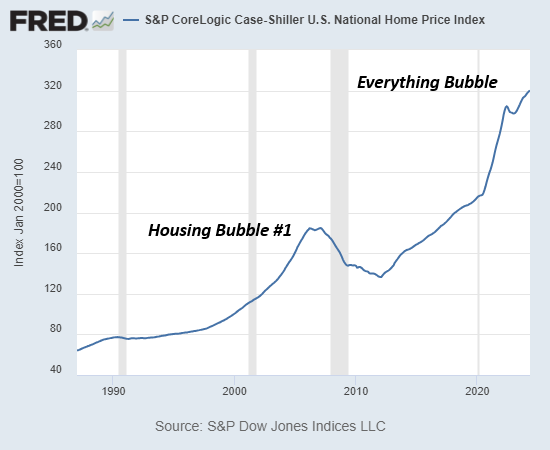
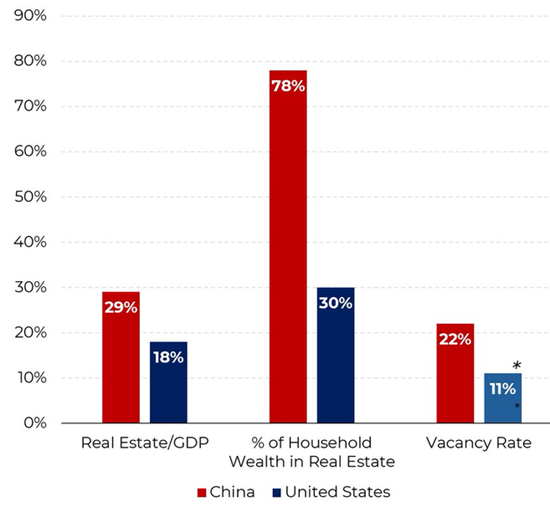
As a result of this model, housing now comprises 70%+ of all household wealth, a percentage more than double that in the U.S. (30%):
But central planning's initial successes generate a blindness to its fatal flaws, a reality now playing out in China's housing sector. The model described above created "winners"--banks, developers and local governments--who have every incentive to continue building more developments, whether they fill a real need or not, and no incentives to recognize the diminishing returns and soaring risks generated by the model.
Without an unfettered, open resale market for homes, the actual value of existing housing is unknown. Since the model only wants buyers of new (and as yet unbuilt) homes, the resale of older homes is suppressed. As a result, there is no feedback as to whether more developments actually fill a need for housing, or if they are nothing more than stupendous mal-investments, black holes sucking in capital, resources and labor that could have been productively deployed elsewhere in the economy.
Two recent reports outline the malaise once the central planning "miracle" becomes a blind machine enriching entrenched interests, grinding on even as the vast asset bubble the "miracle" created is popping:
China's Paradox Under Xi: A Sea /xi:/ of Macro Imbalances - a Story Told Through the Lens of its Bust Property Bubble. Episode 1: The Chinese Housing Market
China's Paradox Under Xi - Episode 2
Since there were no feedback mechanisms allowed in the model, it continued expanding regardless of actual conditions. The net result is a massive debt bubble and an equally massive oversupply of housing: thought official statistics are not published (for the obvious reason that they reflect poorly on central planning), it's estimated that there are 94 million empty homes in China and an astounding 120 million paid-in-full homes that are unfinished or not yet started. That's an oversupply / overproduction of 214 million homes.
Whether the actual number is 160 million, 180 million or 220 million doesn't really matter at this point: the oversupply, losses and distortions are so vast that there are no pain-free policy tweaks that will fix what's broken or reverse the catastrophic losses.
Since the developers used the buyers' funds to buy more land leases, they no longer have the means to complete the 100+ million units promised / under construction. The central government is now on the hook to fund the completion of these millions of homes--many of which were investments, not intended for sheltering a family--and to clear up the enormous debts left by insolvent developers.
Who suffers the most is obvious: the hapless home buyers who are paying mortgages for half-finished homes that may never be completed. The net result is some of the homeowners are living in their half-completed high-rise homes, as shown in the video from BBC News, in which the filming was cut off by local police, as this tragic reality doesn't reflect well on central planners:
China's homeowners living in unfinished apartments BBC News (3:21 min)
Given the enormous over-supply and collapsing demand, what's known as a bidless market, the actual market value of older homes may well be near-zero in Tier 2 and 3 cities, as the costs of ownership exceed the return on the investment. Without paying renters or appreciation generated by scarcity, the value of an existing home is a negative number.
What lessons can we extract from the success and failure of this model?
1. When an economy has untapped productive capacity and is starved for credit, central planning can open the floodgates of credit and direct the productive capacity into specific sectors, creating rapid growth and "winners": in China's real estate boom, the "winners" were banks, developers and local governments, as well as the central government freed of the immense burdens of funding the construction of hundreds of millions of new homes.
2. The "winners" quickly become entrenched in the system, rewarding each other with kickbacks, insider trading, etc., and as their wealth grew, so did their political muscle, which they used to protect their sector from oversight or feedback from the real world.
3. China's central planners reckoned they'd discovered the financial equivalent of the perpetual motion machine,
that housing would continue to provide 10% of the nation's jobs, fill the coffers of local government and enrich insiders indefinitely, all paid for with private capital saved up by households.
4. There were no effective safeguards in the system to protect homeowners from paying in full for a never-built or half-finished home. Central planning incentivizes insiders and entrenched interests to play fast and loose to maximize their private gains, without regard for the distortions and systemic risks their wheeling and dealing generates.
5. Since market mechanisms were eliminated or restricted, there are no structural mechanisms in either the private sector or the central government to fix the machine once it implodes. The immense losses piling up under the surface eventually must be paid by someone, and so central planners, faced with insiders' outsized influence, end up distributing the losses to the powerless, i.e. households, workers, children, retirees, etc.
This eventually generates social malaise, and the decay of the consent of the governed (a.k.a. Mandate of Heaven).
The inherent weaknesses of central planning are on display in every economy. It's tempting to use central planning to kickstart a sector or industrialize / re-industrialize, but there are no mechanisms in central planning to recognize or respond to the fact that you can only funnel private capital into a blind machine of entrenched interests for so long before the machine consumes not only all the gains of central planning but the entire economy, as the distortions become so profound that there are no fixes other than the extreme pain of absorbing catastrophic losses.
The illusion created by the initial success of central planning is that it can continue indefinitely, when the reality is it's unavoidably self-liquidating as the distortions unravel the entire economy. As I explained in my weekend post for subscribers, TINS and the Global Economy's Cliff Dive: There Is No Substitute, once the central planning model reaches its inevitable point of failure, there is no substitute available, as the economy has been optimized to reward the "winners", effectively hollowing out other sectors of the economy.
I was invited to discuss the upsides and downsides of central planning on two recent podcasts: there is quite a lot of ground covered in each discussion, please give them a listen:
Charles Hugh Smith on the China Real Estate Bubble (29:28 min)
Host Richard B. of the Financial Repression Authority
Charles Hugh Smith on The failure(s) of central planning across the globe (42:56 min)
Host Rob S. of the Contrarian Capitalist (Substack)
My recent books:
Disclosure: As an Amazon Associate I earn from qualifying purchases originated via links to Amazon products on this site.
The Mythology of Progress, Anti-Progress and a Mythology for the 21st Century
print $18,
(Kindle $8.95,
Hardcover $24 (215 pages, 2024)
Read the Introduction and first chapter for free (PDF)
Self-Reliance in the 21st Century print $18,
(Kindle $8.95,
audiobook $13.08 (96 pages, 2022)
Read the first chapter for free (PDF)
The Asian Heroine Who Seduced Me
(Novel) print $10.95,
Kindle $6.95
Read an excerpt for free (PDF)
When You Can't Go On: Burnout, Reckoning and Renewal
$18 print, $8.95 Kindle ebook;
audiobook
Read the first section for free (PDF)
Global Crisis, National Renewal: A (Revolutionary) Grand Strategy for the United States
(Kindle $9.95, print $24, audiobook)
Read Chapter One for free (PDF).
A Hacker's Teleology: Sharing the Wealth of Our Shrinking Planet
(Kindle $8.95, print $20,
audiobook $17.46)
Read the first section for free (PDF).
Will You Be Richer or Poorer?: Profit, Power, and AI in a Traumatized World
(Kindle $5, print $10, audiobook)
Read the first section for free (PDF).
The Adventures of the Consulting Philosopher: The Disappearance of Drake (Novel)
$4.95 Kindle, $10.95 print);
read the first chapters
for free (PDF)
Money and Work Unchained $6.95 Kindle, $15 print)
Read the first section for free
Become
a $3/month patron of my work via patreon.com.
Subscribe to my Substack for free
NOTE: Contributions/subscriptions are acknowledged in the order received. Your name and email
remain confidential and will not be given to any other individual, company or agency.
|
Thank you, James W. ($200), for your beyond-outrageously generous subscription
to this site -- I am greatly honored by your steadfast support and readership.
|
|
Thank you, Norbert H. ($70), for your superbly generous subscription
to this site -- I am greatly honored by your steadfast support and readership.
|
Read more...
Turn the crank of social media / search (SM/S) and you get highly profitable Digital Addiction and social destabilization leading to disorder and breakdown.
The extremely profitable inner workings of digital addiction are complex, but the business model is simple: collect user data and sell it to advertisers. The more users you addict, oops I mean attract, and the more time they spend on your platform, the more money you make.
The raison d'etre of social media / search (SM/S) is to collect user data to sell to the highest bidder. To maximize profits, the SM/S platforms stimulate users to post more content and spend more time "engaging" (i.e. creating user data) on their platform.
There are three mechanisms to accomplish this goal:
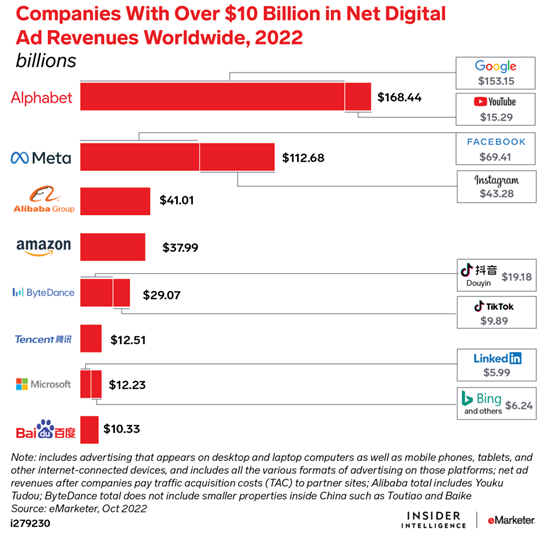
1. Financial incentives. By offering users a tiny share of the third of the trillion dollars in revenue (of just the top three platforms), users are incentivized to post more content, and optimize that content o attract more views / engagement by other users.
The share earned by the few who attract an audience of millions is substantial, but the modest revenues shared with users posting content follows a power law distribution: a handful make millions, a few make $100,000 or more annually, a small circle make a middle class living ($60,000 annually), and the vast "long tail" earn a pittance at best.
Your song received hundreds of thousands of downloads? Thank you for the content and engagement. Here is your share of the revenues generated: $17. Your content attracted thousands of views, here's your share of advert revenue: $73.
The share is a pittance, but it's enough to drive a Darwinian frenzy that optimizes extremism and clickbait. This extremism can be measured, and as a result of the frenzied competition for attention, extremism is off the charts, with predictably destabilizing social consequences.
2. Self-worth incentives. Given the structure of everyday life, the vast majority of us have little influence or power in the status quo. (For many of us, our power lies not in the status quo but in opting out of the status quo.) Given the zeitgeist of our market-driven global economy, we observe others gaining visibility and income within the digital realm of social media. Since anyone with a phone or laptop / tablet can get online, this digital road to fame and fortune is open to all. This is in marked contrast with the real world, which is characterized by few pathways to fame and fortune, or even being noticed.
I'm worthy of attention is a powerful manifestation of selfhood: if I attract attention / engagement, I'm somebody. Without attention / engagement, I'm nobody.
This self-worth incentive is amplified by glorifying the few winners in the free-for-all competition for attention. No wonder it's called the Attention Economy: attention = user data = trillions in revenue.
3. Optimizing addiction. The mechanisms of addiction are fairly well understood, and these mechanisms function with profitable precision in endless scrolls of feeds and posts and algorithms that amplify clickbait and extremism, for these arouse base emotions that then increase "engagement," i.e. collecting more user data.
The net result is Digital Addiction and social destabilization. Turn the crank of social media / search (SM/S) and you get highly profitable Digital Addiction and social destabilization leading to disorder and breakdown.
Digital Addiction has many destructive consequences. Here is one with profound effects stretching across the entire landscape and far into the future:
The Anxious Generation: How the Great Rewiring of Childhood Is Causing an Epidemic of Mental Illness (2024, Jonathon Haidt).
My recent books:
Disclosure: As an Amazon Associate I earn from qualifying purchases originated via links to Amazon products on this site.
The Mythology of Progress, Anti-Progress and a Mythology for the 21st Century
print $18,
(Kindle $8.95,
Hardcover $24 (215 pages, 2024)
Read the Introduction and first chapter for free (PDF)
Self-Reliance in the 21st Century print $18,
(Kindle $8.95,
audiobook $13.08 (96 pages, 2022)
Read the first chapter for free (PDF)
The Asian Heroine Who Seduced Me
(Novel) print $10.95,
Kindle $6.95
Read an excerpt for free (PDF)
When You Can't Go On: Burnout, Reckoning and Renewal
$18 print, $8.95 Kindle ebook;
audiobook
Read the first section for free (PDF)
Global Crisis, National Renewal: A (Revolutionary) Grand Strategy for the United States
(Kindle $9.95, print $24, audiobook)
Read Chapter One for free (PDF).
A Hacker's Teleology: Sharing the Wealth of Our Shrinking Planet
(Kindle $8.95, print $20,
audiobook $17.46)
Read the first section for free (PDF).
Will You Be Richer or Poorer?: Profit, Power, and AI in a Traumatized World
(Kindle $5, print $10, audiobook)
Read the first section for free (PDF).
The Adventures of the Consulting Philosopher: The Disappearance of Drake (Novel)
$4.95 Kindle, $10.95 print);
read the first chapters
for free (PDF)
Money and Work Unchained $6.95 Kindle, $15 print)
Read the first section for free
Become
a $3/month patron of my work via patreon.com.
Subscribe to my Substack for free
NOTE: Contributions/subscriptions are acknowledged in the order received. Your name and email
remain confidential and will not be given to any other individual, company or agency.
|
Thank you, Jim ($7/month), for your superbly generous subscription
to this site -- I am greatly honored by your steadfast support and readership.
|
|
Thank you, Richrd B. ($3/month), for your most generous patronage
to this site -- I am greatly honored by your support and readership.
|
|
Thank you, Dean J. ($3/month), for your marvelously generous patronage
to this site -- I am greatly honored by your support and readership.
|
|
Thank you, Lewis B. ($32.40), for your splendidly generous patronage
to this site -- I am greatly honored by your support and readership.
|
Read more...
Terms of Service
All content on this blog is provided by Trewe LLC for informational purposes only. The owner of this
blog makes no representations as to the accuracy or completeness of any information
on this site or found by following any link on this site. The owner will not be liable
for any errors or omissions in this information nor for the availability of this information.
The owner will not be liable for any losses, injuries, or damages from the display or
use of this information. These terms and conditions of use are subject to change at
anytime and without notice.
RE: European Union AI Act, and Our Use of Generative AI Tools and Agents Policy
All text on this site is composed by Charles Hugh Smith or by a credited guest-author. No Generative AI Tools are used in the composition / writing of any text or graphic content created by Charles Hugh Smith. This site deploys no AI agents or generative AI tools. This site is not responsible for the disclosures, use or non-use of AI agents or generative AI tools in advertisements displayed by Investing Channel or other ad placement services.
Audio files generated by text-to-audio transcription tools are identified as such.
Our Privacy Policy:
Correspondents' email is strictly
confidential. This site does not collect digital data from visitors or distribute cookies.
Advertisements served by third-party advertising networks such as
Investing Channel may use cookies or collect information from visitors for the
purpose of Interest-Based Advertising; if you wish to opt out of Interest-Based Advertising,
please go to
Opt out of interest-based advertising (The Network Advertising Initiative)
If you have other privacy concerns relating to advertisements, please contact
advertisers directly.
PRIVACY NOTICE FOR EEA INDIVIDUALS
This section covers disclosures on the General Data Protection Regulation (GDPR) for users residing
within EEA only. GDPR replaces the existing Directive 95/46/ec, and aims at harmonizing data
protection laws in the EU that are fit for purpose in the digital age. The primary objective of
the GDPR is to give citizens back control of their personal data. Please follow the link below to
access InvestingChannel's General Data Protection Notice.
https://stg.media.investingchannel.com/gdpr-notice/
Notice of Compliance with The California Consumer Protection Act
This site does not collect digital data from visitors or distribute cookies.
Advertisements served by a third-party advertising network
(Investing Channel) may use cookies or collect information from visitors for the
purpose of Interest-Based Advertising. If you do not want any personal information
that may be collected by third-party advertising to be sold, please
follow the instructions on this page:
Do Not Sell My Personal Information.
Regarding Cookies:
This site does not collect digital data from visitors or distribute cookies.
Advertisements served by third-party advertising networks such as
Investing Channel may use cookies or collect information from visitors for the
purpose of Interest-Based Advertising; if you wish to opt out of Interest-Based Advertising,
please go to
Opt out of interest-based advertising (The Network Advertising Initiative)
If you have other privacy concerns relating to advertisements, please contact
advertisers directly.
Our Commission Policy:
Though I earn a small commission on Amazon.com
books and gift certificates and gold (BullionVault) purchased via links on my site, I
receive no fees or compensation for any other non-advertising links or content posted
on my site.
Copyright Notice:
All original images (Drawings and Photographs), text (essays, books and works of fiction), audio and video recordings, musical compositions, graphic design, graphic design elements and HTML coding on this site are the copyrighted work of Charles Hugh Smith unless otherwise credited or noted. They
are published as information for the private use of site visitors, and any
reproduction or redistribution of this content or coding in any media in any format
or distribution channel (text, audio, video/film, web) without the written permission of the
copyright holder is strictly prohibited. All rights in all media reserved globally.