
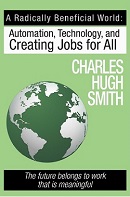
The only sustainable way to avoid being commoditized is to learn to create value in ways that cannot be commoditized.
Though we are still in the early stages of web-enabled automation, it's already evident that the old models of work are broken--though few are willing to admit it.The primary model of work is being an employee in a hierarchy--Corporate America or the state (government) or a government-funded industry (defense, higher education, R&D, Medicare, etc.)
The foundation of employee financial security is the paycheck, which is earned for 1) showing up and 2) following orders.
In the employee model, ownership is generally limited to those with stock options. Those working for start-ups that successfully go public can cash in their options for extraordinary profits; those working for start-ups that fizzle can use their expired options as bathroom wallpaper.
The conventional employee gets no ownership of their work, and this disconnect between the employee and the value created by the employee's labor is the source of Marx's definition of alienation: the worker is alienated from the output of his/her labor, which is owned by others.
In the new model of work, the worker has ownership of his/her work and human capital. Security in the new model flows not from dependence on an employer but on ownership of the entire process of value creation which includes the social and human capital of skills, collaboration, accountability and creativity.
As Gordon Long and I discuss in this program on the changing nature of work, in the new model:
Each participant creates the work and owns the value proposition
Innovation and collaboration are paramount
Innovation, blah, blah, blah, right? Yes, the word is terribly over-used, but the point is to avoid commodification. Whatever tasks can be reduced to input, processes and output can be automated or done anywhere, i.e. the task is a commodity that can be performed by interchangeable workers.
If the work can be performed by interchangeable workers, why pay a premium for labor in the U.S. Japan and Europe?
The only sustainable way to avoid being commoditized is to learn to create value in ways that cannot be commoditized. That's the point of collaboration, accountability and innovation: software and robots are superb at repeating specified processes. Figuring out human emotions and markets and combining insights from different fields--not so much. Those still require human learning, communication, collaboration and ingenuity.
Try programming a robot to navigate a flower bed on uneven ground, remove the rotten boards in a staircase and replace them with the appropriate type of lumber.Perhaps a robot will be able to do this cheaper than a human some day, but that day is not yet here. Being able to apply a variety of skills to ambiguous real-world problems is another set of skills that cannot be commoditized.
It's tempting to pine for the days when just showing up and doing routine work was enough to earn a middle-class paycheck, but that's no different than sighing wistfully for the days when making buggy whips and shoveling horse manure off the streets were common jobs: those days are gone.
Any employer who pays humans to do work that can be automated or performed elsewhere for a fraction of the cost will soon go broke as competitors eat his/her lunch. Employers that want to survive recessions and competition can only pay for the value their employees create in the marketplace. Consumers don't pay for blue sky, and so neither can employers.
The government is currently immune to such pressures, but since the state is itself dependent on taxes skimmed from profits and wages, the erosion of the old model means the state's revenues are doomed to shrink right along with profits and wages.
No sector will be immune to the changing nature of work and value creation.
There is much more on the topic in the video program (31:55):
Get a Job, Build a Real Career and Defy a Bewildering Economy(Kindle, $9.95)(print, $20) Are you like me?Ever since my first summer job decades ago, I've been chasing financial security. Not win-the-lottery, Bill Gates riches (although it would be nice!), but simply a feeling of financial control. I want my financial worries to if not disappear at least be manageable and comprehensible.
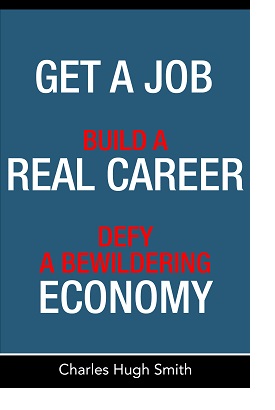
And like most of you, the way I've moved toward my goal has always hinged not just on having a job but a career.
You don't have to be a financial blogger to know that "having a job" and "having a career" do not mean the same thing today as they did when I first started swinging a hammer for a paycheck.
Even the basic concept "getting a job" has changed so radically that jobs--getting and keeping them, and the perceived lack of them--is the number one financial topic among friends, family and for that matter, complete strangers.
It details everything I've verified about employment and the economy, and lays out an action plan to get you employed.
I am proud of this book. It is the culmination of both my practical work experiences and my financial analysis, and it is a useful, practical, and clarifying read.
"I want to thank you for creating your book Get a Job, Build a Real Career and Defy a Bewildering Economy. It is rare to find a person with a mind like yours, who can take a holistic systems view of things without being captured by specific perspectives or agendas. Your contribution to humanity is much appreciated." Laura Y. Gordon Long and I discuss The New Nature of Work: Jobs, Occupations & Careers(25 minutes, YouTube)
NOTE: Contributions/subscriptions are acknowledged in the order received. Your name and email remain confidential and will not be given to any other individual, company or agency.
Thank you, J.M. S. ($200), for your beyond-outrageously generous contribution to this site-- I am greatly honored by your steadfast support and readership.
The central bank high is euphoric, the crash and burn equally epic.
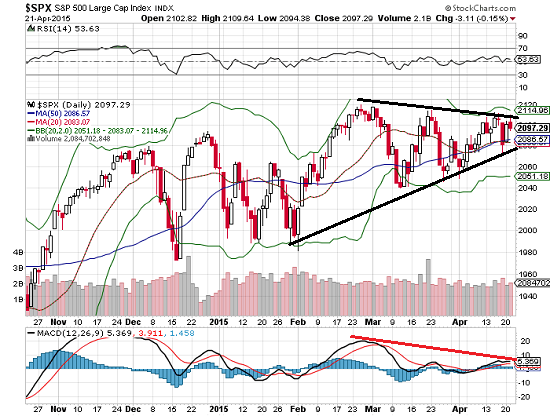
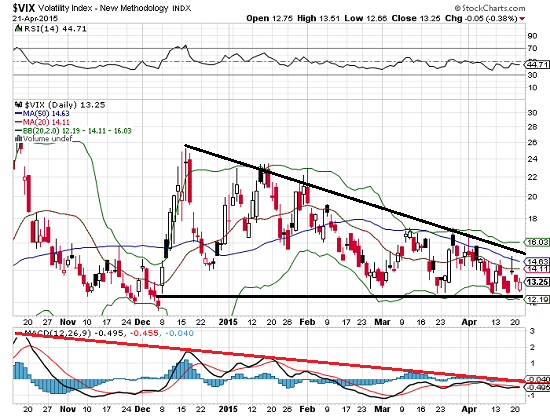
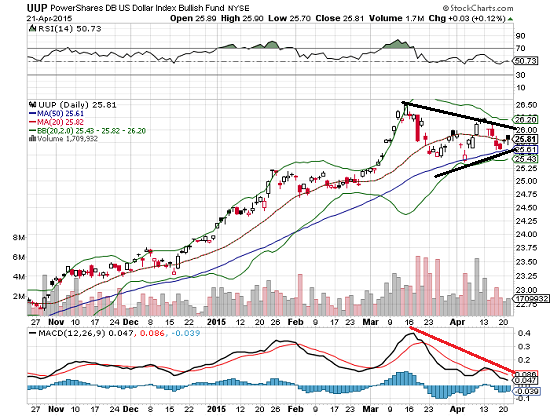
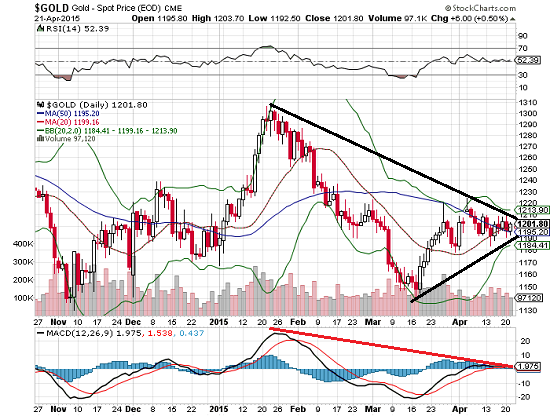
Just out of curiosity, I called up a few charts of key markets: stocks (the S&P 500), volatility (VIX), gold and the U.S. dollar (UUP, an exchange-traded fund for the dollar). Interestingly, all of these charts displayed some version of a wedge/triangle.
In a wedge/triangle (a formation with many variations such as pennants), price traces out a pattern of higher lows and lower highs, compressing price action into the apex of a triangle as buyers and sellers reach an increasingly unstable equilibrium.
As price gets squeezed into a narrowing band, the likelihood increases that price will break out of the triangle, either up or down, in a major move.
So which way will these markets break--up or down? One thing is fairly certain: the S&P 500 (SPX) and the VIX (volatility) are on a see-saw--both don't soar at the same time. If the VIX soars, stocks are plummeting as fear takes hold. If the VIX stumbles along the bottom of its range, market players are complacent and stocks loft higher.
Many observers see the same inverse relationship in gold and the U.S. dollar--when one is going up, the other is weakening.
I tested this widely accepted truism by aligning the charts of both the U.S. dollar and gold, and found that there were lengthy periods during which gold and the U.S. dollar rose in tandem: About That Supposed Correlation of the U.S. Dollar and Gold.... (July 8, 2013)
My conclusion: each is influenced by a number of factors, some shared, some unique to each asset. As a result of this complex confluence, at times both go up together and at times there is a negative correlation (see-saw effect), and during other periods, there is little correlation, i.e. they act entirely independent of the other.
Let's look at the charts. Nothing fancy here--just clear wedges/triangles and declining MACD indicators.
Interestingly, gold rose when the VIX was elevated--that is, when market participants were nervous or fearful. If volatility breaks to the upside, stocks will fall and perhaps gold will move up as the flight to safety/fear trade replaces central-bank administered complacency that stocks can loft higher regardless of fundamentals.
Since the dollar also tends to strengthen when the herd is stampeding in a flight to safety, perhaps we can look to the VIX as the bellwether for what will likely happen to stocks, gold and the dollar.
If the risk-on central bank monetary cocaine trade continues, stocks may loft higher and the VIX, gold and the dollar may all drift lower as volatility and lower-risk assets are avoided in the quickening chase for yield in a negative-interest world.
If the risk-on trade evaporates and risk-off trades gain favor, stocks will be sold off hard, volatility will rocket higher (something we've almost forgotten can happen) and gold and the U.S. dollar will benefit from the flight to safety/central bank cocaine crash trade.
The central bank high is euphoric, the crash and burn equally epic. Be careful what monkey you invite to latch onto your back....
Get a Job, Build a Real Career and Defy a Bewildering Economy(Kindle, $9.95)(print, $20) Are you like me?Ever since my first summer job decades ago, I've been chasing financial security. Not win-the-lottery, Bill Gates riches (although it would be nice!), but simply a feeling of financial control. I want my financial worries to if not disappear at least be manageable and comprehensible.
And like most of you, the way I've moved toward my goal has always hinged not just on having a job but a career.
You don't have to be a financial blogger to know that "having a job" and "having a career" do not mean the same thing today as they did when I first started swinging a hammer for a paycheck.
Even the basic concept "getting a job" has changed so radically that jobs--getting and keeping them, and the perceived lack of them--is the number one financial topic among friends, family and for that matter, complete strangers.
It details everything I've verified about employment and the economy, and lays out an action plan to get you employed.
I am proud of this book. It is the culmination of both my practical work experiences and my financial analysis, and it is a useful, practical, and clarifying read.
"I want to thank you for creating your book Get a Job, Build a Real Career and Defy a Bewildering Economy. It is rare to find a person with a mind like yours, who can take a holistic systems view of things without being captured by specific perspectives or agendas. Your contribution to humanity is much appreciated." Laura Y. Gordon Long and I discuss The New Nature of Work: Jobs, Occupations & Careers(25 minutes, YouTube)
NOTE: Contributions/subscriptions are acknowledged in the order received. Your name and email remain confidential and will not be given to any other individual, company or agency.
Thank you, Steve H. ($10/month), for your supremely generous subscription to this site-- I am greatly honored by your renewed support and readership.
Being grateful boosts your happiness. Ten wonderful things I'm grateful for.
Since every volume on the nearly endless shelf of pop psychology self-help books recommends working up some gratitude as the key to happiness, I've conjured up a list of what I'm grateful for. (Please turn your irony setting on.)
1. I'm grateful that our choice of president has been reduced to two equally detestable dynasties or their proxies. This greatly simplifies the process of selecting a warmongering figurehead for the Empire and its bankers.
2. I'm grateful that I can watch a full spectrum of entertainment, ranging from depraved to dreadfully unfunny on any device at anytime. This white noise helps block out any troubling clarity of thought or urge to ask what I might feel if I wasn't constantly distracted.
3. I'm grateful that there are so many opportunities to borrow money, because if I couldn't borrow more, I might miss an astounding opportunity to consume more of something I don't really need.
4. I'm grateful that every food item in the store now contains sugar in one form or another, or a sugar substitute. This simplifies the process of maintaining my addiction to sugar, as all I need to do is eat anything produced by Corporate America's food sector.
5. I'm grateful I live in a country where the government can trample on the rights of its citizens behind a thin veil of legitimacy. After all, what terrible thing might happen if the government couldn't arrest those horrible people tearing up their front yard lawn to plant a vegetable garden?
6. I'm grateful for our national obsession with fostering phony self-esteem that has no basis in accomplishment, dedication or sacrifice for others, as the self-absorbed, entitled populace will still feel good about themselves as the bloated, dysfunctional status quo implodes.
7. I'm grateful that we have institutionalized moral hazard as the unspoken law of the land, so financiers can gamble billions of dollars without worrying about the potential losses, as they know the taxpayers will foot the bill while they get to keep any gains.
8. I'm grateful our financial markets are now dominated by Federal Reserve manipulation, high frequency trading and dark pool shadow banking. This guarantees that all we commoners need to do to make a lot of money playing the stock market is to buy the dips.
9. I'm grateful that money can buy political influence so transparently, as this informal auction is open to anyone with tens of millions of dollars who wants to protect and expand their wealth and power.
10. I'm grateful that our mainstream media is owned by a handful of corporations, as the homogenized message they broadcast is reassuringly uniform. If every outlet is repeating that unemployment and inflation are low and the rising stock market is making us all wealthier, it must be true.
Get a Job, Build a Real Career and Defy a Bewildering Economy(Kindle, $9.95)(print, $20) Are you like me?Ever since my first summer job decades ago, I've been chasing financial security. Not win-the-lottery, Bill Gates riches (although it would be nice!), but simply a feeling of financial control. I want my financial worries to if not disappear at least be manageable and comprehensible. And like most of you, the way I've moved toward my goal has always hinged not just on having a job but a career.
You don't have to be a financial blogger to know that "having a job" and "having a career" do not mean the same thing today as they did when I first started swinging a hammer for a paycheck.
Even the basic concept "getting a job" has changed so radically that jobs--getting and keeping them, and the perceived lack of them--is the number one financial topic among friends, family and for that matter, complete strangers.
So I sat down and wrote this book: Get a Job, Build a Real Career and Defy a Bewildering Economy.
It details everything I've verified about employment and the economy, and lays out an action plan to get you employed.
I am proud of this book. It is the culmination of both my practical work experiences and my financial analysis, and it is a useful, practical, and clarifying read.
Test drive the first section and see for yourself. Kindle, $9.95print, $20
"I want to thank you for creating your book Get a Job, Build a Real Career and Defy a Bewildering Economy. It is rare to find a person with a mind like yours, who can take a holistic systems view of things without being captured by specific perspectives or agendas. Your contribution to humanity is much appreciated." Laura Y. Gordon Long and I discuss The New Nature of Work: Jobs, Occupations & Careers(25 minutes, YouTube)
NOTE: Contributions/subscriptions are acknowledged in the order received. Your name and email remain confidential and will not be given to any other individual, company or agency.
Thank you, Jim T. ($50), for your superbly generous contribution to this site-- I am greatly honored by your support and readership.
Either join the disruptors or prepare to be disrupted.
Disruptive technology is a tiresome cliche, as every Twitter/ AirBnB/ Uber/ Skype/etc. wannabe start-up declares itself disruptive. That the vast majority of self-congratulatory start-ups are over-hyped and derivative should not distract us from the larger reality that some technologies do in fact disrupt how things are done.
Fossil-fueled mechanization, for example, turned an overwhelmingly rural farming society into a highly urbanized services-dominated economy.
In the more recent past, CraigsList single-handedly turned the newspaper industry from an immensely profitable license to print money (via costly classified ads) to a struggling sector with an unclear future.
Digital file-sharing turned the $14 billion music industry into a $7 billion industry.
And now driverless vehicles are poised to disrupt the taxi and trucking sectors in ways few predicted.
The core idea of Disrupt or be Disrupted is that every sector and industry that avoids being disrupted just becomes a fatter target for disruption.
Higher education is a prime example. The industry has successfully staved off disruption by maintaining a lock on credentialing/accreditation--the famous signaling value of a college diploma, which verifies nothing about what the student learned or knows.
Now that student loan debt is $1.3 trillion and the administrative bloat of higher education can no longer be obscured, the industry is becoming a fatter, juicier target for massive technological disruption by the day.
Employers should receive more than an increasingly worthless signal--they should be offered an accreditation of each individual's actual skills and knowledge. This is self-evident, but impossible in the current cartel-state arrangement.
Healthcare is another sector with bloated costs and protected fiefdoms that is ripe for fundamental disruption. Reductions of 50% or more that lead to better overall health do not require whizbang science fiction advances; simply eliminating the paperwork and cartels and making patients responsible for their care and the costs of their treatments would be enough to unleash a disruptive revolution.
What few in these protected industries dare admit is the state/cartel cost structures are now so burdensome, the nation can no longer afford these services.Healthcare has risen from 5% of GDP to 19%. The more burdensome and intractable the systemic costs, the greater the gains to be reaped from disrupting the status quo.
The Military-Industrial/National Defense Complex is another sector ripe for massive disruption and reduction of costs. Compare the troubled $1 trillion F-35 aircraft program (which is increasingly looking like the most expensive weapons system failure in human history) with increasingly effective and cheaper drones: A Drone Has Never Linked Up With a Refueling Tanker Until Now.
In other words, protecting unaffordable, ineffective fiefdoms and cartels will be a losing strategy in the next 20 years. These costs will come down, one way or another, either by the erosion and collapse of the funding sources or by tech-enabled socio-economic disruptions.
That leaves everyone depending on any existing sector/industry that hasn't yet been turned upside down with a choice: either join the disruptors or prepare to be disrupted.
This essay was drawn from Musings Report 11. The weekly Reports are emailed exclusively to subscribers ($5/month) and major contributors $50+/year).
Get a Job, Build a Real Career and Defy a Bewildering Economy(Kindle, $9.95)(print, $20) Are you like me?Ever since my first summer job decades ago, I've been chasing financial security. Not win-the-lottery, Bill Gates riches (although it would be nice!), but simply a feeling of financial control. I want my financial worries to if not disappear at least be manageable and comprehensible.
And like most of you, the way I've moved toward my goal has always hinged not just on having a job but a career.
You don't have to be a financial blogger to know that "having a job" and "having a career" do not mean the same thing today as they did when I first started swinging a hammer for a paycheck.
Even the basic concept "getting a job" has changed so radically that jobs--getting and keeping them, and the perceived lack of them--is the number one financial topic among friends, family and for that matter, complete strangers.
It details everything I've verified about employment and the economy, and lays out an action plan to get you employed.
I am proud of this book. It is the culmination of both my practical work experiences and my financial analysis, and it is a useful, practical, and clarifying read.
"I want to thank you for creating your book Get a Job, Build a Real Career and Defy a Bewildering Economy. It is rare to find a person with a mind like yours, who can take a holistic systems view of things without being captured by specific perspectives or agendas. Your contribution to humanity is much appreciated." Laura Y. Gordon Long and I discuss The New Nature of Work: Jobs, Occupations & Careers(25 minutes, YouTube)
NOTE: Contributions/subscriptions are acknowledged in the order received. Your name and email remain confidential and will not be given to any other individual, company or agency.
Thank you, Al I. ($50), for your splendidly generous contribution to this site-- I am greatly honored by your steadfast support and readership.
The potential of food to add beauty/pleasure to everyday life should not be under-estimated.
I have been discussing job skills for the past five days, but life skills are equally valuable. For example, knowing how to cook. Knowing how to cook offers benefits beyond just saving money (though that is important); when you know how to cook:
1. You and your household will eat healthier, better-tasting food
2. You can create joy by sharing what you make with friends/neighbors/roommates
3. You gain the power and confidence that comes with having useful skills
4. You can add beauty and pleasure to your life and the lives of others
5. You can dramatically improve your health
6. Your value as a spouse, roommate, friend, colleague etc. rises
7. You can save money for investing or spending on higher-priority items/experiences
8. You have a daily creative outlet
The joys of cooking are varied and flexible. Once you gain the basic skills of prep (chopping, slicing, etc.), stir-frying, sauteeing, baking, etc., then just about any recipe is open to you.
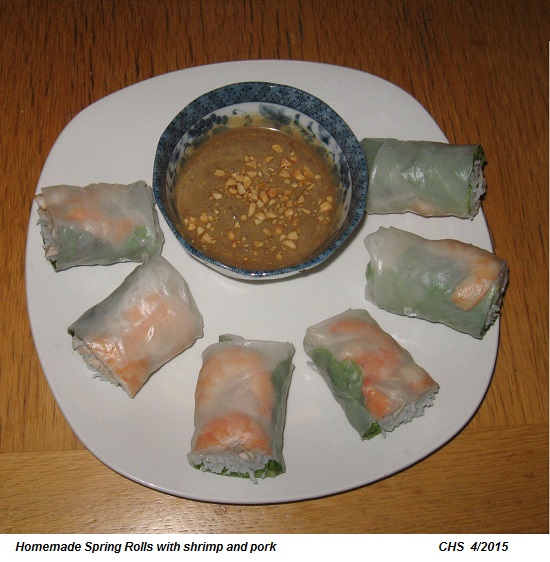
It takes a lot of practice to create beautiful food (presentation), but this is a bonus. I am not adept enough to fashion such perfect spring rolls as the lady of the household; these were her first spring rolls, made a week or so ago (the dipping sauce is from Charles Pham's cookbook Vietnamese Home Cooking):
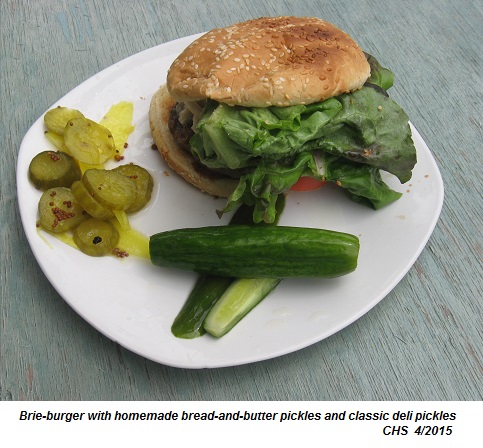
This is more my style: a burger topped with a nice brie cheese (from Costco--very reasonably priced) and home-made pickles--a remarkably easy project.
Even the simplest meals can be presented attractively. Though beauty is dismissed in our culture unless it's being used to signal wealth/prestige/power, the potential of food to add beauty/pleasure to everyday life should not be under-estimated.
The social capital value of sharing appealing, home-made food should also not be under- estimated. Watch how everyone's eyes light up when you stop by with freshly baked pie or a delicious meal; the simple act of sharing something you devoted time and energy to make transforms a mundane day into a special one for the person receiving your home-cooked treat/meal.
By the time you set up to make one or two for yourself, it's not that hard to make more to share with others:
If you type what's cooking at our house into the custom search box in the upper left sidebar, you will find many entries such as What's Cooking at our House: Sichuan Green Beans. My goal in sharing our day-to-day cooking is to show that it isn't that hard to create delicious meals--especially if you have a garden. I am not a great cook, but being a great cook isn't necessary. Knowing the basics and understanding that the prep is 90% of the process is enough.
The hierarchies and complexities of our society tend to make us feel powerless and helpless. In many ways, we are powerless to change the socio-economic structures and some are more equal than others dynamics of the world we inhabit.
But we are not powerless or helpless when it comes to shaping our inner lives and our household lives. We can bring health, beauty, sharing and creativity into our lives by knowing how to cook.
Get a Job, Build a Real Career and Defy a Bewildering Economy(Kindle, $9.95)(print, $20) Are you like me?Ever since my first summer job decades ago, I've been chasing financial security. Not win-the-lottery, Bill Gates riches (although it would be nice!), but simply a feeling of financial control. I want my financial worries to if not disappear at least be manageable and comprehensible. And like most of you, the way I've moved toward my goal has always hinged not just on having a job but a career.
You don't have to be a financial blogger to know that "having a job" and "having a career" do not mean the same thing today as they did when I first started swinging a hammer for a paycheck.
Even the basic concept "getting a job" has changed so radically that jobs--getting and keeping them, and the perceived lack of them--is the number one financial topic among friends, family and for that matter, complete strangers.
So I sat down and wrote this book: Get a Job, Build a Real Career and Defy a Bewildering Economy.
It details everything I've verified about employment and the economy, and lays out an action plan to get you employed.
I am proud of this book. It is the culmination of both my practical work experiences and my financial analysis, and it is a useful, practical, and clarifying read.
Test drive the first section and see for yourself. Kindle, $9.95print, $20
"I want to thank you for creating your book Get a Job, Build a Real Career and Defy a Bewildering Economy. It is rare to find a person with a mind like yours, who can take a holistic systems view of things without being captured by specific perspectives or agendas. Your contribution to humanity is much appreciated." Laura Y. Gordon Long and I discuss The New Nature of Work: Jobs, Occupations & Careers(25 minutes, YouTube)
NOTE: Contributions/subscriptions are acknowledged in the order received. Your name and email remain confidential and will not be given to any other individual, company or agency.
Thank you, William M. ($50), for your stupendously generous contribution to this site-- I am greatly honored by your steadfast support and readership.
All content on this blog is provided by Trewe LLC for informational purposes only. The owner of this
blog makes no representations as to the accuracy or completeness of any information
on this site or found by following any link on this site. The owner will not be liable
for any errors or omissions in this information nor for the availability of this information.
The owner will not be liable for any losses, injuries, or damages from the display or
use of this information. These terms and conditions of use are subject to change at
anytime and without notice.
RE: European Union AI Act, and Our Use of Generative AI Tools and Agents Policy
All text on this site is composed by Charles Hugh Smith or by a credited guest-author. No Generative AI Tools are used in the composition / writing of any text or graphic content created by Charles Hugh Smith. This site deploys no AI agents or generative AI tools. This site is not responsible for the disclosures, use or non-use of AI agents or generative AI tools in advertisements displayed by Investing Channel or other ad placement services.
Audio files generated by text-to-audio transcription tools are identified as such.
Our Privacy Policy:
Correspondents' email is strictly
confidential. This site does not collect digital data from visitors or distribute cookies.
Advertisements served by third-party advertising networks such as
Investing Channel may use cookies or collect information from visitors for the
purpose of Interest-Based Advertising; if you wish to opt out of Interest-Based Advertising,
please go to
Opt out of interest-based advertising (The Network Advertising Initiative)
If you have other privacy concerns relating to advertisements, please contact
advertisers directly.
PRIVACY NOTICE FOR EEA INDIVIDUALS
This section covers disclosures on the General Data Protection Regulation (GDPR) for users residing
within EEA only. GDPR replaces the existing Directive 95/46/ec, and aims at harmonizing data
protection laws in the EU that are fit for purpose in the digital age. The primary objective of
the GDPR is to give citizens back control of their personal data. Please follow the link below to
access InvestingChannel's General Data Protection Notice.
https://stg.media.investingchannel.com/gdpr-notice/
Notice of Compliance with The California Consumer Protection Act
This site does not collect digital data from visitors or distribute cookies.
Advertisements served by a third-party advertising network
(Investing Channel) may use cookies or collect information from visitors for the
purpose of Interest-Based Advertising. If you do not want any personal information
that may be collected by third-party advertising to be sold, please
follow the instructions on this page:
Do Not Sell My Personal Information.
Regarding Cookies:
This site does not collect digital data from visitors or distribute cookies.
Advertisements served by third-party advertising networks such as
Investing Channel may use cookies or collect information from visitors for the
purpose of Interest-Based Advertising; if you wish to opt out of Interest-Based Advertising,
please go to
Opt out of interest-based advertising (The Network Advertising Initiative)
If you have other privacy concerns relating to advertisements, please contact
advertisers directly.
Our Commission Policy:
Though I earn a small commission on Amazon.com
books and gift certificates and gold (BullionVault) purchased via links on my site, I
receive no fees or compensation for any other non-advertising links or content posted
on my site.
Copyright Notice:
All original images (Drawings and Photographs), text (essays, books and works of fiction), audio and video recordings, musical compositions, graphic design, graphic design elements and HTML coding on this site are the copyrighted work of Charles Hugh Smith unless otherwise credited or noted. They
are published as information for the private use of site visitors, and any
reproduction or redistribution of this content or coding in any media in any format
or distribution channel (text, audio, video/film, web) without the written permission of the
copyright holder is strictly prohibited. All rights in all media reserved globally.
As an Amazon Associate I earn from qualifying purchases.
CHS
Weekly Musings Reports
Subscribers ($7/mo) receive weekly Musings Reports. At readers' request, there is also a $10/month subscription option.
What subscribers are saying about the Musings
(read samples):
"What makes you a channel worth paying for? It's actually pretty simple - you possess a clarity of thought that most of us can only dream of, and a perspective that allows you to focus on the truth with laser-like precision." Jim S.
Why I gratefully accept donations and why you might want to donate:
A 95-minute movie with 10 minutes of ads and a small popcorn costs $25.
If you enjoyed this site for at least 2 hours this year, and you donate $25, you already received more entertainment than you did from the movie. The other 100+ hours of enjoyment you receive here is FREE.
Subscribers and donors of $70 or more this year will receive exclusive weekly Musings Reports.
You have the immense moral satisfaction of aiding a writer who seeks to inform, entertain and amuse you.